
South Korea Connected Car Market Size & Forecast:
- South Korea Connected Car Market Size 2025: USD 5.09 Billion
- South Korea Connected Car Market Size 2033: USD 12.41 Billion
- South Korea Connected Car Market CAGR: 13.58%
- South Korea Connected Car Market Segments: By Technology (4G LTE, 5G, V2X, Telematics, Embedded Connectivity, Others) | By Vehicle Type (Passenger Cars, Commercial Vehicles, EVs, Luxury Vehicles, Others) | By Service (Navigation, Infotainment, Remote Diagnostics, Fleet Management, Others) | By End User (OEMs, Fleet Operators, Consumers, Others)
South Korea Connected Car Market Summary
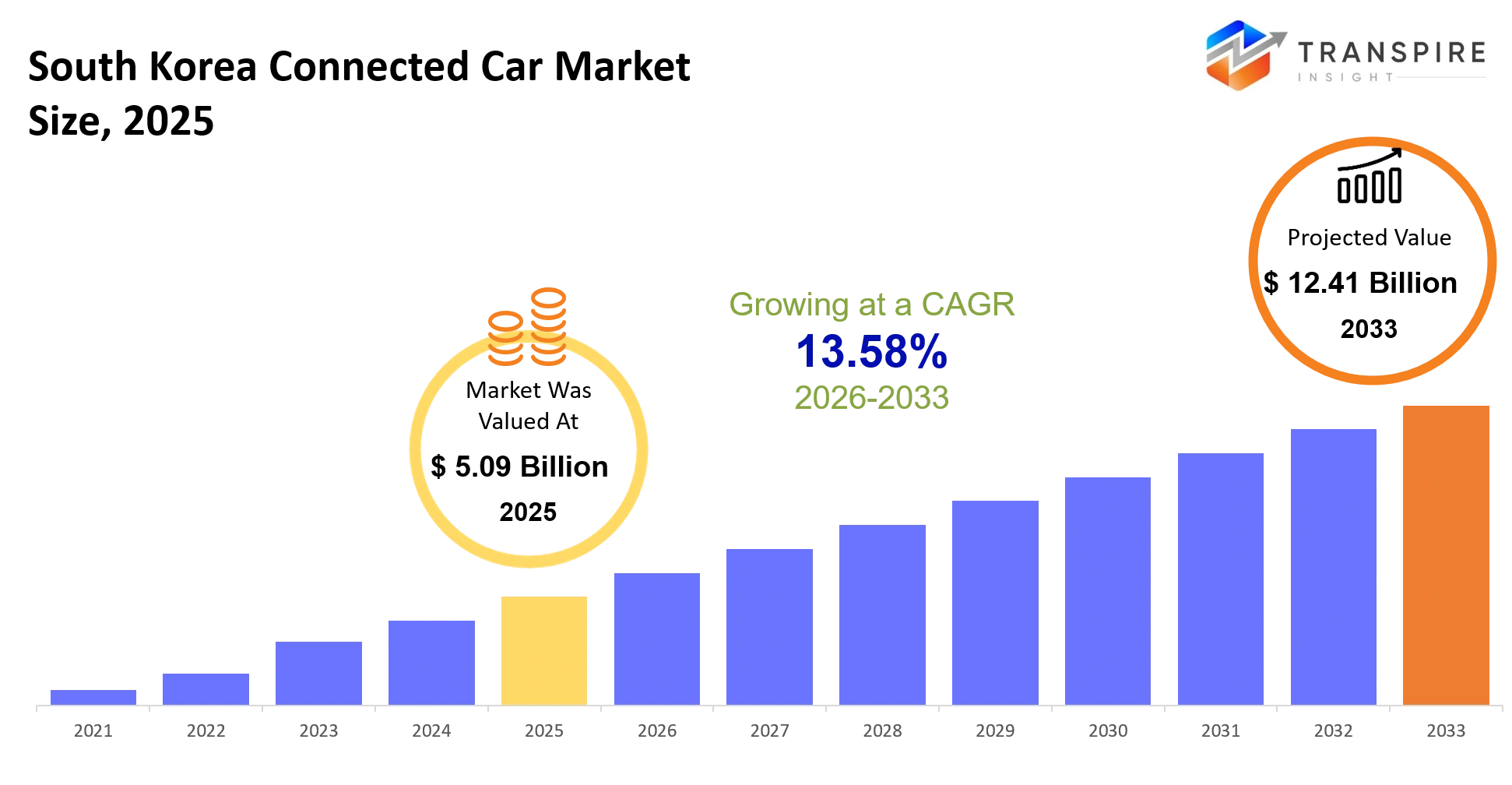
The South Korea Connected Car Market was valued at USD 5.09 Billion in 2025. It is forecast to reach USD 12.41 Billion by 2033. That is a CAGR of 13.58% over the period.
The South Korea Connected Car Market allows vehicles to trade real time data with drivers, manufacturers, service providers and nearby infrastructure, which helps with routing, safety, foreseeing maintenance needs, fleet control, and those in-car digital experiences. Basically, the connected vehicle platform helps cut down idle time , boosts driving efficiency, and helps new mobility ecosystems grow , because the car turns into a constantly linked digital asset , not just a machine.
Over the last three to five years, the market has changed in a more solid way, moving away from simple telematics and infotainment roles, toward software defined vehicles that can be upgraded through over-the-air updates, plus advanced driver assistance, and cloud based connectivity. That change made connected services more valuable commercially, going beyond just selling vehicles into repeatable digital income. A key push, was the COVID-19 pandemic, which made people lean more on contactless tools, remote diagnostics, and digital mobility solutions. As automakers roll in 5G networks, artificial intelligence, and vehicle-to-everything communication, connected features are starting to look like a default option. This shift is also raising platform uptake, shaping service centric business models, and opening up more revenue chances across the whole automotive value chain.
Key Market Insights
- In 2025, the Seoul Capital Area kind of dominates the South Korea Connected Car Market, about 45% market share, helped a lot by the advanced 5G infrastructure plus smart city deployments, which makes the whole thing feel more connected.
- Gyeonggi Province still sits as the second biggest region, mostly because automotive manufacturing is concentrated there and there are steady mobility technology investments.
- Busan and Ulsan look like the fastest-moving regional cluster, stretching through 2032, and that growth is tied to autonomous vehicle testing corridors along with intelligent transportation initiatives, not just one thing.
- When you look at solution types, Embedded connectivity solutions take the lead with nearly 55% market share in 2025, mainly backed by factory-installed telematics and cloud-based vehicle services.
- Then Integrated connectivity platforms come in second, mainly benefiting from rising demand for infotainment and navigation features, in practice.
- For segments that are growing quickest, V2X communication systems are forecasted to expand fastest through 2032, since automakers are pushing cooperative driving technologies more aggressively.
- For applications, Safety and driver assistance tools lead, taking roughly 35% market share, supported by broader ADAS adoption and real-time monitoring systems, everyday usage rising.
- Autonomous mobility and predictive navigation applications are starting to show up faster than the rest, because AI-driven vehicle intelligence capabilities are getting better and more common.
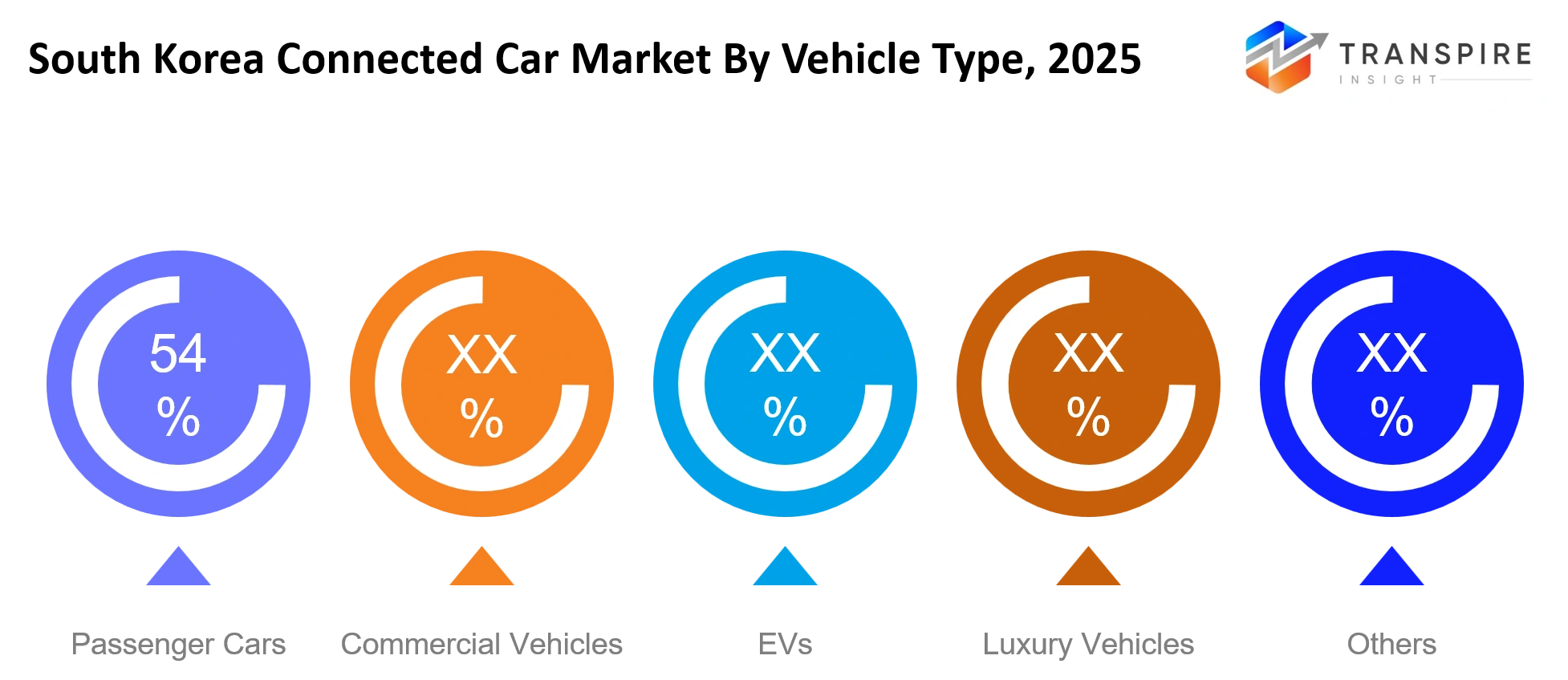
- On the vehicle side, Passenger vehicles bring in nearly 70% of the South Korea Connected Car Market revenue, driven by premium vehicle penetration and consumer demand for digital services.
- Meanwhile, Commercial fleet operators are the fastest-growing end-user group as logistics companies adopt connected fleet management platforms, and yeah that trend keeps strengthening.
What are the Key Drivers, Restraints, and Opportunities in the South Korea Connected Car Market?
The strongest growth catalyst for the South Korea Connected Car Market is the way nationwide 5G rolls out along with government-backed intelligent transportation things. South Korea has one of the most advanced telecommunications networks on the planet, so vehicles can stay connected in real time, while data keeps flowing with low delay, and V2X communication gets more dependable. Lately, automakers are putting connected services right into new vehicle platforms, this lets the manufacturers earn recurring income, often through subscription-based navigation, diagnostics, infotainment, and even software upgrades. In a sense, the whole market is drifting from hardware-first vehicle selling toward digital mobility services, and that helps lift customer lifetime value as well as push up connected vehicle adoption faster.
But cybersecurity, plus data privacy worries, still act like the biggest structural wall. Connected vehicles constantly send huge volumes of location, behavior, and operational details across several networks. Keeping those data flows safe means ongoing spend in encryption, threat sensing, software validation, and regulatory alignment. Since cyber threats change all the time, manufacturers cannot just fix the problem with a one-time investment. That’s why compliance cost plus security requirements can slow deployment, stretch development timelines, and in the end suppress revenue growth that could have happened.
The biggest future chance is probably in software defined cars that get tied to AI powered mobility ecosystems. Once the autonomous driving tech keeps getting better, these vehicles start acting more like linked computing systems rather than just transportation. For example, Hyundai and a bunch of homegrown tech partners are pushing forward with AI enabled vehicle setups that can keep taking continuous over the air feature upgrades. It kind of opens the door to all sorts of things, premium subscription services, predictive servicing programs, more personal driving experiences, and even tighter smart city integration too, and somehow all of that rolls into a fresh phase of how value is created across the connected mobility scene.
What Has the Impact of Artificial Intelligence Been on the South Korea Connected Car Market?
Artificial intelligence is now kind of turning into a foundational technology across South Korea’s connected mobility ecosystem, and honestly it shows up everywhere. Vehicle manufacturers with tech providers more and more lean on AI analytics platforms to handle automated vehicle monitoring, interpret driver behavior, streamline traffic control, and run fleet operations in a smoother way. Connected vehicle systems keep taking in sensor inputs, camera feeds, telematics signals, and location data too, which helps them tune the route decisioning, reduce congestion, and generally raise day to day operational efficiency, overall.
At the same time, machine learning is reshaping predictive maintenance in a pretty direct way. Rather than only reacting later, AI systems can take a look at earlier component performance, engine diagnostics, battery health state, and driving habits, then notice the most likely failures before they even begin. Fleet operators use this kind of foresight to reduce those sudden, unplanned downtime events, improve overall vehicle availability, and yes, lower maintenance spending as well. On the more mature side, AI assisted navigation really keeps re-working routes in near real time, based on changing traffic conditions, weather interruptions, and road hazards, so fuel economy and trip durations improve too.
AI also helps with advanced driver assistance systems, and it does so through support for lane-keeping, collision avoidance, driver monitoring, and adaptive cruise control functions. Together these capabilities tend to push safety outcomes upward, while also improving user experiences, which is usually the goal anyway.
Still, there’s a big limitation that keeps coming back. The cost of integrating AI across vehicle architectures, cloud environments, and communication networks stays high. Plus, getting steady model accuracy across different real world driving conditions takes massive datasets, constant software refreshes, and a lot of validation work. So for market participants, those ongoing constraints keep turning into real implementation headaches, even if the benefits look promising.
Key Market Trends
- Since 2021, automakers have sort of accelerated over-the-air update deployment, trimming down dealership dependent software maintenance and allowing more or less continuous feature improvements, like non stop updates.
- Connected vehicle buyers now seem to care more about digital services, with infotainment subscriptions, and even remote diagnostics getting more attention across premium segments.
- Hyundai and Kia have kept expanding their software defined vehicle approaches since 2023, and it looks like they moved investment away from hardware differentiation, toward digital platform abilities, capability wise.
- Vehicle-to-everything communication pilots have also broadened across major urban routes, which is helping new autonomous and cooperative driving apps grow, even if early.
- Automotive manufacturers are partnering more often with telecom providers to tap 5G networks for near real time vehicle connectivity and low latency message passing.
- AI powered predictive maintenance platforms have gone from small pilot efforts to more commercial rollout among fleet operators, and logistics companies too.
- Cybersecurity spending has climbed a lot, as regulators and manufacturers try to handle rising worries around connected vehicle data protection.
- Cloud native vehicle architectures have started getting a lot of momentum, which helps software releases happen faster, and makes connected services easier to scale.
- Smart city integration initiatives are increasingly wiring vehicles into traffic infrastructure, improving mobility management, plus boosting overall urban transportation efficiency.
- Overall, competitive differentiation is leaning more toward digital ecosystems, with automakers highlighting user experience, data services, and software innovation, not just the physical stuff.
South Korea Connected Car Market Segmentation
By Technology :
Technology is basically the backbone of the South Korea Connected Car Market, because it lets the car talk with networks, local infrastructure, and a range of digital platforms. 4G LTE still keeps the signal steady for navigation, infotainment, and vehicle monitoring, so day to day things work as expected. Then at the same time, 5G is spreading more quickly, largely because it can push data faster with less delay and that means advanced connected vehicle features, plus real time exchange of information, starts becoming normal not special.
V2X technology supports the exchange of signals between vehicles, road infrastructure, pedestrians, and connected networks, which in turn should help road safety and smoother traffic management. Telematics solutions also play a role, giving vehicle tracking, diagnostics, and usage information. And there is embedded connectivity too, where the communication module is placed right inside the vehicle, rather than being an add on. Other related pieces include cloud based platforms, plus wireless software update systems, which in practice help maintain vehicle performance and improve the overall customer experience.
By Vehicle Type :
Vehicle type segmentation shows, sort of, how these connected capabilities roll out across different kinds of automobiles. Passenger cars take a large portion of the market because connected functions like navigation systems, entertainment services, and safety alerts have turned into real buying factors for many drivers. Also, the growing preference for digital driving moments keeps pushing adoption in this group.
Commercial vehicles are starting to rely on connected solutions for route optimization, fleet monitoring, and broader operational efficiency. Electric vehicles, on the other hand, are building in sophisticated connectivity to manage battery behavior and coordinate charging activities. Luxury vehicles still tend to be early adopters of premium connected services, while the other vehicle categories continue to add digital features, as manufacturers expand connectivity in new directions.
By Service :
Service based segmentation mirrors the broad span of digital functions you can actually get through connected vehicle platforms,so it feels like,yeah, everything is there in some form. Navigation services still get the most attention since real time traffic updates and route guidance help people move more efficiently, more smoothly maybe. Infotainment services then cover media access, communication tools, and a more tailored kind of digital experience which boosts convenience for the people inside the car.
Remote diagnostics lets vehicle systems spot technical snags and maintenance needs early, before something turns into a real major failure. Fleet management services back vehicle tracing, fuel monitoring, and day to day operational planning for business users. Other services crop up too, like emergency support, vehicle security functions, software updates, and cloud connected applications , all of which keep adding weight to the overall value of connected mobility solutions.
By End User :
End user segmentation also shows how different groups use connected vehicle technologies, for very specific intentions. OEMs weave connectivity features into the vehicle design, to raise product worth, enable software based services, and also keep customer engagement stronger. Ongoing development of connected platforms will stay a key approach for automotive manufacturers, in practice.
Fleet operators use connected systems to make better use of assets, keep watch on vehicle performance, and lower operating costs. Consumers get convenience, safety, and entertainment upgrades that come via connected vehicles. Other end users, such as government agencies, mobility service providers, and transportation organizations, use these technologies for traffic administration, smoother operations, and smarter mobility initiatives.
What are the Key Use Cases Driving the South Korea Connected Car Market?
The big use case pushing adoption in the South Korea Connected Car Market is real time navigation plus vehicle connectivity services. Drivers are increasingly leaning on connected systems for live traffic updates, route optimization, and location based offerings, and you can really see it in daily commutes. With strong urbanization, and a lot of congestion across the major metropolitan regions, there is a steady need for solutions that make the trip more efficient, and cut down commuting time.
Other applications are picking up speed, especially in fleet operations and remote vehicle management. Logistics firms and commercial transport operators tap into connected platforms to keep an eye on vehicle performance, tune routes on the fly, and also control fuel consumption. Remote diagnostics, meanwhile, can spot maintenance requirements early, so less downtime shows up, and that overall boosts operational efficiency across the business fleet.
Newer applications are also starting to surface, like vehicle-to-everything communication plus advanced help for autonomous driving. Smart city programs and intelligent transportation infrastructure projects open doors for connected vehicles to talk with traffic signals, road networks, and the surrounding cars. Over the forecast period, these features will enable safer mobility, better traffic management, and more automated transportation services, in a way that feels gradual but pretty unmistakable.
|
Report Metrics |
Details |
|
Market size value in 2025 |
USD 5.09 Billion |
|
Market size value in 2026 |
USD 5.09 Billion |
|
Revenue forecast in 2033 |
USD 12.41 Billion |
|
Growth rate |
CAGR of 13.58% from 2026 to 2033 |
|
Base year |
2025 |
|
Historical data |
2021 - 2024 |
|
Forecast period |
2026 - 2033 |
|
Report coverage |
Revenue forecast, competitive landscape, growth factors, and trends |
|
Country scope |
South Korea |
|
Key company profiled |
Hyundai, Kia, Samsung Electronics, LG Electronics, Bosch, Continental, Denso, Aptiv, Harman, Qualcomm, NVIDIA, Ericsson, Cisco, Verizon Connect, TomTom |
|
Customization scope |
Free report customization (country, regional & segment scope). Avail customized purchase options to meet your exact research needs. |
|
Report Segmentation |
By Technology (4G LTE, 5G, V2X, Telematics, Embedded Connectivity, Others) | By Vehicle Type (Passenger Cars, Commercial Vehicles, EVs, Luxury Vehicles, Others) | By Service (Navigation, Infotainment, Remote Diagnostics, Fleet Management, Others) | By End User (OEMs, Fleet Operators, Consumers, Others) |
Which Regions are Driving the South Korea Connected Car Market Growth?
The Seoul Capital Area kinda stands out as the biggest regional market for connected vehicles in South Korea . You see this because the digital infrastructure is strong, the 5G network coverage is wide ,and vehicle ownership rates are high enough to keep adoption moving fast for connected mobility services. Also, the smart city push in Seoul, backed by government programs, still nudges folks toward rolling out intelligent transportation systems and vehicle communication technologies. On top of that, there’s a pretty dense mix of groups—automotive manufacturers, technology firms , telecom providers , and research institutions—so the region keeps that leadership position and keeps innovating, kind of nonstop.
Gyeonggi Province comes in as the second most influential region, though the growth there is powered by a slightly different recipe. The area has a lot going on in terms of automotive production facilities, technology parks, and industrial investments, so demand for connected vehicle solutions stays pretty steady. There’s also steady investment in manufacturing modernization, plus digital mobility platforms ,which gives the market more long term steadiness. With strong economic activity and close ties to major automotive supply chains, Gyeonggi is a reliable contributor to overall market revenue, even when things shift.
Busan and Ulsan seem to be rolling ahead as the quickest regional markets, thanks to more and more money going into future mobility infrastructure. Lately , the growth of autonomous vehicle testing programs, plus intelligent transportation networks and smart logistics projects, has made connected tech easier to adopt. And because there are big automotive manufacturing operations here, along with a bunch of innovation-minded mobility efforts, it feels like the setup is really right for market expansion. As these regions keep growing, technology providers, software developers, and mobility service companies should see solid chances throughout 2026–2033.
Who are the Key Players in the South Korea Connected Car Market and How Do They Compete?
In the South Korea Connected Car Market the competitive environment looks moderately consolidated, like not totally fractured, but not exactly lockstep either. Most of the battling is around tech know-how, software unification, connection quality, plus digital service packages . The older automaker players still keep major ground, however telecom providers and tech firms are gaining more sway via connected mobility platforms, and it feels like this is getting faster. What really matters more and more is whether a firm can deliver smooth digital moments, smarter vehicle intelligence, and software ecosystems that scale well, instead of just focusing on the vehicle hardware by itself.
Hyundai Motor Company is leaning hard into software-defined vehicle development and connected mobility platforms. By bringing in over-the-air update functionality, upgraded telematics systems, and autonomous driving solutions, they build their differentiation. Kia Corporation is on a similar track, but with extra emphasis on connected user experiences and digital vehicle services across many different vehicle categories. Ongoing investment in next-generation mobility platforms , helps keep them competitive and also supports long-run revenue models that are service-based rather than one-time sales.
Samsung Electronics, and LG Electronics, sorta keep going at it via in vehicle electronics and those connectivity modules, digital cockpit technologies too, plus cloud enabled solutions. Their solid background in consumer electronics makes it possible to ship really slick user interfaces and tighter integrated connectivity experiences, if you will. Meanwhile SK Telecom leans into 5G enabled vehicle communication services, it also builds data platforms, and they do some pretty focused collaborations with automotive manufacturers. You can see how telecom providers, and the vehicle makers, keep teaming up, and that momentum keeps pushing connected mobility deployment ahead. At the same time, the service capabilities keep broadening across the South Korean automotive sector , bit by bit.
Company List
- Hyundai
- Kia
- Samsung Electronics
- LG Electronics
- Bosch
- Continental
- Denso
- Aptiv
- Harman
- Qualcomm
- NVIDIA
- Ericsson
- Cisco
- Verizon Connect
- TomTom
Recent Development News
In April 2026, Kia Corporation announced a major increase in investment plans exceeding US$28 billion for 2026–2029 while advancing software-defined vehicle development. The investment will strengthen connected vehicle software, artificial intelligence capabilities, and next-generation mobility technologies across future vehicle platforms.
Sourcehttps://www.reuters.com/
In February 2026, Hyundai Motor Group announced plans for a multi-billion-dollar investment in South Korea focused on artificial intelligence, robotics, AI data centers, and autonomous driving technologies. The commitment is expected to accelerate development of connected vehicle ecosystems and strengthen the country's position in advanced mobility technologies.
Source https://www.reuters.com/
What Strategic Insights Define the Future of the South Korea Connected Car Market?
The South Korea Connected Car Market is gradually, kind of, moving toward a software-defined mobility model where the real long-term value will come more and more from digital services instead of vehicle sales alone. In the next five to seven years, connected vehicles will basically act like continuously refreshed platforms that provide things like navigation, safety, entertainment, predictive servicing, and even autonomous driving features, delivered by software. This change is being pushed forward by 5G being more available than before, stronger semiconductor skills, and a tight integration between car makers and tech companies.
There’s also a risk that is a little less visible, but it can matter a lot. The market is becoming clustered around a limited number of automotive manufacturers, telecom providers , and software platforms. If everyone leans on a small ecosystem, innovation can slow down, cybersecurity exposure can get bigger, and it can become harder for smaller technology suppliers to actually reach the market.
At the same time, an emerging opportunity is growing vehicle-to-everything ecosystems that link into smart city infrastructure, especially in places like Busan and Ulsan. As intelligent transportation projects keep expanding, the need for real-time data sharing and cooperative driving mechanisms will rise. Market participants may want to focus on partnerships between automotive, software, and telecommunications firms so they can build scalable platforms that are ready for future autonomous and connected mobility services.
South Korea Connected Car Market Report Segmentation
By Technology
- 4G LTE
- 5G
- V2X
- Telematics
- Embedded Connectivity
By Vehicle Type
- Passenger Cars
- Commercial Vehicles
- EVs
- Luxury Vehicles
By Service
- Navigation
- Infotainment
- Remote Diagnostics
- Fleet Management
By End User
- OEMs
- Fleet Operators
- Consumers
Frequently Asked Questions
Find quick answers to common questions.
The South Korea Connected Car Market size is USD 12.41 Billion in 2033.
Key segments for the South Korea Connected Car Market are By Technology (4G LTE, 5G, V2X, Telematics, Embedded Connectivity, Others) | By Vehicle Type (Passenger Cars, Commercial Vehicles, EVs, Luxury Vehicles, Others) | By Service (Navigation, Infotainment, Remote Diagnostics, Fleet Management, Others) | By End User (OEMs, Fleet Operators, Consumers, Others).
Major South Korea Connected Car Market players are Hyundai, Kia, Samsung Electronics, LG Electronics, Bosch, Continental, Denso, Aptiv, Harman, Qualcomm, NVIDIA, Ericsson, Cisco, Verizon Connect, TomTom.
The South Korea Connected Car Market size is USD 5.09 Billion in 2025.
The South Korea Connected Car Market CAGR is 13.58% from 2026 to 2033.
- Hyundai
- Kia
- Samsung Electronics
- LG Electronics
- Bosch
- Continental
- Denso
- Aptiv
- Harman
- Qualcomm
- NVIDIA
- Ericsson
- Cisco
- Verizon Connect
- TomTom
About the Authors

Mayur Shinde
I am Mayur Shinde, a Senior Research Analyst at Transpire Insight, specializing in the Automotive & Transportation and Information & Communication Technology (ICT) Industry. My work focuses on analyzing emerging market trends, technological advancements, competitive landscapes, and industry developments to deliver accurate, data-driven insights. I am passionate about transforming complex market information into clear, actionable content that helps businesses, professionals, and decision-makers stay informed and make confident strategic decisions.

Chakradhar Khansole
Chakradhar serves as the Research Director at Transpire Insight, bringing over 8 years of experience in technology, innovation, and strategic market intelligence. He specializes in transforming complex market data into actionable business insights that enable organizations to make informed, growth-oriented decisions. Recognized for his strategic vision and analytical expertise, Chakradhar leads high-impact research initiatives, delivering comprehensive market assessments, competitive intelligence, and forward-looking industry analysis.
Recently Published Reports
-
Apr 2026
ATV & UTV Market
ATV & UTV Market Size, Share & Analysis Report By Type (ATV, and UTV), By Variants (Less Than 400 CC, 400 CC To 800 CC, and More Than 800 CC), and Geography (North America, Europe, Asia-Pacific, Middle East and Africa, South and Central America), 2021 - 2031
-
Apr 2026
Automotive Central Gateway Module Market
Automotive Central Gateway Module Market Size, Share & Analysis Report By Type (Ethernet Central Gateway Module, CAN Central Gateway Module, LIN Central Gateway Module, and FlexRay), By Application (Powertrain Control, Body Control, Infotainment System, Advanced Driver Assistance Systems (ADAS), and Others), By End User (Passenger Vehicles, and Commercial Vehicles), and Geography (North America, Europe, Asia-Pacific, Middle East and Africa, South and Central America), 2021 - 2031
-
Apr 2026
Automotive Engine Oil Filter Market
Automotive Engine Oil Filter Market Size, Share & Analysis Report By Filter Type (Fuel Filter, Engine Oil Filter, Hydraulic Oil Filter, and Others), By Filter Media (Cellulose, Synthetic, and Micro), By Sales Channel (OEMs, and Aftermarket), By Vehicle Type (Passenger Cars, Light Commercial Vehicles, Heavy Duty Trucks, Buses and Coaches, and Off-road Vehicles), and Geography (North America, Europe, Asia-Pacific, Middle East and Africa, South and Central America), 2021 - 2031
-
Apr 2026
Automotive Parts Aluminium Die Casting Market
Automotive Parts Aluminium Die Casting Market Size, Share & Analysis Report By Production Process (Pressure Die Casting, Vacuum Die Casting, Squeeze Die Casting, Gravity Die Casting), By Application (Body Parts, Engine Parts, Transmission Parts, Battery And Related Components, Other Application Types), and Geography (North America, Europe, Asia-Pacific, Middle East and Africa, South and Central America), 2021 - 2031
Our Clients



