

Europe Automotive RADAR Market Size & Forecast:
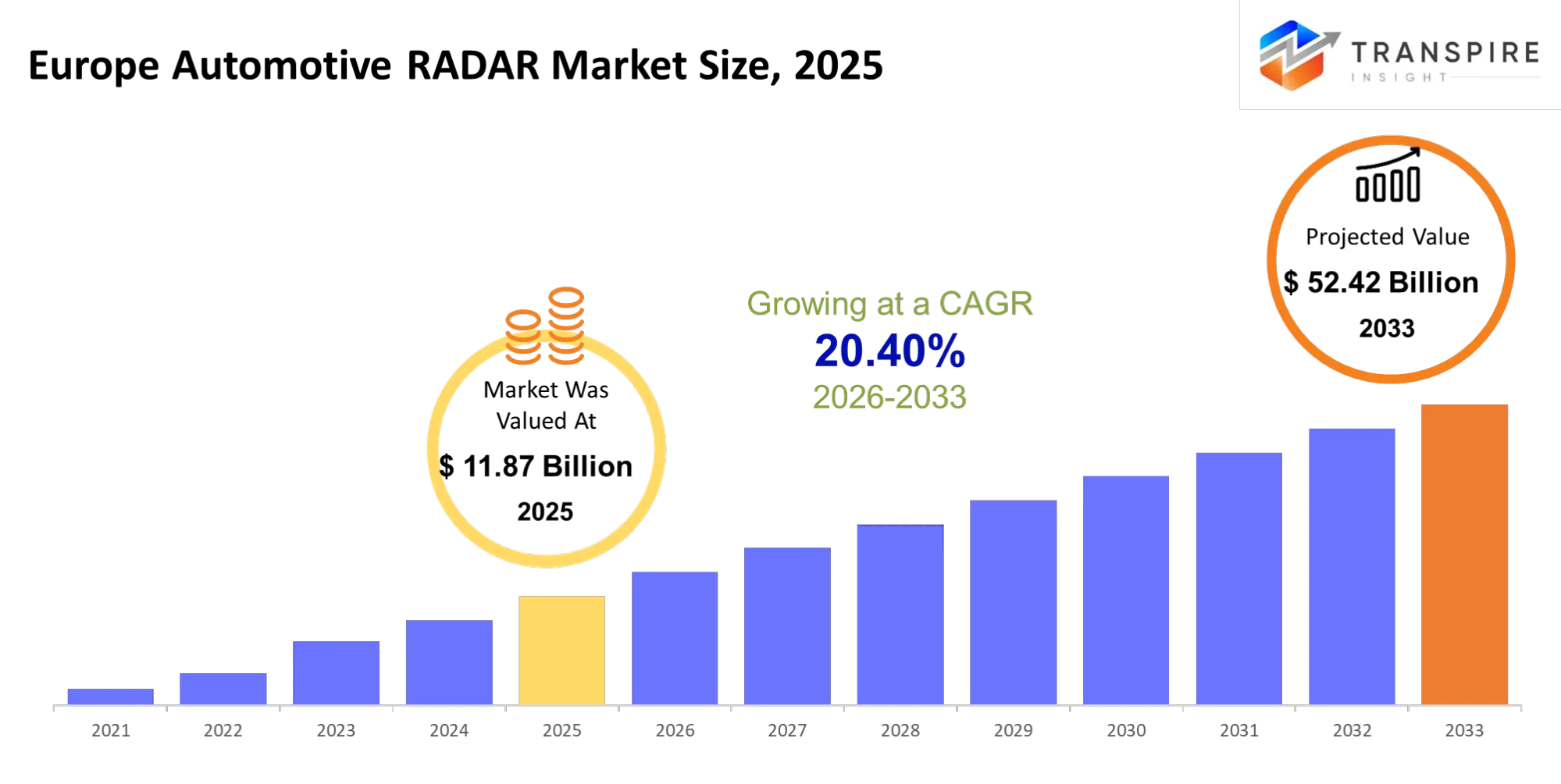
- Europe Automotive RADAR Market Size 2025: USD 11.87 Billion
- Europe Automotive RADAR Market Size 2033: USD 52.42 Billion
- Europe Automotive RADAR Market CAGR: 20.40%
- Europe Automotive RADAR Market Segments: By Range (Short Range, Medium Range, Long Range, Others); By Frequency (24 GHz, 77 GHz, 79 GHz, Others); By Vehicle Type (Passenger Cars, Commercial Vehicles, Electric Vehicles, Others); By Application (Adaptive Cruise Control, Blind Spot Detection, Parking Assistance, Collision Avoidance, Others); By Component (Transceivers, Antennas, Processors, Others); By Sales Channel (OEM, Aftermarket, Others)
Europe Automotive RADAR Market Summary
The Europe Automotive RADAR Market was valued at USD 11.87 billion in 2025. It is forecast to reach USD 52.42 billion by 2033. That is a CAGR of 20.40% over the period.
The Europe Automotive RADAR Market helps cars detect things around them in visibility conditions. This is done through real-world vehicle perception systems. These systems help cars see the distance, speed and movement of surrounding objects.In real-life use RADAR systems enable features like cruise control. They also enable emergency braking, blind-spot detection and collision avoidance. These features make RADAR a core safety technology in passenger and commercial vehicles. This is especially true across Europe’s mobility ecosystem.Over the few years the Europe Automotive RADAR Market has changed a lot. It has moved from driver-assist RADAR systems to high-resolution imaging RADAR. This new type of RADAR is better at classifying objects. The change was driven by EU vehicle safety regulations. These regulations require driver assistance systems and higher automation readiness.
The semiconductor supply chain disruptions during 2020–2022 also played a role. They led to a push for localization of RADAR component sourcing. This meant that OEMs and Tier-1 suppliers had to secure long-term chip supply partnerships.As a result RADAR adoption has increased rapidly. This is especially true in software-defined vehicles. In these vehicles RADAR systems are often used with cameras and LiDAR. This improves decision accuracy. It also increases semiconductor content per vehicle. This has created revenue opportunities for RADAR module suppliers.The shift to frequency 77–81 GHz RADAR systems is also happening. This enables designs with better detection range and precision. These improvements support generation autonomous driving capabilities. This is especially true, across Europe. The Europe Automotive RADAR Market is driving these changes. RADAR systems are becoming more important. They are helping to make vehicles safer and more autonomous.
Key Market Insights
- The Europe Automotive RADAR Market changed a lot from short-range systems before 2020 to using high-resolution 77–81 GHz imaging radar by 2025.85% of new European passenger vehicles used RADAR in 2025 because safety rules across the EU made it mandatory.
- Germany had over 40% share in 2025 because many car makers and radar suppliers are based there.
- Eastern Europe grew the fastest until 2030 as more money was invested in making car
- The Long-range radar systems were most popular in the Europe Automotive RADAR Market for highway safety and adaptive cruise control.
- Short-range radar was growing fast because more people wanted help with parking and detecting spots.
- ADAS was the use for RADAR making up over 50% in 2025 because of safety rules.
- Self-driving car tech was growing fast helped by combining sensors and AI systems.
- Companies, like Bosch, Continental, Aptiv, Valeo and ZF Friedrichshafen are making RADAR and AI better.
- Companies that make RADAR integrate software well and optimize sensors have an advantage.
What are the Key Drivers, Restraints, and Opportunities in the Europe Automotive RADAR Market?
Drivers
The Europe Automotive RADAR Market is mainly driven by safety rules in the EU General Safety Regulation. These rules have made it necessary for cars to have driver assistance systems. This has led to people using radar-based systems to avoid collisions, control speed and detect blind spots. As a result the Europe Automotive RADAR Market has seen an increase in the use of radar systems in each vehicle, which has directly increased revenue for companies that make sensors and for Tier-1 suppliers. It has also made car manufacturers want high-frequency imaging radar solutions more.
Restraints
One big problem is that it is hard to combine radar systems with sensors like cameras and LiDAR. This is a challenge because it takes a long time to develop, needs special calibration and has to work with different types of vehicles. These problems make it more expensive to develop vehicles and delay their release, which limits how fast they can be used in cars that are not too expensive. This also slows down the use of radar systems in cars.
Opportunity
There is an opportunity coming with 4D imaging radar systems. These systems can classify objects and map the environment. Companies are investing in AI and software for cars, which is creating a demand for high-resolution radar systems especially for autonomous driving. Car companies in Germany and France are testing these systems, which will create ways for radar companies to make money from 2026 to 2033 as cars become more autonomous. The Europe Automotive RADAR Market will see revenue streams as autonomy levels advance in the Europe Automotive RADAR Market.
What Has the Impact of Artificial Intelligence Been on the Europe Automotive RADAR Market?
Artificial intelligence is changing the way radar systems work in the car industry in Europe. It is making these systems better at understanding what is happening around them and helping them make decisions quickly in tough driving situations.Artificial intelligence is used to combine information from radar, cameras and other sensors to detect objects and figure out what they are. This helps reduce mistakes in systems that control how fast a car goes and when it stops in an emergency. These systems also help make sure radar systems are working properly when cars are being made which helps make sure all the cars are the same.
People are using machine learning to make radar systems work better. This means the systems can adjust how they detect things based on the weather, how many cars are on the road and the condition of the road. This makes the systems more reliable when it is hard to see or when the car is going fast. Car makers say this is making their systems work better and safer. They also have to fix the systems often because they can detect problems early.
There is still a problem. It is very expensive and complicated to put these radar systems in all the different types of cars. There is also no real-world data to help the systems learn how to handle rare situations. With these problems car companies are starting to use artificial intelligence more and more because they want to make their cars safer and more modern. Artificial intelligence is becoming a part of the car industry in Europe.
Key Market Trends
- The Europe Automotive RADAR Market changed a lot before 2020 when it started using 77–81 GHz imaging radar. By 2025 this new technology was used on a large scale.
- In 2025 more than 85 percent of European passenger vehicles had radar systems because the European Union required cars to have advanced safety features.
- Germany made more than 40 percent of these systems in 2025 because many car companies and radar suppliers are based there.
- After 2024 Eastern Europe started making automotive electronics because it is cheaper to make things there.
- People wanted long-range radar systems more and more after 2023 because they are needed for safety features like cruise control on highways.
- Short-range radar systems were used more and more in cities for things like parking assistance and blind-spot detection in vehicles.
- Advanced safety features were still the reason people used radar systems in 2025 with more than 50 percent of the market because safety rules are getting stricter in Europe.
- The development of radar systems for self-driving cars went fast after 2024 because these systems can work with other sensors and use artificial intelligence to understand what is happening.
- Companies like Bosch, Continental, Aptiv, Valeo and ZF worked hard to develop radar systems that can detect objects better and make maps of the environment.
- The way cars are designed is. Now radar systems are being made to process information in real time and be updated easily.
Europe Automotive RADAR Market Segmentation
By Range
The Europe Automotive RADAR Market is divided into range, medium range, long range and others. Long range radar systems are in demand because many cars and trucks use them for adaptive cruise control and highway safety. Short range radar is becoming more popular as parking assistance and blind spot detection features become standard in city driving.
By Frequency
The market includes 24 GHz, 77 GHz, 79 GHz and others. The 77 GHz segment is leading because it is very accurate, has a design and is used in many advanced driver assistance systems. The 79 GHz segment is gaining popularity as next-generation imaging radar systems need to be more precise and detect objects better.
By Vehicle Type
This includes passenger cars, commercial vehicles, electric vehicles and others. Passenger cars have the share because many have advanced safety features and follow safety rules. Electric vehicles are growing fast as radar systems become important for self-driving cars and eco-friendly transportation.
By Application
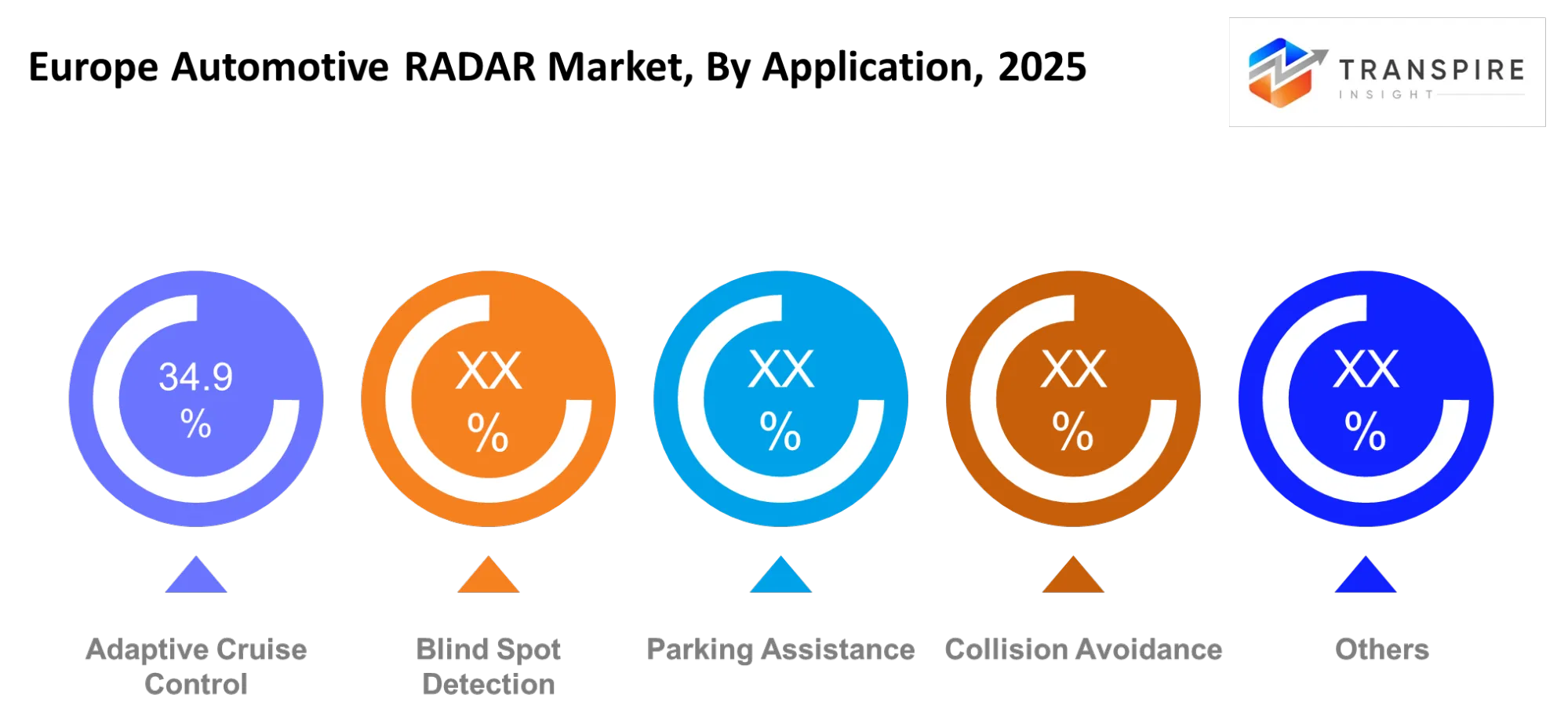
Applications include cruise control, blind spot detection, parking assistance, collision avoidance and others. Adaptive cruise control is popular because highways are becoming more automated. Collision avoidance systems are becoming more common as regulators want road safety in Europe.
By Component
The market is divided into transceivers, antennas, processors and others. Transceivers are leading because they play a role in sending and processing signals accurately. Processors are growing steadily as radar systems rely more on AI to interpret data and combine sensor information.
By Sales Channel
This includes OEM, aftermarket and others. OEM channels are leading because radar systems are installed directly in cars. Aftermarket adoption is increasing as older cars are upgraded with safety features and driver assistance technologies.
What are the Key Use Cases Driving the Europe Automotive RADAR Market?
The Europe Automotive RADAR Market is mainly driven by cruise control systems in passenger cars. These systems use long-range radar to keep a distance and adjust speed on highways. This is the use of radar because of strict safety rules in the European Union and more cars having semi-autonomous driving features.
Radar is also used for things like blind spot detection and parking assistance. This is especially true for city cars and electric vehicles where compact radar systems help with low-speed driving and prevent crashes. Car makers are putting these features in their cars to keep people safe and meet government rules for driver assistance systems.
There are some uses for radar that are still being developed. For example collision avoidance in trucks and predictive hazard detection in self-driving cars. These are not fully developed yet. They have a lot of potential. This is because logistics companies and car makers are investing in automation and sensor technologies to make transportation safer and more efficient in Europe. The Europe Automotive RADAR Market is going to be important for these developments.
|
Report Metrics |
Details |
|
Market size value in 2025 |
USD 11.87 Billion |
|
Market size value in 2026 |
USD 14.29 Billion |
|
Revenue forecast in 2033 |
USD 52.42 Billion |
|
Growth rate |
CAGR of 20.40% from 2026 to 2033 |
|
Base year |
2025 |
|
Historical data |
2021 - 2024 |
|
Forecast period |
2026 - 2033 |
|
Report coverage |
Revenue forecast, competitive landscape, growth factors, and trends |
|
Regional scope |
Europe (Germany, United Kingdom, France, Italy, Spain, Rest of Europe) |
|
Key company profiled |
Bosch, Continental, Aptiv, Denso, Valeo, ZF Friedrichshafen, Hella, NXP Semiconductors, Infineon Technologies, Veoneer, Vayyar Imaging, Texas Instruments, Analog Devices, Arbe Robotics, Uhnder |
|
Customization scope |
Free report customization (country, regional & segment scope). Avail customized purchase options to meet your exact research needs. |
|
Report Segmentation |
By Range (Short Range, Medium Range, Long Range, Others); By Frequency (24 GHz, 77 GHz, 79 GHz, Others); By Vehicle Type (Passenger Cars, Commercial Vehicles, Electric Vehicles, Others); By Application (Adaptive Cruise Control, Blind Spot Detection, Parking Assistance, Collision Avoidance, Others); By Component (Transceivers, Antennas, Processors, Others); By Sales Channel (OEM, Aftermarket, Others) |
Which Regions are Driving the Europe Automotive RADAR Market Growth?
Western Europe leads the Europe Automotive RADAR Market due to strong automotive manufacturing concentration, strict EU vehicle safety regulations, and early adoption of advanced driver assistance systems. Countries such as Germany and France support large-scale radar integration through established OEM ecosystems and Tier-1 supplier networks. Continuous regulatory enforcement for road safety and autonomous readiness has created sustained demand for high-frequency radar technologies across passenger and commercial vehicles.
Northern Europe represents a stable and technology-driven contributor to the market, supported by high digital infrastructure maturity and strong adoption of electric mobility. Unlike Western Europe’s scale-led dominance, this region benefits from consistent investment in smart mobility systems and strong alignment between public policy and automotive innovation programs. Steady regulatory rollout and advanced transport digitalization ensure reliable demand for radar-based safety systems across both passenger and fleet vehicles.
Eastern Europe is the fastest-growing region due to increasing automotive electronics manufacturing and rising foreign investment in production facilities. Recent infrastructure development and cost-efficient engineering capabilities have encouraged global suppliers to expand radar component production in this region. Growing integration into European automotive supply chains and rapid industrial modernization are accelerating adoption, creating strong opportunities for radar suppliers and technology providers over the 2026–2033 period.
Who are the Key Players in the Europe Automotive RADAR Market and How Do They Compete?
The Europe Automotive RADAR Market shows a moderately consolidated competitive structure where a few global Tier-1 suppliers dominate high-performance radar systems while smaller players focus on niche sensing technologies. Competition is primarily driven by technological innovation, particularly improvements in imaging radar resolution, sensor fusion capability, and software integration. Incumbents are actively defending their positions by investing in 4D radar development and strengthening partnerships with automotive OEMs to secure long-term supply integration in next-generation vehicle platforms.
Bosch focuses on high-volume radar deployment for ADAS applications, leveraging its deep integration with European automotive OEMs and strong manufacturing scale. Its competitive strength comes from cost-efficient production of long-range and short-range radar systems, enabling widespread adoption in mid-range passenger vehicles. Expansion is supported through continuous enhancement of radar accuracy and integration with AI-based driving assistance systems.
Continental builds its strategy around advanced driver assistance innovation, particularly in high-resolution radar systems designed for autonomous driving functions. Its differentiation lies in system-level integration capability, combining radar with camera and sensor fusion technologies. Growth is driven by partnerships with premium vehicle manufacturers and expansion into software-defined mobility platforms across Europe.Aptiv positions itself through software-driven radar integration, focusing on modular architectures that support scalable autonomous driving systems. Its advantage lies in combining hardware radar solutions with advanced vehicle software stacks that enable real-time perception processing. Expansion is supported by collaborations with global mobility platforms and investments in next-generation automated driving ecosystems.
Company List
- Bosch
- Continental
- Aptiv
- Denso
- Valeo
- ZF Friedrichshafen
- Hella
- NXP Semiconductors
- Infineon Technologies
- Veoneer
- Vayyar Imaging
- Texas Instruments
- Analog Devices
- Arbe Robotics
- Under
Recent Development News
“In July 2025, Bosch launched a next-generation automotive radar system based on advanced 22nm RF CMOS technology. The development enhanced on-chip integration of digital processing and improved radar accuracy for ADAS applications across European vehicle platforms.”https://www.precedenceresearch.com
“In September 2025, Infineon Technologies introduced upgraded high-performance radar MMIC solutions designed for long-range object detection up to 380 meters. The launch strengthened radar sensing capability for highway automation and advanced emergency braking systems in Europe.”https://www.gminsights.com
“In 2024–2025, Continental AG and Ambarella entered a strategic partnership to develop AI-powered radar systems integrating machine learning for improved object classification and sensor fusion in autonomous driving applications.”https://www.marketresearchfuture.com
What Strategic Insights Define the Future of the Europe Automotive RADAR Market?
The Europe Automotive RADAR Market is structurally moving toward high-resolution imaging radar integrated within fully software-defined vehicle architectures, driven by accelerating autonomy requirements and stricter EU safety regulations. Over the next 5–7 years, radar systems will increasingly shift from standalone sensing modules to fully integrated perception stacks powered by AI-enabled sensor fusion, improving decision-making accuracy and real-time responsiveness in complex driving environments.
A key hidden risk lies in technology substitution pressure from LiDAR and camera-based perception systems, which may reduce radar dependency in certain advanced autonomous driving applications. This could create uneven demand cycles across OEM platforms and slow adoption in premium vehicle segments where multi-sensor redundancy strategies dominate.
An emerging opportunity exists in 4D imaging radar deployment for urban autonomous mobility and logistics fleets, particularly in controlled pilot ecosystems across Germany and France. These systems enhance object classification and environmental mapping under adverse weather conditions. Market participants should prioritize investment in AI-enhanced radar processing and cross-sensor integration platforms to secure long-term relevance. This will enable stronger positioning as vehicle architectures evolve toward fully autonomous, software-defined mobility ecosystems across Europe.
Europe Automotive RADAR Market Report Segmentation
By Range
- Short Range
- Medium Range
- Long Range
- Others
By Frequency
- 24 GHz
- 77 GHz
- 79 GHz
- Others
By Vehicle Type
- Passenger Vehicles
- Commercial Vehicles
- Electric Vehicles
- Others
By Application
- Adaptive Cruise Control
- Blind Spot Detection
- Parking Assistance
- Collision Avoidance
- Others
By Component
- Transceivers
- Antennas
- Processors
- Others
By Sales Channel
- OEM
- Aftermarket
- Others
Frequently Asked Questions
Find quick answers to common questions.
The expected Europe Automotive RADAR Market size for the market will be USD 52.42 Billion in 2033.
Key segments for the Europe Automotive RADAR Market are By Range (Short Range, Medium Range, Long Range, Others); By Frequency (24 GHz, 77 GHz, 79 GHz, Others); By Vehicle Type (Passenger Cars, Commercial Vehicles, Electric Vehicles, Others); By Application (Adaptive Cruise Control, Blind Spot Detection, Parking Assistance, Collision Avoidance, Others); By Component (Transceivers, Antennas, Processors, Others); By Sales Channel (OEM, Aftermarket, Others).
Major Europe Automotive RADAR Market players are Bosch, Continental, Aptiv, Denso, Valeo, ZF Friedrichshafen, Hella, NXP Semiconductors, Infineon Technologies, Veoneer, Vayyar Imaging, Texas Instruments, Analog Devices, Arbe Robotics, Uhnder.
The Europe Automotive RADAR Market size is USD 11.87 Billion in 2025.
The Europe Automotive RADAR Market CAGR is 20.40% from 2026 to 2033.
- Bosch
- Continental
- Aptiv
- Denso
- Valeo
- ZF Friedrichshafen
- Hella
- NXP Semiconductors
- Infineon Technologies
- Veoneer
- Vayyar Imaging
- Texas Instruments
- Analog Devices
- Arbe Robotics
- Under
About the Authors

Mayur Shinde
I am Mayur Shinde, a Senior Research Analyst at Transpire Insight, specializing in the Automotive & Transportation and Information & Communication Technology (ICT) Industry. My work focuses on analyzing emerging market trends, technological advancements, competitive landscapes, and industry developments to deliver accurate, data-driven insights. I am passionate about transforming complex market information into clear, actionable content that helps businesses, professionals, and decision-makers stay informed and make confident strategic decisions.

Chakradhar Khansole
Chakradhar serves as the Research Director at Transpire Insight, bringing over 8 years of experience in technology, innovation, and strategic market intelligence. He specializes in transforming complex market data into actionable business insights that enable organizations to make informed, growth-oriented decisions. Recognized for his strategic vision and analytical expertise, Chakradhar leads high-impact research initiatives, delivering comprehensive market assessments, competitive intelligence, and forward-looking industry analysis.
Recently Published Reports
-
Apr 2026
ATV & UTV Market
ATV & UTV Market Size, Share & Analysis Report By Type (ATV, and UTV), By Variants (Less Than 400 CC, 400 CC To 800 CC, and More Than 800 CC), and Geography (North America, Europe, Asia-Pacific, Middle East and Africa, South and Central America), 2021 - 2031
-
Apr 2026
Automotive Central Gateway Module Market
Automotive Central Gateway Module Market Size, Share & Analysis Report By Type (Ethernet Central Gateway Module, CAN Central Gateway Module, LIN Central Gateway Module, and FlexRay), By Application (Powertrain Control, Body Control, Infotainment System, Advanced Driver Assistance Systems (ADAS), and Others), By End User (Passenger Vehicles, and Commercial Vehicles), and Geography (North America, Europe, Asia-Pacific, Middle East and Africa, South and Central America), 2021 - 2031
-
Apr 2026
Automotive Engine Oil Filter Market
Automotive Engine Oil Filter Market Size, Share & Analysis Report By Filter Type (Fuel Filter, Engine Oil Filter, Hydraulic Oil Filter, and Others), By Filter Media (Cellulose, Synthetic, and Micro), By Sales Channel (OEMs, and Aftermarket), By Vehicle Type (Passenger Cars, Light Commercial Vehicles, Heavy Duty Trucks, Buses and Coaches, and Off-road Vehicles), and Geography (North America, Europe, Asia-Pacific, Middle East and Africa, South and Central America), 2021 - 2031
-
Apr 2026
Automotive Parts Aluminium Die Casting Market
Automotive Parts Aluminium Die Casting Market Size, Share & Analysis Report By Production Process (Pressure Die Casting, Vacuum Die Casting, Squeeze Die Casting, Gravity Die Casting), By Application (Body Parts, Engine Parts, Transmission Parts, Battery And Related Components, Other Application Types), and Geography (North America, Europe, Asia-Pacific, Middle East and Africa, South and Central America), 2021 - 2031
Our Clients



