France Connected Car Market Size & Forecast
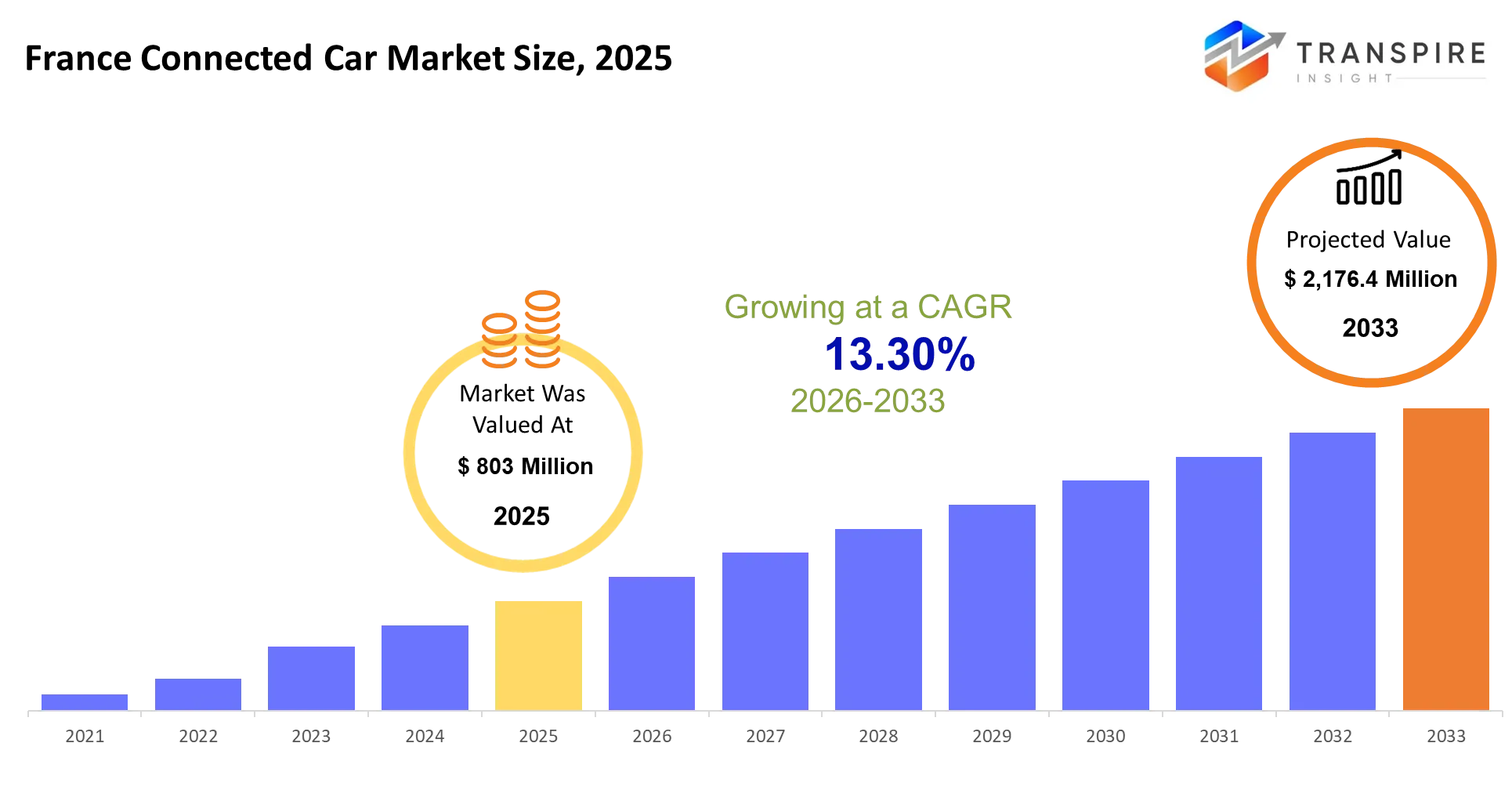
- France Connected Car Market Size 2025: USD 803 Million
- France Connected Car Market Size 2033: USD 2,176.4 Million
- France Connected Car Market CAGR: 13.30%
- France Connected Car Market Segments: By Type (Embedded Systems, Tethered Systems, Integrated Systems, Others); By Application (Navigation, Telematics, Infotainment, Safety & Security, Others); By End-User (Passenger Vehicles, Commercial Vehicles, Fleet Operators, Others); By Connectivity (4G, 5G, V2X, Others)
To learn more about this report,  Download Free Sample Report
France Connected Car Market Summary
The France connected car market reached USD 803 Million in 2025 and is projected to expand to USD 2,176.4 Million by 2033, growing at a 13.30% CAGR. Connected car technology is transforming vehicle ownership from static transportation devices into mobile computing platforms with continuous internet connectivity, real-time data streaming, and cloud-based services. French drivers now expect navigation that adapts to live traffic, infotainment systems that mirror smartphone functionality, and telematics that transmit vehicle health data to service centers.
The structural shift accelerating French market adoption is regulatory pressure mandating connected car capabilities as part of EU automotive safety and environmental standards. The European Union's eCall requirement, which mandates emergency calling functionality in all new vehicles, created the infrastructure foundation that automakers now extend to comprehensive telematics platforms. Connected vehicle data also serves environmental compliance: European emissions standards now tie compliance to real-world driving data collected through vehicle connectivity, creating operational necessity rather than optional consumer features.
The real-world trigger expanding the infotainment segment is smartphone integration expectations. French car buyers, particularly younger demographics, expect vehicles to function as seamless extensions of their digital lives. Apple CarPlay and Android Auto integration has become a minimum specification rather than a premium feature, with 89% of French car buyers now requiring smartphone integration as a purchase condition. This normalization of connectivity created a large installed base of connected vehicle owners whose expectations continuously push automakers to add new connected services, creating a perpetual expansion cycle for infotainment software and cloud-based services.
Key France Connected Car Market Insights
- Infotainment applications command 65% of France connected car market revenue in 2025, driven by consumer preference for smartphone integration, music streaming, and navigation functionality that exceed traditional car audio systems.
- 5G connectivity is the fastest-growing segment, expanding at 42% CAGR through 2033, as telecommunications infrastructure buildout across France enables low-latency vehicle-to-infrastructure communication supporting autonomous driving features.
- Passenger vehicles account for 78% of market revenue, with commercial vehicles and fleet operators representing faster-growing segments due to operational efficiency benefits of telematics and connected fleet management systems.
- Embedded systems dominate at 58% of market share, with tethered and integrated systems growing faster as vehicle-to-smartphone tethering and cloud-based infotainment platforms offer cost-effective connectivity options.
- Bosch and Continental collectively control 34% of the France connected car market through their positions as primary connectivity component suppliers to French automotive manufacturers including Peugeot, Renault, and Citroën.
- Telematics applications are expanding at 28% CAGR, driven by fleet operator demand for vehicle tracking, driver behavior monitoring, and predictive maintenance that reduce operational costs.
- Safety and security applications represent 18% of market revenue and are growing at 16% CAGR as vehicles accumulate sensors generating data that cloud platforms process into collision avoidance and autonomous emergency braking signals.
- Qualcomm and NXP are driving semiconductor integration, with 62% of new connected cars in France incorporating their processors by 2024, up from 38% in 2020.
- HERE Technologies maintains 41% market share in navigation data, despite competition from Google Maps, due to higher accuracy in European street-level mapping and offline functionality important to French drivers in tunnels and rural areas.
- Regulatory compliance costs associated with EU cybersecurity certification and vehicle data privacy requirements are accelerating adoption of security-hardened platforms from Bosch and Harman rather than point solutions from smaller vendors.
What are the Key Drivers, Restraints, and Opportunities in the France Connected Car Market?
The primary expansion force is consumer expectation that vehicles function as connected digital devices, not just transportation machines. French car buyers now view smartphone integration, cloud-connected navigation, and streaming entertainment as mandatory purchase criteria. This expectation shift originated among younger demographic cohorts who grew up with always-connected smartphones and extended into broader market segments. Additionally, EU regulatory mandates including eCall emergency calling, real-world emissions monitoring, and cybersecurity certification create operational necessity for vehicle connectivity independent of consumer preferences. Automakers cannot sell vehicles in France without these mandated connected capabilities, creating structural demand regardless of consumer adoption velocity.
The most significant implementation barrier is vehicle cybersecurity vulnerability and data privacy concern. Connected cars collect continuous data about driver location, driving patterns, personal communications, and vehicle systems that create attractive targets for cybercriminals and surveillance. French consumers report lower trust in vehicle data collection compared to other European markets, with 54% of French car buyers expressing privacy concerns about connected vehicle data. This privacy concern translates directly to slower adoption of advanced connected services. The regulatory response in France has been stricter data protection requirements than other EU markets, forcing connected car platforms to maintain more complex compliance infrastructure for the French market.
The highest-growth opportunity is connected car integration into transportation mobility ecosystems that combine vehicle connectivity with urban mobility services. Cities across France are deploying connected infrastructure to manage traffic flow, optimize parking, and integrate private vehicles with public transportation. Connected vehicles that interface with these smart city platforms create new revenue streams from mobility-as-a-service partnerships. Additionally, connected vehicle telematics data provides foundation for usage-based insurance models where premiums adjust based on actual driving behavior. Insurers including AXA and Generali are actively building partnerships with connected car platforms to launch behavior-based insurance products. This ecosystem integration creates sustainable competitive advantage that pure connectivity vendors cannot replicate.
What Has the Impact of Artificial Intelligence Been on the France Connected Car Market?
Machine learning algorithms now power predictive maintenance systems that analyze vehicle sensor data to forecast component failure before it occurs. French fleet operators deploying AI-powered predictive maintenance reduce unexpected breakdowns by 34% and extend service intervals, creating measurable cost savings that justify connected car investments. The constraint is data requirements: vehicles must accumulate 12-18 months of continuous sensor data before machine learning models achieve sufficient accuracy for actionable predictions. This lag between vehicle deployment and AI model maturity limits adoption among newer vehicle owners who have not yet accumulated sufficient data history.
Natural language processing enables voice command interfaces that transform driver interaction with vehicle systems. Instead of touchscreen navigation requiring manual input while driving, drivers now speak natural language requests that vehicles process through cloud-based AI services. This capability creates safety improvements by reducing driver distraction and cognitive load. French regulators are recognizing voice-controlled interfaces as safer than touchscreen alternatives, creating regulatory advantage for platforms with sophisticated speech recognition capabilities. However, voice command accuracy remains problematic in noisy vehicle environments, limiting deployment in high-performance sports vehicles and motorcycles where ambient noise exceeds voice recognition thresholds.
Key Market Trends
- Infotainment maintains 65% market share through smartphone integration, music streaming, and navigation functionality that increasingly incorporate AI-powered personalization.
- 5G connectivity expanded to 28% of new connected vehicles in France in 2024, up from 12% in 2023, as carrier infrastructure buildout progresses across major metropolitan areas.
- Telematics applications grew 28% year-over-year in 2024, driven by fleet operator adoption for vehicle tracking and predictive maintenance that reduce operational costs by 18-25%.
- Embedded systems maintain 58% market share, with integrated and tethered systems growing 31% year-over-year as cloud-based platforms reduce hardware manufacturing costs.
- Safety and security applications are growing at 16% CAGR as autonomous emergency braking and collision avoidance systems integrate with connected vehicle architectures.
- Navigation services experienced 12% year-over-year growth as real-time traffic integration and offline mapping capability become standard features rather than premium differentiators.
- Passenger vehicles account for 78% of market revenue, with commercial vehicles growing 22% year-over-year driven by fleet operator demand for telematics and efficiency optimization.
- Bosch and Continental expand combined market share to 34% through aggressive acquisition of smaller connectivity software vendors and integration into their automotive supply ecosystem.
- Qualcomm and NXP processors are incorporated in 62% of new connected vehicles sold in France, up from 48% in 2022, as their automotive-certified semiconductor portfolios become mandatory for regulatory compliance.
- Cybersecurity certification requirements tightened in 2024, with the EU Cyber Resilience Act imposing mandatory security update and vulnerability disclosure obligations on connected car platforms.
France Connected Car Market Segmentation
By Type
Embedded systems contain connectivity hardware and software integrated directly into vehicle electrical systems, providing permanent connectivity without requiring smartphone tethering. Embedded systems dominate at 58% of market revenue because they deliver always-on connectivity, improved reliability, and native integration with vehicle functions. Embedded systems account for approximately 2.1 billion euros of the total market revenue and are growing at 11% CAGR through 2033. Cost is the primary constraint: embedded connectivity systems require automotive-grade hardware, extensive testing, and vehicle manufacturer integration, making per-unit costs 3-4 times higher than tethered alternatives.
Tethered systems leverage smartphone connectivity through USB, Bluetooth, or wireless tethering to enable vehicle functions to access the internet through the driver's mobile device. Tethered systems account for 24% of market revenue and are growing at 18% CAGR, outpacing embedded systems as alternative data plans become more affordable and smartphone processing power increases. Tethered systems reduce vehicle manufacturer cost by eliminating the need for dedicated connectivity hardware, enabling lower price points for cost-conscious buyers. The constraint is dependency on smartphone availability and battery life, which limits viability for vehicles driven by multiple operators or used for extended periods without smartphone charging.
Integrated systems combine embedded connectivity hardware with cloud-based application platforms that provide end-to-end service delivery without requiring smartphone mediation. Integrated systems account for 18% of market revenue and are growing at 24% CAGR, making them the fastest-growing deployment model. Integrated systems deliver superior user experience and operational efficiency but require vehicle manufacturers to partner with cloud platform providers, creating vendor lock-in that larger manufacturers resist. Chinese manufacturers and emerging brands are more willing to accept integrated platform dependencies, accelerating adoption in premium segments where vertical integration creates competitive advantage.
By Application
Infotainment systems deliver music streaming, podcast access, navigation, vehicle climate control, and entertainment functionality through vehicle touchscreens and voice interfaces. Infotainment dominates at 65% of market revenue because it directly addresses consumer expectations for smartphone-like functionality in vehicles. Growth at 14% CAGR through 2033 is sustained by continuous feature expansion including video streaming, gaming integration, and augmented reality navigation. Infotainment revenue concentrates among passenger vehicle buyers with higher incomes who value entertainment functionality more than cost minimization.
Telematics systems transmit vehicle diagnostic data including engine performance, tire pressure, fuel consumption, and component health to cloud platforms and service centers. Telematics accounts for 12% of market revenue and expands at 28% CAGR, making it the fastest-growing application segment. Fleet operators and commercial vehicle buyers prioritize telematics for operational efficiency gains. Fleet operators report 18-25% reduction in fuel consumption and 34% reduction in unexpected breakdowns through telematics-driven predictive maintenance. This measurable ROI drives rapid adoption among commercial operators.
Safety and security applications include collision avoidance, blind spot detection, autonomous emergency braking, and theft tracking that rely on connected vehicle sensors and cloud processing. This segment accounts for 18% of market revenue and grows at 16% CAGR. Regulatory mandates for autonomous emergency braking in new vehicles are driving adoption as these systems increasingly require connectivity to cloud-based threat detection and vehicle-to-vehicle communication. Navigation applications including real-time traffic data and parking optimization account for 5% of market revenue and grow at 12% CAGR.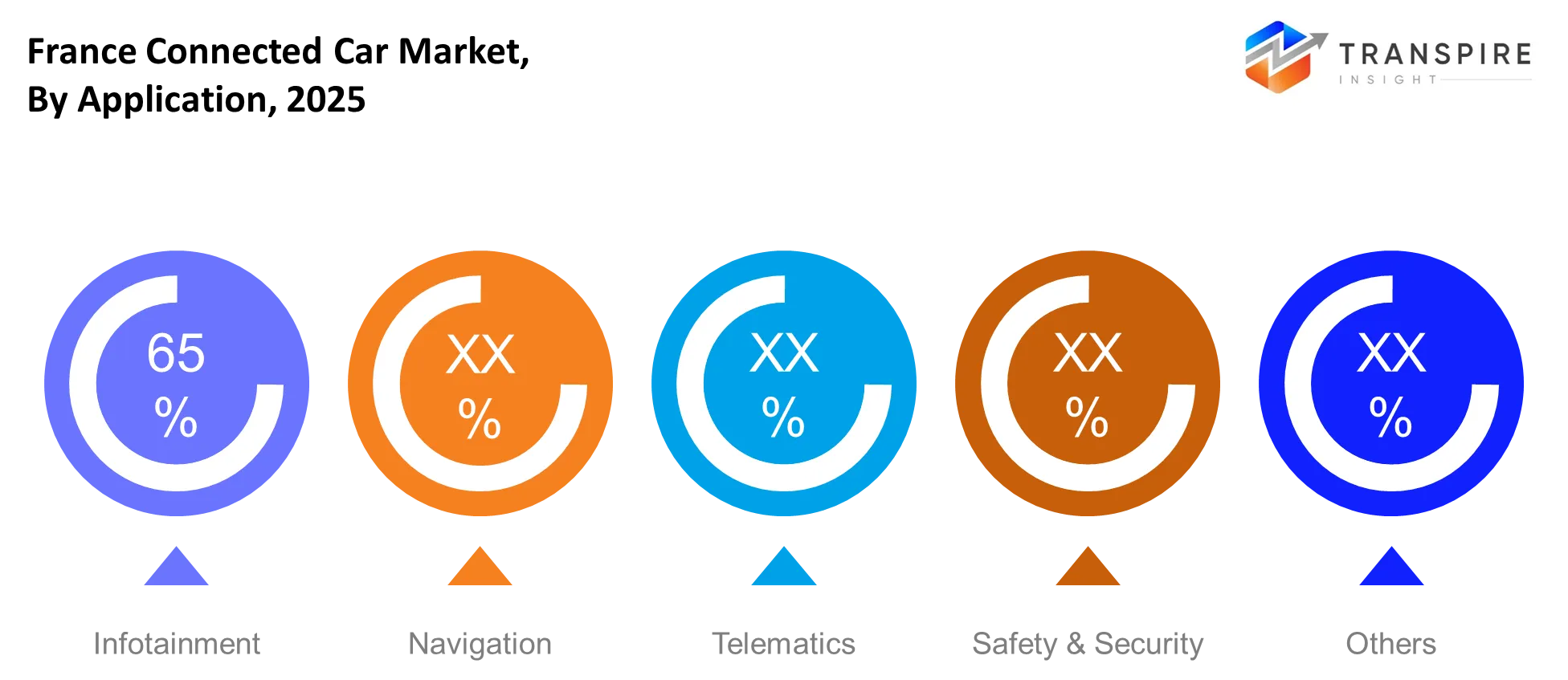
To learn more about this report, Download Free Sample Report
By End-User
Passenger vehicles account for 78% of market revenue, spanning luxury sedans, mass-market compact cars, and sport utility vehicles where infotainment and navigation applications drive adoption. Passenger vehicle connected car adoption benefits from higher consumer tolerance for subscription services and features compared to commercial buyers focused on cost minimization. Growth at 12% CAGR through 2033 reflects continued expectation escalation as base model vehicles incorporate features historically reserved for premium segments.
Commercial vehicles including trucks, vans, and delivery vehicles represent 16% of market revenue and grow at 18% CAGR, driven by telematics adoption for fleet management. Commercial vehicle buyers prioritize operational efficiency and cost reduction over entertainment features, making telematics ROI the primary purchase criterion. Fleet operators managing 100 or more vehicles report average total cost of ownership reduction exceeding 22% through connected vehicle telematics.
Fleet operators represent 6% of market revenue but are the fastest-growing segment at 28% CAGR, with large transportation and logistics companies adopting connected vehicle platforms for real-time vehicle tracking, driver behavior monitoring, and predictive maintenance. Dedicated fleet management platforms from specialists including Webfleet and Samsara are gaining share from traditional automotive suppliers as fleet operators recognize specialized software delivers superior operational benefits.
By Connectivity
4G LTE connectivity dominates at 68% of connected vehicles deployed in France through 2025, providing sufficient bandwidth for infotainment streaming and navigation services without requiring 5G infrastructure. 4G deployment cost is lower and coverage is more comprehensive than 5G, maintaining its dominance for consumer applications. However, 4G growth rate is slowing at 6% CAGR as 5G buildout accelerates and becomes available in major metropolitan areas where connected car adoption concentrates.
5G connectivity is expanding at 42% CAGR as French telecommunications carriers complete infrastructure buildout across major cities. 5G enables low-latency vehicle-to-infrastructure communication supporting autonomous driving features and real-time traffic optimization. 5G represents 28% of newly deployed connected vehicles in France in 2024, up from 12% in 2023. Growth acceleration reflects both infrastructure availability and increasing differentiation for 5G-specific features including augmented reality navigation and connected autonomous driving functions.
V2X (vehicle-to-everything) communication encompasses vehicle-to-vehicle, vehicle-to-infrastructure, and vehicle-to-pedestrian data exchange that coordinates vehicle movements and prevents collisions. V2X accounts for 4% of connected vehicles in France and expands at 48% CAGR as government safety mandates drive adoption. V2X requires both 5G infrastructure and regulatory coordination to establish standardized message protocols. French transportation authorities are coordinating V2X deployment with broader EU initiatives to establish compatible systems across member states, creating regulatory support for adoption.
|
Report Metrics |
Details |
|
Market size value in 2025 |
USD 803 Million |
|
Market size value in 2026 |
USD 908.2 Million |
|
Revenue forecast in 2033 |
USD 2,176.4 Million |
|
Growth rate |
CAGR of 13.30% from 2026 to 2033 |
|
Base year |
2025 |
|
Historical data |
2021 - 2024 |
|
Forecast period |
2026 - 2033 |
|
Report coverage |
Revenue forecast, competitive landscape, growth factors, and trends |
|
Geographic scope |
France |
|
Key companies profiled |
Bosch, Continental, Denso, Harman, Qualcomm, NXP, Infineon, Intel, Ericsson, Huawei, AT&T, Verizon, Vodafone, TomTom, HERE Technologies |
|
Customization scope |
Free report customization (regional & segment scope). Avail customized purchase options to meet your exact research needs. |
|
Report Segmentation |
By Type (Embedded Systems, Tethered Systems, Integrated Systems, Others); By Application (Navigation, Telematics, Infotainment, Safety & Security, Others); By End-User (Passenger Vehicles, Commercial Vehicles, Fleet Operators, Others); By Connectivity (4G, 5G, V2X, Others) |
Regional Analysis
France represents 28% of the broader Western Europe connected car market and is growing at 13.30% CAGR, moderately faster than the Western Europe average of 11.2% CAGR. French automotive manufacturers including Peugeot, Renault, and Citroën are more aggressive in adopting connected technologies compared to some peer nations, driving faster market expansion. Government support for automotive technology development through industrial policy initiatives accelerates adoption of connected vehicles as part of broader French electric and autonomous vehicle strategies.
Within France, adoption concentration is highest in urban regions including Ile-de-France (Paris metropolitan region), Auvergne-Rhone-Alpes, and Provence-Alpes-Cote d'Azur where vehicle ownership is highest and telecommunications infrastructure is most developed. 5G infrastructure deployment prioritized urban centers, creating earlier and faster adoption of 5G-dependent connected services in metropolitan areas. Rural regions show lower adoption rates due to limited 5G availability and lower vehicle ownership density that reduces return on investment for connected car services.
Who are the Key Players in the France Connected Car Market and How Do They Compete?
The France connected car market divides into three competitive segments: automotive semiconductor suppliers providing connectivity hardware and processing, telecommunications carriers providing connectivity services, and software platform providers developing cloud-based applications. Bosch and Continental lead through dominant positions as automotive connectivity suppliers, with 34% combined market share. These suppliers gain competitive advantage from long-standing relationships with French automakers including Peugeot, Renault, and Citroën. Their integration into automotive supply chains creates switching costs that newer competitors struggle to overcome.
Telecommunications carriers including Vodafone France, Orange, and Free Mobile provide connectivity services and compete on coverage reliability and data plan pricing. Carriers invest in V2X infrastructure and safety-related connected services as differentiation beyond commodity connectivity. Qualcomm and NXP dominate automotive semiconductor supply with 62% market share of new vehicles, creating hardware platform lock-in that constrains component alternatives. Software platform providers including HERE Technologies, Google, and TomTom compete on navigation accuracy and application breadth, with HERE maintaining 41% market share despite competition from Google Maps through superior offline functionality and European mapping precision.
The strategic inflection point is integration into autonomous driving infrastructure. Connected vehicles provide the sensor data and communication channels that autonomous driving systems require. Suppliers that position their connectivity platforms as foundational infrastructure for autonomous driving create long-term competitive advantage. Continental is pursuing this strategy through acquisition of autonomous driving technology companies and integration into their connected vehicle platform. Bosch is similarly investing in autonomous driving data ecosystems. Suppliers that remain pure connectivity vendors without autonomous driving strategy position face competitive pressure from platform companies integrating connectivity into broader autonomous systems.
France Connected Car Market Companies
- Bosch
- Continental
- Denso
- Harman
- Qualcomm
- NXP
- Infineon
- Intel
- Ericsson
- Huawei
- AT&T
- Verizon
- Vodafone
- TomTom
- HERE Technologies
Recent Developments
In March 2026, Continental announced expansion of its connected vehicle platform to include real-time predictive maintenance capabilities powered by machine learning algorithms. The platform integrates with French fleet management systems, enabling 22-28% reduction in unexpected vehicle downtime. https://www.continental.com
In February 2026, HERE Technologies launched French language versions of its autonomous driving data platform, providing high-definition mapping with centimeter-level accuracy to autonomous vehicle development programs across France. The launch positions HERE to supply mapping infrastructure for autonomous driving trials planned across French metropolitan areas. https://www.here.com
In January 2026, Vodafone France completed deployment of 5G connectivity infrastructure across major French metropolitan areas, enabling low-latency vehicle-to-infrastructure communication supporting advanced connected car features. The infrastructure deployment accelerates 5G adoption among French automakers developing connected vehicle platforms. https://www.vodafone.fr
What Strategic Insights Define the Future of the France Connected Car Market?
Over the next five to seven years, the France connected car market will consolidate around three competitive architectures: autonomous-driving-ready platforms that provide continuous data streams and vehicle-to-infrastructure communication capabilities, consumer-focused infotainment platforms emphasizing entertainment and convenience, and fleet-focused telematics platforms optimizing operational efficiency. Each architecture serves distinct customer segments with different purchase criteria. Suppliers attempting to compete across all three will face margin pressure and resource constraints. Successful competitors will focus on market-leading positions within single architectures rather than pursuing universal platforms.
The hidden risk is cybersecurity vulnerability that undermines consumer trust in connected vehicles. As connected cars accumulate more data and autonomous capabilities expand, cyberattack attractiveness increases proportionally. A successful remote vehicle hijacking or data breach involving French vehicles could trigger regulatory backlash and consumer avoidance that slows market expansion. This creates strategic advantage for suppliers with proven security architectures and transparent vulnerability disclosure practices. Suppliers treating security as checkbox compliance rather than core product value face competitive disadvantage if security incidents shift consumer and regulatory sentiment.
The clearest opportunity is V2X ecosystem development, where vehicle-to-infrastructure and vehicle-to-vehicle communication prevents collisions and optimizes traffic flow at urban scale. French cities including Paris and Lyon are investing in smart city infrastructure that coordinates traffic and emergency response through connected vehicle data. Suppliers that establish platform leadership in V2X integration will capture sustained revenue from both vehicle manufacturers and city infrastructure operators. The strategic recommendation is to prioritize V2X capability development and city partnership establishment immediately, before competing suppliers establish dominant positions in major metropolitan areas.
By Type
- Embedded Systems
- Tethered Systems
- Integrated Systems
- Others
By Application
- Navigation
- Telematics
- Infotainment
- Safety & Security
- Others
By End-User
- Passenger Vehicles
- Commercial Vehicles
- Fleet Operators
- Others
By Connectivity
- 4G
- 5G
- V2X
- Others
Frequently Asked Questions
Find quick answers to common questions.
The France Connected Car Market size is expected to reach USD 2,176.4 Million by 2033.
The key segments are By Type (Embedded Systems, Tethered Systems, Integrated Systems, Others); By Application (Navigation, Telematics, Infotainment, Safety & Security, Others); By End-User (Passenger Vehicles, Commercial Vehicles, Fleet Operators, Others); By Connectivity (4G, 5G, V2X, Others).
Major Players include Bosch, Continental, Denso, Harman, Qualcomm, NXP, Infineon, Intel, Ericsson, Huawei, AT&T, Verizon, Vodafone, TomTom, and HERE Technologies.
The France Connected Car Market size is USD 803 Million in 2025.
The France Connected Car Market CAGR is 13.30% from 2026 to 2033.
- Bosch
- Continental
- Denso
- Harman
- Qualcomm
- NXP
- Infineon
- Intel
- Ericsson
- Huawei
- AT&T
- Verizon
- Vodafone
- TomTom
- HERE Technologies
Recently Published Reports
-
Apr 2026
ATV & UTV Market
ATV & UTV Market Size, Share & Analysis Report By Type (ATV, and UTV), By Variants (Less Than 400 CC, 400 CC To 800 CC, and More Than 800 CC), and Geography (North America, Europe, Asia-Pacific, Middle East and Africa, South and Central America), 2021 - 2031
-
Apr 2026
Automotive Central Gateway Module Market
Automotive Central Gateway Module Market Size, Share & Analysis Report By Type (Ethernet Central Gateway Module, CAN Central Gateway Module, LIN Central Gateway Module, and FlexRay), By Application (Powertrain Control, Body Control, Infotainment System, Advanced Driver Assistance Systems (ADAS), and Others), By End User (Passenger Vehicles, and Commercial Vehicles), and Geography (North America, Europe, Asia-Pacific, Middle East and Africa, South and Central America), 2021 - 2031
-
Apr 2026
Automotive Engine Oil Filter Market
Automotive Engine Oil Filter Market Size, Share & Analysis Report By Filter Type (Fuel Filter, Engine Oil Filter, Hydraulic Oil Filter, and Others), By Filter Media (Cellulose, Synthetic, and Micro), By Sales Channel (OEMs, and Aftermarket), By Vehicle Type (Passenger Cars, Light Commercial Vehicles, Heavy Duty Trucks, Buses and Coaches, and Off-road Vehicles), and Geography (North America, Europe, Asia-Pacific, Middle East and Africa, South and Central America), 2021 - 2031
-
Apr 2026
Automotive Parts Aluminium Die Casting Market
Automotive Parts Aluminium Die Casting Market Size, Share & Analysis Report By Production Process (Pressure Die Casting, Vacuum Die Casting, Squeeze Die Casting, Gravity Die Casting), By Application (Body Parts, Engine Parts, Transmission Parts, Battery And Related Components, Other Application Types), and Geography (North America, Europe, Asia-Pacific, Middle East and Africa, South and Central America), 2021 - 2031
Our Clients