
South Korea Compound Semiconductor Market Size & Forecast:
- South Korea Compound Semiconductor Market Size 2025: USD 1.44 Billion
- South Korea Compound Semiconductor Market Size 2033: USD 3.416 Billion
- South Korea Compound Semiconductor Market CAGR: 11.40%
- South Korea Compound Semiconductor Market Segments: By Material Type (GaN, SiC, GaAs, InP, GaP, AlN, CdTe, Others); By Application (Power Electronics, RF Devices, Optoelectronics, 5G Infrastructure, Electric Vehicles, Consumer Electronics, Industrial Systems, Others); By Wafer Size (2-inch, 4-inch, 6-inch, 8-inch, Above 8-inch, Custom Wafers, Epitaxial Wafers, Others); By End User (Electronics Manufacturers, Telecom Providers, Automotive OEMs, Defense Organizations, Industrial Companies, Research Institutes, Healthcare Firms, Others)
South Korea Compound Semiconductor Market Summary
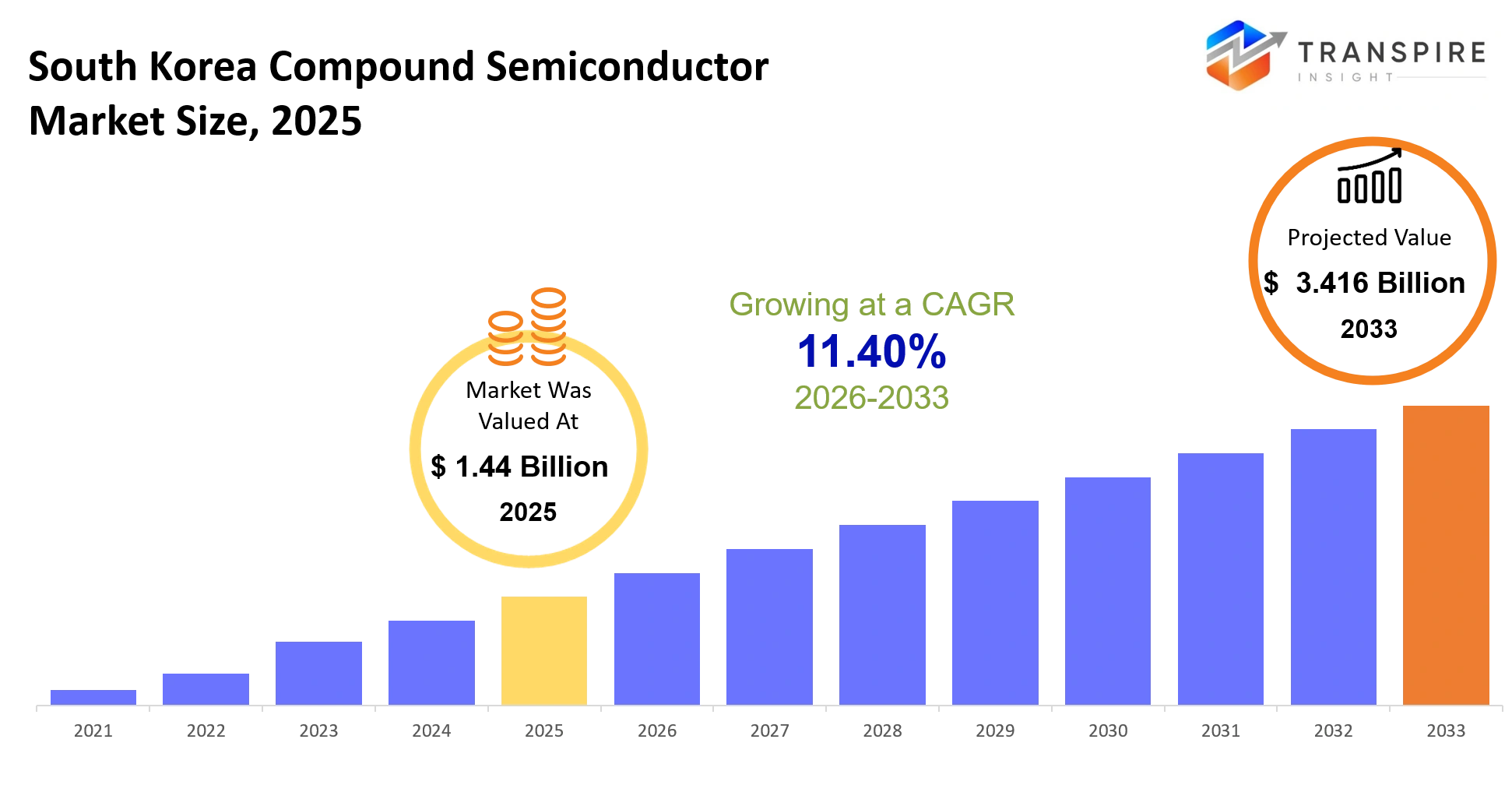
The South Korea Compound Semiconductor Market was valued at USD 1.44 Billion in 2025. It is forecast to reach USD 3.416 Billion by 2033. That is a CAGR of 11.40% over the period.
At the center of South Korea's nascent new-tech infrastructure lies the country's burgeoning compound semiconductor market - next-gen materials for power devices, radio frequency chips, light-emitting diodes, and other optical devices - allowing them to function at higher power, energy and speed than traditional silicon-based counterparts, crucial to electric cars, 5G base stations, data center facilities, or advanced combat weaponry. The domestic compound semiconductor market is going through a phase of transformation from one dominated by R&D to commercial-based manufacturing, particularly in silicon carbide, or SiC, and gallium nitride, or GaN, the past five years, driven in large part by supply chain shocks from COVID-19 and other disruptions that highlight vulnerability to imports and spur domestic output of the component materials. The resulting wave of increased CapEx investment, widening industrial applications and revenue opportunities comes at a time when end-users prioritize efficiency and system-performance.
Key Market Insights
- Seoul has more than half (55%) the South Korea compound semiconductor market share by 2025 because it holds a wide area of the country's semiconductor manufacturing clusters and development research and investment is being heavily invested.
- Gyeonggi Province grows the fastest regionally by the compound semiconductor production facility capacity will be expanded through the construction of new fabs, packaging and government supported semiconductor complex through 2032.
- Silicon Carbide(SiC) is dominating more than 45% market share by 2025 because of growing use in the automotive sector’s power electronics high-voltage applications, while a new market such as energy efficient inverters is developing.
- Gallium Nitride (GaN) accounted for the second largest share, used to produce new generation of devices such as RF power devices in cellular infrastructure, smart phone quick charger, AI chip through faster switching performances.
- In other side of the market, Gallium Oxide (Ga2O3) & Diamond Semiconductor compound has growth rapidly from a small market share up to 2032 with market share which is expected to penetrate due to an increase in demand in ultra high power applications due to the commercialization development and technology advancements.
- EV's represent nearly 35% by 2025 and it will continue growing with a robust CAGR during the period as new electric vehicles models launch in South Korea.
- AI data centers are set to register the fastest CAGR by 2032 to fulfill demand from emerging AI workloads.
- Consumer electronics remain a key segment holding ~30% market share in 2025 as key players are dominant in smartphone, display and television manufacturing.
- Data center operators are anticipated to experience the highest growth by 2032 due to the soaring adoption of AI solutions in cloud computing that leads to an increase in power requirements.
- Manufacturers seek local supply chains and develop new packaging and integration services to alleviate chip shortages. Global chip manufacturers such as Samsung, TSMC and GlobalFoundries look to integrate new capabilities into semiconductor offerings.
What are the Key Drivers, Restraints, and Opportunities in the South Korea Compound Semiconductor Market?
The main force pushing the South Korea Compound Semiconductor Market is kind of a moving target, more or less like the pivot toward high efficiency power electronics for electric vehicles and AI computing infrastructure. The shift really started to accelerate after 2020 , when automakers began leaning into 800-volt architectures and hyperscale data centers looking for ways to reduce energy losses. Silicon carbide and gallium nitride devices operate at higher temperatures and at faster switching frequencies than silicon does.So, manufacturers can push better power efficiency while shrinking the overall system size. In the end, these benefits connect back to more semiconductor content per vehicle and stronger revenue chances for domestic suppliers, maybe sooner rather than later.
The hardest structural obstacle is still the restricted supply of high-quality compound semiconductor wafers, plus the capital-hungry nature of fabrication facilities. To make near perfect silicon carbide substrates, you need specialized tools, long process cycles, and a bunch of years of hands-on manufacturing know-how. Unfortunately this issue cannot be fixed rapidly, and that slows down capacity expansion. It also suppresses revenue growth because downstream industries often end up waiting longer for advanced devices.
A big opening is tied to AI infrastructure and next-generation data centers. South Korea is ramping up investments in AI computing clusters that depend on highly efficient power conversion systems. Gallium nitride power components and silicon carbide modules are becoming key technologies for lowering electricity usage and strengthening thermal management. That creates a new path for long-term market expansion, even if it takes time.
What Has the Impact of Artificial Intelligence Been on the South Korea Compound Semiconductor Market?
Artificial intelligence is starting to reshape the South Korea compound semiconductor industry, by upping manufacturing precision , improving yield tuning, and making equipment more dependable. Semiconductor makers are, more and more frequently, rolling out AI-enabled vision systems that look at wafers, catch those tiny defects , and basically make quality control more automated across the whole fabrication line. Then machine learning models chew through thousands of process signals in real time, so plants can tweak deposition, etching and packaging parameters before issues can spread across the production batches , you know.
Also, predictive analytics is getting just as big. AI models track the condition of machines, anticipate potential component failures , and adjust maintenance windows. That helps fabs cut down on unexpected downtime and get better equipment utilization. In the manufacturing of power devices, digital twins help by simulating thermal behavior and electrical traits, which lets engineers compress development timelines and boost device efficiency. Overall these tools push higher yields, reduce operating costs, and support steadier output.
Still, AI adoption isn’t fully smooth. Putting AI into older, legacy fabrication facilities needs a lot of capital, plus access to big high-quality datasets. A lot of manufacturers keep running into data standardization , and interoperability headaches, and that can reduce model reliability, slow things down for the digital transformation.
Key Market Trends
- Manufacturers redirecting investment to SiC and GaN since 2020 for enhanced power efficiency, thermal performance.
- Domestic firms bring wafer sourcing and specialty materials in-house due to vulnerabilities exposed by global supply chain disruptions.
- EVs transitioning to 800V platform spurs growth of SiC power modules for charging and traction.
- AI data centers emerge as a key market after 2023, preferring GaN devices for efficient power conversion and reduced power consumption.
- Government semiconductor subsidies rose substantially from 2021-2025, driving a focus on strategic expansion of fab capacity and advanced packaging.
- Research labs shift research toward the commercialization of Ga2O3 and diamond semiconductors for industrial use rather than pure research.
- The whole competition kind of shifts away from “just more volume” toward tech leadership, pushed by heavy investment on defect reduction, wafer quality, and also new architectures and such.
- There’s been a notable jump in strategic partnerships between chip makers, car manufacturers, and equipment suppliers, it helps shrink lead times and basically locks in the domestic ecosystem more solidly.
- At the same time, buyers seem much more locked on energy efficiency and life-cycle cost reduction, so they’re asking for higher power density and devices with lower loss, you know.
- And after 2022, advanced packaging technologies keep trending, with a push that sounds smaller, faster and more reliable semiconductors.
South Korea Compound Semiconductor Market Segmentation
By Material Type:
GaN materials are pretty often used in high-frequency and high-power applications, due to their fast switching speed and strong thermal stability, which helps a lot. SiC materials show up in electric vehicles and industrial power systems too, mainly because they reduce energy loss, and boost efficiency. GaAs materials are still relevant for radio frequency devices and optoelectronic products where signal quality and speed are kind of non-negotiable.
InP, GaP, AlN, and CdTe materials go toward specialized use cases that need really advanced optical and electronic properties, not just the basic kind of performance. InP backs fiber optic communication, and AlN provides strong heat dissipation for power devices, so the whole system stays happier under load. Other materials keep getting attention, because research activities keep moving forward, and commercial applications spread across electronics and industrial areas.
By Application:
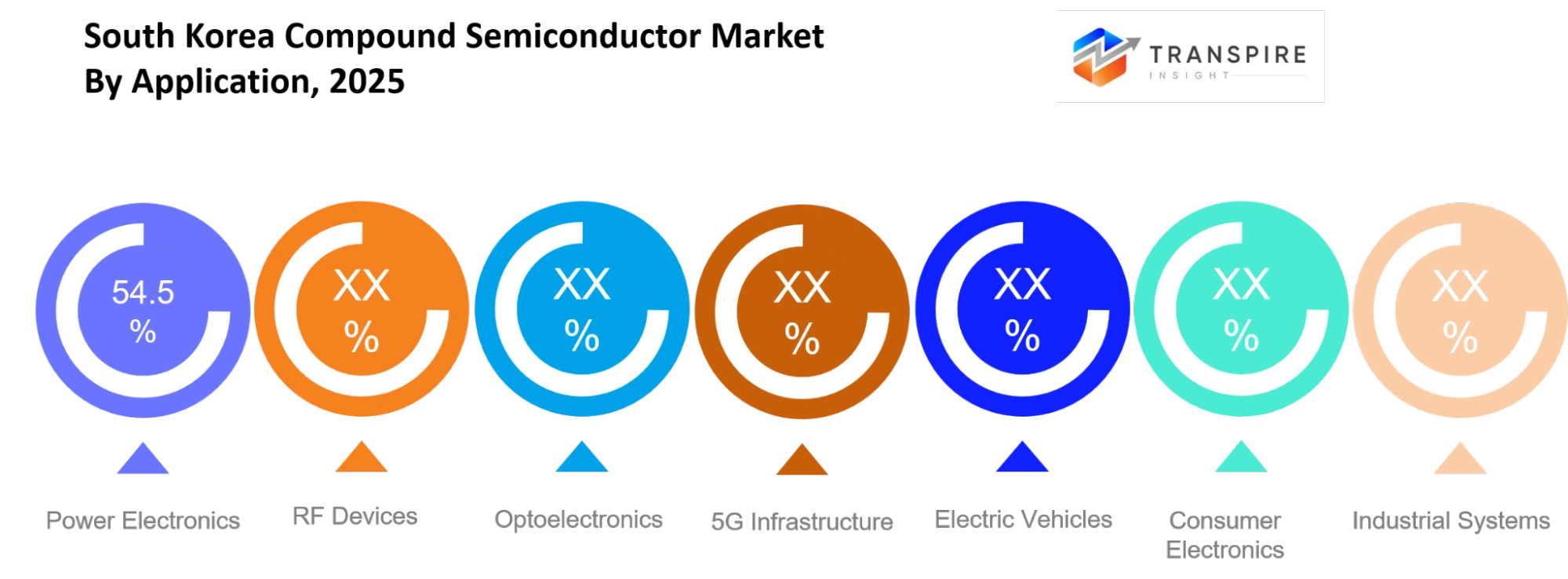
Power electronics take up a major portion, since compound semiconductors make energy conversion better and can cut down on heat generation in advanced setups. RF devices also keep a big role, because telecom networks need quicker data transfer and stable signal behavior. Meanwhile optoelectronics are expanding quite steadily, especially with more use in displays, sensors, and communication equipment.
Applications linked to 5G infrastructure, and electric vehicles are becoming even more important, as industries adopt high efficiency technologies. Consumer electronics and industrial systems also use these semiconductors, to improve performance, lower power demand, and enable smaller product designs. And yeah, other applications will keep popping up, once technology capabilities keep climbing.
By Wafer Size:
Two-inch and four-inch wafers are mainly used for research activities and low-volume production, because the manufacturing processes are already well established. Meanwhile Six-inch wafers have started getting wider acceptance , as manufacturers look for improved production efficiency and lower costs but still try to hold product quality steady.
Eight-inch and even above eight-inch wafers are turning up more often in commercial manufacturing, driven by higher output and economies of scale. Custom wafers plus epitaxial wafers support specialized needs, where precise material properties , and device performance really matter. Other wafer categories will keep evolving alongside the changing manufacturing needs, even if the pace is not uniform.
By End User:
Electronics manufacturers are a major end-user group, since compound semiconductors help boost device efficiency, speed and thermal performance. Telecom providers also lean on these materials for network equipment that supports fast communication and dependable connectivity across expanding digital infrastructure.
Automotive OEMs are taking on more of this, because electric vehicles need advanced power devices and more efficient charging systems. Defense organizations, industrial companies, research institutes, and healthcare organizations use compound semiconductors for specialized use cases, where accuracy and durability are crucial. Other end users will continue adopting these technologies, as performance expectations keep climbing across multiple sectors.
What are the Key Use Cases Driving the South Korea Compound Semiconductor Market?
Electric vehicles stay like the biggest use case for compound semiconductors in South Korea, at least for now. Silicon carbide power devices help with faster charging, longer driving range, and they also cut energy loss in traction inverters, which is kind of a big deal for efficiency. Automotive makers keep folding these components into their systems as high-voltage vehicle platforms become more normal, and because efficiency rules keep getting tighter.
Alongside that, related applications are widening across 5G networks and consumer electronics. Telecom providers rely on gallium nitride and gallium arsenide devices in base stations, so signal transmission looks better and energy efficiency improves. Meanwhile, consumer electronics brands are moving toward these materials in fast chargers, smartphones, and wearable products, where space is limited but power management still has to be compact, and high performance.
Newer and more emerging angles are showing up too, especially AI data centers and advanced defense electronics. High-efficiency power conversion for AI servers and radar systems is opening up extra options, and continued spending on next generation computing infrastructure should back broader uptake over the forecast period.
|
Report Metrics |
Details |
|
Market size value in 2025 |
USD 1.44 Billion |
|
Market size value in 2026 |
USD 1.604 Billion |
|
Revenue forecast in 2033 |
USD 3.416 Billion |
|
Growth rate |
CAGR of 11.40% from 2026 to 2033 |
|
Base year |
2025 |
|
Historical data |
2021 - 2024 |
|
Forecast period |
2026 - 2033 |
|
Report coverage |
Revenue forecast, competitive landscape, growth factors, and trends |
|
Country scope |
South Korea |
|
Key company profiled |
Wolfspeed, Infineon, STMicroelectronics, onsemi, Rohm, Sumitomo Electric, Mitsubishi Electric, SK Siltron, IQE, Coherent, WIN Semiconductors, NXP, Qorvo, Broadcom, Samsung Electronics |
|
Customization scope |
Free report customization (country, regional & segment scope). Avail customized purchase options to meet your exact research needs. |
|
Report Segmentation |
By Material Type (GaN, SiC, GaAs, InP, GaP, AlN, CdTe, Others); By Application (Power Electronics, RF Devices, Optoelectronics, 5G Infrastructure, Electric Vehicles, Consumer Electronics, Industrial Systems, Others); By Wafer Size (2-inch, 4-inch, 6-inch, 8-inch, Above 8-inch, Custom Wafers, Epitaxial Wafers, Others); By End User (Electronics Manufacturers, Telecom Providers, Automotive OEMs, Defense Organizations, Industrial Companies, Research Institutes, Healthcare Firms, Others) |
Which Regions are Driving the South Korea Compound Semiconductor Market Growth?
Gyeonggi Province still feels like the leading area in the South Korea Compound Semiconductor Market, mostly because it has the biggest semiconductor manufacturing clusters, plus research facilities. There is also strong governmental backing , along with modern industrial parks and a pretty dense web of material suppliers. Together they form an ecosystem that somehow pushes ongoing investment in silicon carbide and gallium nitride methods. Several major firms run fabrication plants and research centers here, so new products tend to reach the market faster. The ongoing cooperation between manufacturers, universities and equipment suppliers keeps regional influence strong, and it supports long-term growth.
Seoul sits as the second key regional market, though the growth story is different. Since it is the capital, it’s more about design houses , technology startups, and corporate headquarters instead of massive manufacturing footprints. Even so, steady commitments in artificial intelligence , telecommunications and consumer electronics keep demand steady for advanced semiconductor components. With strong financial strength and a more mature innovation landscape, Seoul stays a dependable contributor for both industry revenue and technical development.
North Chungcheong Province seems to be kicking off as the fastest-growing spot lately, thanks to semiconductor investments that keep expanding and the building of fresh manufacturing facilities. Some recent government pushes, meant to strengthen homegrown chip production, and to make supply chains steadier, have made companies set up new operations in the area, kind of sooner than they planned. At the same time, upgrades to infrastructure and more research activities are putting in place these favorable, long-term conditions for growth. And that overall momentum is likely to turn into real, attractive opportunities for investors and market entrants who want exposure to advanced semiconductor technologies from 2026 through 2033.
Who are the Key Players in the South Korea Compound Semiconductor Market and How Do They Compete?
Competition in the South Korea Compound Semiconductor Market is sort of moderately concentrated, with technology leadership acting as the main basis for competing. Established semiconductor manufacturers are extending or ramping production capacity, while newer entrants tend to zoom in on more specialized materials and next-generation device designs. In practice, companies try to win on wafer quality and manufacturing efficiency, plus power performance, and then the ability to back emerging use cases like electric vehicles and AI infrastructure, too.
Samsung Electronics keeps a strong emphasis on advanced semiconductor fabrication and also folds compound semiconductor know-how into power management as well as communication solutions. With steady investments into research facilities and advanced packaging technologies, they can reduce product development cycles a bit, and the device performance tends to improve. SK Keyfoundry, meanwhile, stands out via specialty foundry services plus customized manufacturing approaches that aim to fit niche industrial and automotive demands.
RFHIC has managed to build a solid foothold in gallium nitride technology by creating high-frequency power amplifiers, for 5G infrastructure and defense use. They also expand through partnerships with telecom equipment providers, and they keep adding production capacity. Seoul Semiconductor leans hard into optoelectronic components and modern lighting technologies, using in-house style designs and continuous innovation to lift product efficiency and widen the adoption, across automotive, industrial, and consumer electronics segments.
Company List
- Wolfspeed
- Infineon
- STMicroelectronics
- Onsemi
- Rohm
- Sumitomo Electric
- Mitsubishi Electric
- SK Siltron
- IQE
- Coherent
- WIN Semiconductors
- NXP
- Qorvo
- Broadcom
- Samsung Electronics
Recent Development News
In February 2026, SK Hynix announced investment of approximately $15 billion to build new semiconductor manufacturing facilities in Yongin, South Korea. The project focuses on expanding advanced chip production capacity for AI-driven demand, including power-efficient and high-performance semiconductor materials used in next-generation computing systems.Source https://www.reuters.com/
In June 2026, Air Liquide entered a long-term partnership with SK Hynix and committed nearly €200 million investment in South Korea to support AI chip production infrastructure. The initiative includes construction of a nitrogen production unit for advanced chip packaging and testing operations, strengthening domestic supply chains for semiconductor materials and process gases critical to compound semiconductor manufacturing. Sourcehttps://www.wsj.com/
What Strategic Insights Define the Future of the South Korea Compound Semiconductor Market?
The South Korea Compound Semiconductor Market seems to be heading toward a deeper , kinda integrated use of wide bandgap materials inside high-power and high-frequency systems, this is pushed by electrification in mobility, plus the quick scaling of AI infrastructure. Over the next 5–7 years, most of the demand is likely to cluster around silicon carbide and gallium nitride, since efficiency and thermal control are becoming the real “must” design specs for automotive and telecom networks. There’s also a quieter risk too, that doesn’t always get talked about , which is supply concentration in high-purity wafer production. In that case the dependence on a small set of upstream suppliers can turn into a bottleneck, even if downstream demand is still pretty strong.
At the same time, there’s an emerging chance that feels more noticeable over time: gallium oxide devices are starting to get commercial traction for ultra-high voltage use. This is supported by ongoing pilot work in advanced power grids, and also in defense systems. Market players probably should put more emphasis on vertical integration, like locking in long-term wafer supply commitments, plus co-developing application-specific semiconductor modules with automotive and AI infrastructure partners. That approach should improve resilience, and also help capture early design wins, before the field gets crowded too.
South Korea Compound Semiconductor Market Report Segmentation
By Material Type
- GaN
- SiC
- GaAs
- InP
- GaP
- AlN
- CdTe
By Application
- Power Electronics
- RF Devices
- Optoelectronics
- 5G Infrastructure
- Electric Vehicles
- Consumer Electronics
- Industrial Systems
By Wafer Size
- 2-inch
- 4-inch
- 6-inch
- 8-inch
- Above 8-inch
- Custom Wafers
- Epitaxial Wafers
By End User
- Electronics Manufacturers
- Telecom Providers
- Automotive OEMs
- Defense Organizations
- Industrial Companies
- Research Institutes
- Healthcare Firms
Frequently Asked Questions
Find quick answers to common questions.
The South Korea Compound Semiconductor Market size is USD 3.416 Billion in 2033.
Key segments for the South Korea Compound Semiconductor Market are By Material Type (GaN, SiC, GaAs, InP, GaP, AlN, CdTe, Others); By Application (Power Electronics, RF Devices, Optoelectronics, 5G Infrastructure, Electric Vehicles, Consumer Electronics, Industrial Systems, Others); By Wafer Size (2-inch, 4-inch, 6-inch, 8-inch, Above 8-inch, Custom Wafers, Epitaxial Wafers, Others); By End User (Electronics Manufacturers, Telecom Providers, Automotive OEMs, Defense Organizations, Industrial Companies, Research Institutes, Healthcare Firms, Others).
Major South Korea Compound Semiconductor Market players are Wolfspeed, Infineon, STMicroelectronics, onsemi, Rohm, Sumitomo Electric, Mitsubishi Electric, SK Siltron, IQE, Coherent, WIN Semiconductors, NXP, Qorvo, Broadcom, Samsung Electronics.
The South Korea Compound Semiconductor Market size is USD 1.44 Billion in 2025.
The South Korea Compound Semiconductor Market CAGR is 11.40% from 2026 to 2033.
- Wolfspeed
- Infineon
- STMicroelectronics
- Onsemi
- Rohm
- Sumitomo Electric
- Mitsubishi Electric
- SK Siltron
- IQE
- Coherent
- WIN Semiconductors
- NXP
- Qorvo
- Broadcom
- Samsung Electronics
About the Authors

Avinash Kumar
I’m Avinash Kumar, a Senior Research Analyst at Transpire Insight, with expertise in the Electronics and Semiconductor and Energy & Power industry. My work focuses on analyzing emerging technologies, market trends, industry developments, and innovation across these sectors. I specialize in transforming complex technical and market insights into clear, research-backed content that helps professionals, businesses, and decision-makers stay informed. Through continuous industry research and data-driven analysis, I strive to deliver accurate, reliable, and practical perspectives on the latest advancements shaping the semiconductor and energy landscape.

Chakradhar Khansole
Chakradhar serves as the Research Director at Transpire Insight, bringing over 8 years of experience in technology, innovation, and strategic market intelligence. He specializes in transforming complex market data into actionable business insights that enable organizations to make informed, growth-oriented decisions. Recognized for his strategic vision and analytical expertise, Chakradhar leads high-impact research initiatives, delivering comprehensive market assessments, competitive intelligence, and forward-looking industry analysis.
Recently Published Reports
-
Apr 2026
Fiber Optic Faceplates Market
Fiber Optic Faceplates Market Size, Share & Analysis Report By Type (< 300 mm2, 300-350 mm2, and > 350 mm2, By Application (Night Vision, Holographic Imaging, Medical, and Others), and Geography (North America, Europe, Asia-Pacific, Middle East and Africa, South and Central America), 2021 - 2031
-
Apr 2026
High Temperature Superconductors Market
High Temperature Superconductors Market Size, Share & Analysis Report By Type (1G HTS, and 2G HTS), By Application (Power Cable, Fault Current Limiter, and Transformer), and Geography (North America, Europe, Asia-Pacific, Middle East and Africa, South and Central America), 2021 - 2031
-
Apr 2026
Industrial Plugs and Socket Market
Industrial Plugs and Socket Market Size, Share & Analysis Report By Type (Industrial Plugs, Industrial Sockets), By Current (Up to 32 A, 32 to 125 A, Above 125 A), By Protection (Dustproof and Splash Proof, Waterproof, Explosion Proof), By End User (Heavy Industries, Oil and Gas, Chemicals and Pharmaceuticals, Power Generation, Others), and Geography (North America, Europe, Asia-Pacific, Middle East and Africa, South and Central America), 2021 - 2031
-
Apr 2026
InGaAs Avalanche Photodiodes Market
InGaAs Avalanche Photodiodes Market Size, Share & Analysis Report By Type (1100 - 1700 nm, and 1000 - 1600 nm), By Application (Missile Warning System, Muzzle Flash Detection, Wafer Defect Inspection, Laser Rangefinders, and Others), and Geography (North America, Europe, Asia-Pacific, Middle East and Africa, South and Central America), 2021 - 2031