
South Korea Coal Gasification Market Size & Forecast:
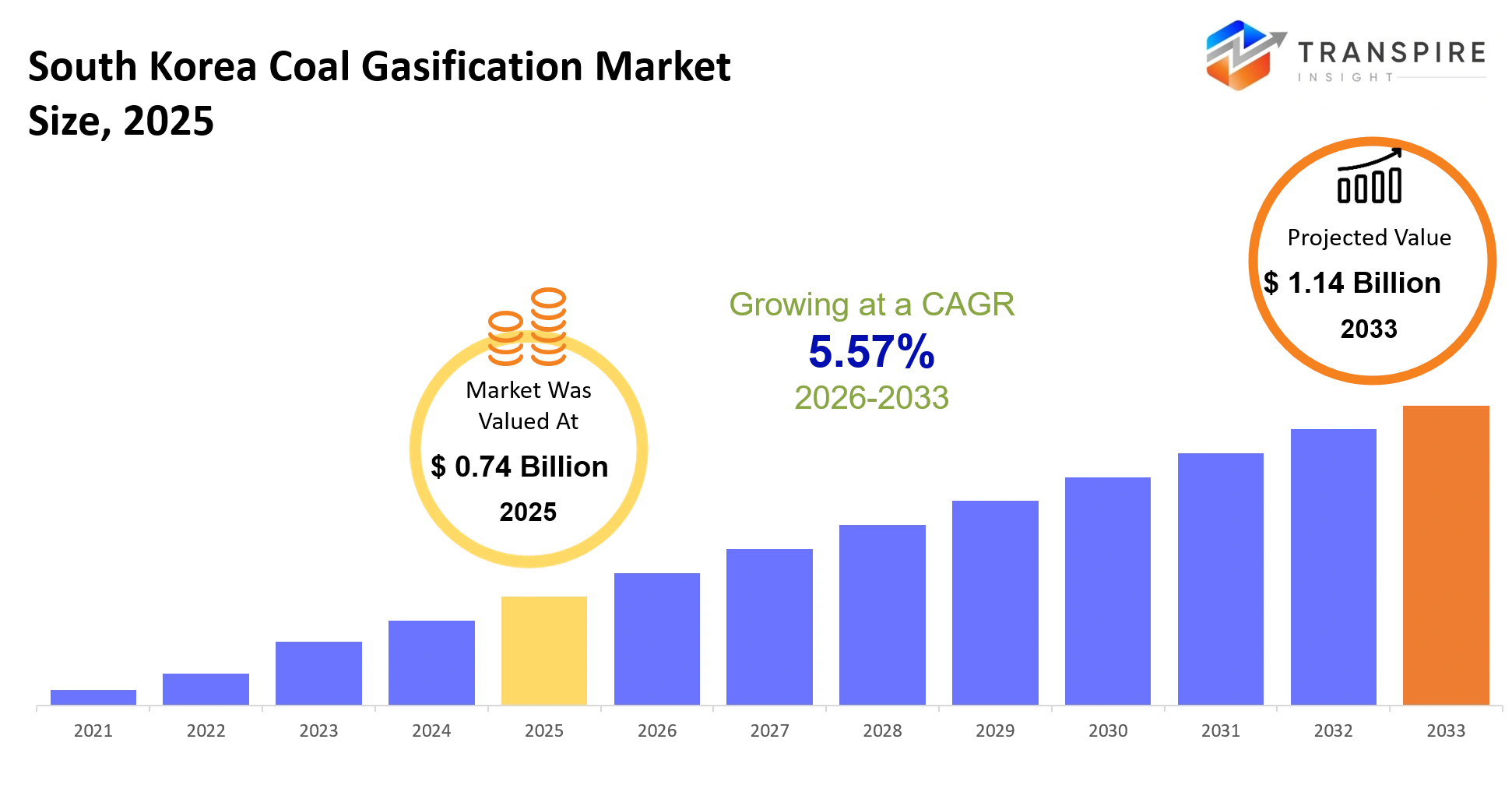
- South Korea Coal Gasification Market Size 2025: USD 0.74 Billion
- South Korea Coal Gasification Market Size 2033:USD 1.14 Billion
- South Korea Coal Gasification Market CAGR: 5.57%
- South Korea Coal Gasification Market Segments:By Technology (Fixed Bed, Fluidized Bed, Entrained Flow, Underground Coal Gasification, Plasma Gasification, Catalytic Gasification, Others),By Feedstock (Lignite, Bituminous Coal, Sub-bituminous Coal, Anthracite, Petroleum Coke, Biomass-Coal Blend, Others),By Application (Power Generation, Chemical Production, Hydrogen Production, Fertilizer Production, Synthetic Natural Gas, Liquid Fuels, Others),By End User (Utilities, Chemical Industry, Refineries, Steel Industry, Industrial Plants, Government Projects, Others)
South Korea Coal Gasification Market Summary
The South Korea Coal Gasification Market was valued at USD 0.74 Billion in 2025. It is forecast to reachUSD 1.14 Billion by 2033. That is a CAGR of 5.57% over the period.
In South Korea, the Coal Gasification Market kinda serves the industries that need a steadier flow of synthesis gas, hydrogen, and chemical feedstocks, but they also want to cut down on how much they rely on straight up coal burning. Basically, in real operations it lets power producers and chemical manufacturers turn coal into “cleaner” intermediate fuels that can help with steelmaking fertilizer production, and also petrochemical processes, not just one thing. Over the last few years the market looks like it's gone through a structural change away from older coal utilization and into more joined up gasification systems, which kinda match the hydrogen economy agenda and carbon management strategies. Then the energy price shock, plus supply disruptions after the Russia–Ukraine conflict, made the shift move faster since it highlighted the dangers tied to imported natural gas dependence. Because of that, industrial operators are now putting more money into gasification projects that give fuel flexibility, and also support domestic energy security. This is widening the project pipelines and opening up fresh revenue chances across engineering services, equipment manufacturing, and then the downstream chemical applications side too.
Key Market Insights
- The South Korea Coal Gasification Market is getting more and more tied up with hydrogen production, like gasification projects are feeding syngas while also backing blue hydrogen for industrial use, kinda in the same motion.
- Industrial clusters around Ulsan and South Chungcheong seem to be the key drivers, taking up roughly 55% of the installed gasification- related capacity by 2025, and that number is not small.
- South Chungcheong should also stay as the fastest expanding regional market through 2032, mostly because there are big chemical and energy infrastructure investments happening there, all the time.
- In terms of process type, entrained-flow gasification is leading, holding well over 45% share since it can handle different coal grades smoothly, and it fits large scale operations better.
- Fixed-bed gasification stays in the picture as the second biggest segment, mostly for smaller industrial facilities that want less upfront capex and a simpler day to day run.
- For technology, Integrated Gasification Combined Cycle is showing the fastest growth, as utilities hunt for higher thermal efficiency, and reduced emissions at the same time.
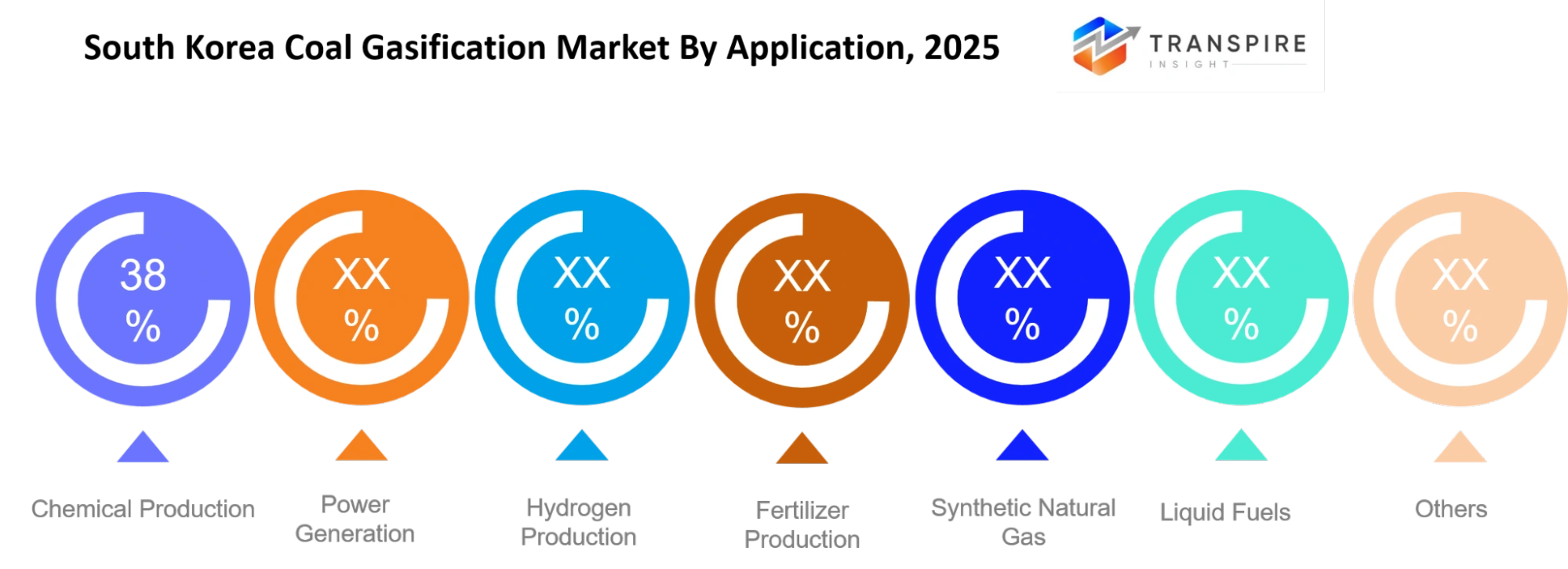
- On the applications side, chemical feedstock production is close to 50% of total needs, supported by steady demand for ammonia, methanol, and synthetic fuels too.
- Hydrogen production has been the fastest-moving application since 2022, with South Korea ramping up investments in low carbon hydrogen infrastructure, and it keeps going.
- When you look at end use, petrochemical companies are still the top customers with more than 40% share, while power generation facilities are scaling up adoption rapidly all the way through 2032.
- Big players, like Doosan Enerbility, Shell, Air Products, Mitsubishi Heavy Industries, Siemens Energy, and GE Vernova, are competing using tech upgrades, strategic partnerships, and more integrated gasification solutions, rather than one standalone approach.
What are the Key Drivers, Restraints, and Opportunities in the South Korea Coal Gasification Market?
The primary force pushing the South Korea Coal Gasification Market is the country’s push to diversify its industrial energy sources, while at the same time it strengthens hydrogen production capacity a bit more. South Korea’s Hydrogen Economy Roadmap and the broader energy security initiatives got a lot more urgency after global fuel price volatility and natural gas supply disruptions during 2022. Big industrial groups increasingly see coal gasification as some sort of route to produce syngas and hydrogen locally, also reducing exposure to imported fuels. That whole shift is widening engineering contracts, equipment sales, and longer term industrial supply agreements, and it ends up creating new revenue streams across different layers of the value chain.
The biggest, toughest barrier is really the high capital intensity of gasification plants plus the heavy carbon emission concerns. Large-scale facilities need major upfront investment, long development cycles, and complicated environmental approvals. This is kind of structural since retrofitting older infrastructure or building new integrated plants takes years of planning, and financing. So projects get delayed in commissioning , and commercialization moves slower, which caps market expansion even when the industrial economics look favorable on paper.
One major opportunity is to connect coal gasification with carbon capture , and also with hydrogen production. Investments tied to blue hydrogen projects and carbon capture technologies are starting to form commercially viable pathways for cleaner gasification systems. Industrial zones that already have petrochemical infrastructure are becoming more attractive locations for next-generation projects, which helps producers monetize hydrogen while also lowering lifecycle emissions.
What Has the Impact of Artificial Intelligence Been on the South Korea Coal Gasification Market?
In South Korea , artificial intelligence is sort of reshaping coal gasification operations, not just in a broad way, but in day to day plant life. It helps with higher efficiency, smoother process stability, and better equipment reliability. More and more industrial teams are rolling out AI-based control systems, the kind that keep an eye on the gasifier temperature , pressure, feedstock quality, and the syngas makeup. Then these setups tweak the operating parameters on the fly , so the process doesn’t swing as much, and the conversion efficiency tends to rise.
At the same time, machine learning is showing up for predictive maintenance across gasifiers, compressors, and heat exchangers. When operators look at sensor traces and past failure behaviors they can spot equipment wear beforehand, before a breakdown actually happens. Several sites say they’ve achieved noticeable gains in uptime and also a drop in the unplanned maintenance costs after predictive analytics got implemented. There's also AI-driven emissions forecasting, which supports regulatory compliance by fine tuning combustion conditions and flagging emission risks earlier than usual.
Another emerging piece is advanced digital twins, which let firms simulate how the plant performs under various operating scenarios, and in many cases improve fuel efficiency too. Still, adoption at scale seems held back by costly integration work, and also by a shortage of solid, high-quality operational datasets. Many older plants keep running with monitoring systems that are split up across different units, so AI deployment becomes more complicated, and the digital transformation moves slower than people would like.
Key Market Trends
- Since 2022, industrial firms have been kind of moving their spending away from the usual coal reliance toward gasification setups, sort of tied in with hydrogen and syngas creation.
- After the Russia–Ukraine conflict, energy price shocks made companies push harder for domestic fuel diversification, and that also brought a lot more curiosity around coal- based syngas programs.
- Carbon capture integration also seems to have shifted, it went from early pilot trials toward commercial planning. This happened as manufacturers wanted lower-emission gasification routes after 2023 and, well, the timing matters.
- Over the last five years, entrained-flow gasification picked up market share because operators are looking for higher efficiency plus more feedstock flexibility, not just throughput.
- Industrial buyers are increasingly drawn to integrated gasification systems, the kind that mash together hydrogen production, power generation, and chemical feedstock manufacturing within one plant, rather than treating them like separate steps.
- Since 2021, AI-enabled process optimization has grown, leading to better plant uptime and fewer maintenance expenses, mainly via predictive analytics , along with digital twins.
- Meanwhile, global tech providers are deepening partnerships with South Korean industrial groups, so they can localize advanced gasification technology along with engineering services that are easier to deploy.
- Petrochemical producers have also been upping investments in syngas and hydrogen infrastructure, especially since feedstock diversification became a strategic priority after 2022.
- Regulatory attention has leaned more toward emissions reduction and lifecycle carbon management, which is encouraging companies to consider carbon capture-enabled gasification initiatives.
- And right now, competition looks less about pure equipment supply or only plant size, and more about technology efficiency, carbon intensity, and the ability to deliver integrated projects end to end.
South Korea Coal Gasification Market Segmentation
By Technology :
Technology segmentation in the South Korea Coal Gasification Market kinda mirrors the different ways coal gets turned into syngas for industrial plus energy use. Fixed bed systems still look good when you want steady operations, and the processing side is relatively simple. Fluidized bed technologies, on the other hand , tend to handle fuel flexibility better and they manage heat transfer more efficiently, so they get used when coal grades vary and the industrial context is less uniform.
Entrained flow gasification is often talked about as a top choice because it gives high conversion efficiency and it fits large scale output pretty well. Underground coal gasification leans into using deep coal resources while avoiding conventional mining, which is kinda the whole point. Plasma and catalytic gasification are also getting more attention, mainly due to better conversion results and cleaner processing outcomes. Then there are the “other” routes, they work for specialized requirements where operational realities or economic factors steer the selection.
By Feedstock :
Feedstock segmentation covers the raw materials gasification facilities actually rely on. Lignite and sub-bituminous coal are commonly chosen since they tend to be available and cost-friendly. Bituminous coal remains important too , mostly because it has a balanced energy profile and it supports large industrial gasification systems without too many headaches.
Anthracite, with its higher carbon content, can support efficient gas production for specific applications. Petroleum coke acts like an alternative, carbon heavy feedstock, especially for industrial projects that want extra fuel options. Biomass-coal blends are showing up more often as industries try to cut overall carbon intensity while still keeping operational efficiency intact. Other feedstocks exist for niche processing needs, and they let plants stay more adaptable during different operating conditions.
By Application :
Application segmentation actually shows a pretty wide spectrum of industries that tap into gasification outputs, and it's not just one niche. Power generation is still one of the main uses because synthesis gas can be turned into electricity, often with better efficiency than some older coal use methods, even if the comparison depends on setup. Chemical production also stays a major slice, and it backs the manufacture of methanol plus several other industrial chemicals.
Hydrogen production is getting more traction too , since many industrial strategies now chase alternative energy sources and cleaner fuel routes. Fertilizer production commonly relies on gasification-derived feedstocks for ammonia making. At the same time, synthetic natural gas and liquid fuels open up more business angles, particularly where operators want flexible products. Beyond that, there are other uses like niche industrial operations that need dependable gas-based feedstocks, plus energy solutions that fit their reliability needs.
By End User :
End-user segmentation is basically about the sectors that gain more directly from coal gasification technologies. Utilities typically run gasification systems to help with electricity generation and to diversify energy sources. The chemical sector leans on synthesis gas as an essential input, used for different chemical outputs and industrial materials.
Refineries use gasification to handle heavy residues , and they improve how well feedstock is utilized. The steel industry benefits from gas-based inputs for certain production steps, while industrial plants generally use gasification outputs both for power and manufacturing requirements. Government projects sometimes back strategic energy development and technology advancement initiatives, because the long-term view matters. Other end users include organizations looking for alternative fuel and feedstock options aimed at long-term operational goals.
What are the Key Use Cases Driving the South Korea Coal Gasification Market?
Chemical production is still the main use case in the South Korea Coal Gasification Market, mainly because gasification gives a dependable way to get synthesis gas for making methanol, ammonia, and other industrial chemicals. Bigger chemical clusters tend to choose this path, because it boosts feedstock flexibility and, in general, lowers how much they get hit by swings in imported natural gas prices.
Hydrogen output and power generation are also getting more attention now. Industrial firms and utility operators are pushing energy diversification plans, so they’re looking at coal gasification more seriously. At the same time, refineries are starting to explore gasification, to turn heavy residues into useful gas streams. Power producers are weighing integrated gasification setups too, aiming for better efficiency and more stable long term energy security targets.
On the newer side, there are emerging roles like blue hydrogen production when paired with carbon capture and also the use of biomass coal blends for lower-carbon fuel generation. These ideas are pretty early, but continued investments in hydrogen infrastructure and emissions curbing tools are expected to open up fresh commercial chances during the forecast period.
|
Report Metrics |
Details |
|
Market size value in 2025 |
USD 0.74 Billion |
|
Market size value in 2026 |
USD 0.78 Billion |
|
Revenue forecast in 2033 |
USD 1.894 Billion |
|
Growth rate |
CAGR of 5.57% from 2026 to 2033 |
|
Base year |
2025 |
|
Historical data |
2021 - 2024 |
|
Forecast period |
2026 - 2033 |
|
Report coverage |
Revenue forecast, competitive landscape, growth factors, and trends |
|
Country scope |
South Korea |
|
Key company profiled |
Shell, Air Liquide, Air Products, Mitsubishi Heavy Industries, Siemens Energy, GE Vernova, Thyssenkrupp, Linde, Sasol, KBR, Kawasaki Heavy Industries, POSCO, Doosan Enerbility, Hyundai Engineering, SK Energy |
|
Customization scope |
Free report customization (country, regional & segment scope). Avail customized purchase options to meet your exact research needs. |
|
Report Segmentation |
Technology (Fixed Bed, Fluidized Bed, Entrained Flow, Underground Coal Gasification, Plasma Gasification, Catalytic Gasification, Others) | Feedstock (Lignite, Bituminous Coal, Sub-bituminous Coal, Anthracite, Petroleum Coke, Biomass-Coal Blend, Others) | Application (Power Generation, Chemical Production, Hydrogen Production, Fertilizer Production, Synthetic Natural Gas, Liquid Fuels, Others) | End User (Utilities, Chemical Industry, Refineries, Steel Industry, Industrial Plants, Government Projects, Others) |
Which Regions are Driving the South Korea Coal Gasification Market Growth?
South Chungcheong still seems to be the most dominant place in the South Korea Coal Gasification Market, mainly because a lot of petrochemical facilities, power plants, and big industrial clusters are all concentrated there. The whole area kinda gets a steady push from the government, especially around energy diversification, and also the more recent industrial modernization initiatives. On top of that, the transport setup is already well-established, and the proximity to the main industrial corridors makes it easier to move both feedstocks and the end products without too much friction. And there is this sort of mature local ecosystem too, with engineering companies, utilities, and chemical manufacturers working together, which keeps reinforcing the regional lead and keeps long-term funding moving, even when conditions feel slower.
Ulsan, meanwhile, shows up as the second largest regional market, but the momentum there takes a slightly different route, more about industrial integration, not only about scale. The refining and petrochemical activities produce a steady need for synthesis gas and hydrogen, so investments tend to stay on a more stable rhythm. The region also has economic resilience, plus ongoing facility upgrades, so market activity doesn’t really stall even when energy prices get jumpy. There’s also solid cooperation between industrial firms and technology suppliers, which helps expansion happen bit by bit across gasification-related projects, rather than all at once.
Gyeonggi Province is kind of emerging, as the fastest-growing area. As investments into hydrogen infrastructure and clean energy technologies keep accelerating, the whole thing feels more active. In the meantime, new policy moves are pushing low-carbon industrial development, and it has boosted interest in gasification systems that are tied together with carbon capture, and hydrogen production. Industrial companies, they are now looking at fresh business models, kind of mixing energy security with emissions management in a more practical way. This momentum should keep going and, in the 2026 to 2033 period, it’s likely to bring really attractive chances for investors and technology suppliers, especially since next-generation projects are edging toward commercialization.
Who are the Key Players in the South Korea Coal Gasification Market and How Do They Compete?
Competition in the South Korea Coal Gasification Market stays fairly consolidated, kind of, because big projects need advanced engineering know-how, big up-front capital and real operating experience. In other words, technology capability is the main lever, then it moves into process efficiency, plus the ability to line up hydrogen production with carbon management solutions. The older, established players still try to hold their share by pushing research spending and making strategic partnerships. Meanwhile the more specialized tech providers seem to compete by pitching gasification systems that run more efficiently and also by selling digital operating solutions, not just hardware.
Doosan Enerbility leans hard on engineering depth and integrated energy solutions designed for local South Korean industrial needs. They stand out with solid domestic project execution skills, and they keep investing in hydrogen related work and carbon capture technologies, steadily. Shell on the other hand competes with its own gasification tech, which is built to deliver high conversion efficiency and dependable operations, while also widening its reach via collaborations tied to cleaner fuel production and industrial decarbonization.
Air Products highlights big industrial gas and hydrogen programs, and the advantage comes from their connected supply network and long-term agreements with customers. Mitsubishi Heavy Industries differentiates through advanced gasification technologies, plus know-how in combining gasification with carbon capture systems in a more seamless way. As energy systems get more varied, and frankly more environmentally focused, ongoing technology upgrades plus partnerships with industrial customers help both firms tighten their positions, even if the market isn’t getting any easy.
Company List
- Shell
- Air Liquide
- Air Products
- Mitsubishi Heavy Industries
- Siemens Energy
- GE Vernova
- Thyssenkrupp
- Linde
- Sasol
- KBR
- Kawasaki Heavy Industries
- POSCO
- Doosan Enerbility
- Hyundai Engineering
- SK Energy
Recent Development News
"In January 2026, Doosan Enerbility showcased an expanded energy portfolio at CES 2026 that included hydrogen and gasification-linked clean energy technologies. The announcement reinforced the company's strategy to integrate gasification, hydrogen production, and low-carbon power systems, supporting future investments across South Korea's industrial energy sector. Sourcehttps://www.doosan.com/
In January 2026, Doosan Enerbility highlighted its Gasification Hybrid Clean Power Generation System based on technology deployed at the Taean IGCC project. The system combines coal gasification with hydrogen separation and carbon capture, strengthening commercialization prospects for cleaner gasification technologies in South Korea.
Source https://www.doosanenerbility.com/
What Strategic Insights Define the Future of the South Korea Coal Gasification Market?
The South Korea Coal Gasification Market is slowly shifting toward a more integrated energy style, where coal gasification acts like a kind of connector between conventional power and low-carbon industrial output. In the next five to seven years, investors are going to lean more and more on whether gasification can be paired with hydrogen production, carbon capture, and even digital process optimization, more smoothly. This change is being pushed less by day to day coal economics and more by the need for energy security, feedstock versatility, and a more steady industrial supply chain.
There is also a risk that feels sort of “hidden” at first , which is technology substitution. When renewable hydrogen output gets cheaper and carbon rules get stricter, certain coal gasification plans might see weaker returns, or approvals could get postponed. But at the same time, there is a real chance in systems that bundle gasification with carbon capture, and also add biomass co-feeding. This seems especially relevant in industrial zones, like South Chungcheong, where infrastructure and demand are already aligned. In general, players who move early into hybrid setups—those that cut emissions while still keeping operational agility—will likely do better, both on emissions performance and on long run commercial staying power.
South Korea Coal Gasification Market Report Segmentation
By Technology
- Fixed Bed
- Fluidized Bed
- Entrained Flow
- Underground Coal Gasification
- Plasma Gasification
- Catalytic Gasification
By Feedstock
- Lignite
- Bituminous Coal
- Sub-bituminous Coal
- Anthracite
- Petroleum Coke
- Biomass-Coal Blend
By Application
- Power Generation
- Chemical Production
- Hydrogen Production
- Fertilizer Production
- Synthetic Natural Gas
- Liquid Fuels
By End User
- Utilities
- Chemical Industry
- Refineries
- Steel Industry
- Industrial Plants
- Government Projects
Frequently Asked Questions
Find quick answers to common questions.
The South Korea Coal Gasification Market size is USD 1.14 Billion in 2033.
Key segments for the South Korea Coal Gasification Market are By Technology (Fixed Bed, Fluidized Bed, Entrained Flow, Underground Coal Gasification, Plasma Gasification, Catalytic Gasification, Others),By Feedstock (Lignite, Bituminous Coal, Sub-bituminous Coal, Anthracite, Petroleum Coke, Biomass-Coal Blend, Others),By Application (Power Generation, Chemical Production, Hydrogen Production, Fertilizer Production, Synthetic Natural Gas, Liquid Fuels, Others),By End User (Utilities, Chemical Industry, Refineries, Steel Industry, Industrial Plants, Government Projects, Others).
Major South Korea Coal Gasification Market players are Shell, Air Liquide, Air Products, Mitsubishi Heavy Industries, Siemens Energy, GE Vernova, Thyssenkrupp, Linde, Sasol, KBR, Kawasaki Heavy Industries, POSCO, Doosan Enerbility, Hyundai Engineering, SK Energy.
The South Korea Coal Gasification Market size is USD 0.74 Billion in 2025.
The South Korea Coal Gasification Market CAGR is 5.57% from 2026 to 2033.
- Shell
- Air Liquide
- Air Products
- Mitsubishi Heavy Industries
- Siemens Energy
- GE Vernova
- Thyssenkrupp
- Linde
- Sasol
- KBR
- Kawasaki Heavy Industries
- POSCO
- Doosan Enerbility
- Hyundai Engineering
- SK Energy
About the Authors

Avinash Kumar
I’m Avinash Kumar, a Senior Research Analyst at Transpire Insight, with expertise in the Electronics and Semiconductor and Energy & Power industry. My work focuses on analyzing emerging technologies, market trends, industry developments, and innovation across these sectors. I specialize in transforming complex technical and market insights into clear, research-backed content that helps professionals, businesses, and decision-makers stay informed. Through continuous industry research and data-driven analysis, I strive to deliver accurate, reliable, and practical perspectives on the latest advancements shaping the semiconductor and energy landscape.

Chakradhar Khansole
Chakradhar serves as the Research Director at Transpire Insight, bringing over 8 years of experience in technology, innovation, and strategic market intelligence. He specializes in transforming complex market data into actionable business insights that enable organizations to make informed, growth-oriented decisions. Recognized for his strategic vision and analytical expertise, Chakradhar leads high-impact research initiatives, delivering comprehensive market assessments, competitive intelligence, and forward-looking industry analysis.
Recently Published Reports
-
Apr 2026
Active Power Filter Market
Active Power Filter Market Size, Share & Analysis Report By Type (Shunt Active Power Filters, Series Active Power Filter, Hybrid Active Power Filter), By Application (Harmonics Mitigation, Reactive Power Compensation, Voltage Regulation, Power Factor Correction), By Phase (Single Phase, Three Phase), By End-User Industry (Manufacturing, Healthcare, Commercial, Automotive, Oil and Gas, Others), and Geography (North America, Europe, Asia-Pacific, Middle East and Africa, South and Central America), 2021 - 2031
-
Apr 2026
Electrical Transformer Market
Electrical Transformer Market Size, Share & Analysis Report By Core (Closed, Shell, and Berry), By Insulation (Gas, Oil, Solid, Air, and Other), By Phase (Single, and Three), By Rating (100 MVA to 500 MVA, 501 MVA to 800 MVA, and 801 MVA to 1200 MVA), and Geography (North America, Europe, Asia-Pacific, Middle East and Africa, South and Central America), 2021 – 2031
-
Apr 2026
Hydraulic Piston Pumps Market
Hydraulic Piston Pumps Market Size, Share & Analysis Report By Type (Axial Piston Pumps, Radial Piston Pumps), By Operating Pressure (Low Pressure, Medium Pressure, High Pressure), By Application (Construction, Mining, Agriculture, Automotive, Oil & Gas, Industrial Machinery, Others), By End-User (OEMs, Aftermarket), and Geography (North America, Europe, Asia-Pacific, Middle East and Africa, South and Central America), 2021 – 2031
-
Apr 2026
Laboratory Gas Generators Market
Laboratory Gas Generators Market Size, Share & Analysis Report By Product (Nitrogen Gas Generator, Hydrogen Gas Generator, Zero Air Gas Generator, Purge Gas Generator, TOC Gas Generators, Others), By Application (Gas Chromatography, Liquid Chromatography-mass Spectrometry (LC-MS), Gas Analyzers, Others), By End-user (Life Science, Chemical & Petrochemical, Food & Beverage, Others), and Geography (North America, Europe, Asia-Pacific, Middle East and Africa, South and Central America), 2021 – 2031