
South Korea Coal Tar Market Size & Forecast:
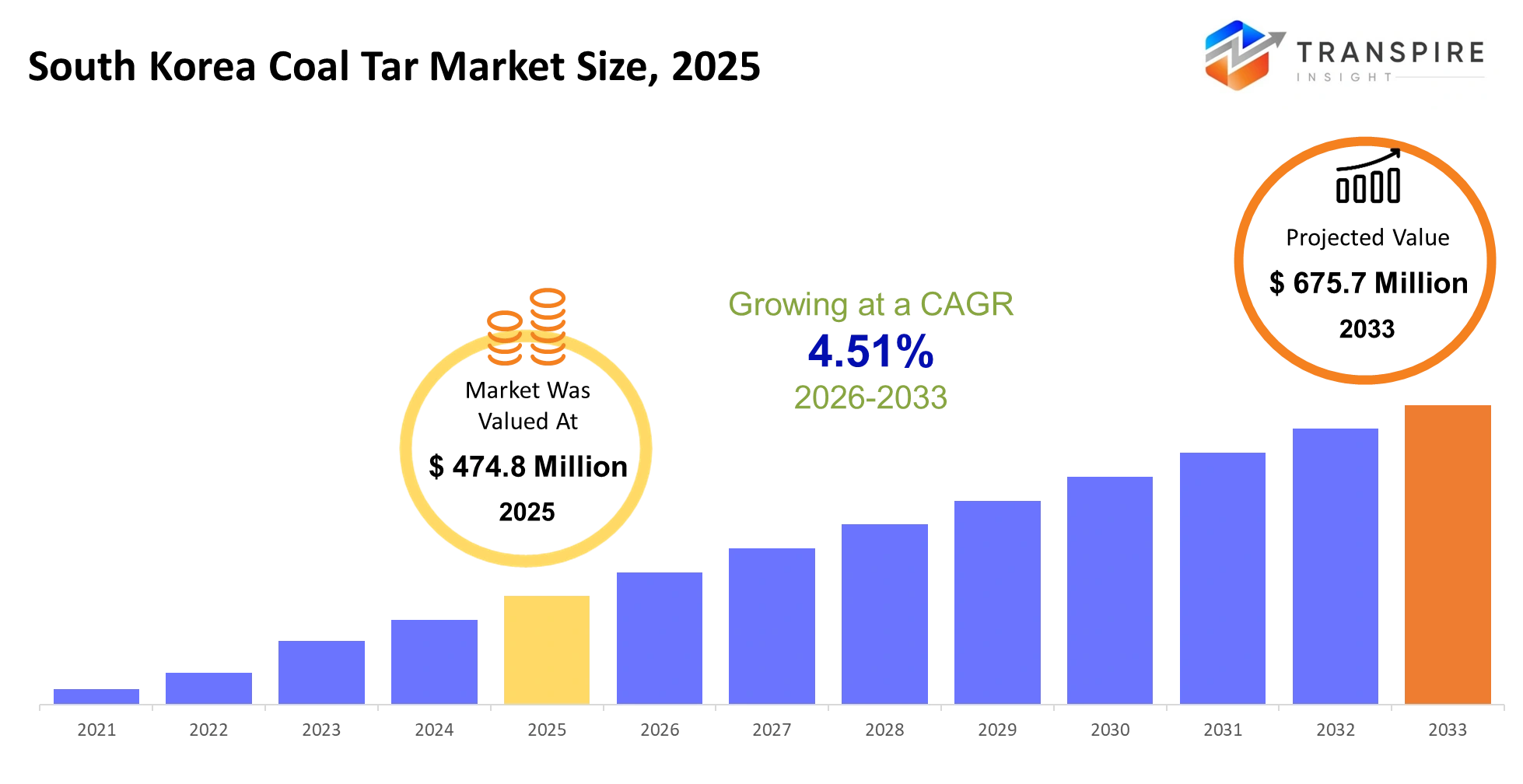
- South Korea Coal Tar Market Size 2025: USD 474.8 Million
- South Korea Coal Tar Market Size 2033: USD 675.7 Million
- South Korea Coal Tar Market CAGR: 4.51%
- South Korea Coal Tar Market Segments: By Type (Light Oil, Middle Oil, Heavy Oil, Pitch), By Application (Aluminum Production, Carbon Black, Roofing, Chemicals), By End-User (Metallurgical Industry, Chemical Industry, Construction).
To learn more about this report,  Download Free Sample Report
South Korea Coal Tar Market Summary:
South Korea Coal Tar Market size was estimated at USD 474.8 Million in 2025 and is anticipated to reach USD 675.7 Million by 2033, growing at a CAGR of 4.51% from 2026 to 2033.
The South Korean coal tar market which operates within the larger chemicals and materials sector will experience ongoing changes because of the nation's strong ties to steelmaking and its associated processing operations. Environmental regulations now require domestic manufacturers to implement cleaner handling systems which include emission control technologies for their coal tar derivative production process. The construction industry and specialty chemicals sector and carbon materials sector will alter their demand patterns because they require consistent quality products that come with verified sourcing information. Local producers will also align their output with export-focused standards especially as regional trade relationships evolve and place emphasis on reliability and compliance.
The use of advanced applications which include electrode materials and high-performance coatings will experience a gradual transformation through distillation and processing technological improvements that apply to coal tar. Companies will respond to air quality and hazardous substance regulations by investing in safer product alternatives and developing improved waste management solutions. Consumer industries will favor materials that meet stricter sustainability expectations which will lead suppliers to improve their products while maintaining supply chain operations. The market position for the upcoming years will emerge from the equilibrium between compliance requirements, performance standards, and industrial market needs.
Key Market Trends & Insights:
- The South Korea Coal Tar Market holds steady because permanent road construction and maintenance work continues to operate throughout all urban areas and rural regions. The application of coal tar-based materials for surface treatments and protective coatings allows infrastructure projects to achieve both long-lasting performance and economical results.
- The South Korea Coal Tar Market shows gradual development of environmental regulations which government authorities have implemented as mandatory standards. The manufacturing sector implements production changes to meet emission control requirements and waste management standards, which results in eco-friendly processing methods that preserve production capacity.
- The South Korea Coal Tar Market benefits from increasing demand for coal tar in both aluminum smelting and graphite electrode production processes. Coal tar pitch serves as a primary binding agent which enables heavy industries that operate at extreme temperatures to conduct their operations.
- The South Korea Coal Tar Market achieves better yield quality and operational efficiency through improved refining and distillation techniques. The new processing methods enable manufacturers to extract their valuable by-products more efficiently which results in better resource management and continuous product availability to various industrial sectors.
- The South Korean coal tar market faces brief interruptions which result from shifts in coal supply and international price movements. The industry uses strategic sourcing and inventory management methods because raw material availability directly affects production planning and cost structures.
South Korea Coal Tar Market Segmentation
By Type :
- Light Oil: South Korea Coal Tar Market demonstrates continuous need for light oil because its solvent and chemical feedstock applications keep increasing. The industrial sector selects light oil because its separation process works better and its product quality remains constant, which results in steady usage throughout refining and specialty chemical production operations.
- Middle Oil: The South Korea Coal Tar Market demonstrates that middle oil has emerged as an essential component for producing disinfectants and washing agents. The chemical composition of middle oil provides industrial users with an acceptable material that meets their production requirements. The demand for the product will sustain itself because coke ovens will provide uninterrupted output while manufacturers will maintain their requirement for intermediate materials.
- Heavy Oil: Heavy oil functions as an essential component in the South Korea Coal Tar Market because it serves two main purposes: fuel blending and protective coatings. The energy-intensive sectors of the industry found heavy oil to be beneficial because of its carbon content and viscosity characteristics.The industrial heating and processing sector will continue to use heavy oil because it provides them with an effective and dependable fuel solution.
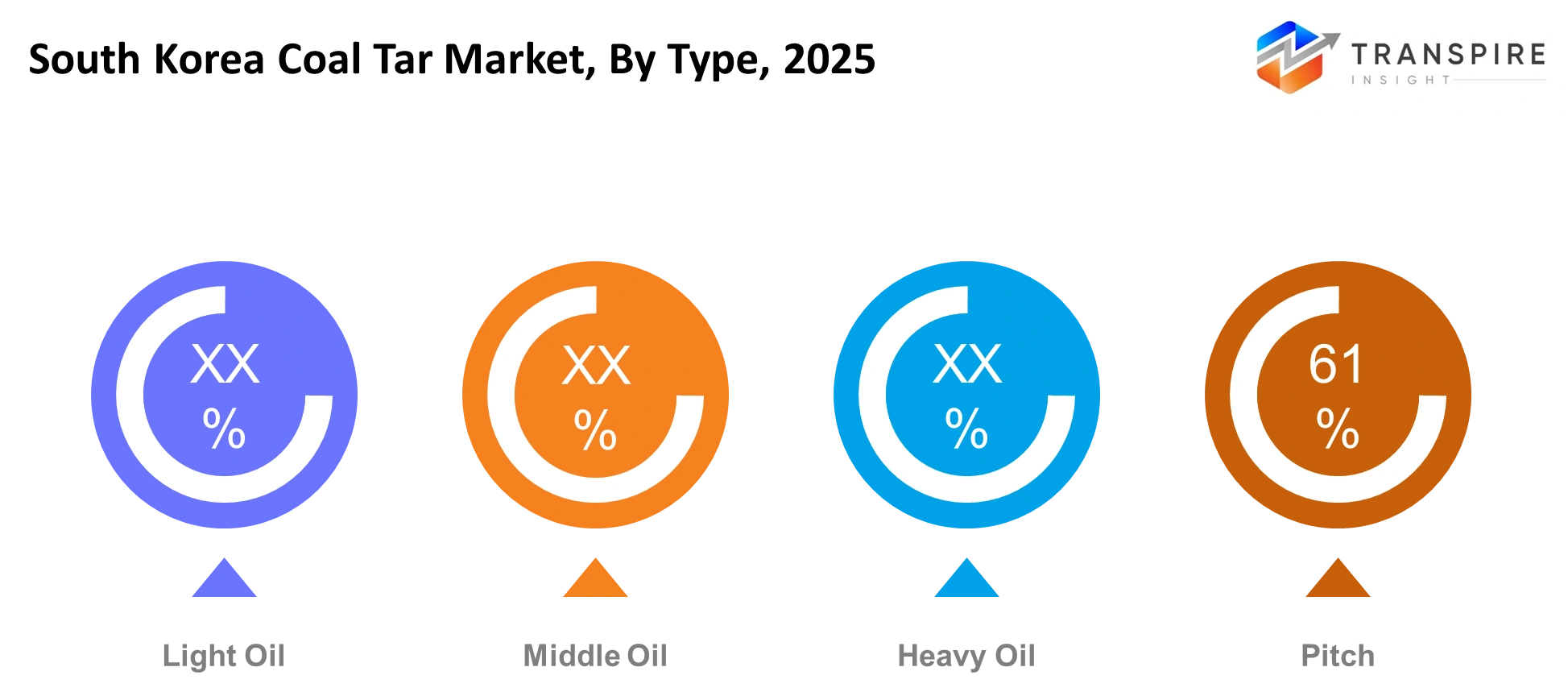
- Pitch: The South Korea Coal Tar Market identifies pitch as an essential substance required for making electrodes and waterproofing products. Pitch serves as a vital component in both aluminum production and construction material manufacturing. The strong relationship between infrastructure development and metallurgy will create a steady demand for industrial applications because these sectors depend on durability and binding capabilities.
To learn more about this report, Download Free Sample Report
By Application :
- Aluminum Production: South Korean coal tar market uses coal tar pitch for aluminum production which creates anodes. The operations of aluminum smelting require high-quality pitch as the essential material to maintain their maximum operational efficiency and produce superior products. The ongoing demand for lightweight materials will drive their continued use throughout automotive manufacturing and packaging production.
- Carbon Black: The South Korean coal tar market provides feedstock for carbon black production through its coal tar distillation process. Carbon black serves as a vital component in both tire production and rubber reinforcement applications. Industrial growth together with steady car production will sustain material demand because durability and strength characteristics dictate material choices.
- Roofing: The South Korean coal tar market supports roofing through the development of waterproofing and sealing materials which use coal tar pitch as their base material. Construction activities require building materials that withstand harsh weather conditions while maintaining their functionality over time. The ongoing use of materials will continue because urban development and repair work need effective moisture protection for building structures.
- Chemicals: The South Korean coal tar market supplies essential chemical production materials which include benzene and toluene as well as naphthalene. The chemical processing industry relies on these chemical derivatives to produce various end products. The pharmaceutical and dye and specialty chemical manufacturing sectors will maintain stable industrial demand which leads to continuous operation of specialized equipment.
By End-User :
- Metallurgical Industry: The South Korea Coal Tar Market supplies the metallurgical industry with coke oven by-products and pitch which smelting operations require. Steel and metal production processes rely on these materials for efficiency and structural quality. Industrial output and infrastructure projects will drive steady consumption within this segment.
- Chemical Industry: The South Korea Coal Tar Market provides essential feedstock to the chemical industry which produces both intermediates and finished goods. The industrial chemical sector will maintain steady demand for coal tar derivatives through its regular operational needs. The manufacturing process will maintain its importance because it produces various products.
- Construction: The South Korea Coal Tar Market provides construction materials which construction projects use for sealing and coating and waterproofing purposes. Coal tar-based products offer durability and resistance against environmental damage. Infrastructure development and maintenance activities will create constant demand because construction materials which last require priority.
Country Insights
- The South Korea Coal Tar Market maintains its industrial presence through its association with steel and aluminum production activities. The market demands fuel for carbon black production and construction materials. The country produces limited domestic supplies which require importation to meet demand. The environmental rules establish standards for coal tar processing which require businesses to adopt environmentally friendly methods that enhance operational efficiency.
- The South Korea Coal Tar Market connects directly to various chemical processing operations which produce pitch and naphthalene products. The construction of infrastructure together with urban development projects creates ongoing demand for products that contain coal tar. The market environment depends on changing crude oil prices because they both affect coal tar alternatives and determine which products manufacturers will buy.
- The South Korea Coal Tar Market shows ongoing technological upgrades in its refining and processing operations. The local companies attempt to improve their production methods while reducing environmental damage to meet government regulations. The trade agreements with neighboring nations create a stable supply chain which enables industries to continue their operations while various sectors utilize their resources at consistent rates.
Recent Development News
April 2026 – Low-emission coke oven project (coal tar supply modernization)
South Korea is investing in cleaner coke production through a new project involving POSCO and thyssenkrupp Uhde. The project develops low-emission coke ovens because they determine both the quality of coal tar production and the achievement of environmental standards which result from the coke production process. The modernization process shows that businesses now prefer to create valuable and environmentally friendly coal tar products instead of increasing their production capacity.
March 2026 – Government lifts coal power limits amid energy crisis
South Korea announced plans to lift caps on coal-fired power generation temporarily due to geopolitical tensions. The decision will raise immediate coal usage which will result in greater coal tar output from coke and coal processing facilities.
|
Report Metrics |
Details |
|
Market size value in 2025 |
USD 474.8 Million |
|
Market size value in 2026 |
USD 496.2 Million |
|
Revenue forecast in 2033 |
USD 675.7 Million |
|
Growth rate |
CAGR of 4.51% from 2026 to 2033 |
|
Base year |
2025 |
|
Historical data |
2021 - 2024 |
|
Forecast period |
2026 - 2033 |
|
Report coverage |
Revenue forecast, competitive landscape, growth factors, and trends |
|
Country scope |
South Korea |
|
Key company profiled |
Koppers Inc., Rain Carbon Inc., Himadri Speciality Chemical Ltd., China Baowu Steel Group Corporation, Nippon Steel Corporation, POSCO Holdings Inc., ArcelorMittal S.A., Tata Steel Ltd., JFE Holdings Inc., Shanxi Coal and Chemical Industry Group, Dalian Special Steel Co. Ltd., SGL Carbon SE, Mitsubishi Chemical Group Corporation, Indian Oil Corporation Ltd., Gerdau S.A. |
|
Customization scope |
Free report customization (country, regional & segment scope). Avail customized purchase options to meet your exact research needs. |
|
Report Segmentation |
By Type (Light Oil, Middle Oil, Heavy Oil, Pitch), By Application (Aluminum Production, Carbon Black, Roofing, Chemicals), By End-User (Metallurgical Industry, Chemical Industry, Construction). |
Key South Korea Coal Tar Company Insights
- The South Korea Coal Tar market shows a steady industrial base supported by strong demand from steel, aluminum, and construction sectors. Major companies maintain integrated production systems linked with coke oven operations, which provide them with uninterrupted access to their essential materials. The system operates to achieve domestic and export requirements through process efficiency and cost management and output quality control.
- Leading participants in the South Korea Coal Tar market emphasize product refinement and value-added derivatives such as pitch and specialty chemicals. National authorities establish environmental standards which drive companies to invest in cleaner processing methods. The company builds distribution networks through strategic partnerships with downstream industries while its technological upgrades enable sustained growth and competitive advantage.
South Korea Coal Tar Market Companies:
- Koppers Inc.
- Rain Carbon Inc.
- Himadri Speciality Chemical Ltd.
- China Baowu Steel Group Corporation
- Nippon Steel Corporation
- POSCO Holdings Inc.
- ArcelorMittal S.A.
- Tata Steel Ltd.
- JFE Holdings Inc.
- Shanxi Coal and Chemical Industry Group
- Dalian Special Steel Co. Ltd.
- SGL Carbon SE
- Mitsubishi Chemical Group Corporation
- Indian Oil Corporation Ltd.
- Gerdau S.A.
South Korea Coal Tar Market Segmentation
By Type
- Light Oil
- Middle Oil
- Heavy Oil
- Pitch
By Application
- Aluminum Production
- Carbon Black
- Roofing
- Chemicals
By End-User
- Metallurgical Industry
- Chemical Industry
- Construction
Frequently Asked Questions
Find quick answers to common questions.
The approximate South Korea Coal Tar Market size for the market will be USD 675.7 Million in 2033.
Key segments for the South Korea Coal Tar Market are By Type (Light Oil, Middle Oil, Heavy Oil, Pitch), By Application (Aluminum Production, Carbon Black, Roofing, Chemicals), By End-User (Metallurgical Industry, Chemical Industry, Construction).
Major South Korea Coal Tar Market players are Koppers Inc., Rain Carbon Inc., Himadri Speciality Chemical Ltd., China Baowu Steel Group Corporation, Nippon Steel Corporation, POSCO Holdings Inc., ArcelorMittal S.A., Tata Steel Ltd., JFE Holdings Inc., Shanxi Coal and Chemical Industry Group, Dalian Special Steel Co. Ltd., SGL Carbon SE, Mitsubishi Chemical Group Corporation, Indian Oil Corporation Ltd., Gerdau S.A.
The South Korea Coal Tar Market size is USD 474.8 Million in 2025.
The South Korea Coal Tar Market CAGR is 4.51%.
- Koppers Inc.
- Rain Carbon Inc.
- Himadri Speciality Chemical Ltd.
- China Baowu Steel Group Corporation
- Nippon Steel Corporation
- POSCO Holdings Inc.
- ArcelorMittal S.A.
- Tata Steel Ltd.
- JFE Holdings Inc.
- Shanxi Coal and Chemical Industry Group
- Dalian Special Steel Co. Ltd.
- SGL Carbon SE
- Mitsubishi Chemical Group Corporation
- Indian Oil Corporation Ltd.
- Gerdau S.A.
Recently Published Reports
-
May 2026
Healthcare Polymer Packaging Market
Healthcare Polymer Packaging Market Size, Share & Analysis Report By Packaging Type (Syringes, IV Bottles and Pouches, Clamshells, Blisters, Bottles & Jars, Containers, Tubes, IV Parental Packaging, Others), By Type (Regulated, Non-regulated), By Polymer Type (LDPE (Low-Density Polyethylene), HDPE (High-Density Polyethylene), Homo-polymer (Homo), Random Copolymer (Random), Block Copolymer (Block), PET, Polystyrene, Polyvinyl Chloride, Polyamide/EVOH, Others), and Geography (North America, Europe, Asia-Pacific, Middle East and Africa, South and Central America), 2021 - 2031
-
Apr 2026
Hydrophilic Tape (Waterstop) Market
Hydrophilic Tape (Waterstop) Market Size, Share & Analysis Report By Type (Bentonite-Based Hydrophilic Tape, Rubber-Based Hydrophilic Tape), By Application (Residential Buildings, Commercial Buildings, Infrastructure Projects), and Geography (North America, Europe, Asia-Pacific, Middle East and Africa, South and Central America), 2021 - 2031
-
Apr 2026
Metalens Market
Metalens Market Size, Share & Analysis Report By Type (Visible Light Metalens, and Infrared Metalens), By Application (Consumer Electronics, Automotive Electronics, Industrial, Medical, and Others), and Geography (North America, Europe, Asia-Pacific, Middle East and Africa, South and Central America), 2021 - 2031
-
Apr 2026
PBT Resin Market
PBT Resin Market Size, Share & Analysis Report By Type (Reinforced PBT Resin, Unreinforced PBT Resin), By Processing Method (Injection Molding, Extrusion, Blow Molding, Others), By End-User (Automotive, Electrical & Electronics, Consumer Appliances, Industrial Machinery, Medical Devices, Packaging, Others), and Geography (North America, Europe, Asia-Pacific, Middle East and Africa, South and Central America), 2021 - 2031