
Asia Pacific Metallurgical Coke Market Size & Forecast:
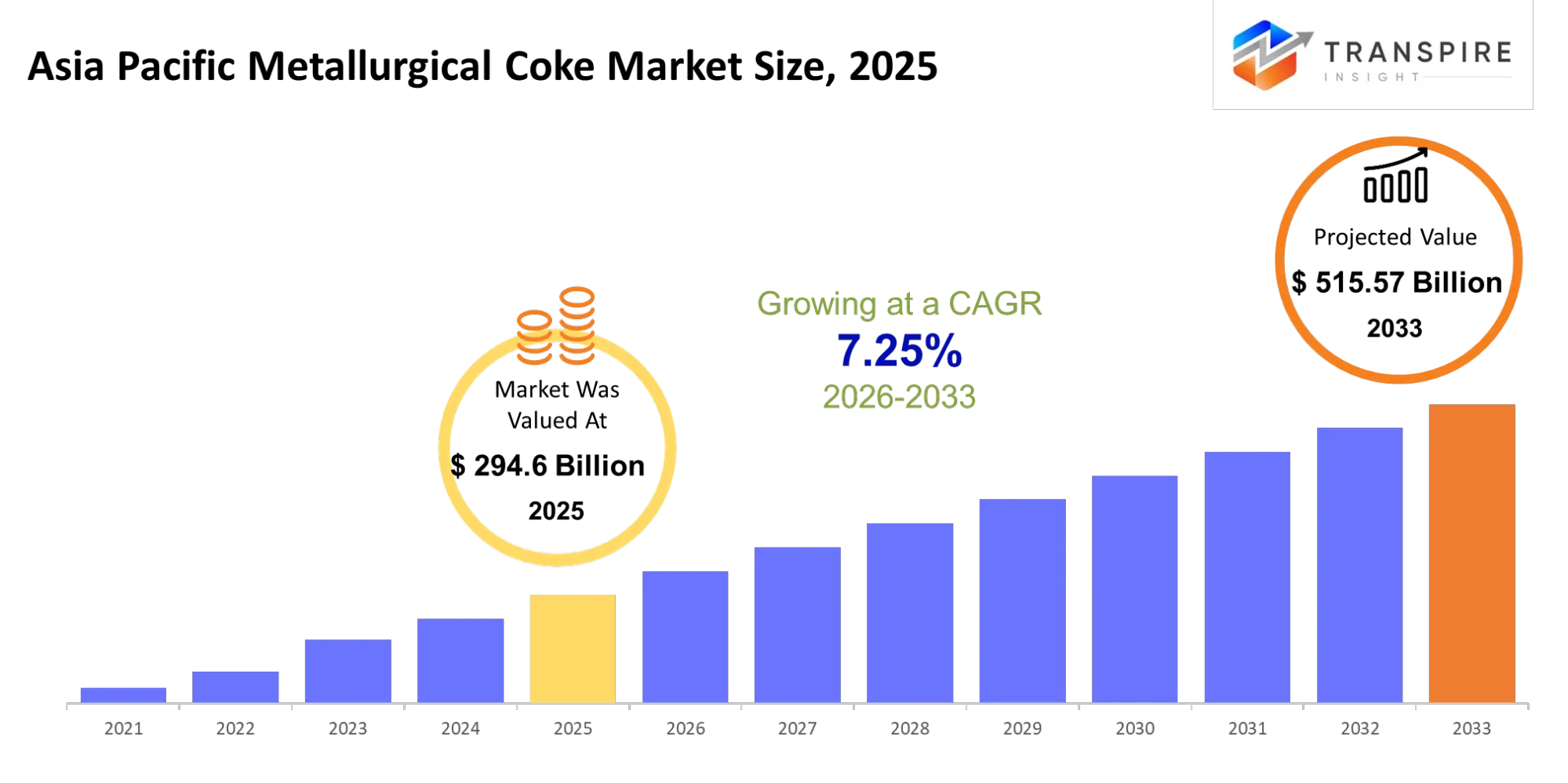
- Asia Pacific Metallurgical Coke Market Size 2025: USD 294.6 Billion
- Asia Pacific Metallurgical Coke Market Size 2033: USD 515.57 Billion
- Asia Pacific Metallurgical Coke Market CAGR: 7.25%
- Asia Pacific Metallurgical Coke Market Segments: By Type (Blast Furnace Coke, Foundry Coke, Nut Coke, Coke Breeze, Metallurgical Coal Coke, Others); By Application (Iron & Steel Production, Foundries, Ferroalloys, Non-Ferrous Metals, Chemicals, Others); By Production Technology (Stamp Charging, Top Charging, Heat Recovery, Others); By End User (Steel Industry, Foundries, Chemical Industry, Others)
To learn more about this report,  Download Free Sample Report
Asia Pacific Metallurgical Coke Market Summary
The Asia Pacific Metallurgical Coke Market was valued at USD 294.6 billion in 2025. It is forecast to reach USD 515.57 billion by 2033. That is a CAGR of 7.25% over the period.
The Asia Pacific Metallurgical Coke Market is very important for making steel. It helps turn iron ore into iron. Metallurgical coke makes it possible to produce steel at temperatures. This steel is used in construction, infrastructure, cars, machinery and industrial equipment.Steel producers need quality coke to keep their furnaces working well. They also need it to control costs and make sure they produce an amount of steel.
In the last few years the market has changed a lot. Coke producers are now making coke efficiently and in a cleaner way. This is because governments have rules about emissions. A big problem was that global coal and steel supplies were disrupted. This made it hard for producers to get the materials they needed.Now producers are investing in technologies. They are also trying to secure their supply chains. As more infrastructure and industrial projects are built in Asia Pacific steel production has stayed strong. This has helped coke producers make money. They are now investing in making production more efficient and secure.Metallurgical Coke Market is. Asia Pacific Metallurgical Coke is in high demand.
Key Market Insights
China is the leader of the Asia Pacific Metallurgical Coke Market. It has a big share of over 60 percent in 2025. This is because China has a large steel production capacity.
India is doing well in the Asia Pacific Metallurgical Coke Market and it will keep growing fast until 2030. The reason for this is that India is making more steel and the country is investing a lot of money in infrastructure projects.
The Asia Pacific Metallurgical Coke Market still prefers blast furnace coke to make most of the steel. Blast furnace coke has a big market share of more than 70 percent. The Asia Pacific Metallurgical Coke Market uses blast furnace coke to make lots of steel.
Foundry coke comes in second with demand from places that make castings and industrial stuff.
Quality low-ash metallurgical coke is growing the fastest till 2030 as steel makers want to make their furnaces more efficient and reduce emissions.
Steel making uses 85% of all metallurgical coke making it the biggest user in the region.
Since 2022 more and more steel makers have started using coke to make their operations better and cleaner.
Big steel producers are still the users but specialty steel makers are growing fast.
Companies, like China Baowu Steel Group, POSCO, Nippon Steel and JSW Steel are working on making their operations more efficient and secure materials for the long term.
Companies are getting ahead by using technologies to improve their supply chains. They are also investing in ways to reduce emissions. This helps them stay ahead in the market. Companies are. Making their supply chains better. They are using technologies for this. Reducing emissions is also a part of their plans.
What are the Key Drivers, Restraints, and Opportunities in the Asia Pacific Metallurgical Coke Market?
Driver
The Asia Pacific Metallurgical Coke Market is doing well. This is because a lot of steel is being made in blast furnaces, in countries. Many countries are spending money on roads, energy systems, factories and buildings. This means people need a lot of steel. So steel companies are using their blast furnaces all the time. The Asia Pacific Metallurgical Coke Market is growing because of this. When more steel is made, the people who make metallurgical coke get orders and can use their factories more. The Asia Pacific Metallurgical Coke Market is benefiting from all this. Stricter environmental rules and higher energy costs triggered this shift. High-quality coke costs more which helps producers with processing capabilities to earn more.
Restraint
The market is really struggling with finding quality coking coal. To make coke you need special coal that is hard to find and if you use a different kind it can affect how well the furnace works. Starting a mining project is tough because it costs a lot of money and you need to get permission from the government and it takes a long time. This makes the cost of materials go up which means the companies that make coke do not make as much money.
Another big problem is that the government has rules about how much pollution coke ovens and steel plants can make. To follow these rules companies have to spend money on systems that control pollution, technologies that use leftover heat and equipment that checks how pollution they are making. Smaller companies often do not have money to pay for these things so they might have to reduce production or even close their plants. This means that the supply of coke does not grow as much as it could. It also means that companies do not have many chances to expand their businesses in different parts of the world. Coking coal and metallurgical coke are really important for the market. These problems are making it hard for the market to grow. The cost of coking coal and the rules about pollution are affecting the industry, including coke manufacturers and steel plants.
Opportunity
A major opportunity is emerging through investments in coke oven technologies that improve energy efficiency and reduce environmental impact. Modern recovery coke ovens can capture by-products like coke oven gas, tar and chemicals. This creates revenue streams beyond coke sales. Several integrated steel producers are expanding these facilities to improve profitability and resource utilization. This trend supports higher-value production while strengthening sustainability.
Another promising opportunity is India's growing steel sector. The government has infrastructure programs and manufacturing initiatives that are increasing long-term steel production capacity. As new blast furnaces become operational demand, for coke will rise alongside coking coal procurement activities. Producers that secure raw material supply and establish partnerships will benefit from this growth phase through 2033.
What Has the Impact of Artificial Intelligence Been on the Asia Pacific Metallurgical Coke Market?
Metallurgical coke production is changing because of intelligence and advanced digital technologies. These new technologies are helping with process control. Making sure the equipment works well. They are also helping with compliance. Coke producers are using intelligence to monitor what is happening in the coke ovens and other parts of the facility.They have systems that track the temperature and pressure levels all the time. This helps the operators make sure the coke is quality and that they do not waste energy. They are also using twins to see how the ovens will work and to plan when to produce coke. This helps the plants make coke and reduces the costs of running the plant.
Artificial intelligence is also helping with maintenance. It looks at the data from the equipment. Can tell when something might go wrong. This means the operators can fix the problem before it happens. Many plants have seen a reduction in downtime because of this. They are also using intelligence to predict when they might have environmental problems.Artificial intelligence is helping with the mixing of materials too. It helps figure out the combination of coal to use for making coke. This makes the coke stronger. Helps the furnaces work better. It also helps keep the costs down.. There is a problem with using artificial intelligence in old facilities. It is very expensive to get the new systems working with the equipment. Many old facilities have data systems that are not connected so it is hard to make big changes.
Key Market Trends
- Steelmakers have started using types of coke since 2021 to make their blast furnaces work more efficiently and use less energy.
- New environmental rules that started in 2022 have made steelmakers invest more in technologies that help reduce pollution from coke production.
- Big steel producers are now signing long-term contracts for coking coal to avoid problems with price changes.
- Since 2023 more steelmakers are using systems to monitor and optimize their coke oven operations and maintenance.
- Supply chain problems have made manufacturers look for coal from suppliers instead of relying on just a few.
- Major production sites have added projects to recover waste heat making energy use more efficient and profitable.
- Coke producers are updating coke batteries with automation technologies to make production more consistent and reduce losses.
- Green steel efforts have brought coke suppliers and steelmakers together to improve how they produce steel and reduce carbon emissions.
- Large steel and mining companies are buying up ones to have more control, over the supply of coking coal and coke.
- Steelmakers are now focusing on making their operations more efficient reducing pollution and producing higher-quality coke of just expanding their capacity.
Asia Pacific Metallurgical Coke Market Segmentation
By Type:
Metallurgical coke is really important for making steel because it is very strong and has a lot of carbon in it. Big steel plants need this type of coke to keep their furnaces running and to make iron consistently. Foundry coke is used to make metal castings. It needs to produce heat all the time so that the products turn out right. Nut coke is used in industrial processes and helps as an extra fuel source in making metals.
Coke breeze is used when making sinter because the small particles help get the raw materials ready efficiently. Metallurgical coal coke is important for industries that need a lot of heat to produce things. The people who make coke are always trying to make it better by mixing coal in ways and controlling how it is made. How much coke is needed depends on what the steel, foundry and metallurgical industries need in parts of the world.
By Application:
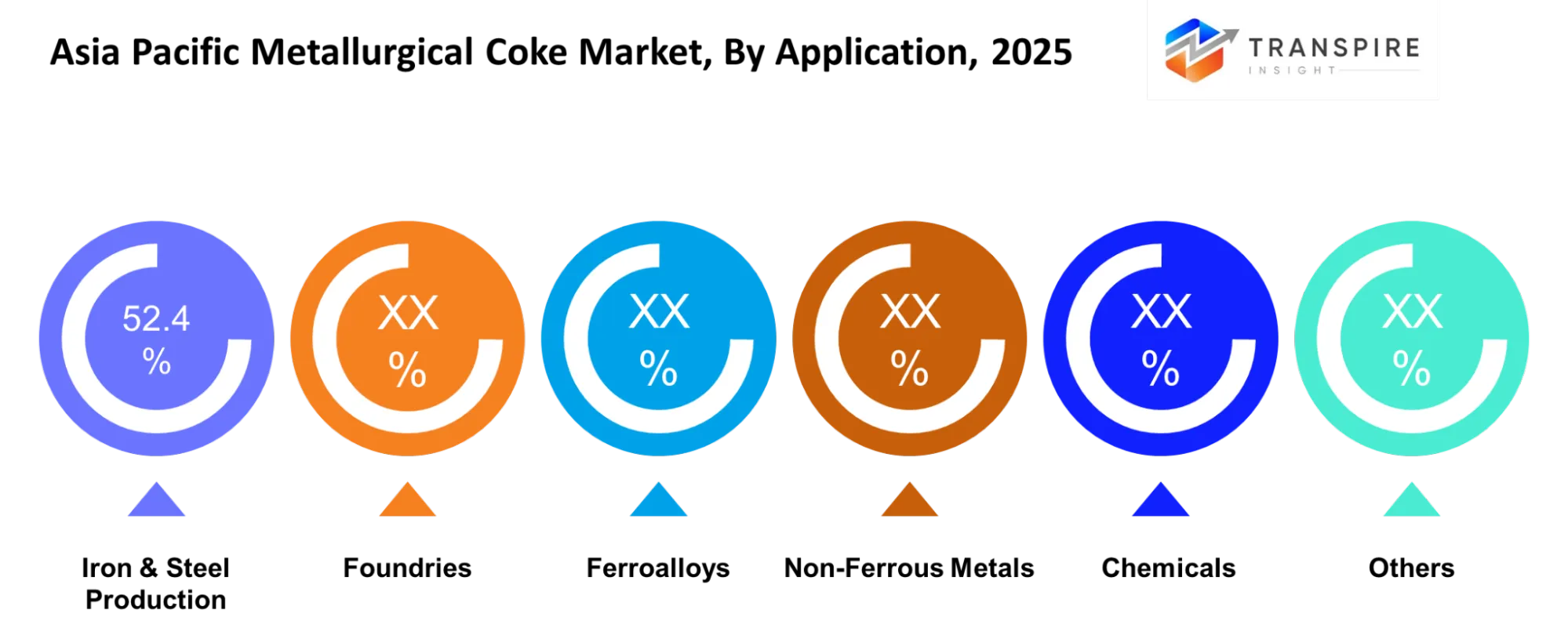
Making iron and steel is the use of metallurgical coke because blast furnaces need a lot of high-quality coke to work. Building roads, expanding industries and making things helps keep the demand for coke steady in steel factories. Foundries use coke as a heat source to cast metals so that the temperature stays the same during production. Making ferroalloys also needs coke to help with reactions and to provide energy.
Companies that make non-ferrous metals use coke when they smelt metals because they need a lot of heat to do it efficiently. Chemical factories also use things that come from coke like gases and chemicals that are made during processing. Industrial users want coke that's always of good quality so that their operations run smoothly and they do not have to stop production. Because metallurgical coke is used in many different industries the demand for it stays steady.
To learn more about this report, Download Free Sample Report
By Production Technology:
There is a way of making coke called stamp charging, which makes the coal denser before it is turned into coke and this makes the coke stronger and better for blast furnaces. Manufacturers use this method to make coke and to use coal more efficiently. Another way, called charging, is still widely used because it is familiar and works well with existing factories. Many factories are updating their equipment to make their processes more efficient and to make coke that is more consistent.
Some companies are also looking at ways to capture and reuse the heat that is made during production, which helps reduce costs and better for the environment. Factories are always trying to improve their production and reduce emissions. New technologies are very important for companies that make coke especially in the Asia Pacific Metallurgical Coke Market.
By End User:
The steel industry uses the metallurgical coke because making steel in blast furnaces needs a lot of coke. As construction, car manufacturing and industrial equipment production grow steel makers need more coke. Foundries also need a lot of coke to make metal castings and parts. Having a supply of coke is essential for these industries to keep producing things on schedule.
The chemical industry also uses things that come from coke like by-products that're used in various industrial processes. Other industries use coke for heat and to help with chemical reactions in special operations. The people who use coke are becoming more and more concerned about getting a supply of high-quality coke so that their operations are not disrupted. Long-term agreements between coke makers and users help build relationships and ensure that everyone gets what they need.
What are the Key Use Cases Driving the Asia Pacific Metallurgical Coke Market?
Metallurgical coke is mainly used for making iron and steel in blast furnaces. The coke helps to remove oxygen from the iron ore. It also gives support to the heavy load, inside the furnace. This makes it possible to turn iron ore into iron easily. A lot of metallurgical coke is needed for this because we need steel for building things making cars and machines and for industries.
Some other companies are also starting to use coke. For example foundries use it to keep the temperature steady when they are casting metal. Companies that make ferroalloys use it to make their products at high temperatures. As more machines and industrial equipment are made these companies will need metallurgical coke.
Now some new ways of using coke are being developed. Some companies are building plants that can reuse the heat from the coke ovens. They are also finding uses for the by-products of coke production. This can help the companies make money. Some companies are also trying to reduce the amount of carbon they release into the air. They are investing in technologies that can make steel in a cleaner way. This might create uses for special types of metallurgical coke that are more efficient.
|
Report Metrics |
Details |
|
Market size value in 2025 |
USD 294.6 Billion |
|
Market size value in 2026 |
USD 315.97 Billion |
|
Revenue forecast in 2033 |
USD 515.57 Billion |
|
Growth rate |
CAGR of 7.25% from 2026 to 2033 |
|
Base year |
2025 |
|
Historical data |
2021 - 2024 |
|
Forecast period |
2026 - 2033 |
|
Report coverage |
Revenue forecast, competitive landscape, growth factors, and trends |
|
Regional scope |
Asia Pacific (India, China, Japan, Australia, South Korea, Rest of Asia Pacific) |
|
Key company profiled |
China Baowu, Nippon Steel, POSCO, JSW Steel, Tata Steel, ArcelorMittal, JFE Steel, BlueScope, Mechel, SunCoke Energy, ABC Coke, Bharat Coking Coal, China Coal, Shanxi Coking, Yanzhou Coal |
|
Customization scope |
Free report customization (country, regional & segment scope). Avail customized purchase options to meet your exact research needs. |
|
Report Segmentation |
By Type (Blast Furnace Coke, Foundry Coke, Nut Coke, Coke Breeze, Metallurgical Coal Coke, Others); By Application (Iron & Steel Production, Foundries, Ferroalloys, Non-Ferrous Metals, Chemicals, Others); By Production Technology (Stamp Charging, Top Charging, Heat Recovery, Others); By End User (Steel Industry, Foundries, Chemical Industry, Others) |
Which Regions are Driving the Asia Pacific Metallurgical Coke Market Growth?
China is the region in the Asia Pacific Metallurgical Coke Market. This is because China has a lot of steel production and a strong industrial system. The big blast furnaces and good coking coal supply networks help keep the coke consumption going. Also the strong demand for steel in China helps. Even though there are rules to protect the environment they have not stopped the activity. Instead they have made the coke ovens better and cleaner. The big steel companies, mining companies and logistics are all. This helps China stay the leader in the market.
Japan is the biggest region in the market.. Japan is different from China. Japan has production technologies and the demand for steel is always there. The companies in Japan invest their money carefully. This helps keep the market stable. They do not just build factories, they make the ones they have work better. They make quality steel and have long term agreements with their buyers. This helps them make money and stay strong even when the global markets are not doing well.
India is the region that is growing the fastest. This is because the steel production is increasing and the infrastructure is getting better. New blast furnaces, industrial areas, transportation networks and factories are being built. This has increased the demand for coke. The government is supporting the industry and private companies are investing more. This is good for the market. Creates opportunities for new companies and investors. They can invest in coke production, coking coal, logistics and technology between 2026 and 2033. The Asia Pacific Metallurgical Coke Market is going to keep growing. India is a big part of it. The metallurgical coke market in India is going to be very important.
Who are the Key Players in the Asia Pacific Metallurgical Coke Market and How Do They Compete?
The Asia Pacific Metallurgical Coke Market is much controlled by big steel producers and major coal suppliers. They have a say in the market because they make a lot of the production. The competition is not about who can sell it for the cheapest price. It is about who can get the raw materials, make the best quality coke, produce it efficiently and follow the environmental rules. The big companies in the market are trying to keep their share by making their own coke, signing long term contracts for coal and using the latest technology.It is very hard for new companies to join the market because they need to get quality coal, spend a lot of money and follow the strict rules about emissions. China Baowu Steel Group is doing well because it controls the process from making steel to getting the raw materials. This means they do not have to worry about the price of coal going up and down. They can always get the coke they need for their blast furnaces. Nippon Steel is different because it uses the technology to make coke. This helps them use energy and make less pollution.
They keep spending money to make their process better and to make quality steel. This helps them make more money than the companies that just make regular steel. POSCO is focusing on making their operations more efficient and better for the environment. They use systems to make the best quality coke while using less energy. JSW Steel is growing by making coke and taking advantage of the growing steel market in India. They are making their coke and steel which gives them an advantage. Tata Steel is using the materials they have and upgrading their technology to make sure they can supply what they need and control their costs.
Both JSW Steel and Tata Steel are spending money to modernize their coke ovens, reduce emissions and make coke. This will help them when the demand for steel in India goes up. They will be able to take advantage of the growth in the country and be stronger when there are problems with getting materials. The Asia Pacific Metallurgical Coke Market is about the metallurgical coke and the companies that make it. These companies are trying to do their best to make metallurgical coke and sell it. Metallurgical coke is very important, for the steel producers and the companies that supply the coal.
Company List
- China Baowu Steel Group
- Nippon Steel
- POSCO
- JSW Steel
- Tata Steel
- ArcelorMittal
- JFE Steel
- BlueScope Steel
- Mechel
- SunCoke Energy
- ABC Coke
- Bharat Coking Coal Limited
- China Coal Energy
- Shanxi Coking Coal Group
- Yanzhou Coal Mining Company
Recent Development News
- In April 2026, Tata Steel entered a partnership with SMS Group to deploy the world’s first EASyMelt decarbonisation technology at its Jamshedpur blast furnace. The project is expected to reduce CO₂ emissions by more than 50% and accelerate low-carbon ironmaking, influencing future metallurgical coke consumption patterns.https://www.tatasteel.com
- In March 2026, SMS Group signed a contract with SAIL IISCO for the supply of two advanced coke dry quenching units for new stamp-charge coke oven batteries. The investment will improve coke quality, production reliability, energy recovery, and environmental performance while supporting steel production expansion.https://www.sms-group.com
- In May 2025, JSW KOKS, part of the JSW Group, commissioned and launched Coke Oven Battery No. 4 at the Przyjaźń Coking Plant. The new facility adds approximately 610,000 tonnes of annual coke production capacity while improving efficiency and reducing environmental impact through advanced coke-making technologies.https://www.jsw.pl
What Strategic Insights Define the Future of the Asia Pacific Metallurgical Coke Market?
The Asia Pacific Metallurgical Coke Market is going to be more efficient and better for the environment in the next 5 to 7 years. The main reason for this change is that the steel industry needs to make steel without making too much pollution and keep costs down. So instead of just making more coke, companies will focus on making better quality coke using new technologies for coke ovens and managing resources in a better way to make furnaces work better and reduce carbon emissions.
There is another problem that's not so obvious. New ways of making iron and steel are getting more popular. Now projects that use direct reduced iron and hydrogen to make steel are not very common but if people keep investing in them they might reduce the need for traditional blast furnaces in some markets. The Asia Pacific Metallurgical Coke Market also has to worry about getting high-quality coking coal because if there are problems with trade or politics it could be hard to get the coal they need.
The Asia Pacific Metallurgical Coke Market has a chance to grow by using technologies that turn coke oven gas and chemicals into more money. Companies in the Asia Pacific Metallurgical Coke Market should make sure they have a supply of coking coal and invest in new technologies that reduce emissions. This will help them compete better, make money and be ready for changes in regulations and technology, in the future. The Asia Pacific Metallurgical Coke Market will be stronger if companies do this.
Asia Pacific Metallurgical Coke Market Report Segmentation
By Type
- Blast Furnace Coke
- Foundry Coke
- Nut Coke
- Coke Breeze
- Metallurgical Coal Coke
- Others
By Application
- Iron & Steel Production
- Foundries
- Ferroalloys
- Non-Ferrous Metals
- Chemicals
- Others
By Production Technology
- Stamp Charging
- Top Charging
- Heat Recovery
- Others
By End User
- Steel Industry
- Foundries
- Chemical Industry
- Others
Frequently Asked Questions
Find quick answers to common questions.
The expected Asia Pacific Metallurgical Coke Market size for the market will be USD 515.57 Billion in 2033.
Key segments for the Asia Pacific Metallurgical Coke Market are By Type (Blast Furnace Coke, Foundry Coke, Nut Coke, Coke Breeze, Metallurgical Coal Coke, Others); By Application (Iron & Steel Production, Foundries, Ferroalloys, Non-Ferrous Metals, Chemicals, Others); By Production Technology (Stamp Charging, Top Charging, Heat Recovery, Others); By End User (Steel Industry, Foundries, Chemical Industry, Others).
Major Asia Pacific Metallurgical Coke Market players are China Baowu, Nippon Steel, POSCO, JSW Steel, Tata Steel, ArcelorMittal, JFE Steel, BlueScope, Mechel, SunCoke Energy, ABC Coke, Bharat Coking Coal, China Coal, Shanxi Coking, Yanzhou Coal.
The Asia Pacific Metallurgical Coke Market size is USD 294.6 Billion in 2025.
The Asia Pacific Metallurgical Coke Market CAGR is 7.25% from 2026 to 2033.
- China Baowu Steel Group
- Nippon Steel
- POSCO
- JSW Steel
- Tata Steel
- ArcelorMittal
- JFE Steel
- BlueScope Steel
- Mechel
- SunCoke Energy
- ABC Coke
- Bharat Coking Coal Limited
- China Coal Energy
- Shanxi Coking Coal Group
- Yanzhou Coal Mining Company
About the Authors

Pankaj Ghogare Patil
I am Pankaj Ghogare Patil, a Senior Research Analyst at Transpire Insight, specializing in the Pharmaceutical, Chemicals & Materials, Healthcare IT, and Biotechnology industry. My expertise lies in conducting comprehensive market research, analyzing industry trends, evaluating competitive landscapes, and translating complex data into actionable insights. At Transpire Insight, I closely follow emerging technologies, regulatory developments, and market innovations to create accurate, well-researched, and informative content that helps businesses and professionals make informed decisions. I am committed to producing credible, evidence-based articles that reflect industry best practices while making technical topics accessible and valuable for a broad audience.

Chakradhar Khansole
Chakradhar serves as the Research Director at Transpire Insight, bringing over 8 years of experience in technology, innovation, and strategic market intelligence. He specializes in transforming complex market data into actionable business insights that enable organizations to make informed, growth-oriented decisions. Recognized for his strategic vision and analytical expertise, Chakradhar leads high-impact research initiatives, delivering comprehensive market assessments, competitive intelligence, and forward-looking industry analysis.
Recently Published Reports
-
May 2026
Healthcare Polymer Packaging Market
Healthcare Polymer Packaging Market Size, Share & Analysis Report By Packaging Type (Syringes, IV Bottles and Pouches, Clamshells, Blisters, Bottles & Jars, Containers, Tubes, IV Parental Packaging, Others), By Type (Regulated, Non-regulated), By Polymer Type (LDPE (Low-Density Polyethylene), HDPE (High-Density Polyethylene), Homo-polymer (Homo), Random Copolymer (Random), Block Copolymer (Block), PET, Polystyrene, Polyvinyl Chloride, Polyamide/EVOH, Others), and Geography (North America, Europe, Asia-Pacific, Middle East and Africa, South and Central America), 2021 - 2031
-
Apr 2026
Hydrophilic Tape (Waterstop) Market
Hydrophilic Tape (Waterstop) Market Size, Share & Analysis Report By Type (Bentonite-Based Hydrophilic Tape, Rubber-Based Hydrophilic Tape), By Application (Residential Buildings, Commercial Buildings, Infrastructure Projects), and Geography (North America, Europe, Asia-Pacific, Middle East and Africa, South and Central America), 2021 - 2031
-
Apr 2026
Metalens Market
Metalens Market Size, Share & Analysis Report By Type (Visible Light Metalens, and Infrared Metalens), By Application (Consumer Electronics, Automotive Electronics, Industrial, Medical, and Others), and Geography (North America, Europe, Asia-Pacific, Middle East and Africa, South and Central America), 2021 - 2031
-
Apr 2026
PBT Resin Market
PBT Resin Market Size, Share & Analysis Report By Type (Reinforced PBT Resin, Unreinforced PBT Resin), By Processing Method (Injection Molding, Extrusion, Blow Molding, Others), By End-User (Automotive, Electrical & Electronics, Consumer Appliances, Industrial Machinery, Medical Devices, Packaging, Others), and Geography (North America, Europe, Asia-Pacific, Middle East and Africa, South and Central America), 2021 - 2031