
Asia Pacific Non-ferrous Scrap Recycling Market Size & Forecast:
- Asia Pacific Non-ferrous Scrap Recycling Market Size 2025: USD 340971.2 Million
- Asia Pacific Non-ferrous Scrap Recycling Market Size 2033: USD 484581.5 Million
- Asia Pacific Non-ferrous Scrap Recycling Market CAGR: 4.50%
- Asia Pacific Non-ferrous Scrap Recycling Market Segments: By Metal Type (Aluminum Scrap, Copper Scrap, Lead Scrap, Zinc Scrap, Nickel Scrap, Others); By Application (Automotive Manufacturing, Construction Industry, Electronics Manufacturing, Packaging Industry, Others); By End User (Metal Recycling Companies, Automotive Industry, Construction Industry, Others)
To learn more about this report,  Download Free Sample Report
Asia Pacific Non-ferrous Scrap Recycling Market Summary
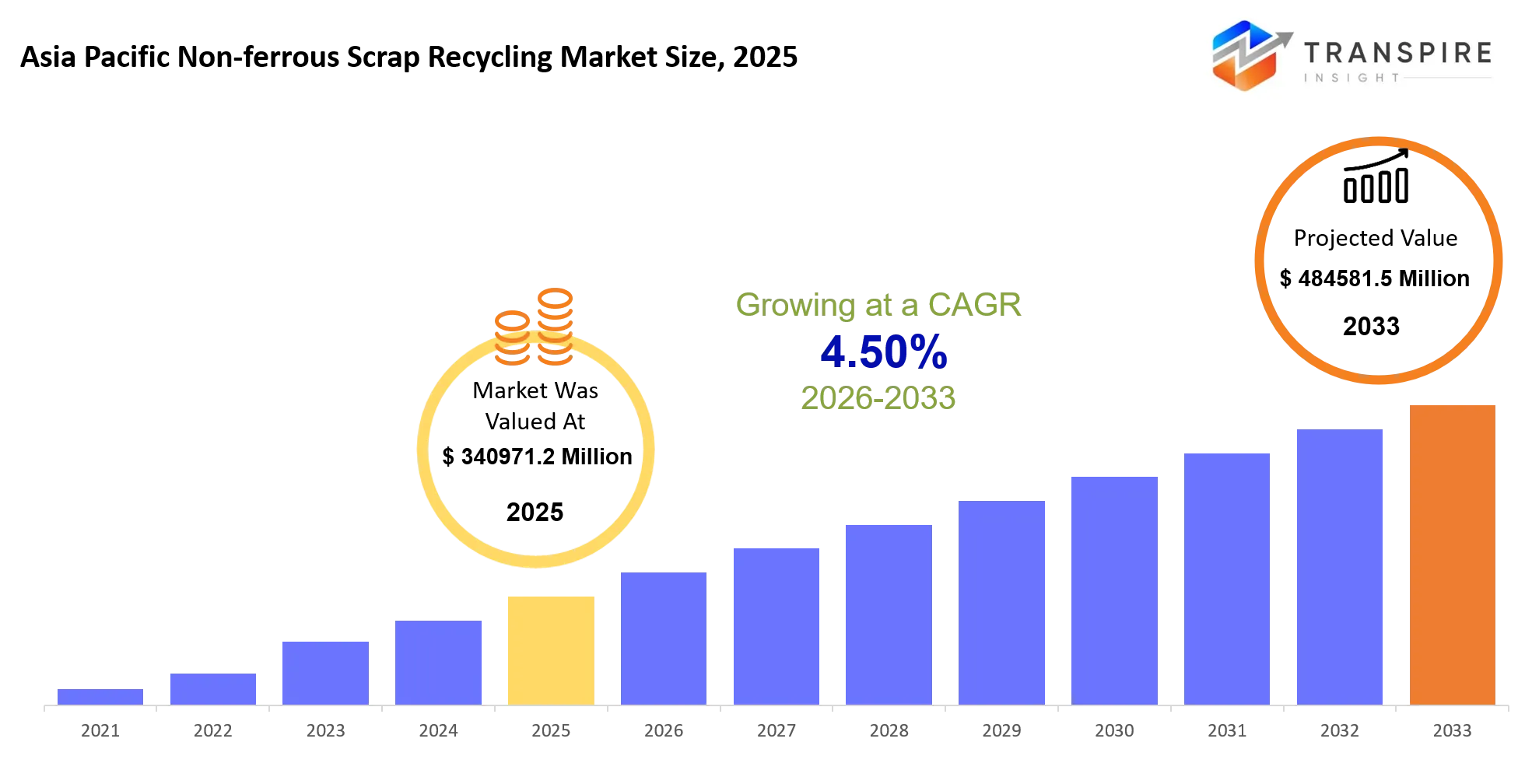
The Asia Pacific Non-ferrous Scrap Recycling Market was valued at USD 340971.2 Million in 2025. It is forecast to reach USD 484581.5 Million by 2033. That is a CAGR of 4.50% over the period.
The Asia Pacific non-ferrous scrap recycling market kinda plays a pretty critical role in pushing secondary metals—like aluminum, copper, lead, zinc, and nickel—back into manufacturing supply chains. When the sector pulls useful metal out of industrial waste, end-of-life vehicles, construction debris, electronics, and everyday consumer products, it lessens the reliance on primary mining. At the same time it helps manufacturers keep raw material costs under control and make sure metal supply stays available. In other words this job has gotten more urgent recently, because regional industries are facing tighter carbon reduction goals and there’s also more pressure to squeeze more efficiency out of materials.
In the past five years, the market saw a more structural shift toward circular metal production, especially inside the aluminum and copper value streams where producers are folding recycled feedstock into normal production routines. China’s more strict environmental controls, and the regional carbon-reduction rules sped up the whole change a bit. At the same time, supply chain disruptions together with shaky commodity prices underscored the hazards of depending only on mined metals. Because of that, producers in the automotive, construction, electrical equipment, and consumer goods side have been kind of steadily increasing their use of recycled metals in the way they manufacture stuff. Recycled materials help in reducing the costs of raw inputs, triming energy consumption as well, and they also provide a more even source of supply when markets feel unpredictable, really.This shift is basically setting up good conditions for greater recycling volumes while also helping keep revenue growth more stable across the industry.
Key Market Insights
- In 2025, the Asia Pacific Non-ferrous Scrap Recycling Market kind of dominated global industry revenue, taking more than 50% market share . China still stayed the biggest regional contributor, helped by broad metal processing capacity and these industrial recycling networks that keep running.
- Meanwhile India is showing the fastest lift through 2033, mostly because manufacturing keeps expanding and recycling investment keeps getting bigger too, sort of a compounding effect .
- On the metal side, aluminum basically led demand, holding about 77.3% of the revenue share in 2025, which makes sense since it’s used everywhere from automotive parts to packaging materials.
- Copper recycling also gained real momentum, electrification plus renewable energy programs and grid upgrades all pushed stronger secondary copper use.
- For applications, construction contributed nearly 38.8% of market revenue in 2025, so it became the top segment. Consumer goods showed up as the fastest-growing category, largely tied to the greater uptake of recycled content in appliances and packaging.
- Automotive manufacturers are increasing their recycled aluminum usage, not only to reduce vehicle mass but also to meet carbon reduction goals.
- Also, major recyclers are rolling out AI enabled sorting technologies to boost metal recovery rates and improve processing efficiency, yeah in a very direct way.
What are the Key Drivers, Restraints, and Opportunities in the Asia Pacific Non-ferrous Scrap Recycling Market?
Market growth is mostly driven by that widening cost and energy edge of recycled metals, compared with going the primary route for metal production. Making recycled aluminum can use notably less energy than primary smelting,and recycled copper also brings meaningful energy savings. At the same time governments across China, Japan, South Korea, India and parts of Southeast Asia have doubled down on industrial decarbonization goals, so manufacturers are pushed to raise the share of recycled metal in vehicles, electrical hardware, packaging, and even construction goods. In practice this kind of change boosts scrap collection volumes right away, and then it also opens extra revenue chances for recyclers.
The biggest restraint though is pretty obvious once you look at it—supply is fragmented and the quality is inconsistent for high-grade scrap. Collection systems differ a lot between countries, and contamination is still a major, ongoing headache. A lot of recyclers cannot reliably obtain enough quantities of clean scrap, especially for premium aluminum and copper uses. And this doesn’t feel temporary, it’s structural, because it relies on longer-term upgrades to waste collection facilities, improved sorting technology, and steadier regulatory follow-through. So the downstream effect is lower processing efficiency, plus it translates into lost revenue possibilities across the whole value chain.
A strong opportunity is sitting in advanced recycling technologies plus regional scale-up. AI-enabled sorting, sensor guided separation, and automated recovery plants are steadily improving metal purity and better recovery rates. India along with Southeast Asia is getting attention as kind of an likely investment destination, since industrial expansion is ramping up, manufacturing output is increasing, and recycling policies are more supportive than before.
What Has the Impact of Artificial Intelligence Been on the Asia Pacific Non-ferrous Scrap Recycling Market?
Artificial intelligence is a kind of reshaping of non-ferrous scrap recycling operations, by making material identification more sharp, sorting accuracy more stable, and plant efficiency better overall. Lately, modern recycling facilities are increasingly leaning on machine vision systems, sensor-based sorting tools, and machine learning algorithms to tell apart aluminum grades, copper types, brass fractions, zinc content, and mixed metal scrap. With these systems, there’s less need for so much manual handling, and you can recover more valuable material that would otherwise slip away during processing.
Also, machine learning models are being used for predictive upkeep, which is sort of maintenance before trouble. Recycling companies can look at equipment vibration patterns, temperature trends, throughput levels, and other operational signals, then spot likely maintenance needs before machinery starts failing. This helps cut downtime, and it boosts facility utilization rates too. And then there are AI-driven optimization tools that help staff tune processing parameters in a way that raises metal recovery while also reducing energy use and day-to-day operating costs.
Some major recyclers have already increased their deployment of AI-enabled sorting systems, aiming for smoother processing efficiency and higher output of high purity recycled metals. These upgrades seem to support stronger margins, plus better alignment with the quality demands from automotive and electronics manufacturers.
Still, adoption is not totally straightforward. It’s limited by high integration costs, and by the limited availability of standardized training data. A lot of facilities run mixed scrap streams, with inconsistent material quality, and that makes it hard for AI models to stay accurate across all kinds of operating environments.
Key Market Trends
- Since 2021, manufacturers have bumped up recycled aluminum content, to cut down on production costs a bit and lower carbon intensity too.
- Meanwhile AI based sorting systems started going more mainstream in 2025–2026, boosting recovery efficiency and keeping material purity more stable.
- India kind of stood out as one of the quickest growing spots for recycling investments, between 2024 and 2026.
- Construction stayed at about 39% revenue share in 2025, so it basically kept being the biggest demand center, without much wobble.
- Aluminum kept holding above 77% metal share in 2025, which shows how crucial it is across transportation,and packaging industries.
- Southeast Asia started pulling in larger scrap inflows, as the recycling infrastructure improved, and processing capacity expanded a bit more than expected.
- Automotive producers got more and more into recycled metals, partly so they could back electric vehicle manufacturing programs.
- At the same time, a lot of companies expanded regional processing facilities not just for feedstock security, but also to limit their exposure to commodity price swings.
- Electronics recycling also gained traction, because governments tightened e-waste management regulations across Asia Pacific in recent years.
- And then strategic acquisitions, along with partnerships, seemed to speed up, since recyclers were chasing access to copper and aluminum scrap streams, faster than before.
Asia Pacific Non-ferrous Scrap Recycling Market Segmentation
By Metal Type
Aluminum Scrap kinda holds a major position in recycling activities, because it is used a lot across transportation, construction, packaging, and also consumer products. The recovery value is strong and the energy requirements are usually lower compared to making primary aluminum so people keep collecting and processing it all the time. For the Asia Pacific Non-ferrous Scrap Recycling Market, the whole situation benefits from steady demand for recycled aluminum from manufacturers who want more stable raw material supplies. Growth still gets support from expanding circular production practices, plus industrial sustainability targets in regional economies, you know.
Copper Scrap stays important too, mainly because it is everywhere in electrical wiring, power infrastructure, electronics, and industrial equipment. Its high conductivity plus a solid resale value help collection and recycling systems run efficiently. Lead Scrap is tied to battery manufacturing and other industrial applications, where material recovery tends to look economically attractive. Zinc Scrap contributes to galvanizing and metal protection processes, and Nickel Scrap supports stainless steel production and more advanced industrial uses. There are also “Other” materials, like mixed non-ferrous scrap recovered from machinery, consumer goods, and various industrial waste streams, sometimes in pretty uneven batches.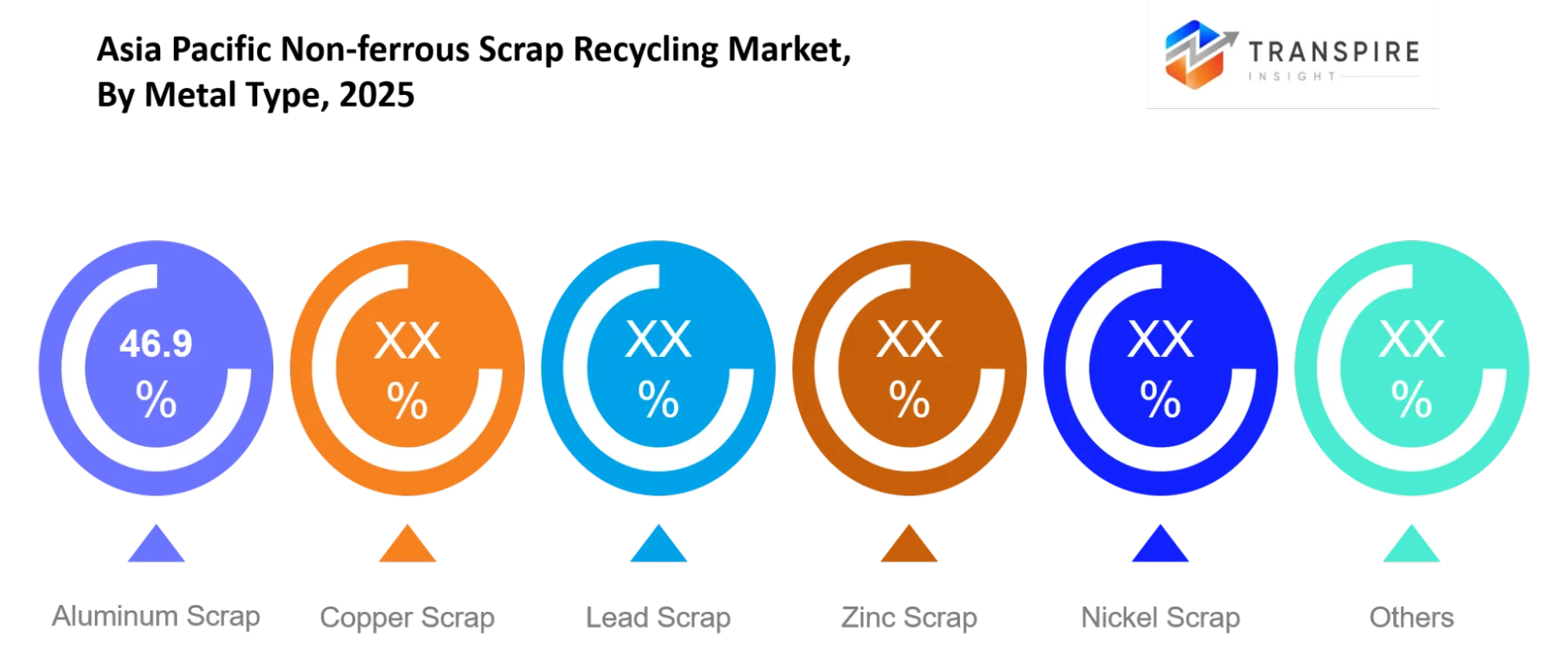
To learn more about this report, Download Free Sample Report
By Application
Automotive Manufacturing creates big pressure for recycled non-ferrous metals, since aluminum, copper and other lighter materials stay in constant use when vehicles are built. The whole cost management focus and the need for better material efficiency push plants to mix more recycled inputs into day-to-day production. In the Asia Pacific Non-ferrous Scrap Recycling Market, automotive production hubs keep offering steady backing, because they want consistent secondary metal sources. Also the rise in electric vehicle output keeps making recycled metals more “everywhere” across the entire supply chain, so demand tends to keep climbing.
Construction Industry is still one of the main use channels because infrastructure programs demand huge quantities of aluminum, copper, and also zinc-based items. Electronics Manufacturing backs recycling activity, by recovering and reusing useful metals both from manufacturing scraps and from end of life devices. Packaging Industry depends a lot on recycled aluminum, mainly for durability, price benefits, and the ability to be reused again and again. Other categories include industrial machinery, consumer goods, renewable energy equipment, plus specialized manufacturing segments that keep using recycled non-ferrous materials during production operations, even when designs change.
By End User
Metal Recycling Companies are basically the biggest end user segment, mostly because collection, sorting, processing and recovery work as the real base of the whole recycling value chain. When companies invest in advanced separation technologies, plus material recovery systems, operations tend to get smoother and metal purity levels go up. In the Asia Pacific Non-ferrous Scrap Recycling Market, the growth keeps coming from the expansion of recycling networks and more processing facilities across several major industrial economies. There’s also a clear emphasis on resource recovery and supply security, so development in this segment keeps moving forward.
The Automotive Industry uses recycled metals for vehicle manufacturing, which helps reduce reliance on primary metal sources. Meanwhile the Construction Industry takes in large volumes of recycled aluminum, copper, and zinc for building systems and infrastructure development work. Other users are things like electronics manufacturers packaging producers electrical equipment suppliers and industrial machinery companies, all trying to get secondary metal supplies that are affordable and dependable. As adoption keeps spreading across different industries, the long term use of recycled non ferrous materials becomes stronger across regional manufacturing ecosystems.
What are the Key Use Cases Driving the Asia Pacific Non-ferrous Scrap Recycling Market?
The biggest, kind of main use case is still construction and infrastructure development. Recycled aluminum, copper, and other non-ferrous metals show up quite often in building systems, electrical wiring, roofing materials, structural pieces, and even across broader urban infrastructure projects. This area keeps pulling in solid demand, too, because recycled metals give cost-friendly raw inputs, while still meeting the expected performance standards.
Automotive manufacturing, and also consumer goods production are getting more noticeable as places where recycled metals end up. Vehicle makers use recycled aluminum more often for lighter components, and appliance and electronics producers end up folding recycled copper and aluminum into the final products. In a practical sense these industries get steadier material access, and they also see reduced production costs.
Fresh, emerging uses keep popping up as well, like renewable energy systems, battery manufacturing, and next-generation electrical infrastructure. Solar installations, electric vehicle charging networks,and grid modernization efforts all need huge quantities of copper and aluminum. So that basically creates longer-term opportunities for recycled metal suppliers,especially as regional electrification programs keep expanding.
|
Report Metrics |
Details |
|
Market size value in 2025 |
USD 340971.2 Million |
|
Market size value in 2026 |
USD 355983.2 Million |
|
Revenue forecast in 2033 |
USD 484581.5 Million |
|
Growth rate |
CAGR of 4.50% from 2026 to 2033 |
|
Base year |
2025 |
|
Historical data |
2021 - 2024 |
|
Forecast period |
2026 - 2033 |
|
Report coverage |
Revenue forecast, competitive landscape, growth factors, and trends |
|
Regional scope |
Asia Pacific (India, China, Japan, Australia, South Korea, Rest of Asia Pacific) |
|
Key company profiled |
Aurubis, Sims Metal Management, OmniSource, Commercial Metals Company, Nucor, Kuusakoski, Schnitzer Steel, Novelis, Hindalco Industries, Mitsubishi Materials, Tata Steel Recycling, European Metal Recycling, SA Recycling, Dowa Holdings, ArcelorMittal |
|
Customization scope |
Free report customization (country, regional & segment scope). Avail customized purchase options to meet your exact research needs. |
|
Report Segmentation |
By Metal Type (Aluminum Scrap, Copper Scrap, Lead Scrap, Zinc Scrap, Nickel Scrap, Others); By Application (Automotive Manufacturing, Construction Industry, Electronics Manufacturing, Packaging Industry, Others); By End User (Metal Recycling Companies, Automotive Industry, Construction Industry, Others) |
Which Regions are Driving the Asia Pacific Non-ferrous Scrap Recycling Market Growth?
China still looks like the biggest player across the Asia Pacific, kind of by a wide margin. It has a huge amount of metal processing capacity, well-formed recycling infrastructure, and decent regulatory backing for circular economy ideas. With big manufacturing happening in automotive, electronics, construction, and industrial equipment, there’s basically a steady inflow of scrap while recycled metal demand is also staying strong. Because of that combined setup, China manages to keep leading the regional recycling volumes,and also the revenue side.
Japan shows up as the second-largest contributor, but it’s a bit different from China. Japan really leans into technological refinement and material recovery efficiency, more than just raw scale. Its recycling industry is helped by already organized collection systems, advanced processing tools, and steady industrial purchasing demand. Also, years of attention toward resource efficiency and high-grade recycling operations, keeps revenues more dependable even when commodities start swinging around. Plus, strong involvement from industrial groups adds another layer of stability to the whole market.
India is moving the quickest, like the fastest-growing market in this region. The reasons are pretty straightforward: rapid industrialization, manufacturing growth, more infrastructure spending, and policy support for recycling. Over the last few years all of that has sped up how the market develops. Demand is rising in automotive, electrical equipment, and construction,so recyclers and investors are seeing fresh chances. From 2026 to 2033, India should pull in major investment into collection networks, processing capabilities, and more advanced recovery technologies.
Who are the Key Players in the Asia Pacific Non-ferrous Scrap Recycling Market and How Do They Compete?
Competition still feels kinda moderately fragmented, so you have multinational recyclers right next to regional metal producers and also specialized scrap processors, in the same arena. In practice, cost efficiency matters a lot, but so does scrap sourcing capability, processing technology, and basically geographic reach. A lot of companies now end up competing by locking in longer term scrap supply agreements and putting money into more advanced recovery technologies, not just small upgrades.
Aurubis stands out because of its advanced copper recovery technologies, plus it keeps investing in facilities that handle complex scrap processing. Their overall emphasis is on squeezing more value out of materials that are hard to process while also shoring up secondary copper supply chains, even when the input is messy.
Sims Metal Management leans heavily into technology driven operations. More recently it expanded advanced metal recovery capabilities, especially with AI enabled sorting systems. That method tends to boost recovery rates and it helps them support production of higher purity recycled metals, which is kind of the whole point.
Hindalco Industries is ramping up aluminum recycling capacity and, at the same time, integrating recycled materials into downstream manufacturing operations. They basically gain from steady domestic demand and from a wide industrial footprint across Asia.
Mitsubishi Materials and Dowa Holdings are more focused on technology intensive recovery processes, along with resource circulation strategies. Their know how in recovering complex metals gives them access to higher value material streams and it reinforces long term competitiveness, so they stay in the better lane instead of the cheaper one.
Company List
- Aurubis
- Sims Metal Management
- OmniSource
- Commercial Metals Company
- Nucor
- Kuusakoski
- Schnitzer Steel
- Novelis
- Hindalco Industries
- Mitsubishi Materials
- Tata Steel Recycling
- European Metal Recycling
- SA Recycling
- Dowa Holdings
- ArcelorMittal
Recent Development News
In February 2026, Gravita India announced the acquisition of up to 100% stake in Rashtriya Metal Industries. The transaction expands Gravita's presence in copper recycling and strengthens its position as an integrated recycling and value-added metals producer.https://www.livemint.com
What Strategic Insights Define the Future of the Asia Pacific Non-ferrous Scrap Recycling Market?
Over the next five to seven years, the market is likely to drift toward deeper integration between recycling activities and downstream manufacturing. The real push, behind this shift, is the growing need for reliable low carbon metal supply chains that can keep up with electrification, infrastructure build out, and the broader industrial decarbonization targets. Firms that manage both scrap sourcing and metal processing may end up capturing a bigger slice of the overall industry value
There’s also a not so obvious risk tucked in there, which is feedstock concentration. As big manufacturers and recyclers lock in exclusive supply agreements, smaller processors might suddenly find it harder to get consistent access to high quality scrap. So even if demand looks solid, you could still see regional supply imbalances show up over time
On the opportunity side, advanced urban mining and electronic waste recovery is starting to stand out. With electronics use ramping up across Asia, a more valuable stream of recoverable copper, aluminum, and specialty metals is forming. Market players should really focus on investing in AI driven sorting technologies, digital traceability platforms, and area based collection networks . That combination should support supply security and help long term profitability look healthier
Asia Pacific Non-ferrous Scrap Recycling Market Report Segmentation
By Metal Type
- Aluminum Scrap
- Copper Scrap
- Lead Scrap
- Zinc Scrap
- Nickel Scrap
- Others
By Application
- Automotive Manufacturing
- Construction Industry
- Electronics Manufacturing
- Packaging Industry
- Others
By End User
- Metal Recycling Companies
- Automotive Industry
- Construction Industry
- Others
Frequently Asked Questions
Find quick answers to common questions.
The Expected Asia Pacific Non-ferrous Scrap Recycling Market size for the Market will be USD 484581.5 Million in 2033.
Key Segments for the Asia Pacific Non-ferrous Scrap Recycling Market are By Metal Type (Aluminum Scrap, Copper Scrap, Lead Scrap, Zinc Scrap, Nickel Scrap, Others); By Application (Automotive Manufacturing, Construction Industry, Electronics Manufacturing, Packaging Industry, Others); By End User (Metal Recycling Companies, Automotive Industry, Construction Industry, Others).
Major Asia Pacific Non-ferrous Scrap Recycling Market Players are Aurubis, Sims Metal Management, OmniSource, Commercial Metals Company, Nucor, Kuusakoski, Schnitzer Steel, Novelis, Hindalco Industries, Mitsubishi Materials, Tata Steel Recycling, European Metal Recycling, SA Recycling, Dowa Holdings, ArcelorMittal.
The Current Asia Pacific Non-ferrous Scrap Recycling Market size is USD 340971.2 Million in 2025.
The Asia Pacific Non-ferrous Scrap Recycling Market CAGR is 4.50% from 2026 to 2033.
- Aurubis
- Sims Metal Management
- OmniSource
- Commercial Metals Company
- Nucor
- Kuusakoski
- Schnitzer Steel
- Novelis
- Hindalco Industries
- Mitsubishi Materials
- Tata Steel Recycling
- European Metal Recycling
- SA Recycling
- Dowa Holdings
- ArcelorMittal
About the Authors

Pankaj Ghogare Patil
I am Pankaj Ghogare Patil, a Senior Research Analyst at Transpire Insight, specializing in the Pharmaceutical, Chemicals & Materials, Healthcare IT, and Biotechnology industry. My expertise lies in conducting comprehensive market research, analyzing industry trends, evaluating competitive landscapes, and translating complex data into actionable insights. At Transpire Insight, I closely follow emerging technologies, regulatory developments, and market innovations to create accurate, well-researched, and informative content that helps businesses and professionals make informed decisions. I am committed to producing credible, evidence-based articles that reflect industry best practices while making technical topics accessible and valuable for a broad audience.

Chakradhar Khansole
Chakradhar serves as the Research Director at Transpire Insight, bringing over 8 years of experience in technology, innovation, and strategic market intelligence. He specializes in transforming complex market data into actionable business insights that enable organizations to make informed, growth-oriented decisions. Recognized for his strategic vision and analytical expertise, Chakradhar leads high-impact research initiatives, delivering comprehensive market assessments, competitive intelligence, and forward-looking industry analysis.
Recently Published Reports
-
May 2026
Healthcare Polymer Packaging Market
Healthcare Polymer Packaging Market Size, Share & Analysis Report By Packaging Type (Syringes, IV Bottles and Pouches, Clamshells, Blisters, Bottles & Jars, Containers, Tubes, IV Parental Packaging, Others), By Type (Regulated, Non-regulated), By Polymer Type (LDPE (Low-Density Polyethylene), HDPE (High-Density Polyethylene), Homo-polymer (Homo), Random Copolymer (Random), Block Copolymer (Block), PET, Polystyrene, Polyvinyl Chloride, Polyamide/EVOH, Others), and Geography (North America, Europe, Asia-Pacific, Middle East and Africa, South and Central America), 2021 - 2031
-
Apr 2026
Hydrophilic Tape (Waterstop) Market
Hydrophilic Tape (Waterstop) Market Size, Share & Analysis Report By Type (Bentonite-Based Hydrophilic Tape, Rubber-Based Hydrophilic Tape), By Application (Residential Buildings, Commercial Buildings, Infrastructure Projects), and Geography (North America, Europe, Asia-Pacific, Middle East and Africa, South and Central America), 2021 - 2031
-
Apr 2026
Metalens Market
Metalens Market Size, Share & Analysis Report By Type (Visible Light Metalens, and Infrared Metalens), By Application (Consumer Electronics, Automotive Electronics, Industrial, Medical, and Others), and Geography (North America, Europe, Asia-Pacific, Middle East and Africa, South and Central America), 2021 - 2031
-
Apr 2026
PBT Resin Market
PBT Resin Market Size, Share & Analysis Report By Type (Reinforced PBT Resin, Unreinforced PBT Resin), By Processing Method (Injection Molding, Extrusion, Blow Molding, Others), By End-User (Automotive, Electrical & Electronics, Consumer Appliances, Industrial Machinery, Medical Devices, Packaging, Others), and Geography (North America, Europe, Asia-Pacific, Middle East and Africa, South and Central America), 2021 - 2031