

Asia Pacific Aluminum Extrusion Market Size & Forecast:
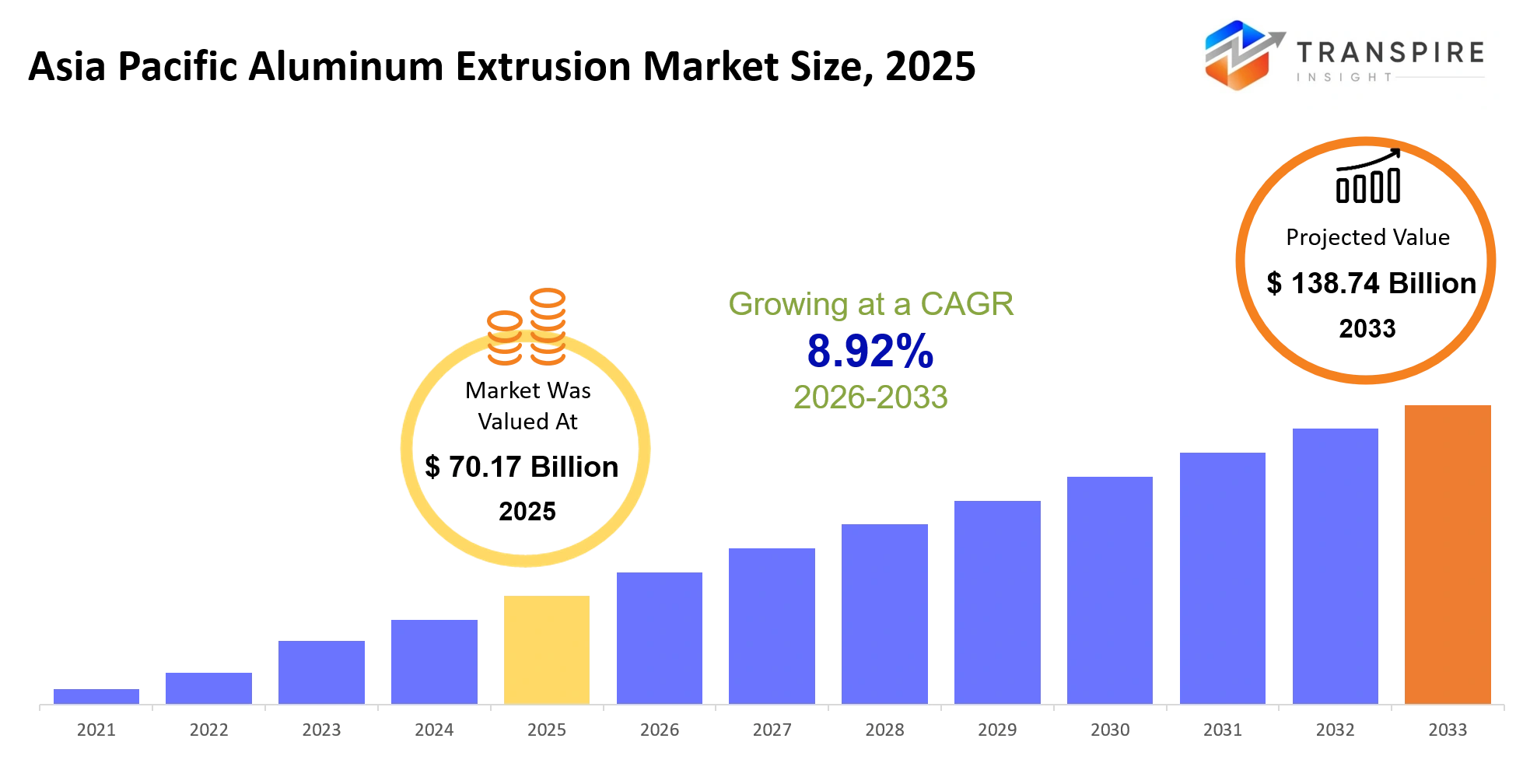
- Asia Pacific Aluminum Extrusion Market Size 2025: USD 70.17 Billion
- Asia Pacific Aluminum Extrusion Market Size 2033: USD 138.74 Billion
- Asia Pacific Aluminum Extrusion Market CAGR: 8.92%
- Asia Pacific Aluminum Extrusion Market Segments: By Product Type (Mill Finished Extrusions, Anodized Extrusions, Powder-coated Extrusions, Fabricated Extrusions, Others); By Application (Construction, Automotive, Electronics, Industrial Machinery, Renewable Energy, Others); By End User (Construction Industry, Automotive Industry, Electronics Industry, Others).
To learn more about this report,  Download Free Sample Report
Asia Pacific Aluminum Extrusion Market Summary
The Asia Pacific Aluminum Extrusion Market was valued at USD 70.17 Billion in 2025. It is forecast to reach USD 138.74 Billion by 2033. That is a CAGR of 8.92%over the period.
Aluminum extrusion, it kinda matters a lot throughout the Asia Pacific industrial ecosystem because it turns aluminum billets into lightweight but also durable, and carefully formed parts, used in buildings, transport systems, electrical infrastructure, renewable energy efforts, and even everyday consumer items. With these extruded profiles, producers can cut overall mass, boost structural strength, and also bring down production costs, while still trying to satisfy performance needs that keep getting more and more demanding.
In the last five years there’s been this clear kind of structural shift in the market, moving toward value added and high precision extrusions. People want them for electric vehicles, solar installations, and more advanced industrial equipment. And this move got a lot of momentum from big infrastructure outlays and national decarbonization programs across China, India, Southeast Asia, and Australia. One major spark, was the supply chain disruption that came from the COVID-19 pandemic, which basically pushed manufacturers to tighten their regional sourcing routes and broaden domestic manufacturing capacity. So as industries chase lighter material solutions to improve energy efficiency and stay within regulatory expectations, aluminum extrusion adoption keeps widening. That same momentum is showing up as higher output volumes, more investment in modern extrusion plants,and steadier revenue generation along the regional value chain as a whole.
Key Market Insights
- In 2025 the Asia Pacific Aluminum Extrusion Market was responsible for more than 55% of the world’s extrusion consumption, mostly because China's manufacturing beats construction activity. The region kind of runs on it and you can feel that momentum in the data.
- China, clearly still the main player, holds almost 60% of regional market share. That leadership is backed by huge extrusion capacity, and ongoing large-scale infrastructure spending. It’s steady, and it’s not just one sector either.
- India looks like the quickest mover through 2033, and it’s getting pulled forward by transportation builds, industrial corridors, and the whole renewable energy roll out. In other words, the demand story keeps widening.
- When it comes to segments, building and construction is leading. It makes up over 35% of regional demand, driven by both residential projects and commercial development. Transportation is second, mainly because automakers are using more aluminum to trim vehicle mass and boost energy efficiency.
- Solar energy uses have been growing at double digit rates every year since 2021. This has created a strong pull for extrusion-based mounting structures, and also for frames that need to stay consistent over time.
- On the EV side, electric vehicle production across Asia Pacific went up by more than 25% from 2022 to 2025. That uptick in output directly lifts demand for lightweight extruded parts.
- Industrial machinery and electrical equipment firms are also shifting toward precision extrusions. The goal is simple but effective: better performance while cutting assembly complexity.
- Key names such as China Zhongwang, China Hongqiao Group, Constellium, Hydro, Hindalco Industries, and Jindal Aluminium are all expanding capacity in the region.
- For many of them, the competitive edge is moving toward automated extrusion lines, tighter recycled aluminum integration, strategic expansion moves, and partnerships with EV and renewable energy builders.
What are the Key Drivers, Restraints, and Opportunities in the Asia Pacific Aluminum Extrusion Market?
The big power pushing market growth seems to come from the move toward lighter materials in transport, building, and renewable energy. Across Asia Pacific, governments have rolled out more strict fuel-efficiency targets, carbon reduction programs, and energy-performance requirements. As a result, a lot of manufacturers have been pushed to swap out heavier options like steel, for certain uses, with aluminum extrusions. Electric vehicle makers, rail operators, and solar project teams are leaning on extruded aluminum parts more and more, mainly because they bring strength along with corrosion resistance, and also lower weight. That switch basically helps extrusion manufacturers reach higher output levels, and then it turns into bigger revenue.
Still, aluminum price volatility is probably the most important structural problem that keeps showing up, it just doesn’t really go away. The market leans a lot on worldwide alumina, bauxite, and energy supply chains, so production costs get hit fast by geopolitical tension, energy shortfalls, and even trade barriers. Also extrusion plants need major capital outlays, they work on long term planning timelines, so sudden jumps in raw material costs arnt something that can be absorbed easily. In practice this sort of uncertainty slows down investment decisions, squeezes margins, and it makes adoption harder for customers who are very price sensitive, like they will hesitate even with small changes.
Looking ahead, the next growth wave is likely to come from renewable power plus advanced mobility.Solar farms, battery production sites, energy storage solutions, and electric vehicle platforms all need lightweight structural pieces with strong durability. India and Southeast Asia are pulling in a lot of investment in these areas, which sets up good conditions for more specialized extrusion products.
What Has the Impact of Artificial Intelligence Been on the Asia Pacific Aluminum Extrusion Market?
Artificial intelligence and advanced digital technologies are somehow changing aluminum extrusion operations, not in a small way really, but in ways that touch production efficiency, quality checks, and how well assets get used. More and more manufacturers are starting to install AI-enabled monitoring setups on extrusion presses, heat treatment units, and also finishing lines, so they can watch temperature, pressure, speed, and the actual material flow in real time. Those automated control systems then use the incoming data streams to keep the output steady while also cutting down on material leftovers and energy usage.
At the same time, machine learning is feeding predictive maintenance programs. When the models look at vibration signatures, equipment performance measurements, and old failure logs, they can flag likely troubles before any unexpected shutdown shows up. so extrusion plants end up improving equipment uptime, trimming maintenance expenses, and pushing more volume through the line. On top of that, digital twins plus more advanced process analytics give manufacturers a way to better tune die design, coordinate production planning, and handle resource distribution.
What’s more, the operational payoffs are starting to look measurable, almost like numbers that you can point at. A lot of facilities say they see reduced scrap, better yield results, faster production cycles, and stronger energy efficiency after using AI-based process controls. Enhanced forecasting tools also allow companies to manage inventory more smoothly and react faster when customer requirements change.
Still, adoption isn’t fully even. Costs to implement can be high, integration can get tricky with older manufacturing equipment, and sometimes there’s not enough high-quality operational data. That combination tends to slow down deployment especially for small and medium-sized extrusion producers.
Key Market Trends
- From 2021 on, EV firms started putting a bit more aluminum into every vehicle, so demand climbs for structural plus battery enclosure extrusion pieces, sorta around the same time.
- After 2020, recycled aluminum consumption also kept growing a lot, because a bunch of producers were going after cheaper production and at the same time trying to reduce their carbon footprint, just a little more aggressively.
- In smart factories where AI monitoring is actually in place, scrap has been trimmed by something like 10–15% in some areas, mostly where the process setup is already mature.
- At the same time, solar energy initiatives across India and Southeast Asia pushed needs for extrusion driven mounting systems upward by over 20% each year, kind of nonstop.
- Producers also shifted toward high strength profiles that are precision engineered, since industrial buyers asked for better performance and also more design flexibility.
- And after the pandemic, supply chains in the region got more localized, because disruptions made people realize how risky it can be when sourcing is too concentrated in a single network.
- There’s also wider adoption of automated extrusion presses, plus robotic handling systems, which helped manufacturers boost throughput and keep product consistency steadier than before.
- On the construction side, customers are increasingly leaning into modular building solutions that use lightweight extruded aluminum frameworks along with façade systems, more and more.
- A number of major players increased spending on downstream processing options, to secure stronger margins from value added uses, rather than stopping at basic extrusion.
- Lastly, sustainability reporting rules nudged producers to add even more recycled content, and to improve traceability across the whole aluminum supply chain, end to end.
Asia Pacific Aluminum Extrusion Market Segmentation
By Product Type
Mill finished extrusions make up a pretty big portion of aluminum profile usage, mainly because a lot of manufacturing steps need something that’s cost-effective and can be fed right into fabrication or assembly. In construction projects, plus transportation equipment and industrial uses, buyers often go for mill finished products since extra surface treatment isn’t really needed. Demand from large-volume jobs keeps things fairly stable across the different regional markets.
Anodized extrusions tend to get more attention, for obvious reasons like better resistance to corrosion, longer lasting durability, and that nice, polished looking surface. Commercial buildings, transit systems, and architectural projects commonly pick anodized options so performance stays strong even when the surroundings get harsh or change fast. Powder-coated extrusions bring in more color flexibility together with added weather protection, so they fit exterior building systems, decorative uses, and similar applications that need extra finishing. Fabricated extrusions, by comparison, cover customized industrial needs via cutting, machining, drilling, and assembly services. Others include specialized profiles built for niche engineering, and industrial work that doesn’t quite match the standard categories.
By Application
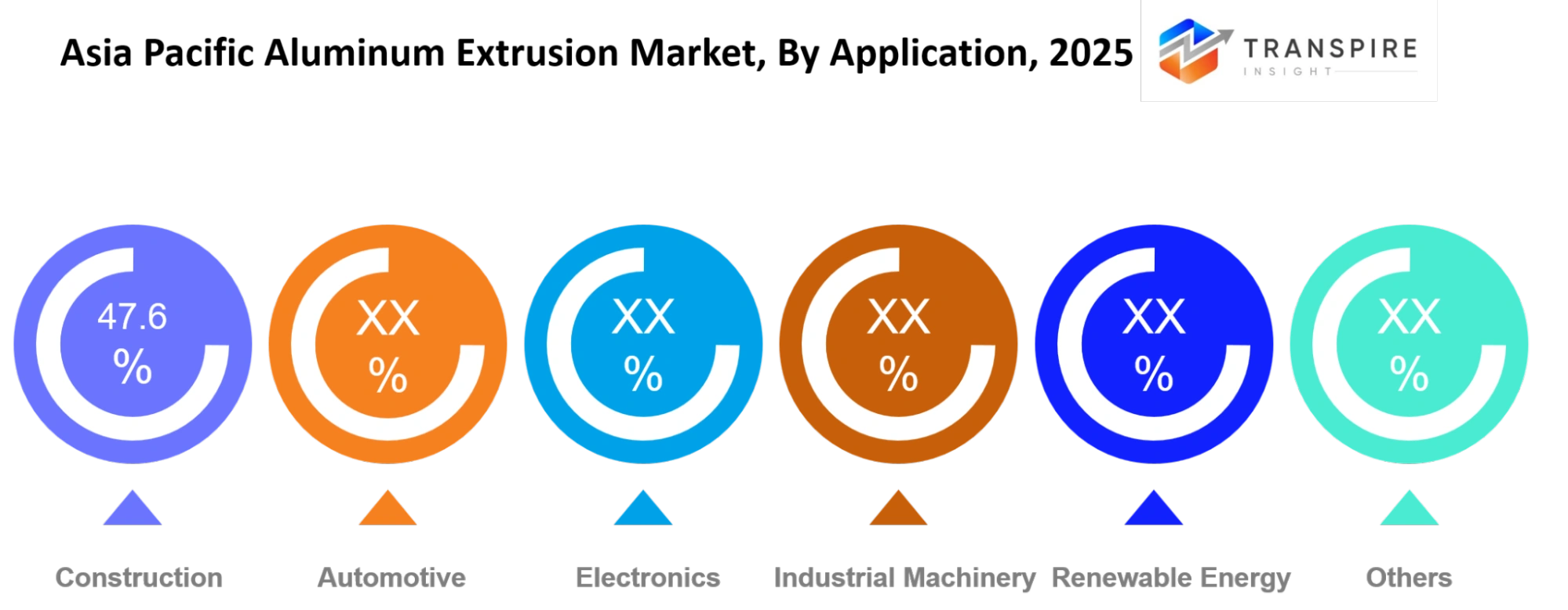
Construction kinda takes the top spot as the largest application area, since aluminum extrusions back up structural performance, allow a lot of design freedom, and still keep a long service life across residential, commercial, plus infrastructure projects. Things like windows doors, curtain walls, roofing systems and façade structures add up to significant consumption, in both developing and developed economies. And yeah, with ongoing urban development programs, along with more infrastructure funding, this segment should keep seeing demand.
Automotive use keeps getting bigger too, because vehicle makers focus on trimming mass, and pushing better energy efficiency. Electronics companies rely on aluminum profiles for heat dispersion systems, enclosures, and precision parts, all of which support modern electronic equipment. For industrial machinery, extruded sections get used in machine frames, automation systems, and production equipment, where sturdiness and low mass properties stay really important. Renewable energy projects lean on aluminum structures for solar panel mounting setups and similar installations, while “Others” covers consumer goods, transportation gear, and specialized engineering applications.
To learn more about this report, Download Free Sample Report
By End User
Construction Industry stays the biggest end-user category, mainly because aluminum profiles are used a lot in buildings, transportation infrastructure and ongoing city development efforts . There is also continued funding for commercial facilities, housing projects, and public infrastructure, so consumption in this segment tends to stay pretty steady. In other words, demand will likely stay tightly connected with economic development and construction activity across the region .
The Automotive Industry is still pushing aluminum into more parts of the vehicle, like structural sections, battery enclosures, and lighter components that help efficiency while aligning with electrification plans. The Electronics Industry meanwhile relies on extruded aluminum for thermal management, protective housings, and precision-engineered elements needed for advanced electronic products. Other uses are also growing, including industrial production, developers of renewable energy, manufacturers of transportation equipment, and consumer goods makers who benefit from durability, adaptability, and resistance to corrosion.
What are the Key Use Cases Driving the Asia Pacific Aluminum Extrusion Market?
The biggest use case for aluminum extrusion is kind of building and construction related work. Extruded profiles get used a lot in windows, doors, curtain walls, roofing systems, structural frameworks and even commercial facades. It’s that mix of solid strength, corrosion resistance,and the lightweight nature that makes aluminum a go to option for large city growth and major infrastructure efforts across Asia Pacific.
Then you have transportation and industrial manufacturing, which are expanding more each year. In automotive, makers use extruded aluminum for vehicle frames, crash control systems and battery enclosures, mainly to cut the weight down and push efficiency. Railway operators, electrical equipment manufacturers, and machinery builders also depend on tailored extrusions, for structural parts as well as functional ones.
More new applications are showing up quickly in renewable energy and advanced mobility. For instance, solar farms need aluminum mounting setups and panel frames, while energy storage systems are starting to include specialized extruded components more often. Looking ahead, there are also chances in electric aircraft, smart infrastructure and modular construction systems, where lightweight materials plus high performance are becoming more and more relevant.
|
Report Metrics |
Details |
|
Market size value in 2025 |
USD 70.17 Billion |
|
Market size value in 2026 |
USD 76.28 Billion |
|
Revenue forecast in 2033 |
USD 138.74 Billion |
|
Growth rate |
CAGR of 8.92%from 2026 to 2033 |
|
Base year |
2025 |
|
Historical data |
2021 - 2024 |
|
Forecast period |
2026 - 2033 |
|
Report coverage |
Revenue forecast, competitive landscape, growth factors, and trends |
|
Regional scope |
Asia Pacific (India, China, Japan, Australia, South Korea, Rest of Asia Pacific) |
|
Key company profiled |
Hydro Extrusions, Hindalco Industries, China Zhongwang, Arconic, Constellium, Kaiser Aluminum, Gulf Extrusions, Jindal Aluminium, Bonnell Aluminum, ETEM Group, Alcoa, Alumil, UACJ Corporation, Nippon Light Metal, SAPA. |
|
Customization scope |
Free report customization (country, regional & segment scope). Avail customized purchase options to meet your exact research needs. |
|
Report Segmentation |
By Product Type (Mill Finished Extrusions, Anodized Extrusions, Powder-coated Extrusions, Fabricated Extrusions, Others); By Application (Construction, Automotive, Electronics, Industrial Machinery, Renewable Energy, Others); By End User (Construction Industry, Automotive Industry, Electronics Industry, Others). |
Which Regions are Driving the Asia Pacific Aluminum Extrusion Market Growth?
East Asia still looks like the main player in the Asia Pacific aluminum extrusion market, with China taking the biggest slice of both regional production and consumption. This kind of edge, at least in practice, comes from plenty of aluminum smelting capacity, plus the integrated supply chain setup, and also these advanced manufacturing clusters that keep working. And there is also the ongoing infrastructure spending, which seems to keep demand steady. On top of that, government policies that push electric vehicles, renewable energy installations and broader industrial modernization tend to keep extrusion demand alive, across several different end uses. Basically, a solid surrounding ecosystem—raw material suppliers, processors, equipment manufacturers, and export driven industries—keeps the region in a strong competitive stance.
South Asia sits in the second position, and it’s mostly driven by India. But unlike East Asia, where sheer scale and manufacturing density do most of the heavy lifting, South Asia leans more on long-term infrastructure development, urbanization initiatives, and industrial expansion programs. Public spending for railways, smart city programs, power transmission networks, and logistics corridors forms a pretty dependable demand base for extruded aluminum items. Then, the consistent policy push for local manufacturing, along with the steady rise in private sector investment, gives the market a reliable runway for further growth, yes.
Southeast Asia is kind of moving up quickly and it’s showing up as the fastest-growing regional market. In the last couple years, investments related to solar energy projects, industrial parks, electric vehicle supply chains, and export oriented manufacturing facilities have pushed demand higher for aluminum extrusion products. Countries like Vietnam, Thailand, Indonesia, and Malaysia are also pulling in production capacity, because a lot of manufacturers are trying to diversify their supply chains away from the classic manufacturing hubs.
Who are the Key Players in the Asia Pacific Aluminum Extrusion Market and How Do They Compete?
Competition in the Asia Pacific aluminum extrusion market is sorta moderately consolidated, kind of a blend of big global aluminum producers plus regional specialists, all pushing into construction, transportation, industrial stuff, and renewable energy use cases. Most players end up fighting on production scale, value-added product know-how, manufacturing efficiency, and the kind of access you get to downstream buyers. The big integrated producers tend to win on raw material control and cost headroom, but the more specialized extrusion manufacturers usually lean on precision engineering, tailored designs, and yes faster lead times.
Hydro Extrusions stands out by putting weight on recycled aluminum content,plus advanced extrusion technologies, and this integrated recycling set-up. The firm keeps tuning its manufacturing footprint and putting money into operational efficiency, with the aim of staying sharp in overseas markets. Hindalco Industries leans heavily on vertical integration through the whole aluminum value chain, which helps with steering raw materials, dialing production costs, and maintaining product quality. Also, its newer investments into downstream aluminum processing and battery-linked materials add extra momentum for transportation and energy-transition applications, even when demand shifts around.
China Zhongwang plays largely with very large production capacity, and it has a strong footprint across transportation, industrial projects, and infrastructure builds. Constellium, on the other hand, focuses on advanced aluminum solutions for automotive and aerospace, separating itself with high-performance alloys, recycling initiatives, and cooperative technology development programs. It continues to grow low-carbon aluminum offerings, and it is building circular manufacturing partnerships, to better match what customers are asking for these days.
Company List
- Hydro Extrusions
- Hindalco Industries
- China Zhongwang
- Arconic
- Constellium
- Kaiser Aluminum
- Gulf Extrusions
- Jindal Aluminium
- Bonnell Aluminum
- ETEM Group
- Alcoa
- Alumil
- UACJ Corporation
- Nippon Light Metal
- SAPA (Sapa Group)
Recent Development News
In January 2026, Hindalco Industries announced a ₹21,000 crore aluminum smelter expansion in Odisha and commissioned new flat-rolled products and battery-grade aluminum foil facilities. The investment strengthens India's downstream aluminum ecosystem and supports electric vehicle and energy storage supply chains.
Source: https://www.hindalco.com
In January 2026, Hydro confirmed the closure and restructuring of selected extrusion operations in the United Kingdom as part of a broader manufacturing optimization program. The move is intended to improve operational efficiency and strengthen long-term competitiveness across its extrusion business.
Source: https://www.hydro.com
In September 2025, Constellium announced its participation in the CirConAl collaborative research project focused on low-carbon aluminum extrusion alloys made from post-consumer scrap. The initiative advances circular manufacturing technologies and supports the development of sustainable automotive aluminum solutions.
Source: https://www.constellium.com
What Strategic Insights Define the Future of the Asia Pacific Aluminum Extrusion Market?
The Asia Pacific aluminum extrusion market is kind of shifting into a more niche, tech led setup, where value added items bring in more income than the usual commodity sort of extrusions. It seems like the momentum is getting tied more and more to electric mobility, renewable power buildouts, advanced manufacturing processes and lighter industrial use cases. Underneath all of it, there is this clear pull for materials that can deliver durability, cut down weight, and improve energy performance, all while still lining up with the region's wider decarbonization goals.
There’s also a not so obvious snag, and it comes from how upstream aluminum output and energy heavy processing are concentrated in a few places. If supply gets interrupted, or energy prices swing around too much, or trade rules tighten up, you can end up with cost pressure that doesn’t show up right away in those headline growth projections. Meanwhile, a quieter opportunity is forming too, around low carbon and recycled aluminum extrusion products, especially in India and Southeast Asia, where sustainability expectations are starting to matter more in procurement decisions. Companies operating here should push resources toward improved extrusion technologies, recycling know-how, and higher value application areas, instead of just trying to outdo each other by raw output size or price alone.
Asia Pacific Aluminum Extrusion Market Report Segmentation
By Product Type
- Mill Finished Extrusions
- Anodized Extrusions
- Powder-coated Extrusions
- Fabricated Extrusions
- Others
By Application
- Construction
- Automotive
- Electronics
- Industrial Machinery
- Renewable Energy
- Others
By End User
- Construction Industry
- Automotive Industry
- Electronics Industry
- Others
Frequently Asked Questions
Find quick answers to common questions.
The expected Asia Pacific Aluminum Extrusion Market size for the market will be USD 138.74 Billion in 2033.
Key segments for the Asia Pacific Aluminum Extrusion Market are By Product Type (Mill Finished Extrusions, Anodized Extrusions, Powder-coated Extrusions, Fabricated Extrusions, Others); By Application (Construction, Automotive, Electronics, Industrial Machinery, Renewable Energy, Others); By End User (Construction Industry, Automotive Industry, Electronics Industry, Others).
Major Asia Pacific Aluminum Extrusion Market players are Hydro Extrusions, Hindalco Industries, China Zhongwang, Arconic, Constellium, Kaiser Aluminum, Gulf Extrusions, Jindal Aluminium, Bonnell Aluminum, ETEM Group, Alcoa, Alumil, UACJ Corporation, Nippon Light Metal, SAPA.
The Asia Pacific Aluminum Extrusion Market size is USD 70.17 Billion in 2025.
The Asia Pacific Aluminum Extrusion Market CAGR is 8.92% from 2026 to 2033.
- Hydro Extrusions
- Hindalco Industries
- China Zhongwang
- Arconic
- Constellium
- Kaiser Aluminum
- Gulf Extrusions
- Jindal Aluminium
- Bonnell Aluminum
- ETEM Group
- Alcoa
- Alumil
- UACJ Corporation
- Nippon Light Metal
- SAPA (Sapa Group)
About the Authors

Pankaj Ghogare Patil
I am Pankaj Ghogare Patil, a Senior Research Analyst at Transpire Insight, specializing in the Pharmaceutical, Chemicals & Materials, Healthcare IT, and Biotechnology industry. My expertise lies in conducting comprehensive market research, analyzing industry trends, evaluating competitive landscapes, and translating complex data into actionable insights. At Transpire Insight, I closely follow emerging technologies, regulatory developments, and market innovations to create accurate, well-researched, and informative content that helps businesses and professionals make informed decisions. I am committed to producing credible, evidence-based articles that reflect industry best practices while making technical topics accessible and valuable for a broad audience.

Chakradhar Khansole
Chakradhar serves as the Research Director at Transpire Insight, bringing over 8 years of experience in technology, innovation, and strategic market intelligence. He specializes in transforming complex market data into actionable business insights that enable organizations to make informed, growth-oriented decisions. Recognized for his strategic vision and analytical expertise, Chakradhar leads high-impact research initiatives, delivering comprehensive market assessments, competitive intelligence, and forward-looking industry analysis.
Recently Published Reports
-
May 2026
Healthcare Polymer Packaging Market
Healthcare Polymer Packaging Market Size, Share & Analysis Report By Packaging Type (Syringes, IV Bottles and Pouches, Clamshells, Blisters, Bottles & Jars, Containers, Tubes, IV Parental Packaging, Others), By Type (Regulated, Non-regulated), By Polymer Type (LDPE (Low-Density Polyethylene), HDPE (High-Density Polyethylene), Homo-polymer (Homo), Random Copolymer (Random), Block Copolymer (Block), PET, Polystyrene, Polyvinyl Chloride, Polyamide/EVOH, Others), and Geography (North America, Europe, Asia-Pacific, Middle East and Africa, South and Central America), 2021 - 2031
-
Apr 2026
Hydrophilic Tape (Waterstop) Market
Hydrophilic Tape (Waterstop) Market Size, Share & Analysis Report By Type (Bentonite-Based Hydrophilic Tape, Rubber-Based Hydrophilic Tape), By Application (Residential Buildings, Commercial Buildings, Infrastructure Projects), and Geography (North America, Europe, Asia-Pacific, Middle East and Africa, South and Central America), 2021 - 2031
-
Apr 2026
Metalens Market
Metalens Market Size, Share & Analysis Report By Type (Visible Light Metalens, and Infrared Metalens), By Application (Consumer Electronics, Automotive Electronics, Industrial, Medical, and Others), and Geography (North America, Europe, Asia-Pacific, Middle East and Africa, South and Central America), 2021 - 2031
-
Apr 2026
PBT Resin Market
PBT Resin Market Size, Share & Analysis Report By Type (Reinforced PBT Resin, Unreinforced PBT Resin), By Processing Method (Injection Molding, Extrusion, Blow Molding, Others), By End-User (Automotive, Electrical & Electronics, Consumer Appliances, Industrial Machinery, Medical Devices, Packaging, Others), and Geography (North America, Europe, Asia-Pacific, Middle East and Africa, South and Central America), 2021 - 2031