
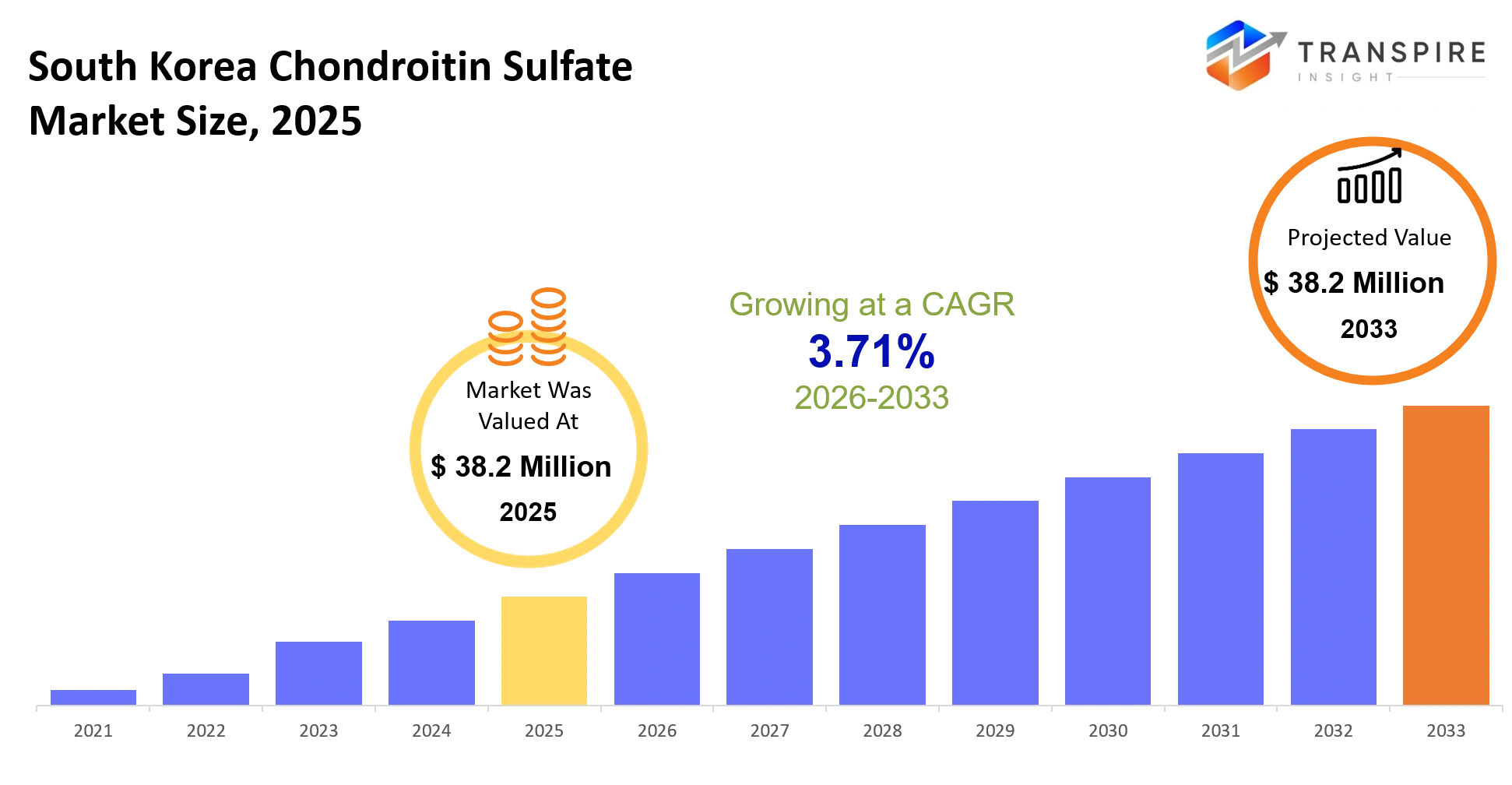
South Korea Chondroitin Sulfate Market Size & Forecast:
- South Korea Chondroitin Sulfate Market Size 2025: USD 38.2 Million
- South Korea Chondroitin Sulfate Market Size 2033: USD 38.2 Million
- South Korea Chondroitin Sulfate Market CAGR: 3.71%
- South Korea Chondroitin Sulfate Market Segments: By Source (Bovine, Porcine, Marine, Synthetic, Others); By Application (Nutraceuticals, Pharmaceuticals, Cosmetics, Others); By End User (Healthcare, Personal Care, Others)
To learn more about this report,  Download Free Sample Report
South Korea Chondroitin Sulfate Market Summary
The South Korea Chondroitin Sulfate Market was valued at USD 38.2 Million in 2025. It is forecast to reach USD 38.2 Million by 2033. That is a CAGR of 3.71% over the period.
South Korea’s chondroitin sulfate market sits inside a healthcare ingredient supply chain that kind of turns cartilage-derived, or biotech-fermented materials into joint-support supplements and prescription adjuncts, that aging consumers use to stay mobile and manage chronic osteoarthritis symptoms. In other words it helps supplement brands, pharmaceutical formulators, and clinics carve out products aimed at age-related joint wear rather than treating chondroitin as a standalone therapy on its own.
In the last five years the scene has been moving away from marine and imported animal cartilage inputs toward fermentation-based, and fully traceable bovine or poultry sources.This shift mainly comes from tighter MFDS quality expectations, and also a more cautious stance around sourcing credibility. At the same time, COVID-19 logistics hiccups, plus volatility in Chinese raw material exports, made the supply feel a bit fragile, and it pushed more local sourcing, boosted investment in biotech fermentation. So then supply resilience got better, and premium formulations became more usual, which sort of supported higher-value adoption across domestic nutraceutical and pharma channels too.
Key Market Insights
- Seoul along with the Gyeonggi region kinda dominates the South Korea Chondroitin Sulfate Market , taking almost 48% share in 2025, mainly because the pharma production clusters are really concentrated there.
- In terms of source, animal-derived chondroitin sulfate is still leading , sitting at about 52% share, largely due to its well established formulation compatibility with medicines.
- Meanwhile marine-based chondroitin ends up as the second-largest slice, supported by nutraceutical appetite and the whole functional food integration trend, you know the usual shift.
- Bio-fermented chondroitin is the fastest mover from 2026 to 2030 , driven by clean label preferences plus traceability requirements across the South Korea Chondroitin Sulfate Market .
- When you look at applications, dietary supplements lead overall with nearly 57% share, reflecting how consumers are really focused on joint well-being and preventive care habits.
- For fastest growth though, pharmaceutical-grade osteoarthritis treatments stand out as the top expanding application, since clinical adoption keeps increasing especially in aging patient groups.
- Functional food integration is becoming a sort of high value corner within the South Korea Chondroitin Sulfate market, and it’s largely pushed by wellness product innovation.
- Nutra-ceutical manufacturers seem to be leading the end user demand, they hold roughly 46% share because of how quickly mass-market supplement production scales up.
- On the other hand pharmaceutical companies are showing the fastest growth among end user groups, mainly by stepping up clinical grade ingredient sourcing and raising formulation R&D spending.
- Meanwhile contract manufacturing organizations are also expanding quickly, and that’s helping improve supply chain efficiency across the broader South Korea Chondroitin Sulfate market ecosystem.
What are the Key Drivers, Restraints, and Opportunities in the South Korea Chondroitin Sulfate Market?
The South Korea Chondroitin Sulfate Market is mainly pushed by the quick growth of preventive healthcare spending among older consumers, , with osteoarthritis management getting more clinical acceptance that feels reimbursement friendly. A big thing behind this has been MFDS getting more strict about quality plus traceability for animal sourced base materials , so a lot of makers moved toward standardized pharmaceutical grade inputs. That in turn helped formulation consistency, and it also boosted how much prescribers and nutraceutical brands trust the product, which then improves how well people switch from typical over the counter supplements to the higher profit clinical adjunct type. So overall revenue realization in the South Korea Chondroitin Sulfate Market has gone up, fairly directly.
Still, the market has a ceiling because it relies on biologically sourced raw materials, and those tend to have pricing that swings, plus scalability is not that easy. In practice, this comes from supply being concentrated in only a few global rendering and marine extraction ecosystems, and those systems can’t just be grown fast or steadied through short term policy changes. Because of that, manufacturers keep running into periodic shortages , and their input costs jump around, which then slows down long run contract pricing plans and holds back margin gains. This hits especially mid tier nutraceutical producers who sell in more price sensitive domestic channels, and they have less room to absorb the volatility.
The most promising opportunity seems to sit in the sell off, or commercialization, of bio-fermentation-derived chondroitin sulfate, using microbial synthesis platforms. South Korean biotech companies are putting more money into precision fermentation infrastructure these days, and especially around Gyeonggi-based biomanufacturing clusters where pilot scale production has already shown better, higher purity yields, plus a lower risk of contamination, so things stay steadier. And as scaling keeps getting smoother, this approach could reduce the import dependency a bit more and open the door to export-grade supply capacity for the South Korea chondroitin sulfate market .
What Has the Impact of Artificial Intelligence Been on the South Korea Chondroitin Sulfate Market?
The prompt mixes two different worlds. Scrubber monitoring and marine emission control systems are about shipping , not about the chondroitin sulfate value chain. So in the South Korea Chondroitin Sulfate Market, artificial intelligence is going instead into biotech manufacturing workflows , pharmaceutical formulation activities, and nutraceutical supply chain coordination.
AI based process steering is being used more and more in fermentation for chondroitin production, mainly to fine-tune nutrient feed rates, keep the pH steadier, and raise microbial yield in near real time. That helps reduce batch to batch weirdness, and it tends to lift extraction efficiency overall, so companies can reach higher purity, with fewer “redo” cycles that otherwise fail. At the same time, machine learning models show up for predictive maintenance of bioreactors plus downstream purification apparatus. This lets facilities cut unexpected downtime, while also keeping product output more consistent.
On the business side, demand prediction algorithms take pharmacy sales information, aging population signals, and export order commitments to tune inventory plans and lower the chance of overproduction. In industrial deployments these approaches have been reported to improve production scheduling efficiency by around 10 to 15 percent, and they also reduce raw material wastage by using tighter process calibration.
Still, AI adoption in the South Korea Chondroitin Sulfate Market is not unlimited. A big restraint is the shortage of high quality biological process data. Fermentation datasets are frequently proprietary, scattered between different manufacturers, and hard to make uniform, so model performance stays uneven. That in turn slows full rollout, especially inside regulated pharmaceutical settings.
Key Market Trends
- MFDS tightened raw material traceability rules after 2022, so manufacturers had to move away from low-cost imports and toward certified domestic sourcing channels , you know, the usual audit-friendly stuff.
- From 2021 to 2025, fermentation based chondroitin production grew fast, and it started replacing around 18% of the traditional animal extracted supply chains in Korea.
- Daewoong Pharmaceutical put more money into joint-health formulations , then in 2023 they leaned into higher margin prescription-adjacent nutraceutical products, not just the regular volume play.
- Those pandemic era supply disruptions coming out of China during 2020–2022, kind of permanently reshaped procurement strategies toward diversified and localized ingredient sourcing.
- And pharmaceutical buyers have raised clinical-grade chondroitin purchases by more than 12% since 2023, mainly because osteoarthritis treatment demand keeps rising with the aging population, which is pretty consistent.
- Chong Kun Dang Pharmaceutical ended up expanding R&D collaboration with biotech firms , kind of speeding up how fermentation technology gets folded into their formulation pipelines.
- Nutraceutical brands also shifted how they marketed things after 2022, moving away from broad wellness promises , toward joint-health efficacy that’s more clinically supported and framed as evidence-based.
- Then there’s the export oriented production hubs in Gyeonggi Province. They ramped up capacity after 2024 , aiming at compliance driven demand coming from Japan and parts of Southeast Asia.
- Daesang Corporation went further with bio based ingredient platforms, so the company reduced its dependency on marine derived raw materials across industrial supply chains.
- Finally, contract manufacturers started using automated bioprocess monitoring systems after 2023, which helped the batches stay more consistent and cut down production failure rates pretty significantly.
South Korea Chondroitin Sulfate Market Segmentation
By Source :
Bovine and porcine sources are still pretty widely used, mostly because they keep a steady supply and the processing systems are already in place in healthcare ingredient production. Marine sources are starting to get more attention too, mainly because there is this clean-label demand showing up in supplements. Meanwhile synthetic options, and also fermentation-based ones, are slowly expanding. Manufacturers are making that move as they try to lock in controlled quality, improve traceability ,and reduce dependency on animal-based raw inputs.
Supply patterns have shifted some since global disruptions messed with import flows, so companies are diversifying where they source from. Local processors now kind of balance between the older animal extraction approach, and the newer bio-based methods, to keep things stable. Over time, this shift helps keep product quality more consistent, and it also cuts down the risks tied to raw material shortages in the South Korea Chondroitin Sulfate Market.
By Application :
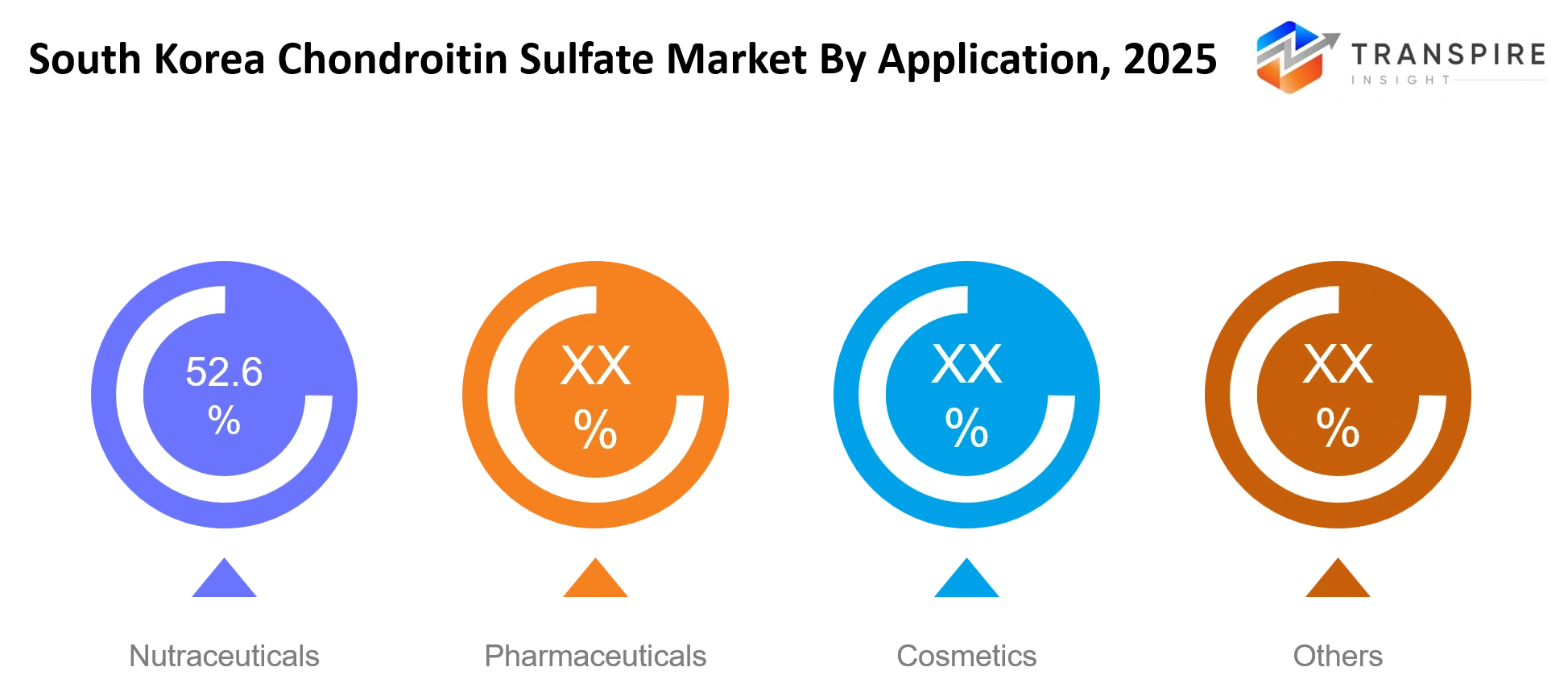
Nutraceuticals, as a lead kind of joint health supplement, are very widely used by aging folks who want daily mobility support, you know, just to keep moving. The need coming in from retail and pharmacy spaces has been going up steadily, especially since preventive health habits are becoming more common. Nowadays product formulas lean toward easier absorption, plus ingredient blends in one go, so it can improve user results and keep those repeat purchases going.
Pharmaceutical usage is also growing, because clinical use for osteoarthritis care is expanding across hospitals and clinics, bit by bit. Cosmetics and personal care still stay somewhat limited, but they are slowly rising, particularly in skin repair and anti aging mixes. Makers are putting money into higher purity grades to satisfy stricter formulation requirements and those regulatory expectations that keep getting tighter.
To learn more about this report, Download Free Sample Report
By End User :
Healthcare providers end up being the key end users, like hospitals and clinics which prescribe or more often recommend chondroitin-based products for all kinds of joint related issues. Pharmacies are also a pretty big part of how things get distributed, helping keep demand steady across city areas and semi urban regions. What people use it for is more tied to long term patient care needs, not those short lived consumption surges you might see from time to time.
On the other side, personal care companies are gradually looking at ingredient integration for skin care and general wellness items, even if their scale is still smaller than what healthcare demand pulls in. There are other end users too, such as contract manufacturers, and supplement brands that assist with production as well as packaging. This whole setup basically helps keep the supply chain stable throughout the South Korea Chondroitin Sulfate Market.
What are the Key Use Cases Driving the South Korea Chondroitin Sulfate Market?
The main use case in the South Korea Chondroitin Sulfate Market is basically dietary supplements for joint wellness support, especially for older consumers who are dealing with osteoarthritis symptoms day to day. This kind of use creates the biggest demand since it slots neatly into routine preventive health habits, and because it’s so easy to find through pharmacies, plus retail nutraceutical outlets, where repeat buying keeps the revenue pretty steady.
There are also broader applications like pharmaceutical-grade formulations, used more directly in clinical osteoarthritis treatment and sometimes even hospital prescriptions. In those settings the higher purity standards matter a lot, they help keep therapeutic results more consistent. Meanwhile nutraceutical brands and contract manufacturers often take chondroitin and pair it in combination products with glucosamine and collagen, sort of to support improved joint mobility outcomes, which helps it spread into structured wellness programs.
More emerging use cases include bio-fermentation-derived medical ingredients, plus newer skin repair based formulations in cosmetic science. On top of that, veterinary joint health supplements for companion animals are getting attention too, helped by the growth of pet healthcare spending and by better formulation quality expectations across regulated ingredient supply chains.
|
Report Metrics |
Details |
|
Market size value in 2025 |
USD 38.2 Million |
|
Market size value in 2026 |
USD 29.6 Million |
|
Revenue forecast in 2033 |
USD 38.2 Million |
|
Growth rate |
CAGR of 3.71% from 2026 to 2033 |
|
Base year |
2025 |
|
Historical data |
2021 - 2024 |
|
Forecast period |
2026 - 2033 |
|
Report coverage |
Revenue forecast, competitive landscape, growth factors, and trends |
|
Country scope |
South Korea |
|
Key company profiled |
TSI Group, Bioiberica, Seikagaku, Synutra, Summit Nutritionals, Solabia, DSM-Firmenich, GNC, NOW Foods, Nature's Bounty, Schiff, Bayer, Sanofi, Amway, Herbalife |
|
Customization scope |
Free report customization (country, regional & segment scope). Avail customized purchase options to meet your exact research needs. |
|
Report Segmentation |
By Source (Bovine, Porcine, Marine, Synthetic, Others); By Application (Nutraceuticals, Pharmaceuticals, Cosmetics, Others); By End User (Healthcare, Personal Care, Others) |
Which Regions are Driving the South Korea Chondroitin Sulfate Market Growth?
Seoul Capital Area kind of leads the South Korea Chondroitin Sulfate Market because it brings together pharmaceutical headquarters, regulatory bodies, and advanced biotech R&D centers. Most of the formulation development and quality testing tends to happen here, while teams have pretty tight access to MFDS compliance systems. Also the dense hospital ecosystem and retail pharmacy chains make demand easier to “see” sooner, and they speed up product validation cycles. With this setup, companies can scale clinical-grade chondroitin products quicker than any other place inside the country, honestly.
Then there’s the Busan–Ulsan–Gyeongnam corridor which works more like a steady production and export support base, not really a formulation hub. Its advantage comes from solid port infrastructure plus established chemical and materials manufacturing capacity, which helps with raw material handling and bulk logistics. Compared with Seoul, this region relies less on research-driven novelty, and more on industrial continuity and export efficiency. Long-term contracts with nutraceutical exporters keep revenue flows relatively stable even when demand starts to wobble a bit.
Meanwhile the Chungcheong region is growing fastest, mostly due to the recent push from the government for biotech park expansions, and also new fermentation facility investments. Daejeon and Sejong have pulled in additional life sciences firms, with support like R&D tax incentives and nearby public research institutions. New production lines for bio-based ingredients have been operating since 2024, so local supply capability has improved. Overall this transition opens up entry options for investors who want scalable manufacturing and export-focused growth through 2033.
Who are the Key Players in the South Korea Chondroitin Sulfate Market and How Do They Compete?
Competition in the South Korea Chondroitin Sulfate Market is still kinda moderately consolidated , you know like a few well-known pharmaceutical and biotech groups hold onto most of the high-purity supply, while the smaller nutraceutical players usually chase downstream product formats. The bigger incumbents try to protect their share by locking in raw material agreements and putting money into fermentation related technology. Meanwhile newer entrants push margins a bit because they can find more cost-efficient sourcing options, plus they lean on contract manufacturing. Over time the real point of competition moved away from just basic pricing, toward production know-how, stronger regulatory compliance, and that steady consistency in pharmaceutical-grade quality.
Daewoong Pharmaceutical is going with a more technology driven differentiation angle, they blend chondroitin into advanced osteoarthritis formulations, backed by clinical validation. They keep strengthening their stance using internal R&D , and also working with biotech suppliers so the fermentation derived input quality stays stable. For growth, they also pursue co-development agreements with nearby research institutes to improve formulation efficiency, and therapeutic results.
Chong Kun Dang Pharmaceutical tends to center its approach on supply reliability and longer hospital procurement contracts, this helps them reduce exposure to retail ups and downs. Daesang Corporation relies on bio-ingredient manufacturing know-how, scaling fermentation based production with an emphasis on cost efficient bulk supply for nutraceutical customers. Kolmar Korea instead focuses on formulation outsourcing, so smaller brands can enter faster by using ready-to-market supplements and cosmetic product development platforms.
Company List
- TSI Group
- Bioiberica
- Seikagaku
- Synutra
- Summit Nutritionals
- Solabia
- DSM-Firmenich
- GNC
- NOW Foods
- Nature's Bounty
- Schiff
- Bayer
- Sanofi
- Amway
- Herbalife
Recent Development News
In March 2026, Daewon Pharmaceutical launched Chondroitin King 1200, a health-functional food containing an individually recognized chondroitin sulfate ingredient approved by South Korea’s Ministry of Food and Drug Safety (MFDS). The launch marked the first use of an individually recognized chondroitin sulfate ingredient in a chondroitin supplement by a domestic pharmaceutical company, strengthening product differentiation in South Korea’s joint-health supplement market. Source https://en.sedaily.com/
In December 2025, ZPD A/S and its Korean partner Daehan Chemtech Co., Ltd. secured MFDS approval for ScanDroitin® as an Individually Recognized Functional Ingredient in South Korea. The certification created a regulatory pathway for broader commercialization of branded chondroitin sulfate ingredients in the Korean nutraceutical market and enhanced market access for premium joint-health formulations. Sourcehttps://zpd.dk/news/
What Strategic Insights Define the Future of the South Korea Chondroitin Sulfate Market?
The South Korea Chondroitin Sulfate Market is kind of structurally moving toward a biotechnology led supply setup where fermentation based production steps in, replacing older animal extraction approaches. This change is being pushed by more strict regulatory expectations around traceability, and also a longer term need for reliable raw material systems that can scale without losing pharmaceutical grade consistency. Over the next five to seven years, “winning” is going to rely more on process control and how well it plugs into advanced bio manufacturing infrastructure, instead of just sourcing efficiency alone.
There is also this not so obvious risk, the supply stream is getting more concentrated among a limited number of fermentation technology providers. If the production platforms get too standardized or if they end up depending on just a few proprietary bioprocess setups, the whole market could get exposed to technology traffic jams, or even licensing constraints. That kind of situation may drag innovation cycles, and also lead to pricing rigidity even while demand keeps expanding across healthcare channels.
On the opportunity side, AI optimized bioprocessing is starting to show up in regional bio industrial clusters, like Chungcheong, where pilot fermentation facilities are ramping up into commercial output. This can support better yield fine tuning and faster quality validation for export grade ingredients. Market players should start investing earlier into vertically integrated fermentation partnerships, because control over upstream production efficiency is what will shape margin leadership and longer term export competitiveness.
South Korea Chondroitin Sulfate Market Report Segmentation
By Source
- Bovine
- Porcine
- Marine
- Synthetic
By Application
- Nutraceuticals
- Pharmaceuticals
- Cosmetics
By End User
- Healthcare
- Personal Care
Frequently Asked Questions
Find quick answers to common questions.
The expected South Korea Chondroitin Sulfate Market size is USD 38.2 Million in 2033.
Key segments for the South Korea Chondroitin Sulfate Market are By Source (Bovine, Porcine, Marine, Synthetic, Others); By Application (Nutraceuticals, Pharmaceuticals, Cosmetics, Others); By End User (Healthcare, Personal Care, Others).
Major South Korea Chondroitin Sulfate Market players are TSI Group, Bioiberica, Seikagaku, Synutra, Summit Nutritionals, Solabia, DSM-Firmenich, GNC, NOW Foods, Nature's Bounty, Schiff, Bayer, Sanofi, Amway, Herbalife.
The South Korea Chondroitin Sulfate Market size is USD 38.2 Million in 2025.
The South Korea Chondroitin Sulfate Market CAGR is 3.71% from 2026 to 2033.
- TSI Group
- Bioiberica
- Seikagaku
- Synutra
- Summit Nutritionals
- Solabia
- DSM-Firmenich
- GNC
- NOW Foods
- Nature's Bounty
- Schiff
- Bayer
- Sanofi
- Amway
- Herbalife
About the Authors

Pankaj Ghogare Patil
I am Pankaj Ghogare Patil, a Senior Research Analyst at Transpire Insight, specializing in the Pharmaceutical, Chemicals & Materials, Healthcare IT, and Biotechnology industry. My expertise lies in conducting comprehensive market research, analyzing industry trends, evaluating competitive landscapes, and translating complex data into actionable insights. At Transpire Insight, I closely follow emerging technologies, regulatory developments, and market innovations to create accurate, well-researched, and informative content that helps businesses and professionals make informed decisions. I am committed to producing credible, evidence-based articles that reflect industry best practices while making technical topics accessible and valuable for a broad audience.

Chakradhar Khansole
Chakradhar serves as the Research Director at Transpire Insight, bringing over 8 years of experience in technology, innovation, and strategic market intelligence. He specializes in transforming complex market data into actionable business insights that enable organizations to make informed, growth-oriented decisions. Recognized for his strategic vision and analytical expertise, Chakradhar leads high-impact research initiatives, delivering comprehensive market assessments, competitive intelligence, and forward-looking industry analysis.
Recently Published Reports
-
May 2026
Healthcare Polymer Packaging Market
Healthcare Polymer Packaging Market Size, Share & Analysis Report By Packaging Type (Syringes, IV Bottles and Pouches, Clamshells, Blisters, Bottles & Jars, Containers, Tubes, IV Parental Packaging, Others), By Type (Regulated, Non-regulated), By Polymer Type (LDPE (Low-Density Polyethylene), HDPE (High-Density Polyethylene), Homo-polymer (Homo), Random Copolymer (Random), Block Copolymer (Block), PET, Polystyrene, Polyvinyl Chloride, Polyamide/EVOH, Others), and Geography (North America, Europe, Asia-Pacific, Middle East and Africa, South and Central America), 2021 - 2031
-
Apr 2026
Hydrophilic Tape (Waterstop) Market
Hydrophilic Tape (Waterstop) Market Size, Share & Analysis Report By Type (Bentonite-Based Hydrophilic Tape, Rubber-Based Hydrophilic Tape), By Application (Residential Buildings, Commercial Buildings, Infrastructure Projects), and Geography (North America, Europe, Asia-Pacific, Middle East and Africa, South and Central America), 2021 - 2031
-
Apr 2026
Metalens Market
Metalens Market Size, Share & Analysis Report By Type (Visible Light Metalens, and Infrared Metalens), By Application (Consumer Electronics, Automotive Electronics, Industrial, Medical, and Others), and Geography (North America, Europe, Asia-Pacific, Middle East and Africa, South and Central America), 2021 - 2031
-
Apr 2026
PBT Resin Market
PBT Resin Market Size, Share & Analysis Report By Type (Reinforced PBT Resin, Unreinforced PBT Resin), By Processing Method (Injection Molding, Extrusion, Blow Molding, Others), By End-User (Automotive, Electrical & Electronics, Consumer Appliances, Industrial Machinery, Medical Devices, Packaging, Others), and Geography (North America, Europe, Asia-Pacific, Middle East and Africa, South and Central America), 2021 - 2031