
Global Phytoestrogen Supplements Market Size & Forecast:
- Global Phytoestrogen Supplements Market Size 2025: USD 4.49 Billion
- Global Phytoestrogen Supplements Market Size 2033: USD 6.47 Billion
- Global Phytoestrogen Supplements Market CAGR: 4.67%
- Global Phytoestrogen Supplements Market Segments: By Type (Soy Isoflavones, Flaxseed Extracts, Red Clover, Herbal Blends), By Application (Menopause, Bone Health, Hormonal Balance, Cardiovascular Health), By End-User (Consumers, Pharma Companies, Supplement Brands, Healthcare Providers)

To learn more about this report,  Download Free Sample Report
Global Phytoestrogen Supplements Market Summary:
The Global Phytoestrogen Supplements Market size is estimated at USD 4.49 billion in 2025 and is anticipated to reach USD 6.47 billion by 2033, growing at a CAGR of 4.67% from 2026 to 2033.
The Phytoestrogen Supplement uses plant compounds, such as soy and red clover, to relieve menopausal discomfort, strengthen bones, and provide a natural way to balance hormones. In the last 3-5 years, the market has evolved from a single soy powder formulation to a mixture of compounds tailored to consumer needs. As a result of the digitalization of healthcare and e-commerce trends, the products became easily available through specialists. Supply shortages, coupled with growing safety concerns about hormonal treatment, forced women to seek out plant-based remedies in real life. Growing demand stems from the aging female population and increased awareness of peri- and post-menopausal conditions, causing customers to buy these supplements and the improved clinical data and growing endorsement by physicians making them easy to promote. The level of competition is moderate, owing to regulatory standards and the need to have strong clinical documentation.
Key Global Phytoestrogen Supplements Market Insights:
- Soy isoflavones are leading with a 38% share, and the ingredient suppliers and ADM are continuing to standardise the genistein/daidzein formulation to achieve clinical-grade isoflavone ingredients.
- The menopause/hormonal health segment accounts for 54.3% revenue, and targeted “one-a-day” blends from Bravura Foods and supplement brands are helping to make dosing easier for symptomatic women.
- Capsules are the leading product format with 45.8% volume, while timed-release capsules from Solaray and others are being introduced to enhance bioavailability and sustained relief.
- Flaxseed extracts have the fastest growth rate with a CAGR of 8.4%, and ingredient innovators are developing optimised lignan concentrates to capture clean-labellers.
- Companies such as Gaia Herbs are promoting red clover as a “safer” synthetic hormone alternative, with high-purity extraction noted.
- Bone-health applications rising 10.1% share, clinical brands (such as Designs for Health) offer a blend of genistein and tocotrienols as a strategy for osteoporosis prevention in older women.
- The largest region is Europe, accounted 38% share, with its regional suppliers and EU regulators demanding standardised extracts and strict safety dossiers to give the market credibility.
- The fastest-growing region is North America at 9.0% share, with NOW Foods and DTC brands achieving conversion of sceptical consumers through omni-channel education and pharmacist/telehealth recommendations.
What are the Key Drivers, Restraints, and Opportunities in the Global Phytoestrogen Supplements Market?
Driver:
The clinical concerns around long-term synthetic HRT have driven peri- and post-menopausal women towards plant-based choices, while guidelines and media coverage in 2022 encouraged clinicians to consider alternative options, influencing retail and pharmacy spend as well as resulting in an increase of revenue for brands with standardised plant extracts. In 2026, the menopause supplement category continued to benefit from consumer caution around long-term synthetic HRT, with UK brands and retailers still promoting standardised soy isoflavone products and related plant-based alternatives.
Restraint:
The regulatory boundaries are not clear, and dosing science is inconsistent, restricting large‑scale procurement and clinician endorsement. This is because there is no one-size-fits-all dosing guideline yet, and responses are affected by individual gut microbiomes and metabolic enzymes. Hence, buyers and prescribers in institutions remain hesitant, and there are no harmonised clinical endpoints or labelling rules globally in major markets.
Opportunity:
Biological uncertainty is addressed, and premium growth can be realised, with personalised nutrition and diagnostics. For instance, using DNA-based hormone profiling alongside telehealth consultations enables better adherence and conversion to phytoestrogen regimens customised for each brand group, based on the DNA profile and microbiome. For the technology: investment in point‑of‑care hormone panels could get clinicians to buy into the idea, while piloting health‑system wellness programs in the region (North America) could open reimbursement avenues—all the while transforming a supplement into a structured preventative care offering.
Instance: In April 2026, North American femtech and personalised nutrition programs continued to combine genetic data, remote consultations, and menopause-focused supplementation to improve adherence and position phytoestrogen regimens as structured preventive care.
What has the Impact of Artificial Intelligence been on the Global Phytoestrogen Supplements Market?
The development of phytoestrogen supplements is becoming quicker, more targeted and more efficient with the help of AI. Machine-learning models in R&D can identify compounds in gigabits of compound libraries and literature that have the potential to be bioactive plant metabolites (such as isoflavones, lignans) and predict which extraction techniques preserve bioactive forms, saving months in the process of ingredient validation. Those leads are then converted into scalable processes in the realm of automation and optimisation – AI-driven control systems adjust the process parameters to maximise potency and minimise solvent consumption, resulting in consistent batches and reduced waste. Predictive functions allow businesses to anticipate consumer needs and offer the most relevant recommendations, while platforms analyse symptom reports, hormone levels, and buying patterns to recommend optimised formulas and timing, enhancing compliance. In operations, AI is used to track supply chains using anomaly detection and blockchain linking to prevent adulteration risks and to optimise sourcing routes for raw materials to minimise lead times.
Limitation: The initial investment and data integration are not without costs: Smaller brands, with less clean clinical and supply data and technical expertise, may experience delays and/or be placed on hold for AI pilots despite their potential benefits.
Instance: A medium-sized U.S. supplement company has ended its AI personalization initiative for 2024 due to low numbers of microbiome outcome data and a threefold cost overrun in implementation, reverting to manual segmentation.
Key Global Phytoestrogen Supplements Market Trends:
- Over time, phytoestrogen supplements have changed from soy pills to better extracts. Brands are now making sure the dose is consistent and clear about how well the body can use these supplements.
- The health and beauty industry is changing. More women want products that doctors agree are good because they want proof before buying.
- People are now looking for products that are tailored to them because they want to know about their hormones and the tiny living things in their bodies. This helps them choose what to buy.
- Digital health is becoming part of what companies offer, and this is because companion apps help brands track symptoms and adjust routines for people.
- Skincare is a way for companies to grow now because they are adding phytoestrogens to products to help with anti-ageing and elasticity.
- People want products that do things, so multi-benefit formulas are replacing single-ingredient capsules. Buyers want one product to support their hormone, bone and heart health.
- E-commerce is getting more popular because shoppers want to buy things, learn about products and buy them again in one place.
- Some regions are doing better than others, while Europe is leading the way when it comes to selling a lot of products. North America is growing faster because people are learning about premium products and wanting to buy them.
Global Phytoestrogen Supplements Market Segmentation
By Type:
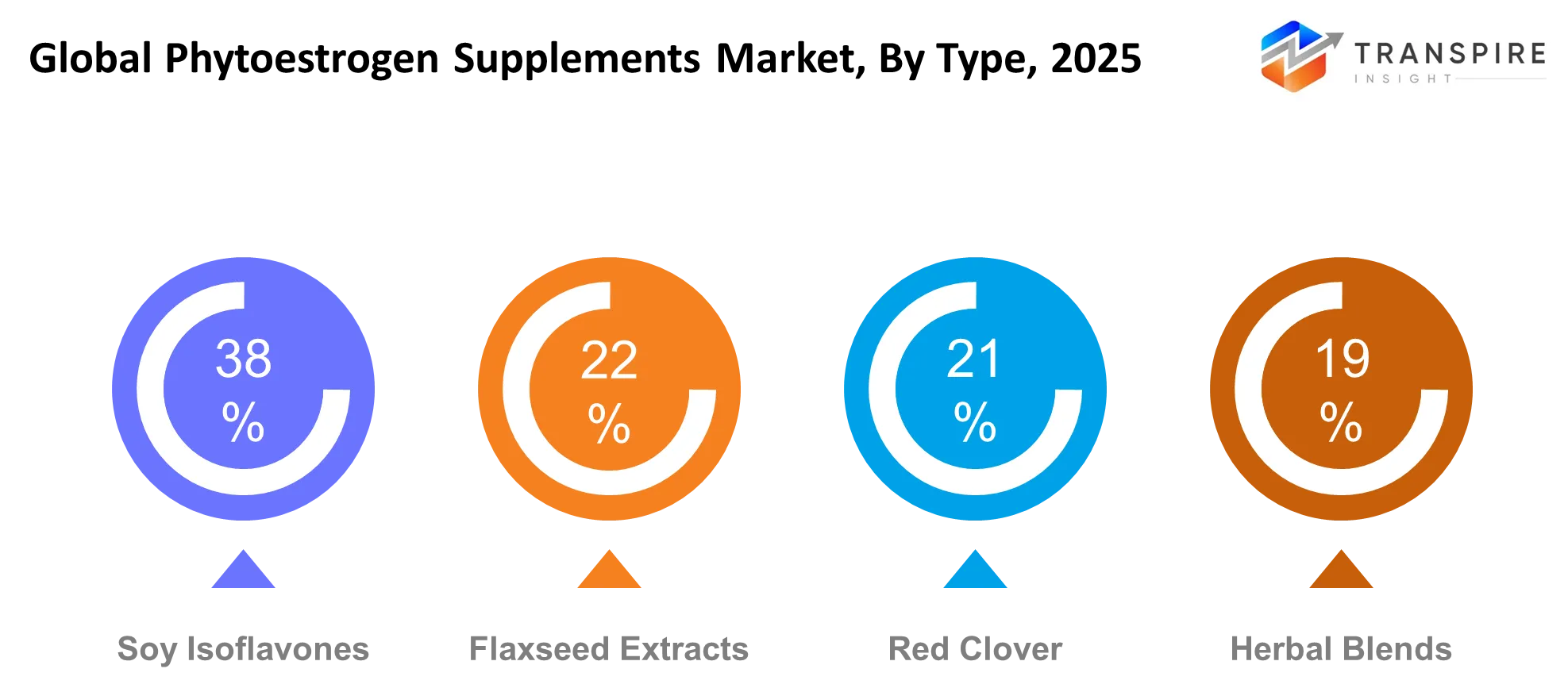
The market for phytoestrogen supplements is still mostly about soy isoflavones. They make up 38 % of the market. Flaxseed extracts are 22 %, red clover is 21 %, and herbal blends are 19 %.Soy isoflavones are still popular because they have been tested a lot, people know about them, and also easy to use in food and pills.Flaxseed extracts are becoming more popular because people want to avoid soy. Red clover and herbal blends are also getting more popular as companies make products with many ingredients.The Global Phytoestrogen Supplements Market will probably have better products in the future because these products will be easier to use, it will work better in the body.
To learn more about this report, Download Free Sample Report
By Application :
Menopause is the reason people use these products, at accounted 62%of share. This is because most people buy them to get relief from flashes and other symptoms. People are also using them for bone health, to balance their hormones, and for cardiovascular health, which are all connected. The products that will be popular next will be the ones that help with all at the same time.
By End-User:
Consumers are the group that Pharma companies, supplement brands and healthcare providers make products look good to people, so that they trust them. Consumers buy a lot of products, while healthcare providers play an important role in building trust, especially those with hormone-related products. Supplement brands are trying things with their products, and pharma companies are keeping an eye on them to see what works. The best products will be ones that can be sold in stores, clinics and online without people losing trust in them.
What are the Key Use Cases Driving the Global Phytoestrogen Supplements Market?
The primary use case for women's hormones remains, particularly in the most prevalent flavonoid niche. Many people are turning to herbal remedies over traditional hormone replacement therapy due to these ingredients providing practical relief of symptoms associated with perimenopause and menopause, including hot flashes.
Further, nutraceuticals and cosmetics are growing the market. Supplements containing isoflavones and lignans are used for antioxidant and anti-inflammatory purposes, and have been associated with bone density, heart and skin elasticity.
There are also new use cases that are becoming available. Fertility support, PCOS, and even prostate health in men are all areas of interest for brands looking at phytoestrogens. The continuous scientific effort on metabolic support and healthful ageing is driving enterprises to formulate more specifically targeted products.
|
Report Metrics |
Details |
|
Market size value in 2025 |
USD 4.49 Billion |
|
Market size value in 2026 |
USD 4.7 Billion |
|
Revenue forecast in 2033 |
USD 6.47 Billion |
|
Growth rate |
CAGR of 4.67% from 2026 to 2033 |
|
Base year |
2025 |
|
Historical data |
2021 - 2024 |
|
Forecast period |
2026 - 2033 |
|
Report coverage |
Revenue forecast, competitive landscape, growth factors, and trends |
|
Regional scope |
United States; Canada; Mexico; United Kingdom; Germany; France; Italy; Spain; Denmark; Sweden; Norway; China; Japan; India; Australia; South Korea; Thailand; Brazil; Argentina; South Africa; Saudi Arabia; United Arab Emirates |
|
Key company profiled |
Amway, Herbalife, GNC, Nature’s Bounty, NOW Foods, Solgar, Swanson, Himalaya, Blackmores, Nature’s Way, Vitabiotics, Jamieson, Garden of Life, Life Extension, Twinlab |
|
Customization scope |
Free report customisation (country, regional & segment scope). Avail customised purchase options to meet your exact research needs. |
|
Report Segmentation |
By Type (Soy Isoflavones, Flaxseed Extracts, Red Clover, Herbal Blends), By Application (Menopause, Bone Health, Hormonal Balance, Cardiovascular Health), By End-User (Consumers, Pharma Companies, Supplement Brands, Healthcare Providers) |
Which Regions are Driving the Global Phytoestrogen Supplements Market Growth?
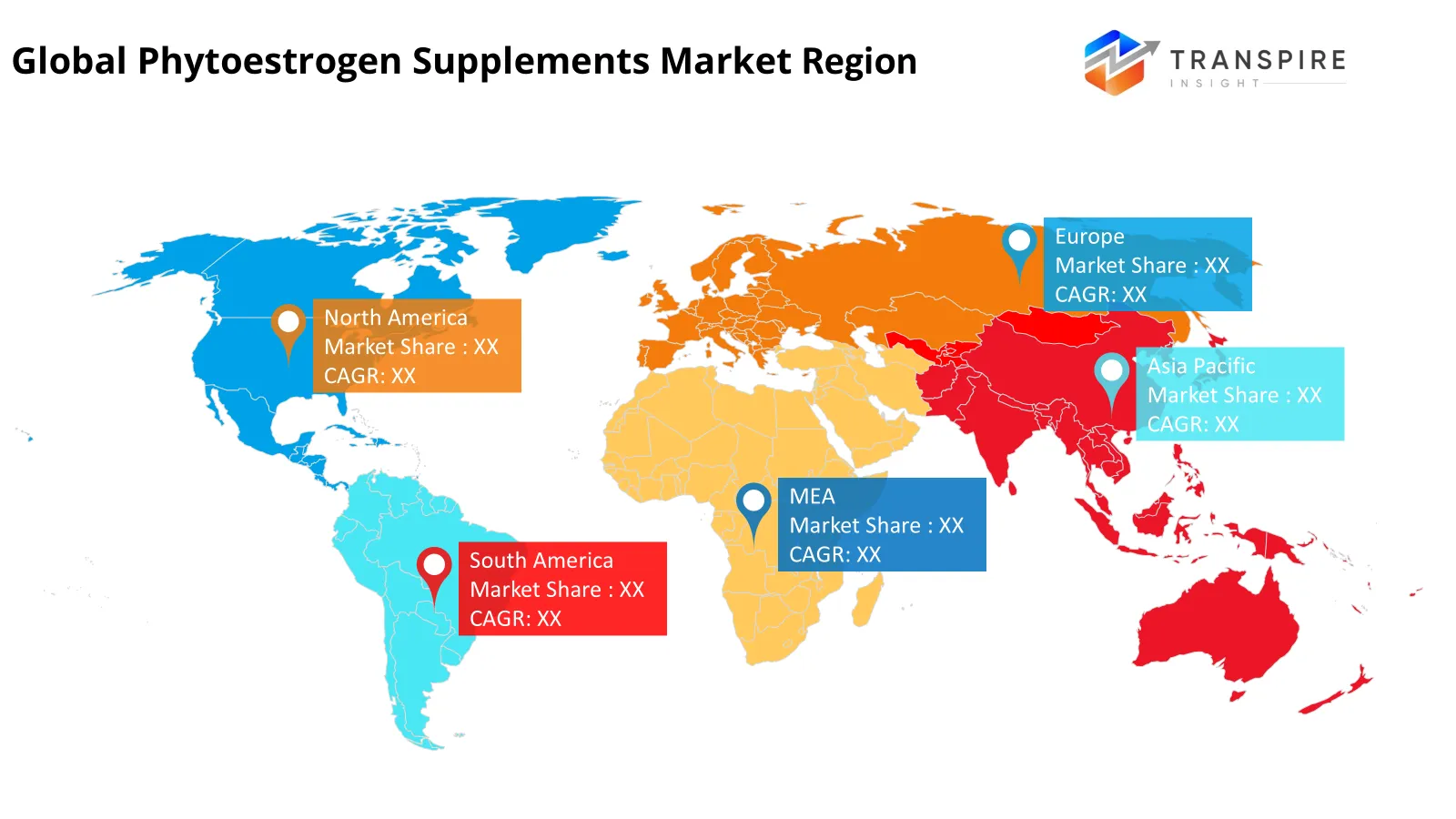
Europe is the market segment where phytoestrogens will be sold, accounting for about 38% of global revenue. This is due to the fact that Europe has a significant number of consumers who are passionate about taking care of themselves during their menopause, and therefore phytoestrogens will become an excellent addition to their health, provided that medical approval has been obtained for their use. Europe has a good regulatory framework, and its pharmaceutical market has very well-developed distribution channels. Therefore, the European market will provide an attractive environment in terms of selling phytoestrogen supplements in a relatively stable manner.
Instance: The rise of lignan‑rich flaxseed products in Germany and France, where pharmacies and clinics are increasingly recommending these for hormone‑related concerns, has been gaining momentum since around 2020–2021 and accelerated through 2023–2025 as demand for plant‑based hormone support and functional foods has grown.
The Asia Pacific region represents the second most extensive market share at approximately 20%, with a growth trend behind that of Europe. The new development comes through with the advent of functional foods and crossovers, whereby phytoestrogen-containing foods become increasingly available to mid-aged women looking to balance their hormones through common foods like beverages, tonics, and enhanced snack foods. The potential remains excellent, with government-sponsored women’s health programs emerging in countries like Japan, China, and India, in addition to increased demand for solutions to conditions like PCOS and fertility.
3Instance: The launch and scaling of Japanese‑style fermented soy‑based phytoestrogen beverages and patches by domestic brands, which are now targeting urban women in Japan, China, and India through digital‑commerce and social‑commerce platforms, has mainly taken place from 2023 to 2025 as demand for hormone‑balance products has grown.
North America is the fastest‑growing region, currently holding about 30–33% of global phytoestrogen supplement revenue, with recent private‑sector analyses pointing to a CAGR around 9.0% over the next decade. It stands out because growth comes from channels and consumers. Women buy this supplement after hearing about phytoestrogen supplements from influencers or wellness sites. The region has manufacturing and supply systems, with flexible rules. This allows companies to innovate and market quickly. Future opportunities lie in building trusted phytoestrogen supplement brands with messaging and strong science. The market is crowded, and Simple and clean labels can help women feel confident in their choices.
To learn more about this report, Download Free Sample Report
Who are the Key Players in the Global Phytoestrogen Supplements Market and how do they Compete?
The marketplace for phytoestrogen supplements is quite competitive, but the real competition is trust! Brands are aiming to win the consumer vote by sourcing clean, backed by clinical evidence, and gaining greater access via ecommerce and retail, but also curbing costs by localizing production and streamlining supply chains. This creates a market that can look like the same products on paper, and companies rely on the quality of their formulations, transparency and the credibility of their brands to differentiate themselves.
In Nature's Way, Foods and Solgar battle it out with innovation; they strive to provide plant-based formulas, increased quality testing, and a digital-first selling approach to make it easier for customers to purchase and feel more confident. ADM follows a cost strategy, using its scale to supply non-GMO isoflavone ingredients efficiently and secure raw material partnerships across North America and Europe. Herbalife, GNC and Amway are more distribution-focused, with wide retail and direct selling networks for visibility. Life Extension, Garden of Life, Himalaya, Blackmores and Vitabiotics are in the niche lane and stand out in terms of their focused wellness positioning, superior formulations and health education.
Key Players are :
- Amway
- Herbalife
- GNC
- Nature’s Bounty
- NOW Foods
- Solgar
- Swanson
- Himalaya
- Blackmores
- Nature’s Way
- Vitabiotics
- Jamieson
- Garden of Life
- Life Extension
- Twinlab
Recent Development News
- In February 2026, Monterey Bay Herb Co. acquired NP Nutra. The transaction extends its botanical extract supply chain to more than 1,000 herbal and nutraceutical extract portfolio it has now. Source: https://www.lovelifesupplements.co.uk
- In December 2025, Makers Nutrition released strategic guidance for botanical formulation. The guidance guides the transition to clean-label, science-based lines of supplements for brands targeting the soy isoflavones, red clover, and flaxseed lignans category. Source: https://www.makersnutrition.com
What Strategic Insights Define the Future of the Global Phytoestrogen Supplements Market?
Market dynamics are evolving from ‘quick symptom fixes' to complete ‘hormonal care' tactics—personalised stacks, lifestyle coaching and products that are supported by clinician signatories and linked to telehealth will be responsible for growth. One of the short-term opportunities is synbiotic formulations where phytoestrogens are combined with targeted probiotics/prebiotics to enhance the microbial conversion to active metabolites and thus develop defensible differentiation. Conduct small controlled microbiome-related trials to produce clinician-grade evidence, useful in clinician dossiers, and useful to clear consumer claims, and roll out first in markets where supplement rules are clearer (EU/UK) to build credibility before broader rollout.
Meanwhile, the mix of raw materials from different suppliers can cause batch-to-batch variation, which can undermine claims and result in expensive returns. Formulate the product as an asset, and perform quantitative release testing: establish long-term contracts with quality-assessed growers; test delivery technologies (lipid carriers, microencapsulation) that will stabilise bioactive fractions and provide consistent pharmacokinetics. Consistent exposure will yield clinician referrals, top shelf retail shelves and continued customer loyalty, and thereby create an ongoing care productout of a wellness product.
Key Segmentations are:
By Type
- Soy Isoflavones
- Flaxseed Extracts
- Red Clover
- Herbal Blends
By Application
- Menopause
- Bone Health
- Hormonal Balance
- Cardiovascular Health
By End-User
- Consumers
- Pharma Companies
- Supplement Brands
- Healthcare Providers
Regional Outlook
North America
- United States
- Canada
- Mexico
Europe
- Germany
- United Kingdom
- France
- Spain
- Italy
- Rest of Europe
Asia Pacific
- Japan
- China
- Australia & New Zealand
- South Korea
- India
- Rest of Asia Pacific
South America
- Brazil
- Argentina
- Rest of South America
Middle East & Africa
- Saudi Arabia
- United Arab Emirates
- South Africa
- Rest of the Middle East & Africa
Frequently Asked Questions
Find quick answers to common questions.
The expected global phytoestrogen supplements market size for the market will be USD 6.47 Billion in 2033.
Key segments for the global phytoestrogen supplements market are By Type (Soy Isoflavones, Flaxseed Extracts, Red Clover, Herbal Blends), By Application (Menopause, Bone Health, Hormonal Balance, Cardiovascular Health), By End-User (Consumers, Pharma Companies, Supplement Brands, Healthcare Providers).
Major global phytoestrogen supplements market players are Amway, Herbalife, GNC, Nature’s Bounty, NOW Foods, Solgar, Swanson, Himalaya, Blackmores, Nature’s Way, Vitabiotics, Jamieson, Garden of Life, Life Extension, Twinlab.
The global phytoestrogen supplements market size is USD 4.49 Billion in 2025.
The global phytoestrogen supplements market CAGR is 4.67%.
- Amway
- Herbalife
- GNC
- Nature’s Bounty
- NOW Foods
- Solgar
- Swanson
- Himalaya
- Blackmores
- Nature’s Way
- Vitabiotics
- Jamieson
- Garden of Life
- Life Extension
- Twinlab
About the Authors

Pankaj Ghogare Patil
I am Pankaj Ghogare Patil, a Senior Research Analyst at Transpire Insight, specializing in the Pharmaceutical, Chemicals & Materials, Healthcare IT, and Biotechnology industry. My expertise lies in conducting comprehensive market research, analyzing industry trends, evaluating competitive landscapes, and translating complex data into actionable insights. At Transpire Insight, I closely follow emerging technologies, regulatory developments, and market innovations to create accurate, well-researched, and informative content that helps businesses and professionals make informed decisions. I am committed to producing credible, evidence-based articles that reflect industry best practices while making technical topics accessible and valuable for a broad audience.

Chakradhar Khansole
Chakradhar serves as the Research Director at Transpire Insight, bringing over 8 years of experience in technology, innovation, and strategic market intelligence. He specializes in transforming complex market data into actionable business insights that enable organizations to make informed, growth-oriented decisions. Recognized for his strategic vision and analytical expertise, Chakradhar leads high-impact research initiatives, delivering comprehensive market assessments, competitive intelligence, and forward-looking industry analysis.
Recently Published Reports
-
Jul 2026
Alopecia Treatment Market
Alopecia Treatment Market Size, Share & Analysis Report By Disease Type (Alopecia Areata, Cicatricial Alopecia, Traction Alopecia, Alopecia Totalis, Androgenetic Alopecia, Alopecia Universalis, and Other Disease Types), By Treatment Type (Topical Treatments, Oral Medications, Injectable Therapies, and Hair Transplantation), By Gender (Male, and Female), By Distribution Channel (Hospitals and Clinics, Retail Pharmacies, and Online Retailers), and Geography (North America, Europe, Asia-Pacific, Middle East and Africa, South and Central America), 2021 - 2031
-
Jul 2026
Medical Ultrasound Probe Market
Medical Ultrasound Probe Market Size, Share & Analysis Report By Type (Linear Type, Convex Type, Endocavitary Probe, Phased Array/Cardiac Probe, Transesophageal (TEE) Probe, and Others), By Application (Ophthalmology, Cardiology, Musculoskeletal, Oncology, Obstetrics & Gynecology, General Imaging, and Others), By End User (Hospitals & Clinics, Diagnostic Centers, Ambulatory Surgical Centers, and Others), and Geography (North America, Europe, Asia-Pacific, Middle East and Africa, South and Central America), 2021 – 2031
-
May 2026
Biosimilars Market
Biosimilars Market By Product Type (Monoclonal Antibodies, Recombinant Hormones, Erythropoietin, G-CSF, Others), By Indication (Oncology, Autoimmune Diseases, Blood Disorders, Diabetes, Others), By Manufacturing Type (In-House Manufacturing, Contract Manufacturing), By Distribution Channel (Hospital Pharmacies, Retail Pharmacies, Online Pharmacies), By Industry Analysis, Size, Share, Growth, Trends, and Forecasts 2021-2033
-
Apr 2026
Gastrointestinal Endoscopy Market
Gastrointestinal Endoscopy Market By Type (Rigid Gastrointestinal Endoscope, Flexible Gastrointestinal Endoscopes, Disposable Gastrointestinal Endoscope), By Procedure Type (Colonoscopy, Gastroscopy, Duodenoscopy, Enteroscopy, Flexible Sigmoidoscopy, Others), By Application (Diagnosis, Treatment), By End-Users (Hospitals, Ambulatory Surgical Centers, Specialty Clinics, Laboratories, Others), By Industry Analysis, Size, Share, Growth, Trends, and Forecasts 2021-2033