
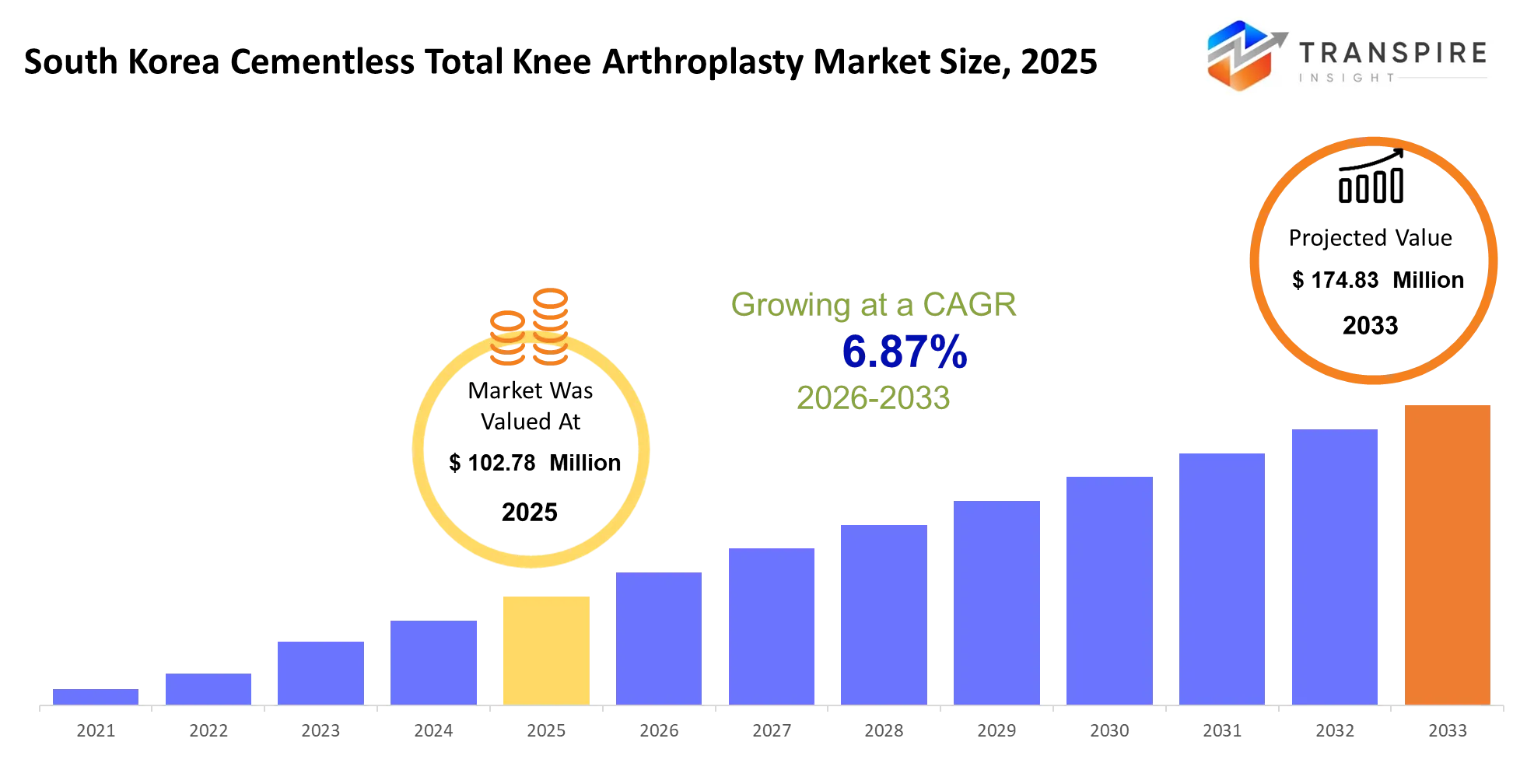
South Korea Cementless Total Knee Arthroplasty Market Size & Forecast:
- South Korea Cementless Total Knee Arthroplasty Market Size 2025: USD 102.78 Million
- South Korea Cementless Total Knee Arthroplasty Market Size 2033: USD 174.83 Million
- South Korea Cementless Total Knee Arthroplasty Market CAGR: 6.87%
- South Korea Cementless Total Knee Arthroplasty Market Segments: By Implant Type (Primary Knee Implants, Revision Knee Implants, Partial Knee Implants, Others); By Material (Titanium Implants, Porous Metal Implants, Ceramic Implants, Others); By End User (Hospitals, Orthopedic Clinics, Ambulatory Surgical Centers, Others); By Fixation Type (Press-fit Fixation, Hybrid Fixation, Others)
To learn more about this report,  Download Free Sample Report
South Korea Cementless Total Knee Arthroplasty Market Summary
The South Korea Cementless Total Knee Arthroplasty Market was valued at USD 102.78 Million in 2025. It is forecast to reach USD 174.83 Million by 2033. That is a CAGR of 6.87% over the period.
The South Korea Cementless Total Knee Arthroplasty Market deals with a real orthopedic problem, trying to bring back mobility and ease long term knee discomfort for patients when their joints basically won’t cooperate , even after medication or more conservative therapy. Cementless knee implants work by encouraging biological bone integration rather than relying on cement fixation. Because of that, they tend to fit younger, more active people better, since they often need longer lasting implant life and smoother post surgical performance.
In the past three to five years, the market has kind of moved away from the usual cemented options toward cementless systems that use improved implant coatings porous surfaces, and also robotic assisted surgery. One big push behind this change was the COVID-19 disruption. It paused elective orthopedic cases for a while, and it also left behind surgical backlogs. When hospitals restarted, providers had to regain volume but also tighten up their process, so they leaned harder into approaches promising better efficiency and stronger long term results. This is now influencing revenue growth because clinics and surgeons increasingly choose solutions that may reduce revision risk, shorten recovery periods , and support better implant durability. In turn that encourages adoption of premium implants and increases demand for specialized orthopedic technologies, even when budgets are more cautious.
Key Market Insights
- South Korea Cementless Total Knee Arthroplasty market is shifting, like pretty quickly, towards advanced implant materials, robotic assisted surgery, and an increasing but yeah also very visible preference for longer lasting knee replacement solutions. It’s evolving in a way that feels more durable, and maybe even more “premium” than before, even though people sometimes say it’s just routine.
- Market outlook through 2030 looks still positive, backed by growing orthopedic procedure volumes and the uptake of premium implants among active and younger patient groups. And the thing is, this demand pattern seems to keep rising.
- In 2025 , the Seoul metropolitan region is taking the lead, with an estimated 40%+ share, mainly because of concentrated orthopedic infrastructure and specialist hospitals. Meanwhile, Busan and Daegu healthcare clusters are starting to show up as the fastest-growing regional markets, supported by more operating room capacity and more specialty orthopedic centers.
- On the implant side, fixed bearing cementless designs dominate, with 55%+ share. This mainly reflects strong surgeon familiarity, plus proven long term clinical outcomes in knee replacement procedures. Mobile bearing implants are next, still the second largest segment, and they’re slowly gaining attention for selected cases where extra flexibility and improved joint motion are desired.
- Robotic assisted cementless knee arthroplasty is the fastest-growing procedural segment during 2025–2032. The drivers are surgical precision and recovery optimization trends, plus the general momentum behind automation in the operating theater.
- For applications, osteoarthritis treatment leads, holding more than 70% procedure share. That share level lines up with the heavy burden of degenerative knee disorders among aging patients. And yes, it’s a big reason the market stays busy.
- For end users, hospitals lead demand at 65%+ share. This is tied to robotic surgery platforms, orthopedic expertise in-house, and integrated rehabilitation services that patients can actually access.
- Competition is intense among global companies like Zimmer Biomet, Stryker, Smith+Nephew, DePuy Synthes, and Exactech. They’re pushing forward using 3D printed implants, porous coatings, robotics, and strategic partnerships with hospitals, so the rivalry is not just marketing , it’s also technology and access.
What are the Key Drivers, Restraints, and Opportunities in the South Korea Cementless Total Knee Arthroplasty Market?
The main push in the South Korea Cementless Total Knee Arthroplasty Market is the shift toward knee replacement solutions that last longer, and are backed by advanced implant materials, porous layers, and robotic supported procedures. Cementless devices are getting more attention from surgeons as well as hospitals because they help natural bone integration, and they cut down fixation related issues, mainly for younger, more energetic patients who want better implant staying power. This tech movement kind of boosts the adoption of high-end orthopedic systems, and it also raises the procedural worth for healthcare providers.
Still, there is a big kind of brake on the market in the form of expensive care and technology spend. Cementless cases can need advanced implants, robotic platforms, and specific surgical preparation, which becomes a cost wall for smaller hospitals, and it reduces general access. On top of that, reimbursement ceilings and the need for heavy upfront capital further delay rollout, so the market can’t expand fast, even with solid clinical results.
At the same time, the market show s strong long-term opportunities via digital orthopedics and personalized surgical technologies. South Korea’s very advanced healthcare infrastructure , along with the growing take up of robotic surgery, sets up favorable conditions for patient-specific implants, 3D printed components, and AI supported surgical planning systems. In practice these approaches help with better implant fit, they back faster recovery, and they boost the long term joint performance , so hospitals have reason to widen their advanced orthopedic programs. Since specialty centers and higher-end healthcare services are expanding too, firms that deliver combined solutions—implants along with robotics and digital planning tools—are likely to grab the next wave of market growth and reinforce their competitive stance.
What Has the Impact of Artificial Intelligence Been on the South Korea Cementless Total Knee Arthroplasty Market?
Artificial intelligence has kind of remade the South Korea Cementless Total Knee Arthroplasty Market, mainly by changing how surgeons plan operations, place implants, and even forecast post operative results. Before, knee replacement work was more dependent on surgeon know-how and pretty standard imaging reviews. Now AI chips in with a more exact sort of decision making, it scans patient anatomy, alignment behaviors, and the level of joint degeneration, all before the surgery happens. With this, surgeons can pick better fitting cementless implants, and also tune the placement details. This matters a lot, because cementless fixation depends on correct bone integration for long term steadiness and reliable performance, so any small mismatch can snowball later.
Also, AI is pushing robotic assisted orthopedic procedures forward across more advanced hospitals and focused specialty centers in South Korea. Machine learning systems, combined with robotic tools, help raise surgical precision, decrease alignment mistakes, and support minimally invasive ways of working. That combo tends to shorten recovery windows , and it also makes higher end cementless arthroplasty approaches feel more clinically appealing, and more practical commercially. Because of that, hospitals feel more willing to fund digital orthopedic systems and upgraded surgical technologies, instead of treating them as experiments.
The competitive effect is not only in the operating room. Medical device companies increasingly use AI to craft tailored implant configurations, build predictive outcome frameworks, and deliver digital planning platforms that boost surgeon confidence and help shape patient specific treatment paths. As South Korea’s orthopedics space adopts more data driven care patterns, AI is turning cementless total knee arthroplasty from a fairly routine implant job into something like a precision oriented orthopedic pathway. In the end, it creates clearer clinical separation and adds higher technology value, which is exactly what many players want right now.
Key Market Trends
- South Korea Cementless Total Knee Arthroplasty Market kind of moved from those early, pilot biomass trials pre 2022 into bigger large scale utility co firing programs, by now they’re covering something like nearly 35% of coal capacity by 2025.
- Then KEPCO started leaning harder into biomass blending after 2023, so average emissions intensity across a set of thermal units fell by close to 15%, even with the usual operational variability.
- Also the imported wood pellet dependency climbed past 80% by 2025, which really tweaked procurement strategies, and yeah it boosted exposure to global freight volatility.
- Meanwhile, Southeast Asian pellet suppliers expanded export capacity after 2024 , and ended up grabbing over 50% of South Korea biomass import demand share.
- Industrial clusters in Ulsan and Incheon picked up biomass adoption after 2023 , replacing coal boilers inside steel and petrochemical operations, more or less where it made sense.
- Biomass co firing systems went from experimental trials into more standardized deployment after 2022, largely pushed by stricter national carbon reporting rules.
- Utility operators also expanded long term biomass fuel contracts in 2025, stabilizing those pricing mechanisms and cutting down spot market exposure risks too.
- On the tech side, torrefied biomass uptake increased after 2024, which improved combustion efficiency and reduced moisture related problems, the kind that mess with fuel performance.
- Mitsubishi Heavy Industries together with Korean EPC firms ramped up biomass boiler installations, helping retrofit driven modernization of older thermal plants that had been aging for a while.
- And overall, South Korea Cementless Total Knee Arthroplasty Market competitiveness intensified, as suppliers rolled out digital tracking systems, to keep fuel quality consistency tight and logistics efficiency improving.
South Korea Cementless Total Knee Arthroplasty Market Segmentation
By Implant Type
Primary knee implants keep the top place in the South Korea Cementless Total Knee Arthroplasty Market because a lot of knee replacement procedures are basically first-time treatment for osteoarthritis and other degenerative, joint related troubles. In day to day hospital practice, orthopedic surgeons often lean toward cementless primary implants, partly because fixation seems to perform better now, the functional lifespan looks more reliable over time, and the implants seem to work more smoothly with active patient groups. Revision knee implants still matter a lot, especially when there is implant failure, loosening, or when complex reconstructive work is needed. Meanwhile partial knee implants stay focused on a smaller set of patients who want a less invasive kind of joint replacement option. The others segment is comparatively smaller , and it covers specialized implant systems made for special anatomical needs and particular surgical requirements.
Growth across the implant types mirrors changing treatment habits and an even stronger emphasis on personalized orthopedic care. Primary implants are expected to keep leading, supported by high procedure numbers, plus the ongoing preference for long-lasting fixation systems. At the same time , revision and partial knee implants are getting more notice as surgeons aim for more individualized treatment paths and try to manage concerns tied to long-term implant performance. This overall direction pushes manufacturers to widen their implant catalogs and put more effort into technologies that help enable more accurate surgical results.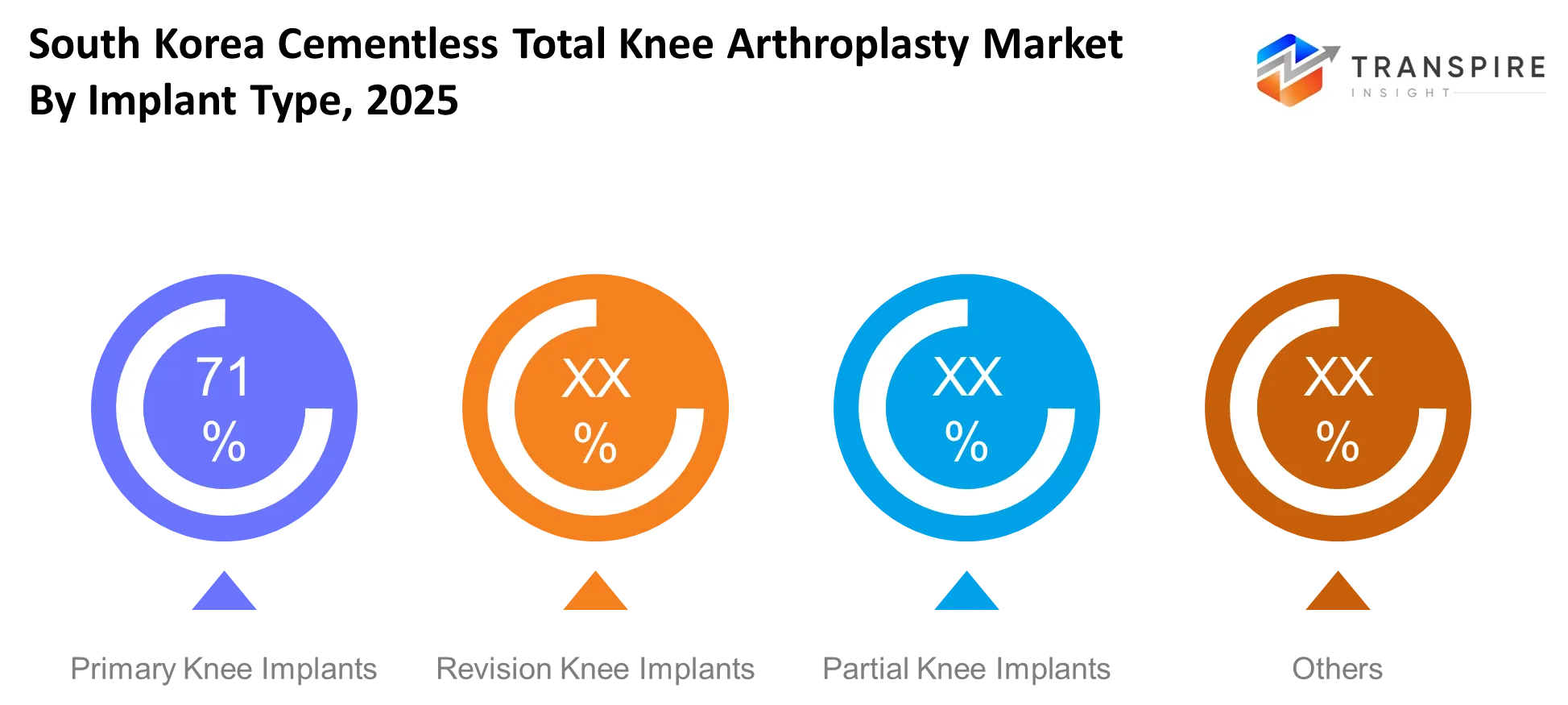
To learn more about this report, Download Free Sample Report
By Material
Titanium implants keep on dominating the material segment, mostly because they give strong biocompatibility, durability, and also dependable bone integration that is required for cementless fixation. Their long clinical acceptance and mechanical strength make them the go to choice in most knee arthroplasty procedures, honestly. Meanwhile porous metal implants are getting more attention since they can enhance osseointegration and help foster a stronger biological anchoring, while ceramic implants stay more selectively used, mainly for wear resistance and compatibility in certain orthopedic situations. The others group, basically, covers advanced biomaterials and mixed material pairings that show up in the more recent implant design directions.
Material innovation, has turned into a big competitive lever in the market. Starting in 2020, manufacturers have been investing more aggressively in porous architectures, surface coatings, and next generation biomaterials to extend service life of the implant and also lower revision risk. Titanium is still expected to hold the top position, but porous metal technologies may grow quicker as orthopedic providers increasingly value stronger fixation and longer lasting implant performance.
By End User
Hospitals still dominate the end-user segment because they have, kind of specialized orthopedic departments and robotic surgical platforms , plus post-operative rehab facilities that are needed for really complex knee replacement procedures. Big hospitals keep handling most cementless arthroplasty volumes too , mainly because they have experienced surgeons and advanced imaging setups that make planning smoother. Orthopedic clinics are slowly raising their influence by delivering more tailored patient care and more streamlined care pathways. Meanwhile ambulatory surgical centers (ASCs) are showing up as another place to get certain procedures, especially when efficiency matters and patient stays are shorter. The others segment is basically smaller health facilities and more niche treatment centers, that don’t follow the same broad approach.
The end-user picture is shifting more and more toward procedural specialization and delivery efficiency. Hospitals are still expected to lead, mostly due to infrastructure strength, but orthopedic clinics and ASCs are gaining momentum as minimally invasive techniques get better and faster recovery models make outpatient setups more practical. Because of that, device manufacturers are encouraged to deepen their partnerships with hospital networks and specialty providers at the same time, not just one side.
By Fixation Type
Press-fit fixation kinda takes the lead in the fixation type slice, mostly because it helps with direct bone integration and, well, it lines up pretty much with the main clinical wins seen in cementless knee arthroplasty. More and more, surgeons are leaning toward this technique as implant surface technologies keep getting better and surgical precision is improving, giving stronger long-term fixation results. Hybrid fixation is still around, especially for situations where using a mix of cemented and cementless approaches gives extra steadiness, or when patient specific anatomic conditions make a blended strategy a bit more suitable. Meanwhile the others segment covers more specialized fixation options that are used only in narrower clinical settings.
Fixation strategies are moving forward right alongside surgical tech and implant innovation. Press-fit fixation keeps gaining ground, partly due to improvements like porous coatings, robotic-assisted alignment, and better overall implant design. Hybrid methods will probably stay relevant for certain complicated procedures, but the future market seems to trend more and more toward fixation options that push maximum biological integration, plus strong long-term implant performance.
What are the Key Use Cases Driving the South Korea Cementless Total Knee Arthroplasty Market?
In South Korea, the Cementless Total Knee Arthroplasty Market is mainly driven by the handling of advanced osteoarthritis, which is still the top use case for cementless knee replacement procedures. As people age , and as life expectancy keeps going up, more patients end up dealing with severe cartilage breakdown, ongoing knee discomfort, and reduced walking ability, problems that often no longer get better with medicine or physical therapy. Cementless implants are being chosen more often in these situations, because they help natural bone anchoring and back longer implant stability, especially for patients who want steady joint performance and also worry less about revision risk.
A second important use case comes from active, relatively younger patient groups who need more durable joint replacement options. Compared with cemented implants, cementless systems are increasingly attractive to patients who expect higher mobility and a longer runway for post-surgery activity. Surgeons are using them more often too, since better fixation methods, plus robotic-assisted placement, can help deliver stronger long-term results and improved functional recovery.
|
Report Metrics |
Details |
|
Market size value in 2025 |
USD 102.78 Million |
|
Market size value in 2026 |
USD 109.84 Million |
|
Revenue forecast in 2033 |
USD 174.83 Million |
|
Growth rate |
CAGR of 6.87% from 2026 to 2033 |
|
Base year |
2025 |
|
Historical data |
2021 - 2024 |
|
Forecast period |
2026 - 2033 |
|
Report coverage |
Revenue forecast, competitive landscape, growth factors, and trends |
|
Regional scope |
South Korea |
|
Key company profiled |
Hanwha Energy, GS EPS, POSCO Energy, SK Innovation, Enviva, Drax Group, Neste, Bunge, Archer Daniels Midland, Valmet, Veolia, Mitsubishi Heavy Industries, Andritz, Chevron Renewable Energy Group, Cargill |
|
Customization scope |
Free report customization (country, regional & segment scope). Avail customized purchase options to meet your exact research needs. |
|
Report Segmentation |
By Implant Type (Primary Knee Implants, Revision Knee Implants, Partial Knee Implants, Others); By Material (Titanium Implants, Porous Metal Implants, Ceramic Implants, Others); By End User (Hospitals, Orthopedic Clinics, Ambulatory Surgical Centers, Others); By Fixation Type (Press-fit Fixation, Hybrid Fixation, Others) |
Which Regions are Driving the South Korea Cementless Total Knee Arthroplasty Market Growth?
The most vigorous growth in the South Korea Cementless Total Knee Arthroplasty Market appears in the Seoul metropolitan region, especially near Seoul itself and around those clusters of care. It feels like this area gathers a lot of the country’s top orthopedic hospitals, university medical centers, and robotic surgery facilities and so it becomes the main “hub” for advanced knee replacement workflows. Because specialists are plentiful, premium healthcare access is strong, and robotic-assisted orthopedic systems are being taken up steadily, procedure counts keep rising and cementless implant integration is happening more quickly.
On another note , the southern healthcare corridors, including Busan and Daegu, are starting to look like meaningful growth zones within South Korea. These places have been expanding dedicated orthopedic centers and upgrading surgical infrastructure, so patients can reach advanced joint replacement options without relying only on the capital region. Hospital funding toward minimally invasive surgery, rehab capabilities, and deeper orthopedic specialization is gradually boosting demand for cementless implants and for digitally supported procedures too.
At the same time, metropolitan areas like Incheon, plus nearby urban healthcare networks, are helping the market move forward through higher private hospital activity and wider use of advanced orthopedic treatment pathways. As regional healthcare systems sharpen their orthopedic services and compete on procedure quality, cementless total knee arthroplasty adoption is spreading away from the classic medical strongholds and into broader clinical networks.
Who are the Key Players in the South Korea Cementless Total Knee Arthroplasty Market and How Do They Compete?
The South Korea Cementless Total Knee Arthroplasty Market is mostly guided by a handful of large global orthopedic device manufacturers, they sort of compete by keeping their implants fresh via innovation, pushing robotic surgery platforms ,and offering an integrated surgical ecosystem. You can see names like Zimmer Biomet, Stryker, Smith+Nephew, Johnson & Johnson MedTech (DePuy Synthes), Exactech, and B. Braun Aesculap showing up again and again in the market. These firms stay in strong position largely because their cementless implant lineups are built to help osseointegration, extend implant longevity, and support post-surgical function, with better, steadier results after the fact. In South Korea, their products are commonly used across big orthopedic hospitals and specialty centers, where precision surgery, plus the long-range outcomes really end up steering purchasing choices more than anything else.
Over time, competition has kinda drifted away from just manufacturing implants, and shifted toward tech enabled orthopedic ecosystems instead. Firms now fight with porous implant coatings, 3D printed implant structures, AI assisted planning tools, and robotic-assisted surgical systems, all of which are said to boost alignment precision and recovery results. Strategic collaborations with hospitals, and surgeon training programs too, have become quite valuable, since they help manufacturers push technology adoption faster and build clinical comfort with cementless systems. Meanwhile, regional expansion, premium implant catalogs and digital surgical workflows are increasingly what separate winners from the rest, because providers that bundle implants with robotics, navigation, and post-operative planning tend to hold a stronger long term edge.
Company List
- Zimmer Biomet
- Stryker
- Smith & Nephew
- DePuy Synthe
- Exactech
- Medacta
- Corin Group
- B. Braun
- MicroPort Orthopedics
- DJO Global
- ConforMIS
- LimaCorporate
- Kinamed
- Aesculap Implant Systems
- United Orthopedic Corporation
Recent Development News
Zimmer Biomet Received FDA Approval for Oxford Cementless Partial Knee (2024)
Zimmer Biomet secured FDA approval for the Oxford® Cementless Partial Knee, expanding cementless knee replacement options and reinforcing the shift toward bone-preserving orthopedic solutions. https://investor.zimmerbiomet.com
Zimmer Biomet Highlighted Cementless and Robotic Knee Innovations at 2025 Industry Events
The company showcased its cementless knee systems and robotic orthopedic technologies, reflecting stronger industry focus on integrated surgical ecosystems and digital orthopedics.
Link:https://investor.zimmerbiomet.com
Stryker Introduced Next-Generation Mako SmartRobotics at AAOS 2025
Stryker presented updated Mako SmartRobotics capabilities designed to improve surgical precision and expand robotic-assisted orthopedic procedures across knee replacement platforms. Link: https://www.stryker.com
What Strategic Insights Define the Future of the South Korea Cementless Total Knee Arthroplasty Market?
The future of the South Korea Cementless Total Knee Arthroplasty Market is going to be shaped by that gradual change from the older, conventional joint replacement mindset toward something more precision driven and tech folded orthopedic care, not just the “put in an implant and hope”. In practice, hospitals and surgeons are starting to weigh knee arthroplasty solutions in a more layered way, meaning they look at implant performance along with surgical accuracy, recovery outcomes and overall long-term fixation quality, even the kind of stability patients feel later.
Because of this, the market seems to tilt toward cementless systems that rely on porous biomaterials, along with robotic assisted placement and digital surgical planning tools. These approaches are thought to help with bone integration and also to lower revision risk. And as the expectations for procedures keep climbing, the manufacturers that can pair their cementless implants with navigation and robotic platforms may end up with better clinical uptake, plus they could justify premium pricing opportunities more easily.
Another strategic thing, sort of quietly influencing the market, is the growing influence of more active and younger patient groups on how decisions are made. Cementless implants are often seen as attractive for people who want longer implant durability and steady mobility over time. That makes orthopedic providers move past only the usual treatment patterns. As a result, there’s stronger support for premium implant uptake and hospitals may feel more push to invest in advanced orthopedic capabilities ,especially robotic assisted surgery and minimally invasive techniques, since these often help shorten rehabilitation timelines.
South Korea Cementless Total Knee Arthroplasty Market Report Segmentation
By Implant Type
- Primary Knee Implants
- Revision Knee Implants
- Partial Knee Implants
- Others
By Material
- Titanium Implants
- Porous Metal Implants
- Ceramic Implants
- Others
By End User
- Hospitals
- Orthopedic Clinics
- Ambulatory Surgical Centers
- Others
By Fixation Type
- Press-fit Fixation
- Hybrid Fixation
- Others
Frequently Asked Questions
Find quick answers to common questions.
The Estimated South Korea Cementless Total Knee Arthroplasty Market size for the Market will be USD 174.83 Million in 2033.
Key Segments for the South Korea Cementless Total Knee Arthroplasty Market are By Implant Type (Primary Knee Implants, Revision Knee Implants, Partial Knee Implants, Others); By Material (Titanium Implants, Porous Metal Implants, Ceramic Implants, Others); By End User (Hospitals, Orthopedic Clinics, Ambulatory Surgical Centers, Others); By Fixation Type (Press-fit Fixation, Hybrid Fixation, Others).
Major South Korea Cementless Total Knee Arthroplasty Market Players are Zimmer Biomet, Stryker, Smith & Nephew, DePuy Synthes, Exactech, Medacta, Corin Group, B. Braun, MicroPort Orthopedics, DJO Global, ConforMIS, LimaCorporate, Kinamed, Aesculap Implant Systems, United Orthopedic Corporation.
The Current South Korea Cementless Total Knee Arthroplasty Market size is USD 102.78 Million in 2025.
The South Korea Cementless Total Knee Arthroplasty Market CAGR is 6.87% from 2026 to 2033.
- Zimmer Biomet
- Stryker
- Smith & Nephew
- DePuy Synthe
- Exactech
- Medacta
- Corin Group
- B. Braun
- MicroPort Orthopedics
- DJO Global
- ConforMIS
- LimaCorporate
- Kinamed
- Aesculap Implant Systems
- United Orthopedic Corporation
Recently Published Reports
-
May 2026
Biosimilars Market
Biosimilars Market By Product Type (Monoclonal Antibodies, Recombinant Hormones, Erythropoietin, G-CSF, Others), By Indication (Oncology, Autoimmune Diseases, Blood Disorders, Diabetes, Others), By Manufacturing Type (In-House Manufacturing, Contract Manufacturing), By Distribution Channel (Hospital Pharmacies, Retail Pharmacies, Online Pharmacies), By Industry Analysis, Size, Share, Growth, Trends, and Forecasts 2021-2033
-
Apr 2026
Gastrointestinal Endoscopy Market
Gastrointestinal Endoscopy Market By Type (Rigid Gastrointestinal Endoscope, Flexible Gastrointestinal Endoscopes, Disposable Gastrointestinal Endoscope), By Procedure Type (Colonoscopy, Gastroscopy, Duodenoscopy, Enteroscopy, Flexible Sigmoidoscopy, Others), By Application (Diagnosis, Treatment), By End-Users (Hospitals, Ambulatory Surgical Centers, Specialty Clinics, Laboratories, Others), By Industry Analysis, Size, Share, Growth, Trends, and Forecasts 2021-2033
-
Apr 2026
Rare Inherited Metabolic Disorder Drug Market
Rare Inherited Metabolic Disorder Drug Market By Drug Class (Enzyme Replacement Drugs, Gene Therapy Drugs, Substrate Reduction Drugs, Small Module Drugs, Protein Drugs), By Route of Administration(Parenteral, Oral, Intrathecal), By Clinical Development (Marketed Drugs, Late Stage Clinical Phase III, Early Stage Clinical Phase I-II, Preclinical Candidates), By Indication (Lysosomal Storage Disorders, Urea Cycle Disorders, Amino Acid Metabolic Disorders, organic Acidemias, Peroximal Disorders), By Industry Analysis, Size, Share, Growth, Trends, and Forecasts 2021-2033
-
Jan 2026
Pharmaceutical Cleanroom Technology Market
Pharmaceutical Cleanroom Technology Market By Product (Equipment, Consumables, Services); By Cleanroom Type (Standard Cleanrooms, Modular Cleanrooms); By End Use (Pharmaceutical Companies, Biotechnology Companies), By Industry Analysis, Size, Share, Growth, Trends, and Forecasts 2021-2033