

Middle East and Africa Ceramic Tiles Market Size & Forecast:
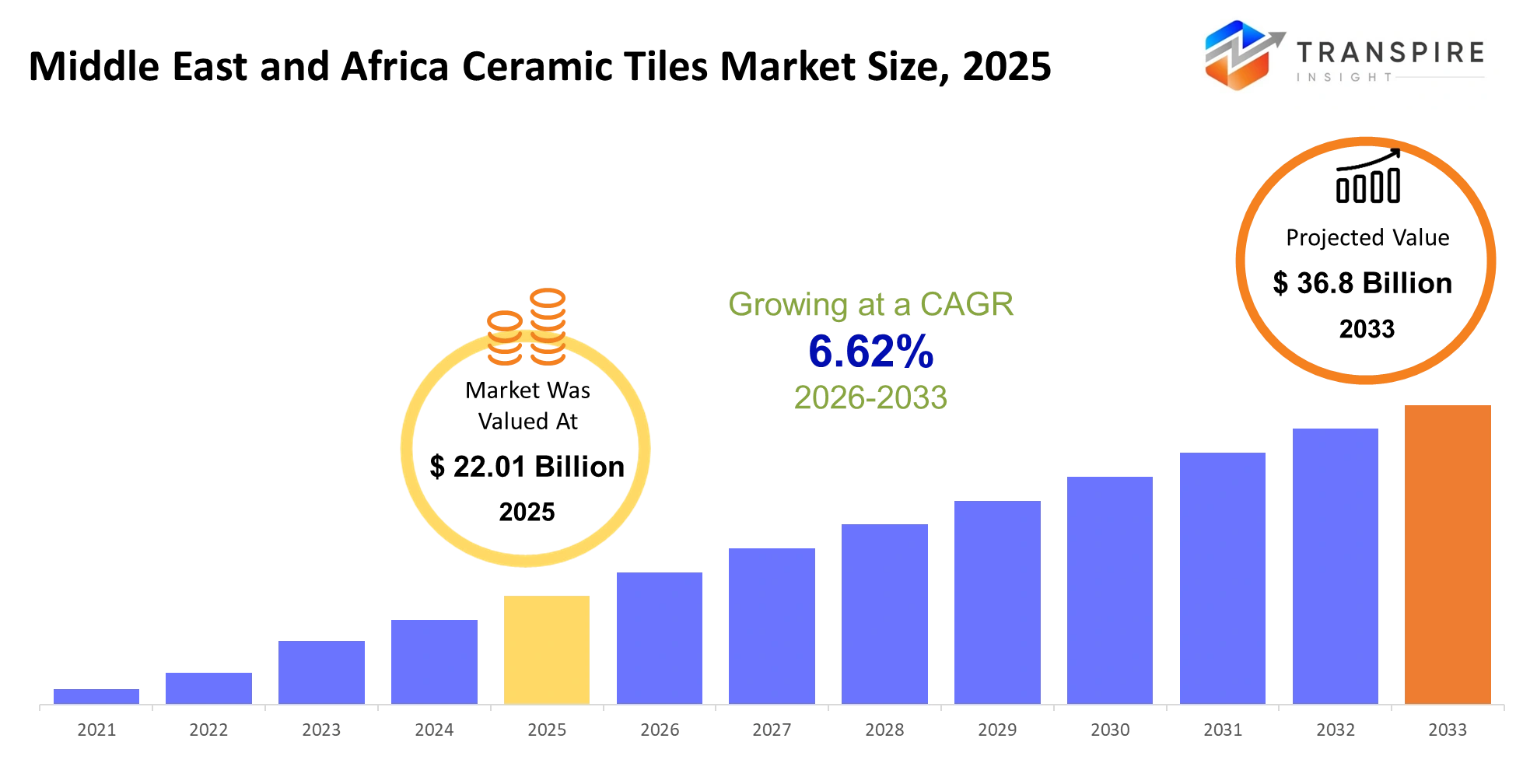
- Middle East and Africa Ceramic Tiles Market Size 2025: USD 22.01 Billion
- Middle East and Africa Ceramic Tiles Market Size 2033: USD 36.8 Billion
- Middle East and Africa Ceramic Tiles Market CAGR: 6.62%
- Middle East and Africa Ceramic Tiles Market Segments: By Type (Glazed Tiles, Unglazed Tiles, Porcelain Tiles, Others); By Application (Residential, Commercial, Industrial, Renovation, Others); By End-User (Construction Companies, Real Estate Developers, Consumers, Government, Others); By Surface (Polished, Matte, Textured, Others).
To learn more about this report,  Download Free Sample Report
Middle East and Africa Ceramic Tiles Market Summary
The Middle East and Africa Ceramic Tiles Market was valued at USD 22.01 Billion in 2025. It is forecast to reach USD 36.8 Billion by 2033. That is a CAGR of 6.62% over the period.
The Middle East and Africa ceramic tiles market basically delivers finished surface materials, for residential commercial and even infrastructure builds, so builders tend to lean on tiles for heat resistance, long term durability, and that easy upkeep, especially when the climate is rough and inconsistent. In the past 3 to 5 years the market has moved away from relying on imported standard tiles , and more toward locally made large-format porcelain, plus digitally printed styles that help teams install faster and still chase premium architectural looks. There’s also been a big structural shift as regional production capacity expands, driven by industrial diversification initiatives in places like Saudi Arabia and Egypt. If you think about it, that momentum got pushed harder by supply chain disruptions during COVID-19 and then the Red Sea logistics issues that, honestly, highlighted how fragile import routes can be. so now developers favor localized sourcing and higher-spec materials, and that is nudging manufacturers to spend on automation and design skills, gradually redirecting revenue toward value-added products instead of pure volume, or at least not only volume.
Key Market Insights
- GCC countries are basically dominating the Middle East and Africa Ceramic Tiles market, with an estimated 35–40% share because of huge infrastructure efforts and real estate development in 2025.
- And, honestly, Africa is also moving the fastest through 2030, powered by urbanization programs , affordable housing initiatives, and construction investments that keep on rising.
- Looking at the product or service side, Porcelain tiles are leading the market, they hold a notable share thanks to durability , heat resistance, and that more premium architectural look people are choosing more often.
- After that, Ceramic wall tiles sit in the second-largest spot, they’re widely used for residential interiors and mid-range commercial spaces in many urban centers.
- Then there’s the bigger shift , Large-format tiles combined with digitally printed tiles are the fastest-growing segment, supported by design personalization, and the whole faster installation trend , it’s expected to continue up to 2030.
- For applications, Residential construction is taking the lead across the Middle East and Africa Ceramic Tiles Market.
- It’s getting the largest share from housing demand and those ongoing renovation cycles.
- Commercial infrastructure, like hotels and retail sites, is the fastest-growing application segment , driven by tourism momentum and urban development projects.
- End users are also changing a bit. Construction contractors stay the leading end-user group, they still have strong procurement influence across major housing and infrastructure developments.
- Meanwhile real estate developers are the fastest-growing category, using premium materials to push higher property value and stronger differentiation.
What are the Key Drivers, Restraints, and Opportunities in the Middle East and Africa Ceramic Tiles Market?
The main driving force feels like it’s mostly big-scale infrastructure build outs, with government backed urbanization pushes, especially across Saudi Arabia, the UAE, and Egypt. You can see it in mega projects such as NEOM, and Egypt’s New Administrative Capital, they’ve been sustaining a steady demand for high performance ceramic and porcelain tiles. And this change isn’t just lifting the amount per order or per installation, it’s also nudging tile makers to push higher value large-format goods and digitally printed surfaces. That directly helps revenue per square meter, and at the same time it accelerates premium category reach across the Middle East and Africa Ceramic Tiles Market.
One notable restraint is that the industry is still too reliant on energy hungry kiln operations, plus the natural gas and electricity costs can swing around, especially in multiple manufacturing clusters. Because of this built in cost stress, pricing flexibility stays limited , and smaller producers end up not scaling, so capacity utilization ends up uneven. It also kind of drags the move toward more advanced production methods, since the upfront capex is large and the payback timeline can get long, which then suppresses the near-term expansion appetite.
The most attractive opportunity, at least in my view, is more localized manufacturing expansion across East and West Africa, with Nigeria and Kenya standing out. There, infrastructure spend and housing shortfalls seem to meet each other, like a convergence point. Recently, investments in regional tile factories, along with technology transfer deals with Asian manufacturers, are supporting import substitution while also opening new demand pathways, and that sets up the next phase of growth in the Middle East and Africa Ceramic Tiles Market.
What Has the Impact of Artificial Intelligence Been on the Middle East and Africa Ceramic Tiles Market?
Artificial intelligence along with more advanced digital systems are, little by little, changing manufacturing efficiency and product quality across the Middle East and Africa Ceramic Tiles Market. They are reshaping how production lines function, and how they react to demand variability, sort of more smoothly than before.
In today’s tile plants, AI powered automation shows up everywhere, especially in kiln temperature control, glazing precision setups, and computer vision defect spotting. These tools pick up on micro-cracks, uneven coloration, and dimensional mismatches in real time, which means less dependence on manual checking and more stable yield. On top of that, robotics attached to conveyor workflows makes the handling and packing part faster, and it tends to cut down operational slowdowns. The result is steadier throughput across those big, high-volume production lines.
Predictive analytics is also becoming normal practice. Machine learning models keep an eye on press machines, dryers, and kilns, trying to predict failures before they actually happen. That supports predictive maintenance planning, so unplanned downtime drops and energy consumption patterns look more controlled. Meanwhile many manufacturers are using data centered energy optimization models too, to manage fuel usage during high temperature firing. This improves cost efficiency overall, and it keeps production stability from swinging too much.
Still, uptake isn’t fully smooth. High integration expenses slow things down, and retrofitting old equipment in older plants can get very complicated. Also quite a few facilities do not yet have enough real time production data infrastructure, and that weakens model accuracy. Because of that, AI scaling across the Middle East and Africa Ceramic Tiles Market moves slower than it could.
Key Market Trends
- GCC manufacturers seemed to expand localized tile production by almost 25% since 2022,which ended up trimming import dependence across a lot of premium construction jobs.
- Developers then started leaning away from standard ceramic formats and more toward large-format porcelain tiles sometime between 2023 and 2026, so that installation speed felt better faster.
- RAK Ceramics, also after 2023, leaned into digital printing more, letting them push bespoke architectural layouts for luxury hospitality and retail spaces.
- Meanwhile, in 2022, supply chain disruptions made contractors choose regional sourcing more often, and that quietly reshaped procurement habits across construction hubs in the Middle East.
- After 2023, kiln modernization (the energy-heavy kind) kept accelerating, with manufacturers bringing in automated temperature control to smooth out fuel consumption variability.
- On the African side, places like Nigeria saw tile imports rise roughly 30% from 2021 to 2024, before the momentum started shifting toward investments in local manufacturing.
- In 2024, smart factory systems also rolled out real-time defect detection, and that cut production waste rates quite noticeably in leading UAE tile plants.
- After 2023, export diversification came up too, with manufacturers chasing Africa and Southeast Asia to offset Gulf demand that had started to feel saturated.
- And of course there was competitive pressure, from Mohawk Industries plus Asian suppliers, pushing regional players to upgrade design and automation capabilities, quickly, like right away.
Middle East and Africa Ceramic Tiles Market Segmentation
By Type
Porcelain tiles, kinda hold a leading place in the ceramic surface materials world because they are tough , and they resist water well, plus they’re a good match for high temperature climates. This part kinda gets a lot of traction from big infrastructure works and premium homes, where durability and appearance are basically the deciding factors for what people buy. Glazed tiles keep a steady portion in mid-range residential interiors, while unglazed tile options tend to cover the more practical flooring requests for industrial sites and outdoor areas.
Porcelain growth is powered by the move toward large-format designs and digitally printed surfaces, which click with current architecture tastes in many city based developments. Construction momentum in Gulf countries and North Africa also helps , since it boosts the need for high-performance materials that can reduce how often maintenance happens. Glazed tiles do face some moderate competition from pricier alternatives , but they still manage to keep cost minded buyers in secondary housing markets.
Looking ahead demand will tilt even more toward porcelain innovation, especially thin and lightweight variants for quicker installation. Tile makers will keep putting money into automation and surface engineering to separate the product lines. Investors, meanwhile, should probably expect better returns from value-added tile categories rather than the usual low margin, more common formats.
By Application
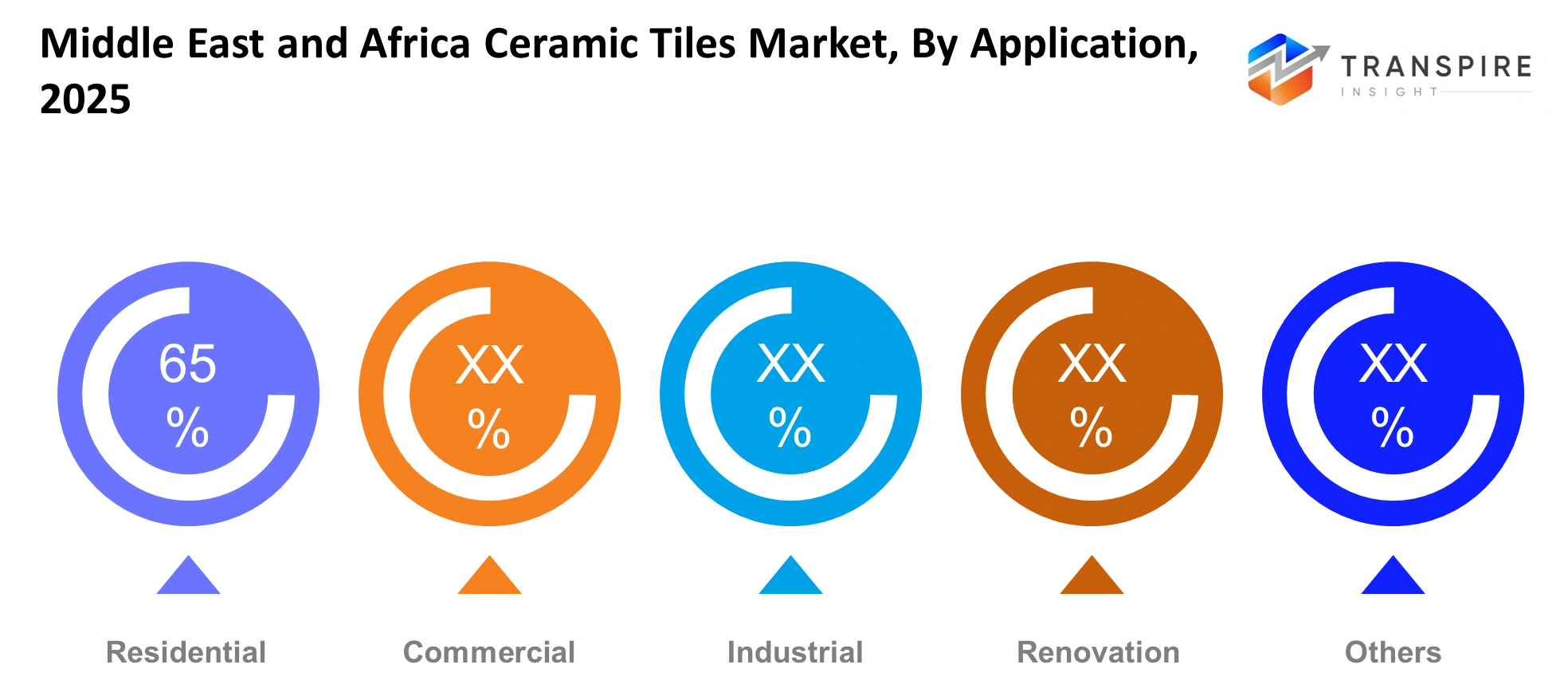
Residential building takes the lead in ceramic tile use, because housing needs keep flowing across economies that are urbanizing, plus redevelopment cycles. Commercial demand, like hotels, malls, and office spaces stays in a strong secondary role, helped by tourism and retail growth. Industrial consumption stays limited but it’s fairly steady, mainly for plants and facilities that need heat resistant surfaces and also ones that are easy to clean.
Residential growth is kind of propped up by government-backed housing programs and private real estate expansion across big Gulf and African cities, you know. At the same time commercial appetite tends to rise quicker in hospitality corridors as well as mixed-use zones, where the design quality really affects the customer journey experience… directly. Renovation activity is also ticking upward fairly steadily, because older city infrastructure gets modernized, metro by metro, bit by bit.
Going forward, demand should increasingly lean toward commercial builds and renovation work, especially once residential cycles cool down in more mature Gulf markets. Developers will likely choose premium materials that lower lifecycle upkeep costs, which is a pretty practical trade. Tile and material manufacturers may gain more from diversification across project-driven usage rather than depending on one single housing slice.
To learn more about this report, Download Free Sample Report
By End-User
Construction companies still hold the biggest share, mainly because they manage large scale procurement for infrastructure, residential towers, and commercial complexes. Real estate developers come next, particularly when big urban expansion projects are underway and they require premium spec surfaces. Government procurement stays meaningful too, especially for public infrastructure and housing initiatives across developing African economies.
Why construction demand grows here is mostly tied to rapid urbanization and infrastructure megaprojects, which want standardized high-volume tile supply. Real estate developers push the premiumization momentum, selecting high-design finishes to strengthen property valuation and improve the market stance. Government demand can swing with policy cycles, but it still stays structurally important for affordable housing programs.
Future growth is gonna increasingly favor developers and public-sector buyers as infrastructure led urban planning keeps expanding, Suppliers will have to build up stronger contract manufacturing abilities and lock in long term supply agreements. The competitive edge will hinge on reliability , customization capacity and yeah, large scale fulfillment efficiency.
By Surface
Polished surfaces keep a solid spot in premium residential and commercial uses , mainly because the glossy look feels kinda upscale and it’s visually strong. Matte surfaces still keep steady demand in interior residential spaces where slip resistance matters and the aesthetics are more calm, a bit understated. Textured surfaces usually end up in a more specific lane for outdoor and industrial environments where grip and durability are the main story.
Demand for polished tiles is climbing in luxury real estate and hospitality builds across Gulf cities , since the visual impact really steers the material choice. Matte finishes are picking up in modern minimalist directions and functional housing efforts . Textured surfaces grow slower but they keep moving, especially in infrastructure related work and exterior landscaping areas.
Looking ahead, growth should tilt toward matte and textured segments as safety expectations rise, plus functional design preferences get stronger. Polished surfaces will still stay relevant for higher value commercial areas but they may face pricing pressure . Manufacturers are likely to focus on surface innovation, hybrid finishes in particular, to cover multiple use cases at once.
What are the Key Use Cases Driving the Middle East and Africa Ceramic Tiles Market?
Residential housing still feels like the main use case across the Middle East and Africa Ceramic Tiles Market, mostly because the whole region is building fast, and also big-scale apartment construction in Gulf countries plus North African cities . Builders tend to stick with ceramic and porcelain tiles, not only because they can handle high temperatures , but also because they need low upkeep and they let teams finish work quickly, especially where there are lots of units in one place.
On the other hand commercial real estate and hospitality keep adding secondary pull, especially in hotels, shopping centers and office complexes, usually driven by real estate developers and construction firms. Also there is renovation work across older city areas, that steady replacement demand, as landlords and property owners refresh interiors so they can raise rental yields and keep asset value moving up.
More emerging angles show up too, like smart infrastructure programs and premium public-sector facilities that blend advanced surface materials for durability and a more consistent design look. There are also industrial-grade uses in transport locations, airports for instance and metro stations , where governments are investing in long-life low-maintenance flooring, for those high-footfall settings that never really slow down.
|
Report Metrics |
Details |
|
Market size value in 2025 |
USD 22.01 Billion |
|
Market size value in 2026 |
USD 23.5 Billion |
|
Revenue forecast in 2033 |
USD 36.8 Billion |
|
Growth rate |
CAGR of 6.62% from 2026 to 2033 |
|
Base year |
2025 |
|
Historical data |
2021 - 2024 |
|
Forecast period |
2026 - 2033 |
|
Report coverage |
Revenue forecast, competitive landscape, growth factors, and trends |
|
Regional scope |
Middle East and Africa (Saudi Arabia, United Arab Emirates, South Africa, Rest of Middle East and Africa) |
|
Key company profiled |
Mohawk Industries, RAK Ceramics, Kajaria Ceramics, Somany Ceramics, Grupo Lamosa, SCG Ceramics, Porcelanosa, China Ceramics, Siam Cement, Florida Tile, Crossville, Atlas Concorde, Nitco, Asian Granito, Panariagroup. |
|
Customization scope |
Free report customization (country, regional & segment scope). Avail customized purchase options to meet your exact research needs. |
|
Report Segmentation |
By Type (Glazed Tiles, Unglazed Tiles, Porcelain Tiles, Others); By Application (Residential, Commercial, Industrial, Renovation, Others); By End-User (Construction Companies, Real Estate Developers, Consumers, Government, Others); By Surface (Polished, Matte, Textured, Others). |
Which Regions are Driving the Middle East and Africa Ceramic Tiles Market Growth?
The Gulf Cooperation Council area basically leads the Middle East and Africa Ceramic Tiles Market, mainly because of those big, long-scale infrastructure pipelines in Saudi Arabia and the United Arab Emirates. You know, mega developments like smart cities, tourism zones, and commercial hubs keep pushing tile consumption up, especially across premium projects ,not just small builds. On top of that, solid industrial policy backing helps local manufacturing grow, which cuts down import reliance, and also makes supply security a bit more dependable. There is this fairly connected web of contractors, logistics corridors, and already established ceramic producers that just keeps the dominance going.
North Africa is sitting in second place, fairly steady, and it is mostly backed by Egypt and Morocco. In that place, demand feels more driven by population-related housing needs, rather than luxury megaprojects. Construction stays active ,because urban expansion keeps rolling forward, and government-backed affordable housing programs keep demand from slipping. Unlike the Gulf region, this part leans more on cost-efficient production, plus export competitiveness. So they end up supplying tiles for both home markets and some specific European trade lanes. The construction rhythm is stable enough that demand stays predictable, which makes it a dependable revenue contributor.
Sub-Saharan Africa is showing the quickest growth momentum, led by Nigeria , Kenya, and a cluster of emerging East African economies. Since around 2022, investments in local tile manufacturing ,and import substitution rules, have actually changed how supply works. Rapid urbanization and serious housing shortfalls are pushing demand harder for affordable construction materials across those fast-growing cities. For 2026–2033, this region looks like a strong entry space for manufacturers and investors aiming at early-stage, infrastructure-led growth markets.
Who are the Key Players in the Middle East and Africa Ceramic Tiles Market and How Do They Compete?
The Middle East and Africa Ceramic Tiles Market looks kinda moderately fragmented, like regional producers plus some global exporters are trading it out across infrastructure and housing builds. The main players tend to keep their ground with capacity boosts, more automation, and making sure production is closer to where demand shows up, not just on paper. What really pushes rivalry is pricing efficiency, design tweaks that feel more personal, and contract dependability , especially for large developers and government buyers. Lately, how near the supply chain is to the end market seems to decide who wins when imports get volatile.
RAK Ceramics leans into digital printing and premium collections to go after hospitality clientele and export channels across the GCC and Europe. Saudi Ceramics sticks to cost-effective domestic output and leans on government housing arrangements, backed by kiln modernization. Kajaria Ceramics keeps expanding with strong distribution reach, tiered pricing, and deeper export activity, mainly into African residential construction.
Mohawk Industries tends to grow by acquiring other firms and using more advanced manufacturing systems, so scale efficiency and product consistency stay tight across global supply chains. Porcelanosa differentiates through luxury design specialization, plus architect collaborations that fit high-end hospitality and commercial projects. Both companies also expand by teaming up with distributors , to tap into Middle East and Africa demand growth.
Company List
- Mohawk Industries
- RAK Ceramics
- Kajaria Ceramics
- Somany Ceramics
- Grupo Lamosa
- SCG Ceramics
- Porcelanosa
- China Ceramics
- Siam Cement
- Florida Tile
- Crossville
- Atlas Concorde
- Nitco
- Asian Granito
- Panariagroup
Recent Development News
In October 2025, RAK Ceramics announced the acquisition of BANKOOK DESIGN CHAMBRE S.L., strengthening its premium design portfolio and expanding hospitality-focused ceramic offerings across Europe and the Middle East.
Source: https://corporate.rakceramics.com
In February 2026, RAK Ceramics reported FY2025 financial results highlighting margin expansion driven by higher-margin project business and upgraded slab production capacity in the UAE. The development reinforced its strategy to shift toward premium porcelain tiles and localized manufacturing.
Source: https://corporate.rakceramics.com
What Strategic Insights Define the Future of the Middle East and Africa Ceramic Tiles Market?
The Middle East and Africa Ceramic Tiles Market seems to be shifting, kind of, toward value driven and more locally rooted production setups. This is backed by ongoing infrastructure spending, plus urban expansion across Gulf regions and across many African economies too, you know. Over the next 5–7 years demand will likely cluster more around premium, design heavy ceramic and porcelain solutions, since developers keep leaning into lifecycle efficiency, faster installation cycles and also a clearer, differentiated architectural look. And that move is reinforced by supply chains that are slowly regionalizing, plus industrial policy backing for homegrown manufacturing hubs.
There’s also a risk that is a bit less obvious. It comes from energy volatility and carbon tied production limits, especially where kiln intensive manufacturing clusters are concentrated. As compliance expectations keep rising around emissions and energy intensity, mid sized producers could end up squeezed, mainly if they don’t have the capital to upgrade their plants. That could lead to uneven consolidation across the broader supply side, in a way that’s not evenly paced.
Meanwhile an opportunity is starting to show up, especially in East and West Africa where import substitution is getting more attention. In places like Nigeria and Kenya, new tile manufacturing investments are beginning to localize the supply chain, which matters more than people think at first. This creates a window for early entrants to build distribution dominance before local capacity is fully mature. The smart positioning, at least for now, would focus on localized partnerships, modular production technologies, and longer term agreements with developers, so demand stays more visible and cost stability improves a bit.
Middle East and Africa Ceramic Tiles Market Report Segmentation
By Type
- Glazed Tiles
- Unglazed Tiles
- Porcelain Tiles
- Others
By Application
- Residential
- Commercial
- Industrial
- Renovation
- Others
By End-User
- Construction Companies
- Real Estate Developers
- Consumers
- Government
- Others
By Surface
- Polished
- Matte
- Textured
- Others
Frequently Asked Questions
Find quick answers to common questions.
The Middle East and Africa Ceramic Tiles Market size is USD 36.8 Billion in 2033.
Key segments for the Middle East and Africa Ceramic Tiles Market are By Type (Glazed Tiles, Unglazed Tiles, Porcelain Tiles, Others); By Application (Residential, Commercial, Industrial, Renovation, Others); By End-User (Construction Companies, Real Estate Developers, Consumers, Government, Others); By Surface (Polished, Matte, Textured, Others).
Major Middle East and Africa Ceramic Tiles Market players are Mohawk Industries, RAK Ceramics, Kajaria Ceramics, Somany Ceramics, Grupo Lamosa, SCG Ceramics, Porcelanosa, China Ceramics, Siam Cement, Florida Tile, Crossville, Atlas Concorde, Nitco, Asian Granito, Panariagroup.
The Middle East and Africa Ceramic Tiles Market size is USD 22.01 Billion in 2025.
The Middle East and Africa Ceramic Tiles Market CAGR is 6.62% from 2026 to 2033.
- Mohawk Industries
- RAK Ceramics
- Kajaria Ceramics
- Somany Ceramics
- Grupo Lamosa
- SCG Ceramics
- Porcelanosa
- China Ceramics
- Siam Cement
- Florida Tile
- Crossville
- Atlas Concorde
- Nitco
- Asian Granito
- Panariagroup
Recently Published Reports
-
Apr 2026
Handling and Lifting Equipment Market
Handling and Lifting Equipment Market Size, Share & Analysis Report By Product (Cranes and Hoists, Forklifts, Conveyor Systems, Aerial Work Platforms, Others), By Application (E-Commerce, Automotive and Railway, Food and Beverages, Aviation, Others), and Geography (North America, Europe, Asia-Pacific, Middle East and Africa, South and Central America), 2021 - 2031
-
Apr 2026
HVAC Equipment Market
HVAC Equipment Market Size, Share & Analysis Report By Heating Equipment Type (Boilers and Furnaces, Heat Pumps, and Unitary Heaters), By Ventilation Equipment (Air Handling Units, Humidifiers and Dehumidifiers, Air Filters, and Fan Coiling Units), By Air Conditioning Equipment (Unitary Air Conditioners, Room Air Conditioners, Packaged Terminal Air Conditioners, and Chillers), By End User (Commercial, Residential, Industrial, and others), and Geography (North America, Europe, Asia-Pacific, Middle East and Africa, South and Central America), 2021 – 2031
-
Apr 2026
Refrigeration Valves Market
Refrigeration Valves Market Size, Share & Analysis Report By Type (Solenoid Valves, Expansion Valves, Check Valves, Service Valves, Others), By Application (Commercial Refrigeration, Industrial Refrigeration, Transport Refrigeration, Residential Refrigeration, Air Conditioning Systems), By End User (Food and Beverage Industry, Pharmaceutical Industry, HVAC Industry, Chemical Industry, Others), and Geography (North America, Europe, Asia-Pacific, Middle East and Africa, South and Central America), 2021 – 2031
-
Apr 2026
E-Commerce Packaging Materials Market
E-Commerce Packaging Materials Market By Material Type (Corrugated Boxes, Paper & Paperboard, Foam & Cushioning Materials, Plastic Packaging, Flexible Packaging, Protective Packaging, Others), By Product(Primary Packaging, Secondary Packaging, Tertiary Packaging), By Packaging Function (Protective Packaging, Branding & Presentation Packaging, Transit & Logistic Packaging, Sustainable Packaging, Tamper Evidence Packaging), By End-User (Retail & Consumer Goods, Electronic Appliances, Food & Beverages, Healthcare & Pharmaceutical, Fashion & Apparel, Home & Furnishing, Others); By Industry Analysis, Size, Share, Growth, Trends, and Forecasts 2021-2033