France Breast Implants Market Size & Forecast:
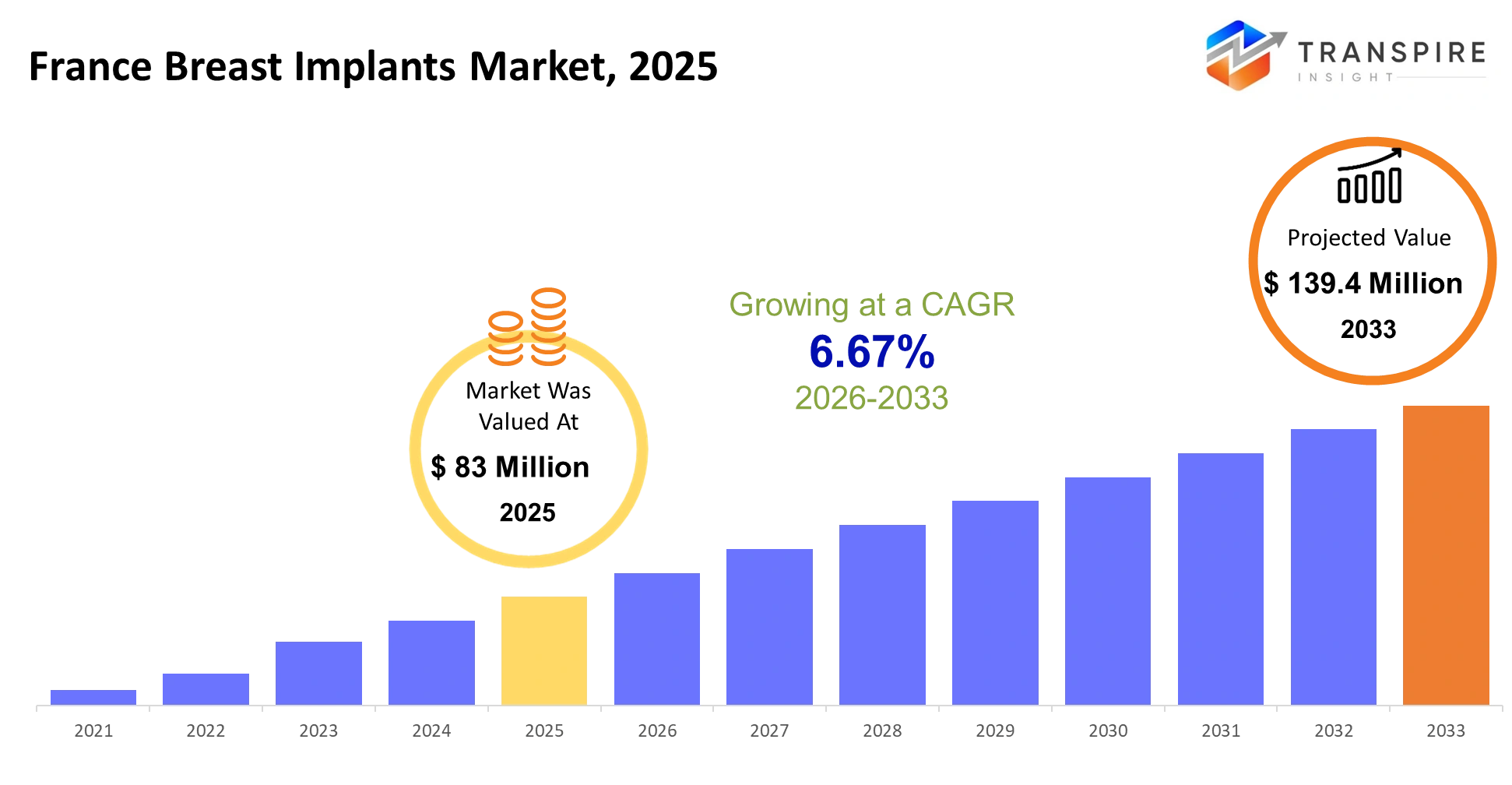
- France Breast Implants Market Size 2025: USD 83 Million
- France Breast Implants Market Size 2033: USD 139.4 Million
- France Breast Implants Market CAGR: 6.67%
- France Breast Implants Market Segments: By Type (Silicone, Saline, Others); By Application (Cosmetic Surgery, Reconstructive Surgery, Others); By End-User (Hospitals, Cosmetic Clinics, Others); By Shape (Round, Anatomical, Others)
To learn more about this report,  Download Free Sample Report
France Breast Implants Market Summary
The France Breast Implants Market was valued at USD 83 Million in 2025. It is forecast to reach USD 139.4 Million by 2033. That is a CAGR of 6.67% over the period.
The France breast implants market has a critical role in reconstructive and aesthetic healthcare, helping people kind of restore breast shape, symmetry, and self belief after mastectomy cases, trauma, congenital conditions, or elective cosmetic surgery. In practice it backs plastic surgery clinics, oncology reconstruction centers, plus specialized medical device suppliers that cover both therapeutic goals and appearance related patient needs . Over the last five years, the whole market has leaned more toward highly cohesive silicone gel implants and anatomically shaped options, since they aim to give more natural outcomes, and also tend to lower complication rates . One huge reshaping moment for the industry was the tightening of European Union Medical Device Regulation standards , you know, kind of, which pushed manufacturers to strengthen clinical validation , their traceability and also their post market surveillance routines. It was like the whole setup got more strict than before, and everyone had to adapt.
That regulatory shift, while it raised entry barriers, also built more patient confidence and helped surgeons embrace premium implant technologies. Revenue growth these days is being pushed by higher reconstruction procedure volumes, a widening spread of private cosmetic surgery networks, and a growing preference for technologically advanced implants that offer stronger safety profiles, and longer lasting product durability.
Key Market Insights
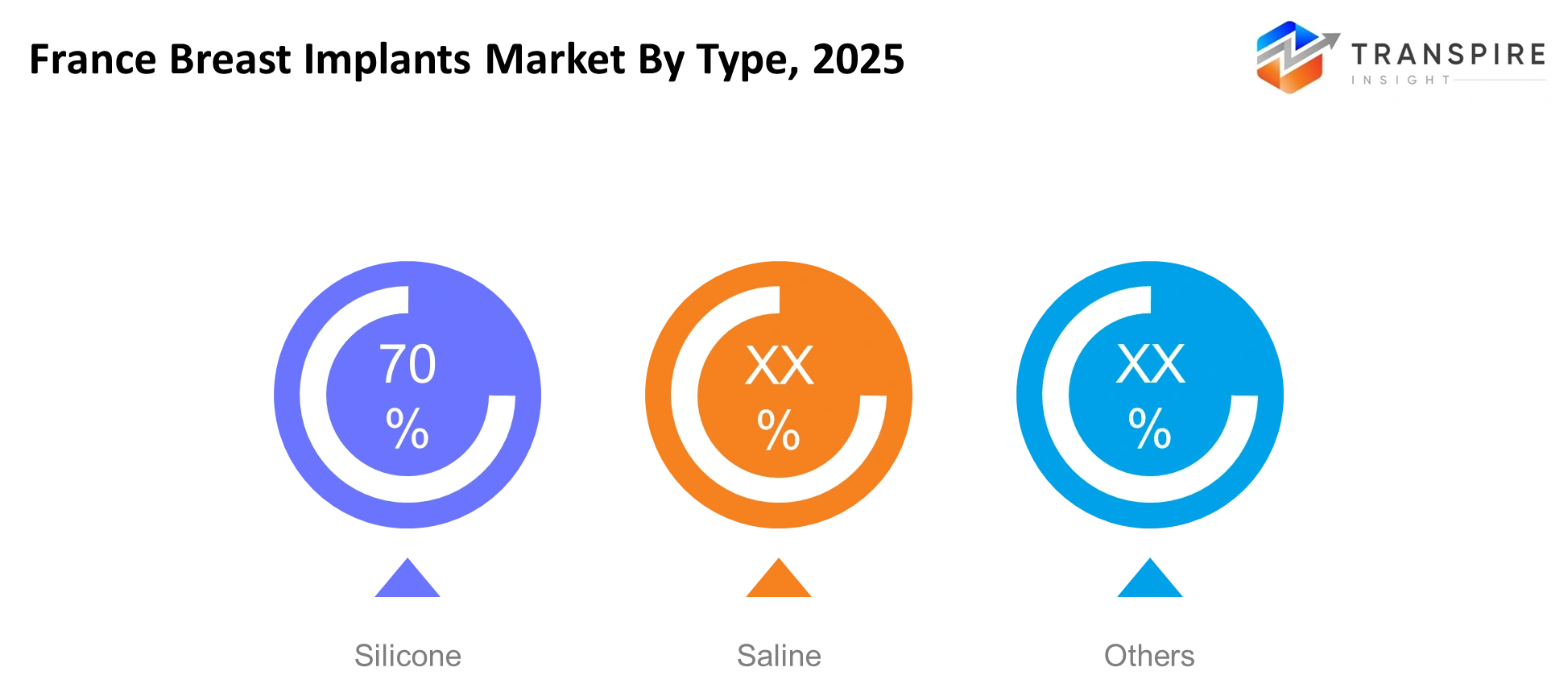
- The France Breast Implants Market is slowly leaning more toward silicone gel implants, and in 2025 those implants reportedly made up more than 70% of total industry revenue , mainly because they tend to feel more natural for patients.
- Meanwhile Northern France and the more urban areas keep pulling the highest procedure volumes, helped by clusters of cosmetic surgery clinics and solid reconstructive oncology infrastructure that’s already in place.
- Southern France on the other hand is starting to grow quicker , it looks set to become the fastest-growing regional market through 2033 thanks to rising private investments in aesthetic surgery , and that momentum is pretty noticeable.
- Round breast implants still hold the leading share, because many surgeons favor more predictable surgical placement and generally lower procedural complexity , compared to other options.
- Anatomical implants are the fastest-growing product segment though , since patients are increasingly asking for customized post mastectomy reconstruction results and not just a standard look.
- On applications, cosmetic augmentation stays in front, accounting for almost 60% of procedural demand across the France Breast Implants Market.
- Breast reconstruction is also seeing the strongest long-term growth, in large part due to expanded post cancer rehabilitation support across French healthcare institutions.
- When you look at end users, private cosmetic surgery clinics lead the demand, while specialized reconstructive hospitals are expanding pretty fast across metro healthcare networks.
- Manufacturers are also investing in RFID traceability systems, new shell technologies , and training partnerships with surgeons, to improve their competitive positioning across the French implant sector.
What are the Key Drivers, Restraints, and Opportunities in the France Breast Implants Market?
The main driver pushing the France breast implants market forward is the growing integration of reconstructive breast surgery into post-cancer treatment routes. In France, there has been a steady increase in breast cancer screening, and early detection outcomes, so more patients end up needing mastectomy-related reconstruction across both public and private care. At the same time, improvements in cohesive silicone gel engineering, and better implant shell strength have helped lower the chances of revision operations. Because of that, higher grade implants are becoming more commercially attractive for hospitals and also for cosmetic surgery clinics. Overall, these changes nudge up procedural frequency and they also support stronger average revenue per patient.
The biggest slowdown factor is the heavy regulatory load added under the European Union Medical Device Regulation rules. Implant companies have to complete broad clinical assessments, run long-term safety surveillance, and handle traceability documentation before they can get commercial approval. This kind of structure makes compliance more expensive, and it also drags out product launch schedules, particularly for smaller manufacturers. So smaller suppliers can hit late market entry, meanwhile some clinics report less consistent product availability, plus higher purchasing prices.
A key opening sits in personalized implant solutions and digital surgical planning platforms. Firms are putting more money into 3D imaging systems and patient-specific implant matching software which helps refine surgical accuracy and boosts aesthetic predictability. France, with its developed private cosmetic surgery environment, creates decent conditions for rolling out these premium procedural technologies over the coming ten years.
What Has the Impact of Artificial Intelligence Been on the France Breast Implants Market?
Artificial intelligence and those advanced digital planning tools are kind of re-shaping the France breast implants market, mostly by making surgical work more precise, improving how patients get assessed, and tightening up post-operative monitoring routines. AI powered imaging platforms are being used more and more in cosmetic as well as reconstructive clinics, to automate breast symmetry checks, suggest implant sizing, and even run procedural simulations. In practice, surgeons can lean on machine learning models that were trained using thousands of past surgical outcomes, so they can estimate implant placement, tissue reactions, and overall aesthetic balance before anything even starts in the operating room.
On top of that, advanced predictive analytics are also easing clinic concerns about revision surgeries. With AI-assisted surgical planning systems, teams can look at skin elasticity, chest wall measurements, and implant compatibility, then fine tune procedural decisions accordingly. The result tends to be better satisfaction, while complication driven costs drop for hospitals and private practices alike. Then there are digital patient monitoring platforms too, which support recovery tracking after surgery, so physicians can spot swelling trends or possible implant displacement risks earlier than they might with more traditional follow-ups.
From an operations point of view, clinics that adopt integrated digital planning systems often report shorter consultation windows, and smoother surgical prep workflows too. Still, AI adoption hits a big limitation, because strong predictive models depend on lots of high-quality clinical imaging data and standardized surgical records.
Key Market Trends
- Since 2021, French clinics have sort of shifted strongly toward fifth-generation silicone implants, with more cohesive gel structures and somehow a lower rupture incidence, compared to before.
- Between 2022 and 2025 surgeons started relying more on 3D imaging consultation systems so they can better estimate implant sizing , and personalize procedures a bit more.
- After 2021, European Medical Device Regulation enforcement pushed manufacturers to tighten long-term clinical validation , and strengthen post-market surveillance processes too.
- In the meantime, post-mastectomy reconstruction procedures grew steadily as oncology centers began to fold reconstructive surgery into the wider breast cancer treatment pathways.
- Premium implant manufacturers also increased investment into nanotextured shell technologies, aiming to reduce capsular contracture risks while improving patient comfort.
- Independent aesthetic surgery clinics then expanded aggressively across secondary French cities, which helped regional access, for cosmetic augmentation procedures.
- Implant suppliers increasingly partnered with plastic surgery associations to run surgeon education programs, focused on complication reduction and safety compliance.
- After 2023 demand for anatomically shaped implants picked up faster, since patients seemed to prioritize natural contour restoration rather than classic augmentation profiles.
- Digital patient engagement platforms became common too, letting clinics automate things like consultation scheduling, recovery monitoring, and even surgical outcome visualization.
- And overall competitive behavior moved away from price competition, toward premium differentiation strategies , largely because approval and compliance requirements got tighter.
France Breast Implants Market Segmentation
By Type
Silicone implants still hold the dominant position in the market, mostly because both surgeons and patients really, really lean toward cohesive gel products that end up looking more natural in everyday views, plus the feel tends to be softer, not as “stiff”. They also tend to deliver higher durability, less obvious creasing , and a wider set of customization choices, so clinics can keep premium pricing for both cosmetic and reconstructive procedures. More advanced shell technologies, combined with better resistance to rupture , have made lots of plastic surgery specialists and oncology reconstruction centers feel a bit more confident clinically, or maybe just more steady in their calls. At the same time, manufacturers are slowly moving toward next generation silicone implant designs, leaning into stricter safety validation, and building stronger long term performance monitoring systems.
Saline implants keep a smaller but fairly stable market presence, mainly due to simplified rupture detection, and because the overall procedural costs are lower, which pulls in more specific patient groups. Regulatory transparency helps too , and the monitoring after surgery is often easier, so adoption fits better in cost-sensitive treatment tracks and revision surgeries. Other implant types, including lightweight approaches and hybrid filler technologies, are slowly getting more attention as innovation pushes new aesthetic procedures that aim for faster recovery and better comfort. Going forward , ongoing material innovation should open up fresh chances for implant developers who want differentiation, like reduced weight, improved biocompatibility, and compatibility with less invasive surgical techniques across the forecast period.
To learn more about this report, Download Free Sample Report
By Application
Cosmetic surgery kind of stays in the lead because aesthetic enhancement procedures make up most of the implant placements happening across private clinics in France. There is strong pull for body contour remodeling , symmetry refinement , and also those post pregnancy aesthetic follow ups which keeps bringing steady income to surgeons and premium implant manufacturers. Digital imaging consultation systems and personalized surgical planning tech have also raised a lot of procedural assurance , plus that tends to improve patient conversion rates. More access to minimally invasive augmentation methods is expected to keep procedural growth moving inside urban cosmetic surgery networks.
Reconstructive surgery keeps expanding in a pretty steady way too, mainly because implant driven reconstruction is getting more integrated into breast cancer rehabilitation programs throughout hospitals and oncology centers. Public healthcare reimbursement support , and better post mastectomy reconstruction pathways , helps keep procedural consistency going even when discretionary cosmetic spending slows down. Other uses, like revision surgeries and correction of congenital deformities are also getting more traction, as more patients swap older implants with newer technically advanced options that promise better durability and safety results. Looking ahead, growth tied to reconstruction is expected to push additional investment into anatomically customized implant systems and digitally assisted surgical planning tools.
By End-User
Hospitals keep a notable market share, partly because reconstructive breast procedures after mastectomy require a multidisciplinary surgical setup, and also sustained patient follow-up, which is kind of hard to do consistently. Big healthcare organizations lean on more robust imaging technologies, regulatory compliance systems, and dedicated oncology reconstruction programs that smaller facilities just can’t copy, not easily. The steady flow of procedures tied to cancer rehabilitation pathways keeps implant procurement moving in both public and private hospitals. At the same time, the rising use of robotic-assisted surgery plus digital recovery monitoring tracking is projected to improve how efficiently hospital reconstruction services run.
Cosmetic clinics end up leading elective augmentation work because specialized aesthetic centers can offer quicker waiting periods, more individualized consultations and even a more premium surgical experience that feels “built for” private-pay patients. Strong surgeon branding, and easier access to advanced implant portfolios, also help push growth at the clinic level especially across metro areas. Other users, like ambulatory surgical centers and specialty reconstructive facilities, are gradually lifting their procedural volumes too, as outpatient breast enhancement and revision procedures keep getting more popular. With the ongoing expansion of high-end aesthetic surgery chains, you can expect some selective investment opportunities for implant suppliers, and for procedural technology providers as well.
By Shape
Round implants still keep the leading market spot, largely because surgeons tend to like the predictable placement look, also the overall procedural complexity feels lower, and frankly the upper-pole looks more filled in than expected. Cosmetic augmentation keeps fueling demand for round implants, especially with younger patients who want visible volume enhancement and a smoother, simplified recovery pathway. You can also find these implants in plenty of projection levels and sizes, which gives private cosmetic surgery clinics more procedural flexibility. On top of that, manufacturers are refining shell textures and gel cohesiveness inside round portfolios, trying to boost long-term safety results and patient comfort, without making the process harder.
Anatomical implants are showing up as the fastest-growing piece of the market, because reconstructive work plus premium cosmetic procedures are now leaning harder toward natural contour restoration and personalized surgical outcomes. Newer texturing technologies, and better rotational stability, have made surgeons more confident when they use anatomically shaped implants, especially during post-mastectomy reconstruction. Other implant shapes and custom formats still feel more like niche options but they’re slowly getting attention through individualized reconstruction approaches and hybrid augmentation methods. Going forward, market expansion will likely favor companies that can deliver patient-specific implant geometry, backed by digital surgical simulation and 3D planning tech.
What are the Key Use Cases Driving the France Breast Implants Market?
In the France breast implants market the dominant use case still feels like cosmetic breast augmentation, mainly for people wanting volume enhancement, shape correction, or simply better symmetry. This particular path pulls the highest procedural demand, because private aesthetic clinics all around France keep expanding their premium surgical menu, and they do it with advanced silicone implant technologies plus those personalized consultation services that sound a bit simple but really matter.
Breast reconstruction after mastectomy, that part is more like a fast growing secondary use case. Oncology hospitals and reconstructive surgery centers are more and more tying implant based reconstruction into long term breast cancer rehabilitation programs. Also, revision surgeries and corrective procedures are getting more attention too , especially for patients replacing older implants with newer cohesive silicone models. They often expect improved safety, and a cleaner aesthetic outcome overall.
There are also emerging applications that look more hybrid on paper, like reconstruction procedures that pair implants with autologous fat grafting, plus digitally guided implant planning systems. Right now these remain a niche category but they show solid potential among higher end cosmetic surgery providers. The idea is very targeted post surgical outcomes , with fewer complication risks during the forecast period, even if it’s not yet mainstream.
|
Report Metrics |
Details |
|
Market size value in 2025 |
USD 83 Million |
|
Market size value in 2026 |
USD 88.7 Million |
|
Revenue forecast in 2033 |
USD 139.4 Million |
|
Growth rate |
CAGR of 6.67% from 2026 to 2033 |
|
Base year |
2025 |
|
Historical data |
2021 - 2024 |
|
Forecast period |
2026 - 2033 |
|
Report coverage |
Revenue forecast, competitive landscape, growth factors, and trends |
|
Regional scope |
France |
|
Key company profiled |
Allergan, Mentor Worldwide, Sientra, GC Aesthetics, Polytech, Establishment Labs, HansBiomed, Cereplas, Sebbin, Ideal Implant, Nagor, Arion, Silimed, Eurosilicone, Wanhe |
|
Customization scope |
Free report customization (country, regional & segment scope). Avail customized purchase options to meet your exact research needs. |
|
Report Segmentation |
By Type (Silicone, Saline, Others); By Application (Cosmetic Surgery, Reconstructive Surgery, Others); By End-User (Hospitals, Cosmetic Clinics, Others); By Shape (Round, Anatomical, Others) |
Which Regions are Driving the France Breast Implants Market Growth?
In the Île-de-France region , it still feels like the dominant force in the France breast implants market, mainly because it keeps together the country’s highest density of cosmetic surgery clinics , specialized oncology hospitals, and yes also populations with higher income levels. Paris basically sits at the center of this more advanced aesthetic medicine, where surgeons start adopting premium implant technologies earlier than in most other regions. There is also this supportive layer of reimbursement pathways for reconstructive breast procedures after cancer treatment , so the procedures keep going even when the demand is not just purely cosmetic. On top of that, you’ve got a mature ecosystem of private healthcare groups, surgical training institutions, and premium medical device distributors, and it kind of seals the region’s leadership.
Auvergne-Rhône-Alpes comes next as the second-largest contributor, though the way it grows is not the same as Paris. It leans more heavily on a mix of reconstructive needs and elective surgical demand. Locations like Lyon and Grenoble hold steady procedure volumes, largely thanks to resilient healthcare infrastructure and a solid chain of mid-sized private clinics. The region has also turned into a meaningful hub for surgeon training workshops, plus implant technology demonstrations set up by European manufacturers. So overall, this more stable clinical investment environment supports predictable revenue generation, even when economic pressure hits discretionary cosmetic procedures.
Then Provence-Alpes-Côte d’Azur looks like it’s emerging as the fastest-growing market , mostly because medical tourism is expanding and there’s increasing investment in premium cosmetic surgery centers along the Mediterranean corridor.
Who are the Key Players in the France Breast Implants Market and How Do They Compete?
Competition in the France breast implants market stays, moderately consolidated. A small set of multinational manufacturers seems to control most premium implant sales, mostly because they have surgeon relationships, solid clinical evidence, and regulatory credibility that people trust. Lately, the market looks more and more toward companies that can handle tight European MDR compliance expectations while also bringing differentiated implant technologies plus long-term safety evidence. In practice, competition is driven far less by price and more by product performance, surgeon training support, implant traceability systems, and reconstruction-oriented innovation. Established brands keep trying to hold their share via premium positioning, and newer entrants lean on minimally invasive techniques along with more ergonomic implant technologies.
AbbVie competes mainly through its Natrelle portfolio. It stresses a wide implant selection, reconstruction capabilities and long-term surgeon familiarity, even when protocols get complicated. AbbVie also seems to push its standing by widening procurement partnerships with hospital networks and by funding procedural efficiency programs for surgeons. Mentor Worldwide LLC differentiates through MemoryGel technology, and it also leans on close integration with reconstructive oncology practices, especially for post-mastectomy procedures. It keeps moving forward via surgeon education initiatives, and it promotes newer implant formats aimed at larger cup-size reconstructions and augmentation procedures.
GC Aesthetics competes with extra intensity around European regulatory leadership. It commercializes one of the first MDR-approved anatomical implants, which gives it a small but noticeable credibility edge in safety-first markets.
Company List
- Allergan
- Mentor Worldwide
- Sientra
- GC Aesthetics
- Polytech
- Establishment Labs
- HansBiomed
- Cereplas
- Sebbin
- Ideal Implant
- Nagor
- Arion
- Silimed
- Eurosilicone
- Wanhe
Recent Development News
In February 2025, Establishment Labs launched Preservé™, a minimally invasive breast tissue-preserving augmentation platform. The launch strengthened the company’s expansion into next-generation aesthetic procedures with reduced recovery times and broader international commercialization plans.https://www.businesswire.com
In April 2026, Johnson & Johnson highlighted the commercial rollout of Mentor MemoryGel Enhance breast implants targeting larger cup-size procedures. The expansion reinforced competition in premium augmentation and reconstructive surgery categories while supporting broader global market penetration.https://www.ocbj.com
What Strategic Insights Define the Future of the France Breast Implants Market?
In France, the breast implants market is kinda moving toward more tailored, reconstruction-first, digitally supported surgical ecosystems over the next five to seven years. Honestly you can see it getting shaped by stricter European rules, better implant biomaterials, and the wider way aesthetic reconstruction is being woven into cancer recovery pathways. The direction is slowly drifting away from mass-produced augmentation products toward premium implants, with AI-assisted planning, stronger traceability systems , and less invasive surgical techniques.
One risk that might not look obvious at first is the growing concentration of technological leadership among only a handful of MDR-compliant manufacturers. As regulatory costs climb up, smaller suppliers can find it hard to keep up certification pipelines, which may reduce competitive diversity and raise reliance on a limited supplier base. Meanwhile, hybrid reconstruction procedures that blend implants with fat grafting technologies are starting to show up as an opportunity, but they still feel underpenetrated across France.
Market players should focus on funding surgeon education, digital procedural planning, and building long-term clinical proof over time. Firms that pair premium implant innovation with integrated post-operative monitoring capabilities will probably secure the strongest margin expansion through 2033.
France Breast Implants Market Report Segmentation
By Type
- Silicone
- Saline
- Others
By Application
- Cosmetic Surgery
- Reconstructive Surgery
- Others
By End-User
- Hospitals
- Cosmetic Clinics
- Others
By Shape
- Round
- Anatomical
- Others
Frequently Asked Questions
Find quick answers to common questions.
The approximate France Breast Implants Market size for the market will be USD 139.4 Million in 2033.
Key segments for the France Breast Implants Market are By Type (Silicone, Saline, Others); By Application (Cosmetic Surgery, Reconstructive Surgery, Others); By End-User (Hospitals, Cosmetic Clinics, Others); By Shape (Round, Anatomical, Others).
Major France Breast Implants Market players are Allergan, Mentor Worldwide, Sientra, GC Aesthetics, Polytech, Establishment Labs, HansBiomed, Cereplas, Sebbin, Ideal Implant, Nagor, Arion, Silimed, Eurosilicone, Wanhe.
The France Breast Implants Market size is USD 83 Million in 2025.
The France Breast Implants Market CAGR is 6.67% from 2026 to 2033.
- Allergan
- Mentor Worldwide
- Sientra
- GC Aesthetics
- Polytech
- Establishment Labs
- HansBiomed
- Cereplas
- Sebbin
- Ideal Implant
- Nagor
- Arion
- Silimed
- Eurosilicone
- Wanhe
Recently Published Reports
-
Apr 2026
AI in Diabetic Retinopathy Market
AI in Diabetic Retinopathy Market Size, Share & Analysis Report By Type (Screening AI Systems, Diagnostic AI Systems, and Predictive AI Models), By Application Segment (Hospitals, Ophthalmology Clinics, Diagnostic Centers, and Research and Development), and Geography (North America, Europe, Asia-Pacific, Middle East and Africa, South and Central America), 2021 - 2031
-
Apr 2026
Psychometric Tests Market
Psychometric Tests Market Size, Share & Analysis Report By Type (Personality Tests, Ability/Aptitude Tests, Skill/Knowledge Tests, and Others), By Application (Talent Acquisition and Talent Management), and Geography (North America, Europe, Asia-Pacific, Middle East and Africa, South and Central America), 2021 – 2031
-
Apr 2026
Rare Biological Sample Collection Market
Rare Biological Sample Collection Market Size, Share & Analysis Report By Type (Isolation Kits & Reagent, Blood Collection Tubes, and Others), By Application (Oncology, Transcriptomics, Pharmacogenomics, and Others), and Geography (North America, Europe, Asia-Pacific, Middle East and Africa, South and Central America), 2021 – 2031
-
Apr 2026
Patient Lift Pendant Market
Patient Lift Pendant Market By Product Type (Wired Pendants, Wireless, Programmable), By Operation Type(Manual, Electric), By End-Users (Healthcare Professionals, Patients), By Application (Hospitals, Homecare, Rehabilitation Centers, Others), By Industry Analysis, Size, Share, Growth, Trends, and Forecasts 2021-2033
Our Clients
.jpg)