

South Korea Butylated Hydroxytoluene Market Summary
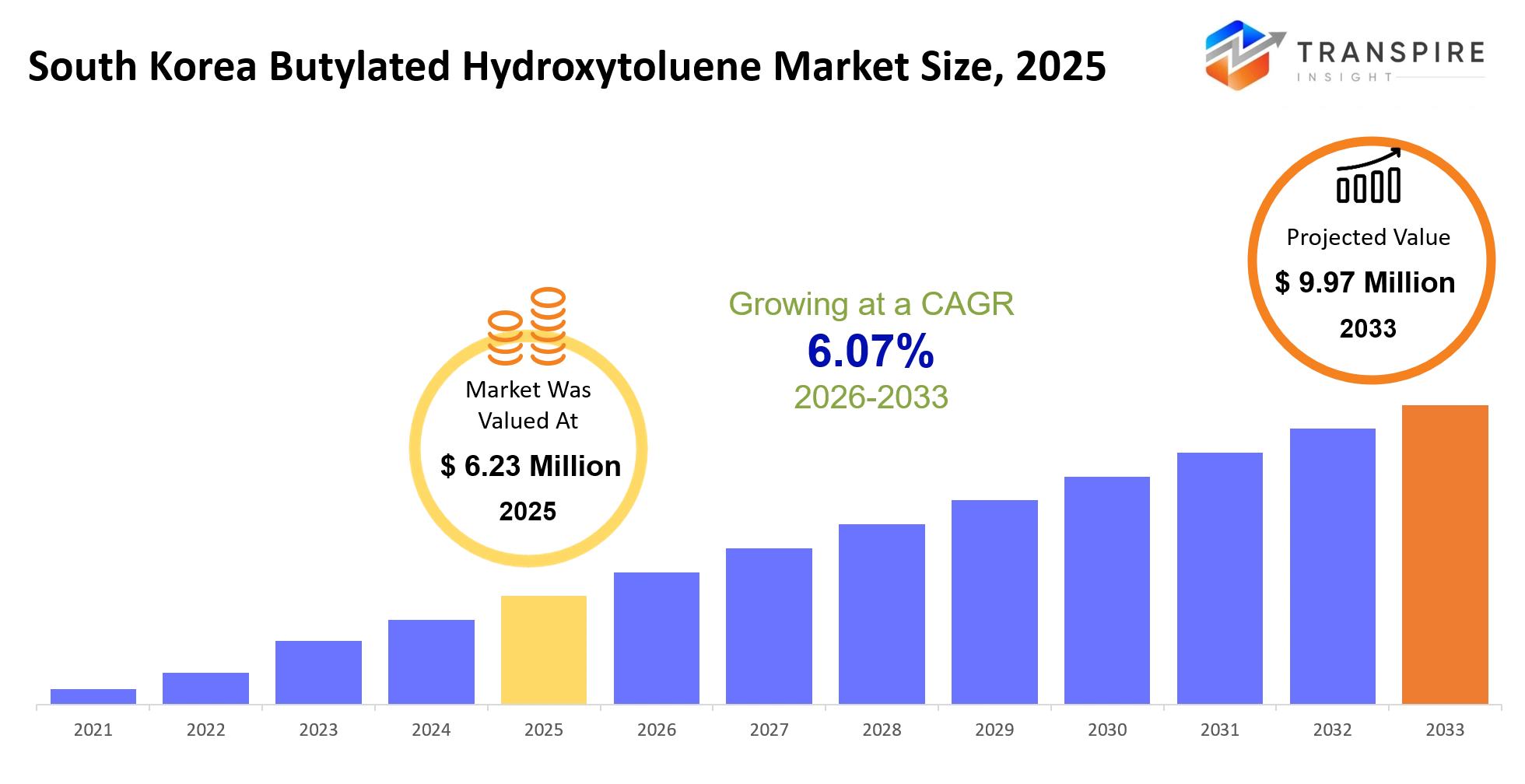
As per Transpire Insight Analysis the South Korea Butylated Hydroxytoluene Market size is estimated at USD 20.8 Million in 2025 and is anticipated to reach USD 9.97 Million by 2033, growing at a CAGR of 6.07% from 2026 to 2033.
Butylated hydroxytoluene kind of supports manufacturers that want to slow down oxidation and keep oils, polymers, rubber compounds, cosmetics, pharmaceuticals, and other formulations from quality deterioration during storage and processing, you know. In South Korea demand really ties in with food processing and specialty chemical manufacturing, where controlled antioxidant performance helps extend product stability and also reduce material losses, which is important. Over the past three to five years the market has moved toward tighter grade selection and higher purity materials, because manufacturers now face tougher formulation rules and product safety requirements. South Korea’s food additive framework still spells out permitted additives and use conditions, while cosmetic regulations also keep their own set of controls for restricted ingredients. Supply chain disruptions during 2020–2022, even pushed buyers to diversify sourcing and lock in regional inventories. So basically the current emphasis on compliant grades, consistent supply, and application specific performance is what helps drive revenue from USD 6.23 million in 2025 up to USD 9.97 million by 2033.
South Korea Butylated Hydroxytoluene Market Size & Forecast:
- South Korea Butylated Hydroxytoluene Market Size 2025: USD 6.23 Million
- Expected Market Value 2033: USD 9.97 Million
- Forecast CAGR: 6.07%
- Leading region in 2025:
- Fastest Growing region:
- Key Profile: LANXESS AG, Eastman Chemical Company, SI Group, Oxiris Chemicals, Sasol Ltd., Caldic B.V., Merck KGaA, OXEA GmbH, Songwon Industrial, BASF SE, Addivant, ChemService Inc., Spectrum Chemical, Thermo Fisher Scientific, Tokyo Chemical Industry.
Key Market Insights
- The industry sort of reached USD 6.23 million in 2025, with specialty applications helping keep revenue expansion fairly steady through 2033, or at least that is what the pattern seems to show.
- In the Seoul Capital Area, and also inside big industrial clusters across Gyeonggi, Ulsan and Yeosu, chemical-demand activity stays important, even if regional shares are not really disclosed.
- Food-grade uses still carry strategic weight because antioxidant use remains tied to Korea’s detailed food additive standards.
- Meanwhile, high-purity grades and application-specific types are getting more attention, as manufacturers tighten up formulation control and also start enforcing supplier qualification requirements more carefully.
- Polymer and rubber processors keep relying on antioxidant chemistry to curb oxidation-linked breakdown, during processing, storage, and also in finished-product service later on.
- The supply-chain disruptions during 2020–2022 basically pushed Korean buyers to diversify suppliers, and to keep more resilient inventory arrangements, rather than sticking to a single sourcing path.
- For cosmetics, formulation scrutiny is higher, since Korean safety standards regulate which ingredients can be used in locally manufactured, as well as imported, cosmetics.
- Direct supplier relationships are becoming more important for industrial buyers, especially those wanting consistent specifications, proper documentation, and predictable delivery schedules that do not shift around too much.
- LANXESS continues to maintain a South Korean product presence for Vulkanox BHT, which supports local access to established antioxidant grades.
- Overall, revenue growth increasingly depends on compliant specialty grades, instead of just pursuing simple volume expansion across undifferentiated BHT products.
What are the Key Drivers, Restraints, and Opportunities in the South Korea Butylated Hydroxytoluene Market?
Driver: The main growth push seems to come, from the ongoing use of antioxidants in formulations where oxidation can quietly reduce shelf life, shift physical traits, or even cause processing losses. South Korea’s food additive rules basically lay out what is allowed, for permitted antioxidant use, and they mention BHT in specific use-cases, so in practice it becomes more of a compliance-based market not really a free-for-all commodity thing. So demand tends to tilt toward vendors who can hand over documented grades, with stable specs, and not just “similar enough” materials.
Restraint: The regulatory spotlight kind of messes with any attempt at broad, unrestrained expansion into consumer-facing products. Korean food and cosmetic regulations push manufacturers to operate inside defined ingredient limits and usage boundaries, while cosmetic safety rules also point to restricted raw materials and the concentration caps that have to be followed. Because of that, companies may slow down reformulation plans and find that the reachable market shrinks when they replace BHT, or cut it down in formulations that are more sensitive.
Opportunity: The clearest chance is higher-purity antioxidant grades, and ones that are tailored for specific applications. South Korea has a strong manufacturing footprint across polymer, rubber, food processing, pharmaceuticals, and cosmetics, and that setup creates several technical niches where oxidation control performance matters. Suppliers who can provide consistent purity, solid traceability, the right regulatory documents, and smaller custom batch sizes, can win higher-value contracts and not only fight on commodity pricing, alone.
What Has the Impact of Artificial Intelligence Been on the South Korea Butylated Hydroxytoluene Market?
Artificial intelligence is startin to influence the wider specialty chemical manufacturing world, not really BHT in isolation, if you get what I mean. In Korea, chemical producers can run machine learning setups that sort of chew on process data, equipment sensor streams and quality measurements plus production histories, so they can notice odd operating conditions before failures end up interrupting antioxidant production. With predictive maintenance they can rank pumps, reactors, heat exchangers, compressors, and even the packing equipment by failure likelihood, which helps the plant cut down on unplanned downtime , and also smooth out when maintenance should happen. On top of that, AI quality analytics can match batch traits against older, already known specs, then raise early flags when something drifts , making purity and consistency control more strict.Digital demand forecasting then ties together customer orders, inventory levels, procurement timetables and available production capacity, so raw-material planning is improved and excess stock is easier to avoid.
The maritime-specific angles in the prompt like scrubber monitoring, plus fleet compliance tracking, they don’t actually map cleanly onto the BHT market. Exhaust gas cleaning systems are more about marine emissions management, rather than making antioxidants as a chemical product. One practical roadblock still shows up though data quality: AI models depend on trustworthy sensor history and standardized production records, while smaller facilities can struggle with integration costs and may only have limited datasets. So, AI rollouts are more apt to move first inside larger, automated chemical plants, where the data foundation is already there.
Key Market Trends
- Since 2020, supply disruptions have pushed Korean chemical buyers a bit toward diversifying sourcing, and also trying to strengthen inventory planning for critical additives. It’s sort of like they want a back up plan, even if that means more coordination.
- Food manufacturers, meanwhile, keep putting more weight on documented antioxidant grades, because Korea still maintains detailed additive standards, plus permitted-use requirements that don’t really leave much room.
- Since 2023, the paperwork part also matters more. Regulatory documentation has gained importance as manufacturers manage updated food additive requirements and their supplier qualification processes, which is… not always simple.
- For cosmetic formulators, the ingredient controls feel tighter too. So they end up scrutinizing BHT concentration, the formulation purpose, and whether it’s compatible with the relevant regulation, more closely than before.
- Industrial buyers are also shifting. They increasingly evaluate suppliers on technical documentation, consistency, delivery reliability, and even application support, instead of focusing purely on price.
- LANXESS continues serving South Korea with Vulkanox BHT, which helps reinforce established specialty-antioxidant supply channels, and keeps those routes stable.
- At the polymer and rubber level, processors are using antioxidant specifications that are tailored to processing conditions, rather than just leaning on generic grades and hoping it works out.
- Digital procurement platforms are gradually improving supplier comparison, documentation exchange, and order management, specifically for specialty chemical purchases.
- Higher-purity grades are gaining strategic relevance too, especially where manufacturers need tighter control over formulation quality, and also downstream product performance.
- And chemical producers are increasingly mixing regional distribution with direct technical support, which helps shorten procurement cycles, and improve customer retention, because the support is there when questions pop up.
South Korea Butylated Hydroxytoluene Market Segmentation
By Grade
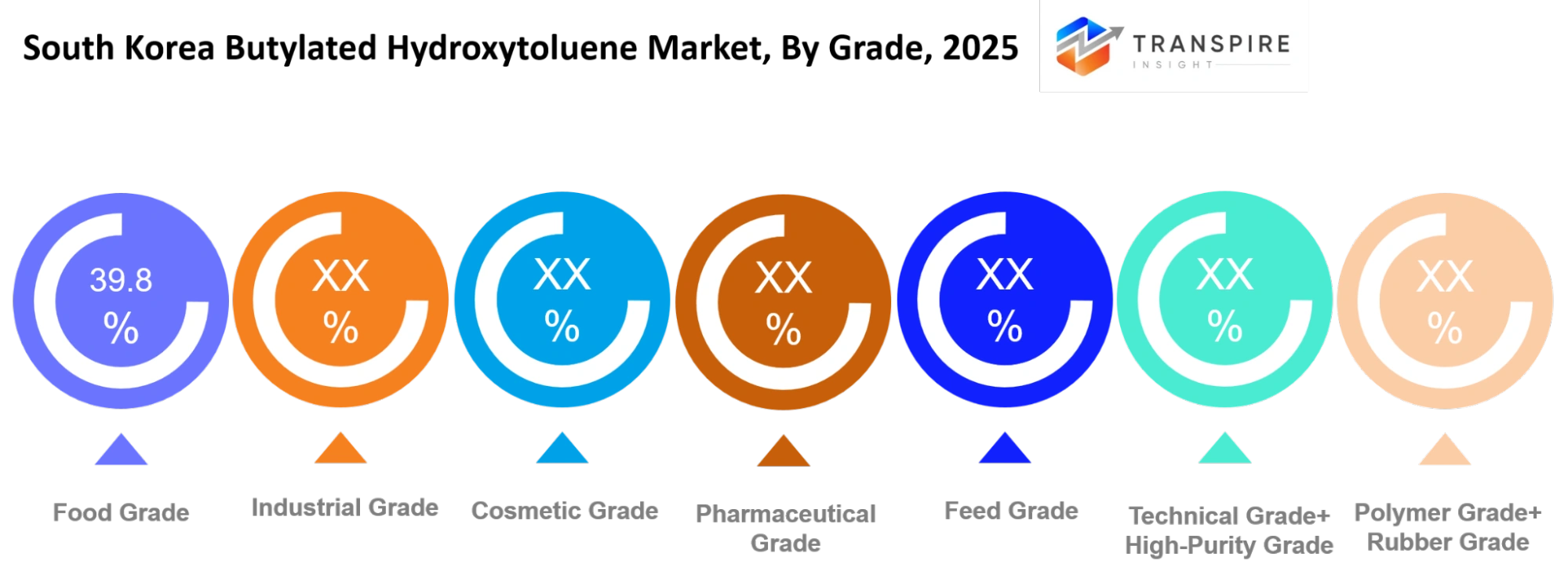
Food Grade is for food processors that need a controlled antioxidant performance, within the permitted uses and concentration limits. Korean food additive rules set the detailed standards for which substances are allowed and under what conditions they can be used, so documentation, and specification control ends up being really important for food manufacturers.
Industrial Grade supports general chemical processing activities including coatings, formulations, and manufacturing steps where oxidation control still matters. Cosmetic Grade is used in personal-care type formulations, and it has to follow the Korean cosmetic safety requirements, while Pharmaceutical Grade is aimed at tightly controlled pharmaceutical formulations that need higher spec consistency, even when lots vary a bit.
Feed Grade covers antioxidant applications for animal nutrition products, meanwhile Technical Grade serves industrial formulations where the standard performance requirements are expected to hold. High-Purity Grade is for uses where impurity levels have to stay low and where stronger analytical oversight is needed. Polymer Grade and Rubber Grade are used for plastics, elastomers, and rubber processing, because oxidation can affect processing stability and the durability of finished goods. Others covers specialized grades that are built for narrower industrial needs.
By Application
Food & Beverages is a major application since antioxidants help safeguard suitable oils, fats, and formulations from oxidation, under allowed food-use conditions. Korean food additive rules set out exact requirements for antioxidant use, so there is a clear need for compliant materials and dependable records, plus the right paperwork. Plastics & Polymers rely on BHT based antioxidant chemistry to keep things stable during processing and storage. Rubber Processing uses antioxidant protection too, to reduce oxidation related breakdown while manufacturing and also during product service life.
Cosmetics & Personal Care call for careful selection of ingredients because Korean cosmetic regulations manage restricted substances, and the use conditions that come with them. Pharmaceuticals focus on consistent specifications and controlled raw-material quality, because variability can be a problem. Animal Feed supports antioxidant uses in acceptable feed formulations. Fuel Additives and Lubricants apply antioxidant chemistry to enhance oxidative stability in certain blends. Industrial Chemicals cover wider manufacturing uses, while Others ends up meaning specialized formulation needs, that don’t fit the main buckets properly.
By Form
Powder remains a practical form for dry blending, controlled dosing, and general industrial formulation, kind of works nicely when the process wants that dry behavior. Granules support cleaner handling and better dosing during manufacturing, and Liquid grades give easier incorporation into chosen liquid formulations. Flakes offer convenient bulk handling for certain industrial processes, even when flow matters. Pellets provide controlled feeding characteristics for automated production systems. Crystals are for use cases that need a defined solid form and predictable handling, without surprises.
Concentrated Solutions support applications needing rapid incorporation into liquid systems, while Blended Formulations blend an antioxidant material with compatible carriers or other additives, for easier application. Custom Grades target customers who need a specific purity, particle size, concentration, or handling characteristics. Others includes specialized physical forms developed for more narrow manufacturing requirements, sometimes very particular ones. Form selection generally depends on dosing equipment, storage needs , formulation compatibility, and production scale.
By Distribution Channel
Direct Sales still stays meaningful for large food manufacturers, polymer producers, rubber processors, pharmaceutical companies, and chemical manufacturers when they have recurring purchasing needs. Direct procurement helps with the day to day technical discussions, specification management, contract pricing, and then planned deliveries. Chemical Distributors also give wider reach for small and medium industrial buyers, while Online B2B channels make it easier for supplier discovery and quotation comparisons. Specialty Chemical Suppliers bring in more technical know how for application tailored materials , where the use case actually matters.
Wholesalers tend to focus on volume procurement and regional inventory availability , whereas Retail Suppliers handle smaller volume customers who just need accessible packaging. Exporters and Importers still matter a lot, because South Korea relies on international specialty chemical supply networks for certain selected grades. Industrial Dealers provide localized selling along with logistics support for manufacturing clusters. Others includes procurement agents and specialized sourcing channels that assist smaller orders or customized requests, without so much friction.
By End User
Food manufacturers are sort of a key customer group because antioxidant use can help protect , you know, suitable food formulations while still following regulated conditions. In Korea the food additive rules demand controlled use, so it makes clear kind of a need for compliant grades and dependable supplier documentation. Plastic manufacturers and the rubber industry also use antioxidant materials to manage oxidation, during processing and even throughout product service. Cosmetic companies then usually want careful ingredient qualification under the Korean cosmetic safety standards, too.
Pharmaceutical companies usually push for consistent raw-material specifications, plus solid quality documentation. At the same time Chemical manufacturers buy BHT for industrial formulations and intermediate applications. Feed producers are another specialized customer group. Oil & Gas companies can apply antioxidant chemistry in only selected lubricant and fuel-related formulations. Research institutes tend to purchase smaller quantities for analytical, formulation, and laboratory applications, while others covers specialty manufacturers with application-specific needs.
What are the Key Use Cases Driving the South Korea Butylated Hydroxytoluene Market?
Food and beverage manufacturing stays a main use case, because managed antioxidant performance sort of helps protect the right fats, oils, and overall formulations from oxidation, even when they sit in storage. Korean rules for food spell out where antioxidants can be used and what limits apply , so for manufacturers, using compliant materials is not really optional.
Polymer and rubber processing is also a big deal for industry. Plastic makers and rubber producers rely on antioxidant chemistry to curb deterioration during heat treatment, storage, and later product service, so there’s continuing demand from industrial production sites.
New chances are showing up too, like higher-purity grades for pharmaceutical work and specialized formulation, plus antioxidant packages that are tailored, for more advanced polymer uses and specialty chemical applications. Suppliers are placing more weight on traceability, analytical reporting, and specs that match the application , which can support higher-margin agreements through 2033.
|
Report Metrics |
Details |
|
Market size value in 2025 |
USD 6.23 Million |
|
Market size value in 2026 |
USD 6.60 Million |
|
Revenue forecast in 2033 |
USD 9.97 Million |
|
Growth rate |
CAGR of 6.07% from 2026 to 2033 |
|
Base year |
2025 |
|
Historical data |
2021 - 2024 |
|
Forecast period |
2026 - 2033 |
|
Report coverage |
Revenue forecast, competitive landscape, growth factors, and trends |
|
Regional scope |
United States; Canada; Mexico; United Kingdom; Germany; France; Italy; Spain; Denmark; Sweden; Norway; China; Japan; India; Australia; South Korea; Thailand; Brazil; Argentina; South Africa; Saudi Arabia; United Arab Emirates |
|
Key company profiled |
LANXESS AG, Eastman Chemical Company, SI Group, Oxiris Chemicals, Sasol Ltd., Caldic B.V., Merck KGaA, OXEA GmbH, Songwon Industrial, BASF SE, Addivant, ChemService Inc., Spectrum Chemical, Thermo Fisher Scientific, Tokyo Chemical Industry. |
|
Customization scope |
Free report customization (country, regional & segment scope). Avail customized purchase options to meet your exact research needs. |
|
Report Segmentation |
By Grade (Food Grade, Industrial Grade, Cosmetic Grade, Pharmaceutical Grade, Feed Grade, Technical Grade, High-Purity Grade, Polymer Grade, Rubber Grade, Others); By Application (Food & Beverages, Plastics & Polymers, Rubber Processing, Cosmetics & Personal Care, Pharmaceuticals, Animal Feed, Fuel Additives, Lubricants, Industrial Chemicals, Others); By Form (Powder, Granules, Liquid, Flakes, Pellets, Crystals, Concentrated Solutions, Blended Formulations, Custom Grades, Others); By Distribution Channel (Direct Sales, Chemical Distributors, Online B2B, Specialty Chemical Suppliers, Wholesalers, Retail Suppliers, Exporters, Importers, Industrial Dealers, Others); By End User (Food Manufacturers, Plastic Manufacturers, Rubber Industry, Cosmetic Companies, Pharmaceutical Companies, Chemical Manufacturers, Feed Producers, Oil & Gas Companies, Research Institutes, Others). |
Which Regions are Driving the South Korea Butylated Hydroxytoluene Market Growth?
Ulsan feels like the strongest regional demand spot , mostly because South Korea’s biggest petrochemical production base sits there. It has 297 companies, and they produce around KRW 132 trillion in output, so yeah it’s kind of massive . The Ulsan industrial complex kind of bundles refiners, polymer makers , and specialty chemical firms all together, which ends up making a tight customer base for antioxidant materials used across fuels, lubricants, plastics and rubber. On top of that, global chemical players , including BASF and Eastman, are operating in the same cluster, which helps with both technical backup and distribution support.
Yeosu meanwhile shows a different growth thing, more export oriented petrochemical ecosystem rather than the broader industrial concentration you see in Ulsan. The Yeosu National Industrial Complex recorded 303 companies and KRW 84 trillion in production value in 2023, and the main producers alone account for about 84% of total output. There’s also government momentum after Yeosu got designated in May 2025 as an industrial crisis response area, which is pushing more investment toward higher value and more environmentally minded chemical products.
Daesan looks like it might grow faster than the others , because recent restructuring and new petrochemical investments are actually reshaping the local production base. Government backed restructuring covers Daesan too , alongside Ulsan and Yeosu, and big producers are moving toward higher value products as commodity petrochemical margins keep thinning out. Also, S-Oil’s KRW 9.26 trillion Shaheen project in Ulsan is kind of a signal , suggesting wider regional downstream chemical capacity building, which should open extra chances for specialty antioxidant suppliers across 2026–2033.
Who are the Key Players in the South Korea Butylated Hydroxytoluene Market and How Do They Compete?
Competition in global specialty chemicals is kinda concentrated, and the leading five BHT producers together bring in roughly 49.3% market share by 2025. In South Korea, it seems like the fight is more on purity, regulatory paperwork, steady imports, hands-on technical support, and being near big chemical production clusters, not just on price, like you might expect. LANXESS ends up with a pretty noticeable local footprint because LANXESS Korea directly lists Vulkanox BHT right inside its Korean product line.
What LANXESS does differently is its higher-purity BHT grades, for example PUROLAN BHT Food Grade which sits at minimum 99.8% purity, aimed at food, personal care and other controlled or regulated formulations. Eastman goes after more application specific antioxidant blends, like Tenox 8, a BHT-based food grade item that is sold across Asia Pacific. SI Group is taking a wider performance additives angle, they develop substitute antioxidants and also add-on technologies, for lubricants, fuels, plastics, elastomers, plus those products that try to replace BHT.
Songwon Industrial is pushing differentiation by leaning into sustainability minded antioxidant development. In 2026, they launched an RSPO certified option for SONGNOX 1076, so customers who care about responsible sourcing and lower carbon polymer additive routes can pick it. Sasol, meanwhile, leans on its integrated chemical manufacturing platform, while Oxiris Chemicals stays more focused on antioxidant products and international supply chains.
For Korean buyers, suppliers that can deliver consistent purity with local technical backing , the right documentation, and dependable delivery typically win more often than suppliers trying to win purely through commodity pricing or “lowest quote” logic.
Company List
- LANXESS AG
- Eastman Chemical Company
- SI Group
- Oxiris Chemicals
- Sasol Ltd.
- Caldic B.V.
- Merck KGaA
- OXEA GmbH
- Songwon Industrial
- BASF SE
- Addivant
- ChemService Inc.
- Spectrum Chemical
- Thermo Fisher Scientific
- Tokyo Chemical Industry
Recent Development News
"July 2026, SONGWON introduced its first RSPO-certified antioxidant product. SONGNOX® 1076 received an RSPO Mass Balance certification issued in January 2026, with trial quantities planned from April and commercial launch scheduled for the second half of 2026, strengthening the company’s sustainable antioxidant portfolio.
Source: https://www.songwon.com/media/news/rspo-songnox-1076-antioxidant (SONGWON).”
"February 2025, LANXESS announced new sustainable rubber-additive solutions. The company presented a sustainable antioxidant based on more than 55% sustainable raw materials and announced the Q2 2025 launch of Aflux SD, expanding its specialty additive portfolio for tire and rubber manufacturers.
Source: https://lanxess.com/en/media/press-releases/2025/02/tire-technology-expo-lanxess-presents-innovative-and-sustainable-rubber-additives (LANXESS).”
"April 2025, SI Group showcased new polymer stabilization technologies at Chinaplas 2025. The portfolio included ANOX NDB S2226P, LOWINOX FAST XL, and a polyurethane liquid antioxidant solution, reinforcing the shift toward higher-performance and lower-emission additive technologies that can compete with conventional antioxidant systems.
Source: https://siigroup.com/news/si-group-to-showcase-polymer-additive-innovations-at-chinaplas-2025 (SI Group).”
What Strategic Insights Define the Future of the South Korea Butylated Hydroxytoluene Market?
The market, like, is kind of moving toward higher-spec and application-specific antioxidant supply, instead of just plain volume growth. In South Korea, the chemical industry is going through restructuring because the whole global petrochemical situation has too much capacity, margins have weakened, and producers are being pushed into higher-value materials and more specialty uses
A risk that’s a bit less obvious, is substitution pressure. SI Group already sells phenolic antioxidant products that are framed as alternatives to BHT for lubricant and fuel applications, which basically shows customers can rework formulations when performance, regulatory conditions, or the economics line up better with another chemistry
Then there’s an emerging opening in high-purity and sustainably sourced antioxidant grades. LANXESS promotes BHT Food Grade at ≥99.8% purity, while SONGWON’s 2026 RSPO-certified antioxidant effort suggests more commercial pull for traceable and sustainability-linked additive supply
For both established players and new entrants, the most solid play through 2033 seems to be building portfolios that are tailored to specific applications, supported by Korean technical assistance, regulatory paperwork, diversified sourcing, and sustainability credentials, and not trying to win only by fighting BHT price, period
South Korea Butylated Hydroxytoluene Market Report Segmentation
By Grade
• Food Grade
• Industrial Grade
• Cosmetic Grade
• Pharmaceutical Grade
• Feed Grade
• Technical Grade
• High-Purity Grade
• Polymer Grade
• Rubber Grade
• Others
By Application
• Food & Beverages
• Plastics & Polymers
• Rubber Processing
• Cosmetics & Personal Care
• Pharmaceuticals
• Animal Feed
• Fuel Additives
• Lubricants
• Industrial Chemicals
• Others
By Form
• Powder
• Granules
• Liquid
• Flakes
• Pellets
• Crystals
• Concentrated Solutions
• Blended Formulations
• Custom Grades
• Others
By Distribution Channel
• Direct Sales
• Chemical Distributors
• Online B2B
• Specialty Chemical Suppliers
• Wholesalers
• Retail Suppliers
• Exporters
• Importers
• Industrial Dealers
• Others
By End User
• Food Manufacturers
• Plastic Manufacturers
• Rubber Industry
• Cosmetic Companies
• Pharmaceutical Companies
• Chemical Manufacturers
• Feed Producers
• Oil & Gas Companies
• Research Institutes
• Others
Frequently Asked Questions
Find quick answers to common questions.
The expected South Korea Butylated Hydroxytoluene Market size for the market will be USD 9.97 Million in 2033.
Key segments for the South Korea Butylated Hydroxytoluene Market are By Grade (Food Grade, Industrial Grade, Cosmetic Grade, Pharmaceutical Grade, Feed Grade, Technical Grade, High-Purity Grade, Polymer Grade, Rubber Grade, Others); By Application (Food & Beverages, Plastics & Polymers, Rubber Processing, Cosmetics & Personal Care, Pharmaceuticals, Animal Feed, Fuel Additives, Lubricants, Industrial Chemicals, Others); By Form (Powder, Granules, Liquid, Flakes, Pellets, Crystals, Concentrated Solutions, Blended Formulations, Custom Grades, Others); By Distribution Channel (Direct Sales, Chemical Distributors, Online B2B, Specialty Chemical Suppliers, Wholesalers, Retail Suppliers, Exporters, Importers, Industrial Dealers, Others); By End User (Food Manufacturers, Plastic Manufacturers, Rubber Industry, Cosmetic Companies, Pharmaceutical Companies, Chemical Manufacturers, Feed Producers, Oil & Gas Companies, Research Institutes, Others).
Major South Korea Butylated Hydroxytoluene Market players are LANXESS AG, Eastman Chemical Company, SI Group, Oxiris Chemicals, Sasol Ltd., Caldic B.V., Merck KGaA, OXEA GmbH, Songwon Industrial, BASF SE, Addivant, ChemService Inc., Spectrum Chemical, Thermo Fisher Scientific, Tokyo Chemical Industry.
The South Korea Butylated Hydroxytoluene Market size is USD 6.23 Million in 2025.
The South Korea Butylated Hydroxytoluene Market CAGR is 6.07% from 2026 to 2033.
- LANXESS AG
- Eastman Chemical Company
- SI Group
- Oxiris Chemicals
- Sasol Ltd.
- Caldic B.V.
- Merck KGaA
- OXEA GmbH
- Songwon Industrial
- BASF SE
- Addivant
- ChemService Inc.
- Spectrum Chemical
- Thermo Fisher Scientific
- Tokyo Chemical Industry
About the Authors

Pankaj Ghogare Patil
I am Pankaj Ghogare Patil, a Senior Research Analyst at Transpire Insight, specializing in the Pharmaceutical, Chemicals & Materials, Healthcare IT, and Biotechnology industry. My expertise lies in conducting comprehensive market research, analyzing industry trends, evaluating competitive landscapes, and translating complex data into actionable insights. At Transpire Insight, I closely follow emerging technologies, regulatory developments, and market innovations to create accurate, well-researched, and informative content that helps businesses and professionals make informed decisions. I am committed to producing credible, evidence-based articles that reflect industry best practices while making technical topics accessible and valuable for a broad audience.

Chakradhar Khansole
Chakradhar serves as the Research Director at Transpire Insight, bringing over 8 years of experience in technology, innovation, and strategic market intelligence. He specializes in transforming complex market data into actionable business insights that enable organizations to make informed, growth-oriented decisions. Recognized for his strategic vision and analytical expertise, Chakradhar leads high-impact research initiatives, delivering comprehensive market assessments, competitive intelligence, and forward-looking industry analysis.
Recently Published Reports
-
May 2026
Healthcare Polymer Packaging Market
Healthcare Polymer Packaging Market Size, Share & Analysis Report By Packaging Type (Syringes, IV Bottles and Pouches, Clamshells, Blisters, Bottles & Jars, Containers, Tubes, IV Parental Packaging, Others), By Type (Regulated, Non-regulated), By Polymer Type (LDPE (Low-Density Polyethylene), HDPE (High-Density Polyethylene), Homo-polymer (Homo), Random Copolymer (Random), Block Copolymer (Block), PET, Polystyrene, Polyvinyl Chloride, Polyamide/EVOH, Others), and Geography (North America, Europe, Asia-Pacific, Middle East and Africa, South and Central America), 2021 - 2031
-
Apr 2026
Hydrophilic Tape (Waterstop) Market
Hydrophilic Tape (Waterstop) Market Size, Share & Analysis Report By Type (Bentonite-Based Hydrophilic Tape, Rubber-Based Hydrophilic Tape), By Application (Residential Buildings, Commercial Buildings, Infrastructure Projects), and Geography (North America, Europe, Asia-Pacific, Middle East and Africa, South and Central America), 2021 - 2031
-
Apr 2026
Metalens Market
Metalens Market Size, Share & Analysis Report By Type (Visible Light Metalens, and Infrared Metalens), By Application (Consumer Electronics, Automotive Electronics, Industrial, Medical, and Others), and Geography (North America, Europe, Asia-Pacific, Middle East and Africa, South and Central America), 2021 - 2031
-
Apr 2026
PBT Resin Market
PBT Resin Market Size, Share & Analysis Report By Type (Reinforced PBT Resin, Unreinforced PBT Resin), By Processing Method (Injection Molding, Extrusion, Blow Molding, Others), By End-User (Automotive, Electrical & Electronics, Consumer Appliances, Industrial Machinery, Medical Devices, Packaging, Others), and Geography (North America, Europe, Asia-Pacific, Middle East and Africa, South and Central America), 2021 - 2031