
South Korea Bus Rapid Transit Market Size & Forecast:
- South Korea Bus Rapid Transit Market Size 2025: USD 41.7 Million
- South Korea Bus Rapid Transit Market Size 2033: USD 80.3 Million
- South Korea Bus Rapid Transit Market CAGR: 8.49%
- South Korea Bus Rapid Transit Market Segments: By Component (Infrastructure, Vehicles, Ticketing Systems, ITS, Others); By Application (Urban Transport, Intercity Transport, Others); By End User (Public Authorities, Private Operators, Others)
South Korea Bus Rapid Transit Market Summary
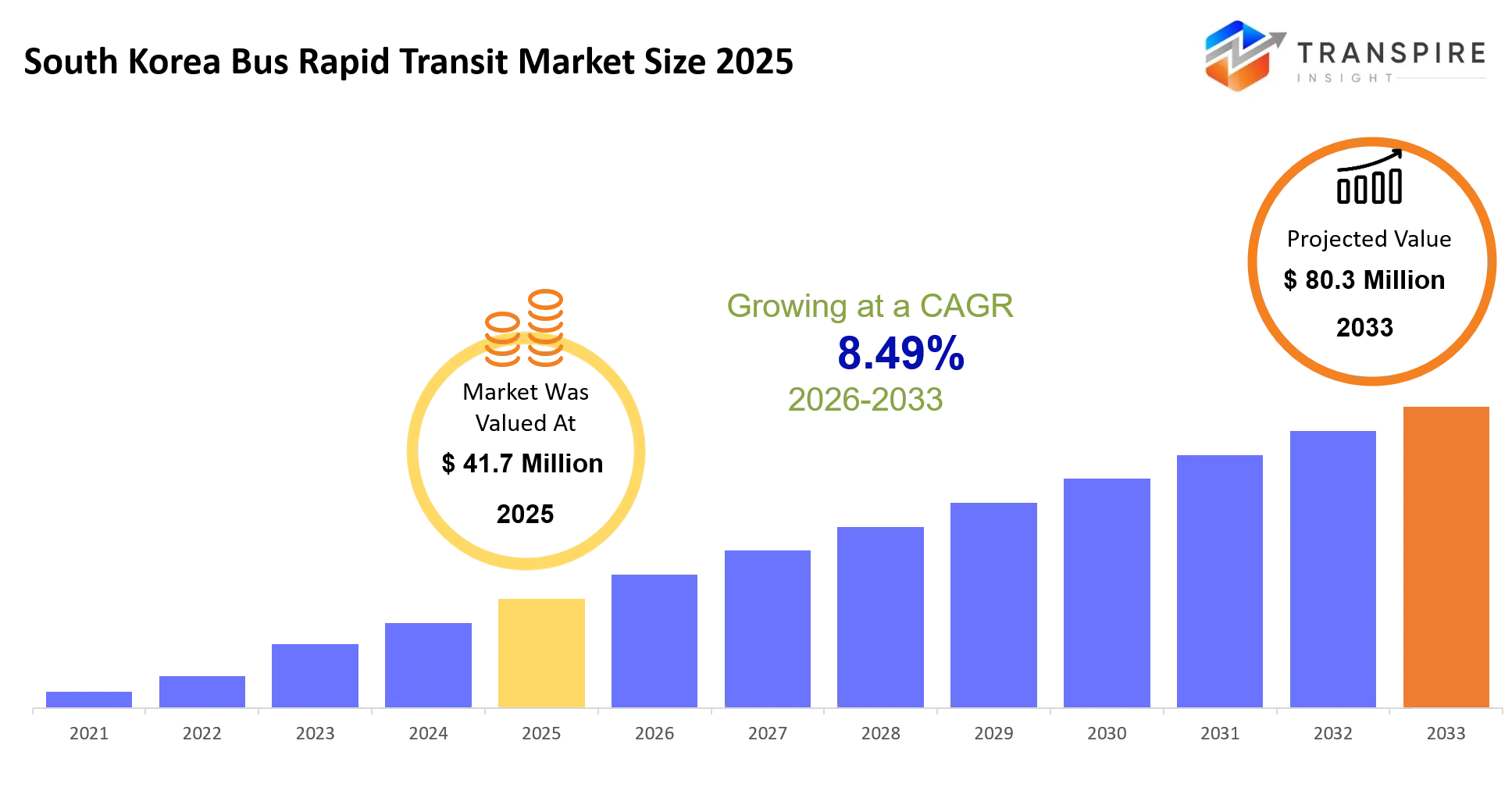
The South Korea Bus Rapid Transit Market was valued at USD 41.7 Million in 2025. It is forecast to reach USD 80.3 Million by 2033. That is a CAGR of 8.49% over the period.
Bus Rapid Transit (BRT) is a smart mode of travel, which in South Korea is the high capacity backbone serving densely built-up corridors of traffic. It uses bus lanes to divert traffic into corridors using signal priority systems, this way substituting private vehicles and lessening load on metrorail extensions. It becomes more important to have the system in Seoul and the surrounding cities where conventional transit has been struggling to achieve speed due to congestion. Over the past three to five years, with the general drift of electrification of vehicles, there is more interest towards AI-based systems to manage smart transit like traffic signal priority.
There is a gradual move towards digital transport management systems and this change includes integration with BRT, which will help in directing traffic at the optimal routes. The rise of traffic volume in urban centres after the COVID-19 pandemic has been coupled with the country's commitment to carbon neutrality policies. The emissions norms have tightened for the city transit, which is pushing the cities towards better infrastructure and electric vehicles. This trend is having a material impact on the procurement processes. This is an advantage for the system integrators and manufacturers of the buses.
Key Market Insights
- The Seoul Metropolitan Area held the largest market share in the South Korea Bus Rapid Transit Market, by almost 48% in 2025, driven by extensive commuter routes and existing high technology infrastructure.
- Gyeonggi Province is the highest growth region, estimated to have substantial growth by 2030 and new connectivity projects for surrounding new town transit networks are likely to boost development.
- The Dedicated lane infrastructure holds a significant share in the market by approximately 42%, owing to continuous development of corridor development programs in the country.
- The Electric bus fleet service is the second-highest shareholding segment, backed by fleet replacement schemes and incentives provided by the government.
- The AI powered traffic management systems holds the fastest growing market share till 2031, spurred by rapid deployment of smart city concepts.
- Urban commuter transit is the leading application holding market share of almost 60% of South Korea Bus Rapid Transit Market.
- The Airport and Intercity corridor BRT services segment is anticipated to be the highest growth application in the BRT market in the region, driven by multimodal connectivity needs.
- The Municipal Transit authorities hold a majority share of approximately 55% as end users in the market owing to its long term infrastructure planning strategy.
- The private mobility operators and outsourcing fleet managers are predicted to hold the largest share in the category, driven by an increase in outsourcing of transit operations.
What are the Key Drivers, Restraints, and Opportunities in the South Korea Bus Rapid Transit Market?
The market for South Korea Bus Rapid Transit has been driven by government policies that favor a carbon-neutral transport system, underpinned by rigid regulations on emissions, as well as a mandate to electrify municipal transit fleets. This shift toward an eco-friendly fleet has obliged transit authorities to move away from diesel-fueled buses, towards electric buses and low-emission fleet types, thus directly boosting vehicle purchase cycles, as well as charging station and smart corridor systems deployment cycles, thereby, in turn, widening the revenue generation streams in vehicle production, and also in digital traffic management and infrastructure enhancement projects.
The bottleneck in development is the physical inability to enhance urban road networks in hyper-dense metropolitans, particularly in Seoul, where the building stock and underground utility lines make corridor enhancement impractical and thus prevent the deployment of dedicated corridors and the realization of full BRT capacity. High investment costs also serve to stretch development cycles, leading to slower rollout of systems on a regional basis in the near term.
A future growth segment in the South Korea BRT market is the hybridization of autonomous vehicle technologies and multi-modal mobility stations into the BRT network. Experiments have been conducted in the Gyeonggi smart city zones on vehicle connectivity on corridors which may synchronize buses with traffic signals, metro lines, and other transportation infrastructure, potentially allowing for an era of near autonomous, near real-time passenger and cargo movements.
What Has the Impact of Artificial Intelligence Been on the South Korea Bus Rapid Transit Market?
The development of AI is transforming the South Korea Bus Rapid Transit Market by facilitating real-time fleet coordination, optimization of routes and prediction of infrastructure maintenance. Bus transit companies more commonly utilize control platforms enabled by artificial intelligence for real-time adjustment of frequencies to match real-time ridership through real-time passenger flow data analyzed from smart cards, CCTV camera analysis, and cellular network mobility applications. These actions have increased on-time performance along high-capacity corridors between 15-25%, particularly along commuting arteries during peak travel hours.
Machine learning is also currently used to predict component wear for electric buses. AI can detect patterns in battery discharge that indicate wear and the performance of braking systems before failure, reducing service interruptions and enabling longer equipment lifecycle efficiencies while decreasing maintenance costs of the transit agency's fleet. Signal priority technologies that incorporate AI allow transit companies to influence traffic signals along a specific transit corridor to maintain corridor speeds for bus rapid transit through real-time transit information and adaptable city traffic systems.
High integration complexity across old transit infrastructures poses a limitation to adoption, as cities often have disconnected and nonintegrated systems which can decrease efficiency and delay deployment for real-time artificial intelligence decisions. Variations in transit data standardization across transit agencies hinders the efficiency of training models for predictive congestion prediction in combined traffic.
Key Market Trends
- With increased urban emissions regulations by Korea, fleets powered solely by diesel have been phased out since 2022, with electrification by electric buses being introduced.
- AI-powered traffic signal priority systems have been rolled out through Seoul corridors since 2023, allowing buses to be on time and reduce the past bus delays caused by congestion.
- Procurement of vehicles changed from solely vehicle purchases, to procurement of an integrated mobility system composed of vehicles, charging stations, and software systems since 2021.
- Since 2024, local governments have started outsourcing fleet analysis to IT companies such as Samsung SDS, promoting the digitisation of public transportation systems.
- BRT lane construction in dense urban centers decreased, but in the corridors of Gyeonggi suburban areas, infrastructure approvals sped up after 2023.
- In 2022, Hyundai-powered mobility services by Hyundai Motor Company started bundling electric buses with fleet telematics.
- Since the 2021 post-pandemic, transit passenger volume recovery resulted in the shift to improving high frequency transit corridor efficiency, rather than focusing on transit network construction projects.
- In 2023, the integration between BRT transit corridors and the metropolitan and railroad multimodal hub was facilitated after 2023.
- Modernisation of transit vehicle rolling stock has accelerated, driven by suppliers such as Hyundai Rotem to integrate smart depot and transit fleet automation solutions.
- In the transit industry, increasing competition among market players introduced the transit platforms of smart traffic signal priority solutions powered by AI technology, leading domestic players to develop real time transit mobility analytics in 2024.
South Korea Bus Rapid Transit Market Segmentation
By Component :
The infrastructure component within the South Korea Bus Rapid Transit Market includes dedicated lanes, stations, and corridor upgrades, aimed at enhancing the efficiency and speed of high-capacity buses. Growth is decelerating within highly congested urban centers but is picking pace in the outer areas due to greater availability of space. The emphasis is now shifting from the development of new BRT corridors to improving signal prioritization and curtailing bus stop delays.
The vehicle segment is gradually migrating from the diesel vehicle type to electric vehicles, prompted by the implementation of severe emission regulations along with individual city-level clean mobility objectives. Ticketing systems are advancing from card only and cash only types to fully digital modes, incorporating mobile payment and fare integration mechanisms. The Intelligent Transport System (ITS) component is an important emerging feature, which provides advantages such as real time bus tracking and traffic coordination, hence improving operational efficiency. Another crucial component is the depot charging and maintenance technology.
By Application :
Urban transport is the most common use case of the South Korea Bus Rapid Transit Market, to help move commuters in crowded urban corridors. The current demand in the sector focuses more on improving the frequency of buses rather than expanding the service area coverage, owing to increasing traffic congestion and efforts made by the city authorities to reduce travel time in city limits via enhanced corridor operations.
Intercity transport use case is observing a slow and steady growth, primarily between satellite cities and metropolis, aided by an increase in the integration of highway-linked BRT corridors for faster regional travel. Other prevalent use cases of BRT include airport shuttle services and special event transport, which exhibit increased demand during high traffic periods, benefiting from seamless integration with rail, metro and bus services.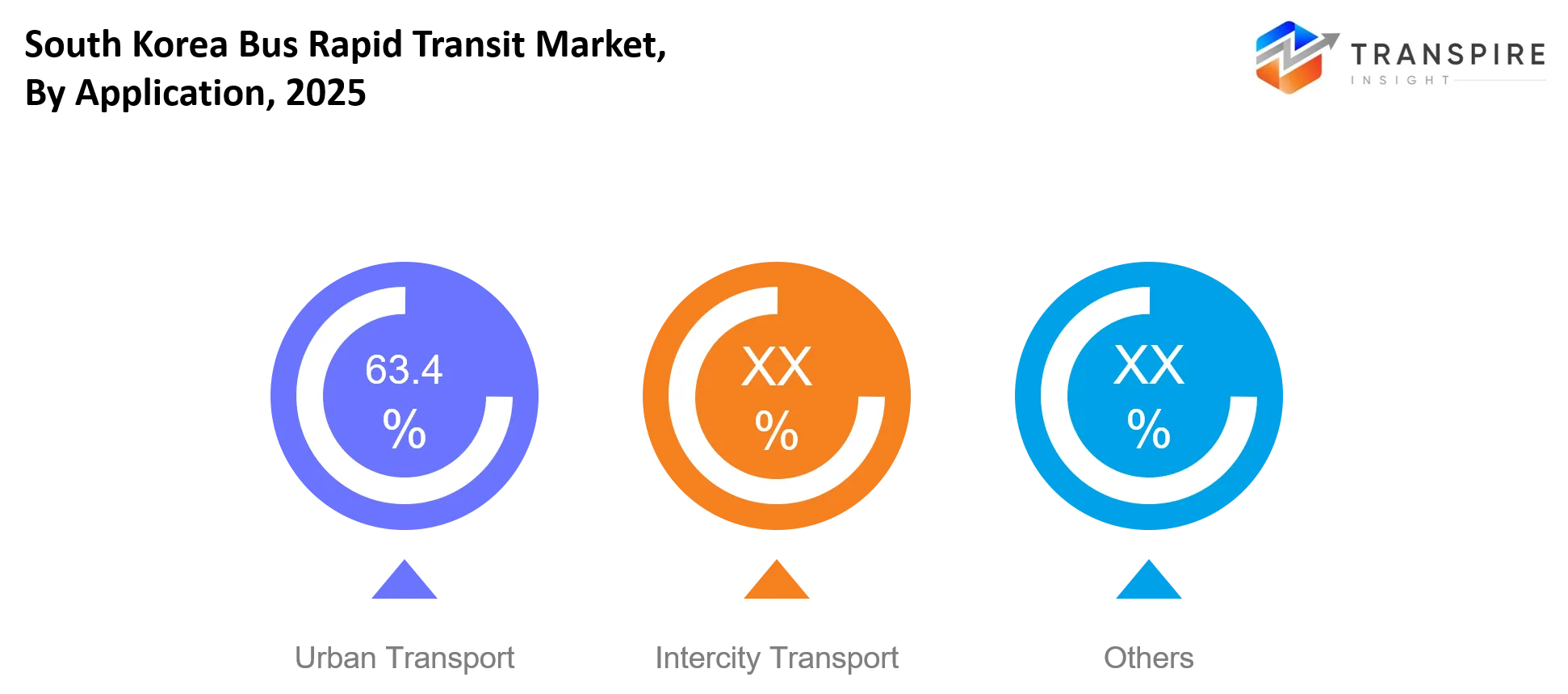
By End User :
The public authorities will be the dominant end-user sector in the South Korea Bus Rapid Transit Market, as public authorities will be responsible for planning, funding and delivery of infrastructure projects. The government has shown committed policy support for low emission transport, and has provided a steady flow of investments into upgrading the fleet and corridor systems. Procurement has shifted towards integrated technology systems with the vehicle rather than just the vehicle itself.
Private operators are enlarging their share in terms of outsourced fleet management, digital mobility services or marketing. End users are also private organizations such as transport contractors or service partners involved in charging infrastructure and system integration. Efficiency improvement, route optimization and data-based scheduling are priorities for private operators. Collaboration between private and public actors is getting more formalized with the aim to facilitate everyday functioning.
What are the Key Use Cases Driving the South Korea Bus Rapid Transit Market?
Core use cases occur along dense, commuter corridors of urban centers, where the predictable, high-frequency movement of Bus Rapid Transit is able to overcome traffic conditions along congested urban paths, thereby easing reliance on private vehicles and leading to a more predictable commute time along metropolitan-based corridors in the city of Seoul.
Growth uses include public and private operating entities running commuter inter-city corridors between suburbs and the urban core, as well as airport shuttle bus routes. These increases have been spurred by increased regional connectivity and by commuters moving away from the core downtown corridors toward suburban locations.
New use cases comprise the ability of AI to facilitate traffic flow management and enable autonomous bus demonstrations in smart city corridors; use of electrified fleets to adhere to stringent emission standards; and the continued, long-term upgrade and modernization of urban transportation.
|
Report Metrics |
Details |
|
Market size value in 2025 |
USD 41.7 Million |
|
Market size value in 2026 |
USD 45.4 Million |
|
Revenue forecast in 2033 |
USD 80.3 Million |
|
Growth rate |
CAGR of 8.49% from 2026 to 2033 |
|
Base year |
2025 |
|
Historical data |
2021 - 2024 |
|
Forecast period |
2026 - 2033 |
|
Report coverage |
Revenue forecast, competitive landscape, growth factors, and trends |
|
Country scope |
South Korea |
|
Key company profiled |
Hyundai Rotem, BYD, Yutong, Volvo Buses, Scania, Daimler Buses, Tata Motors, Ashok Leyland, Siemens Mobility, Thales, Cubic, Conduent, INIT, Hitachi Rail, Alstom |
|
Customization scope |
Free report customization (country, regional & segment scope). Avail customized purchase options to meet your exact research needs. |
|
Report Segmentation |
By Component (Infrastructure, Vehicles, Ticketing Systems, ITS, Others); By Application (Urban Transport, Intercity Transport, Others); By End User (Public Authorities, Private Operators, Others) |
Which Regions are Driving the South Korea Bus Rapid Transit Market Growth?
The Seoul Capital Area (SCA) dominates the South Korean Bus Rapid Transit market as a result of its extreme commuter congestion and severe traffic mitigation policies. Constant enforcement of low-emission vehicle zone policies, it has become more practical for transport agencies to implement capacity-intensive corridor solutions than standard bus routes. Robust integration with its subway transit systems, smart traffic signal solutions, and centralized fleet management systems maintain the reliability and functionality of everyday operations. Financial assistance for electric fleet retrofitting, sponsored by public funds, has solidified a steady expansion and long-term use of buses across major corridors in the capital.
Gyeonggi province exhibits a much more expansion-oriented environment compared to Seoul's more mature system. The region's expansion is sustained by the suburban growth of satellite cities and their commuter influx into Seoul. Uncharacteristically of the SCA, its current transit infrastructure in Gyeonggi still has capacity for expansion of dedicated lanes and depots. Its expansion is facilitated by a phased implementation of traffic management policies and upgrades which corresponds to the development of new residential and industrial areas, resulting in steady but unhindered expansion of the system.
The fastest growing mobility hub is Busan and its Southern corridors. Following its recent major port transit investments and rise in demand from tourism, investments in corridor construction and connection with coastal urban redevelopment have accelerated transit upgrades and the replacement of older buses starting 2023. An increase in regional transit investment has directly correlated with adoption of electric buses in the intercity segment. Its market offers a greater opportunity for growth potential for new entrants and investors, where long-term contracts will be signed to support and finance corridor infrastructure projects through 2033.
Who are the Key Players in the South Korea Bus Rapid Transit Market and How Do They Compete?
The South Korea Bus Rapid Transit Market is moderately fragmented with strong influence from domestic manufacturers and digital systems developers. Technology integration is now a primary factor of competition with significant weight being given to electric mobility platforms and AI supported fleet management rather than solely price point. Long term contracts with municipal operators are a key factor of competition among existing operators while innovative technology start-ups cater to smart mobility services and software layers.
Hyundai Motor Company provides smart integration of electric bus platforms and real time telematics systems for optimizing bus fleet operations. Hyundai Rotem specializes in providing transit system engineering solutions, depot automation systems for optimal management of bus fleets. Samsung SDS offers transit control systems based on artificial intelligence for mobility analysis of routes and estimation of fleet operations. Daewoo Bus leverages cost efficient manufacturing of buses for steady replacement contracts with municipal operators. Siemens Mobility leverages its expertise to offer smart signaling and corridor management systems for interconnected transit systems.
Company List
- Hyundai Rotem
- BYD
- Yutong
- Volvo Buses
- Scania
- Daimler Buses
- Tata Motors
- Ashok Leyland
- Siemens Mobility
- Thales
- Cubic
- Conduent
- INIT
- Hitachi Rail
- Alstom
Recent Development News
In August 2025, Hyundai Motor Company launched the Next Urban Mobility Alliance (NUMA) in collaboration with public and private transport stakeholders. The initiative focuses on integrating electric buses, BRT corridors, and AI-based traffic systems into unified smart city mobility networks, improving operational efficiency and fleet electrification across urban transit systems.Source https://www.hyundainews.com/
In January 2025, Hyundai Motor Company announced expansion of its electric bus platform deployment for urban transit corridors. The initiative integrates fleet telematics with corridor-level traffic signal priority systems to improve bus frequency reliability. The move strengthens electric BRT adoption across Seoul metropolitan routes. Sourcehttps://www.hyundai.com/
What Strategic Insights Define the Future of the South Korea Bus Rapid Transit Market?
The South Korea BRT market is marching toward full integration and low emission corridor systems over the next 5-7 years. Electrification and digital real-time coordination are becoming standard features, instead of upgrades and options due to stricter carbon neutral targets and the challenges in overcoming major city congestion and road-space scarcity. Yet, an unseen risk is dependence on a centralized software platform and an interdependence between operators and vendors on interoperability, which might delay large-scale adoption and make a system vulnerable to long term operating failures.
One emerging prospect is to incorporate BRT corridors with semi-autonomous vehicle trials into existing corridors in satellite cities, such as Gyeonggi, and leverage the current controlled environment of corridor development. Such development could alter current service frequency and fare structures over the time. Stakeholders should favor modular fleet and software architectures compatible for integration across various city systems instead of building one system in one corridor, and adapt to procurements of a unified mobility ecosystem.
South Korea Bus Rapid Transit Market Report Segmentation
By Component
- Infrastructure
- Vehicles
- Ticketing Systems
- ITS
By Application
- Urban Transport
- Intercity Transport
By End User
- Public Authorities
- Private Operators
Frequently Asked Questions
Find quick answers to common questions.
The South Korea Bus Rapid Transit Market size is USD 80.3 Million in 2033.
Key Segments for the South Korea Bus Rapid Transit Market are By Component (Infrastructure, Vehicles, Ticketing Systems, ITS, Others); By Application (Urban Transport, Intercity Transport, Others); By End User (Public Authorities, Private Operators, Others).
Major South Korea Bus Rapid Transit Market Players are Hyundai Rotem, BYD, Yutong, Volvo Buses, Scania, Daimler Buses, Tata Motors, Ashok Leyland, Siemens Mobility, Thales, Cubic, Conduent, INIT, Hitachi Rail, Alstom.
The Current South Korea Bus Rapid Transit Market size is USD 41.7 Million in 2025.
The South Korea Bus Rapid Transit Market CAGR is 8.49% from 2026 to 2033.
- Hyundai Rotem
- BYD
- Yutong
- Volvo Buses
- Scania
- Daimler Buses
- Tata Motors
- Ashok Leyland
- Siemens Mobility
- Thales
- Cubic
- Conduent
- INIT
- Hitachi Rail
- Alstom
About the Authors

Mayur Shinde
I am Mayur Shinde, a Senior Research Analyst at Transpire Insight, specializing in the Automotive & Transportation and Information & Communication Technology (ICT) Industry. My work focuses on analyzing emerging market trends, technological advancements, competitive landscapes, and industry developments to deliver accurate, data-driven insights. I am passionate about transforming complex market information into clear, actionable content that helps businesses, professionals, and decision-makers stay informed and make confident strategic decisions.

Chakradhar Khansole
Chakradhar serves as the Research Director at Transpire Insight, bringing over 8 years of experience in technology, innovation, and strategic market intelligence. He specializes in transforming complex market data into actionable business insights that enable organizations to make informed, growth-oriented decisions. Recognized for his strategic vision and analytical expertise, Chakradhar leads high-impact research initiatives, delivering comprehensive market assessments, competitive intelligence, and forward-looking industry analysis.
Recently Published Reports
-
Apr 2026
ATV & UTV Market
ATV & UTV Market Size, Share & Analysis Report By Type (ATV, and UTV), By Variants (Less Than 400 CC, 400 CC To 800 CC, and More Than 800 CC), and Geography (North America, Europe, Asia-Pacific, Middle East and Africa, South and Central America), 2021 - 2031
-
Apr 2026
Automotive Central Gateway Module Market
Automotive Central Gateway Module Market Size, Share & Analysis Report By Type (Ethernet Central Gateway Module, CAN Central Gateway Module, LIN Central Gateway Module, and FlexRay), By Application (Powertrain Control, Body Control, Infotainment System, Advanced Driver Assistance Systems (ADAS), and Others), By End User (Passenger Vehicles, and Commercial Vehicles), and Geography (North America, Europe, Asia-Pacific, Middle East and Africa, South and Central America), 2021 - 2031
-
Apr 2026
Automotive Engine Oil Filter Market
Automotive Engine Oil Filter Market Size, Share & Analysis Report By Filter Type (Fuel Filter, Engine Oil Filter, Hydraulic Oil Filter, and Others), By Filter Media (Cellulose, Synthetic, and Micro), By Sales Channel (OEMs, and Aftermarket), By Vehicle Type (Passenger Cars, Light Commercial Vehicles, Heavy Duty Trucks, Buses and Coaches, and Off-road Vehicles), and Geography (North America, Europe, Asia-Pacific, Middle East and Africa, South and Central America), 2021 - 2031
-
Apr 2026
Automotive Parts Aluminium Die Casting Market
Automotive Parts Aluminium Die Casting Market Size, Share & Analysis Report By Production Process (Pressure Die Casting, Vacuum Die Casting, Squeeze Die Casting, Gravity Die Casting), By Application (Body Parts, Engine Parts, Transmission Parts, Battery And Related Components, Other Application Types), and Geography (North America, Europe, Asia-Pacific, Middle East and Africa, South and Central America), 2021 - 2031
Our Clients



