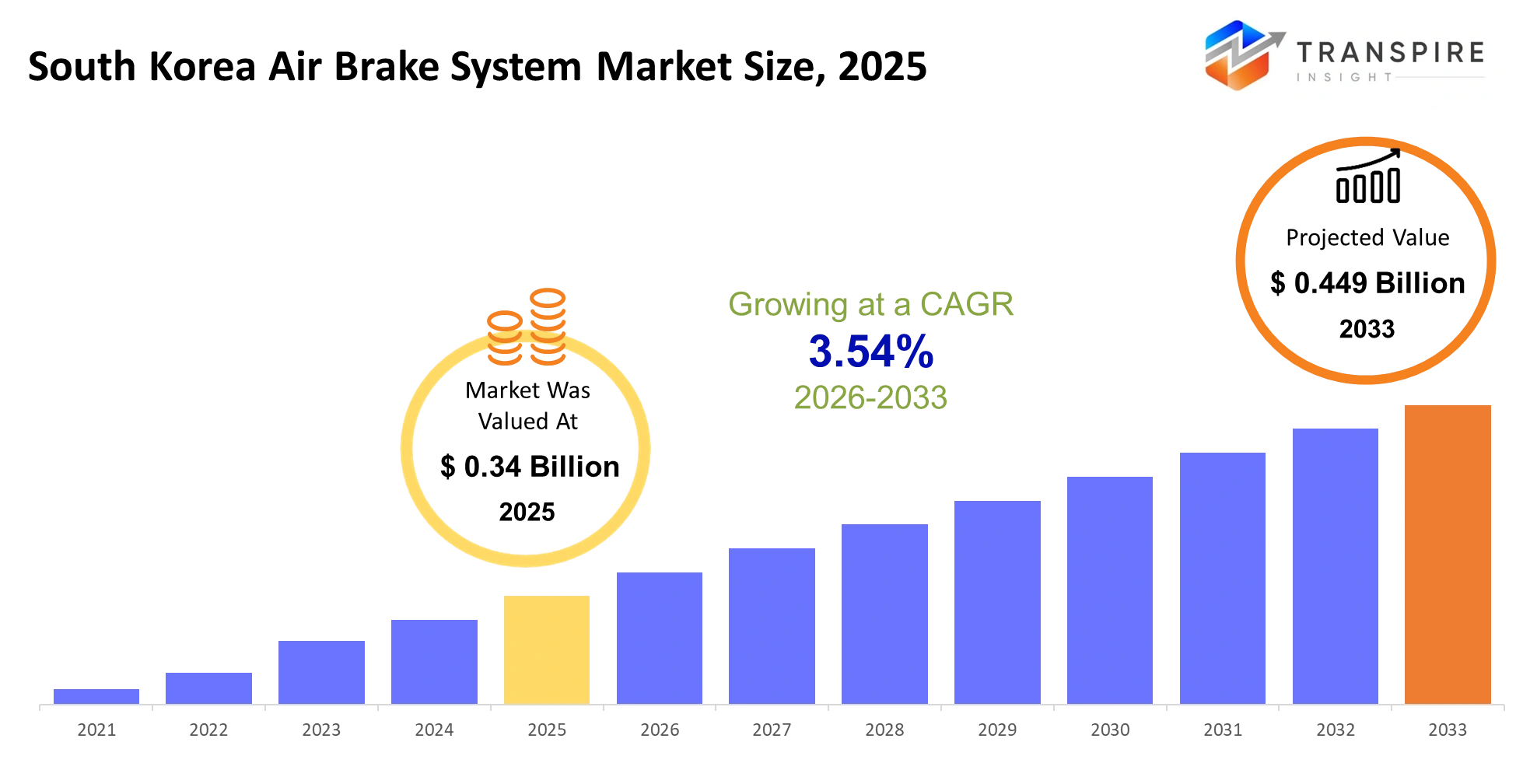
South Korea Air Brake System Market Size & Forecast:
- South Korea Air Brake System Market Size 2025: USD 0.34 Billion
- South Korea Air Brake System Market Size 2033: USD 0.449 Billion
- South Korea Air Brake System Market CAGR: 3.54%
- South Korea Air Brake System Market Segments: By Component (Compressors, Brake Chambers, Air Dryers, Valves, Slack Adjusters, Others); By Vehicle Type (Heavy Commercial Vehicles, Buses, Semi-trailers, Off-highway Vehicles, Others); By Technology (ABS Systems, Electronic Brake Systems, Pneumatic Brake Systems, Smart Brake Systems, Others); By Application (Fleet Transportation, Construction Vehicles, Mining Vehicles, Public Transportation, Others); By End User (OEMs, Aftermarket Suppliers, Fleet Operators, Others).
To learn more about this report,  Download Free Sample Report
South Korea Air Brake System Market Summary
The South Korea Air Brake System Market was valued at USD 0.34 Billion in 2025. It is forecast to reach USD 0.449 Billion by 2033. That is a CAGR of 3.54% over the period.
In practice air brake systems in South Korea kinda function as critical safety and control mechanisms for heavy transport, industrial machines, and also maritime auxiliary setups where proper stopping strength and load stability are needed, especially when high pressure operating conditions show up. Over the last few years the market has shifted pretty noticeably, because digital control integration and electronically modulated braking systems have replaced those older pneumatic-only arrangements, and that improves response exactness plus system diagnostics. One big structural change is the movement toward sensor enabled braking designs, aligned with automated fleet management systems, or at least that’s how it’s being described in most deployments.
Market behavior was also affected a lot by the post pandemic supply chain disruptions, which revealed how much everyone depended on imported high precision valves and control units. Because of that, local manufacturers started to strengthen domestic sourcing, and they redesigned modular systems too. This change then sped up the take up of localized production and smarter maintenance frameworks. So now revenue growth seems more tied to retrofitting cycles and compliance driven upgrades, rather than just new vehicle pull, and it suggests a growth route that’s led by technology upgrades, even if the demand story is more complicated.
Key Market Insights
- The South Korea Air Brake System market is basically run by commercial vehicles, holding around 42% share, mainly because freight logistics keep expanding.
- Railway related uses, plus heavy industrial equipment, are moving the quickest too, backed by infrastructure improvements and automation alignment trends that keep showing up.
- North Gyeongsang and Ulsan seem to lead the demand pretty hard, with over 35% combined share, mostly linked to concentrated manufacturing and logistics hubs.
- The Seoul metro area is still the fastest-growing adoption zone, pushed by smart mobility efforts and fleet digitization programs.
- For products, brake control modules sit in front, at about 38% share, since electronically managed braking systems are getting requested more often.
- Air compressor systems are next in line, they make up the second-largest segment, and that is mostly tied to the fact that heavy vehicles still rely heavily on pneumatic power.
- On the category side, predictive maintenance integrated braking systems are the fastest-growing, and they’re likely to expand fast between 2025 and 2033 as well.
- Looking at end users, freight transport remains the top, taking more than 45% share in the South Korea Air Brake System Market.
- Public transportation operators are showing the quickest adoption growth too, because safety regulation updates keep tightening, and fleet replacement cycles are constantly happening.
What are the Key Drivers, Restraints, and Opportunities in the South Korea Air Brake System Market?
The main thing that pushes the South Korea air brake system market is the fast modernization of commercial fleets, sort of under tighter safety, and efficiency rules than before. Regulators have been more strict about braking performance for heavy vehicles and also for public transport. So operators are being pushed to swap older pneumatic setups for electronically managed braking, with built-in sensors that kind of “talk” through the system. That shift really boosts aftermarket revenue because retrofits are needed, and it also accelerates OEM adoption of newer braking designs during new-vehicle production cycles.
One notable drag, though, is the pricey and messy integration effort involved when traditional mechanical braking gets upgraded to digitally controlled platforms. A lot of smaller and mid-sized fleet operators tend to wait because the conversion isn’t just about changing parts; it also means recalibrating the whole system and training the workforce, and, well, that’s not trivial. This acts as a structural roadblock, so penetration remains slow in cost-sensitive logistics and regional transport areas, thereby dampening near-term revenue growth.
At the same time, there’s a promising opening around predictive maintenance and connected fleet ecosystems. Firms like Hyundai Mobis, along with major global suppliers, are investing in IoT-based braking diagnostics to reduce unexpected downtime. And as South Korea keeps expanding smart logistics corridors, plus testing zones for autonomous freight, the demand for self-monitoring brake systems could open up a more service-led kind of revenue stream, not just parts replacement.
What Has the Impact of Artificial Intelligence Been on the South Korea Air Brake System Market?
Artificial intelligence is getting more and more slipped into modern braking ecosystems, sort of, to boost operational reliability and reduce that maintenance uncertainty felt in heavy duty transport. In South Korea, AI driven control units are now used to tune the braking force distribution in real time, especially within electronically controlled pneumatic setups in freight trucks and other industrial vehicles. These setups look at the load situation, road gradients, and how the vehicle is being driven, then adjust the braking response on the fly… which helps keep safety more consistent as operating conditions change.
Machine learning models are also showing up in predictive maintenance, where sensor signals from brake pads, compressors, and pressure valves are constantly examined to catch early stage wear behaviors. That means fleet operators can plan maintenance before something fails, reducing downtime and helping components last longer. In real industry deployments, there have been notable directionally positive results in uptime and reduced maintenance cost, especially for big logistics fleets and rail linked transport operations.
Still, take-up is not fully smooth because the integration work can be pretty complex, and real world data quality is sometimes inconsistent. A lot of braking systems run in low connectivity zones, like long haul freight routes, and even maritime adjacent industrial areas, so real time data transfer gets limited. Also, there is a shortage of standardized training datasets across different vehicle types, and that lowers algorithm precision, so large scale AI based braking optimization across the South Korea Air Brake System Market gets delayed.
Key Market Trends
- Electronically controlled pneumatic braking adoption jumped about 28% from 2022 to 2025 through South Korean commercial freight fleets, so yeah kinda fast growth there.
- In the same window, legacy mechanical brake replacements dropped more than 15%, and operators seemed to move toward modular sensor driven braking setups, with extra instrumentation.
- Meanwhile, freight logistics companies rolled out AI enabled brake monitoring roughly 20% more in 2024, with the stated goal to limit downtime while also boosting safety compliance.
- Rail and urban transit modernization programs then pushed smart braking integration up around 25% across 2023–2025, especially during the usual infrastructure upgrade cycles that never seem to pause.
- On the domestic side, suppliers like Hyundai Mobis boosted localized brake component production by about 18% after the global supply disruptions in 2022 and the response was pretty direct.
- Globally, players such as Knorr-Bremse tightened South Korea partnerships, expanding electronic brake system deployments for heavy duty vehicles.
- Predictive maintenance in braking systems also helped, cutting unplanned fleet failures by nearly 22% in major logistics operators since the 2023 rollout, which sounds huge.
- Then in 2024 safety rules got stricter and retrofitting demand picked up, affecting roughly 30% of the existing commercial vehicle fleets across the country.
- Smart fleet connectivity initiatives in Seoul increased real time braking diagnostics coverage to around 40% of public transport buses by 2025.
- And finally supply chain localization reduced imported brake valve dependency by about 16% , which in turn improved resilience across OEM manufacturing networks.
South Korea Air Brake System Market Segmentation
By Component
Compressor units still kinda hold the leading position, mainly because they generate and keep steady air pressure for heavy duty braking, especially across freight and industrial vehicles. Their durability requirements are high, and they operate under continuous duty cycles in logistics fleets, so their dominant share remains solid. Brake Chambers sit right behind, they take pneumatic pressure and turn it into mechanical force, so they’re basically non-negotiable for dependable stopping. Air Dryers are the speediest expanding piece of the lineup , pushed by the increasing need for air that’s moisture-free. That helps braking reliability and also cuts down corrosion problems in damp or humid work conditions. Valves keep demand stable, too, since they’re in the middle of airflow regulation and overall system responsiveness. Slack Adjusters are climbing at a steady pace because fleet operators prefer automatic adjustment setups, which reduces maintenance downtime. Other parts stay pretty limited, more tied to niche customization requests and not much else.
Looking ahead, future gains will bunch up around Air Dryers and more advanced Valves, because system reliability becomes a main buying criteria in fleet modernization. Compressors will continue to anchor volume demand, though upgrades will lean more toward efficiency improvements rather than just more capacity. Brake Chambers should stay on a fairly steady replacement schedule that aligns with heavy-duty vehicle lifespans. Slack Adjusters are likely to be picked more often in automated maintenance ecosystems, particularly for long haul logistics routes. During the forecast window, component innovation will drift toward integrated, low-maintenance assemblies , with the goal of lowering downtime and improving lifecycle cost efficiency for operators.
By Vehicle Type
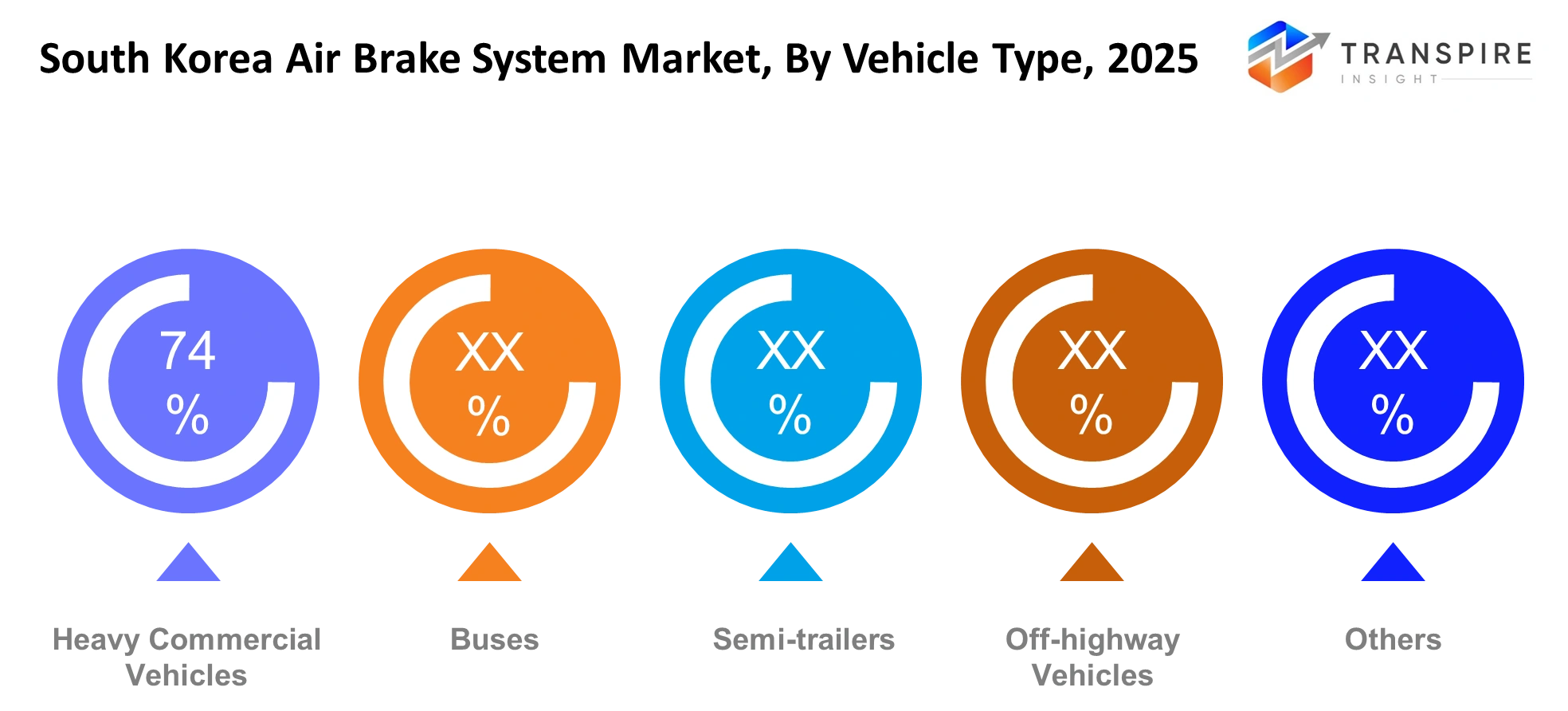
Heavy Commercial Vehicles kinda hold the upper hand because they’re used a lot in freight logistics, construction moving , and long distance hauling where you really need solid load braking stability. A big fleet footprint plus constant replacement cycles, keeps the need pretty steady. Buses, on the other hand, look more stable because public transport networks are already set, and there is strong regulatory focus on passenger safety standards. Semi-trailers feel like the faster mover here, mostly pulled by cross border logistics growth and the rising push for better freight efficiency in industrial corridors. Off-highway Vehicles stay steady, too, tied to mining, construction, and infrastructure buildouts underway in the background. The “Others” group stays kinda narrow, limited to more specialized haulage use cases.
In the future, Semi-trailers will probably lead the way. As logistics networks broaden, and the appetite for high capacity cargo movement ramps up, that category should benefit the most. Heavy Commercial Vehicles will still dominate overall consumption volumes, but the change is more like slow efficiency led improvements, not a sudden expansion kind of jump. Buses should keep seeing consistent replacement demand, supported by investments in urban mobility. Off-highway Vehicles should rise at a moderate pace following infrastructure development timelines. Over time, vehicle demand will lean toward modular braking systems, meant for multi application compatibility, so fleets can adapt easier across different vehicle groups and varied operating conditions.
To learn more about this report, Download Free Sample Report
By Technology
ABS Systems are kind of holding the leading position thanks to mandatory safety rules, plus it shows up everywhere across commercial vehicles and passenger car platforms too. The way braking safety standards are enforced pretty strongly helps ensure adoption keeps happening across OEM production lines. Meanwhile Pneumatic Brake Systems are still one of the main foundations, especially for heavy-duty use where you actually need high-force braking capability. Electronic Brake Systems are the fastest-growing area, mostly because digital control systems are getting more integrated, and real-time vehicle diagnostics are becoming normal. Smart Brake Systems are also growing, albeit more slowly, as more connected fleet management solutions are adopted. The other options stay pretty niche, usually only in legacy setups or hybrid configurations, so not much change there.
Looking ahead, future growth will be driven mainly by Electronic Brake Systems and Smart Brake Systems, as fleet operators shift toward data-driven, more automated braking control environments. ABS Systems will still be essential, but they’ll be more standardized, meaning there’s less room for differentiation. Pneumatic systems will keep surviving in heavy-duty segments, but over time, they’ll gradually get layered with electronic overlays, to boost performance. Over the forecast period, the major technology evolution theme will focus on fully integrated braking architectures—sensors, connectivity, and predictive analytics—working together to improve safety outcomes and operational efficiency across the entire transport ecosystem.
By Application
Fleet Transportation still kind of owns the market, mainly because of its big logistics work, plus those never-ending vehicle utilization cycles that need braking systems that are reliable and durable, not just “good enough.” On top of that, the freight density is high and the trips are long, so the need kind of stays consistent, almost without breaks. Public Transportation stays pretty stable too, helped by regulatory safety requirements and the fact that cities keep pushing fleet modernization for urban mobility systems. Construction Vehicles are showing up as the fastest-growing part, mostly due to infrastructure expansion and more mechanization in construction. Mining Vehicles also keep a steady rhythm tied to resource extraction operations, and they have heavy load-braking needs that don’t really go away. The rest are more niche, with limited scale and fewer buyers.
Looking ahead, growth will lean toward Construction Vehicles as infrastructure investment cycles accelerate and demand for high-performance braking systems rises. Fleet Transportation will still be the leader, but it will slowly shift to efficiency focused upgrades and more predictive maintenance integration, sort of like planned rather than reactive service. Public Transportation should remain steady, with modernization-driven demand, plus safety compliance upgrades that keep coming. Mining Vehicles are expected to increase, but only moderately, reflecting commodity cycle stability. During the forecast period, application demand will be increasingly tugged toward ruggedized braking systems, designed for high durability, so they can function under extreme loads and harsh environmental conditions without much drama.
By End User
OEMs still kinda hold the dominant position, mainly because they steer vehicle design integration and they’re usually the first to get advanced braking technologies into fresh production platforms. Their strong supplier ties, plus all the compliance requirements, keep their leading role pretty locked in when it comes to system adoption.
Fleet Operators are the fastest-growing end-user group right now because logistics companies and transport providers are increasingly investing in retrofit upgrades and predictive maintenance solutions. Meanwhile, Aftermarket Suppliers keep seeing fairly steady demand, driven by replacement cycles and ongoing servicing needs across older vehicle fleets. The rest of the players stay rather limited, mostly tied to niche procurement channels,
Looking ahead, future growth seems to continue tilting toward Fleet Operators, as operational efficiency and downtime reduction are becoming key decision factors for fleet management. OEMs will still be the backbone for volume demand, but they’ll also face more pressure to make advanced electronics, and smart braking systems become normal standard features. Aftermarket Suppliers will remain important for legacy fleet upgrades and component replacement cycles. Over the forecast period, end-user dynamics should move more toward service-oriented procurement models, where lifecycle performance, digital monitoring, and maintenance optimization are what drive buying decisions , more than just the price of a standalone component.
What are the Key Use Cases Driving the South Korea Air Brake System Market?
In South Korea, the dominant use case for air brake systems is heavy-duty freight transport, where braking remains consistent even as cargo loads change, helping road safety and operational efficiency at once. This segment tends to draw the most demand because logistics networks continue to expand and long-haul trucking remains busy along industrial corridors.
Then there are secondary use cases, mostly showing up in public transportation fleets and rail-linked systems, where operators are upgrading toward electronically controlled braking , for better passenger safety. They’re also trying to match compliance with tougher national transport regulations. You can notice this especially among urban transit authorities, as well as regional rail operators in modernization programs that are running right now.
A more nascent but still growing direction is automated and semi-autonomous vehicle testing environments. Here, smart braking systems get folded into sensor-driven driving controls, which supports future mobility platforms as well as smart logistics pilots.
|
Report Metrics |
Details |
|
Market size value in 2025 |
USD 0.34 Billion |
|
Market size value in 2026 |
USD 0.352 Billion |
|
Revenue forecast in 2033 |
USD 0.449 Billion |
|
Growth rate |
CAGR of 3.54% from 2026 to 2033 |
|
Base year |
2025 |
|
Historical data |
2021 - 2024 |
|
Forecast period |
2026 - 2033 |
|
Report coverage |
Revenue forecast, competitive landscape, growth factors, and trends |
|
Regional scope |
South Korea |
|
Key company profiled |
WABCO, Knorr-Bremse, Hyundai Mobis, Haldex, Bendix Commercial Vehicle Systems, Nabtesco, SORL Auto Parts, ZF Friedrichshafen, Continental AG, Meritor, MAN SE, Hitachi Astemo, Tata AutoComp, Aisin Corporation, Mando Corporation. |
|
Customization scope |
Free report customization (country, regional & segment scope). Avail customized purchase options to meet your exact research needs. |
|
Report Segmentation |
By Component (Compressors, Brake Chambers, Air Dryers, Valves, Slack Adjusters, Others); By Vehicle Type (Heavy Commercial Vehicles, Buses, Semi-trailers, Off-highway Vehicles, Others); By Technology (ABS Systems, Electronic Brake Systems, Pneumatic Brake Systems, Smart Brake Systems, Others); By Application (Fleet Transportation, Construction Vehicles, Mining Vehicles, Public Transportation, Others); By End User (OEMs, Aftermarket Suppliers, Fleet Operators, Others). |
Which Regions are Driving the South Korea Air Brake System Market Growth?
Seoul Capital Region really kind of dominates the South Korea Air Brake System Market , mostly because it has a lot of logistics hubs, dense fleets of commercial vehicles, and they enforce road safety and emissions compliance pretty strictly. There is also high freight turnover through metropolitan distribution centers , and that made operators lean toward electronically controlled braking systems, partly for quicker response and partly for better safety buffers. On top of that, advanced fleet management firms and OEM service networks are around, too, which speed up replacement cycles and create more retrofit demand. And the government-led smart mobility efforts in Seoul, well, those are pushing even more sensor-based braking diagnostics into public transport systems, so the region stays in a leadership position.
Then you have the Busan–Ulsan–Gyeongnam corridor as the second-largest contributor, backed by a strong maritime logistics base and an industrial manufacturing ecosystem. Unlike Seoul, where adoption is more policy driven, here the stability shows up because shipbuilding is ongoing, export freight keeps moving, and industrial contracts run long term. Busan’s large-scale port operations keep demand steady for heavy duty braking systems, especially in cargo handling equipment and transport fleets. The investment pattern in this belt is more up and down , but it still holds up, since shipowners and industrial operators tend to value durability and lifecycle cost efficiency rather than chasing rapid technological change, so revenue stays fairly consistent.
For the fastest growing area, you get the Daejeon–Sejong–Chungcheong innovation belt. This is driven by recent expansion of smart mobility testbeds and government-backed pilot programs for autonomous transport. Since 2024, new infrastructure spending has encouraged electrification trials for fleets, and it also supports the integration of AI assisted braking systems, at least in controlled environments where testing is manageable.
Who are the Key Players in the South Korea Air Brake System Market and How Do They Compete?
South Korea Air Brake System Market looks moderately consolidated, where global Tier-1 suppliers go head to head with pretty tough domestic automotive component makers. In practice, the rivalry isn’t only about price, it’s more about who can pull off better technology integration, especially when it comes to electronically controlled braking and predictive diagnostics. The established brands tend to hold ground by going deeper into OEM supply chains, then there’s disruption that is sort of creeping in, from software-enabled braking innovators and localized suppliers that are trying to strengthen domestic manufacturing resilience.
Knorr-Bremse focuses on high-performance rail and commercial vehicle braking systems, and it stands out for its advanced electronic brake control modules and strong alignment with worldwide safety standards. They keep pushing forward through long-term OEM commitments in heavy-duty freight transport and rail modernization programs across Asia.
ZF Friedrichshafen plays differently, using integrated mobility platforms that bring braking together with chassis and ADAS systems. The edge is system-level integration, not just standalone parts, so OEM dependency becomes deeper, not weaker. Sometimes it feels like they sell the whole “vehicle brain” idea, rather than a single unit. Hyundai Mobis leans hard on domestic supply chain closeness, plus fast customization for Korean OEMs. It’s expanding by upgrading local production lines and developing smart braking modules for the next generation mobility platforms, with more adaptive behavior and cleaner integration.
Company List
- WABCO
- Knorr-Bremse
- Hyundai Mobis
- Haldex
- Bendix Commercial Vehicle Systems
- Nabtesco
- SORL Auto Parts
- ZF Friedrichshafen
- Continental AG
- Meritor
- MAN SE
- Hitachi Astemo
- Tata AutoComp
- Aisin Corporation
- Mando Corporation
Recent Development News
“In March 2025, Knorr-Bremse announced a partnership with Hyundai Rotem to co-develop advanced braking systems for next-generation rail fleets. The collaboration aims to improve braking efficiency and reduce maintenance cycles in high-speed rail operations.”
Source: https://www.knorr-bremse.com
“In January 2026, ZF Friedrichshafen launched an upgraded electronic brake control platform for commercial vehicles in Asia. The system enhances predictive braking response and integrates directly with fleet telematics for real-time safety optimization.”
Source: https://www.zf.com
“In September 2025, Hyundai Mobis secured a technology collaboration agreement with a Korean logistics fleet operator to deploy AI-enabled brake monitoring systems. The initiative focuses on reducing unplanned downtime through predictive maintenance analytics.”
Source: https://www.mobis.co.kr (Hyundai Mobis)
What Strategic Insights Define the Future of the South Korea Air Brake System Market?
The South Korea Air Brake System Market is shifting, toward software-defined braking ecosystems, where the hardware performance is more and more steered by digital control intelligence and some predictive analytics. In the next 5–7 years, you’ll likely see growth shaped by how fleet electrification meets autonomous mobility pilots and also, stricter safety enforcement across commercial transport routes. There is also a quieter issue, like over dependency on imported semiconductor and sensor parts. That can make braking system supply chains more fragile in the face of geopolitics or sudden fabrication capacity disruptions.
At the same time, an actual chance is showing up, via AI driven retrofit solutions for older fleets, especially for logistics and public transport teams that can’t just replace everything at once. Market players should focus on modular, upgradeable braking architectures that integrate smoothly with fleet software platforms. Because value creation is likely to shift away from just selling components and toward lifecycle intelligence services, more or less.
South Korea Air Brake System Market Report Segmentation
By Component
- Compressors
- Brake Chambers
- Air Dryers
- Valves
- Slack Adjusters
- Others
By Vehicle Type
- Heavy Commercial Vehicles
- Buses
- Semi-trailers
- Off-highway Vehicles
- Others
By Technology
- ABS Systems
- Electronic Brake Systems
- Pneumatic Brake Systems
- Smart Brake Systems
- Others
By Application
- Fleet Transportation
- Construction Vehicles
- Mining Vehicles
- Public Transportation
- Others
By End User
- OEMs
- Aftermarket Suppliers
- Fleet Operators
- Others
Frequently Asked Questions
Find quick answers to common questions.
The estimated South Korea Air Brake System Market size for the market will be USD 0.449 Billion in 2033.
Key segments for the South Korea Air Brake System Market are By Component (Compressors, Brake Chambers, Air Dryers, Valves, Slack Adjusters, Others); By Vehicle Type (Heavy Commercial Vehicles, Buses, Semi-trailers, Off-highway Vehicles, Others); By Technology (ABS Systems, Electronic Brake Systems, Pneumatic Brake Systems, Smart Brake Systems, Others); By Application (Fleet Transportation, Construction Vehicles, Mining Vehicles, Public Transportation, Others); By End User (OEMs, Aftermarket Suppliers, Fleet Operators, Others).
Major South Korea Air Brake System Market players are WABCO, Knorr-Bremse, Hyundai Mobis, Haldex, Bendix Commercial Vehicle Systems, Nabtesco, SORL Auto Parts, ZF Friedrichshafen, Continental AG, Meritor, MAN SE, Hitachi Astemo, Tata AutoComp, Aisin Corporation, Mando Corporation.
The South Korea Air Brake System Market size is USD 0.34 Billion in 2025.
The South Korea Air Brake System Market CAGR is 3.54% from 2026 to 2033.
- WABCO
- Knorr-Bremse
- Hyundai Mobis
- Haldex
- Bendix Commercial Vehicle Systems
- Nabtesco
- SORL Auto Parts
- ZF Friedrichshafen
- Continental AG
- Meritor
- MAN SE
- Hitachi Astemo
- Tata AutoComp
- Aisin Corporation
- Mando Corporation
Recently Published Reports
-
Apr 2026
ATV & UTV Market
ATV & UTV Market Size, Share & Analysis Report By Type (ATV, and UTV), By Variants (Less Than 400 CC, 400 CC To 800 CC, and More Than 800 CC), and Geography (North America, Europe, Asia-Pacific, Middle East and Africa, South and Central America), 2021 - 2031
-
Apr 2026
Automotive Central Gateway Module Market
Automotive Central Gateway Module Market Size, Share & Analysis Report By Type (Ethernet Central Gateway Module, CAN Central Gateway Module, LIN Central Gateway Module, and FlexRay), By Application (Powertrain Control, Body Control, Infotainment System, Advanced Driver Assistance Systems (ADAS), and Others), By End User (Passenger Vehicles, and Commercial Vehicles), and Geography (North America, Europe, Asia-Pacific, Middle East and Africa, South and Central America), 2021 - 2031
-
Apr 2026
Automotive Engine Oil Filter Market
Automotive Engine Oil Filter Market Size, Share & Analysis Report By Filter Type (Fuel Filter, Engine Oil Filter, Hydraulic Oil Filter, and Others), By Filter Media (Cellulose, Synthetic, and Micro), By Sales Channel (OEMs, and Aftermarket), By Vehicle Type (Passenger Cars, Light Commercial Vehicles, Heavy Duty Trucks, Buses and Coaches, and Off-road Vehicles), and Geography (North America, Europe, Asia-Pacific, Middle East and Africa, South and Central America), 2021 - 2031
-
Apr 2026
Automotive Parts Aluminium Die Casting Market
Automotive Parts Aluminium Die Casting Market Size, Share & Analysis Report By Production Process (Pressure Die Casting, Vacuum Die Casting, Squeeze Die Casting, Gravity Die Casting), By Application (Body Parts, Engine Parts, Transmission Parts, Battery And Related Components, Other Application Types), and Geography (North America, Europe, Asia-Pacific, Middle East and Africa, South and Central America), 2021 - 2031
Our Clients