

South Korea Vehicle-to-Grid Market Size & Forecast:
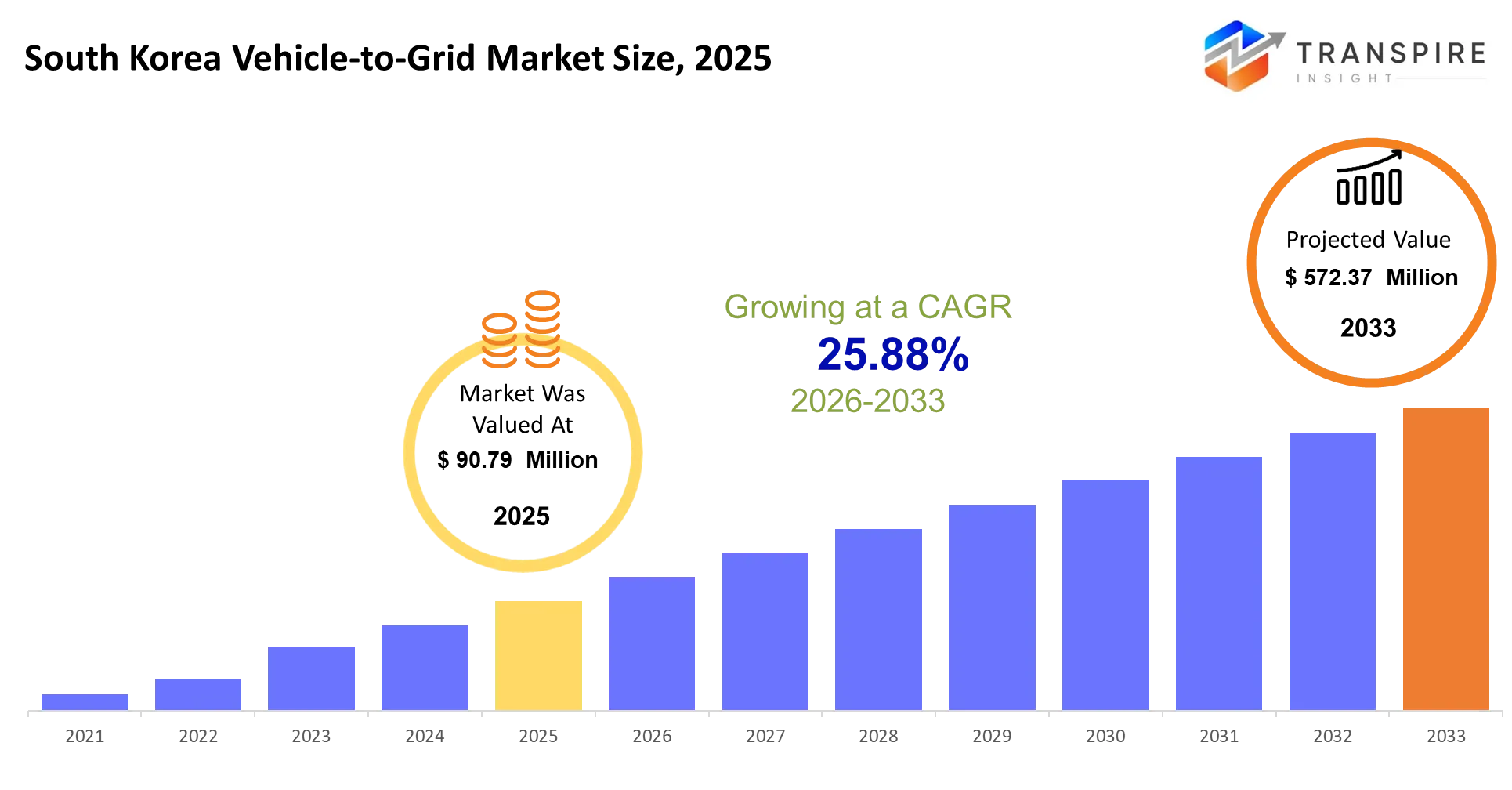
- South Korea Vehicle-to-Grid Market Size 2025: USD 90.79 Million
- South Korea Vehicle-to-Grid Market Size 2033: USD 572.37 Million
- South Korea Vehicle-to-Grid Market CAGR: 25.88%
- South Korea Vehicle-to-Grid Market Segments: By Component (Charging Stations, Bidirectional Chargers, Energy Management Software, Grid Communication Systems, Others); By Vehicle Type (Passenger EVs, Commercial EVs, Electric Buses, Others); By Application (Grid Stabilization, Renewable Energy Integration, Peak Load Management, Others); By End User (Utilities, Fleet Operators, Residential Users, Others)
To learn more about this report,  Download Free Sample Report
South Korea Vehicle-to-Grid Market Summary
The South Korea Vehicle-to-Grid Market was valued at USD 90.79 Million in 2025. It is forecast to reach USD 572.37 Million by 2033. That is a CAGR of 25.88% over the period.
In South Korea, vehicle to grid systems are helping electric vehicles act like flexible energy assets, so they can push stored electricity back to the grid when demand peaks, or when the grid gets a little unstable. In real life this also lets utilities smooth out fast shifting renewable production, especially solar alongside wind, while cutting reliance on peak load power plants. And on the other side it gives fleet managers, plus regular EV owners, a way to profit from “spare” battery capacity, through grid services, kind of like turning downtime into a benefit.
Over the last 3–5 years, there has been a sort of structural change, toward bidirectional charging standards, and that moves lines up EV infrastructure with smart grid modernization programs. At the same time, renewable penetration targets keep expanding under national carbon neutrality roadmaps, which effectively pressured grid operators to look harder at distributed flexibility solutions. One big spark, that made adoption feel more urgent, was the volatility in energy pricing and the congestion on the grid during the post pandemic industrial rebound. That period showed limits in centralized power balancing, and it became harder to ignore. So utilities, together with automakers, started folding V2G pilots into commercial EV environments, which improves revenue logic, and speeds up early stage rollout.
Key Market Insights
- South Korea Vehicle to Grid market is expanding like, as EV take up passes 25% penetration in new registrations by 2025.
- Grid operators are more and more rolling out V2G trials, to help steady renewable-heavy electricity systems and to lower how much they depend on peak-load moments.
- The fastest growing area is the Seoul metropolitan zone, it’s nearing 40% of all pilot charging infrastructure installs, so it kinda leads.
- Industrial fleets are the main segment here, mostly because their charging rhythms are pretty predictable and they offer strong grid interaction potential.
- Passenger EVs stay as the second largest group, helped by home charging growth and smart meter integration that keeps getting easier.
- At the same time, fleet centered V2G applications are also growing quickest, with more than a 30% jump in commercial pilot involvement since 2023.
- Public charging infrastructure still holds a big chunk too, especially as government backing ramps up deployment across the country.
- In terms of use cases, energy arbitrage is the leader, with utilities leaning on vehicle batteries for peak shaving and demand response programs.
- Key players showing up are Hyundai Motor Company, Kia Corporation, Samsung SDS, LG CNS, POSCO Energy, and SK Telecom.
- The strategic edge seems to come from having connected EV platforms, cloud based energy management systems, plus utility partnerships that support grid balancing services.
What are the Key Drivers, Restraints, and Opportunities in the South Korea Vehicle-to-Grid Market?
The main pull behind the South Korea Vehicle-to-Grid Market, is the fast growth of bidirectional EV charging setups , helped by a national energy transition policy. In practice, government backed smart grid programs have nudged utilities and automakers toward deploying V2G-ready charging stations, so EV batteries can basically serve as distributed storage assets. This change helps grid stability in high demand hours , and it also opens up fresh income channels via demand response and energy arbitrage. All of that tends to speed up adoption especially for fleet operators and utility providers, who are looking for more reliable leverage.
The biggest brake is the awkward integration complexity, between EV makers, charging infrastructure, and the utility grid itself. Vehicle-to-grid depends on standardized communication protocols plus battery degradation management systems, but these are still not aligned across various platforms. Because of that structural mismatch, deployment costs climb and rollouts get slowed down since utilities often need to modernize the grid heavily first, before monetization looks realistic. So a lot of efforts get stuck in pilot mode , meaning full scale revenue realization comes later than expected.
A strong opportunity shows up with fleet electrification in logistics and public transport networks . When you have EV fleets run by municipalities or delivery firms, the charging behavior is more predictable, which makes them a good fit for V2G value capture . For instance, electrified bus depots in Seoul and Busan, are being evaluated as aggregated energy storage hubs, letting utilities smooth renewable variations more effectively and enabling revenue models that can scale without too much rework.
What Has the Impact of Artificial Intelligence Been on the South Korea Vehicle-to-Grid Market?
Artificial intelligence is getting embedded more and more in vehicle-to-grid systems, to help sort out energy flow choices between EV batteries and the power grid. In live settings, AI driven platforms watch charging habits, grid demand cues, and electricity prices basically all the time, then decide when the vehicles should push energy back into the grid. With this kind of automation the response speed is better than doing manual grid balancing, also it boosts the effectiveness of distributed energy management systems in day to day operations.
Machine learning is used too, for predictive maintenance of charging hardware and for estimating battery condition. When the systems analyze how people use the equipment, plus thermal readings, they can forecast battery degradation and fine tune charging routines. That means less slow wear on long-term assets, and better uptime for fleet operators. Utilities also get an advantage, because they can lean on sharper load predictions, and that helps renewable energy plug in more smoothly while lowering the need for backup fossil fuel power generation.
Even so, adoption is still kind of held back by limited training examples in real world scenarios and by uneven connectivity across spread out charging networks. A lot of vehicle-to-grid setups run with intermittent data exchange, especially in underground areas or in high density urban charging centers. That situation can reduce model precision and it also limits the immediate optimization opportunities. Still, despite the constraints, AI integration is steadily getting better, and it’s starting to support more scalable deployment of smart energy ecosystems, across South Korea’s developing mobility grid infrastructure.
Key Market Trends
- South Korea's Vehicle-to-Grid market sort of shifted from those more experimental pilot runs in 2021 into more structured, utility-backed rollout programs by 2025.
- EV manufacturers are now more and more embedding bidirectional charging as a default capability inside new electric vehicle platforms since 2024, like it’s not even treated as a special option anymore.
- With renewable generation surpassing 30% of the grid mix, there’s been a higher dependence on EV batteries for peak load leveling , and honestly it shows in daily dispatch needs.
- Meanwhile Seoul smart grid pilots expanded by more than 35% across 2023 to 2025, and that boosted urban V2G uptake density , noticeably.
- Fleet operators adopted V2G systems 28% faster than private customers, mostly because charging schedules are steadier and operational control is easier to manage.
- Utility providers are also leaning toward distributed energy resources instead of only centralized peak plants, aiming for cost efficiency improvements that are easier to justify.
- Battery management systems, now paired with AI, have improved charging efficiency by nearly 20% during pilot deployments , compared with older approaches.
- Cross sector partnerships between automakers and telecom companies helped build stronger real-time energy data communication links, so data flows faster and with less lag.
- Regulatory frameworks rolled out in 2024 standardized bidirectional charging protocols across major EV infrastructure providers, smoothing compatibility issues.
- And competition among global automakers has intensified , because software-defined electric vehicle platforms have become the real differentiator for V2G readiness.
South Korea Vehicle-to-Grid Market Segmentation
By Component
Charging Stations take the lead in the South Korea Vehicle-to-Grid Market, more or less because of big public and commercial rollouts across urban transit nodes and highway stretches. With government-supported EV infrastructure push, installation coverage comes out broad, especially around crowded metropolitan areas, where demand is steadier. Bidirectional Chargers sit in the second-largest slice, since automakers are folding V2G-capable hardware into newer EV models, step by step and not just as an add-on. Energy Management Software stays a key enabler too, because utilities need ongoing load balancing , plus demand response coordination across spread out EV resources. Grid Communication Systems and other pieces still act as supportive layers, mainly for interoperability, and for making sure data transmission works cleanly between vehicles and utilities.
Charging Stations keep broadening as they get tied into renewable-powered charging hubs, these hubs kinda do double duty for mobility and grid services at the same time. Bidirectional Chargers are also picking up, because OEMs are starting to standardize V2G compatibility in higher-tier EV lineups, which reduces the need for retrofits . Energy Management Software adoption is speeding up as it becomes harder to balance distributed storage capacity against the swings of renewable energy supply. Grid Communication Systems help performance as well, mainly via low-latency data exchange between EV fleets and utility operators. During the forecast period, Energy Management Software is expected to be the fastest grower, since software-defined energy orchestration is turning into the centerpiece of monetization plans across distributed grid systems.
By Vehicle Type
Passenger EVs keep the dominant position, mostly because private EV ownership is pretty strong in city homes , plus smart charging infrastructure showed up early, in a sort of quiet way. Commercial EVs sit in the second-largest spot , since logistics and delivery outfits are using controlled charging routines that match grid participation requirements fairly well. Electric Buses are starting to roll out in a more structured fashion across public transport routes, meanwhile other vehicle types stay comparatively limited, due to lower electrification rates and some day to day operational constraints that are hard to iron out.
For Passenger EVs , demand is pulled along by household involvement in pilot V2G programs, with utility incentives playing support and residential smart charging integration doing the heavy lifting. Commercial EVs , on the other hand, do well because fleet operations follow predictable cycles, which makes scheduled energy discharge during peak grid demand periods feel more natural. Electric Buses are getting momentum through municipal electrification programs, where depot charging is paired with renewable energy balancing systems, so everything stays in sync. During the forecast period, Commercial EVs are likely to grow the fastest, as logistics operators push hard on energy cost optimization and on monetizing fleets through grid participation models , even when planning gets a bit complex.
By Application
Grid Stabilization is holding that leading position a bit, as utilities lean on EV batteries to help with frequency hiccups and peak load volatility in cities, like urban electricity networks. Peak Load Management keeps showing up as the second-largest segment too, mostly because it ties directly into cost-cutting programs when consumption spikes. Renewable Energy Integration is also moving up fast , since solar and wind penetration is rising and that brings grid intermittency hurdles, while the remaining use cases are more or less just supportive add-ons in terms of breadth.
Grid Stabilization is still essential because distributed EV storage gives fast, near real-time balancing capability that conventional generation assets can’t match as efficiently. Peak Load Management adoption gets extra backing from tariff structures, they encourage energy discharge during high-price intervals, which is pretty practical for operators. Renewable Energy Integration keeps growing at a steady pace , because EV fleets can take in surplus solar output over daytime cycles and then re-route that energy during evening peaks. Over the forecast horizon, Renewable Energy Integration is expected to expand the most quickly, as Korea’s decarbonization roadmap pushes more reliance on distributed flexibility resources.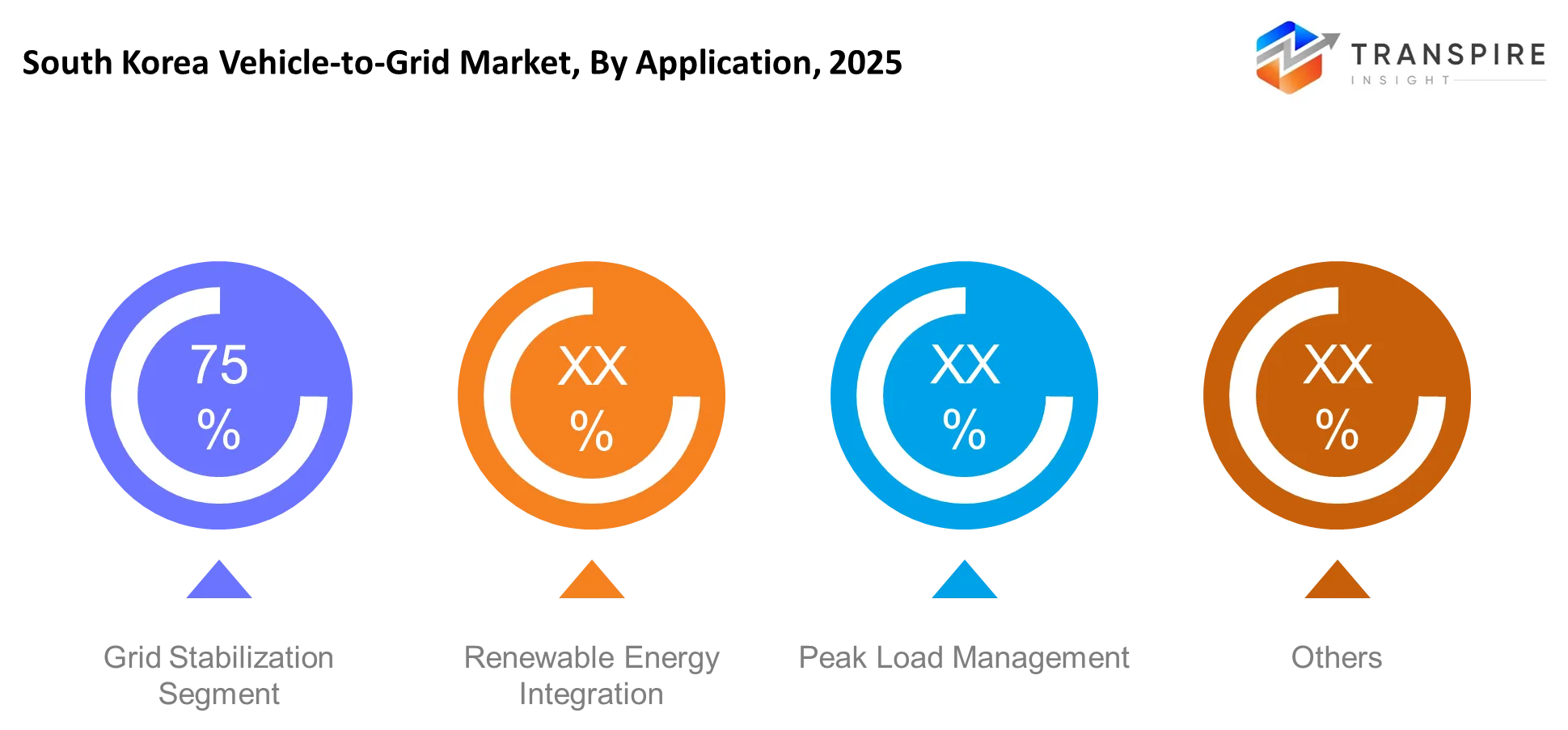
To learn more about this report, Download Free Sample Report
By End User
Utilities hold a pretty dominant position as the main orchestrators of grid balancing operations, and also the big-scale V2G aggregation systems. Fleet Operators sit in the second-largest slice more or less, mostly because their vehicle usage is structured in a way that makes energy scheduling pretty predictable. Residential Users are expanding more slowly, but steadily as home charging infrastructure gets smarter, whereas other end users stay niche for now and show up in early-stage deployments, not really at scale.
For the demand side, Utility-driven needs are centered around stabilizing grids that are already heavy with renewables and lowering reliance on peaking power plants. Fleet Operators get an advantage from centralized oversight of EV charging assets, which lets them monetize idle vehicle capacity when vehicles are not being used. Residential Users are catching on via smart meters and home energy management systems, so participation can happen at household level in energy markets. In the forecast window Fleet Operators are expected to be the fastest-growing group, since logistics, ride-hailing, and municipal transport are scaling electrified fleets, with V2G features built right in.
What are the Key Use Cases Driving the South Korea Vehicle-to-Grid Market?
The main use case for vehicle-to-grid in South Korea is basically peak load managing for city power systems. EV batteries can discharge the energy they hold during the highest demand hours, which helps ease stress on regular power plants and keeps the grid frequency more stable. It also tends to create the biggest demand, because very dense metropolitan consumption means peak load strain shows up a lot, not just occasionally.
Other secondary uses show up too, like fleet centered energy trading for logistics companies and backup power for commercial buildings. Delivery fleets and public transport operators often plug in V2G features to cut charging expenses while still providing grid balancing services, especially in those high-density industrial belts where demand swings happen quickly.
More new, emerging uses include renewable energy buffering and microgrid stabilization for residential smart city projects. In those setups EVs become decentralized storage, kind of like distributed reserves, supporting solar heavy neighborhoods and future autonomous energy communities where local participation matters.
|
Report Metrics |
Details |
|
Market size value in 2025 |
USD 90.79 Million |
|
Market size value in 2026 |
USD 114.29 Million |
|
Revenue forecast in 2033 |
USD 572.37 Million |
|
Growth rate |
CAGR of 25.88% from 2026 to 2033 |
|
Base year |
2025 |
|
Historical data |
2021 - 2024 |
|
Forecast period |
2026 - 2033 |
|
Report coverage |
Revenue forecast, competitive landscape, growth factors, and trends |
|
Regional scope |
South Korea |
|
Key company profiled |
Nuvve Holding, Hyundai Motor Company, Kia Corporation, LG Energy Solution, Samsung SDI, SK On, ABB, Siemens, Schneider Electric, Enel X, Wallbox, Fermata Energy, Denso, Hitachi Energy, Delta Electronics |
|
Customization scope |
Free report customization (country, regional & segment scope). Avail customized purchase options to meet your exact research needs. |
|
Report Segmentation |
By Component (Charging Stations, Bidirectional Chargers, Energy Management Software, Grid Communication Systems, Others); By Vehicle Type (Passenger EVs, Commercial EVs, Electric Buses, Others); By Application (Grid Stabilization, Renewable Energy Integration, Peak Load Management, Others); By End User (Utilities, Fleet Operators, Residential Users, Others) |
Which Regions are Driving the South Korea Vehicle-to-Grid Market Growth?
Seoul Metropolitan Region is kinda leading the South Korea Vehicle-to-Grid Market , mostly because there’s a dense EV adoption base ,and also because the smart grid infrastructure there is more advanced and ready. The area seems to get extra momentum from aggressive municipal decarbonization goals that basically fold EV fleets into grid stabilization programs running across both residential and commercial districts. There’s also a high concentration of fast-charging corridors plus data-driven energy management platforms so utilities can pull together thousands of vehicles for peak shaving tasks. Because city authorities and energy providers coordinate well together , you end up with an ecosystem that feels mature enough that V2G pilots move from testing , into semi-commercial deployments pretty quickly.
Busan and the southeastern industrial corridor act as a steady second region, mainly driven by port-linked logistics electrification and the heavier electricity needs of industry. In contrast to Seoul, this place is less reliant on neighborhood residential uptake and it leans more on dependable fleet cycles from shipping, warehousing and manufacturing clusters. Long-term contracts between industrial operators and energy utilities help keep V2G integration consistent, without too much policy wobble . So the financial effect stays gradual but reliable, especially for cargo-handling fleets and electrified port operations that really can’t miss uninterrupted energy balancing support.
Then there’s Jeju Island, which is emerging as the fastest-growing V2G region. This is largely tied to its isolated grid layout and the faster-than-average push into renewable generation. When wind and solar capacity keep expanding , you get grid imbalance situations more often, which makes EV-based storage solutions particularly useful. Government-backed carbon-free island initiatives have pushed bidirectional charging infrastructure rollout across tourism-related mobility and rental vehicle fleets too , so adoption is moving faster than you’d expect.
Who are the Key Players in the South Korea Vehicle-to-Grid Market and How Do They Compete?
Competition in the South Korea Vehicle-to-Grid market is moderately concentrated, but the fight is sorta less about single standalone vendors and more about the technology ecosystems behind the scenes. So, rather than just one company shipping a product, established automakers, energy storage players, and grid-tech providers compete via integrated platforms that stitch together EV hardware charging infrastructure, and energy management software. The biggest competitive axis ends up being system interoperability, meaning firms that line up vehicles with utility-grade grid protocols get a better commercial position, like it or not.
Hyundai Motor Company leans hard into vertically integrated EV platforms, and it basically embeds bidirectional charging capability into its next generation electric vehicles. That gives them a differentiator, since hardware and software are aligned with grid operators, which can help speed up V2G certification during pilot projects. Kia Corporation, on the other hand, pursues fleet-centric deployment models, partnering with mobility service providers to expand controlled charging settings that are meant to maximize grid participation efficiency.
LG Energy Solution keeps strengthening its spot through more advanced battery management systems, optimizing charge-discharge cycles and trying to reduce degradation risk during V2G operation. ABB competes with high-performance charging infrastructure built for grid-scale interoperability, and it puts emphasis on meeting utility-grade reliability requirements. Meanwhile, Siemens is expanding through smart grid software integration, tying distributed energy assets to predictive load balancing systems that react earlier instead of later.
Also, these companies are increasingly forming cross-sector partnerships with utilities and telecom providers, partly to secure longer-term infrastructure contracts and partly to lock in ecosystem control.
Company List
- Nuvve Holding
- Hyundai Motor Company
- Kia Corporation
- LG Energy Solution
- Samsung SDI
- SK On
- ABB
- Siemens
- Schneider Electric
- Enel X
- Wallbox
- Fermata Energy
- Denso
- Hitachi Energy
- Delta Electronics
Recent Development News
In November 2025, Hyundai Motor Group announced the launch of South Korea’s first large-scale Vehicle-to-Grid pilot service on Jeju Island. The initiative integrates Kia EV9 and Hyundai IONIQ 9 models into a renewable-heavy island grid to test bidirectional energy trading and peak-load balancing. The project is expected to accelerate commercial V2G deployment by validating utility integration and pricing mechanisms in real-world conditions.https://www.hyundai.com/
In December 2025, Hyundai Motor Group entered a strategic collaboration with Korea Electric Power Corporation (KEPCO) for V2G grid integration in Jeju Island. The partnership focuses on enabling EVs to discharge stored electricity into the distribution grid during peak demand, improving renewable energy absorption and reducing curtailment. This cooperation strengthens regulatory alignment and supports nationwide scaling of bidirectional charging infrastructure after pilot validation.https://www.enlit.world
What Strategic Insights Define the Future of the South Korea Vehicle-to-Grid Market?
The South Korea Vehicle-to-Grid Market is kind of moving, in a structural way, toward utility-integrated distributed energy networks, where EV fleets end up acting as modular storage assets inside broader national grid balancing frameworks. At the same time, this shift is being pushed by more renewable energy showing up , and also by the need to retire centralized peak power assets and swap them with more adaptable demand-side resources. But there’s a quiet risk that people might not notice early, because battery lifecycle constraints can bite , especially if accelerated bidirectional cycling happens. That could lower EV resale value and also dampen consumer willingness, particularly when the compensation models are still weak, or not clear enough.
Meanwhile, a different opening is showing up in aggregated fleet orchestration platforms that bundle thousands of EVs into so-called virtual power plants. This is especially noticeable in logistics and public transport hubs where loads are predictable and schedules are repeatable. Market players should really lean into software-layer ownership, not get stuck fighting over hardware performance. The idea is to build long-term contracts with utilities that lock in control over energy dispatch algorithms and grid integration standards, before the interoperability rules get fully standardized across the 2026–2033 adoption cycle, and before everyone else catches up.
South Korea Vehicle-to-Grid Market Report Segmentation
By Component
- Charging Stations
- Bidirectional Chargers
- Energy Management Software
- Grid Communication Systems
- Others
By Vehicle Type
- Passenger EVs
- Commercial EVs
- Electric Buses
- Others
By Application
- Grid Stabilization
- Renewable Energy Integration
- Peak Load Management
- Others
By End User
- Utilities
- Fleet Operators
- Residential Users
- Others
Frequently Asked Questions
Find quick answers to common questions.
The Expected South Korea Vehicle-to-Grid Market size for the Market will be USD 572.37 Million in 2033.
Key Segments for the South Korea Vehicle-to-Grid Market are By Component (Charging Stations, Bidirectional Chargers, Energy Management Software, Grid Communication Systems, Others); By Vehicle Type (Passenger EVs, Commercial EVs, Electric Buses, Others); By Application (Grid Stabilization, Renewable Energy Integration, Peak Load Management, Others); By End User (Utilities, Fleet Operators, Residential Users, Others).
Major South Korea Vehicle-to-Grid Market Players are Nuvve Holding, Hyundai Motor Company, Kia Corporation, LG Energy Solution, Samsung SDI, SK On, ABB, Siemens, Schneider Electric, Enel X, Wallbox, Fermata Energy, Denso, Hitachi Energy, Delta Electronics.
The Current South Korea Vehicle-to-Grid Market size is USD 90.79 Million in 2025.
The South Korea Vehicle-to-Grid Market CAGR is 25.88% from 2026 to 2033.
- Nuvve Holding
- Hyundai Motor Company
- Kia Corporation
- LG Energy Solution
- Samsung SDI
- SK On
- ABB
- Siemens
- Schneider Electric
- Enel X
- Wallbox
- Fermata Energy
- Denso
- Hitachi Energy
- Delta Electronics
Recently Published Reports
-
Apr 2026
Active Power Filter Market
Active Power Filter Market Size, Share & Analysis Report By Type (Shunt Active Power Filters, Series Active Power Filter, Hybrid Active Power Filter), By Application (Harmonics Mitigation, Reactive Power Compensation, Voltage Regulation, Power Factor Correction), By Phase (Single Phase, Three Phase), By End-User Industry (Manufacturing, Healthcare, Commercial, Automotive, Oil and Gas, Others), and Geography (North America, Europe, Asia-Pacific, Middle East and Africa, South and Central America), 2021 - 2031
-
Apr 2026
Electrical Transformer Market
Electrical Transformer Market Size, Share & Analysis Report By Core (Closed, Shell, and Berry), By Insulation (Gas, Oil, Solid, Air, and Other), By Phase (Single, and Three), By Rating (100 MVA to 500 MVA, 501 MVA to 800 MVA, and 801 MVA to 1200 MVA), and Geography (North America, Europe, Asia-Pacific, Middle East and Africa, South and Central America), 2021 – 2031
-
Apr 2026
Hydraulic Piston Pumps Market
Hydraulic Piston Pumps Market Size, Share & Analysis Report By Type (Axial Piston Pumps, Radial Piston Pumps), By Operating Pressure (Low Pressure, Medium Pressure, High Pressure), By Application (Construction, Mining, Agriculture, Automotive, Oil & Gas, Industrial Machinery, Others), By End-User (OEMs, Aftermarket), and Geography (North America, Europe, Asia-Pacific, Middle East and Africa, South and Central America), 2021 – 2031
-
Apr 2026
Laboratory Gas Generators Market
Laboratory Gas Generators Market Size, Share & Analysis Report By Product (Nitrogen Gas Generator, Hydrogen Gas Generator, Zero Air Gas Generator, Purge Gas Generator, TOC Gas Generators, Others), By Application (Gas Chromatography, Liquid Chromatography-mass Spectrometry (LC-MS), Gas Analyzers, Others), By End-user (Life Science, Chemical & Petrochemical, Food & Beverage, Others), and Geography (North America, Europe, Asia-Pacific, Middle East and Africa, South and Central America), 2021 – 2031