
United Kingdom Ground Handling Software Market Size & Forecast:
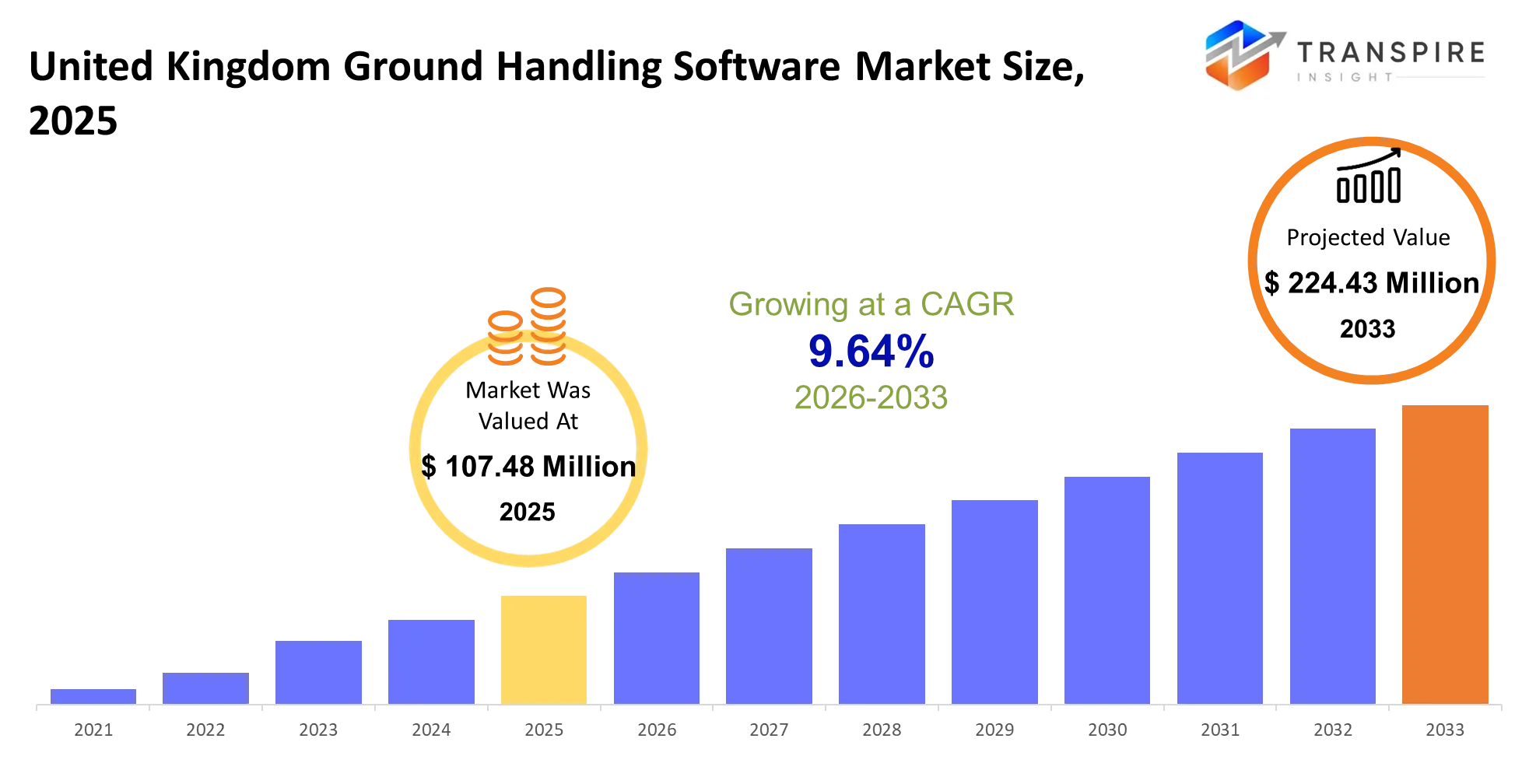
- United Kingdom Ground Handling Software Market Size 2025: USD 107.48 Million
- United Kingdom Ground Handling Software Market Size 2033: USD 224.43 Million
- United Kingdom Ground Handling Software Market CAGR: 9.64%
- United Kingdom Ground Handling Software Market Segments: By Component (Software Platforms, Mobile Applications, Analytics Tools, Cloud Services, Others); By Application (Flight Operations Management, Passenger Handling, Cargo Handling, Ramp Management, Others); By Deployment (Cloud-based, On-premise, Hybrid Systems, Others); By End User (Airports, Airlines, Ground Handling Service Providers, Cargo Operators, Others)
To learn more about this report,  Download Free Sample Report
United Kingdom Ground Handling Software Market Summary
The United Kingdom Ground Handling Software Market was valued at USD 107.48 Million in 2025. It is forecast to reach USD 224.43 Million by 2033. That is a CAGR of 9.64% over the period.
In the United Kingdom , ground handling software is used by airports , airlines, and third party handlers so they can line up baggage movement, aircraft turnaround work, crew allocation , and ramp operations in real time, and yes it helps cut down delays and boosts overall aircraft utilization. Over the last five years, the whole market has kind of moved away from patchwork on premise dispatch systems toward cloud and mobile enabled platforms. These let handlers switch or reassign resources instantly across terminals and stands, which used to be much harder.
After COVID , the recovery push , plus ongoing labor shortages at big hubs like Heathrow, has nudged operators to lean on automation driven scheduling tools. Especially now when airlines want tighter turnaround SLAs and also more carbon efficiency reporting, the pressure is not small. In practice this change can improve gate usage and trim turnaround delays , which then supports revenue recovery for airports. So for ground service providers competing on tight contract margins, digital handling systems aren’t really optional anymore, more like necessary.
Key Market Insights
- London and Southeast England, kind of dominate the United Kingdom Ground Handling Software Market with around 45% share, mainly because Heathrow and Gatwick have such high traffic density.
- Still, when you look at the bigger picture, it’s the Flight and ramp management software segment that leads, with about 38% share, driven by the need for faster turnaround optimization requirements, pretty much every day.
- Baggage handling tracking systems are in the second spot too, because airports are prioritizing lost baggage reduction and also improving the passenger experience, nothing surprising there.
- AI driven predictive scheduling tools seem to be the fastest-growing slice through 2030, supported by automation push and workforce optimization needs, you know.
- And on the application side aircraft turnaround coordination stays the most important part, holding nearly 40% share, largely owing to tough airline punctuality requirements, so coordination is non-negotiable.
- Resource allocation and workforce management is, like, the fastest-growing app area, as airports try to deal with staffing shortages and those efficiency gaps that keep showing up.
- Baggage logistics optimization keeps picking up speed, mostly because passenger numbers go up and the operational mix gets more intricate.
- Airport operators are still the leading end user group, with more than 50% share in the United Kingdom Ground Handling Software Market.
- Ground service providers are also becoming the fastest-growing end-user category , driven by outsourcing habits and the kinda contract-based, competitive way work is handled.
- Airlines are increasingly folding software platforms into their routines so they can manage turnaround efficiency more directly, and cut down on how much they rely on third-party handlers.
What are the Key Drivers, Restraints, and Opportunities in the United Kingdom Ground Handling Software Market?
The main driver is this kind of accelerated push toward operational digitization in UK airports, set off by those persistent turnaround delays and the more rigid airline on-time performance contracts. Heathrow, Gatwick, and Manchester have been increasingly requiring real-time coordination tools for baggage flow, gate allocation , and ramp scheduling. And that has directly raised software penetration as ground handlers start relying on automation to keep away from SLA penalties , and to optimize aircraft turnaround time, which then boosts asset utilization and revenue per flight slot in a more consistent way.
One big restraint still shows up though, it’s the fragmented legacy infrastructure across those mid-sized regional airports. A lot of them run partly on older dispatch logic or even paper based coordination systems that don’t play nicely with modern cloud platforms. This structural mismatch slows adoption overall, because full migration needs capital spending, workforce retraining, and some temporary operational disruption too , and that combination tends to dampen the short-term revenue growth for vendors in the United Kingdom Ground Handling Software Market.
The main opportunity sits with AI driven predictive turnaround optimization, particularly as airports like Birmingham and Edinburgh put money into smart airport initiatives. Those systems use historical delay patterns along with live sensor data to forecast where bottlenecks might form before they actually happen, which supports proactive resource allocation and helps unlock the next efficiency cycle for the United Kingdom Ground Handling Software Market.
What Has the Impact of Artificial Intelligence Been on the United Kingdom Ground Handling Software Market?
Artificial intelligence and newer digital technologies are, in a real way, shifting the United Kingdom Ground Handling Software Market— like it’s changing how airports deal with ground service work, equipment rosters, and those hectic turnaround flows. One of the key use cases is basically automating ground support equipment oversight and fleet compliance tracing. AI enabled telematics setups keep observing vehicle use, maintenance schedules, and safety adherence, across baggage tractors, loaders, and refueling units. As a result, there is less time spent on manual checks, and assets tend to stay more available across major hubs like Heathrow , and Manchester too.
At the same time,machine learning is showing up more often for predictive maintenance , catching early warning patterns in ground hardware before an actual failure happens. Alongside that, predictive analytics helps with turnaround tuning by estimating gate crowding, baggage disruptions, and staffing gaps. This makes it possible to redirect resources on the fly, rather than waiting until something goes wrong. Also, some airport teams are starting to weave in emissions tracking models that estimate how much fuel is used, and the carbon effects linked to ground activities. That supports sustainability statements and regulatory compliance, tied to the UK aviation decarbonization goals.
These technologies offer measurable operational wins , like less equipment downtime, better turnaround timing punctuality , and reduced upkeep expenses , while at the same time boosting fuel efficiency for ground fleets. Still, there’s a big fly in the ointment , namely the rather high integration cost of AI systems with patchwork legacy airport infrastructure, especially in regional hubs where digital readiness is uneven. That situation basically drags out broader rollout across the United Kingdom Ground Handling Software Market , even though the longer-term efficiency advantages are strong.
Key Market Trends
- Since 2022, UK airports have been moving away from older on-prem dispatch tools, and into cloud based ground handling platforms for real-time coordination and stuff.
- AI driven turnaround optimization tools are now doing what used to be manual scheduling, they improve how gates are assigned and they cut down on aircraft idle time at hubs, pretty noticeably.
- After the pandemic, staffing shortages came in fast, and that made automation adoption accelerate, because handlers then lean on software based workforce planning to keep airport operations steady and continuous.
- At Heathrow and Gatwick, stronger SLA enforcement also nudged vendor consolidation, so airlines got pushed toward more integrated platforms via SITA and Amadeus IT Group , rather than piecing things together.
- Baggage tracking modernization expanded too, using RFID together with IoT sensors, and that improves real time visibility across ground handling activities nationwide.
- Meanwhile, the UK Civil Aviation Authority compliance requirements pushed emissions tracking to be integrated into ground support software, for more accurate sustainability reporting.
- Regional airports in the UK now often adopt modular SaaS platforms , mainly to reduce IT costs while still matching some of the digital capability you see at major hubs.
- And competitive pressure from IBS Software and Inform GmbH keeps driving rapid AI feature upgrades across UK ground handling vendors.
United Kingdom Ground Handling Software Market Segmentation
By Component :
Software platforms are basically the core of the United Kingdom Ground Handling Software Market , kind of like the glue that helps people coordinate aircraft turnaround, baggage monitoring, and ramp scheduling all at once. Airports pick these platforms to swap out the older, manual coordination routines and to cut down on operational delays that can stack up fast. Mobile apps also help with quick, real time talk between ground crews, where messaging can be a little more direct. At the same time analytics tools let operators watch performance more closely and estimate when disruptions might pop up.
Cloud services have been growing really quickly as airports move away from legacy systems. With cloud deployment, data can be shared across terminals and among different service providers more smoothly. It also makes it easier to push updates sooner and scale systems, without the usual heavy infrastructure costs. There are also integration tools , these help tie legacy airport systems into modern digital platforms so the day to day operations feel less clunky.
By Application :
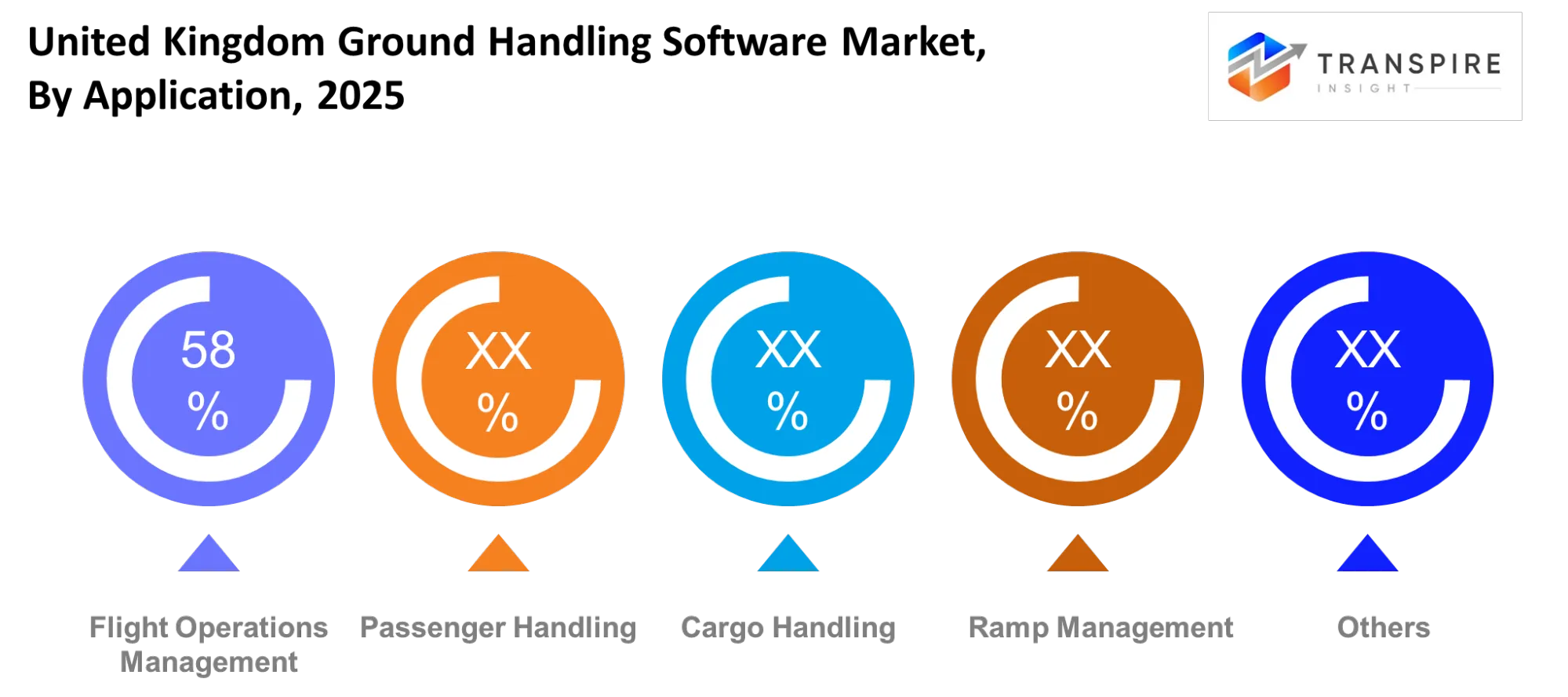
Flight operations management sits in a key spot in the United Kingdom Ground Handling Software Market, mainly because it supports aircraft scheduling, turnaround planning, and gate coordination. Airports depend on these systems to stay punctual, and to reduce congestion during busy periods.
Meanwhile passenger handling applications focus on check in coordination, boarding flow, and service tracking, all aimed at improving the overall airport experience. Cargo handling systems handle freight movement , paperwork, and loading efficiency in a more controlled way. Ramp management tools coordinate ground support equipment, and they help ensure aircraft servicing stays safe and on time.
To learn more about this report, Download Free Sample Report
By Deployment :
Cloud-based deployment is winning most of the new installations in the United Kingdom Ground Handling Software Market, because airports want flexible systems that still allow real-time updates and remote access. With this approach, organizations typically cut down on their reliance on physical servers, and they get better operational scale, especially when demand changes quickly.
Still, on-premise systems are not gone, mainly at older airports where existing infrastructure investments are already in place. Hybrid deployment is also getting more traction since it mixes legacy steadiness with cloud efficiency, so airports can move in stages, without causing a lot of disruption in daily operations. There are also other deployment styles, but those tend to focus on more specific or niche operational needs.
By End User :
Airports are usually the primary end users in the United Kingdom Ground Handling Software Market, since they handle the overall choreography for passenger flow, aircraft movement, and ground services coordination. In practice, these platforms help airports lower delays, and they boost how well resources are used across the terminal.
Airlines, for their part, rely on ground handling software to watch turnaround efficiency and keep schedules reliable. Ground handling service providers use the same kind of tooling for staff coordination and equipment visibility, while cargo operators lean on digital tools to increase freight handling precision, and to reduce processing time.
What are the Key Use Cases Driving the United Kingdom Ground Handling Software Market?
In the United Kingdom Ground Handling Software Market, the core use case is mostly about aircraft turnaround coordination , where airports along with service providers handle gate allocation, baggage movement and ramp activities in real time. This is where demand tends to spike, because any delay can ripple into airline timetables , slot usage, and penalty-linked service agreements, notably when it’s busy at Heathrow and Gatwick.
More expanding applications show up in passenger flow optimization and workforce scheduling, and these are more often adopted by airport operators and ground handling companies. They help manage check-in queues, improve boarding velocity, and place people where they’re needed during the busiest travel moments. Cargo handling visibility is also getting serious momentum, since freight operators want closer supervision over load correctness and delivery due dates .
Newer use cases are starting to surface around predictive disruption management and emissions tracking, which ties in with UK aviation sustainability mandates. Airports are now deploying software that foresees weather related delays and equipment hold-ups, and at the same time it measures ground fleet emissions, so carbon reporting duties can be met with less friction.
|
Report Metrics |
Details |
|
Market size value in 2025 |
USD 107.48 Million |
|
Market size value in 2026 |
USD 117.84 Million |
|
Revenue forecast in 2033 |
USD 224.43 Million |
|
Growth rate |
CAGR of 9.64% from 2026 to 2033 |
|
Base year |
2025 |
|
Historical data |
2021 - 2024 |
|
Forecast period |
2026 - 2033 |
|
Report coverage |
Revenue forecast, competitive landscape, growth factors, and trends |
|
Regional scope |
Middle East and Africa (Saudi Arabia, United Arab Emirates, South Africa, Rest of Middle East and Africa) |
|
Key company profiled |
SITA, Amadeus IT Group, IBM, Lufthansa Systems, INFORM GmbH, Damarel Systems, TAV Technologies, Wipro, Honeywell, Sabre Corporation, Res2, Swiss AviationSoftware, HCL Technologies, ADB SAFEGATE, NEC Corporation |
|
Customization scope |
Free report customization (country, regional & segment scope). Avail customized purchase options to meet your exact research needs. |
|
Report Segmentation |
By Component (Software Platforms, Mobile Applications, Analytics Tools, Cloud Services, Others); By Application (Flight Operations Management, Passenger Handling, Cargo Handling, Ramp Management, Others); By Deployment (Cloud-based, On-premise, Hybrid Systems, Others); By End User (Airports, Airlines, Ground Handling Service Providers, Cargo Operators, Others) |
Which Regions are Driving the United Kingdom Ground Handling Software Market Growth?
London and the Southeast region kinda dominates the United Kingdom Ground Handling Software Market, mainly because of the heavy clustering of key international hubs, like Heathrow and Gatwick. Add to that strong regulatory enforcement from aviation authorities and the pretty strict airline slot management rules, and you get continuous investment into digital coordination systems. There’s also this dense web of global airlines plus third-party ground handlers that makes the whole operational setup feel tightly integrated… and it really leans on real time software solutions. On top of it all, the region benefits from better airport infrastructure that helps with early adoption of AI assisted turnaround and baggage management platforms , so it moves faster than other places.
The Midlands and Northern England look like a stable secondary region, supported by airports such as Manchester and Birmingham, which handle passenger and cargo traffic. Compared with the Southeast, growth here seems to come more from cost efficiency requirements and steady airline relationships, not so much from relentless congestion pressure. Industrial and logistics work in these areas keeps demand fairly consistent for cargo handling and fleet coordination systems. Airlines in these airports tend to favor predictable service levels and incremental digital upgrades, rather than going for big transformation programs all at once.
Scotland is, arguably, the fastest-growing area. That’s driven by modernization activities at Edinburgh and Glasgow airports, plus tourism recovery that’s been gaining traction. New infrastructure investments and regional connectivity initiatives have encouraged airports to put cloud based ground handling systems in place at a quicker pace. There’s also low cost carrier expansion, which in turn boosts the need for efficient turnaround and passenger processing tools. For people entering the market or investors , Scotland offers noticeable long term upside, because digital adoption is still set to accelerate through 2026
Who are the Key Players in the United Kingdom Ground Handling Software Market and How Do They Compete?
The United Kingdom Ground Handling Software Market shows a moderately consolidated competitive landscape where a few big aviation IT providers, mainly operate with strong enterprise contracts, while the smaller specialists kind of scramble around niche airport tasks. In practice, rivalry seems to be pushed more by technical capability and how deep the integration really goes, not so much by price , because airports keep stressing reliability in turnaround coordination and baggage handling systems. So incumbents are defending their installed footprint by upgrading older platforms into cloud-native environments, and new entrants typically come in with modular SaaS tools that lower deployment friction for regional airports.
Amadeus IT Group keeps improving its standing with combined airport operations suites that bring passenger processing and ground handling coordination together. The core advantage is its deep airline system integration, so it can sync booking systems and airport operations in real time. Their expansion angle leans heavily on cloud migration partnerships, with major UK airports to unify operational data across terminals, and it sounds pretty direct.
SITA, meanwhile, differentiates through its global aviation network infrastructure, meaning it supports secure data exchange among airlines, airports, and handlers. IBS Software leans into SaaS turnaround optimization capabilities, basically letting mid-sized airports launch quickly without too much fuss. Inform GmbH uses advanced optimization algorithms for ramp operations and resource scheduling, which helps in day-to-day complexity, while Damarel Systems International goes after more specific baggage and check-in systems. Damarel is expanding via regional UK airport partnerships and adding service-focused modules, so the focus stays narrow but persistent.
Company List
- SITA
- Amadeus IT Group
- IBM, Lufthansa Systems
- INFORM GmbH
- Damarel Systems
- TAV Technologies
- Wipro
- Honeywell
- Sabre Corporation
- Res2
- Swiss AviationSoftware
- HCL Technologies
- ADB SAFEGATE
- NEC Corporation
Recent Development News
In March 2026, Ramco Systems announced that Tata Advanced Systems Limited selected its aviation MRO software for a major aircraft maintenance facility under development to support the C-130J Super Hercules fleet of the Indian Air Force. The platform includes maintenance planning, supply chain management, and operations modules used in airline and ground operations workflows, reinforcing Ramco’s aviation software footprint in global aviation operations markets including Europe. Source https://en.wikipedia.org/
In June 2025, Jetex announced a strategic partnership with Archer Aviation to integrate Archer’s Midnight eVTOL aircraft into Jetex’s global network of private aviation terminals, enhancing digital coordination and operational systems used for aircraft turnaround and ground handling processes across its international FBO network. Source https://en.wikipedia.org/
What Strategic Insights Define the Future of the United Kingdom Ground Handling Software Market?
The United Kingdom Ground Handling Software market is, kinda, shifting toward fully integrated, AI-orchestrated airport operations platforms that try to stitch turnaround management, workforce scheduling and compliance tracking into one digital layer. This momentum is being pushed by ongoing pressure on UK airports to squeeze more out of slot efficiency while still meeting tougher environmental rules and punctuality targets, so older, fragmented legacy setups start to look increasingly unsustainable over the next five to seven years.
There’s also a quieter risk creeping in, namely vendor concentration inside the core airport software stacks, where reliance on a small set of global providers could reduce interoperability and lock airports into long-term switching barriers. That in turn can drag out innovation cycles and leave operators more exposed to pricing rigidity or, even, “set it and forget it” commercial models. Meanwhile, a solid opportunity is beginning to show up in predictive disruption orchestration, meaning AI systems don’t only respond to delays but actively reconfigure ground operations in real time, based on weather conditions, passenger movement, and equipment telemetry, which matters a lot for regional airports that are expanding and trying to stay reliable.
So the market players should really lean into modular, open-architecture platforms that integrate smoothly with third-party airport systems, because in practice flexibility will become a decisive procurement factor for UK airport digital transformation efforts.
United Kingdom Ground Handling Software Market Report Segmentation
By Component
- Software Platforms
- Mobile Applications
- Analytics Tools
- Cloud Services
By Application
- Flight Operations Management
- Passenger Handling
- Cargo Handling
- Ramp Management
By Deployment
- Cloud-based
- On-premise
- Hybrid Systems
By End User
- Airports
- Airlines
- Ground Handling Service Providers
- Cargo Operators
Frequently Asked Questions
Find quick answers to common questions.
The United Kingdom Ground Handling Software Market size is USD 224.43 Million in 2033.
Key segments for the United Kingdom Ground Handling Software Market are By Component (Software Platforms, Mobile Applications, Analytics Tools, Cloud Services, Others); By Application (Flight Operations Management, Passenger Handling, Cargo Handling, Ramp Management, Others); By Deployment (Cloud-based, On-premise, Hybrid Systems, Others); By End User (Airports, Airlines, Ground Handling Service Providers, Cargo Operators, Others).
Major United Kingdom Ground Handling Software Market players are SITA, Amadeus IT Group, IBM, Lufthansa Systems, INFORM GmbH, Damarel Systems, TAV Technologies, Wipro, Honeywell, Sabre Corporation, Res2, Swiss AviationSoftware, HCL Technologies, ADB SAFEGATE, NEC Corporation.
The United Kingdom Ground Handling Software Market size is USD 107.48 Million in 2025.
The United Kingdom Ground Handling Software Market CAGR is 9.64% from 2026 to 2033.
- SITA
- Amadeus IT Group
- IBM, Lufthansa Systems
- INFORM GmbH
- Damarel Systems
- TAV Technologies
- Wipro
- Honeywell
- Sabre Corporation
- Res2
- Swiss AviationSoftware
- HCL Technologies
- ADB SAFEGATE
- NEC Corporation
Recently Published Reports
-
Apr 2026
Aerospace Fluoropolymers Market
Aerospace Fluoropolymers Market Size, Share & Analysis Report By Type (PTFE, FEP, PFA, ETFE, and Others), By Application (Electrical Insulation, Seals & Gaskets, Coatings, and Others), By End User (Commercial Aviation, Military Aviation, General Aviation, and Others), and Geography (North America, Europe, Asia-Pacific, Middle East and Africa, South and Central America), 2021 - 2031
-
Apr 2026
Airborne SATCOM System Market
Airborne SATCOM System Market Size, Share & Analysis Report By Type (SATCOM Terminals, Transceivers, Airborne Radio, Modems and Routers, SATCOM Radomes, and Other), By Application (Government and Defense and Commercial), and Geography (North America, Europe, Asia-Pacific, Middle East and Africa, South and Central America), 2021 – 2031
-
Apr 2026
Ship Leasing Market
Ship Leasing Market Size, Share & Analysis Report By Vessel Type (Container Ships, Bulk Carriers, Tankers, and Specialized Vessels), By Lease Duration (Short-Term Lease (Less than 1 year), Medium-Term Lease (1-5 years), and Long-Term Lease (More than 5 years)), By Lease Type (Bareboat Charter, Time Charter, Financial Lease, and Others), By End-User Industry (Oil and Gas, Manufacturing and Industrial, Automotive, Agriculture and Food, Retail and Consumer Goods, and Others), and Geography (North America, Europe, Asia-Pacific, Middle East and Africa, South and Central America), 2021 – 2031
-
Apr 2026
Thread Rolling Dies Market
Thread Rolling Dies Market Size, Share & Analysis Report By Type (Flat Thread Rolling Dies, Circular (Cylindrical) Dies, Tangential Thread Rolling Dies, Planetary Thread Rolling Dies, and Other Types), By Material Type (High-Speed Steel (HSS), Carbide, Tool Steel, Alloy Steel, and Other Specialized Alloys), By Distribution Channel (Direct Sales, Distributors and Dealers, and Online Platforms), By Application (Automotive Industry, Aerospace and Defense, Construction and Infrastructure, Industrial Machinery, Electronics and Electrical Components, Medical Devices, and Fastener Production), and Geography (North America, Europe, Asia-Pacific, Middle East and Africa, South and Central America), 2021 – 2031
Our Clients