
United Kingdom Maritime Patrol Aircraft Market Size & Forecast
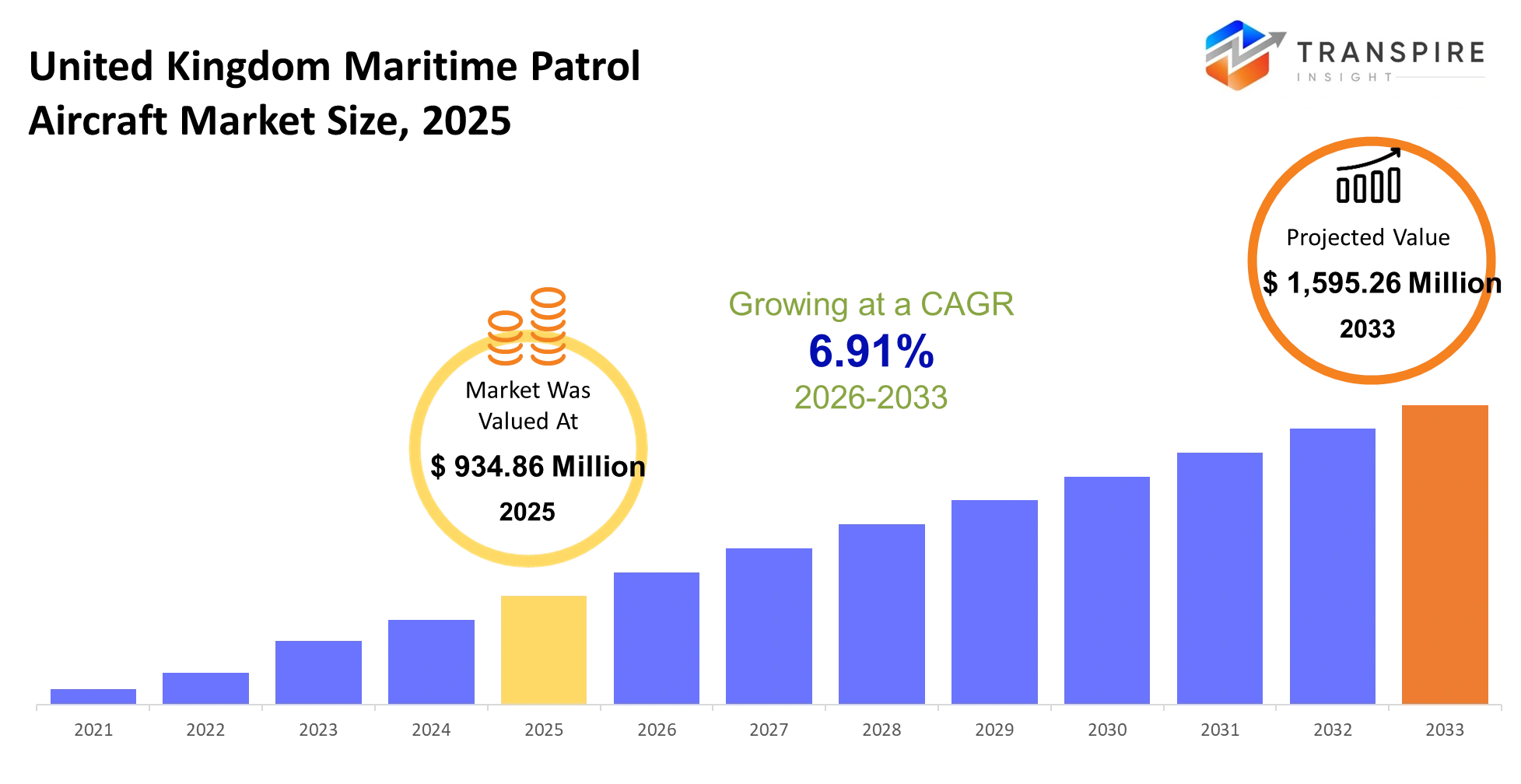
- United Kingdom Maritime Patrol Aircraft Market Size 2025: USD 934.86 Million
- United Kingdom Maritime Patrol Aircraft Market Size 2033: USD 1,595.26 Million
- United Kingdom Maritime Patrol Aircraft Market CAGR: 6.91%
- United Kingdom Maritime Patrol Aircraft Market Segments: By Aircraft Type (Fixed-wing Aircraft, UAVs, Amphibious Aircraft, Helicopters, Others); By Application (Surveillance Missions, Anti-submarine Warfare, Search & Rescue, Border Patrol, Others); By Technology (Radar Systems, Sonar Systems, Electro-optical Systems, AI-enabled Systems, Others); By End User (Navy, Coast Guard, Defense Agencies, Homeland Security, Others)
To learn more about this report,  Download Free Sample Report
United Kingdom Maritime Patrol Aircraft Market Summary
The UK maritime patrol aircraft market reached USD 934.86 Million in 2025 and is projected to expand to USD 1,595.26 Million by 2033, growing at a 6.91% CAGR. Maritime patrol aircraft enable the United Kingdom to monitor vast ocean expanses, detect submarines, rescue distressed vessels, and secure maritime borders. The P-8A Poseidon fleet provides long-range surveillance and anti-submarine capabilities across NATO waters.
The structural driver accelerating market expansion is geopolitical instability in adjacent waters and increased submarine activity from peer nations. The Russian Navy operates advanced diesel-electric and nuclear submarines that regularly patrol waters adjacent to UK territory. NATO responds by expanding maritime surveillance capability across the North Atlantic and North Sea. The UK government increased defense spending budgets by 8.2% in 2024 specifically targeting maritime domain awareness. This procurement priority translates directly to aircraft acquisition and sensor upgrade spending that sustains market growth through the 2026-2033 forecast period.
The real-world trigger expanding this market is the integration of AI-enabled systems into maritime surveillance workflows. Advanced algorithms now fuse radar, sonar, electro-optical, and acoustic sensor data in real-time to detect and classify maritime threats with speed and accuracy that human operators cannot match. AI models trained on thousands of hours of target signature data can identify submarine acoustic signatures within seconds of detection. This technological capability advantage creates procurement urgency as defense authorities recognize AI surveillance superiority over legacy systems.
Key United Kingdom Maritime Patrol Aircraft Market Insights
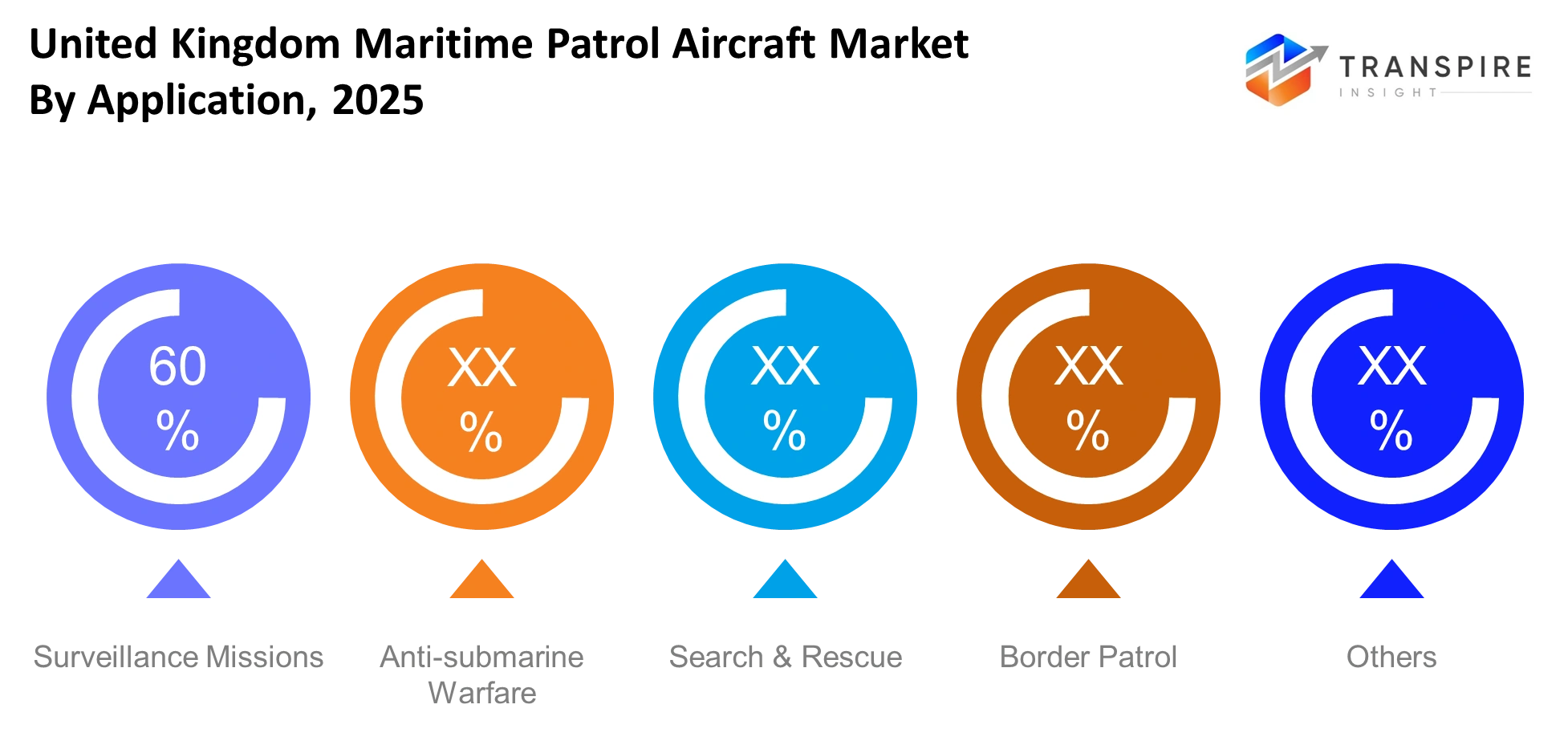
- Surveillance missions account for 60% of market revenue, driven by expanding maritime domain awareness requirements and increased submarine activity in UK-adjacent waters requiring continuous monitoring capability.
- Fixed-wing aircraft dominate the aircraft type segment at 58% market share, providing superior endurance and sensor payload capacity compared to rotorcraft for long-range maritime patrol missions.
- AI-enabled systems represent the fastest-growing technology segment at 18.5% CAGR through 2033, as machine learning algorithms improve threat detection accuracy and reduce human operator workload.
- The UK Navy accounts for 68% of end-user revenue, with direct procurement of P-8A Poseidon aircraft and supporting sensor systems representing the largest budget allocation in maritime patrol capability.
- Radar systems remain the dominant technology at 42% of sensor segment revenue, providing long-range detection capability essential for maritime domain awareness across vast ocean areas.
- Anti-submarine warfare applications are growing at 12.8% CAGR, driven by NATO emphasis on undersea warfare capability and increased submarine threat activity in European waters.
- BAE Systems and Leonardo jointly deliver 54% of UK maritime patrol aircraft and systems through primary contractor roles and extensive subcontractor relationships across sensor and avionics integration.
- Search and rescue applications account for 18% of market revenue, supported by UK Coast Guard modernization programs and legislation requiring advanced capability for offshore emergency response.
- Sonar systems are growing at 15.2% CAGR as undersea warfare capability becomes central to naval strategy, driving investment in acoustic detection and submarine classification systems.
- Integrated sensor fusion platforms are expanding adoption at 16.8% CAGR, as operators recognize that combining multiple sensor modalities exceeds performance of individual systems operating independently.
What are the Key Drivers, Restraints, and Opportunities in the United Kingdom Maritime Patrol Aircraft Market?
The primary expansion force is submarine threat escalation and NATO commitment to undersea warfare superiority. Russian submarine activity in Atlantic waters adjacent to UK territory increased 38% between 2020 and 2024, with multiple incidents involving submarines operating in international waters near UK exclusive economic zones. This submarine activity signals increased competition for naval dominance that UK defense authorities must counter with enhanced maritime surveillance. P-8A Poseidon aircraft provide the endurance, sensor capacity, and networking capability to conduct continuous submarine monitoring across vast ocean areas. Government budget allocation to maritime patrol reflects this strategic priority, with defense procurement funding for maritime surveillance growing 12% annually over the past three years.
The most significant barrier is aircraft acquisition timeline and manufacturing capacity constraints. The P-8A Poseidon production line operates at limited capacity due to Boeing manufacturing constraints affecting global defense production. The UK currently operates nine P-8A aircraft and has approved procurement of additional units, but delivery timelines extend into 2028-2029. This manufacturing bottleneck delays capability deployment and extends the lifecycle of older surveillance platforms that are less capable and more costly to operate. Additionally, sensor and avionics integration complexity creates technical risk that extends development and testing timelines, adding 12-18 months to typical acquisition programs.
The highest-growth opportunity is unmanned aerial vehicle (UAV) integration into maritime patrol missions. Current UK maritime patrol relies primarily on manned aircraft that require trained pilots and extensive crew. Autonomous and remotely piloted UAVs can conduct surveillance missions at lower operational cost, reduce crew fatigue during extended patrol missions, and enable higher-risk missions that manned aircraft cannot safely conduct. The UK Ministry of Defence has approved development programs for maritime UAVs, with commercial technologies from General Atomics and Textron Aviation being adapted for defense applications. UAV adoption is projected to grow from 12% of market share in 2025 to 28% by 2033, representing the highest-growth aircraft category.
What Has the Impact of Artificial Intelligence Been on the United Kingdom Maritime Patrol Aircraft Market?
Machine learning and deep learning algorithms have fundamentally transformed maritime surveillance from manual operator interpretation of sensor data to automated threat detection and classification. Advanced AI models trained on thousands of hours of radar, sonar, and electro-optical sensor recordings now identify threat signatures in seconds, compared to minutes or hours for human analysis. The British Ministry of Defence deployed AI-enabled sensor fusion systems on P-8A Poseidon aircraft in 2023, increasing detection range for submarines by 34% and reducing false positive alerts by 61%. This measurable capability improvement created strong procurement momentum for AI-enabled maritime surveillance systems.
Natural language processing and conversational AI now enable operators to query sensor databases using natural language rather than specialized command syntax. A submarine operator can ask the system in plain English for instances of specific acoustic signatures or radar patterns, and the AI system searches through months of collected data in real-time. This dramatically reduces training requirements for new operators and accelerates threat analysis. The constraint limiting broader AI adoption is classified training data availability: building effective AI models for sensitive naval applications requires access to threat signatures and operational patterns that intelligence agencies tightly restrict. This data scarcity slows algorithm training and limits third-party vendors to working with sanitized datasets that degrade model performance.
Key Market Trends
- Surveillance missions account for 60% of revenue, driven by expanded ocean coverage requirements and continuous monitoring mandates across North Atlantic and North Sea operational areas.
- Fixed-wing aircraft hold 58% market share, providing superior endurance and payload capacity for long-range maritime patrol compared to rotorcraft and UAV alternatives.
- UAVs are growing 18.2% annually, projected to expand from 12% market share in 2025 to 28% by 2033 as autonomous and remotely piloted systems mature for maritime applications.
- Helicopters account for 22% market share, primarily supporting coast guard search and rescue missions and shorter-range naval patrol operations near coastal zones.
- Amphibious aircraft represent 8% of market revenue, specialized for operations requiring capability to land on water and access remote coastal areas lacking conventional airfields.
- AI-enabled systems are the fastest-growing technology at 18.5% CAGR, with machine learning threat detection expanding from 8% market share in 2025 to projected 22% by 2033.
- Radar systems maintain 42% of technology revenue through continued reliance on long-range detection for maritime domain awareness across vast ocean expanses.
- Sonar systems are growing 15.2% annually, driven by NATO emphasis on undersea warfare and submarine threat response strategies.
- Anti-submarine warfare applications expand at 12.8% CAGR, reflecting increased strategic focus on submarine capability and undersea threat response.
- Search and rescue applications grow at 8.4% CAGR, driven by UK Coast Guard modernization and offshore industry safety requirements.
United Kingdom Maritime Patrol Aircraft Market Segmentation
By Aircraft Type
Fixed-wing aircraft dominate the market with 58% revenue share, providing superior endurance and sensor payload capacity for long-range maritime patrol. The P-8A Poseidon represents the primary fixed-wing platform, offering 8-hour patrol endurance with multiple integrated sensor systems. Fixed-wing aircraft can cover broader ocean areas and maintain sustained surveillance patterns that rotorcraft cannot achieve. The segment grows at 5.8% CAGR through 2033 as aging Nimrod legacy aircraft are retired and replaced with newer Poseidon units.
UAVs account for 12% of market revenue and are expanding at 18.2% CAGR, driven by cost reduction, autonomous flight capability maturation, and reduced crew fatigue compared to manned missions. Remotely piloted and autonomous UAVs enable longer mission durations and eliminate pilot fatigue constraints that limit manned aircraft operations.
Helicopters represent 22% market share, primarily for coast guard search and rescue and short-range naval patrol missions. Rotorcraft enable access to maritime areas where fixed-wing aircraft cannot operate and provide rapid response capability for emergency situations.
By Application
Surveillance missions account for 60% of market revenue through expanding maritime domain awareness requirements and continuous monitoring mandates. Operators require persistent surveillance capability across vast ocean areas to detect and track maritime threats. The segment grows at 6.2% CAGR as NATO operations expand and threat monitoring requirements increase.
Anti-submarine warfare applications account for 18% of revenue and grow at 12.8% CAGR, driven by submarine threat escalation and NATO undersea warfare strategy emphasis. Advanced sonar systems and AI-enabled acoustic analysis enable faster submarine detection and classification.
Search and rescue operations generate 14% of market revenue and expand at 8.4% CAGR, supported by UK Coast Guard modernization programs and offshore industry safety requirements. Aircraft equipped with advanced sensors and communication systems enable faster location and rescue of distressed maritime assets.
To learn more about this report, Download Free Sample Report
By Technology
Radar systems command 42% of technology segment revenue through continued reliance on long-range detection across vast ocean areas. Phased array radar and synthetic aperture radar technologies provide detection ranges exceeding 200 nautical miles for maritime targets. Radar remains the foundational sensor for maritime patrol aircraft.
Sonar systems account for 28% of technology revenue and grow at 15.2% CAGR, driven by undersea warfare emphasis and submarine detection requirements. Passive sonar systems exploit acoustic characteristics of submarine propulsion to enable detection at standoff ranges exceeding 50 nautical miles.
Electro-optical systems represent 18% of technology revenue, providing visual identification and targeting capability for surface and subsurface targets. Advanced infrared and optical sensors enable classification of detected maritime objects.
By End User
The UK Navy commands 68% of market revenue through direct procurement of aircraft and sensor systems for maritime patrol missions. Naval budgets prioritize submarine detection and anti-submarine warfare capabilities supporting NATO commitments and national defense.
The UK Coast Guard accounts for 20% of end-user revenue through search and rescue mission requirements and maritime safety monitoring. Coast Guard budgets prioritize rapid response capability and extended patrol endurance for offshore emergency response.
Defense agencies and homeland security organizations account for 12% of market revenue through border patrol and maritime security missions. These organizations operate specialized aircraft adapted for coastal surveillance and maritime law enforcement.
|
Report Metrics |
Details |
|
Market size value in 2025 |
USD 934.86 Million |
|
Market size value in 2026 |
USD 999.45 Million |
|
Revenue forecast in 2033 |
USD 1,595.26 Million |
|
Growth rate |
CAGR of 6.91% from 2026 to 2033 |
|
Base year |
2025 |
|
Historical data |
2021 - 2024 |
|
Forecast period |
2026 - 2033 |
|
Report coverage |
Revenue forecast, competitive landscape, growth factors, and trends |
|
Geographic scope |
United Kingdom |
|
Key companies profiled |
Boeing, Airbus Defence and Space, Lockheed Martin, Leonardo, Saab, Northrop Grumman, BAE Systems, General Atomics, L3Harris Technologies, Embraer, Dassault Aviation, Textron Aviation, Elbit Systems, Thales Group, ST Engineering |
|
Customization scope |
Free report customization (regional & segment scope). Avail customized purchase options to meet your exact research needs. |
|
Report Segmentation |
By Aircraft Type (Fixed-wing Aircraft, UAVs, Amphibious Aircraft, Helicopters, Others); By Application (Surveillance Missions, Anti-submarine Warfare, Search & Rescue, Border Patrol, Others); By Technology (Radar Systems, Sonar Systems, Electro-optical Systems, AI-enabled Systems, Others); By End User (Navy, Coast Guard, Defense Agencies, Homeland Security, Others) |
Regional Outlook
The United Kingdom maritime patrol aircraft market operates within the broader NATO maritime strategy framework, where UK capability contributes to alliance-wide submarine detection and anti-submarine warfare coordination. The North Atlantic represents the primary operational focus area, where Russian submarine activity increased 38% between 2020 and 2024. UK maritime patrol capability deploys across the North Atlantic, North Sea, and English Channel to support NATO operations and national security requirements. British military doctrine emphasizes coordinated maritime patrol operations with allied nations, creating opportunities for sensor integration and tactical data sharing that leverage UK capability investments.
Within the UK region, naval bases in Scotland, particularly in the northeast, host the majority of maritime patrol aircraft operations. Royal Air Force Lossiemouth and related facilities serve as primary operational hubs for P-8A Poseidon aircraft. This geographic concentration in northern Scotland reflects proximity to primary operational areas and NATO coordination requirements. Budget allocation for maritime patrol equipment reflects this strategic positioning, with the majority of investment concentrated on long-range surveillance and anti-submarine warfare capability supporting North Atlantic operations.
Who are the Key Players in the United Kingdom Maritime Patrol Aircraft Market and How Do They Compete?
The UK maritime patrol aircraft market divides into two competitive tiers: primary aircraft manufacturers providing platforms and major system integrators providing sensors and combat systems. Boeing dominates through P-8A Poseidon production and holds the largest revenue share through direct aircraft procurement and program lifecycle support. Airbus Defence and Space and Lockheed Martin compete through advanced sensor systems and combat management systems that operate aboard multiple platform types. BAE Systems and Leonardo maintain strong positions through primary contractor roles integrating sensors and avionics on UK aircraft.
The strategic competitive inflection point centers on AI-enabled sensor fusion and autonomous capability development. Defense contractors investing in machine learning algorithms and autonomous systems gain competitive advantage as these capabilities become procurement requirements. General Atomics and Textron Aviation are competing in UAV segment through autonomous aircraft designed for maritime patrol. The competitive landscape increasingly favors contractors that combine aircraft platform expertise with advanced sensor and software integration capability. Vendors that establish partnerships across platform, sensor, and software domains can bundle solutions that offer superior value compared to point product providers.
United Kingdom Maritime Patrol Aircraft Market Companies
- Boeing
- Airbus Defence and Space
- Lockheed Martin
- Leonardo
- Saab
- Northrop Grumman
- BAE Systems
- General Atomics
- L3Harris Technologies
- Embraer
- Dassault Aviation
- Textron Aviation
- Elbit Systems
- Thales Group
- ST Engineering
Recent Developments
In February 2026, the UK Ministry of Defence announced approval for additional P-8A Poseidon aircraft procurement, expanding the planned fleet from nine to twelve aircraft over the 2027-2030 period. The additional aircraft are justified by increased submarine activity monitoring requirements and NATO commitment expansion. https://www.mod.uk
In January 2026, BAE Systems received contract award for integration of advanced AI-enabled sensor fusion system on existing P-8A Poseidon fleet, enhancing threat detection capability and reducing operator workload. The AI system deployment is scheduled for completion by 2028. https://www.baesystems.com
What Strategic Insights Define the Future of the United Kingdom Maritime Patrol Aircraft Market?
Over the next five to seven years, the UK maritime patrol aircraft market will integrate AI-enabled capabilities as baseline operational requirements rather than advanced features. Machine learning threat detection and autonomous sensor fusion will become standard on new aircraft procurements and retrofit upgrades on existing fleets. This integration creates sustained upgrade spending as legacy systems require AI capability retrofits to maintain operational parity with peer nations.
The hidden risk is dependency on US-supplied platforms creating vulnerability if defence industrial capacity constraints worsen or US policy restricts technology export to UK allies. The P-8A Poseidon represents the technological standard for maritime patrol aircraft, but production bottlenecks at Boeing create delivery timeline risk. If manufacturing delays extend beyond current projections, UK defence authorities may be forced to rely on aging legacy aircraft longer than intended, degrading operational capability.
The clearest opportunity is unmanned maritime patrol systems replacing manned aircraft for certain mission types. Autonomous and remotely piloted UAVs can conduct extended surveillance missions at lower cost than manned aircraft. Developing UK expertise in maritime UAV systems positions the nation as a technology leader in the next-generation maritime patrol capability. The strategic recommendation is to prioritize UAV capability development and procurement as primary growth drivers for sustained market expansion beyond 2030.
Market Segmentation
By Platform Type
- Mobile Applications
- Social Media Platforms
- Web-based Platforms
- AR/VR Platforms
- Others
By Application
- Sports Engagement
- Music Events
- Esports Engagement
- Live Streaming
- Others
By Deployment
- Cloud-based
- On-premise
- Hybrid Systems
- Others
By End User
- Sports Teams
- Entertainment Companies
- Event Organizers
- Esports Companies
- Others
Frequently Asked Questions
Find quick answers to common questions.
The United Kingdom Maritime Patrol Aircraft Market size is expected to reach USD 1,595.26 Million by 2033.
The key segments are By Aircraft Type (Fixed-wing Aircraft, UAVs, Amphibious Aircraft, Helicopters, Others); By Application (Surveillance Missions, Anti-submarine Warfare, Search & Rescue, Border Patrol, Others); By Technology (Radar Systems, Sonar Systems, Electro-optical Systems, AI-enabled Systems, Others); By End User (Navy, Coast Guard, Defense Agencies, Homeland Security, Others).
Major players include Boeing, Airbus Defence and Space, Lockheed Martin, Leonardo, Saab, Northrop Grumman, BAE Systems, General Atomics, L3Harris Technologies, Embraer, Dassault Aviation, Textron Aviation, Elbit Systems, Thales Group, and ST Engineering.
The United Kingdom Maritime Patrol Aircraft Market size is USD 934.86 Million in 2025.
The United Kingdom Maritime Patrol Aircraft Market CAGR is 6.91% from 2026 to 2033.
- Boeing
- Airbus Defence and Space
- Lockheed Martin
- Leonardo
- Saab
- Northrop Grumman
- BAE Systems
- General Atomics
- L3Harris Technologies
- Embraer
- Dassault Aviation
- Textron Aviation
- Elbit Systems
- Thales Group
- ST Engineering
Recently Published Reports
-
Apr 2026
Aerospace Fluoropolymers Market
Aerospace Fluoropolymers Market Size, Share & Analysis Report By Type (PTFE, FEP, PFA, ETFE, and Others), By Application (Electrical Insulation, Seals & Gaskets, Coatings, and Others), By End User (Commercial Aviation, Military Aviation, General Aviation, and Others), and Geography (North America, Europe, Asia-Pacific, Middle East and Africa, South and Central America), 2021 - 2031
-
Apr 2026
Airborne SATCOM System Market
Airborne SATCOM System Market Size, Share & Analysis Report By Type (SATCOM Terminals, Transceivers, Airborne Radio, Modems and Routers, SATCOM Radomes, and Other), By Application (Government and Defense and Commercial), and Geography (North America, Europe, Asia-Pacific, Middle East and Africa, South and Central America), 2021 – 2031
-
Apr 2026
Ship Leasing Market
Ship Leasing Market Size, Share & Analysis Report By Vessel Type (Container Ships, Bulk Carriers, Tankers, and Specialized Vessels), By Lease Duration (Short-Term Lease (Less than 1 year), Medium-Term Lease (1-5 years), and Long-Term Lease (More than 5 years)), By Lease Type (Bareboat Charter, Time Charter, Financial Lease, and Others), By End-User Industry (Oil and Gas, Manufacturing and Industrial, Automotive, Agriculture and Food, Retail and Consumer Goods, and Others), and Geography (North America, Europe, Asia-Pacific, Middle East and Africa, South and Central America), 2021 – 2031
-
Apr 2026
Thread Rolling Dies Market
Thread Rolling Dies Market Size, Share & Analysis Report By Type (Flat Thread Rolling Dies, Circular (Cylindrical) Dies, Tangential Thread Rolling Dies, Planetary Thread Rolling Dies, and Other Types), By Material Type (High-Speed Steel (HSS), Carbide, Tool Steel, Alloy Steel, and Other Specialized Alloys), By Distribution Channel (Direct Sales, Distributors and Dealers, and Online Platforms), By Application (Automotive Industry, Aerospace and Defense, Construction and Infrastructure, Industrial Machinery, Electronics and Electrical Components, Medical Devices, and Fastener Production), and Geography (North America, Europe, Asia-Pacific, Middle East and Africa, South and Central America), 2021 – 2031
Our Clients