

South Korea Broaching Machines Market Size & Forecast:
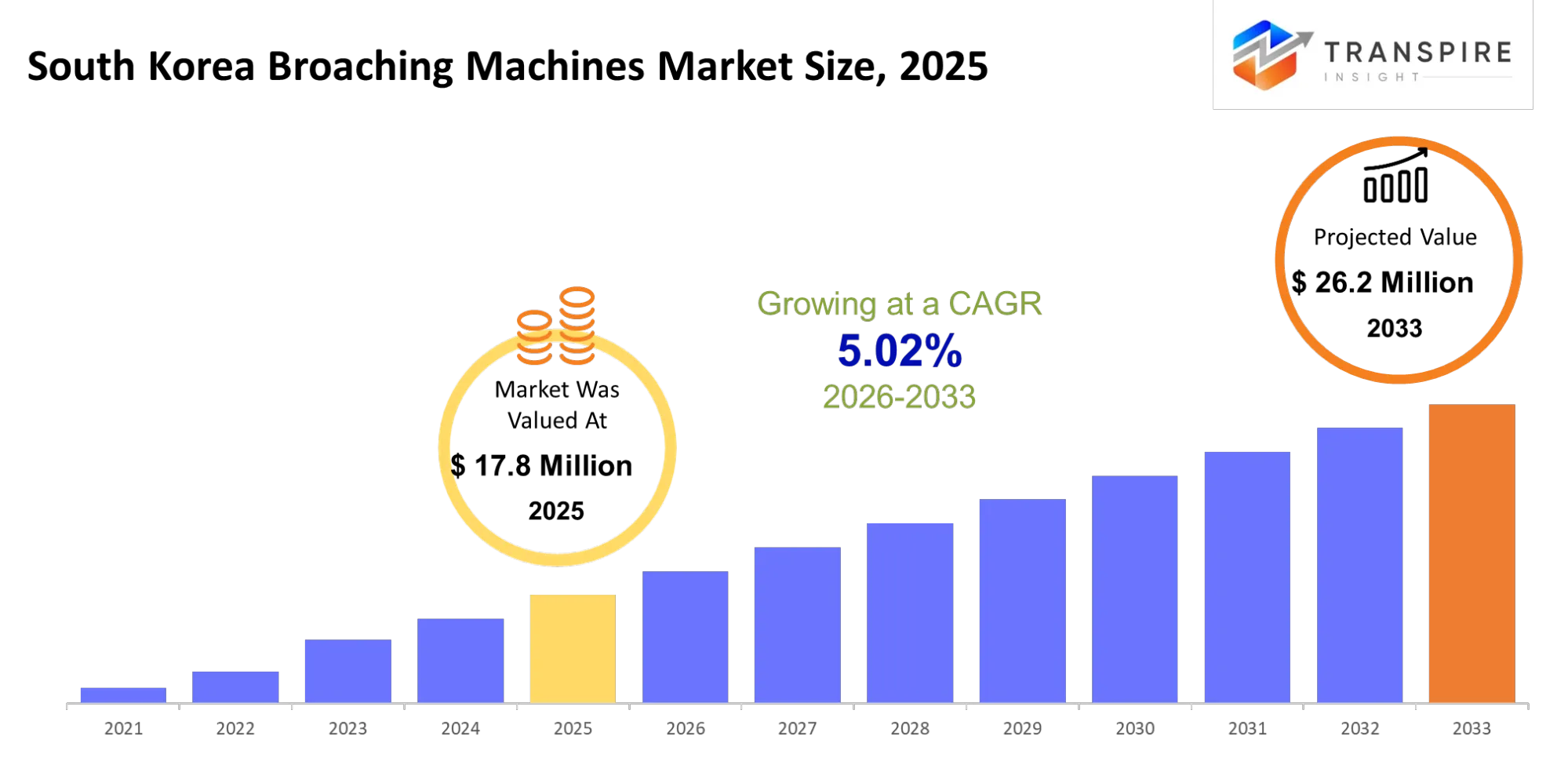
- South Korea Broaching Machines Market Size 2025: USD 17.8 Million
- South Korea Broaching Machines Market Size 2033: USD 26.2 Million
- South Korea Broaching Machines Market CAGR: 5.02%
- South Korea Broaching Machines Market Segments: By Type (Vertical, Horizontal, Surface, Continuous, Others); By Application (Automotive, Aerospace, Industrial Machinery, Others).
To learn more about this report,  Download Free Sample Report
South Korea Broaching Machines Market Summary
The South Korea Broaching Machines Market was valued at USD 17.8 Million in 2025. It is forecast to reach USD 26.2 million by 2033. That is a CAGR of 5.02%over the period.
South Korea’s broaching machines market is mainly about high precision metal finishing systems, the kind that can form complicated internal plus external shapes in parts used for automotive drivetrains, shipbuilding tooling, turbines, and large-scale industrial assemblies. Basically, these machines let makers turn out tight-tolerance components like gears, splines, and turbine blades, and that helps keep things reliable when loads stay harsh for a long time.
In the last 3–5 years, the whole market kind of shifted, more toward CNC-integrated and automation-ready broaching systems, because plants are upgrading into smart manufacturing lines. A big trigger was the post pandemic supply chain disruption, which showed how much some producers depended on imported precision pieces, so domestic resilience programs got more attention. Meanwhile, tougher efficiency plus emission rules in the automotive and marine sectors pushed OEMs to choose higher precision machining, not just for quality but also to cut material waste and keep performance steadier. So now the demand is becoming more focused on advanced digitally controlled machines that can shrink the production timeline, while also boosting repeatability and long-term operational efficiency for manufacturers overall.
Key Market Insights
- Market growth is kinda pushed along by the Industry 4.0 push, where more than 40% of the new installations in 2025 are rolling out CNC-based automation systems.
- At the same time, the increasing localization of high-tolerance machining is cutting back import reliance, and that is basically helping domestic production capabilities get stronger, too.
- In South Korea, Gyeonggi-do kind of stands out as the biggest spot for Broaching Machines, with almost 35% share in 2025, mainly because of dense industrial clusters and the presence of OEMs that are already rooted there.
- Ulsan is the fastest-growing region from 2025 to 2030, because shipbuilding keeps expanding, and heavy machinery manufacturing investments are getting bigger.
- Busan still feels like a steady hub for marine engineering use cases, plus precision part fabrication demand.
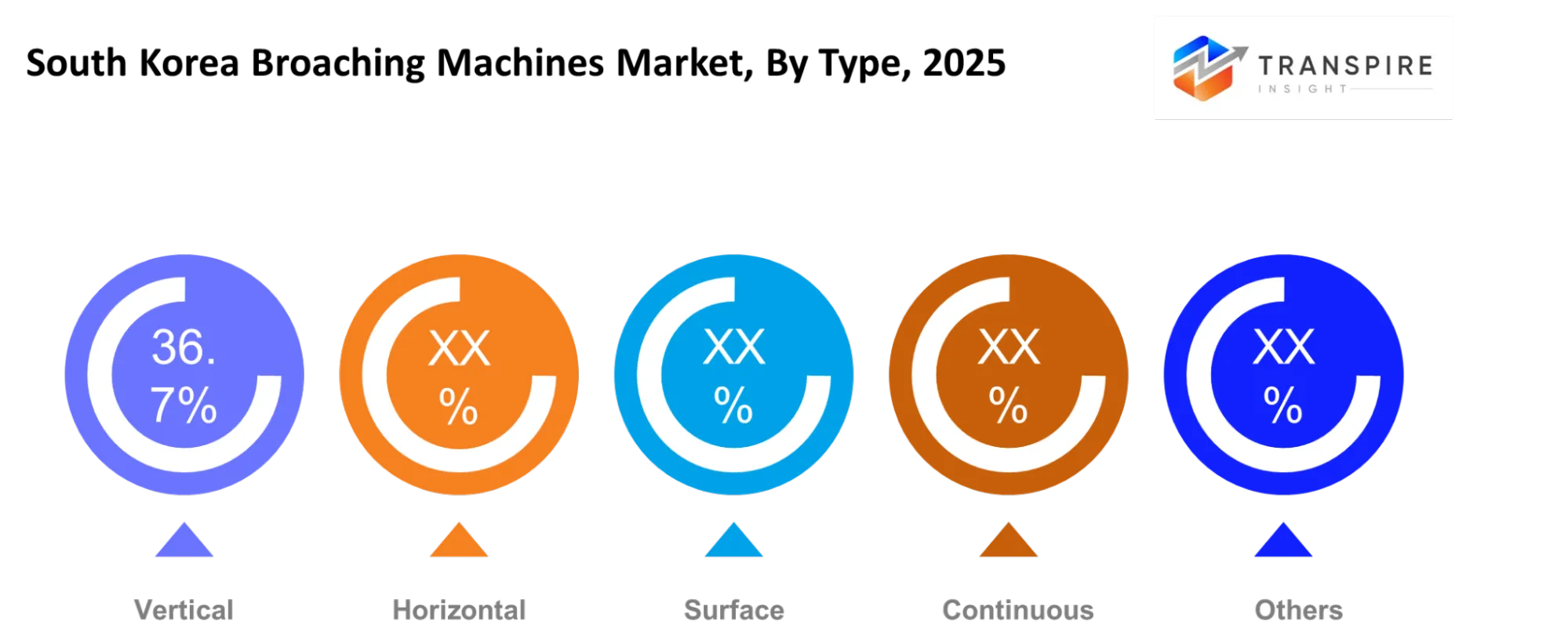
- When it comes to machine type, vertical broaching machines take the lead with about 38% share. This is usually tied to compact design, and also the ability to deliver high-precision output.
- On the segment side, CNC integrated broaching machines are the quickest to grow between 2025 and 2030, driven by automation upgrades and smart factory changes.
- Automotive applications are leading the South Korea Broaching Machines Market at roughly 45% share, and it is largely linked to transmission and drivetrain production.
- For end users, automotive OEMs are still out front, sitting at about 42% share in 2025.
- Heavy engineering and shipbuilding industries are growing the fastest, largely because infrastructure modernization keeps going forward, step by step.
What are the Key Drivers, Restraints, and Opportunities in the South Korea Broaching Machines Market?
The South Korea Broaching Machines Market is mostly driven by the fast move toward CNC-enabled precision machining across automotive transmission lines and heavy equipment manufacturing. This move got momentum because companies want less production variability, and they need stricter tolerances in drivetrain parts, especially for electric and hybrid vehicles. As OEMs reorganize supply chains toward localized, high-precision output, the uptake of advanced broaching systems has been ramping up, which helps machine replacement cycles too, and pushes more capital equipment spending across Tier 1 suppliers.
Still, there is a kind of structural pinch—high capital intensity, plus limited domestic capability when it comes to ultra-high-precision broaching tool design. A lot of small to mid-sized manufacturers lean on imported tooling and also on software integration services. That combo can lift procurement costs and stretch deployment timelines. So modernization gets slower, it’s kind of noticeable extra fast, especially for subcontractors working with thin margins, where bigger tech upgrades get postponed, again and again.
At the same time, there’s a sort of parallel opportunity showing up, mainly through smart factory investments in Ulsan and Gyeonggi-do, where the automotive and shipbuilding hubs are bringing in IoT-enabled machining setups. For instance, Hyundai-related plants are increasingly using broaching machines with predictive maintenance capabilities, so downtime drops, and throughput becomes more consistent. Put together, automation, data analytics, and precision engineering are expected to open the next growth phase for the South Korea Broaching Machines Market.
What Has the Impact of Artificial Intelligence Been on the South Korea Broaching Machines Market?
Artificial intelligence, along with advanced digital technologies, is slowly, kinda reshaping precision manufacturing in South Korea’s broaching and high-tolerance machining ecosystem, mainly because plants are starting to use connected production systems, as we see in other smart industrial equipment categories. In day-to-day broaching, AI-enabled CNC controllers can juggle cutting speed, tool load, and feed rate in real time, which tends to cut down chatter and boost dimensional accuracy for the most demanding automotive and shipbuilding parts. Also, these automated control systems make it easier to keep the same output quality across long production runs, something that is crucial for drivetrain elements and turbine component fabrication.
Machine learning models are now being used more and more for predictive maintenance by watching spindle vibration, temperature swings, and tool wear signatures. That way, operators can plan tool changes ahead of failure, not after, and the machine uptime can improve by about 10–20% in digitally upgraded facilities. On top of that, AI-driven production analytics provide extra leverage for performance optimization, since they can spot sluggish cycle times and elevated energy usage. In practice, this helps manufacturers lower operational costs while still holding onto strict precision requirements.
Still, there’s this main hitch that keeps popping up, the rather high integration cost when you want AI systems plugged into older broaching equipment, especially for smaller and medium-sized suppliers. A lot of plants today still don’t have standardized sensor infrastructure, and they also don’t maintain good training datasets, so the model can’t be as accurate when you drop it into real machining conditions. So, even if the long-run potential looks very promising for the South Korea Broaching Machines Market, full-scale AI adoption stays uneven.
Key Market Trends
- After 2023, CNC-integrated broaching systems kind of surged, replacing the more conventional mechanical machines across automotive transmission lines in South Korea at least that’s how it looked in most plants.
- Automation adoption went up almost 40% from 2022 to 2025, because manufacturers kept upgrading toward smart-factory-ready precision machining setups, not just basic tooling. There was also this kind of clear shift away from standalone machines, and toward connected production cells, with IoT sensors used for real-time tracking of tool wear and performance signals, sort of in the background all the time.
- Around 2024, the Hyundai-linked manufacturing ecosystems broadened digital machining use, so broaching machine modernization really accelerated across Tier 1 supplier networks. On the import side, dependency on high-precision broaching tools fell steadily after 2022, because local production abilities improved in the Gyeonggi-do industrial clusters, at least that’s how it looked.d
- From 2023 onward, predictive maintenance systems gained traction, and they helped reduce unplanned downtime by as much as 15% in advanced machining facilities. Meanwhile, in Ulsan, shipbuilding-related demand climbed after 2023, so the application focus leaned more toward heavy-duty broaching systems for marine components, more rugged stuff.
- Competition strategies also drifted toward CNC retrofitting rather than total replacement of the whole machine, which made upgrades feel more cost-efficient for mid-sized manufacturers. In 2024, energy-efficient machining expectations came in, pushing OEMs to use optimized cutting cycles and reduce material wastage during production, resulting in less waste in general.
- Finally, supplier collaboration with global firms such as Sandvik and Atlas Copco increased, so technology transfer and automation integration in South Korea moved faster, with fewer dead ends and more trial runs that actually mattered, not just paperwork
South Korea Broaching Machines Market Segmentation
By Type
Vertical broaching machines get a lot of real usage in precision machining lines, mostly because they have a compact structure, and the output stays stable when it comes to high-volume production setups. In the last few years, adoption started shifting toward CNC-based vertical systems after 2023, as manufacturers improved control accuracy and cycle efficiency, kind of step by step. The demand growth feels tied to automotive transmission, and also to small component manufacturing, where tight tolerance control is a must, not just a nice thing to have. In the South Korean broaching machine market, there is a steady preference for automated vertical configurations, since factories are trying to reduce manual intervention and increase repeatability.
Horizontal broaching machines are still widely used for longer workpieces like shafts angear-relateded components, especially in heavy engineering applications. Over time, the preference moved more and more toward digitally controlled horizontal systems beginning in 2022, and in multiple plants,older hydraulic-only setups were replaced, not all at once. Surface and continuous broaching machines are also showing up more often in specialized industrial machining lines, mainly where an uninterrupted production flow is required. Continuous systems got extra attention after 2024 because productivity needs kept rising, and changeover time dropped across manufacturing units, which helped them keep going.
To learn more about this report, Download Free Sample Report
By Application
Automotive use pretty much leads overall, mostly because there is constant demand for accurate drivetrain gearbox and engine component making. After 2023, the push toward electric and hybrid vehicle production sort of shifted the priorities, and that made companies lean more on CNC broaching systems, especially when they need tighter tolerances and a dependable output quality that stays consistent. In the same way, industrial machinery use kept rising, as more plants moved from older layouts to newer ones, with the aim of improving overall efficiency and trimming operational downtime. The South Korea Broaching Machines Market also seems to match well with automotive-led spending cycles and broader modernization programs.
For aerospace, the expansion is slower but noticeable, mostly tied to stricter precision needs for turbine and structural component manufacturing. Since around 2022, adoption has climbed as worldwide supply chains have basically leaned into localized high-precision machining capacity, so there has been more room to run these processes nearby. The industrial machinery portion gained more momentum, too, becauseautomation-heavyy production settings keep demanding customized equipment parts. For other uses, like specialized tooling and defense-related manufacturing, the pattern is steadier, with upgrades happening selectively. These upgrades often lean toward automated broaching systems for better accuracy and fewer redo cycles.
What are the Key Use Cases Driving the South Korea Broaching Machines Market?
Automotive component manufacturing remains the primary driver of the South Korea Broaching Machines Market; it is the dominant use case. Transmission systems, gear assemblies, and drivetrain parts really need high precision and strong repeatability, so companies end up leaning on CNC broaching systems a lot. On top of that, the growth in electric and hybrid vehicles has helped tighten demand for machining within smaller tolerances, which in turn improves output consistency across Tier 1 automotive suppliers, not that they ever had much slack anyway.
Industrial machinery and heavy equipment manufacturing is also gaining momentum, especially as factories modernize older production lines. Broaching machines are used to make shafts, couplings, and structural components for automated industrial systems. There is also shipbuilding-related engineering that adds a steady pull, mainly around Ulsan manufacturing clusters, where durablehigh-loadd components are basically a daily requirement, and the tolerance talk is never really finished.
Aerospace component machining is starting to look like a promising lane, too. Local manufacturers are boosting their ability for turbine parts and structuralpartst productin, so broaching fits into that plan more often. Defense manufacturing shows early-stage adoption as well, largely because it needs high-strength precision parts. These applications should expand further as more advanced machining investments roll in across the forecast period, even if budgets feel a bit unpredictable.
|
Report Metrics |
Details |
|
Market size value in 2025 |
USD 17.8 Million |
|
Market size value in 2026 |
USD 18.6 Million |
|
Revenue forecast in 2033 |
USD 26.2 Million |
|
Growth rate |
CAGR of 5.02% from 2026 to 2033 |
|
Base year |
2025 |
|
Historical data |
2021 - 2024 |
|
Forecast period |
2026 - 2033 |
|
Report coverage |
Revenue forecast, competitive landscape, growth factors, and trends |
|
Regional scope |
South Korea |
|
Key company profiled |
Nachi, Mitsubishi Heavy Industries, Forst, American Broach, Colonial Tool, Apex Broaching, Arthur Klink, Hoffmann Rumpf, YKT, Fuji, HMT, Pioneer Broach, Axisco, Accu-Cut, BMS |
|
Customization scope |
Free report customization (country, regional & segment scope). Take advantage of customized purchase options tailored to meet your exact research needs. |
|
Report Segmentation |
By Type (Vertical, Horizontal, Surface, Continuous, Others); By Application (Automotive, Aerospace, Industrial Machinery, Others), By Industry Analysis, Size, Share, Growth, Trends, and Forecasts 2026-2033. |
Which Regions are Driving the South Korea Broaching Machines Market Growth?
Gyeonggi-d kind of leads the South Korea Broaching Machines Market because there’s a dense cluster of automotive OEMs, precision engineering companies, and advanced manufacturing clusters. Also, government support for smart factory setups has led firms to adopt CNC broaching systems across production facilities, not just in one plant. The region is supported by a fairly complete industrial ecosystem, including tooling providers, automation integrators, and talent networks that actually know the craft. With ongoing investment in high-precision machining infrastructure, companies continue to need more advanced broaching equipment across several industries, which keeps demand steady.
Ulsan, on the other hand,d is more stable and mature, mainly tied to shipbuilding and heavy machinery work. It’s a bit different than Gyeonggi-do, where diversification pushes growth, since Ulsan leans on long-cycle capital commitments from big shipbuilders and equipment producers. That means the broaching machines' demand has predictable rhythms, especially for marine-grade component manufacturing. Strong corporate backing from established industrial groups tends to translate into regular upgrades rather than sudden, fast expansion cycles, so Ulsan becomes a reliable revenue base.
Then there’s Busan, and it shows the fastest growth momentum, mostly because port modernization programs keep expanding, and precision marine components demand keeps rising. Since 2024, local activity has felt stronger after investments in port infrastructure and logistics linked to manufacturing, sort of reinforcing the entire value chain. With more emphasis on export-oriented production, manufacturers are adopting automated machining setups to boost efficiency and throughput. For investors and market entrants, Busan looks like it has real upside between 2026 and 2033, as maritime manufacturing keeps growing along with the surrounding supporting industrial clusters.
Who are the Key Players in the South Korea Broaching Machines Market and How Do They Compete?
Competition within the South Korea Broaching Machines Market is, in a way, moderately consolidated, not totally fragmented or anything. A small group of global machine tool and industrial equipment suppliers keeps a pretty strong influence, while many local manufacturers tend to lean on customization and that service- responsiveness angle, like being quicker. The established incumbents keep their ground through advanced CNC technology integration, solid after-sales support, and long-running OEM relationships with automotive and heavy engineering firms. For new entrants, it's harder than you might think, because entry barriers are raised by precision needs, tooling know-how, and the overall integration complexity, so rapid disruption is not really the norm. In practice, competition is driven by technology performance, machining accuracy, and lifecycle service capability more than by price alone.
Sandvik seems to run a technology innovation posture, mainly around high-precision machining systems, plus digital monitoring features. They differentiate via advanced tooling solutions that raise cutting efficiency and also reduce tool wear during high-volume automotive production. Their expansion work also includes strengthening partnerships with Korean Tier 1 suppliers, so broaching solutions can be slotted into automated production lines, more neatly than before.
Atlas Copco kind of pushes automation-based machining support systems plus energy-saving equipment design, and yeah, it’s clear they want the whole process to run more smoothly. Their edge mainly comes from how they integrate compressed air systems directly into industrial machining environments, which boosts operational stability even when conditions get a bit rough. For growth, they talk about enlarging service networks while also rolling out predictive upkeep solutions, especially for manufacturing clusters around Gyeonggi-do and Ulsan.
Doosan Bobcat, on the other hand,d leans hard on local manufacturing strength and those solid relationships with customers. They’re oriented toward cost-effective machining approaches that are also adaptable, aimed at mid-sized industrial users, not just the biggest players. Their expansion is helped along by ongoing product localization and by tying everything in with smart factory initiatives across South Korea’s automotive and heavy equipment sectors.
Company List
- Nachi-Fujikoshi
- Mitsubishi Heavy Industries
- Forst Technologie
- American Broach & Machine Company
- Colonial Tool Group
- Apex Broaching Systems
- Arthur Klink GmbH
- Hoffmann Räumtechnik
- YKT Corporation
- Fuji Corporation
- HMT Machine Tools
- Pioneer Broach Company
- Axisco Precision Machinery
- Accu-Cut Diamond Tool
- BMS Machines
Recent Development News
What Strategic Insights Define the Future of the South Korea Broaching Machines Market?
The South Korea Broaching Machines Market is kinda shifting, like for real, toward fully digitalized, CNC-connected production setups, since manufacturers keep pushing for tighter precision, automation, and faster output across automotive plus heavy engineering value chains. That move is mostly tied to smart factory expansion and the requirement for localized high-tolerance cutting, which ends up lowering dependence on imported precision parts and also improves domestic supply resilience.
There’s also a risk that’s a bit more hidden, namely technological substitution—advanced multi-axis CNC machining centers can handle overlapping shaping functions, so in some cases, they slowly replace the need for dedicated broaching tools. Over time, this substitution pressure may cap the pace of demand growth in lower complexity machining segments, especially for cost-sensitive subcontractors.
A key emerging opportunity kinda lives in AI-enabled adaptive broaching systems being tested across advanced manufacturing clusters in Gyeonggi-do, where real-time tool correction and predictive wear control are improving output consistency, in practice. Over the next 5–7 years, the firms that blend digital monitoring with machine tool design will likely pull in higher margin contracts in the automotive and aerospace supply chains. Market participants should focus on modular machine upgrades and software-driven service models to remain competitive, especially since procurement decisions are shifting toward lifecycle performance instead of just upfront equipment cost.
South Korea Broaching Machines Market Report Segmentation
By Type
- Vertical
- Horizontal
- Surface
- Continuous
- Others
By Application
- Automotive
- Aerospace
- Industrial Machinery
- Others
Frequently Asked Questions
Find quick answers to common questions.
The expected South Korea Broaching Machines Market size is USD 26.2 Million in 2033.
By Type (Vertical, Horizontal, Surface, Continuous, Others); By Application (Automotive, Aerospace, Industrial Machinery, Others).
Major South Korea Broaching Machines Market players are Nachi, Mitsubishi Heavy Industries, Forst, American Broach, Colonial Tool, Apex Broaching, Arthur Klink, Hoffmann Rumpf, YKT, Fuji, HMT, Pioneer Broach, Axisco, Accu-Cut, BMS.
The South Korea Broaching Machines Market size is USD 17.8 Million in 2025.
The South Korean Broaching Machines Market CAGR is 5.02% from 2026 to 2033.
- Nachi-Fujikoshi
- Mitsubishi Heavy Industries
- Forst Technologie
- American Broach & Machine Company
- Colonial Tool Group
- Apex Broaching Systems
- Arthur Klink GmbH
- Hoffmann Räumtechnik
- YKT Corporation
- Fuji Corporation
- HMT Machine Tools
- Pioneer Broach Company
- Axisco Precision Machinery
- Accu-Cut Diamond Tool
- BMS Machines
About the Authors

Kartik bhong
I am Kartik Bhong, a Senior Research Analyst at Transpire Insight, specializing in the Packaging, Manufacturing, and Construction industry. My work focuses on analyzing market trends, emerging technologies, industry regulations, and competitive landscapes to deliver accurate, data-driven insights. I am passionate about transforming complex industry information into clear, practical content that helps businesses, professionals, and decision-makers stay informed and make confident strategic decisions. Through continuous research and a strong commitment to accuracy, I strive to create reliable, well-researched content that reflects the latest developments across these dynamic industries and supports the vision of Transpire Insight in delivering valuable market intelligence.

Chakradhar Khansole
Chakradhar serves as the Research Director at Transpire Insight, bringing over 8 years of experience in technology, innovation, and strategic market intelligence. He specializes in transforming complex market data into actionable business insights that enable organizations to make informed, growth-oriented decisions. Recognized for his strategic vision and analytical expertise, Chakradhar leads high-impact research initiatives, delivering comprehensive market assessments, competitive intelligence, and forward-looking industry analysis.
Recently Published Reports
-
Apr 2026
Handling and Lifting Equipment Market
Handling and Lifting Equipment Market Size, Share & Analysis Report By Product (Cranes and Hoists, Forklifts, Conveyor Systems, Aerial Work Platforms, Others), By Application (E-Commerce, Automotive and Railway, Food and Beverages, Aviation, Others), and Geography (North America, Europe, Asia-Pacific, Middle East and Africa, South and Central America), 2021 - 2031
-
Apr 2026
HVAC Equipment Market
HVAC Equipment Market Size, Share & Analysis Report By Heating Equipment Type (Boilers and Furnaces, Heat Pumps, and Unitary Heaters), By Ventilation Equipment (Air Handling Units, Humidifiers and Dehumidifiers, Air Filters, and Fan Coiling Units), By Air Conditioning Equipment (Unitary Air Conditioners, Room Air Conditioners, Packaged Terminal Air Conditioners, and Chillers), By End User (Commercial, Residential, Industrial, and others), and Geography (North America, Europe, Asia-Pacific, Middle East and Africa, South and Central America), 2021 – 2031
-
Apr 2026
Refrigeration Valves Market
Refrigeration Valves Market Size, Share & Analysis Report By Type (Solenoid Valves, Expansion Valves, Check Valves, Service Valves, Others), By Application (Commercial Refrigeration, Industrial Refrigeration, Transport Refrigeration, Residential Refrigeration, Air Conditioning Systems), By End User (Food and Beverage Industry, Pharmaceutical Industry, HVAC Industry, Chemical Industry, Others), and Geography (North America, Europe, Asia-Pacific, Middle East and Africa, South and Central America), 2021 – 2031
-
Apr 2026
E-Commerce Packaging Materials Market
E-Commerce Packaging Materials Market By Material Type (Corrugated Boxes, Paper & Paperboard, Foam & Cushioning Materials, Plastic Packaging, Flexible Packaging, Protective Packaging, Others), By Product(Primary Packaging, Secondary Packaging, Tertiary Packaging), By Packaging Function (Protective Packaging, Branding & Presentation Packaging, Transit & Logistic Packaging, Sustainable Packaging, Tamper Evidence Packaging), By End-User (Retail & Consumer Goods, Electronic Appliances, Food & Beverages, Healthcare & Pharmaceutical, Fashion & Apparel, Home & Furnishing, Others); By Industry Analysis, Size, Share, Growth, Trends, and Forecasts 2021-2033