
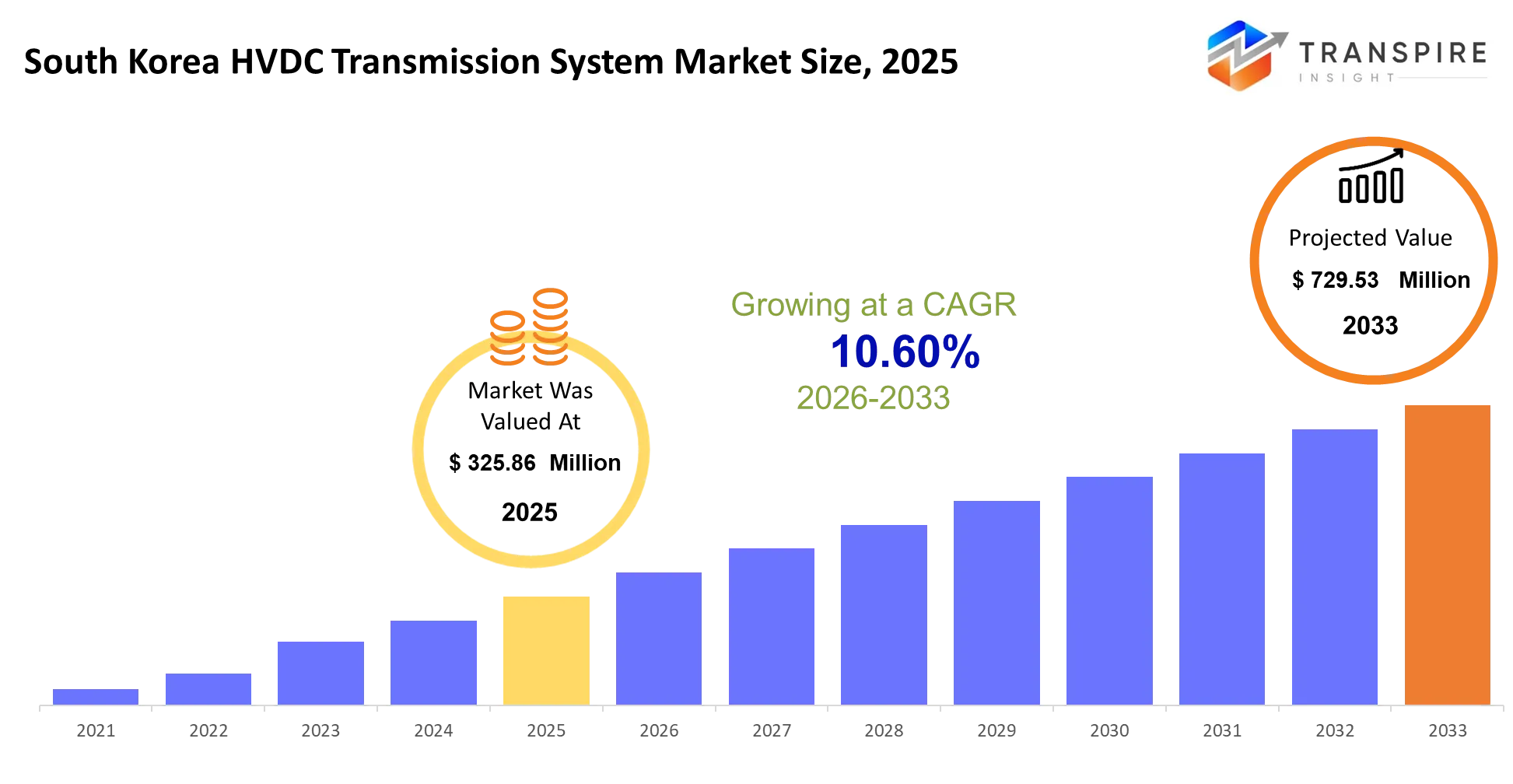
South Korea HVDC Transmission System Market Size & Forecast:
- South Korea HVDC Transmission System Market Size 2025: USD 325.86 Million
- South Korea HVDC Transmission System Market Size 2033: USD 729.53 Million
- South Korea HVDC Transmission System Market Segments: By Component (Converters, Transformers, DC Cables, Circuit Breakers, Control Systems, Others); By Technology (Voltage Source Converter, Line Commutated Converter, Modular Multilevel Converter, Others); By Application (Renewable Energy Integration, Long-distance Power Transmission, Offshore Wind Integration, Grid Interconnection, Others); By End User (Utilities, Power Grid Operators, Renewable Energy Companies, Others)
To learn more about this report,  Download Free Sample Report
South Korea HVDC Transmission System Market Summary
The South Korea HVDC Transmission System Market was valued at USD 325.86 Million in 2025. It is forecast to reach USD 729.53 Million by 2033. That is a CAGR of 10.60% over the period.
The South Korea HVDC Transmission System Market has this kind of important role in shifting big volumes of electricity across long distances, usually with fewer transmission losses ,and better grid steadiness in real-world operations. Basically these systems tie together offshore wind farms, industrial clusters, and neighboring power networks at the same time while assisting utilities deal with the swingy renewable energy demand. Over the last five years, the market kind of moved away from older point-to-point transmission builds and more toward multi-terminal plus renewable-connected HVDC infrastructure. This change really picked up speed once South Korea pushed its carbon neutrality roadmap further, and started putting more money into offshore wind expansion near coastal areas.
Also, during the global energy crisis , supply chain disruptions forced many utilities to think more carefully about sturdy homegrown transmission lines and broader grid modernization programs. Since renewable generation capacity is rising faster than the usual grid upgrade cycles, utilities and industrial operators are using HVDC solutions to avoid bottlenecks, lift power quality, and keep electricity delivery stable. And yes, that overall direction is showing up as larger budgets for converter stations , submarine cables, and even digital grid management technologies that help coordinate everything.
Key Market Insights
- South Korea is planning to put in more than 12 GW offshore wind capacity by 2030 , and that is expected to create a really strong pull for long-distance HVDC transmission infrastructure plus submarine cable systems.
- Voltage Source Converter tech seems to take the lead with over 60% of new HVDC project deployments, mostly because it helps renewables come online quicker and also gives a more stable grid feel performance . not to mention, it helps with grid stabilization in a way that older approaches struggle to match.
- Jeollanam-do, along with the southwest coastal areas, is basically where nearly 40% of the upcoming HVDC infrastructure investment is pointing. This is tied to offshore wind transmission corridors and also island connectivity projects, so it is a kind of one-two effect.
- On the submarine side, HVDC cable installations have been growing more than 15% after 2022. Utilities were accelerating mainland-to-island interconnection , and at the same time they pushed ahead with offshore renewable energy transmission projects , so demand rose pretty clearly.
- In terms of revenue, utility scale transmission use cases dominate the picture, while Korea Electric Power Corporation stays focused on nationwide smart grid , and resiliency upgrades stretching through 2033.
- On top of that, semiconductor clusters and EV battery manufacturing are increasingly leaning into advanced power transmission systems. The goal is to minimize voltage instability and also reduce production downtime risk, which is always a big deal for continuous manufacturing lines.
- AI-enabled smart grid platforms have also helped. Transmission fault detection efficiency improved by nearly 30%, and operators were able to cut outage response times and maintenance costs , pretty noticeably.
- Companies like LS Electric , Hyosung Heavy Industries, Hitachi Energy, Siemens Energy, and ABB are expanding converter station automation and building more localized manufacturing capabilities too.
- Finally, strategic partnerships between domestic utilities and overseas transmission technology providers have sped up localized engineering knowledge. That has helped shorten project delivery timelines and reduced supply chain dependence, which makes the whole program move faster, even when constraints show up.
What are the Key Drivers, Restraints, and Opportunities in the South Korea HVDC Transmission System Market?
The main thing pushing the South Korea HVDC Transmission System Market forward is kind of a two part deal. The country's quick offshore wind push, alongside grid decarbonization goals. South Korea’s clean energy shift needs efficient long distance electricity transfer from the coastal wind spots to crowded industrial and urban demand areas. Traditional AC transmission stuff has a harder time, because it tends to bring higher transfer losses and more grid instability, especially when you stretch it across long distances. Because of that, many utilities are putting serious money into HVDC converter stations and submarine transmission links. And yeah this kind of spending spiral is, in practice, boosting procurement deals, engineering services income, and the overall demand for advanced power electronics systems.
Still, the biggest drag on the market is the heavy upfront cost and the long approvals timeline tied to HVDC rollout. Converter stations, submarine cables, and the grid integration layers all need multibillion dollar investments plus complicated environmental permitting. These hurdles aren’t easy to fix fast, because transmission development relies on coordinated utility planning, coastal authorizations, and specialized engineering know-how. When permitting runs behind schedule, and when grid synchronization gets delayed, project commissioning gets postponed too, and near term revenue basically gets muted.
One clear opening is merging energy storage systems and smart digital substations into HVDC networks. South Korea already has battery manufacturing strength, and ongoing smart grid commitments, so the setup supports hybrid transmission arrangements that can smooth out renewable ups and downs. Also, newer projects that connect offshore renewable hubs to industrial hydrogen production facilities could help open the next market phase, and make expansion feel more practical than just theory.
What Has the Impact of Artificial Intelligence Been on the South Korea HVDC Transmission System Market?
Artificial intelligence plus advanced digital tech are kind of changing HVDC transmission work in a big way , mostly because grid reliability gets better, predictive maintenance becomes more practical and real time power flow management is handled in a smoother way. Utilities and transmission operators are moving toward AI monitoring systems that can sort of “run themselves” for converter station diagnostics, also spotting weird behavior before an equipment failure can even show up. Machine learning models look at voltage ripples, thermal stress patterns , and cable performance records, then they tune transmission efficiency and try to cut down downtime risks.
Digital twin methods have also picked up speed within South Korea’s smart grid projects. Operators rely on simulation platforms to foresee transmission chokepoints, test how renewable energy load variability might behave, and refine dispatch choices during the heavy demand hours. In practice these setups help utilities shrink operational losses and stabilize the network , especially in offshore wind integration initiatives where generation schedules shift quite a lot.
There’s also AI powered analytics that backs predictive maintenance for submarine cables and converter transformers. This tends to reduce emergency repair expenses and supports longer asset lifespan. Still, uptake isn’t fully effortless because the integration costs are high, and there are limited historical operating datasets for newer HVDC deployments. On top of that many utilities feel stuck when they need to connect older grid infrastructure with modern AI enabled monitoring platforms, which slows down wide scale rollouts.
Key Market Trends
- Since 2021, it looks like offshore wind integration projects with planned capacity over 12 GW kinda shifted the whole HVDC investment focus, toward coastal transmission corridors and also more submarine cable deployment stuff.
- After 2022 utilities started adopting Voltage Source Converter systems by more than 35% , partly because renewable balancing got better, and the reactive power control efficiency felt improved in practice or so it seems.
- Meanwhile, domestic manufacturers expanded localized converter and cable production capacity by almost 25% between 2022 and 2025, with the idea of lowering reliance on imported transmission equipment, not sure it’s perfect but that’s the point.
- Smart substations with AI-enabled monitoring systems improved transmission fault detection accuracy by around 30% , and that led to shorter outage response times and maintenance costs.
- Korea Electric Power Corporation also moved faster on digital transmission modernization projects between 2023 and 2025, and they kept pushing investments toward grid resilience and renewable integration.
- At the same time, semiconductor plus EV battery manufacturing facilities increased their need for stable high-capacity transmission systems, because industrial electricity consumption kept rising across big production clusters.
- Strategic collaborations involving LS Cable & System and global technology providers grew stronger , and they helped tighten the localization of advanced HVDC engineering alongside cable manufacturing expertise.
- Grid operators have been leaning more and more toward underground and submarine HVDC links, mainly to deal with urban land constraints and to ease transmission congestion across densely populated industrial corridors.
- Power electronics suppliers also expanded their investment in modular multilevel converter technologies, which can reduce long-distance transmission losses by nearly 15%.
- And after 2024, energy storage integration within HVDC networks showed up more clearly, because utilities wanted flexible renewable balancing systems and they tried to make them real.
South Korea HVDC Transmission System Market Segmentation
By Component
Converters sort of hold the dominant position because high-voltage conversion systems really are the core interface layer between renewable generation and those long distance transmission lines. Their strong deployment in offshore wind integration initiatives, plus grid stabilization programs, tends to support this segment’s standing in infrastructure-heavy spending. Transformers come next as the second-largest segment, because utilities lean on voltage step-up and step-down functions so transmission flow stays stable across industrial zones and coastal corridors. DC Cables still keep real relevance too, given the submarine and underground transmission expansion trend, while Circuit Breakers, Control Systems, and Others stay important but comparatively smaller, since they mostly play supportive roles inside HVDC architecture, and that’s a bit indirect.
Converters keep growing in importance mainly through modular multilevel converter adoption and efficiency improvements, especially for dealing with that fluctuating, variable renewable load. Transformers also get a push from grid modernization programs that want higher capacity handling, plus better thermal performance, for long-distance stability. DC Cables are expected to show the fastest expansion as offshore wind corridors grow, and as island-grid connectivity projects accelerate the infrastructure appetite. During the forecast period, innovation at the component level will likely keep focusing on efficiency gains, reduced transmission losses, and the integration of digital monitoring, which opens solid opportunities for companies that specialize in power electronics and high capacity transmission hardware.
By Technology
Voltage Source Converter technology sort of holds the top spot, mainly because it can pull in renewable energy sources pretty well and keep weak, or sometimes wildly fluctuating grids from going out of control. There is also strong take-up in offshore wind and city grid interconnection endeavors , which pushes its leadership further across the newer HVDC deployments. Meanwhile Line Commutated Converter systems still look relevant in older, very high-capacity transmission schemes , but over time they get constrained by less flexibility especially when the grid has a lot of renewable energy. Modular Multilevel Converter tech , and a few other newer configurations, stay important for the next wave of systems that need high efficiency plus easy scalability.
VC S converter uptake keeps growing, largely because it enables bidirectional energy exchange along with reactive power governance, things that are needed for renewables integration in practice. Modular Multilevel Converter systems are becoming more common since they improve the waveform look , cut down harmonic pollution, and make everyday operations more reliable in tricky grid settings. Line Commutated Converter usage is likely to ease down gradually as utilities move toward more flexible, digitally managed solutions. During the forecast window, the technology will keep evolving , with an emphasis on squeezing out better efficiency, reinforcing grid stability , and connecting transmission management to AI-based control so operations can be real-time responsive.
By Application
Renewable Energy Integration still holds the lead, because HVDC systems basically act as the main transmission spine for offshore wind plus other big scale renewables. There is also strong policy backing for decarbonization, and grid modernization, which pretty much keeps its leading share steady in new build investments. Long-distance Power Transmission is the next biggest chunk, driven by the practical need to shuttle electricity efficiently between generation hubs and where people actually consume it. Offshore Wind Integration is climbing fast too, as coastal energy projects keep expanding, while Grid Interconnection and Others mainly help with flexibility and regional load balancing needs.
Renewable Energy Integration keeps pulling ahead, mainly through more offshore wind capacity add-ons and growing grid electrification demands across industrial areas. Offshore Wind Integration looks like the most rapidly moving segment right now, largely thanks to quicker approvals along the coast, plus bigger bets on submarine transmission infrastructure. Long-distance Power Transmission seems relatively steady, since it remains a core bridge that links far away renewable sources to nearby urban demand centers. In the forecast window, application demand should edge toward hybrid energy systems—renewable output, storage, and smart grid balancing ideas all together—so dependence on high capacity HVDC networks increases.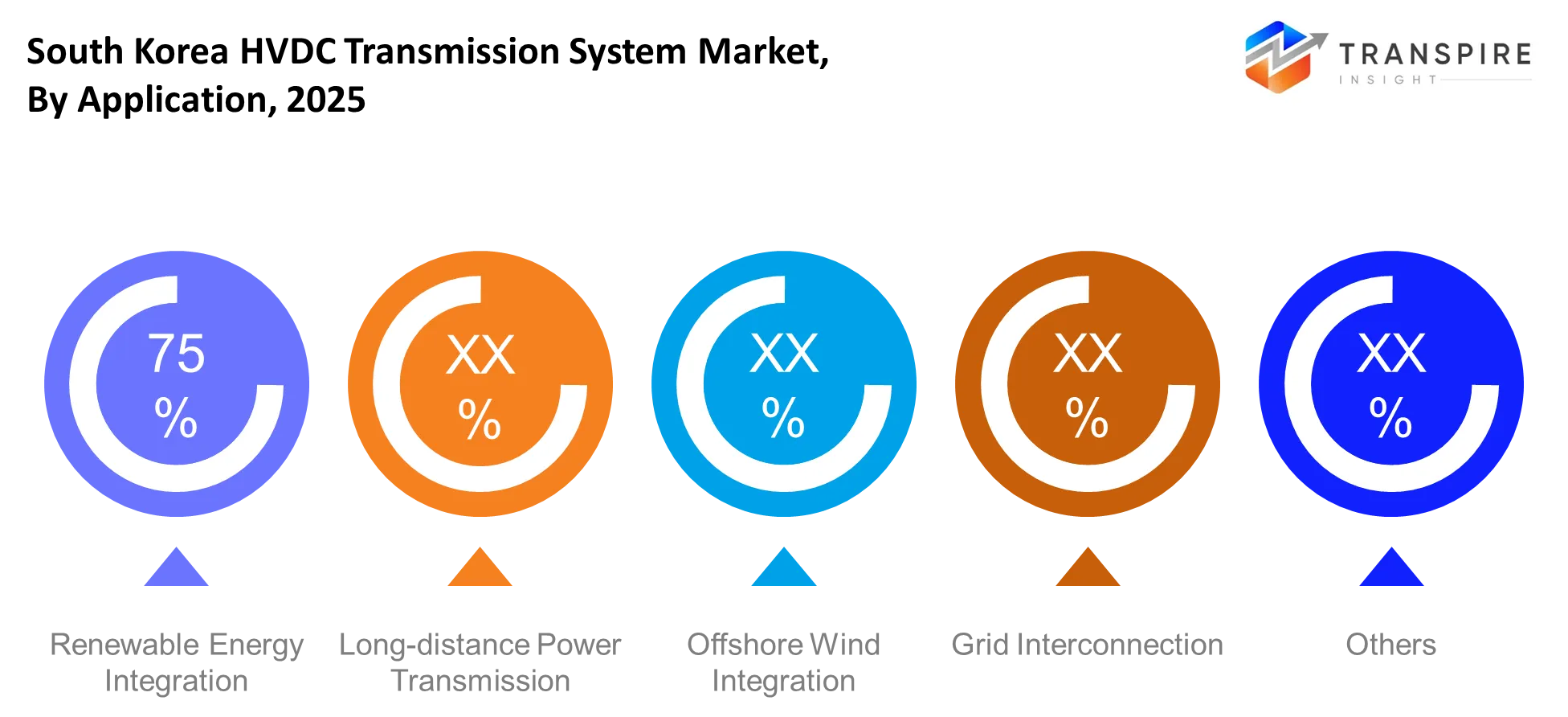
To learn more about this report, Download Free Sample Report
By End User
Utilities hold the dominant position, mainly because national and regional power providers take the lead in large scale transmission infrastructure planning and deployment. It’s not just a vibe either, strong government supported grid modernization programs ,along with renewable integration directives, tend to keep them in front when it comes to HVDC investments. Power Grid Operators come next,more or less, since they oversee real time electricity flow optimization and overall system dependability across these linked networks. Renewable Energy Companies keep expanding their role too, partly because offshore wind ownership is rising, and also because utility scale generation assets are becoming more common in their portfolios.
Utilities are still pushing adoption through long term infrastructure planning cycles that focus on renewable integration ,and transmission efficiency upgrades. Power Grid Operators are getting even more important, due to the extra complexity of balancing variable renewable output with swings in industrial demand. Renewable Energy Companies are expected to show the quickest expansion, since project ownership structures are moving toward independent power producers, and hybrid energy developers, in other words. During the forecast window, end user behavior will likely start reflecting more collaboration between utilities, private developers, and grid operators. This makes the investment landscape feel more intertwined, and centered on stability, higher efficiency, and decarbonized power delivery.
What are the Key Use Cases Driving the South Korea HVDC Transmission System Market?
In South Korea the dominant use case for HVDC transmission systems kinda centers on offshore wind power integration, where utilities rely on HVDC to shunt electricity from coastal and offshore renewable sites over to industrial and metropolitan load areas. In practice they value the HVDC link because it keeps transmission losses low, and also because AC solutions can be a bit limited when you go over long submarine stretches. So yeah , that’s where the biggest demand tends to show up, mainly due to those efficiency constraints tied to extended underwater distances.
Beyond that, adjacent applications are also spreading into industrial manufacturing clusters. You’ll see it especially near semiconductor fabrication plants and battery production facilities which want a stable, high-capacity electricity delivery. At the same time, grid interconnection projects are picking up too, linking island territories and remote coastal pockets back into the mainland power network, usually driven by public utility operators who need more dependable supply paths.
Then there are emerging use cases such as hydrogen production hubs, powered by offshore renewable electricity, plus integrated smart grid ecosystems that mix energy storage with HVDC transmission networks. Those efforts are still pretty early, and not fully rolled out yet , but they look promising over the long term as South Korea pushes harder on decarbonization and ramps up investments in digital energy infrastructure.
|
Report Metrics |
Details |
|
Market size value in 2025 |
USD 325.86 Million |
|
Market size value in 2026 |
USD 360.39 Million |
|
Revenue forecast in 2033 |
USD 729.53 Million |
|
Growth rate |
CAGR of 10.60% from 2026 to 2033 |
|
Base year |
2025 |
|
Historical data |
2021 - 2024 |
|
Forecast period |
2026 - 2033 |
|
Report coverage |
Revenue forecast, competitive landscape, growth factors, and trends |
|
Regional scope |
South Korea |
|
Key company profiled |
LS Electric, Hyundai Electric, Hitachi Energy, Siemens Energy, GE Vernova, Toshiba Energy Systems, Mitsubishi Electric, ABB, Nexans, Prysmian Group, NR Electric, Eaton, Schneider Electric, Fuji Electric, TBEA |
|
Customization scope |
Free report customization (country, regional & segment scope). Avail customized purchase options to meet your exact research needs. |
|
Report Segmentation |
By Component (Converters, Transformers, DC Cables, Circuit Breakers, Control Systems, Others); By Technology (Voltage Source Converter, Line Commutated Converter, Modular Multilevel Converter, Others); By Application (Renewable Energy Integration, Long-distance Power Transmission, Offshore Wind Integration, Grid Interconnection, Others); By End User (Utilities, Power Grid Operators, Renewable Energy Companies, Others) |
Which Regions are Driving the South Korea HVDC Transmission System Market Growth?
Southwest coastal South Korea is still basically the main regional market for HVDC transmission deployment, partly because there’s a cluster, not just one or two, offshore wind projects and a lot of large scale renewable integration planning. Provinces like Jeollanam-do keep showing up as the lead in investment activity because they’re tied to major offshore wind corridors, and those corridors connect toward industrial plus metropolitan demand centers. With the national carbon neutrality roadmap pushing forward, and the grid modernization push staying steady, converter station work plus submarine cable construction keeps speeding up in these coast areas .
The Seoul Capital Area along with the Gyeonggi industrial corridor is the second most important regional market, yet the growth reasoning is sort of different than what you see in the coastal renewable buildouts. Here the focus is more on grid dependability upgrades, to support semiconductor fabrication plants, battery manufacturing facilities , and data center expansion too. Utilities and industrial operators tend to rank stable high capacity electricity transmission as priority number one, since even brief outages can cause very real financial damage for advanced manufacturing . Because industrial electricity demand is fairly consistent, and large corporate groups keep funding long term, this region feels like a stable contributor to HVDC infrastructure spending instead of a high volatility growth market.
Jeju Island, and the neighboring southern island grids, are getting called the fastest growing HVDC deployment region, mainly due to quick renewable integration and island-grid interconnection efforts. Newer investments in Voltage Source Converter systems and submarine transmission links improved grid steadiness, and also helped with renewable energy balancing . At the same time, government backed smart island infrastructure programs, along with offshore renewable pilot projects, have been speeding up the infrastructure.
Who are the Key Players in the South Korea HVDC Transmission System Market and How Do They Compete?
The South Korea HVDC Transmission System Market is still kind of moderately consolidated, with competition basically swinging around technological capability, grid integration knowhow, and this localized engineering execution that actually matters on site. Big global transmission technology players go head to head with domestic electrical equipment manufacturers, which have those strong utility relationships and a pretty solid regional manufacturing setup. Lately the market seems to prefer companies who can bundle everything together, like converter stations plus digital monitoring systems, submarine cables, and also longer-term maintenance services, not just one piece.
LS Electric keeps pushing a localization approach, and it puts weight on grid automation integration, so it can stay relevant in South Korea’s renewable transmission ecosystem. They lean on domestic manufacturing capabilities, and on utility-sector relationships, so supply chain hiccups are reduced and project lead times get shortened, which is … you know, practical. Hitachi Energy competes with advanced Voltage Source Converter technology, plus broad grid integration experience that was built through a lot of HVDC work worldwide. Its collaborations with Korean partners and EPC contractors help it blend international technical strength with local project delivery capacity.
Siemens Energy puts emphasis on digital grid intelligence platforms and modular converter solutions, aiming for improved operational efficiency, and better renewable balancing performance, in a more responsive way. ABB keeps widening its footprint via automation-focused substation systems and predictive maintenance platforms, made for smart transmission networks. Hyundai Electric uses its industrial equipment ecosystem and domestic production footprint to win transformer and power infrastructure supply contracts, especially when those are connected to industrial transmission projects.
Company List
- LS Electric
• Hyundai Electric
• Hitachi Energy
• Siemens Energy
• GE Vernova
• Toshiba Energy Systems
• Mitsubishi Electric
• ABB
• Nexans
• Prysmian Group
• NR Electric
• Eaton
• Schneider Electric
• Fuji Electric
• TBEA
Recent Development News
In April 2026, Hitachi Energy entered a partnership with Samsung C&T. The agreement expanded collaboration on global grid infrastructure and HVDC-related transmission projects, strengthening renewable integration and energy security initiatives.http://www.hitachi.com
In October 2025, HD Hyundai Electric entered a strategic MoU with Hitachi Energy for HVDC technology cooperation. The partnership focused on localization of HVDC infrastructure and support for South Korea’s West Sea Energy Highway transmission project.http://www.hitachienergy.com
In November 2025, LS Cable & System launched the Donghae-Singhamyeong HVDC transmission project in South Korea. The project introduced the world’s first commercialized 500 kV 90°C HVDC cable, increasing transmission capacity and strengthening long-distance renewable power delivery infrastructure.http://www.cablefact.com
What Strategic Insights Define the Future of the South Korea HVDC Transmission System Market?
The South Korea HVDC Transmission System Market is kind of moving, structurally, toward a transmission setup that is more renewable-centered, but still backed by digital grid intelligence and this bigger push for large scale offshore energy integration. In the next five to seven years, investment will keep sliding away from standalone transmission jobs toward interconnected smart energy ecosystems, so think HVDC networks energy storage and AI enabled grid balancing platforms all together. The real underlying driver is South Korea’s need to steady up renewable-heavy electricity output, while also supporting energy intensive semiconductor, battery, and data center industries.
One risk that’s often not talked about enough is how concentrated the supply of advanced converter technology is, among a limited number of global manufacturers. If there are delays in semiconductor grade power electronics, or even submarine cable materials, then project timelines can get knocked around, and infrastructure costs can rise pretty fast. Meanwhile, there’s also a hybrid offshore energy hub concept, integrating hydrogen production with HVDC export systems, that looks like a major emerging opportunity but it’s still pretty underdeveloped right now.
Market participants should lean more into localized engineering partnerships and digital monitoring capabilities, instead of competing only on equipment pricing. Firms that bundle grid automation know how with renewable integration services will likely be in a better spot to win long-term infrastructure contracts through 2033.
South Korea HVDC Transmission System Market Report Segmentation
By Component
- Converters
- Transformers
- DC Cables
- Circuit Breakers
- Control Systems
- Others
By Technology
- Voltage Source Converter
- Line Commutated Converter
- Modular Multilevel Converter
- Others
By Application
- Renewable Energy Integration
- Long-distance Power Transmission
- Offshore Wind Integration
- Grid Interconnection
- Others
By End User
- Utilities
- Power Grid Operators
- Renewable Energy Companies
- Others
Frequently Asked Questions
Find quick answers to common questions.
The Estimated South Korea HVDC Transmission System Market size for the Market will be USD 729.53 Million in 2033.
Key Segments for the South Korea HVDC Transmission System Market are By Component (Converters, Transformers, DC Cables, Circuit Breakers, Control Systems, Others); By Technology (Voltage Source Converter, Line Commutated Converter, Modular Multilevel Converter, Others); By Application (Renewable Energy Integration, Long-distance Power Transmission, Offshore Wind Integration, Grid Interconnection, Others); By End User (Utilities, Power Grid Operators, Renewable Energy Companies, Others).
Major South Korea HVDC Transmission System Market Players are LS Electric, Hyundai Electric, Hitachi Energy, Siemens Energy, GE Vernova, Toshiba Energy Systems, Mitsubishi Electric, ABB, Nexans, Prysmian Group, NR Electric, Eaton, Schneider Electric, Fuji Electric, TBEA.
The Current South Korea HVDC Transmission System Market size is USD 325.86 Million in 2025.
The South Korea HVDC Transmission System Market CAGR is 10.60% from 2026 to 2033.
- LS Electric
• Hyundai Electric
• Hitachi Energy
• Siemens Energy
• GE Vernova
• Toshiba Energy Systems
• Mitsubishi Electric
• ABB
• Nexans
• Prysmian Group
• NR Electric
• Eaton
• Schneider Electric
• Fuji Electric
• TBEA
Recently Published Reports
-
Apr 2026
Active Power Filter Market
Active Power Filter Market Size, Share & Analysis Report By Type (Shunt Active Power Filters, Series Active Power Filter, Hybrid Active Power Filter), By Application (Harmonics Mitigation, Reactive Power Compensation, Voltage Regulation, Power Factor Correction), By Phase (Single Phase, Three Phase), By End-User Industry (Manufacturing, Healthcare, Commercial, Automotive, Oil and Gas, Others), and Geography (North America, Europe, Asia-Pacific, Middle East and Africa, South and Central America), 2021 - 2031
-
Apr 2026
Electrical Transformer Market
Electrical Transformer Market Size, Share & Analysis Report By Core (Closed, Shell, and Berry), By Insulation (Gas, Oil, Solid, Air, and Other), By Phase (Single, and Three), By Rating (100 MVA to 500 MVA, 501 MVA to 800 MVA, and 801 MVA to 1200 MVA), and Geography (North America, Europe, Asia-Pacific, Middle East and Africa, South and Central America), 2021 – 2031
-
Apr 2026
Hydraulic Piston Pumps Market
Hydraulic Piston Pumps Market Size, Share & Analysis Report By Type (Axial Piston Pumps, Radial Piston Pumps), By Operating Pressure (Low Pressure, Medium Pressure, High Pressure), By Application (Construction, Mining, Agriculture, Automotive, Oil & Gas, Industrial Machinery, Others), By End-User (OEMs, Aftermarket), and Geography (North America, Europe, Asia-Pacific, Middle East and Africa, South and Central America), 2021 – 2031
-
Apr 2026
Laboratory Gas Generators Market
Laboratory Gas Generators Market Size, Share & Analysis Report By Product (Nitrogen Gas Generator, Hydrogen Gas Generator, Zero Air Gas Generator, Purge Gas Generator, TOC Gas Generators, Others), By Application (Gas Chromatography, Liquid Chromatography-mass Spectrometry (LC-MS), Gas Analyzers, Others), By End-user (Life Science, Chemical & Petrochemical, Food & Beverage, Others), and Geography (North America, Europe, Asia-Pacific, Middle East and Africa, South and Central America), 2021 – 2031