
South Korea Autonomous Mobile Robot Market Size & Forecast:
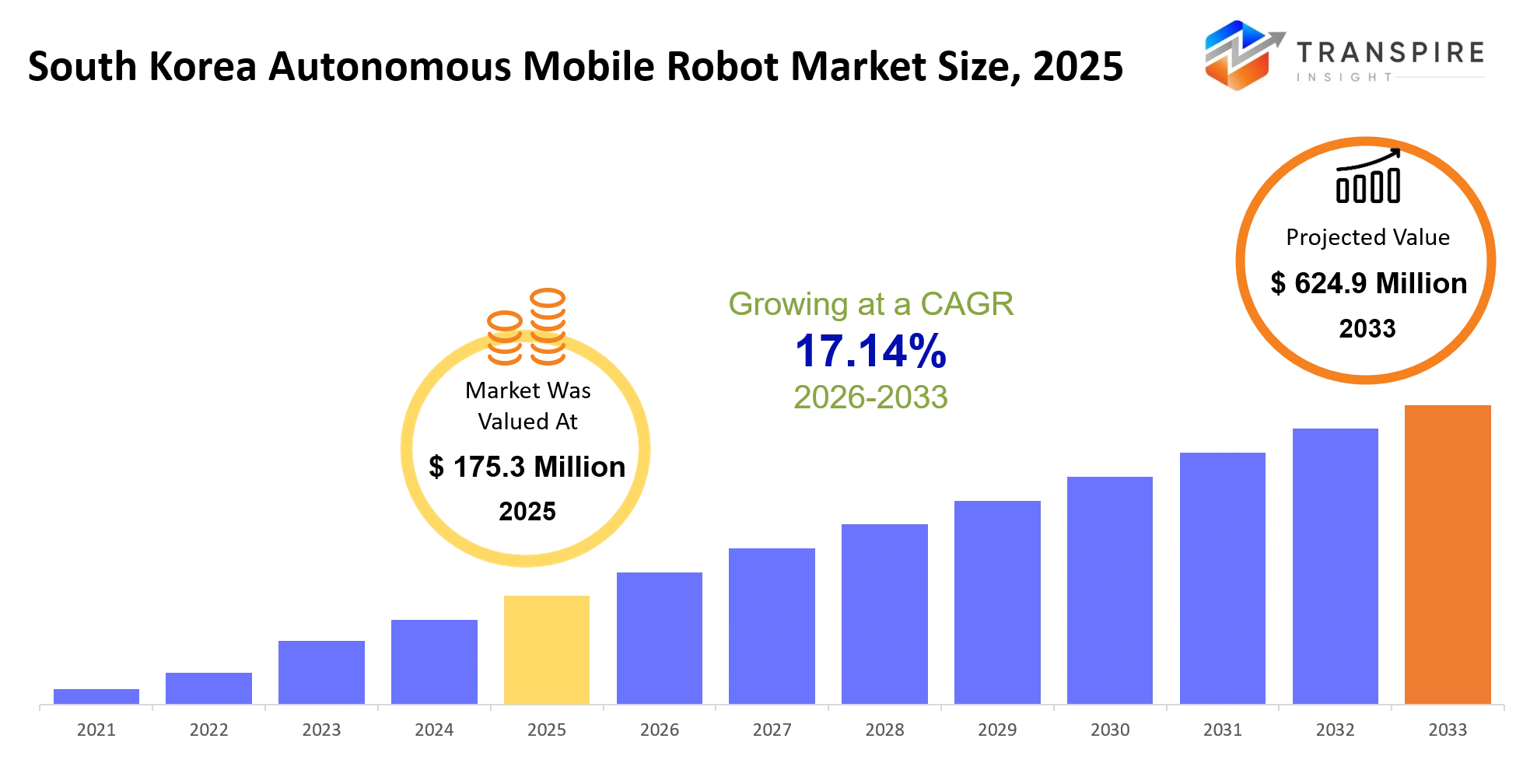
- South Korea Autonomous Mobile Robot Market Size 2025: USD 175.3 Million
- South Korea Autonomous Mobile Robot Market Size 2033: USD 624.9 Million
- South Korea Autonomous Mobile Robot Market CAGR: 17.14%
- South Korea Autonomous Mobile Robot Market Segments: By Type (Goods-to-Person Robots, Self-Driving Forklifts, Delivery Robots, Inspection Robots, Others); By Application (Warehousing, Manufacturing, Healthcare, Retail, Others); By Navigation (Laser Guidance, Vision Guidance, GPS, Others); By End User (Logistics, Manufacturing, Healthcare, Others).
To learn more about this report,  Download Free Sample Report
South Korea Autonomous Mobile Robot Market Summary
The South Korea Autonomous Mobile Robot Market was valued at USD 175.3 Million in 2025. It is forecast to reach USD 624.9 Million by 2033. That is a CAGR of 17.14% over the period.
South Korea's autonomous mobile robot market kinda revolves around machines that move materials, parts, and finished goods around factories , shipyards , and warehouse spaces ,instead of relying so much on manual handling and to keep work running without stopping in those super automated, industrial settings.
In the last 3–5 years , it feels like the whole thing moved away from those smaller isolated robots that only do one job at a time, and more toward integrated fleets. These fleets lean on AI based navigation , plus vision systems and also some 5G enabled orchestration platforms, so they can coordinate in real time across production and logistics nodes ,which is sorta the key part.
This change was pushed hard by pandemic era supply chain disruptions ,and by South Korea's aging workforce faster than expected. That combo kinda showed the weak spots of labor heavy logistics, and manufacturers plus e-commerce operators then started to bet more on automation resilience instead.
So now, adoption is no longer just pilots or limited trials, it is rolling into actual core operations. You can see it especially in electronics, automotive , and shipbuilding, where efficiency improvements and labor substitution really end up meaning higher throughput and less operational risk.
Key Market Insights
- Seoul Capital Region kind of dominates the South Korea Autonomous Mobile Robot Market, with that ~45–50% share in 2025E, because of dense manufacturing AND logistics clusters, it’s like everything is packed together.
- Meanwhile the Ulsan–Busan industrial belt looks like the fastest mover through 2026–2030, mostly tied to shipbuilding automation and the port modernization investments so ports are getting upgraded and the ecosystem follows.
- And honestly the regional expansion feels uneven, smart factory adoption is not uniform, the coastal industrial zones are speeding up deployment faster than the inland areas, even if the overall trend is steady.
- For the robot types, Autonomous Mobile Robots (AMRs) used for material handling are taking the lead, they hold the highest share and are backed by scalable warehouse automation demand, which keeps growing.
- Automated Guided Vehicles (AGVs) still sit as the second-largest segment, especially in older automotive sites and heavy manufacturing plants, where legacy systems are common and replacements don’t happen overnight.
- AI-integrated AMR platforms are still the fastest-growing segment through 2030, even as fleets move toward adaptive navigation and cloud orchestration, kind of in a practical way
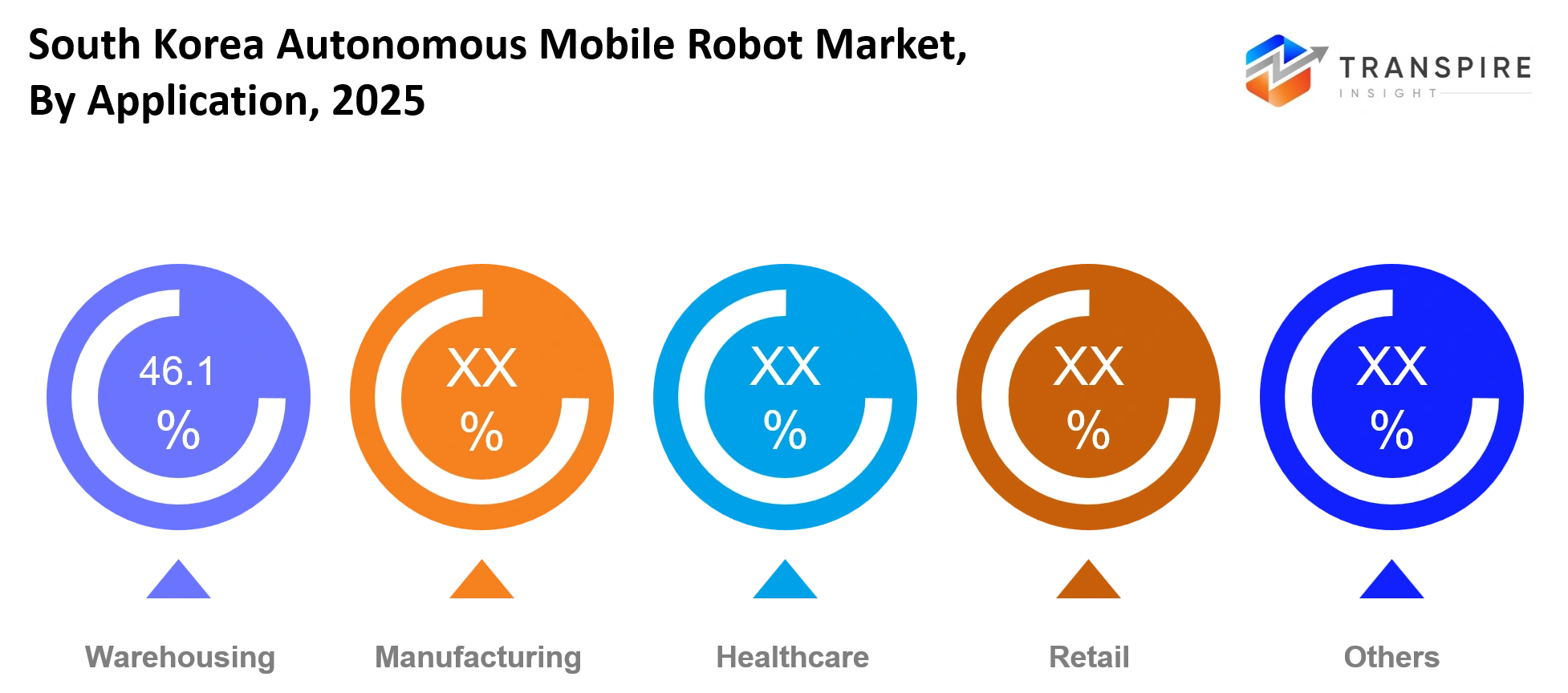
- Intralogistics and warehouse automation account for about ~50% share because e-commerce keeps expanding, plus factory digitization pushes demand forward
- For assembly line transport, it’s the fastest growth application, as electronics and semiconductor plants aim to reduce manual handling errors and keep throughput stable
- Shipyard and port logistics adoption is rising steadily too, which is helping industrial diversification in the South Korea Autonomous Mobile Robot Market, more or less
- Automotive manufacturing leads end-use demand, with a meaningful portion, since high-volume precision assembly requirements demand that kind of consistency
What are the Key Drivers, Restraints, and Opportunities in the South Korea Autonomous Mobile Robot Market?
The South Korea Autonomous Mobile Robot Market is kind of being shaped by three interlinked forces that, honestly, determine how fast and how well these systems get adopted across industrial spaces.
The main driver is the rapid shift toward smart factory automation under South Korea’s Industry 4.0 manufacturing strategy. This push got extra momentum after the post-pandemic period, when labor shortages highlighted inefficiencies in manual intralogistics, mostly in electronics and automotive plants. So, in practice, companies are moving autonomous mobile robots into the central production workflows, not just some supporting chores. That change increases procurement volumes in a pretty direct way, and also boosts recurring, software-led revenue streams tied to fleet management systems.
There’s still a notable restraint though, which is the high upfront integration complexity inside older, legacy industrial facilities. A lot of mid-sized manufacturers still run semi-automated layouts, and those often need infrastructure redesign before AMR deployment. This kind of built-in structural limitation drags out adoption cycles, while also raising total cost of ownership. In the end, ROI gets delayed, and short-term revenue growth for vendors in the South Korea Autonomous Mobile Robot Market tends to be suppressed.
Meanwhile, the most promising opportunity is the convergence of 5G private networks and AI-based fleet orchestration platforms, especially in semiconductor mega-sites around places like Pyeongtaek. Companies such as Samsung Electronics are building out highly automated fabs where real-time robot coordination can optimize wafer handling and cut down on downtime. That whole setup is gradually becoming a scalable plan, like a blueprint, for next-generation AMR deployment across high-precision manufacturing clusters.
What Has the Impact of Artificial Intelligence Been on the South Korea Autonomous Mobile Robot Market?
Artificial intelligence is kinda reshaping the South Korea Autonomous Mobile Robot Market by taking scrubber performance systems and marine emission control technologies, and turning them into constantly optimized data-driven operations rather than stuff that is manually supervised all the time. In industrial and maritime-linked logistics, AI-enabled control platforms are starting to automate fleet compliance tracking: they pull together sensor inputs from autonomous units , watch for deviations in real time, and then tweak routing or workload distribution so operational consistency stays intact.
Meanwhile machine learning models are getting used more and more for predictive maintenance, where vibration signals, temperature readings, and load data get analyzed to forecast component degradation in autonomous mobility systems, and also in exhaust gas cleaning equipment. That helps operators arrange servicing before failure events happen, which in advanced deployments cuts unplanned downtime by an estimated 15–25% , and it boosts asset utilization across high-throughput facilities.
On the ground, these approaches improve energy efficiency and reduce compliance costs by finding better movement routes and minimizing redundant cycles, especially in tightly regulated port and shipyard ecosystems. Still, AI adoption is limited because it relies on high-quality training data from real-world maritime conditions, and that data is not always available especially when humidity swings, corrosion is a factor, and connectivity gets unstable out at sea. Because of that, model accuracy can drop , and full-scale deployment takes longer in complex offshore environments.
Companies like HD Hyundai are putting money into integrated digital monitoring platforms to close some of those gaps, and to strengthen system reliability across next-generation autonomous maritime and industrial ecosystems.
Key Market Trends
- South Korea’s Autonomous Mobile Robot market kind of shifted after 2022, from standalone AMRs into fleet-based, cloud orchestrated mobility, especially around smart factories, you know, the whole workflow.
- Between 2021 and 2025, electronics makers bumped up AMR deployment density by almost 35%, which lowered reliance on manual labor for internal logistics quite a bit, not just a little.
- Automotive plants moved away from AGV-heavy layouts, toward AI enabled navigation, and that made routing feel more efficient , while also cutting material handoff delays across the production lines.
- In Busan shipbuilding yards , autonomous logistics robots showed up more after 2023, and they started replacing rigid conveyor systems with flexible reconfigurable transport pathways that can be tuned later.
- Samsung SDS expanded AI led logistics platforms in 2024, and they connected predictive fleet monitoring into warehouse automation networks across the country.
- LG CNS changed approach toward 5G enabled robot orchestration, which supports real time coordination across autonomous units, particularly in crowded industrial zones.
- In 2025, Hyundai Robotics rolled out modular AMR systems, aiming at flexible manufacturing cells instead of the usual fixed production line lock in.
- Semiconductor fabs increased AMR usage after 2023, largely because of contamination control rules, plus the need for ultra precise wafer transport automation.
- And competitive pressure from ABB and KUKA kinda pushed Korean vendors to speed up AI navigation improvements, and also strengthen localization knowhow.
South Korea Autonomous Mobile Robot Market Segmentation
By Type :
Goods-to-person robots, plus self-driving forklifts, are basically taking material handling out of fixed rails and into more flexible roaming across factory and warehouse floors. Like, the delivery robots do that short distance moving thing, while the inspection robots focus on monitoring, inside environments that are kept under control.
Adoption is climbing too, since manufacturers seem to move away from manual goods handling and toward these automated flow systems that cut down pauses. And many companies don’t bet on just one machine type, they mix robot styles so coordination is better, handling time drops a lot, and production keeps going without weird interruptions across different facilities.
By Application :
For the main use cases, it’s really warehousing and manufacturing where autonomous robots carry raw materials and finished goods between storage areas and production zones. In healthcare and retail, the fleets are smaller, mainly used for internal delivery runs plus inventory related support tasks.
Demand keeps rising because companies are reorganizing internal logistics, trying to reduce congestion and push workflow speed up. Manufacturing plants in particular lean on robots to back just in time production, and warehouses lean on automation to deal with higher order volumes and those stricter delivery timelines.
To learn more about this report, Download Free Sample Report
By Navigation :
Laser guidance systems are still pretty common in structured settings, but vision guidance is getting more of the nod for dynamic spaces where you really need to tweak the route on the fly. GPS based systems help a lot with outdoor moving, especially across big industrial and logistics areas, where the path may not be that “clean” all the time.
Overall, the technology adoption is sliding toward vision based navigation as computing power keeps improving and hardware costs keep dropping. In practice, companies are gradually moving away from fixed path approaches, toward adaptive navigation, so robots can better handle layout changes and those unexpected operational disruptions in real time.
By End User :
In terms of who’s using this, logistics and manufacturing are still the main end users, deploying autonomous robots to speed up internal transport and also cut down on dependence on manual labor. Healthcare systems also bring in automation, mainly for controlled movement of supplies and equipment inside facilities.
Manufacturing adoption is rising quicker as factories modernize production lines and weave automation through multiple steps. Logistics players are growing their robot fleets to meet the rising distribution needs, while healthcare grows more steadily, with extra emphasis on operational efficiency and controlled environments.
What are the Key Use Cases Driving the South Korea Autonomous Mobile Robot Market?
Warehousing and intralogistics inside electronics and automotive plants still count as the main use case for the South Korea Autonomous Mobile Robot Market , you know the usual thing. Most companies deploy autonomous robots to shift components between storage zones and assembly lines, cutting down handling delays a bit, and keeping production continuity more stable in those high-volume setups.
Then there are the secondary areas that are slowly growing, like shipbuilding yards, and also third-party logistics operations where autonomous fleets handle heavy material moves and order fulfillment. Automotive suppliers, too, have started using robots for just-in-time part delivery , which ends up easing congestion and improving the timing, even when production is spread across several smaller networks .
Looking ahead, newer use cases are showing up in semiconductor cleanrooms transport and hospital internal logistics. Semiconductor fabs are leaning more on precision controlled robots to carry sensitive wafers around, while healthcare facilities are testing automated delivery for medicines and sterile equipment. This is happening alongside stricter efficiency and safety needs, so the robots are expected to behave a lot more carefully, basically.
|
Report Metrics |
Details |
|
Market size value in 2025 |
USD 175.3 Million |
|
Market size value in 2026 |
USD 206.5 Million |
|
Revenue forecast in 2033 |
USD 624.9 Million |
|
Growth rate |
CAGR of 17.14% from 2026 to 2033 |
|
Base year |
2025 |
|
Historical data |
2021 - 2024 |
|
Forecast period |
2026 - 2033 |
|
Report coverage |
Revenue forecast, competitive landscape, growth factors, and trends |
|
Country scope |
South Korea |
|
Key company profiled |
ABB, KUKA, Omron, Geek+, Locus Robotics, MiR, Seegrid, Fetch Robotics, Samsung, LG Electronics, Hyundai Robotics, Siemens, Honeywell, Zebra Technologies, Teradyne. |
|
Customization scope |
Free report customization (country, regional & segment scope). Avail customized purchase options to meet your exact research needs. |
|
Report Segmentation |
By Type (Goods-to-Person Robots, Self-Driving Forklifts, Delivery Robots, Inspection Robots, Others); By Application (Warehousing, Manufacturing, Healthcare, Retail, Others); By Navigation (Laser Guidance, Vision Guidance, GPS, Others); By End User (Logistics, Manufacturing, Healthcare, Others). |
Which Regions are Driving the South Korea Autonomous Mobile Robot Market Growth?
Seoul Capital Region, I mean, kind of leads the South Korea Autonomous Mobile Robot Market mostly because it has this dense pack of electronics, automotive and e-commerce distribution hubs all in one place. On top of that, strong government backing for smart factory programs sped up automation rollout in a bunch of manufacturing clusters. Plus, with advanced 5G infrastructure showing up everywhere, and with labor costs staying high, companies have been leaning hard toward autonomous systems instead of manual intralogistics. And there’s also this kinda mature circle ecosystem, you know, robotics suppliers , software providers ,and system integrators that keep enabling continuous upgrades while also supporting big fleet deployments.
Ulsan Gyeongnam, though, contributes steadily, rather than doing a “digital-first” thing like Seoul. It’s more tied to heavy industry and shipbuilding dominance, not really high-tech clustering. Instead of quick transformation, this region usually uses gradual integration inside large-scale production facilities, like shipyards, and petrochemical complexes. Long-term contracts from well known shipowners, and industrial operators, help keep investment cycles consistent over time. Then, regulatory compliance for safety and operational efficiency in heavy manufacturing also pushes adoption forward, but without any sharp spikes or sudden volatility.
And the Busan and coastal logistics corridor shows the fastest growth, kinda right now, because port modernization programs along with export recovery efforts are speeding up automation demand. New investments in smart port infrastructure and container handling efficiency have made rapid deployment of autonomous mobile robots in cargo yards much more likely. Also when global shipping activity picked up again, after fleet restructuring, it basically reinforced demand for automated logistics handling systems. So this momentum looks like a strong “entry” opening for robotics vendors and investors who are aiming for scalable port automation across 2026–2033.
Who are the Key Players in the South Korea Autonomous Mobile Robot Market and How Do They Compete?
In the South Korea Autonomous Mobile Robot Market, competition is kind of moderately consolidated at the very top, but then it gets more fragmented across those mid tier system integrators and robotics specialists. You can see big industrial software and automation firms going head to head with hardware focused robotics manufacturers and, at the same time, smaller companies often aim for narrower warehouse or factory use cases. Lately, the main fight is not really hardware pricing anymore, it’s more about integrated performance, especially AI navigation accuracy, fleet software capability, and also how easily the whole thing plugs into smart factory ecosystems.
Samsung SDS leans hard on software led automation. It builds AI driven logistics orchestration platforms that connect autonomous mobile robot fleets with warehouse management systems. Their edge is more about enterprise IT integration than actual hardware output. They also tend to expand via partnerships with manufacturing and e-commerce operators, and they embed their platform into big distribution networks, so they can keep pulling in recurring service revenue.
LG CNS, on the other hand, puts the spotlight on 5G enabled robotics control systems, basically letting real time coordination happen across multi robot fleets in crowded industrial areas. That connectivity angle makes it different from the more hardware centered rivals, and it supports deployments in smart factories plus logistics hubs too. Their growth seems to come from working with telecom providers and industrial clients, especially those setting up private 5G networks.
Company List
- ABB
- KUKA
- Omron
- Geek+
- Locus Robotics
- MiR
- Seegrid
- Fetch Robotics
- Samsung
- LG Electronics
- Hyundai Robotics
- Siemens
- Honeywell
- Zebra Technologies
- Teradyne
Recent Development News
In March 2026, Hyundai Motor Group Robotics LAB launched the “MobED Alliance.” The initiative creates a collaborative ecosystem with industrial partners, public agencies, and component suppliers to commercialize the MobED autonomous mobile robot platform in South Korea, accelerating its transition from demonstration to full-scale deployment in logistics, delivery, and industrial mobility applications.
Source: https://hyundaimotorgroup.co.kr/
In March 2026, Hyundai Motor Group Robotics LAB announced the commercialization expansion of its MobED mobile robot platform through the AW 2026 deployment program. The company positioned MobED for domestic market rollout with industry-specific modules (including delivery and signage systems), signaling a shift toward real-world autonomous mobile robot services in Korea’s industrial automation sector.
Source: https://www.hyundai.news/
What Strategic Insights Define the Future of the South Korea Autonomous Mobile Robot Market?
The South Korea Autonomous Mobile Robot Market is kind of drifting, structurally, toward fully autonomous software-defined industrial mobility systems where robots behave as coordinated fleets instead of, sort of, standalone units. That shift seems pulled along by tighter ties between smart factory ecosystems , AI-based decision layers and private 5G infrastructure, which basically gives real time control across production + logistics networks. In the next 5–7 years, you can expect the value creation to move away from hardware sales and toward recurring software fees, plus data services and fleet optimization, more like it.
There’s also a less obvious risk, in the way that dependency can build up around a small set of platform integrators. They might end up holding most of the pricing leverage and, as a side effect, reduce interoperability across different industrial sites. That scenario could make adoption slower for mid-sized manufacturers that usually want a more adaptable vendor ecosystem. On the other hand, an emerging change is tied to how semiconductor and battery giga-factories are expanding in areas like Pyeongtaek and Pohang. In those places the ultra-clean, high-precision logistics needs are pushing early use of next generation autonomous systems, not just pilots.
Market participants should focus on interoperable fleet software and open architecture designs, so everything plugs in easily with existing MES and WMS platforms. If they do that, they’ll likely be better positioned to win long-term contracts as factories move toward fully connected, autonomous production environments.
South Korea Autonomous Mobile Robot Market Report Segmentation
By Type
- Goods-to-Person Robots
- Self-Driving Forklifts
- Delivery Robots
- Inspection Robots
By Application
- Warehousing
- Manufacturing
- Healthcare
- Retail
By Navigation
- Laser Guidance
- Vision Guidance
- GPS
By End User
- Logistics
- Manufacturing
- Healthcare
Frequently Asked Questions
Find quick answers to common questions.
The expected South Korea Autonomous Mobile Robot Market size is USD 624.9 Million in 2033.
Key segments for the South Korea Autonomous Mobile Robot Market are By Type (Goods-to-Person Robots, Self-Driving Forklifts, Delivery Robots, Inspection Robots, Others); By Application (Warehousing, Manufacturing, Healthcare, Retail, Others); By Navigation (Laser Guidance, Vision Guidance, GPS, Others); By End User (Logistics, Manufacturing, Healthcare, Others).
Major South Korea Autonomous Mobile Robot Market players are ABB, KUKA, Omron, Geek+, Locus Robotics, MiR, Seegrid, Fetch Robotics, Samsung, LG Electronics, Hyundai Robotics, Siemens, Honeywell, Zebra Technologies, Teradyne.
The South Korea Autonomous Mobile Robot Market size is USD 175.3 Million in 2025.
The South Korea Autonomous Mobile Robot Market CAGR is 17.14% from 2026 to 2033.
- ABB
- KUKA
- Omron
- Geek+
- Locus Robotics
- MiR
- Seegrid
- Fetch Robotics
- Samsung
- LG Electronics
- Hyundai Robotics
- Siemens
- Honeywell
- Zebra Technologies
- Teradyne
About the Authors

Avinash Kumar
I’m Avinash Kumar, a Senior Research Analyst at Transpire Insight, with expertise in the Electronics and Semiconductor and Energy & Power industry. My work focuses on analyzing emerging technologies, market trends, industry developments, and innovation across these sectors. I specialize in transforming complex technical and market insights into clear, research-backed content that helps professionals, businesses, and decision-makers stay informed. Through continuous industry research and data-driven analysis, I strive to deliver accurate, reliable, and practical perspectives on the latest advancements shaping the semiconductor and energy landscape.

Chakradhar Khansole
Chakradhar serves as the Research Director at Transpire Insight, bringing over 8 years of experience in technology, innovation, and strategic market intelligence. He specializes in transforming complex market data into actionable business insights that enable organizations to make informed, growth-oriented decisions. Recognized for his strategic vision and analytical expertise, Chakradhar leads high-impact research initiatives, delivering comprehensive market assessments, competitive intelligence, and forward-looking industry analysis.
Recently Published Reports
-
Apr 2026
Fiber Optic Faceplates Market
Fiber Optic Faceplates Market Size, Share & Analysis Report By Type (< 300 mm2, 300-350 mm2, and > 350 mm2, By Application (Night Vision, Holographic Imaging, Medical, and Others), and Geography (North America, Europe, Asia-Pacific, Middle East and Africa, South and Central America), 2021 - 2031
-
Apr 2026
High Temperature Superconductors Market
High Temperature Superconductors Market Size, Share & Analysis Report By Type (1G HTS, and 2G HTS), By Application (Power Cable, Fault Current Limiter, and Transformer), and Geography (North America, Europe, Asia-Pacific, Middle East and Africa, South and Central America), 2021 - 2031
-
Apr 2026
Industrial Plugs and Socket Market
Industrial Plugs and Socket Market Size, Share & Analysis Report By Type (Industrial Plugs, Industrial Sockets), By Current (Up to 32 A, 32 to 125 A, Above 125 A), By Protection (Dustproof and Splash Proof, Waterproof, Explosion Proof), By End User (Heavy Industries, Oil and Gas, Chemicals and Pharmaceuticals, Power Generation, Others), and Geography (North America, Europe, Asia-Pacific, Middle East and Africa, South and Central America), 2021 - 2031
-
Apr 2026
InGaAs Avalanche Photodiodes Market
InGaAs Avalanche Photodiodes Market Size, Share & Analysis Report By Type (1100 - 1700 nm, and 1000 - 1600 nm), By Application (Missile Warning System, Muzzle Flash Detection, Wafer Defect Inspection, Laser Rangefinders, and Others), and Geography (North America, Europe, Asia-Pacific, Middle East and Africa, South and Central America), 2021 - 2031