
South Korea Automotive Brake Caliper Market Size & Forecast:
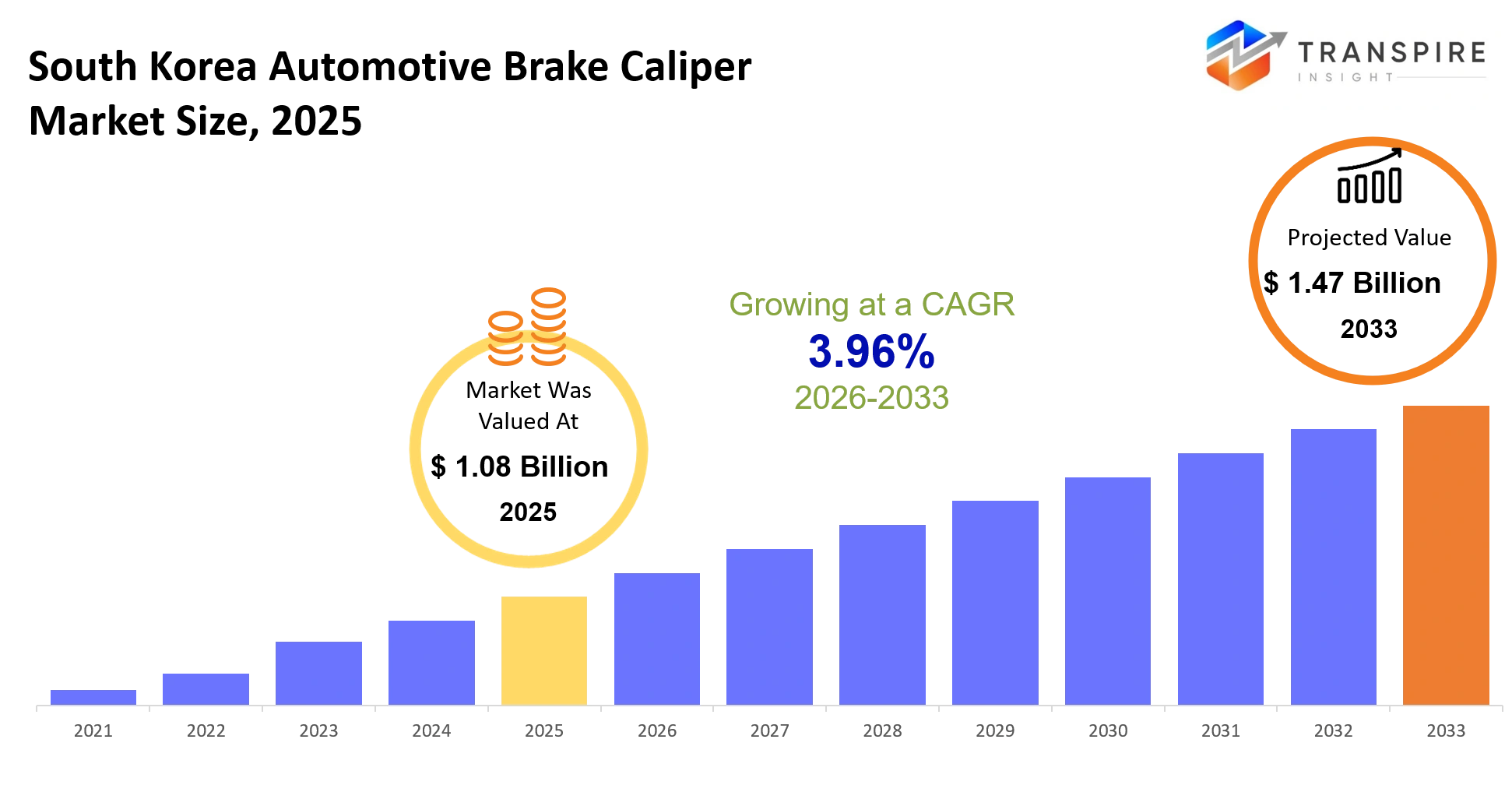
- South Korea Automotive Brake Caliper Market Size 2025: USD 1.08 Billion
- South Korea Automotive Brake Caliper Market Size 2033: USD 1.47 Billion
- South Korea Automotive Brake Caliper Market CAGR: 3.96%
- South Korea Automotive Brake Caliper Market Segments: By Product Type (Fixed Calipers, Floating Calipers, Sliding Calipers, Performance Calipers, Electric Brake Calipers, Aluminum Calipers, Cast Iron Calipers, Others); By Vehicle Type (Passenger Cars, SUVs, Light Commercial Vehicles, Heavy Trucks, Buses, Electric Vehicles, Luxury Vehicles, Others); By Material (Aluminum, Cast Iron, Steel, Composite Materials, Lightweight Alloys, Hybrid Materials, Performance Materials, Others); By End User (OEMs, Aftermarket, Fleet Operators, Repair Shops, Racing Teams, Distributors, Vehicle Manufacturers, Others)
South Korea Automotive Brake Caliper Market Summary
The South Korea Automotive Brake Caliper Market was valued at USD 1.08 Billion in 2025. It is forecast to reach USD 1.47 Billion by 2033. That is a CAGR of 3.96% over the period.
South Korea's automotive brake caliper market sort of sits in the middle of vehicle safety and day to day driving feel, and also performance. Brake calipers take hydraulic pressure and turn it into the clamping force, so the car slows down in a predictable way, even when the road isn’t great or the weather changes. That matters for passenger cars, commercial vehicles, and now also for electric vehicles where braking control needs to be more exact.
In the last five years, the whole market structure has moved away from conventional cast-iron calipers, and it’s been trending toward lighter aluminum calipers, plus braking systems that are electronically controlled. Automakers are doing this because they want better energy efficiency and longer driving range, not just short term gains. At the same time, the global semiconductor shortage and those supply chain disruptions around the pandemic, really pushed companies to rethink how they source components. So manufacturers ended up diversifying suppliers, and they started localizing production, a bit more than before.
All those changes then made room for heavier investment in advanced brake technologies. That’s where you see new revenue streams forming for premium parts, and EV focused components too. It also speeds up adoption across South Korea domestic vehicle platforms, and it helps export oriented production lines scale faster.
Key Market Insights
- South Korea Automotive Brake Caliper Market seems like it’s moving away from cast iron toward aluminum calipers ,and honestly the lightweight kind are taking more than 40% of new vehicle installations in 2025.
- The Seoul Capital Area is pretty much leading everything right now with almost 55% market share, helped a lot by the really dense automotive manufacturing clusters and all those component suppliers nearby.
- Meanwhile, Southeastern South Korea is turning into the fastest expanding regional hub through 2032, mainly because of EV investments and the ongoing growth of battery ,plus vehicle assembly facilities.
- When it comes to products, fixed brake calipers are still in front with roughly 48% share ,and that’s tied to their better braking precision in premium cars and electric vehicles. Floating brake calipers are next ,they hang around as the second-largest slice because they cost less to produce and they are widely used in mass-market passenger cars.
- Electronic brake calipers are the one moving fastest ,since automakers are rolling brake-by-wire technologies into next generation vehicle platforms, more and more.
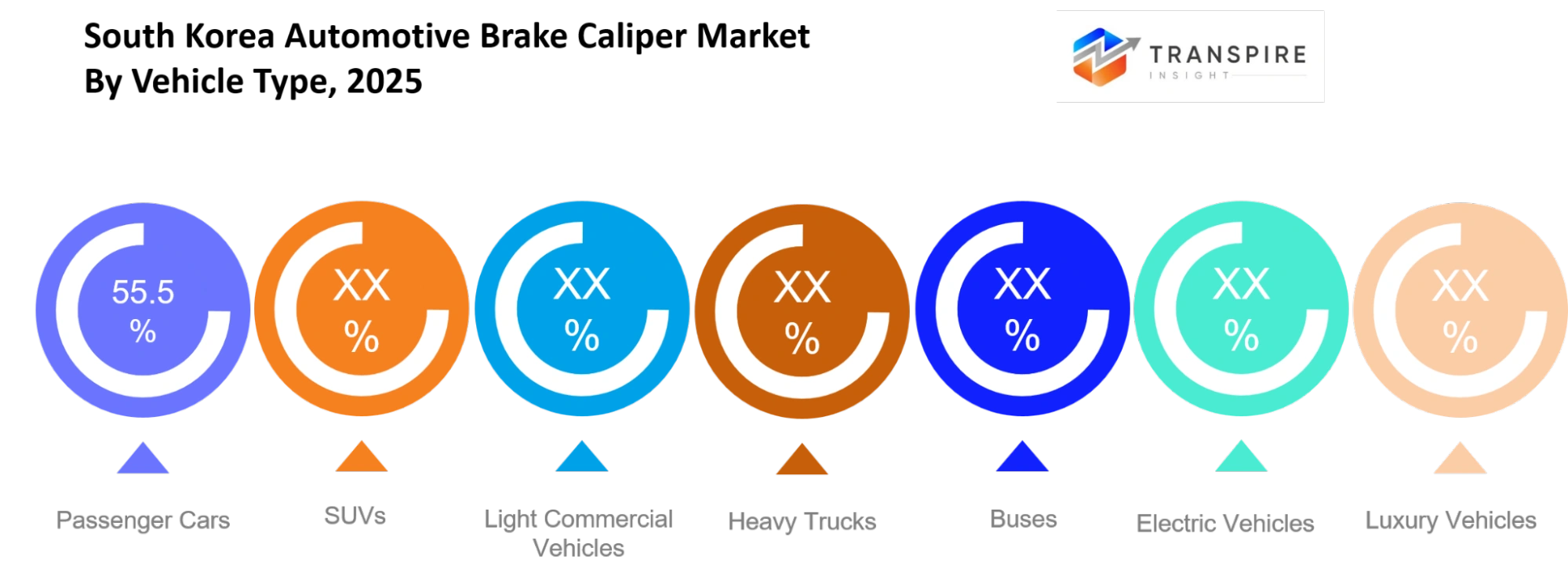
- For applications, passenger vehicles dominate, taking over 70% market share, supported by strong local production and manufacturing strategies that lean export-oriented.
- Electric vehicles are also showing up as the fastest-growing use case, with EV registrations more than doubling from 2021 to 2025 across South Korea.
- As for end users, original equipment manufacturers stay on top with about 75% share, reflecting steady vehicle output and those long-term supplier contracts that don’t just disappear.
- The aftermarket side keeps expanding too, at a steady pace, because vehicle owners want premium replacement components that offer higher durability and stronger braking performance.
What are the Key Drivers, Restraints, and Opportunities in the South Korea Automotive Brake Caliper Market?
The main force pushing the South Korea Automotive Brake Caliper Market forward is basically the quick growth in electric vehicle output , together with tighter safety rules for cars. Since 2021 South Korean automakers have been putting more money into EV platforms , and that has created demand for lighter aluminum calipers plus electronically managed braking setups. These help with energy efficiency and they also boost regenerative braking. Because of this, the average selling price for brake assemblies has climbed, and suppliers who can deliver high performance parts are seeing new revenue channels. As more EV models move into local and export markets, carmakers are making longer term supply contracts and at the same time, they’re scaling up their production capacity.
The biggest roadblock though is the pricey nature and the technical complexity of newer brake systems. Building lightweight materials, brake-by-wire style architectures , and precision manufacturing steps takes major capital spending. It also needs specialized engineering knowledge. Smaller vendors sometimes can’t really take on those costs easily, so adoption of the technology gets delayed. That slows down how fast fresher products reach the wider market.
There’s also a strong opportunity when intelligent braking systems get paired with autonomous driving technologies. More investment in software centered vehicles and advanced driver assistance features is driving demand for electronically controlled calipers that can change performance in real time. Suppliers who can blend strong hardware know-how with digital control solutions are positioned pretty well to take part in the next round of market growth.
What Has the Impact of Artificial Intelligence Been on the South Korea Automotive Brake Caliper Market?
Artificial intelligence along with newer digital technologies are quietly changing the South Korea Automotive Brake Caliper Market, mostly by making manufacturing feel more exact, supporting predictive maintenance, and tightening up quality control. More and more, auto suppliers are using AI–enabled vision systems to check brake calipers for surface flaws, odd dimensional shifts, plus coating issues, often in real time. This kind of setup cuts down inspection mistakes and speeds up the whole production rhythm, so output stays more steady across those large volume manufacturing lines
At the same time, machine learning is letting manufacturers foresee equipment problems before they actually happen. When models study vibration behaviors, temperature changes, and production signals, predictive maintenance platforms can reduce sudden downtime and raise the overall factory utilization rates. Then there is AI-based process optimization, which boosts machining precision, trims material waste , and tends to reduce operating expenses across both casting and assembly steps.
Also, digital twins and simulation platforms are getting more common as suppliers try to craft lighter calipers, especially for electric vehicles and newer braking systems. Still, AI adoption has some friction, because it’s not only plug and play. The integration costs can be high, legacy manufacturing systems are often fragmented, and there’s a shortage of specialized AI talent. So scaling this across the board becomes difficult, particularly for small, and mid-sized component manufacturers trying to modernize their operations fast.
Key Market Trends
- After 2021, aluminum brake calipers started grabbing a substantial market share, mainly because automakers kept pushing harder on lowering vehicle mass and boosting the driving range , especially for electric cars.
- At the same time , manufacturers began sending more money toward brake-by-wire approaches, and it looks like electronic braking tech turned into a sort of differentiator for premium models.
- From 2022 through 2025, domestic suppliers also expanded their local production capacity ,to cut down on reliance on overseas component sourcing, which was getting harder and more expensive.
- More and more automakers also favor integrated braking modules. These are basically compact systems that bundle calipers, sensors, and electronic controls together , instead of treating everything as separate parts.
- On top of that, some factories moved from manual quality checking to AI based inspection systems, and that improved how reliably defects are spotted, plus it helped stabilize manufacturing consistency.
- Meanwhile, EV platforms kept pushing regenerative braking forward, so suppliers had to rethink calipers to handle thermal loads better, with enhanced thermal performance becoming a bigger priority.
- There were also more collaborations between automakers and component manufacturers, because software-defined vehicles changed what braking systems must do, and everyone had to adjust.
- Premium brands even shifted toward fixed multi-piston calipers, so their footprint grew beyond sports vehicles and into mainstream luxury segment vehicles, kinda steadily.
- Finally , supply chains became more regionalized after recent disruptions, so manufacturers leaned on multiple suppliers and tightened inventory management, rather than depending on a single distant source.
South Korea Automotive Brake Caliper Market Segmentation
By Product Type :
Fixed calipers are made so that pistons sit on each side of the brake rotor, it helps balance the braking force and gives smoother control, in a way that drivers can actually feel. These caliper types are mostly seen on premium and high performance cars, where consistent braking response matters a lot. Even so, demand keeps climbing, partly because automakers keep putting more emphasis on vehicle safety and road holding stability, you know, the whole driving balance thing.
Floating and sliding calipers are also very common in regular passenger vehicles, mainly because their designs are simpler and the manufacturing cost stays lower. Then you have performance calipers, they are usually paired with sports and luxury models that want stronger stopping power and steadier pedal feel. Electric brake calipers are getting more attention too, mostly with the rise of advanced braking systems in electric vehicles. When it comes to materials, aluminum calipers and cast iron calipers are important categories, they cover different needs like reduced mass, durability, and cost efficiency.
By Vehicle Type :
Passenger cars take up a big share of brake caliper usage, largely because vehicle production is high and replacements happen on a regular basis. Since a dependable braking system is required for everyday commuting and road use, calipers end up being a core part of this segment. As car sales continue, that also supports steady demand across both domestic and export markets.
SUVs, and electric vehicles too, are moving into bigger roles as buyer preferences shift toward larger bodies and alternative powertrains. Heavy trucks, buses, and light commercial vehicles still need calipers that can last through heavier loads and longer operating hours, without losing effectiveness. Luxury vehicles often use advanced braking solutions, these are tuned for better performance, safety, and driving comfort across different road surfaces and weather conditions.
By Material :
Aluminum is still kind of a go-to material, mostly because it stays lightweight which helps with fuel efficiency and overall vehicle handling. A lot of manufacturers are now putting aluminum calipers on newer vehicle models, to trim total vehicle mass and still keep the braking action effective. You notice this pattern a lot in electric cars, and also in more premium trims.
Cast iron keeps its solid foothold too, mainly for durability, strength, and the cost angle that matters in production. Meanwhile steel, composite materials, lightweight alloys, and even hybrid material blends are being used in specialized jobs, where performance, heat resistance, and reduced weight are all being weighed together. These performance minded materials really back advanced vehicle designs, especially when the brakes need stronger efficiency and when the parts should last longer over time.
By End User :
OEMs are a major end-user group since brake calipers get installed during the vehicle assembly stage. Long-term supply arrangements between parts manufacturers and automakers can help keep demand steady. Vehicle manufacturers usually look closely at quality, safety, and performance standards when they choose braking system suppliers.
The aftermarket matters as well, because vehicle owners end up replacing worn or damaged brake components during the life of the car. Fleet operators, plus repair shops, regularly buy replacement calipers in order to keep things reliable. Racing teams also want specialized products that can handle high performance track conditions, and distributors play their part too, expanding product availability across nearby regions and national distribution lanes.
What are the Key Use Cases Driving the South Korea Automotive Brake Caliper Market?
Passenger vehicles are still basically the main use case for automotive brake calipers in South Korea. The whole strong domestic vehicle build , and the exports on top of that, means there’s pretty steady demand for braking systems that feel safe, last long, and stay pretty consistent in performance. Automakers are also leaning toward lightweight calipers here and there, mainly so they can squeeze out better fuel efficiency and stay in line with the tighter vehicle efficiency rules.
Then you’ve got EVs and SUVs starting to show up more as secondary applications. For electric vehicles, manufacturers are using aluminum and electronic brake calipers more often, because those help with regenerative braking and they also help reduce the vehicle mass overall. SUVs, on the other hand, tend to need stronger braking because they’re bigger, and they deal with heavier loads while driving so it opens the door for more advanced braking technologies.
More “upcoming” stuff includes brake-by-wire systems and autonomous driving platforms. These need electronically controlled calipers that can respond quickly, and blend in smoothly with sensors and the software. And as software-defined vehicles keep gaining momentum, intelligent braking systems should turn into a real growth area over the forecast period.
|
Report Metrics |
Details |
|
Market size value in 2025 |
USD 1.08 Billion |
|
Market size value in 2026 |
USD 1.12 Billion |
|
Revenue forecast in 2033 |
USD 1.47 Billion |
|
Growth rate |
CAGR of 3.96% from 2026 to 2033 |
|
Base year |
2025 |
|
Historical data |
2021 - 2024 |
|
Forecast period |
2026 - 2033 |
|
Report coverage |
Revenue forecast, competitive landscape, growth factors, and trends |
|
Country scope |
South Korea |
|
Key company profiled |
Mando, Hyundai Mobis, Brembo, Akebono, Continental, ZF, Bosch, Aisin, Hitachi Astemo, ADVICS, Knorr-Bremse, Nissin Kogyo, Haldex, AP Racing, TRW |
|
Customization scope |
Free report customization (country, regional & segment scope). Avail customized purchase options to meet your exact research needs. |
|
Report Segmentation |
By Product Type (Fixed Calipers, Floating Calipers, Sliding Calipers, Performance Calipers, Electric Brake Calipers, Aluminum Calipers, Cast Iron Calipers, Others); By Vehicle Type (Passenger Cars, SUVs, Light Commercial Vehicles, Heavy Trucks, Buses, Electric Vehicles, Luxury Vehicles, Others); By Material (Aluminum, Cast Iron, Steel, Composite Materials, Lightweight Alloys, Hybrid Materials, Performance Materials, Others); By End User (OEMs, Aftermarket, Fleet Operators, Repair Shops, Racing Teams, Distributors, Vehicle Manufacturers, Others) |
Which Regions are Driving the South Korea Automotive Brake Caliper Market Growth?
The Seoul Capital Area stays as the biggest region in the South Korea Automotive Brake Caliper Market, mostly because it sort of pulls together vehicle production, research facilities and a tightly packed network of suppliers in one industrial belt. A lot of major automakers as well as component manufacturers run production plants and engineering centers across Seoul, Gyeonggi Province and Incheon . And on top of that the government keeps backing electric vehicles and the more modern mobility technologies, so companies keep channeling money into braking systems plus lighter components. With this kind of joined up ecosystem, manufacturers can speed up their development timing, make supply chain operations more efficient, and still hold a solid grip on both local presence and export demand.
Meanwhile the southeastern area, with Ulsan and Busan included, tends to take on another part of the story. It leans more toward manufacturing steadiness and production that is aimed at exports. Big assembly sites, already established logistics infrastructure, and ongoing investments from automakers help form a rather predictable demand for brake calipers, along with the supporting parts. If you compare it to the Seoul Capital Area, this region gains more from industrial scale and long established supplier ties than from heavy research efforts. With steady vehicle exports and stable production volumes, it keeps acting like a reliable contributor to industry revenue .
Chungcheong Province is kind of emerging as the fastest growing area, since investments in electric vehicle production and battery manufacturing are really accelerating. A few suppliers have already expanded their facilities , or they even announced additional projects to back next-gen vehicle platforms and electronically controlled braking systems. With that kind of shift, it opens up room for firms working on lightweight materials and also for intelligent braking solutions, you know, the more smart control type. And between 2026 and 2033, as the industrial build out keeps moving forward, the region should become a really appealing place for new entrants and long term investors who want exposure to future mobility trends.
Who are the Key Players in the South Korea Automotive Brake Caliper Market and How Do They Compete?
In the South Korea automotive brake caliper market, competition is sort of moderately consolidated, and the big players usually go at it through technology, manufacturing power, and long term ties with vehicle makers. The established suppliers keep trying to hold on to share, investing in lighter materials, electronic braking systems, and production methods that are more advanced than before. For new entrants though, it’s hard because brake parts have to meet strict quality rules, demand precision manufacturing, and then go through long validation cycles before they can actually get sold and used.
Hyundai Mobis, for example, leans into integrated braking approaches that blend electronic controls with mechanical systems. By working close with local automakers, they can shape their offerings for electric vehicles and for software defined vehicle architectures. Mando Corporation plays a different angle with brake-by-wire solutions, plus a strong engineering backbone. They keep funding R&D, and they also maintain overseas production facilities, which helps Mando move beyond South Korea, while still serving global automotive clients reliably.
Brembo, meanwhile, focuses on high performance braking, using lightweight aluminum calipers and targeting more premium vehicle segments. They keep launching new products for electric, and luxury applications, and they strengthen partnerships with automakers around the world. Bosch concentrates on intelligent braking systems and digital integration, drawing on know how in sensors and in vehicle electronics to deliver safety features that fit next generation mobility platforms.
Company List
- Mando
- Hyundai Mobis
- Brembo
- Akebono
- Continental
- ZF
- Bosch
- Aisin
- Hitachi Astemo
- ADVICS
- Knorr-Bremse
- Nissin Kogyo
- Haldex
- AP Racing
- TRW
Recent Development News
In March 2026, Hyundai Mobis showcased its next-generation integrated braking system at its Swedish winter testing facility and confirmed mass production plans for later in the year. The technology demonstration strengthened Hyundai Mobis' position in advanced braking systems and increased opportunities to supply electronic brake technologies to European and South Korean automakers. Sourcehttps://thebrakereport.com/
In June 2026, Brembo announced a joint venture with Ningbo SAFE Brake Systems to manufacture anti-lock braking systems in India. The partnership expands Brembo's footprint in Asia and strengthens regional braking technology capabilities, supporting future growth opportunities for advanced brake components across Asian automotive markets.
Source https://www.reuters.com/
What Strategic Insights Define the Future of the South Korea Automotive Brake Caliper Market?
South Korea Automotive Brake Caliper Market seems to be drifting toward electronically controlled, lighter, and more software integrated braking solutions over the next five to seven years. Honestly this move feels less tied to sheer vehicle production levels, and more tied to how fast electric vehicles are taking over, plus the rise of advanced driver assistance and those software defined vehicle architectures. As braking starts fitting into larger vehicle control ecosystems, the players who know electronics, sensors, and lightweight materials will end up owning more of the future value.
There’s also a risk that doesn’t get talked about that much. It’s the bigger dependence on aluminum and specialized electronic components. When raw material prices jump around, and when supply is concentrated among only a few semiconductor and alloy providers, margins can get squeezed, and production calendars can get disturbed too, even if vehicle demand is still strong.
At the same time, there’s a real opening that’s starting to show up. Brake-by-wire for autonomous and premium electric vehicles. Firms should jump on it early by forming strategic partnerships with software developers along with semiconductor suppliers, so integrated braking systems can be built that actually match next generation mobility platforms.
South Korea Automotive Brake Caliper Market Report Segmentation
By Product Type
- Fixed Calipers
- Floating Calipers
- Sliding Calipers
- Performance Calipers
- Electric Brake Calipers
- Aluminum Calipers
- Cast Iron Calipers
By Vehicle Type
- Passenger Cars
- SUVs
- Light Commercial Vehicles
- Heavy Trucks
- Buses
- Electric Vehicles
- Luxury Vehicles
By Material
- Aluminum
- Cast Iron
- Steel
- Composite Materials
- Lightweight Alloys
- Hybrid Materials
- Performance Materials
By End User
- OEMs
- Aftermarket
- Fleet Operators
- Repair Shops
- Racing Teams
- Distributors
- Vehicle Manufacturers
Frequently Asked Questions
Find quick answers to common questions.
The South Korea Automotive Brake Caliper Market size is USD 1.47 Billion in 2033.
Key segments for the South Korea Automotive Brake Caliper Market are By Product Type (Fixed Calipers, Floating Calipers, Sliding Calipers, Performance Calipers, Electric Brake Calipers, Aluminum Calipers, Cast Iron Calipers, Others); By Vehicle Type (Passenger Cars, SUVs, Light Commercial Vehicles, Heavy Trucks, Buses, Electric Vehicles, Luxury Vehicles, Others); By Material (Aluminum, Cast Iron, Steel, Composite Materials, Lightweight Alloys, Hybrid Materials, Performance Materials, Others); By End User (OEMs, Aftermarket, Fleet Operators, Repair Shops, Racing Teams, Distributors, Vehicle Manufacturers, Others).
Major South Korea Automotive Brake Caliper Market players are Mando, Hyundai Mobis, Brembo, Akebono, Continental, ZF, Bosch, Aisin, Hitachi Astemo, ADVICS, Knorr-Bremse, Nissin Kogyo, Haldex, AP Racing, TRW.
The South Korea Automotive Brake Caliper Market size is USD 1.08 Billion in 2025.
The South Korea Automotive Brake Caliper Market CAGR is 3.96% from 2026 to 2033.
- Mando
- Hyundai Mobis
- Brembo
- Akebono
- Continental
- ZF
- Bosch
- Aisin
- Hitachi Astemo
- ADVICS
- Knorr-Bremse
- Nissin Kogyo
- Haldex
- AP Racing
- TRW
About the Authors

Mayur Shinde
I am Mayur Shinde, a Senior Research Analyst at Transpire Insight, specializing in the Automotive & Transportation and Information & Communication Technology (ICT) Industry. My work focuses on analyzing emerging market trends, technological advancements, competitive landscapes, and industry developments to deliver accurate, data-driven insights. I am passionate about transforming complex market information into clear, actionable content that helps businesses, professionals, and decision-makers stay informed and make confident strategic decisions.

Chakradhar Khansole
Chakradhar serves as the Research Director at Transpire Insight, bringing over 8 years of experience in technology, innovation, and strategic market intelligence. He specializes in transforming complex market data into actionable business insights that enable organizations to make informed, growth-oriented decisions. Recognized for his strategic vision and analytical expertise, Chakradhar leads high-impact research initiatives, delivering comprehensive market assessments, competitive intelligence, and forward-looking industry analysis.
Recently Published Reports
-
Apr 2026
ATV & UTV Market
ATV & UTV Market Size, Share & Analysis Report By Type (ATV, and UTV), By Variants (Less Than 400 CC, 400 CC To 800 CC, and More Than 800 CC), and Geography (North America, Europe, Asia-Pacific, Middle East and Africa, South and Central America), 2021 - 2031
-
Apr 2026
Automotive Central Gateway Module Market
Automotive Central Gateway Module Market Size, Share & Analysis Report By Type (Ethernet Central Gateway Module, CAN Central Gateway Module, LIN Central Gateway Module, and FlexRay), By Application (Powertrain Control, Body Control, Infotainment System, Advanced Driver Assistance Systems (ADAS), and Others), By End User (Passenger Vehicles, and Commercial Vehicles), and Geography (North America, Europe, Asia-Pacific, Middle East and Africa, South and Central America), 2021 - 2031
-
Apr 2026
Automotive Engine Oil Filter Market
Automotive Engine Oil Filter Market Size, Share & Analysis Report By Filter Type (Fuel Filter, Engine Oil Filter, Hydraulic Oil Filter, and Others), By Filter Media (Cellulose, Synthetic, and Micro), By Sales Channel (OEMs, and Aftermarket), By Vehicle Type (Passenger Cars, Light Commercial Vehicles, Heavy Duty Trucks, Buses and Coaches, and Off-road Vehicles), and Geography (North America, Europe, Asia-Pacific, Middle East and Africa, South and Central America), 2021 - 2031
-
Apr 2026
Automotive Parts Aluminium Die Casting Market
Automotive Parts Aluminium Die Casting Market Size, Share & Analysis Report By Production Process (Pressure Die Casting, Vacuum Die Casting, Squeeze Die Casting, Gravity Die Casting), By Application (Body Parts, Engine Parts, Transmission Parts, Battery And Related Components, Other Application Types), and Geography (North America, Europe, Asia-Pacific, Middle East and Africa, South and Central America), 2021 - 2031
Our Clients



