
South Korea Ammonium Sulphate Market Summary:
According to Transpire Insights, a detailed research report on the market reflects that the fertilizers application segment dominates the South Korea Ammonium Sulphate Market, supported by steady demand for nitrogen- and sulfur-based fertilizers across the country's agricultural sector. Namhae Chemical leads the South Korean fertilizer industry with approximately 43% domestic fertilizer market share in 2025, making it a leading contributor to South Korea's fertilizer market development, production capabilities, supply-chain strength, advanced fertilizer manufacturing, and growth dynamics.
Market Snapshot
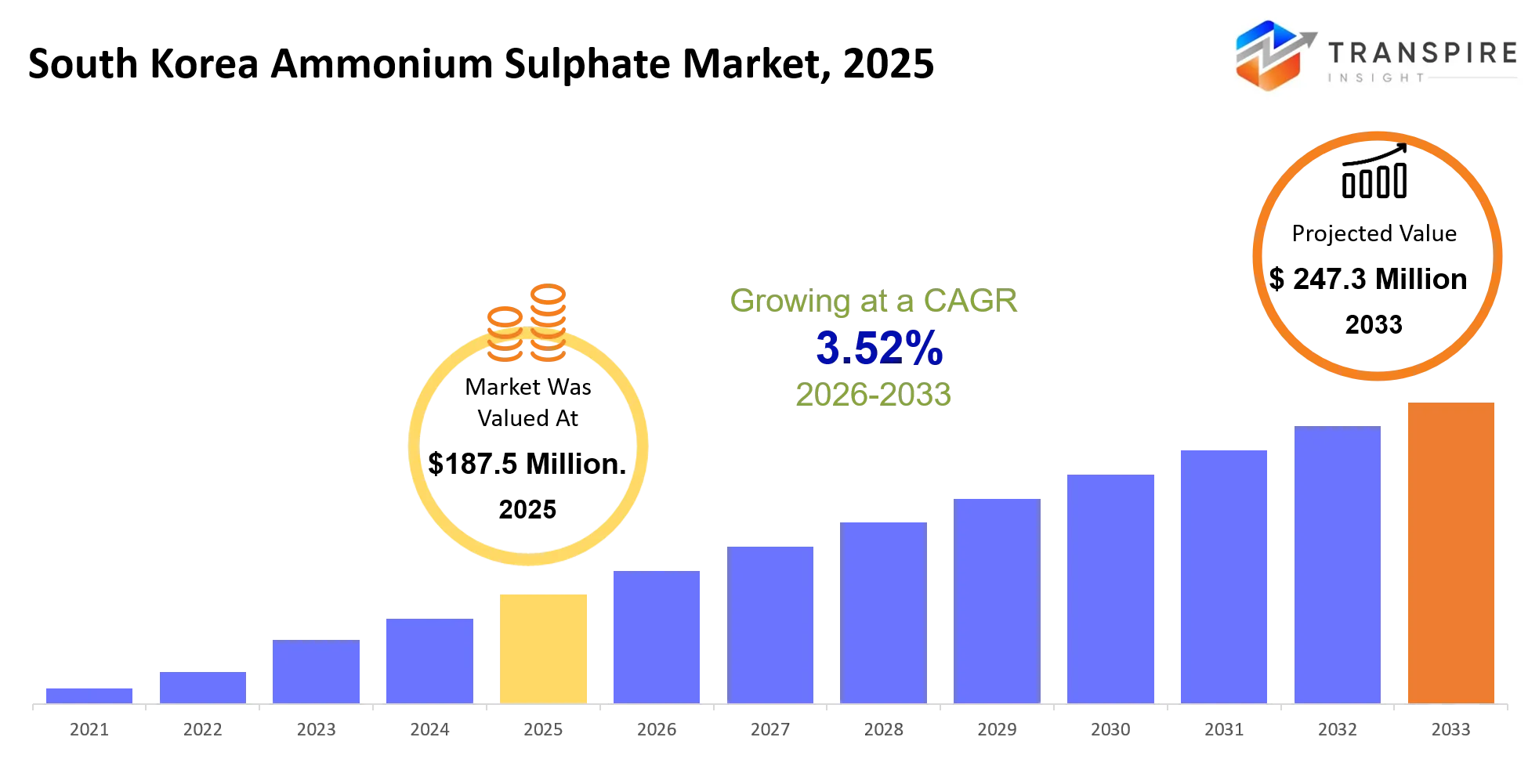
- Market Value (2025): USD 187.5 Million.
- Expected Market Value (2026): USD 194.1 Million.
- Estimated Market Value (2033): USD 247.3 Million.
- Forecast CAGR (2026–2033): 3.52%
Introduction
The ammonium sulfate market covers both the global and the local aspects of the trade, production and usage of (NH₄)₂SO₄ on both the synthetic and the recovery markets. The latter includes the ammonium sulfate produced from industry processes like caprolactam production and gas from the coke oven industry. Ammonium sulfate is used mainly as an effective fertilizer providing nitrogen and sulfur for alkali systems while its usages range also from food additives to the field of pharmaceuticals and some aspects of water purification. Ammonium sulfate brings a number of important benefits to the ammonium sulfate sector in South Korea. This material allows for the simultaneous supply of both nitrogen and sulfur to easily promote the growth of vegetative parts of plants, the formation of protein, the performance of enzyme reactions, and the growth of root systems of crops. It is also useful as a solution for the deficiency of sulfur or for raising the productivity of crops when there are such deficiencies. Ammonium sulfate is very soluble in water and can dissolve quickly and deliver nutrients to crops in the most effective manner. The fertilizer also allows for the lowering of the soil pH in case of alkaline soil types and enhancing the accessibility of micronutrients for plants. Furthermore, ammonium sulfate has versatile applications in water purification and chemical production industries in addition to agriculture, making the industrial market of this product diversified.
Key Market Highlights: -
- By grade, the Fertilizer Grade segment dominated the market and holds nearly 70 % share in 2025 and is projected to grow at a substantial CAGR during the forecast period.
- By application, the Fertilizers segment dominated the market and holds nearly 87 % share in 2025 and is projected to grow at a substantial CAGR during the forecast period.
- By end user, the Chemical Industry segment dominated the market and holds nearly 28 % share in 2025 and is projected to grow at a substantial CAGR during the forecast period.
- The ammonium sulfate industry in South Korea is backed by rules established by the government to keep the prices of fertilizers low and allow for constant availability. In 2026, KRW 11.5 billion was made available to cover the rate of inorganic fertilizers, with 80% of the relevant increases covered through contributions of the state and NongHyup. These steps allow for easing the pressure on farmers’ input costs and ensuring consistent availability of fertilizers, thus fostering demand for ammonium sulfate.
How is Technology Driving Growth in the South Korea Ammonium Sulphate Market?
The ammonium sulfate market of South Korea is gaining momentum due to the increasing application of precision farming techniques, innovative production technologies, and smart farming practices. The use of fertigation allows for efficient delivery of soluble ammonium sulfate through the irrigation system, whereas variable rate technology (VRT) helps to optimize nitrogen and sulfur application and minimize nutrient loss. The development of advanced foliar application systems makes it possible to deliver nutrients precisely in accordance with the crop growth stage. Automated irrigation systems, along with data-driven soil analysis, facilitate the precise identification of nutrient deficits in soil and enable effective fertilization. Custom fertilizer blending, notably NPK + S fertilizers, makes crop-specific nutrient application possible and improves efficiency.
Market Drivers
The ammonium sulfate market in South Korea is supported by soil nutrient depletion, balanced crop nutrition, and the limited amount of land available for farming. Intensive farming may limit the availability of important sulfur and nitrogen elements and thus requires fertilizers that provide these nutrients. At the same time, the growing use of balanced fertilization methods encourages farmers to increase the application of fertilizers. The limited amount of agricultural land makes it important to achieve the maximum possible yield from crops. The efforts to improve agricultural productivity, food security, and the efficiency of fertilizer use will allow the ammonium sulfate market to remain stable. The ammonium sulfate market in South Korea is flourishing because of the strong fundamentals of the product and the industry, such as soil correction, high solubility level, circular economy involvement, and the well-developed infrastructure used for production. Ammonium sulfate is used because it is an easy source of nitrogen and sulfur, and this helps deal with the deficiency of nutrients and ensures high crop productivity. It is water-soluble that allows the quick dissolving of nutrients for agricultural needs. The recovery process from industrial activities like caprolactam manufacturing is helpful in terms of effective resource consumption and cost efficiency. South Korean chemical industry is well developed, and thus it guarantees the successful production and distribution of ammonium sulfate fertilizers.
Restrain
The ammonium sulfate sector in South Korea is challenged by several factors, including soil acidity, environmental issues, and rising use of alternative fertilizers. The continuous use of ammonium sulfate causes a decline in soil pH level, while leaching of nutrients raises an environmental alarm. As more organic and slow-release fertilizers are utilized, the impact of the ammonium sector can be diminished. In addition, prices of ammonia and sulfuric acid are inconsistent, making margins decrease, while weak demand in the synthetic fibers and nylon market can impact industrial demand as well.
|
Driver |
Relative Impact on Growth (%) |
Geographic Relevance |
Impact Timeline |
Demand Strength |
Growth Mechanism |
Key Beneficiaries |
Major Constraint |
|
Driver 1: Strong Agricultural Demand for Nitrogen & Sulfur Nutrition |
28% |
Nationwide; major agricultural regions |
Long-term |
High |
Supports crop nutrition and improves fertilizer efficiency |
Fertilizer manufacturers; agricultural cooperatives; farmers |
Soil acidification from repeated application |
|
Driver 2: Government Fertilizer Price Support & Supply Stabilization |
23% |
Nationwide; agricultural production regions |
Short-term |
High |
Reduces farmer input costs and supports fertilizer purchasing |
Farmers; fertilizer producers; distributors; NongHyup |
Support measures may be temporary |
|
Driver 3: Precision Agriculture and Smart Fertilization Adoption |
19% |
Gyeonggi, Chungcheong, Jeolla regions |
Medium-term |
High |
Enables precise nitrogen-sulfur application and reduces losses |
Smart-farming vendors; fertilizer producers; commercial farms |
High technology adoption and equipment costs |
|
Driver 4: Industrial Recovery and Chemical-Process Demand |
16% |
Major industrial and chemical clusters |
Medium-term |
Medium |
Expands non-agricultural ammonium sulfate consumption |
Chemical manufacturers; water-treatment providers; industrial users |
Cyclical industrial production demand |
|
Driver 5: Circular Production and Byproduct Recovery |
14% |
Industrial production centers |
Long-term |
Medium |
Converts industrial byproducts into cost-efficient fertilizer inputs |
Chemical producers; fertilizer manufacturers; sustainability technology providers |
Dependence on upstream industrial output |
Analysis of Prices and Consumer Behaviour
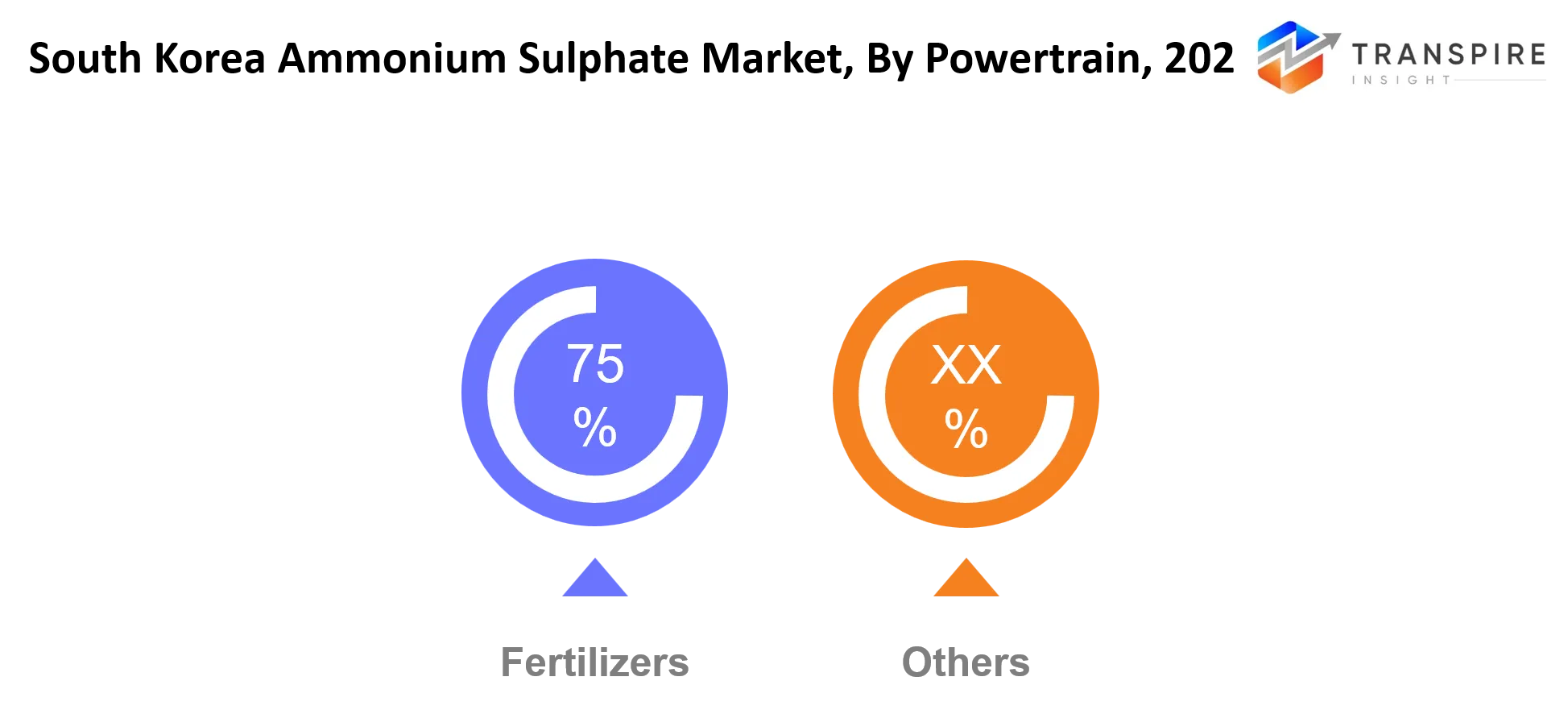
In 2025, the fertilizer application segment is predicted to control the South Korea ammonium sulfate market with around 75 % of overall market revenue. The reason is contributed to the rising requirement for nitrogen and sulfur crop nutrition. The application of standard ammonium Sulphate is likely to make up more than 60 % in 2025 because of the corrections in its prevalent use in agriculture and established major fertilizer applications. The regional market is likely to have accumulated around 35-40 % of the market concentration through the Gyeonggi and Chungcheong provinces. As much as 65% will be attributed to the commercial farming segment by 2025 due to huge increase in crop production leading to a bigger need for sulfur fertilizers. The consumers show particular importance of nutrient composition, quality of products, supply reliability and price competitiveness.
Who are the Key Players in the South Korea Ammonium Sulphate Market and how do they compete?
The competitive nature of the ammonium sulfate market in South Korea depends on various companies involved in the manufacture of fertilizers, those producing special agricultural solutions, and those working on various types of effective distribution networks. It's not just about competing on price; competitors analyze product quality, the content of nitrogen and sulfur in products, production technologies, supply reliability, and how well their products fit into agricultural and fertilizer supply chains. Moreover, being engaged in constant innovation, companies not only become more productive but also help boost agricultural productivity along with supply efficiency and availability on the market.
Using advanced fertilizer products and enhancing domestic chemical production capabilities enables OCI to improve its position on the ammonium sulfate market. Companies can be successful if they create high-quality fertilizers based on nitrogen and sulfur formulas to meet agricultural needs. Yara International improves its standing by supplying integrated crop nutrition solutions.
Top Companies in the South Korea Ammonium Sulphate Market
- BASF
- Evonik
- Lanxess
- AdvanSix
- Domo Chemicals
- Fibrant
- Honeywell
- Sumitomo Chemical
- Toray
- Ube Corporation
- OCI
- LG Chem
- Lotte Chemical
- Hanwha Solutions
- SKC
|
Company |
Est. Revenue Share Range |
Key Offerings |
Strategic Positioning |
Geographic Strength |
Technology Focus |
|
Capro Corporation |
18–25% |
Ammonium sulfate; ammonium sulfate nitrate; caprolactam |
Integrated caprolactam-byproduct supply |
South Korea; Asia-Pacific |
Caprolactam-linked sulfate recovery |
|
Namhae Chemical |
12–18% |
Fertilizers; nitrogen fertilizers; sulfur-containing fertilizers; chemical inputs |
Domestic fertilizer supply integration |
South Korea; Asia-Pacific |
Fertilizer formulation and production |
|
Fibrant |
8–13% |
Ammonium sulfate; Gran grades; ASpure®; caprolactam |
Premium specialty-grade differentiation |
Europe; Asia-Pacific |
Crystallization and high-purity production |
|
BASF |
6–10% |
Ammonium sulfate special grade; technical ammonium salts |
Specialty and industrial-grade supply |
Europe; Asia-Pacific; North America |
High-purity salt processing |
|
AdvanSix |
5–9% |
Sulf-N® ammonium sulfate; granular grades; soluble grades |
Agricultural product specialization |
North America; Asia-Pacific |
Granulation and nutrient formulation |
|
FarmHannong |
4–7% |
Granular ammonium sulfate 20-0-0; compound fertilizers; water-soluble fertilizers |
Domestic crop-nutrition portfolio expansion |
South Korea; Asia-Pacific |
Precision fertilizer formulation |
|
LANXESS |
3–6% |
Ammonium sulfate; specialty chemical products |
Specialty chemical diversification |
Europe; Asia-Pacific |
Specialty salt manufacturing |
|
UBE Corporation |
2–5% |
Ammonium sulfate; chemical intermediates; fertilizer-related products |
Integrated chemical manufacturing |
Japan; Asia-Pacific |
Chemical-process integration |
|
Sumitomo Chemical |
2–4% |
Agricultural inputs; chemical intermediates; fertilizer-related solutions |
Diversified chemical and agricultural portfolio |
Japan; Asia-Pacific |
Advanced chemical processing |
|
Domo Chemicals |
1–3% |
Caprolactam-related products; chemical intermediates; ammonium sulfate-linked products |
Integrated polyamide value-chain participation |
Europe; Asia-Pacific |
Caprolactam process integration |
South Korea Ammonium Sulphate Market Segmentation
The South Korea Ammonium Sulphate Market share is divided into five categories: By grade, application, form, production process and end user.
The Fertilizer Grade dominated the market, accounting for nearly 70% in 2025 and is expected to rise at a significant CAGR during the forecast period.
The South Korea Ammonium Sulphate Market is segmented by grade into Standard Grade, Caprolactam Grade, Fertilizer Grade, Industrial Grade, Food Grade, Pharmaceutical Grade, High-Purity Grade. Among these, the Fertilizer Grade segment dominated the market, accounting for nearly 70% in 2025 and expected to increase at a significant CAGR during the forecast period. Fertilizer grade is the leading grade because there is a great need for the nutrients such as nitrogen and sulfur in agriculture because of their role in improving soil fertility and productivity of crops. The water-soluble nature of ammonium sulfate ensures its easy utilization by the crops through the modern farming methods. The increasing focus on fertilizer balance and soil nutrition will help drive growth in the future.
The Fertilizers dominated the market, accounting for nearly 87% in 2025, and is expected to rise at a significant CAGR during the forecast period.
The South Korea Ammonium Sulphate Market is segmented by application into Fertilizers, Water Treatment, Pharmaceuticals, Food Additives, Chemical Manufacturing, Textile Processing, Industrial Applications. Among these, the Fertilizers segment dominated the market, accounting for nearly 87% in 2025 and expected to increase at a significant CAGR during the forecast period. The fertilizers sub-segment accounted for the major share of the South Korea Ammonium Sulphate Market owing to the high demand from the agriculture sector due to the presence of nitrogen and sulphur nutrients in the fertilizer which help in promoting the growth of crops and increase the fertility of the soil.
The Chemical Industry dominated the market, accounting for nearly 28% in 2025 and is expected to rise at a significant CAGR during the forecast period.
The South Korea Ammonium Sulphate Market is segmented by end user into Agriculture, Chemical Industry, Pharmaceuticals, Food & Beverage, Water Treatment, Textile Industry, Mining. Among these, the Chemical Industry segment dominated the market, accounting for nearly 28% in 2025 and expected to increase at a significant CAGR during the forecast period. The chemical industry application segment occupied the dominant position in South Korea’s ammonium sulphate market owing to the wide usage of ammonium sulphate as a chemical product. Consumption is driven by its uses in the chemical process industry, pharmaceuticals, water treatment industry, and other industries. South Korea has a well-developed chemical manufacturing base, and stable industrial activities ensure continued consumption of ammonium sulphate.
Future Market Trends for the South Korea Ammonium Sulphate Market: -
- Modernization in Agriculture: The use of precision agriculture increases the demand for fertilizers with two nutrients.
- Implementation of Measures for Removal of Sulfur Deficiency: Increasing demand for the treatment of sulfur-deficient agricultural soils.
- Industrial Sector Utilization: Continuous growth in the use of chemical production and waste water treatment.
- Environmental Influence: Strict restrictions on emissions and soil acidification limit traditional methods of application.
Recent Development
- In April 2026: Coherent Market Insights recently released their report on the Ammonium Sulfate Market in East Asia and the Baltic States, projecting the size of this market to reach USD 1,700.1 million in 2026. The analysis involves the South Korean market specifically, identifying the ammonium sulfate demand on the basis of production methods and shedding light on the region's market dynamics and production trends.
- In June 2026: Hexagon Group AG and Lucky Grace International progressed the construction of a new ammonium Sulphate granulation facility at Yangzhou Port, China, which will consist of two production lines and an annual output of 1.2 million tons. The start of operations at the facility is significant for the development of regional supplies of ammonium Sulphate and will affect its availability and trade in East Asian countries, including South Korea.
Market Segment
This study forecasts revenue at South Korea, regional and country levels from 2020 to 2033. Transpire Insights has segmented the South Korea Ammonium Sulphate Market based on the below-mentioned segments:
South Korea Ammonium Sulphate Market, By Grade
- Standard Grade
- Caprolactam Grade
- Fertilizer Grade
- Industrial Grade
- Food Grade
- Pharmaceutical Grade
- High-Purity Grade
South Korea Ammonium Sulphate Market, By Application
- Fertilizers
- Water Treatment
- Pharmaceuticals
- Food Additives
- Chemical Manufacturing
- Textile Processing
- Industrial Applications
South Korea Ammonium Sulphate Market, By Form
- Granular
- Crystalline
- Powder
- Prilled
- Fine Crystals
- Coarse Crystals
- Solution
South Korea Ammonium Sulphate Market, By Production Process
- Caprolactam By-Product
- Coke-Oven Gas
- Gypsum Process
- Synthetic Process
- Neutralization Process
- Recovery Process
- Other Processes
South Korea Ammonium Sulphate Market, By End User
- Agriculture
- Chemical Industry
- Pharmaceuticals
- Food & Beverage
- Water Treatment
- Textile Industry
- Mining
Frequently Asked Questions
Find quick answers to common questions.
The market is projected to reach USD 247.3 million by 2033, growing at a 3.52% CAGR.
Fertilizer Grade dominates, accounting for nearly 70% in 2025, driven by strong agricultural demand for nitrogen and sulfur nutrients.
Fertilizers account for nearly 87% in 2025, supported by increasing demand for nitrogen, sulfur, soil fertility, and crop productivity.
Key drivers include soil nutrient depletion, balanced fertilization, precision agriculture, limited arable land, and increasing agricultural productivity requirements.
Key companies include OCI, BASF, Evonik, LANXESS, AdvanSix, Sumitomo Chemical, Toray, UBE Corporation, LG Chem, and Lotte Chemical.
- BASF
- Evonik
- Lanxess
- AdvanSix
- Domo Chemicals
- Fibrant
- Honeywell
- Sumitomo Chemical
- Toray
- Ube Corporation
- OCI
- LG Chem
- Lotte Chemical
- Hanwha Solutions
- SKC
About the Authors

Pankaj Ghogare Patil
I am Pankaj Ghogare Patil, a Senior Research Analyst at Transpire Insight, specializing in the Pharmaceutical, Chemicals & Materials, Healthcare IT, and Biotechnology industry. My expertise lies in conducting comprehensive market research, analyzing industry trends, evaluating competitive landscapes, and translating complex data into actionable insights. At Transpire Insight, I closely follow emerging technologies, regulatory developments, and market innovations to create accurate, well-researched, and informative content that helps businesses and professionals make informed decisions. I am committed to producing credible, evidence-based articles that reflect industry best practices while making technical topics accessible and valuable for a broad audience.

Chakradhar Khansole
Chakradhar serves as the Research Director at Transpire Insight, bringing over 8 years of experience in technology, innovation, and strategic market intelligence. He specializes in transforming complex market data into actionable business insights that enable organizations to make informed, growth-oriented decisions. Recognized for his strategic vision and analytical expertise, Chakradhar leads high-impact research initiatives, delivering comprehensive market assessments, competitive intelligence, and forward-looking industry analysis.
Recently Published Reports
-
May 2026
Healthcare Polymer Packaging Market
Healthcare Polymer Packaging Market Size, Share & Analysis Report By Packaging Type (Syringes, IV Bottles and Pouches, Clamshells, Blisters, Bottles & Jars, Containers, Tubes, IV Parental Packaging, Others), By Type (Regulated, Non-regulated), By Polymer Type (LDPE (Low-Density Polyethylene), HDPE (High-Density Polyethylene), Homo-polymer (Homo), Random Copolymer (Random), Block Copolymer (Block), PET, Polystyrene, Polyvinyl Chloride, Polyamide/EVOH, Others), and Geography (North America, Europe, Asia-Pacific, Middle East and Africa, South and Central America), 2021 - 2031
-
Apr 2026
Hydrophilic Tape (Waterstop) Market
Hydrophilic Tape (Waterstop) Market Size, Share & Analysis Report By Type (Bentonite-Based Hydrophilic Tape, Rubber-Based Hydrophilic Tape), By Application (Residential Buildings, Commercial Buildings, Infrastructure Projects), and Geography (North America, Europe, Asia-Pacific, Middle East and Africa, South and Central America), 2021 - 2031
-
Apr 2026
Metalens Market
Metalens Market Size, Share & Analysis Report By Type (Visible Light Metalens, and Infrared Metalens), By Application (Consumer Electronics, Automotive Electronics, Industrial, Medical, and Others), and Geography (North America, Europe, Asia-Pacific, Middle East and Africa, South and Central America), 2021 - 2031
-
Apr 2026
PBT Resin Market
PBT Resin Market Size, Share & Analysis Report By Type (Reinforced PBT Resin, Unreinforced PBT Resin), By Processing Method (Injection Molding, Extrusion, Blow Molding, Others), By End-User (Automotive, Electrical & Electronics, Consumer Appliances, Industrial Machinery, Medical Devices, Packaging, Others), and Geography (North America, Europe, Asia-Pacific, Middle East and Africa, South and Central America), 2021 - 2031