
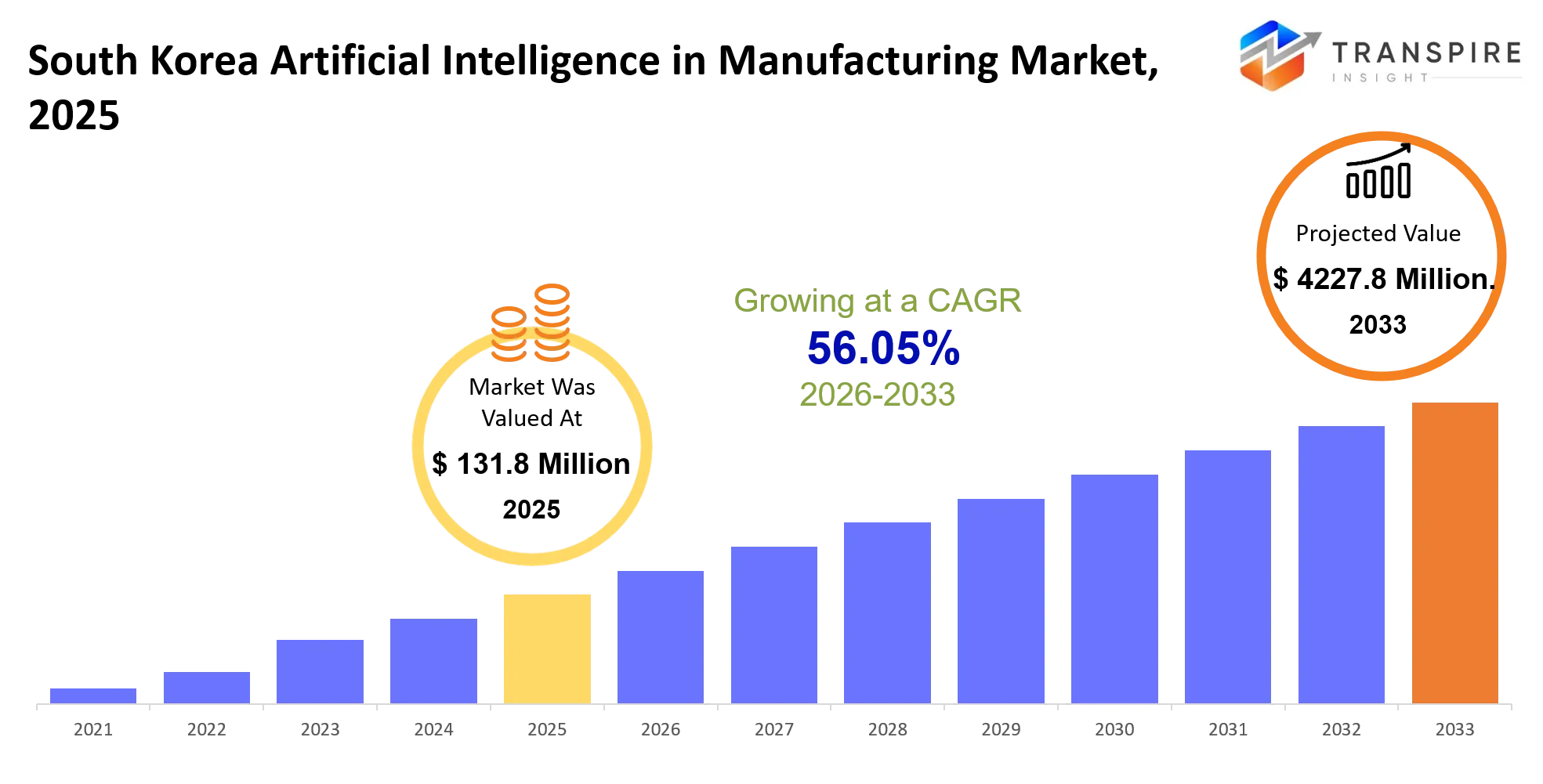
South Korea Artificial Intelligence in Manufacturing Market Summary:
According to Transpire Insights, a detailed research report on the market reflects that the manufacturing application segment dominates the South Korea Artificial Intelligence in Manufacturing Market, accounting for approximately 30% of the total South Korea AI market. Samsung Electronics leads the market with approximately (around USD 300 billion) in annual revenue and a significant South Korea market presence, making it a leading contributor to South Korea market development, innovation, AI-powered manufacturing, expanding smart-factory capabilities, nd growth dynamics.
Market Snapshot
- Market Value (2025): USD 131.8 Million.
- Expected Market Value (2026): USD 187.6 Million.
- Estimated Market Value (2033): USD 4227.8 Million.
- Forecast CAGR (2026–2033): 56.05%
Introduction
Manufacturing artificial intelligence is the term used to describe the utilization of sophisticated machine learning systems and computing tools aimed at improving efficiency and making production process predictions possible within the industry. These tools work well with factory systems to deliver applications such as predictive maintenance, quality assurance, production scheduling, automation of production process, and digital twins. Artificial Intelligence (AI) in Manufacturing is an application of machine learning, computer vision, and intelligent automation for optimization of production, predictive maintenance, and quality control within industrial environments. The South Korean Artificial Intelligence in manufacturing market is offering great advantages through predictive maintenance, where real-time sensor data and algorithms are used for detecting and predicting equipment breakdowns to minimize downtime. Quality control processes have been made more effective by using computer vision and machine learning for detecting production defects quickly and reliably, minimizing waste and reducing the need for inspections. Increased operational efficiency can be observed by using AI-based production scheduling, robotics and process optimization for increased throughput and cost efficiency. Moreover, the competitiveness of South Korean manufacturers has been improved by incorporating 5G, Internet of Things (IoT), edge AI and intelligent automation.
Key Market Highlights: -
- By component, the Hardware segment dominated the market and holds nearly 52 % share in 2025 and is projected to grow at a substantial CAGR during the forecast period.
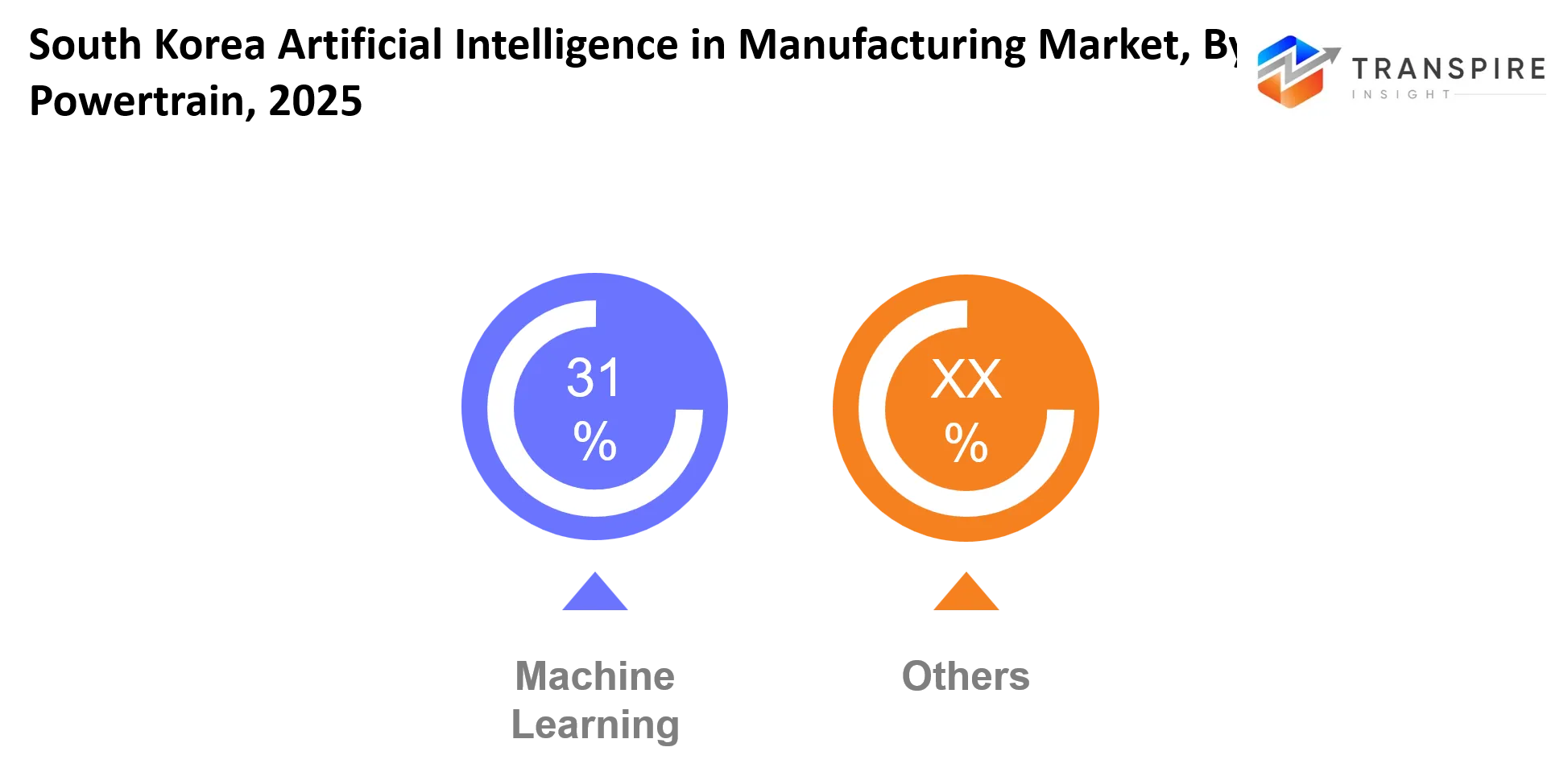
- By technology, the Machine Learning segment dominated the market and holds nearly 41% share in 2025 and is projected to grow at a substantial CAGR during the forecast period.
- By application, the Production Planning segment dominated the market and holds nearly 23 % share in 2025 and is projected to grow at a substantial CAGR during the forecast period.
- South Korean Innovation Program for Smart Manufacturing in 2026 has 450 projects to fast track development of AI enabled smart factories, autonomous manufacturing, intelligent automation, and data driven manufacturing in Artificial Intelligence in Manufacturing Market.
How is Technology Driving Growth in the South Korea Artificial Intelligence in Manufacturing Market?
Artificial Intelligence in the Manufacturing Market in South Korea has made rapid progress because of its incorporation into smart factories through the use of IIoT, Big Data, and collaborative robots to monitor and optimize manufacturing processes. Predictive maintenance and AI-powered quality control allow the manufacturers to predict machine breakdowns, cut downtime periods, and detect defects automatically. Digital Twins and industrial data-sharing platforms help to conduct simulations and improve manufacturing processes by making them more efficient. Simultaneously, the latest advances in semiconductor hardware allow the use of high-performance processors and edge computing as well as packaging technologies to enhance AI.
Market Drivers
The South Korean Market for Artificial Intelligence in Manufacturing has been influenced by the dominance of semiconductors. Samsung and SK Hynix are driving innovation in manufacturing with AI, intelligent automation, and advanced process optimization. The government is playing a role in the form of AI strategies as well as smart factories initiative to boost industrial digitalization and motivate manufacturers to use AI technologies. Robot density is one more factor that helps the market grow because it allows manufacturers to apply AI in robots, production automation, and intelligent manufacturing processes. Operational optimization makes predictive maintenance, quality control, demand forecasting, and logistics automation more widespread. South Korean Artificial Intelligence in Manufacturing Market enjoys robust semiconductor industry leadership due to the influence of Samsung and SK Hynix as well as sophisticated chip manufacturing processes that they offer. The presence of full-stack competencies in semiconductor manufacturing, artificial intelligence development, and data center infrastructure adds to the strength of the national industrial artificial intelligence ecosystem. The involvement of the government in the form of artificial intelligence investments, startup programs, and smart factories is driving the digital transformation of the manufacturing industry. The use of state-of-the-art infrastructure, which includes 5G connectivity and IoT integrations, allows real-time data exchange and intelligent automation and monitoring of the manufacturing process through AI.
Restrain
The South Korean market for AI in the manufacturing industry faces various constraints such as the high cost incurred in implementing AI solutions due to the high price of hardware, software, and data infrastructure. Constraints on talent might limit the application of specialized AI. With more interconnectivity in manufacturing systems, cybersecurity and data privacy become major issues. Moreover, there are external factors such as tariffs which increase the cost of technology.
|
Driver |
Relative Impact on Growth (%) |
Geographic Relevance |
Impact Timeline |
Demand Strength |
Growth Mechanism |
Key Beneficiaries |
Major Constraint |
|
Government-led Manufacturing AI Transformation and Smart Factory Programs |
27% |
Nationwide; Gyeonggi, Chungcheong, Gyeongsang |
Short-term |
High |
Accelerates subsidized AI adoption across manufacturing facilities |
AI vendors, system integrators, manufacturers |
Implementation complexity and limited AI expertise |
|
Semiconductor and Electronics Manufacturing Expansion |
24% |
Gyeonggi, Chungcheong, Seoul Metropolitan Area |
Long-term |
High |
Drives AI deployment for yield optimization and defect detection |
Semiconductor firms, AI vendors, equipment suppliers |
High integration costs and stringent production requirements |
|
Industrial Automation, Robotics and Physical AI Adoption |
20% |
Gyeongsang, Daegu-Gyeongbuk, Gyeonggi |
Medium-term |
High |
Connects AI intelligence with autonomous industrial machinery |
Robotics firms, manufacturers, AI platform providers |
Safety validation and technology integration challenges |
|
Predictive Maintenance and AI-Based Quality Control |
16% |
Nationwide; major manufacturing clusters |
Short-term |
High |
Reduces downtime and defects through real-time analytics |
Manufacturers, software providers, sensor vendors |
Data quality and legacy-system compatibility |
|
AI Infrastructure, Edge Computing and Industrial Data Expansion |
13% |
Gyeonggi, Chungcheong, Seoul, nationwide |
Medium-term |
High |
Enables low-latency AI inference and scalable factory analytics |
Cloud providers, chipmakers, AI infrastructure vendors |
High computing costs and cybersecurity exposure |
Analysis of Prices and Consumer Behaviour
The artificial intelligence (AI) in the manufacturing market is led by software solutions (the most prominent product type segment in 2025; mostly because of the requirements in smart manufacturing, predictive maintenance, quality improvement and intelligent automation). The South Korea AI in Manufacturing Market size is estimated to be around USD 1.15 billion in 2025 and is expected to grow up to almost USD 5.98 billion by 2030 with a 39.0 % CAGR from 2026 to 2030. The sales volume is influenced by the flexibility of AI software in such spheres as semiconductor, electronics, automotive and advanced manufacturing processes, which provide real-time data analysis, process automation and production optimization. The semiconductor and electronics sectors become major markets for the implementation of AI in manufacturing in South Korea. The purchasing behavior of manufacturers is characterized by the high importance of such aspects as the accuracy of AI solutions, integration, scalability, cybersecurity and real-time analysis. Moreover, the manufacturers start to pay more attention to the long-term agreements on technologies providing them with system updates and technical services.
Who are the Key Players in the South Korea Artificial Intelligence in Manufacturing Market and how do they compete?
The competitiveness of South Korea in the field of artificial intelligence in manufacturing lies in the firms specialized in innovation in the field of AI, industry-based solutions, advanced analytics, and creation of digital manufacturing platforms. Competing not only based on price but also on the basis of machine learning, computer vision, predictive maintenance, digital twins, edge AI, and integration of industrial automation and enterprise systems, this type of competition contributes to technological progress while helping manufacturers to increase their productivity, quality, efficiency, and production visibility. marketsandmarkets.com
Creating AI computing platforms, digital twins, and intelligent manufacturing solutions, NVIDIA is increasing its market presence. By creating industrial automation, AI, and manufacturing software solutions in semiconductors, electronics, automobiles, and other industries, companies can distinguish themselves from their competitors. The market positioning of Siemens consists of creating integrated industrial AI, automation, digital twin, and industrial software solutions that help optimize production processes.
Top Companies in the South Korea Artificial Intelligence in Manufacturing Market
- Samsung Electronics
- LG Electronics
- Hyundai Motor Group
- Hyundai Mobis
- SK Hynix
- POSCO
- Doosan Robotics
- Hanwha Robotics
- FANUC
- Siemens
- ABB
- Rockwell Automation
- Schneider Electric
- NVIDIA
- Bosch
|
Company |
Est. Revenue Share Range |
Key Offerings |
Strategic Positioning |
Geographic Strength |
Technology Focus |
|
Samsung Electronics |
12–16% |
AI-driven factories, semiconductor manufacturing AI, digital twins, AI agents |
Vertical integration across AI, semiconductors and manufacturing |
Asia Pacific, North America, Europe |
Digital twins, agentic AI, GPUs, predictive analytics |
|
Siemens |
9–13% |
Industrial AI, Industrial Edge, Siemens Xcelerator, digital twins |
Integrated industrial software and automation ecosystem |
Europe, Asia Pacific, North America |
Industrial AI, digital twins, Industrial Edge, automation |
|
NVIDIA |
8–12% |
AI computing platforms, Omniverse, Isaac, CUDA-X, AI factories |
AI computing platform leadership for industrial applications |
North America, Asia Pacific, Europe |
Accelerated computing, physical AI, simulation, digital twins |
|
LG Electronics |
7–10% |
Smart factories, AI manufacturing, robotics, Data Factory |
AI-enabled manufacturing and robotics ecosystem expansion |
Asia Pacific, North America, Europe |
Robotics AI, computer vision, digital twins, edge AI |
|
Hyundai Motor Group |
7–10% |
Software-defined factories, AI robotics, predictive manufacturing, physical AI |
Manufacturing-led physical AI and robotics integration |
Asia Pacific, North America, Europe |
Physical AI, robotics, digital twins, AI agents |
|
SK hynix |
6–9% |
AI semiconductor manufacturing, smart factories, process optimization, AI infrastructure |
AI-driven semiconductor manufacturing specialization and scale |
Asia Pacific, North America, Europe |
AI process optimization, predictive analytics, digital twins |
|
ABB |
5–8% |
Robotics, industrial automation, AI-enabled inspection, ABB Ability |
Automation-led industrial AI and robotics solutions |
Europe, Asia Pacific, North America |
Robotics, machine vision, industrial IoT, edge analytics |
|
Doosan Robotics |
4–7% |
Collaborative robots, AI vision, robot solutions, automation platforms |
Collaborative robotics specialization for smart manufacturing |
Asia Pacific, Europe, North America |
Cobots, AI vision, robot intelligence, automation |
|
POSCO |
4–6% |
Smart steel factories, AI process control, predictive maintenance, digital platforms |
AI optimization across integrated steel manufacturing operations |
Asia Pacific, North America, Europe |
Process AI, predictive maintenance, digital twins |
|
Hanwha Robotics |
3–5% |
Collaborative robots, mobile robots, AI-enabled automation, smart-factory solutions |
Robotics-focused expansion across Korean industrial automation |
Asia Pacific, Europe, North America |
Cobots, AI vision, mobile robotics, automation |
South Korea Artificial Intelligence in Manufacturing Market Segmentation
The South Korea Artificial Intelligence in Manufacturing Market share is divided into five categories: By component, technology, application, industry and deployment.
The Hardware dominated the market, accounting for nearly 52% in 2025 and is expected to rise at a significant CAGR during the forecast period.
The South Korea Artificial Intelligence in Manufacturing Market is segmented by component into Hardware, Software, Services, AI Platforms, AI Infrastructure, Integration Services, Support & Maintenance. Among these, the Hardware segment dominated the market, accounting for nearly 52% in 2025 and expected to increase at a significant CAGR during the forecast period. The Hardware Segment is the Dominating Segment within the South Korea CO₂ Laser Market due to high demand for laser sources, optical components, power supplies, cooling devices, and processing machines in the applications of semiconductors, electronics, automobile, and industries. Automation and the need for precision processing are driving the adoption of hardware segments.
The Machine Learning dominated the market, accounting for nearly 41% in 2025, and is expected to rise at a significant CAGR during the forecast period.
The South Korea Artificial Intelligence in Manufacturing Market is segmented by technology into Machine Learning, Deep Learning, Computer Vision, Natural Language Processing, Predictive Analytics, Generative AI, Robotics AI. Among these, the Machine Learning segment dominated the market, accounting for nearly 41% in 2025 and expected to increase at a significant CAGR during the forecast period. The Machine Learning section is the leading segment in the South Korea CO2 Laser Market owing to the rising implementation of intelligent process monitoring, prediction of failures, automation of the setting parameters, and quality control. Through machine learning, laser systems can be able to study the production process data, detect deviations in the process, increase accuracy, minimize wastage of material, and increase machine utilization.
The Production Planning dominated the market, accounting for nearly 23% in 2025 and is expected to rise at a significant CAGR during the forecast period.
The South Korea Artificial Intelligence in Manufacturing Market is segmented by application into Predictive Maintenance, Quality Control, Production Planning, Supply Chain Optimization, Process Optimization, Robotics & Automation, Demand Forecasting. Among these, the Production Planning segment dominated the market, accounting for nearly 23% in 2025 and expected to increase at a significant CAGR during the forecast period. The Production Planning section is the major contributor to the South Korea CO₂ Laser Market owing to increasing requirements for optimal production planning, resource management, and coordination of work flow process. Increasing use of lasers in conjunction with digital planning systems has become common practice to achieve improved productivity, reduced downtime, production cost savings, and precision manufacturing.
Future Market Trends for the South Korea Artificial Intelligence in Manufacturing Market: -
- AI Physicalization and Humanoid Integration: Factories are moving towards “physical AI,” where smart robots and humanoid ideas are used to tackle actual-world factory floor problems, including labor issues.
- Semiconductors and Electronics Domination: The semiconductor industry is dominated by Samsung, SK Hynix, among other giants, and the fabrication plants have a lot of AI-powered automation, packaging, and production systems.
- Predictive Maintenance and Quality Control in Real-Time: Companies are moving to edge computing to do machine learning and computer vision jobs, ensuring minimal downtime and errors.
- Generative AI and Intelligent Agents: Organizations are going beyond data analysis to intelligent agents based on Generative AI.
Recent Development
- In September 2026: Korea maintained its efforts on national AI programs, aiming at boosting digital transformation and AI for enterprises. The programs will assist in promoting the Artificial Intelligence in Manufacturing Market by facilitating intelligent automation, AI-based manufacturing processes, decision-making using big data analytics, smart factories, and digitalization.
- In April 2026: The report was published by MarketsandMarkets, showcasing AI implementation trends within the semiconductor and electronics manufacturing industries in South Korea. The key focus areas mentioned in the report include production yield optimization, defect detection, manufacturing efficiency, and quicker time to market.
Market Segment
This study forecasts revenue at South Korea, regional and country levels from 2020 to 2033. Transpire Insights has segmented the South Korea Artificial Intelligence in Manufacturing Market based on the below-mentioned segments:
South Korea Artificial Intelligence in Manufacturing Market, By Component
- Hardware
- Software
- Services
- AI Platforms
- AI Infrastructure
- Integration Services
- Support & Maintenance
South Korea Artificial Intelligence in Manufacturing Market, By Technology
- Machine Learning
- Deep Learning
- Computer Vision
- Natural Language Processing
- Predictive Analytics
- Generative AI
- Robotics AI
South Korea Artificial Intelligence in Manufacturing Market, By Application
- Predictive Maintenance
- Quality Control
- Production Planning
- Supply Chain Optimization
- Process Optimization
- Robotics & Automation
- Demand Forecasting
South Korea Artificial Intelligence in Manufacturing Market, By Industry
- Automotive
- Electronics & Semiconductors
- Food & Beverage
- Pharmaceuticals
- Chemicals
- Machinery
- Metals & Mining
South Korea Artificial Intelligence in Manufacturing Market, By Deployment
- Cloud
- On-Premise
- Hybrid
- Edge AI
- Private Cloud
- Public Cloud
- Distributed AI
Frequently Asked Questions
Find quick answers to common questions.
Smart factories, semiconductor investments, industrial automation, predictive maintenance, and AI-powered quality control are accelerating market growth across South Korea.
Hardware dominated with approximately 52% share in 2025, supported by rising demand for AI infrastructure, computing systems, and manufacturing equipment.
Machine Learning dominated with approximately 41% share in 2025, driven by predictive analytics, process optimization, automation, and real-time monitoring.
Production Planning dominated with approximately 23% share in 2025, supported by optimized scheduling, resource allocation, workflow coordination, and productivity improvements.
Physical AI, humanoid robotics, edge AI, predictive maintenance, generative AI, intelligent agents, and AI-powered semiconductor manufacturing represent major future trends.
- Samsung Electronics
- LG Electronics
- Hyundai Motor Group
- Hyundai Mobis
- SK Hynix
- POSCO
- Doosan Robotics
- Hanwha Robotics
- FANUC
- Siemens
- ABB
- Rockwell Automation
- Schneider Electric
- NVIDIA
- Bosch
About the Authors

Mayur Shinde
I am Mayur Shinde, a Senior Research Analyst at Transpire Insight, specializing in the Automotive & Transportation and Information & Communication Technology (ICT) Industry. My work focuses on analyzing emerging market trends, technological advancements, competitive landscapes, and industry developments to deliver accurate, data-driven insights. I am passionate about transforming complex market information into clear, actionable content that helps businesses, professionals, and decision-makers stay informed and make confident strategic decisions.

Chakradhar Khansole
Chakradhar serves as the Research Director at Transpire Insight, bringing over 8 years of experience in technology, innovation, and strategic market intelligence. He specializes in transforming complex market data into actionable business insights that enable organizations to make informed, growth-oriented decisions. Recognized for his strategic vision and analytical expertise, Chakradhar leads high-impact research initiatives, delivering comprehensive market assessments, competitive intelligence, and forward-looking industry analysis.
Recently Published Reports
-
Apr 2026
3D Optical Profiler Market
3D Optical Profiler Market Size, Share & Analysis Report By Type (Desktop 3D Optical Profiler, and Portable 3D Optical Profiler), By Technology (Confocal Technology, and White Light Interference), By End-Use Industry (Manufacturing, Research Institutions, Automotive, Aerospace and Defense, Medical Devices, and Other), and Geography (North America, Europe, Asia-Pacific, Middle East and Africa, South and Central America), 2021 - 2031
-
Apr 2026
Depth Sensor Market
Depth Sensor Market Size, Share & Analysis Report By Type (Infrared Depth Sensors, Time-of-Flight (ToF) Sensors, Stereo Vision Sensors, Structured Light Sensors, Ultrasonic Depth Sensors), By Application (Automotive, Robotics, Gaming, Consumer Electronics, Industrial Automation, Healthcare, Security & Surveillance, Others), By End Users (Automotive Manufacturers, Consumer Electronics Companies, Healthcare Providers, Industrial Companies, Security Agencies, Gaming Companies, Robotics Companies, Others), and Geography (North America, Europe, Asia-Pacific, Middle East and Africa, South and Central America), 2021 – 2031
-
Apr 2026
Digital Manufacturing Market
Digital Manufacturing Market Size, Share & Analysis Report By Component (Hardware, Software, and Services), By Technology (Robotics, 3D Printing, Internet of Things (IoT), and Others), By Application (Automotive and Transportation, Aerospace and Defense, Consumer Electronics, Industrial Machinery, and Others), By Process Type (Computer-Based Designing, Computer-Based Simulation, Computer 3D Visualization, Analytics, and Others), and Geography (North America, Europe, Asia-Pacific, Middle East and Africa, South and Central America), 2021 – 2031
-
Apr 2026
Digital Visa Services Market
Digital Visa Services Market Size, Share & Analysis Report By Type (Individual Travelers, Group Travelers), By Application (Tourism, Business Travel, Others), and Geography (North America, Europe, Asia-Pacific, Middle East and Africa, South and Central America), 2021 – 2031