
Precision Farming Software Market Summary:
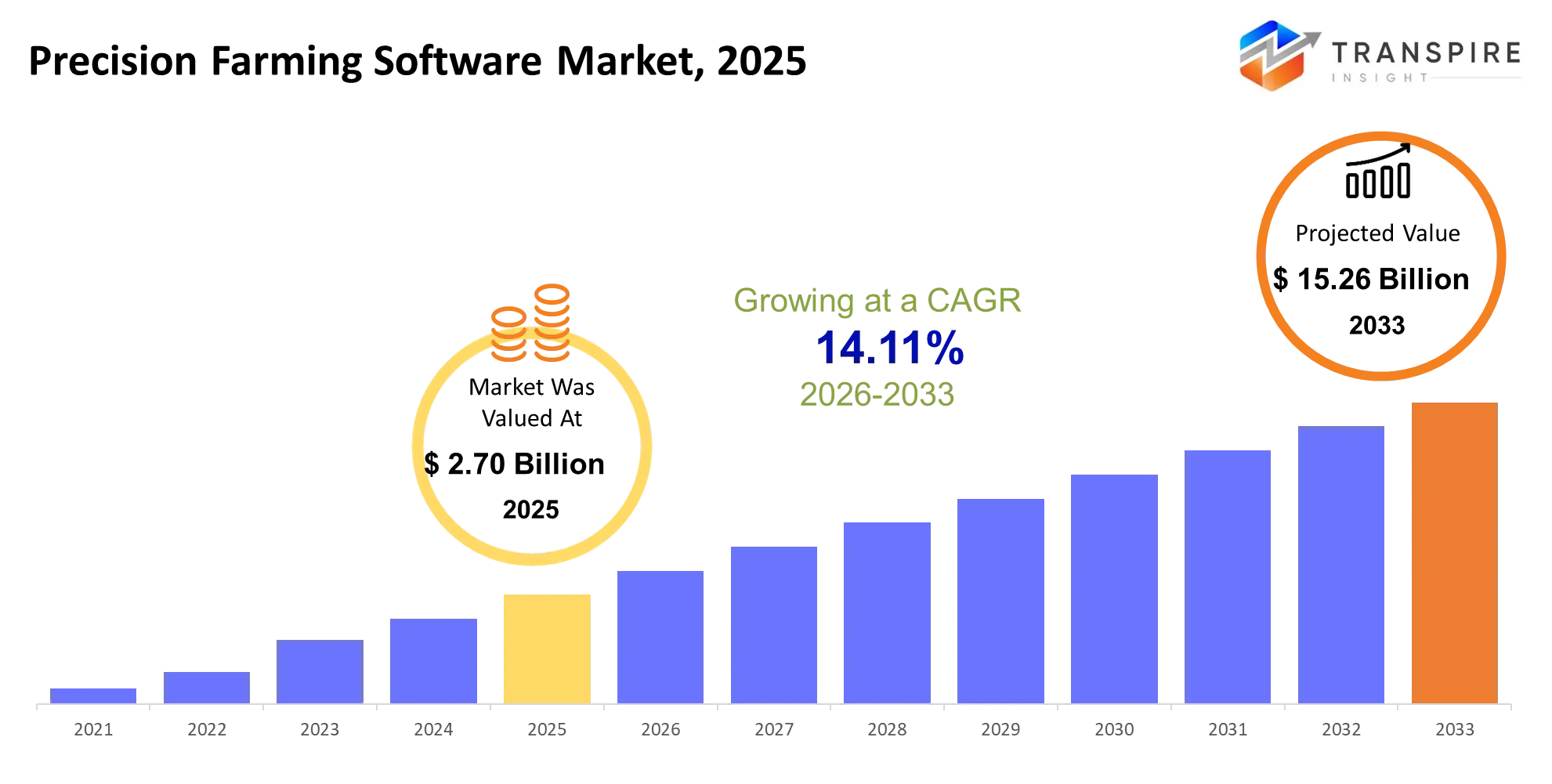
As per Transpire Insight, the Precision Farming Software Market size is estimated at USD 2.70 billion in 2025 and is anticipated to reach USD 15.26 billion by 2033, growing at a CAGR of 14.11% from 2026 to 2033.
The precision farming software market is growing fast. More and more farmers are turning to tools to boost crop yields, manage resources better and cut down on costs. These tools help keep an eye on field conditions, study soil data, check how crops are doing and guide decisions on watering, fertilising, and when to harvest. In the three to five years the market has changed a lot. It’s moved from recordkeeping to full-fledged platforms. These new systems bring together satellite images, GPS, IoT sensors and artificial intelligence. Farmers face costs for seeds, fertilizers and fuel. The weather is getting harder to predict.. There’s more pressure to grow more food using less land and water. Places hit by drought and water shortages are turning to software that helps plan irrigation accurately. When water is tight, every drop counts. That’s why farmers are using these tools to save water and use it where and when it’s needed. As internet access gets better on farms and more equipment connects to networks, precision farming software is becoming more useful. It helps farms run smoother reduce waste and farm in a way that’s kinder to the land. This kind of software isn’t, about saving money. It’s about farming smarter and more sustainably..
Precision Farming Software Market Size & Forecast:
- Market Size 2025: USD 2.70 Billion
- Expected Market Value (2033): USD 15.26 Billion
- Forecast CAGR (2026–2033): 14.11%
- Leading Region in 2025: North America
- Fastest Growing Region: Asia Pacific
- Key Company Profiles: Trimble, John Deere, AGCO, CNH Industrial, Topcon Positioning Systems, Hexagon Agriculture, DeLaval, Raven Industries, Climate LLC, CropX, Ag Leader Technology, Farmers Edge, Granular, Prospera Technologies, Taranis
Key Market Insights
Farm software is more useful when the information leads to practical decisions on the field. From the provided segmentation, integrated farm operations continue to be the most prevalent application of farm software, and there is an increasing trend in predictive artificial intelligence.
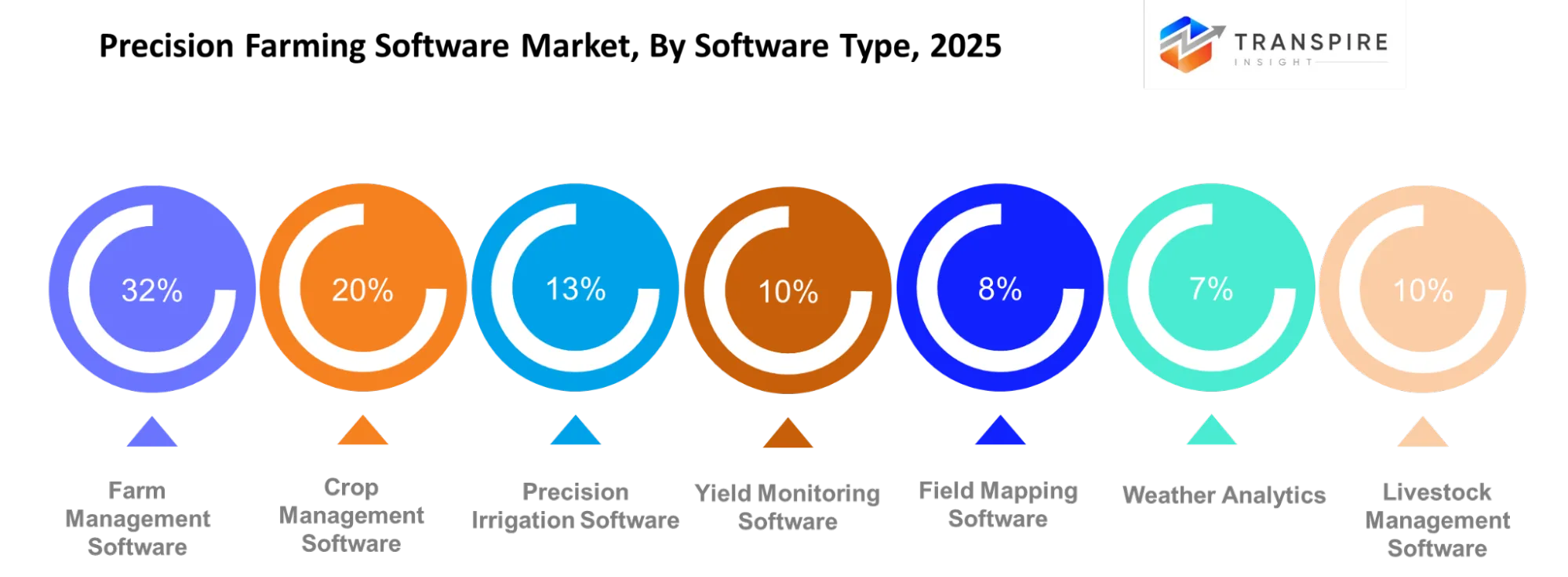
- Management software represents 31.60% of the market due to the requirement of a consolidated system to coordinate field records, schedule of activities, and use of inputs.
- Crop management software represents 20.00% of the market since vendors combine the crop observation with scouting and application activities.
- Precision irrigation software accounts for 13.00% of the market since soil moisture sensors allow the farmer to manage water consumption.
- Weather analytics software represents 7.00% of the market since weather variability is managed through spraying, watering, and harvesting.
- Livestock management software represents 6.00% of the market due to the use of sensors and digital records in the animal health observation.
- Farm accounting software represents 4.40% of the market since farmers are able to correlate records and expenses for profit analysis of crops and other activities.
What are the Key Drivers, Restraints, and Opportunities in the Precision Farming Software Market?
Drivers:
The technology deployed to fine-tune management practices aids in optimising production for farmers. The cost of fertilisers, fuels, labour, and water is quite high; hence, zone-specific management of time, finances and inputs is vital to profitability during variable rainfall situations in the farm. Field machinery, guided by GPS, mapping, and sensors, enables variable rate planting, application and watering. The use of satellite imagery in farm management software helps in monitoring crops and detection.
Restraints:
There is a restriction on economic implementation. It is difficult to convince small-scale farmers about investing in hardware, connectivity, subscriptions and training, as agronomic results vary between different seasons and crops. The disconnected machinery systems and different data formats require efforts towards integration before providing any meaningful advice to the farmers. Poor field boundaries, calibration and network coverage affect accuracy.
Opportunities:
The opportunities are to offer modular and mobile-compatible subscriptions through cooperatives, equipment dealers, and agronomists. In the case of Asia-Pacific, affordable sensors, local user interfaces, and collective advisory applications could make digital technology available for small farms. Those vendors who measure cost savings, support multi-vendor systems, and give advisory in simple language would most probably succeed in monetising trial periods. The process of onboarding and seasonal help could lead to stickiness because of the monitoring of advisory impact on costs, yields, and resource utilisation.
|
Driver |
Relative Impact on Growth (%) |
Geographic Relevance |
Impact Timeline |
Demand Strength |
Growth Mechanism (5–10 words) |
Key Beneficiaries (5–10 words) |
Major Constraint (5–10 words) |
|
AI-powered analytics and data-driven farm management |
26% |
North America, Europe, Asia-Pacific |
Short-term (≤2 years) |
High |
Converts field data into predictive crop management recommendations |
Software developers, agritech firms, commercial farmers, agronomists |
Inconsistent farm data reduces prediction accuracy and reliability |
|
Rising need to optimize farm inputs and improve yields |
24% |
North America, Asia-Pacific, Europe |
Medium-term (2–4 years) |
High |
Optimizes fertilizer, pesticide, seed, and irrigation application |
Farmers, equipment manufacturers, farm management software providers |
High implementation costs limit adoption among smaller farms |
|
Growing adoption of IoT sensors, satellite imagery, drones, and GNSS |
20% |
North America, Asia-Pacific, Europe |
Medium-term (2–4 years) |
High |
Integrates field observations for precise monitoring and automated decisions |
Sensor vendors, drone operators, satellite analytics firms, farmers |
Connectivity gaps and incompatible equipment restrict integration |
|
Climate variability and sustainability-driven resource management |
16% |
Europe, North America, Asia-Pacific |
Long-term (≥4 years) |
High |
Supports water conservation, soil protection, and climate-resilient cultivation |
Irrigation technology providers, farmers, sustainability solution vendors |
Unpredictable weather weakens forecasting accuracy and returns |
|
Government support and expansion of digital agriculture infrastructure |
14% |
Asia-Pacific, Europe, North America |
Long-term (≥4 years) |
Medium |
Public initiatives encourage digital tools, advisory, and farm modernization |
Agritech startups, agricultural cooperatives, software vendors, farmers |
Funding uncertainty and fragmented policies slow implementation |
|
Total |
100% |
Global |
— |
— |
— |
— |
— |
What Has the Impact of Artificial Intelligence Been on the Precision Farming Software Market?
AI technology is transforming the use of precision agriculture equipment by becoming increasingly productive in converting field data into usable information. In what way? Image recognition software can analyse satellite images, drone images, or smartphone images and notify farmers about stressed crops, pest damage, weed infestation, or possible disease. With the integration of forecasts, soil testing, and previous yields, such predictions will be able to highlight problem areas that need assistance and help farmers decide when to scout, spray or irrigate. Machine learning algorithms can define field zones, making it easier for variable rate applications to avoid blanket treatments. However, all these results depend on high-quality and local training data. Poor connectivity can be an issue in rural areas, as well as inaccuracy with crops, plant development stages, lighting, moisture levels, and soil types and conditions. Sensor systems, imagery, and subscription costs can be too expensive for small farms. That is why AI technology is primarily used for decision-making.
Instance:
In March 2026, CropX Technologies released their CropX Vision, which is an AI-based crop monitoring technology that employs computer vision and agronomic modelling for assessing water stress in vineyards from canopy images. This technology aids farmers in detecting water stress in crops and making irrigation decisions based on data.https://cropx.com/vineyard-water-stress-monitoring/
Key Market Trends:
The market is evolving from standalone digital tools to services that integrate observation, planning, and action. Buyers are now looking for platforms based on integration with current processes, robustness and proven value.
- Farm software has evolved from a tool for digitally managing records to become an integrated system that links field operations and machinery and financial data.
- Satellite images have progressed from providing infrequent data to frequent monitoring in order to allow advisers to spot changes before going out into the field.
- The use of drones in agriculture is transitioning from using drones for visual inspections to crop assessment and application planning, subject to regulation and cost economics of operations.
- Predictive and alerting capabilities are evolving AI tools to the point when they provide recommendations regarding the most suitable place for scouting or action.
- With the growing necessity to have software that works across different machines, equipment connectivity is becoming ever more important.
- Mobile interfaces and remote advisory services are becoming relevant where farmers do not have direct access to computers at office.
Precision Farming Software Market Segmentation
By Software Type:
Farm Management Software is the market leader, accounting for 31.60% of the market share; Crop Management Software accounts for 20.00%, Precision Irrigation Software 13.00%, Yield Monitoring Software 10.00%, Field Mapping Software 8.00%, Weather Analytics 7.00%, Livestock Management Software 6.00%, and Farm Accounting Software 4.40%. The total composition is 100%. Farm management software is dominant as it is responsible for coordinating all tasks and documentation throughout the season, while Crop Management software is directly concerned with crop health and treatments. Irrigation and yield management software help resolve operational issues
By Technology:
A field of play in which all the components are identified under the following categories. GPS/GNSS, GIS, IoT, AI, machine learning, remote sensing, cloud computing and big data. Software powered by artificial intelligence and machine learning is the fastest-growing segment, with a reported 16.40% CAGR, although there is no breakout for the different components in the data supplied. GPS/GNSS and GIS provide the location dimension; field sensors provide the field data. Remote sensing provides a macro view; and cloud computing sits above it all, tying the many together for analysis.
By Application:
Applications would include crop monitoring, yield optimisation, irrigation and nutrient applications, soil and fertiliser management, pest management and farm planning. . Crop monitoring can be used to predict stress. Irrigation and nutrient applications close the loop from data to inputs. Yield optimisation and farm planning is used to guide the next operation using previous results and current conditions. As software develops, applications that get to the cost and outcome of a recommendation should be easier for growers to evaluate and implement.
By Farm Size:
The market for small, medium, large, commercial, plantation, cooperative and corporate farms . Large and corporate farms will be able to amortise technology costs over a larger area of land and could even have their own agronomy or IT team. Smaller farms will require a simpler interface, a lower purchase price and information delivered via a co-operative or local dealer. Shared services, mobile devices and flexible subscription models could bridge the gap but enable vendors to serve different scales of operation.
By Deployment:
Reported deployment models are cloud, on-premise, mobile, hybrid, SaaS, edge, and web-based. Cloud and SaaS deployment models offer remote access and scalability through updates; mobile app delivery places field records and messaging at the fingertips. On-premise and edge deployment address features that require local system processing or weak links; hybrid models can be tailored to meet these needs. Buyers will likely prefer versatility that keeps their data accessible and their systems running when there's limited coverage.
By End User:
End users include farmers, farm staff, agribusiness, cooperative groups, agri-consultants, food producers, government and research. Farmers will use the software on a daily basis to inform field activities and decision-making, in combination with agribusiness and food producers to help plan supply from farms and meet traceability requirements; and co-operatives and consultants to facilitate uptake of advice through insight into data and analysis. Governments and research establishments are interested in the use of digital tools for monitoring and trials, and there is scope for platforms that provide reliable data exchanges and transparent analysis.
What are the Key Use Cases Driving the Precision Farming Software Market?
Farming management is the use case as it integrates all the field data, seasonal planning, machinery movements and input decisions into a single process. This use case highlights the importance of coordination of operations on a routine basis. Data from crops will allow comparison of field performance. The other areas that could be included in the list of applications are crop monitoring, precision irrigation, soil and fertiliser management, pest scouting and yield optimisation. Crop management software accounts for most of the stated applications, but irrigation systems are also included in the category. The other emerging applications that involve the use of AI, remote sensing, and machinery include yield impact predictions, pest scouting priority, and variable rate applications.
|
Report Metrics |
Details |
|
Market size value in 2025 |
USD 2.70 Billion |
|
Market size value in 2026 |
USD 3.08 Billion |
|
Revenue forecast in 2033 |
USD 15.26 Billion |
|
Growth rate |
CAGR of 14.11% from 2026 to 2033 |
|
Base year |
2025 |
|
Historical data |
2021 - 2024 |
|
Forecast period |
2026 - 2033 |
|
Report coverage |
Revenue forecast, competitive landscape, growth factors, and trends |
|
Regional scope |
United States; Canada; Mexico; United Kingdom; Germany; France; Italy; Spain; Denmark; Sweden; Norway; China; Japan; India; Australia; South Korea; Thailand; Brazil; Argentina; South Africa; Saudi Arabia; United Arab Emirates |
|
Key company profiled |
Trimble, John Deere, AGCO, CNH Industrial, Topcon Positioning Systems, Hexagon Agriculture, DeLaval, Raven Industries, Climate LLC, CropX, Ag Leader Technology, Farmers Edge, Granular, Prospera Technologies, Taranis |
|
Customization scope |
Free report customization (country, regional & segment scope). Avail customized purchase options to meet your exact research needs. |
|
Report Segmentation |
Software Type (Farm Management Software, Crop Management Software, Precision Irrigation Software, Yield Monitoring Software, Field Mapping Software, Weather Analytics, Livestock Management Software, Farm Accounting Software); Technology (GPS/GNSS, GIS, IoT, AI, Machine Learning, Remote Sensing, Cloud Computing, Big Data Analytics); Application (Crop Monitoring, Yield Optimization, Irrigation Management, Soil Management, Fertilizer Management, Pest Management, Farm Planning); Farm Size (Small Farms, Medium Farms, Large Farms, Commercial Farms, Plantation Farms, Cooperative Farms, Corporate Farms); Deployment (Cloud, On-Premise, Mobile, Hybrid, SaaS, Edge, Web-Based); End User (Farmers, Agribusinesses, Cooperatives, Agricultural Consultants, Food Producers, Government Agencies, Research Institutions) |
Which Regions are Driving the Precision Farming Software Market Growth?
North America:
North America accounts for a 39.20% share of the market at the regional level. Large commercial farms, developed systems of precision equipment, and advanced agricultural digitisation solutions are factors that drive adoption here. In addition, the region has access to GPS-guided equipment, farm software and agronomic services that aid in making field-based decisions based on analysis. The leadership of North America is further ensured through its growers' interest in efficiency of operation and reduction of cost of inputs and equipment compatibility.
In March 2025, Trimble and PTx Trimble made public the release of IonoGuard, a new advancement in technology that helps ensure reliable RTK GNSS positioning in precision agricultural equipment during tough environmental conditions such as solar and atmospheric phenomena. Reliable positioning enhances field operations and promotes the use of connected technologies in the agriculture field in North America.
Europe:
Europe holds a 29.00% market share on the basis of advanced suppliers of agricultural technologies and concern for efficient use of resources. Digitised farm production, environmental interests and the necessity to report on the practices used in the application of inputs create the need for monitoring and planning solutions. While the fragmented structure of farms and diverse national requirements are reasons that may hinder adoption to some extent, cooperatives and advisory bodies will contribute to knowledge dissemination.
In November 2025, BASF released the xarvio FIELD MANAGER for Grapes, expanding the reach of its digital agricultural system to grape-growing farmers in France, Spain and Türkiye. The system offers tailored information on pest and disease management, nutrition planning, plant stress, and irrigation. The development contributes towards the spread of the precision farming software solution across European vineyards
https://agriculture.basf.com/global/en/business-areas/digital-farming
Asia-Pacific:
Asia-Pacific accounts for 24.00% of the market share and is the fastest-growing region with a CAGR of 13.80%. Drivers behind adoption include investments in digital agriculture, sensor irrigation, drone monitoring, and AI-driven crop advisory services. Issues with farm size diversity and poor connectivity continue to persist in the region, although mobile-based technology and shared services can help overcome them. There is potential for software tailoring according to local needs.
In September 2025, it was reported that XAG is deploying its agricultural drones in Sang Hyang Seri, an Indonesian state-owned rice paddy farm covering around 5,000 hectares of land. With XAG's drones deployed, it becomes possible for farmers to control the dose rate of sprays, as well as the speed and flying heights via a mobile app. The advancement is notable because it indicates the increasing implementation of digital control solutions and precision agricultural technologies in the Asia Pacific region.
https://www.xag.cn/en/news/application/Indonesia-Drone
Who are the Key Players in the Precision Farming Software Market and how do they Compete?
The competition lies in the ability to bring together useful agronomic advice and the connectivity of equipment, available data, and quantifiable results at the farm level. Deere and Trimble focus on precision guidance, machine connectivity, and data on field operations, whereas AGCO and Topcon position their tools based on the integration of equipment and multi-machine workflows. Climate FieldView and Cropwise by Bayer and Syngenta, respectively combine the field data with decision-making on crop management and advisory services. Their differentiation relies more and more on the ability to convert the data from imagery, weather forecasts, machinery and field data into useful advice.The other type of competition is in partnerships, not in developing everything independently. Syngenta made its partnership with Planet even closer and integrated the frequent satellite imagery into Cropwise, which improves remote monitoring of crops.Other players like Cropin and Farmers Edge specialise in digital agriculture platforms and data services for commercial farms and agriculture businesses. The methods of expansion include subscriptions, dealer and advisor distribution channels, integration with existing machinery and regional crops. The test of competition is the ability of the platform to deliver results reliably without high costs and complexity of adoption.
Precision Farming Software Market Companies
- Trimble
- John Deere
- AGCO
- CNH Industrial
- Topcon Positioning Systems
- Hexagon Agriculture
- DeLaval
- Raven Industries
- Climate LLC
- CropX
- Ag Leader Technology
- Farmers Edge
- Granular
- Prospera Technologies
- Taranis
|
Company |
Est. Revenue Share Range |
Key Offerings |
Strategic Positioning |
Geographic Strength |
Technology Focus |
|
Deere & Company |
Estimated 10–16% |
John Deere Operations Center, Work Planner, field data analytics, machine performance monitoring |
Integrated equipment-linked digital farming ecosystem |
North America, Europe, South America |
Connected machinery, cloud analytics, precision automation |
|
Trimble Inc. / PTx Trimble |
Estimated 8–14% |
Farm management software, guidance data tools, field operations management, connectivity solutions |
Mixed-fleet compatibility and precision technology specialization |
North America, Europe, South America |
GNSS guidance, interoperability, cloud connectivity |
|
Bayer AG |
Estimated 7–12% |
Climate FieldView, FieldView Plus, FieldView Premium, field data analytics |
Agronomic insights combined with crop science expertise |
North America, South America, Europe |
Satellite imagery, data science, variable-rate decisions |
|
AGCO Corporation |
Estimated 5–9% |
PTx farm management, Precision Planting digital tools, PTx Trimble solutions, farm data integration |
Multi-brand precision portfolio and retrofit-led expansion |
North America, Europe, South America |
Mixed-fleet automation, precision planting, cloud data |
|
CNH Industrial N.V. |
Estimated 4–8% |
FieldOps, AFS Connect, agriculture fleet monitoring, machine data management |
Connected machinery and farm operations integration |
North America, Europe, South America |
Telematics, machine analytics, connected equipment |
|
Topcon Corporation |
Estimated 3–6% |
Topcon Agriculture Platform, digital farm management, GNSS correction services, field data tools |
Geospatial accuracy and cross-brand precision solutions |
North America, Europe, Asia Pacific |
GNSS/RTK, geospatial mapping, data integration |
|
Ag Leader Technology |
Estimated 2–5% |
SMS Software, AgFiniti, InCommand data tools, field mapping and analysis |
Specialist farm data management and precision application |
North America, South America, Europe |
Yield mapping, variable-rate control, field analytics |
|
Farmers Edge |
Estimated 1–4% |
FarmCommand, satellite-based field monitoring, agronomic analytics, digital farm records |
Data-led farm management and field-level intelligence |
North America, South America |
Satellite imagery, remote sensing, predictive analytics |
|
Cropin Technology Solutions |
Estimated 1–3% |
Cropin Cloud, SmartFarm, crop monitoring, predictive crop intelligence |
Enterprise-focused digital agriculture and scalable analytics |
Asia Pacific, Europe, North America |
AI/ML, satellite data, cloud-based crop intelligence |
|
Syngenta Group |
Estimated 1–3% |
Cropwise, Cropwise Operations, digital agronomy tools, crop monitoring |
Agronomy-led digital platform linked to crop protection expertise |
Europe, Asia Pacific, Latin America |
AI-supported agronomy, field analytics, digital advisory |
Recent Development News
- In March 2025, Syngenta and Planet extended their satellite imagery collaboration. The partnership increased the availability of daily satellite imagery on Syngenta’s Cropwise platform, enabling farmers and advisers to monitor crop health, potential pest outbreaks, and diseases. This indicates how remote sensing technologies are increasingly being incorporated into farm management software applications. https://www.syngenta.com/media/media-releases/2026/sap-and-syngenta-announce-partnership-scale-ai-assisted-agriculture
- In January 2026, SAP and Syngenta signed a strategic technology partnership deal. The multi-year partnership seeks to increase AI-enabled innovations at Syngenta using cloud computing and data analytics. This indicates how AI and integrated data systems are increasingly becoming part of agri-tech solutions. https://www.syngenta.com/media/media-releases/2025/new-level-precision-agriculture-thanks-renewed-partnership-between
What Strategic Insights Define the Future of the Precision Farming Software Market?
The future is towards integrated solutions that connect field observation, equipment, weather and economics of farming. The vendors need to focus on interoperability and recommendations that make sense in terms of action and value. One of the latent risks is that poor-quality data will lead to incorrect recommendations and reduce the level of farmers’ trust. Small farms may have difficulties in recovering the cost of sensors, imagery and subscriptions without any shared services or savings proofs. One of the new opportunities is a mobile-first regional language solution that integrates satellite monitoring, inexpensive sensors and agronomic consulting, especially in Asia Pacific. The providers should test different crop and season scenarios, provide evidence of the performance, support a multi-equipment fleet and give the farmers control over the data.
Key Segmentations are:
Software Type
- Farm Management Software
- Crop Management Software
- Precision Irrigation Software
- Yield Monitoring Software
- Field Mapping Software
- Weather Analytics
- Livestock Management Software
- Farm Accounting Software
Technology
- GPS/GNSS
- GIS
- IoT
- AI
- Machine Learning
- Remote Sensing
- Cloud Computing
- Big Data Analytics
Application
- Crop Monitoring
- Yield Optimization
- Irrigation Management
- Soil Management
- Fertilizer Management
- Pest Management
- Farm Planning
Farm Size
- Small Farms
- Medium Farms
- Large Farms
- Commercial Farms
- Plantation Farms
- Cooperative Farms
- Corporate Farms
Deployment
- Cloud
- On-Premise
- Mobile
- Hybrid
- SaaS
- Edge
- Web-Based
End User
- Farmers
- Agribusinesses
- Cooperatives
- Agricultural Consultants
- Food Producers
- Government Agencies
- Research Institutions
By Regional Analysis
North America
- US
- Canada
- Mexico
Europe
- Germany
- UK
- France
- Italy
- Spain
- Russia
- Rest of Europe
Asia Pacific
- China
- Japan
- India
- South Korea
- Australia
- Rest of Asia Pacific
South America
- Brazil
- Argentina
- Rest of South America
Middle East & Africa
- UAE
- Saudi Arabia
- Qatar
- South Africa
- Rest of the Middle East & Africa
Frequently Asked Questions
Find quick answers to common questions.
The precision farming software market size was valued at USD 2.70 billion in 2025 and is poised to reach USD 15.26 billion by 2033, expanding at a 14.11% CAGR.
Key segments for the precision farming software market are Software Type (Farm Management Software, Crop Management Software, Precision Irrigation Software, Yield Monitoring Software, Field Mapping Software, Weather Analytics, Livestock Management Software, Farm Accounting Software); Technology (GPS/GNSS, GIS, IoT, AI, Machine Learning, Remote Sensing, Cloud Computing, Big Data Analytics); Application (Crop Monitoring, Yield Optimization, Irrigation Management, Soil Management, Fertilizer Management, Pest Management, Farm Planning); Farm Size (Small Farms, Medium Farms, Large Farms, Commercial Farms, Plantation Farms, Cooperative Farms, Corporate Farms); Deployment (Cloud, On-Premise, Mobile, Hybrid, SaaS, Edge, Web-Based); End User (Farmers, Agribusinesses, Cooperatives, Agricultural Consultants, Food Producers, Government Agencies, Research Institutions).
Growth is primarily driven by increasing adoption of smart farming technologies, rising demand for higher crop yields, growing use of GPS and IoT-based solutions, the need to reduce farming costs, and increasing demand for efficient water and fertilizer management.
The market is led by major manufacturers including Trimble, John Deere, AGCO, CNH Industrial, Topcon Positioning Systems, Hexagon Agriculture, DeLaval, Raven Industries, Climate LLC, CropX, Ag Leader Technology, Farmers Edge, Granular, Prospera Technologies, Taranis.
The North American market for precision agriculture software has an industry share of 39.20%. This can be attributed to the high level of agricultural technology, use of GPS, IoT, large-scale farms, digital infrastructure setup, and government incentives for smart farming.
Commercial opportunities in the market of precision farming software consist of increasing use of AI-driven farm analytics, increasing need for precision irrigation systems, using Internet-of-Things sensors and satellite data, creating affordable cloud-based software for small and medium farms, as well as developing in emerging agriculture markets.
- Trimble
- John Deere
- AGCO
- CNH Industrial
- Topcon Positioning Systems
- Hexagon Agriculture
- DeLaval
- Raven Industries
- Climate LLC
- CropX
- Ag Leader Technology
- Farmers Edge
- Granular
- Prospera Technologies
- Taranis
About the Authors

Avinash Kumar
I’m Avinash Kumar, a Senior Research Analyst at Transpire Insight, with expertise in the Electronics and Semiconductor and Energy & Power industry. My work focuses on analyzing emerging technologies, market trends, industry developments, and innovation across these sectors. I specialize in transforming complex technical and market insights into clear, research-backed content that helps professionals, businesses, and decision-makers stay informed. Through continuous industry research and data-driven analysis, I strive to deliver accurate, reliable, and practical perspectives on the latest advancements shaping the semiconductor and energy landscape.

Chakradhar Khansole
Chakradhar serves as the Research Director at Transpire Insight, bringing over 8 years of experience in technology, innovation, and strategic market intelligence. He specializes in transforming complex market data into actionable business insights that enable organizations to make informed, growth-oriented decisions. Recognized for his strategic vision and analytical expertise, Chakradhar leads high-impact research initiatives, delivering comprehensive market assessments, competitive intelligence, and forward-looking industry analysis.
Recently Published Reports
-
Apr 2026
Fiber Optic Faceplates Market
Fiber Optic Faceplates Market Size, Share & Analysis Report By Type (< 300 mm2, 300-350 mm2, and > 350 mm2, By Application (Night Vision, Holographic Imaging, Medical, and Others), and Geography (North America, Europe, Asia-Pacific, Middle East and Africa, South and Central America), 2021 - 2031
-
Apr 2026
High Temperature Superconductors Market
High Temperature Superconductors Market Size, Share & Analysis Report By Type (1G HTS, and 2G HTS), By Application (Power Cable, Fault Current Limiter, and Transformer), and Geography (North America, Europe, Asia-Pacific, Middle East and Africa, South and Central America), 2021 - 2031
-
Apr 2026
Industrial Plugs and Socket Market
Industrial Plugs and Socket Market Size, Share & Analysis Report By Type (Industrial Plugs, Industrial Sockets), By Current (Up to 32 A, 32 to 125 A, Above 125 A), By Protection (Dustproof and Splash Proof, Waterproof, Explosion Proof), By End User (Heavy Industries, Oil and Gas, Chemicals and Pharmaceuticals, Power Generation, Others), and Geography (North America, Europe, Asia-Pacific, Middle East and Africa, South and Central America), 2021 - 2031
-
Apr 2026
InGaAs Avalanche Photodiodes Market
InGaAs Avalanche Photodiodes Market Size, Share & Analysis Report By Type (1100 - 1700 nm, and 1000 - 1600 nm), By Application (Missile Warning System, Muzzle Flash Detection, Wafer Defect Inspection, Laser Rangefinders, and Others), and Geography (North America, Europe, Asia-Pacific, Middle East and Africa, South and Central America), 2021 - 2031