

Hardware Firewall Market Summary:
According to Transpire Insight, a detailed research report on the market reflects that the Network Security segment dominates the Hardware Firewall Market, accounting for approximately 24% of the total market share in 2025. Cisco Systems leads the market with significant global enterprise presence and a strong cybersecurity portfolio, making it a key contributor to Hardware Firewall Market development, innovation, advanced network security solutions, expanding technological capabilities, and growth dynamics.
Market Snapshot
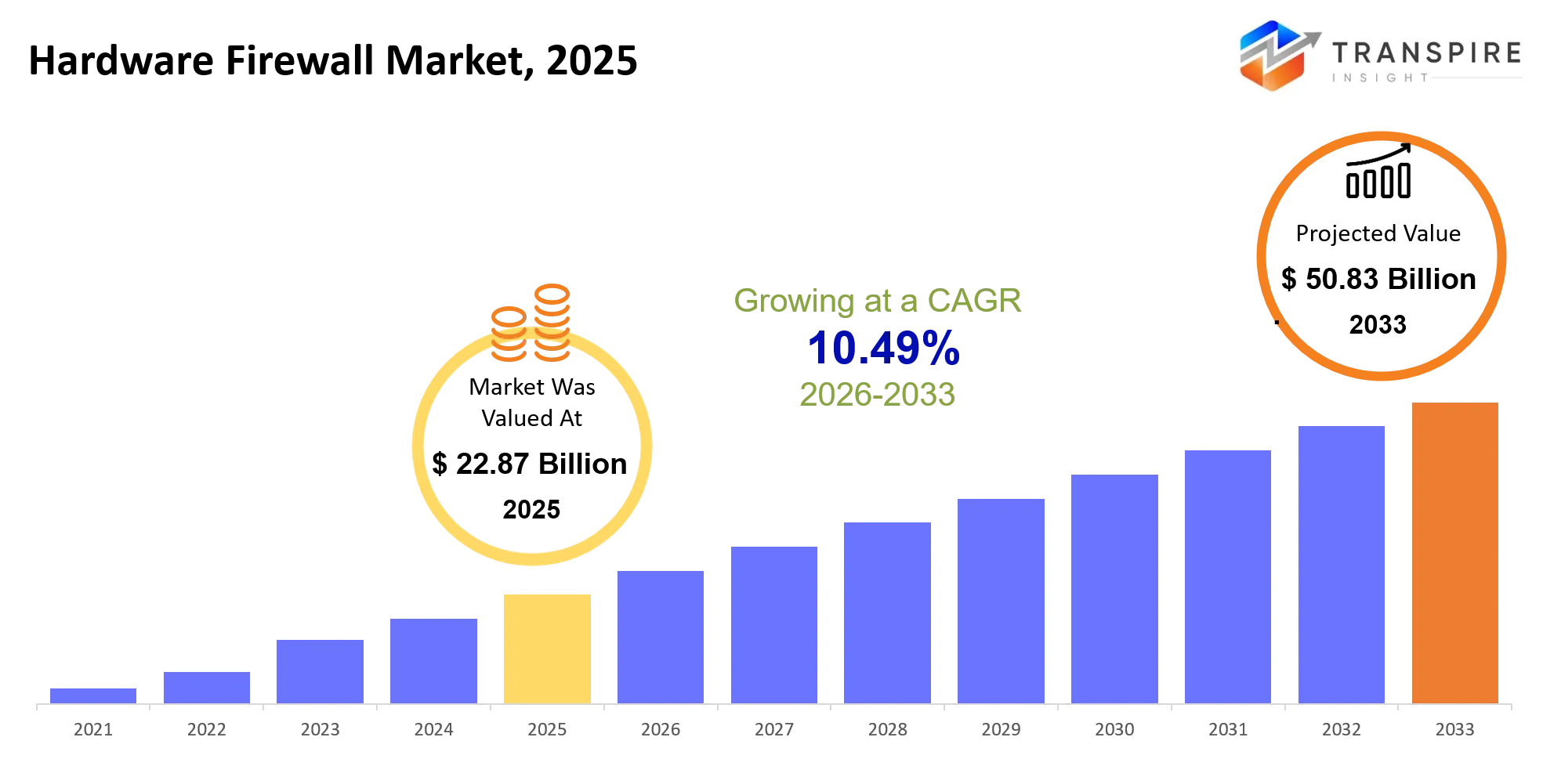
- Global Market Value (2025): USD 22.87 Billion.
- Expected Market Value (2026): USD 25.28 Billion.
- Estimated Market Value (2033): USD 50.83 Billion.
- Forecast CAGR (2026–2033): 10.49%
- Leading Region in 2025: North America
- Second-largest Region: Europe
- Fastest Growing Region: Asia Pacific
Introduction
Hardware firewall industry deals in the installation, configuration, and maintenance of network security hardware devices, which perform filtering and examination of traffic coming in or out from the trusted internal networks to untrusted external networks. A hardware firewall, which is also called a network security appliance, is a physically installed device on the edge of the network that filters traffic flowing in and out of the network. It is different from the software firewall, which runs as an application on the computer system or the host operating system, because the hardware firewall has dedicated computing power, memory, and networking capabilities. Hardware firewalls ensure overall network protection because the hardware secures all the devices connected to the network via the use of a centralized perimeter security device. The resource offloading feature ensures that the specific hardware handles security tasks without using the CPU and memory space of the endpoint. The high-performance ability allows for enterprise-class network traffic handling and secure transfer of information without causing network disruption. Independent security architecture ensures another layer of protection by running independently of the host operating system. Centralized control is important because it allows an organization to have uniform policies across its networks.
For instance:-The North American region leads the global hardware firewall market Due to strict regulatory compliance requirements, critical infrastructure protection needs, and complex cyber-attacks, the investments made by corporate enterprises keep growing. This market enjoys the benefit of considerable financial investment for ASIC-based inspection and zero trust frameworks.
Market Highlights: -
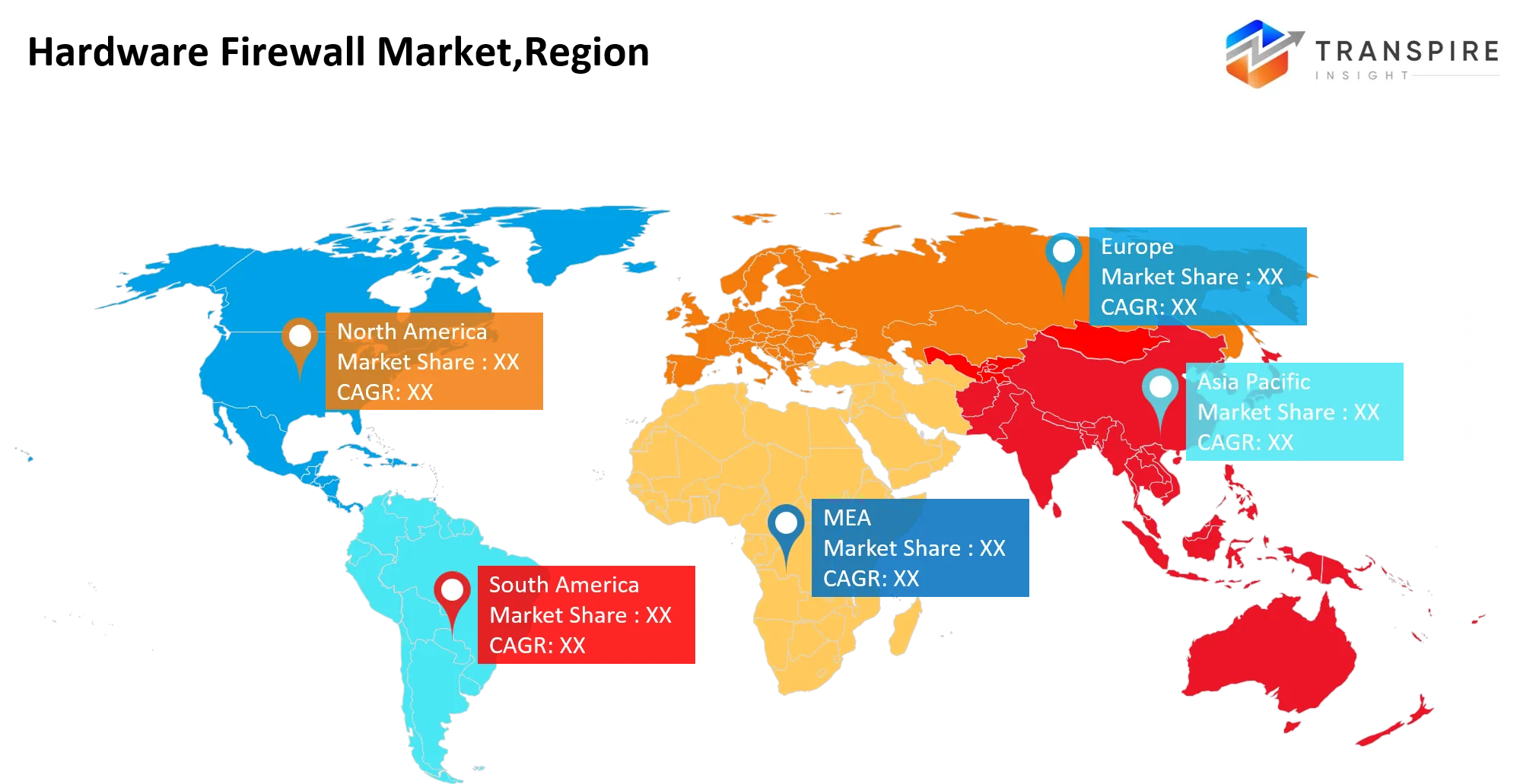
- North America is anticipated to hold roughly 35 % share of the Hardware Firewall Market over the predicted timeframe.
- Europe is expected to grow at a rapid CAGR in the Hardware Firewall Market by holding roughly 25 % of the share during the forecast period.
- Asia Pacific is anticipated to hold roughly 17 % share of the Hardware Firewall Market over the predicted timeframe.
- By type, the Next-generation Firewall segment dominated the market and holds nearly 40 % share in 2025 and is projected to grow at a substantial CAGR during the forecast period.
- By application, the Network Security segment dominated the market and holds nearly 24 % share in 2025 and is projected to grow at a substantial CAGR during the forecast period.
- By connectivity, the Wireless segment dominated the market and holds nearly 78% share in 2025 and is projected to grow at a substantial CAGR during the forecast period.
- CYBERSECURITY EXPENSE FY2026–27: The Indian Government allocated ₹790 crore towards Cyber Security Projects during FY2026–27. This fund is used to develop cyber security capabilities in India. Although it does not include any expenditure on hardware firewalls, the fund increases the demand for network security, threat prevention, and hardware firewall capabilities.
How is Technology Driving Growth in the Hardware Firewall Market?
Hardware Firewalls Market is progressing because of the emergence of advanced technologies that will enhance network security, performance, and threat detection capabilities. Advanced processing via ASIC accelerates high speed deep packet inspection while reducing the processing latency. With the use of AI and machine learning, the threat detection in real time is enhanced by detecting the anomaly in the network behavior and any new threats other than the ones which can be detected using the signature based approach. The growth of 5G networks and edge computing has made it necessary to have strong security in the distributed network nodes and local infrastructures.
|
Report Metrics |
Details |
|
Market size value in 2025 |
USD 22.87 Billion |
|
Market size value in 2026 |
USD 25.28 Billion |
|
Revenue forecast in 2033 |
USD 50.83 Billion |
|
Growth rate |
CAGR of 10.49% from 2026 to 2033 |
|
Base year |
2025 |
|
Historical data |
2021 - 2024 |
|
Forecast period |
2026 - 2033 |
|
Report coverage |
Revenue forecast, competitive landscape, growth factors, and trends |
|
Regional scope |
United States; Canada; Mexico; United Kingdom; Germany; France; Italy; Spain; Denmark; Sweden; Norway; China; Japan; India; Australia; South Korea; Thailand; Brazil; Argentina; South Africa; Saudi Arabia; United Arab Emirates |
|
Key company profiled |
Cisco, Fortinet, Palo Alto Networks, Check Point, SonicWall, Sophos, WatchGuard, Juniper Networks, Huawei, Barracuda Networks, Forcepoint, Zyxel, Hillstone Networks, Sangfor, Netgate |
|
Customization scope |
Free report customization (country, regional & segment scope). Avail customized purchase options to meet your exact research needs. |
|
Report Segmentation |
By Type (Network Firewall, Next-generation Firewall, Unified Threat Management, Web Application Firewall, Cloud Firewall, Industrial Firewall, Database Firewall, Others); By Deployment (On-premise, Cloud, Hybrid, Virtual, Hardware Appliance, Edge, Data Center, Others); By Enterprise Size (Large Enterprises, SMEs, Government, Startups, Mid-sized, Multinationals, Educational, Others); By Application (Network Security, Data Security, Application Security, Endpoint Security, Cloud Security, Industrial Security, IoT Security, Others); By Industry (BFSI, IT & Telecom, Healthcare, Government, Manufacturing, Retail, Energy, Others); By Component (Firewall Appliance, Management Software, Security Services, Threat Intelligence, Monitoring, Analytics, Support, Others); By Connectivity (Ethernet, Fiber, Wireless, 5G, Internet, MPLS, SD-WAN, Others) |
Market Drivers
The Hardware Firewall Market is being influenced by a number of important technology and infrastructure trends. Increased use of ASIC-assisted inspection is creating more demand for high speed, hardware-based Deep Packet Inspection to process encrypted, multi-gigabit traffic. Increasing government-mandated Zero Trust architectures are creating stringent needs for network segmentation and access control. At the same time, edge densification through 5G is creating more distributed attack surfaces, which is bolstering the need for local firewalls. Convergence of IT and OT along with adoption of Industry 4.0 architecture is fueling the need for solid security deployment in industrial networks. A hardware firewall ensures network security through offering protection for all the connected devices using one central security appliance. Pre-routing filtering prevents any malicious packet from reaching an endpoint device by blocking it from the network. The performance offload ensures fast inspection of the traffic without placing too much load on the endpoint processor by using special hardware processors. The centralized management makes it easier to manage and configure the network security policies, monitor the network, and manage any potential threat. Moreover, the current hardware firewall systems have multipurpose use as they can perform routing, virtual private networks, intrusion detection, traffic filtering, and many other tasks in one system.
For Instance: - The United States' hardware firewall market is a strong investment prospect due to the government zero-trust mandate and increasing cyber risks. The US NGFW market is the largest market in the world, being dominated by North America. Market leadership within the United States includes Palo Alto Networks and Fortinet.
There is an enormous investment in the European hardware firewall market, which is being propelled by regulations such as GDPR and NIS2 Directive, which are obligatory for firms. The expenditure on enterprise solutions mainly focuses on NGFW hardware with AI and performance capabilities.
Restrain
The Hardware Firewall Market is facing stiff competition by FWaaS as enterprises embrace cloud-based security services. The initial cost of purchasing the appliance could hinder adoption by SMBs, especially in developing nations. Lack of experienced cybersecurity experts makes it difficult to effectively manage policies. In addition, open source technologies, such as those that implement eBPF-based network filtering, have created competition among low-end hardware firewalls.
|
Driver |
Relative Impact on Growth (%) |
Geographic Relevance |
Impact Timeline |
Demand Strength |
Growth Mechanism |
Key Beneficiaries |
Major Constraint |
|
Escalating Cyberattacks and Advanced Threats |
27% |
North America, Europe, Asia-Pacific |
Short-term |
High |
Rising attacks accelerate enterprise firewall replacement cycles |
Firewall manufacturers, cybersecurity vendors, enterprises |
High deployment and maintenance costs constrain adoption |
|
Zero-Trust Adoption and Regulatory Security Requirements |
23% |
North America, Europe |
Medium-term |
High |
Zero-trust policies increase segmentation and access-control deployments |
NGFW vendors, security integrators, government organizations |
Complex integration with existing security architectures |
|
Cloud, Hybrid Networks and Edge Infrastructure Expansion |
20% |
North America, Asia-Pacific, Europe |
Medium-term |
High |
Distributed infrastructure requires localized network security enforcement |
Firewall vendors, cloud providers, enterprises, MSPs |
FWaaS alternatives reduce physical appliance demand |
|
High-Speed Encrypted Traffic and ASIC Acceleration |
17% |
North America, Europe, Asia-Pacific |
Short-term |
High |
Hardware acceleration enables faster encrypted traffic inspection |
ASIC vendors, firewall manufacturers, data centers |
Advanced hardware increases acquisition and upgrade costs |
|
5G, IoT and Industrial Network Expansion |
13% |
Asia-Pacific, North America, Europe |
Long-term |
Medium |
Connected infrastructure expands attack surfaces requiring dedicated protection |
Industrial enterprises, telecom operators, firewall vendors |
Skills shortages complicate specialized security deployment |
Analysis of Prices and Consumer Behaviour
The Hardware Firewall market share is dominated by Next-Generation Firewalls (58.85% of 2025 shipments; owing to growing demand for next-generation solutions that offer advanced threat prevention, application control, intrusion prevention and network security). The reason why high-end hardware firewalls are worth more money is that they have dedicated computing power, secure throughput, centralized security management, and traffic inspection capabilities. The device and system market shares amounted to about 71.29% of 2025 revenues, aided by persistent corporate spending on physical firewall devices for data centers, branch networks, and critical infrastructures. BFSI comprised around 24.52% of 2025 revenues, thanks to the stringent security considerations and handling of sensitive financial information. Organizations are becoming more selective regarding scalability, threat prevention, performance, and integration of hardware firewalls into cybersecurity systems.
|
Investment Factor |
Why It Matters to Investors |
Opportunity |
Investment Implication |
|
AI-Accelerated and ASIC-Based Firewalls |
High-performance inspection supports premium enterprise security deployments |
Terabit-class appliances, encrypted-traffic inspection, AI threat prevention |
Prioritize vendors with proprietary silicon and differentiated performance |
|
Zero-Trust and Regulatory Security Adoption |
Compliance requirements encourage sustained security infrastructure investment |
Government, BFSI, critical infrastructure, regulated enterprises |
Target suppliers supporting segmentation and policy enforcement |
|
5G, Edge and Distributed Infrastructure |
Distributed networks expand requirements for localized security enforcement |
5G edge nodes, branch networks, industrial sites, telecom infrastructure |
Expand into edge-focused high-throughput firewall architectures |
|
Recurring Services and Hardware-as-a-Service |
Subscription models improve revenue visibility beyond appliance sales |
Managed firewalls, cloud management, support, HWaaS |
Favor vendors combining appliances with recurring services |
|
Asia-Pacific Expansion |
Rapid digitalization and infrastructure development create new security deployments |
India, China, Southeast Asia, telecom and enterprise networks |
Build regional channels and localized cybersecurity offerings |
|
Industrial, OT and Critical-Infrastructure Security |
Operational networks increasingly require dedicated protection and segmentation |
Manufacturing, energy, utilities, transportation, industrial IoT |
Develop specialized ruggedized and OT-capable firewall platforms |
Who are the Key Players in the Hardware Firewall Market and how do they compete?
The competitiveness of the international market for hardware firewalls is based on the specialization of firms in innovative network security technologies, enterprise cybersecurity, and the creation of comprehensive security portfolios that feature global distribution networks. Competition in the field arises not only because of price competition but also due to next-generation firewall technologies, intrusion prevention, threat intelligence, secure connectivity, cloud integration, and zero-trust security.
Developing next-generation firewalls, integrated threat prevention, and security management solutions, Cisco Systems raises its competitiveness in the market. Delivering high-end performance firewalls intended for enterprises, data centers, branch networks, and distributed systems, firms raise their competitiveness through security performance and management features. Fortinet raises its competitiveness through the provision of integrated network security solutions that involve hardware acceleration, secure SD-WAN, intrusion prevention, and unified threat management solutions.
Top Companies in the Hardware Firewall Market
- Cisco
- Fortinet
- Palo Alto Networks
- Check Point
- SonicWall
- Sophos
- WatchGuard
- Juniper Networks
- Huawei
- Barracuda Networks
- Forcepoint
- Zyxel
- Hillstone Networks
- Sangfor
- Netgate
|
Company |
Est. Revenue Share Range |
Key Offerings |
Strategic Positioning |
Geographic Strength |
Technology Focus |
|
Fortinet |
12–16% |
FortiGate NGFW, FortiGate 400G/6000F, FortiGuard Security Services, FortiManager |
ASIC-driven security with broad enterprise scale |
North America, Europe, Asia-Pacific |
Purpose-built ASICs, AI threat intelligence, SD-WAN |
|
Palo Alto Networks |
11–15% |
PA-Series NGFW, PA-400/1400/3400/5400/5500/7500, Panorama |
Premium NGFW platform with ML-powered security |
North America, Europe, Asia-Pacific |
ML-powered inspection, custom ASICs, zero-trust architecture |
|
Cisco |
9–13% |
Secure Firewall 1200, 3100, 4200 Series, Secure Firewall Management Center |
Enterprise ecosystem-led network security integration |
North America, Europe, Asia-Pacific |
Threat intelligence, automation, VPN, centralized management |
|
Check Point |
6–9% |
Quantum Security Gateways, Quantum Force, Quantum Maestro, Security Management |
AI-powered prevention with unified security management |
North America, Europe, Asia-Pacific |
AI engines, threat prevention, clustering, hyperscale security |
|
SonicWall |
4–7% |
TZ Series, NSa Series, NSsp Series, SonicWall Network Security Manager |
Flexible security appliances for distributed enterprises |
North America, Europe, Asia-Pacific |
Real-time inspection, encrypted traffic protection, SD-WAN |
|
Sophos |
3–5% |
XGS Series, Sophos Firewall, Sophos Central, Xstream Protection |
Integrated security with flexible service-based deployment |
Europe, North America, Asia-Pacific |
Xstream architecture, DPI, synchronized security, AI |
|
WatchGuard |
2–4% |
Firebox M-Series, T-Series, Firebox M4850/M5850/M6850, WatchGuard Cloud |
MSP-focused security with scalable appliance offerings |
North America, Europe, Asia-Pacific |
High-speed inspection, cloud management, SD-WAN, UTM |
|
Juniper Networks |
2–4% |
SRX Series, SRX1500/4100/4600/5000, Security Director Cloud |
High-performance network-edge and data-center security |
North America, Europe, Asia-Pacific |
Microsegmentation, identity policies, automation, high throughput |
|
Barracuda Networks |
1–3% |
CloudGen Firewall F-Series, CloudGen Firewall Rugged, Control Center |
Distributed-network and SD-WAN security specialization |
North America, Europe, Europe/Asia-Pacific |
SD-WAN, centralized management, encrypted traffic, OT security |
|
Huawei |
1–3% |
HiSecEngine USG Series, USG6000E, USG9000 Series |
Integrated network-security solutions for regional enterprises |
Asia-Pacific, Middle East & Africa, Latin America |
AI threat detection, high-speed processing, SD-WAN, 5G |
Market Segmentation
The Hardware Firewall Market share is divided into seven categories: By type, deployment, enterprise size, application, industry, component and connectivity.
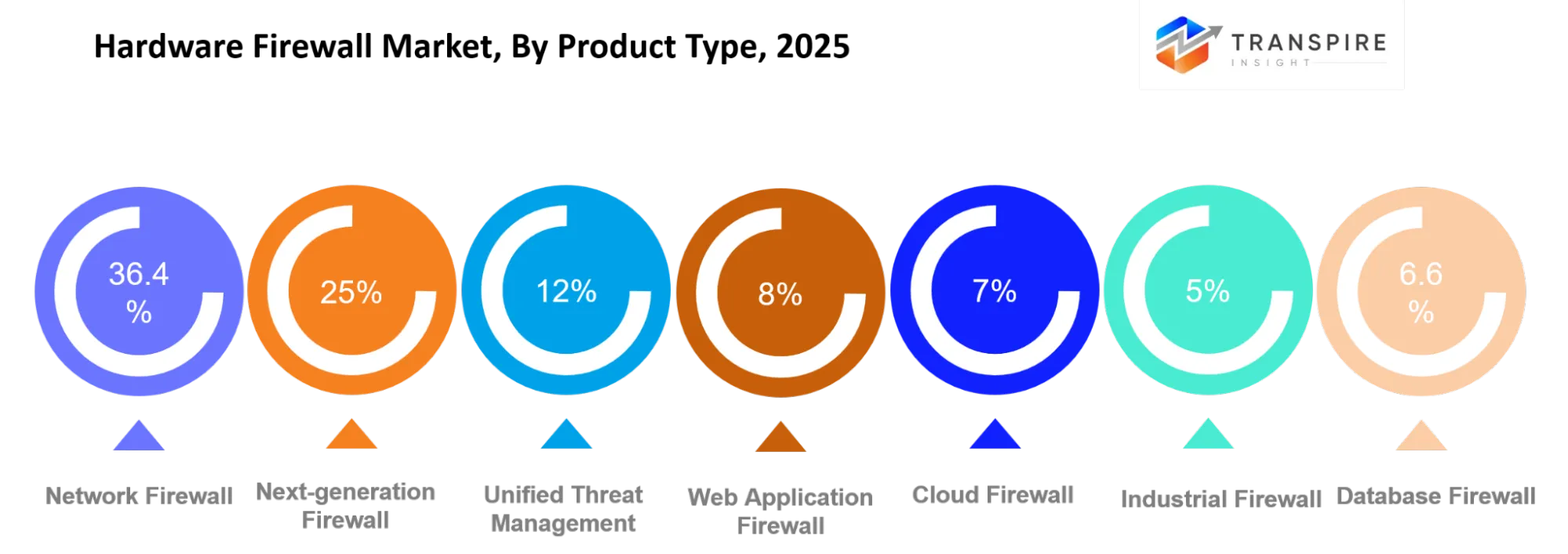
The Next-generation Firewall dominated the market, accounting for nearly 40% in 2025 and is expected to rise at a significant CAGR during the forecast period.
The Hardware Firewall Market is segmented by type into Network Firewall, Next-generation Firewall, Unified Threat Management, Web Application Firewall, Cloud Firewall, Industrial Firewall, Database Firewall, Others. Among these, the Next-generation Firewall segment dominated the market, accounting for nearly 40% in 2025 and expected to increase at a significant CAGR during the forecast period. Next-Generation Firewall held the largest share of the market, at about 40%, in 2025, on the strength of growing cybersecurity risks, cloud computing, remote working environments, and complex attacks from applications. Businesses have implemented next-gen firewall technology to combine threat protection, application management, threat intelligence, and deep packet inspection capabilities. Rising need for centralized network security and zero-trust approaches has aided the acceptance of the technology and fueled growth in the market.
The Network Security dominated the market, accounting for nearly 24% in 2025, and is expected to rise at a significant CAGR during the forecast period.
The Hardware Firewall Market is segmented by application into Network Security, Data Security, Application Security, Endpoint Security, Cloud Security, Industrial Security, IoT Security, Others. Among these, the Network Security segment dominated the market, accounting for nearly 24% in 2025 and expected to increase at a significant CAGR during the forecast period. The Network Security vertical led the market, contributing around 24% of the total revenue share in 2025. The growing trend of cyberattacks, increasing cloud computing architecture, remote working practices, and an increase in connected devices have contributed to this vertical. Enterprises have been enhancing their network security with the help of firewalls, intrusion detection/prevention systems, and other threat detection solutions.
The Wireless dominated the market, accounting for nearly 78% in 2025 and is expected to rise at a significant CAGR during the forecast period.
The Hardware Firewall Market is segmented by connectivity into Ethernet, Fiber, Wireless, 5G, Internet, MPLS, SD-WAN, Others. Among these, the Wireless segment dominated the market, accounting for nearly 78% in 2025 and expected to increase at a significant CAGR during the forecast period. Wireless is the major player in this market, contributing to almost 78% in 2025. The reason behind such a huge share is the wide use of wireless connection across businesses, smart devices, industrial machines, and IoT systems. Increased requirement for mobility, flexibility in implementation, fast communication, and networking has further boosted the acceptance of wireless technology.
Regional Segment Analysis of the Hardware Firewall Market:
- North America (U.S., Canada, Mexico)
- Europe (Germany, France, U.K., Italy, Spain, Rest of Europe)
- Asia-Pacific (China, Japan, India, Rest of APAC)
- South America (Brazil and the Rest of South America)
- The Middle East and Africa (UAE, South Africa, Rest of MEA)
- North America is the fastest-growing region in the Hardware Firewall Market during the period, holding roughly 35% share.
North America is expected to grow at a rapid CAGR in the Hardware Firewall Market holding roughly 35% share during the forecast period. North America is the fastest growing region in the Hardware Firewall Market with nearly 35% share due to highly developed cybersecurity framework, increasing use of enterprise clouds, and advanced cyberattacks. The high requirement for network security within financial institutions, health care institutions, government, and technology sectors, along with strict data security needs and rapid adoption of zero trust approach, boosts regional market growth.
Europe is expected to grow at a rapid CAGR in theHardware Firewall Market, holding roughly 25% of the share during the forecast period.
Europe is expected to grow at a rapid CAGR in the Hardware Firewall Market holding roughly 25% share during the forecast period. The Europe Hardware Firewall Market is predicted to exhibit a fast CAGR in the Hardware Firewall Market, contributing to around 25% share over the forecast period, owing to increased focus on cybersecurity regulations, growing use of the cloud, and rising threats due to ransomware. Increasing investments in network protection and zero trust security within the enterprises are adding momentum to the growth.
Asia Pacific is the fastest-growing region in the Hardware Firewall Market during the period, holding roughly 17% share.
Asia Pacific is the fastest-growing region in the Hardware Firewall Market during the forecast period, holding roughly 17% share during the forecast period. Hardware Firewall Market in Asia Pacific is expected to be the fastest-growing regional market, accounting for around 17% of the share. The region’s growth in the market will be propelled by the fast pace of digitalization, increasing cloud infrastructure, cyber security threats, and enhanced enterprise connectivity in the region.
Strategies for Market Growth in Non-Leading Regions:
The use of technology that ensures effective and scalable deployment of hardware firewalls in non-leading regions will be of great help to small to medium enterprises. It will lead to lower dependency on outsourcing and lower implementation costs. Strategic alliances with regional systems integrators, cloud service providers, telecoms and managed security service providers will increase the penetration of hardware firewall solutions into the market. Training on network security, threat detection, firewall configuration, compliance and cybersecurity management will help to increase the level of knowledge on how to use hardware firewalls. Furthermore, the provision of flexible financing, service contracts and managed security will increase access to hardware firewall solutions. Collaboration between the government, telecom and digital infrastructure initiatives, coupled with digital sales, will increase access to hardware firewall solutions.
Future Market Trends for the Hardware Firewall Market: -
- ASICs & AI Integration: Application specific integrated circuits that have been customized integrate AI threat analytics to handle large-scale SSL processing.
- 5G Edge Designs: Enterprise branch architectures create the need for highly performant and dedicated edge appliance devices.
- Zero Trust Enforcement: Next Generation Firewalls serve as deterministic micro-segmentation gateways in the zero trust architecture.
- Supply Chain Normalization: Reduced merchant silicon delivery times hasten the core enterprise datacenter refresh cycle.
Recent Development
- In June 2026: The new line of rack mountable products from WatchGuard includes Firebox M4850, M5850, and M6850, which offer high-speed connection capabilities via 25G and 100G and have been designed with the OCP 3.0 card slot. These products help organizations to inspect encrypted traffic, scale up, enhance network performance, and improve cybersecurity.
- In July 2026: Sophos introduced Firewall HWaaS, making it possible for Managed Service Providers (MSPs) to procure hardware from the XGS Series range on a recurring monthly basis through subscription without any upfront costs. The service combines the firewall appliance with Xstream Protection, hence ensuring flexible implementation, predictable costs, and scalability in network security.
This study forecasts revenue at global, regional and country levels from 2020 to 2033. Transpire Insights has segmented the Hardware Firewall Market based on the below-mentioned segments:
Hardware Firewall Market, By Type
- Network Firewall
- Next-generation Firewall
- Unified Threat Management
- Web Application Firewall
- Cloud Firewall
- Industrial Firewall
- Database Firewall
- Others
Hardware Firewall Market, By Deployment
- On-premise
- Cloud
- Hybrid
- Virtual
- Hardware Appliance
- Edge
- Data Center
- Others
Hardware Firewall Market, By Enterprise Size
- Large Enterprises
- SMEs
- Government
- Startups
- Mid-sized
- Multinationals
- Educational
- Others
Hardware Firewall Market, By Application
- Network Security
- Data Security
- Application Security
- Endpoint Security
- Cloud Security
- Industrial Security
- IoT Security
- Others
Hardware Firewall Market, By Industry
- BFSI
- IT & Telecom
- Healthcare
- Government
- Manufacturing
- Retail
- Energy
- Other
Hardware Firewall Market, By Component
- Firewall Appliance
- Management Software
- Security Services
- Threat Intelligence
- Monitoring
- Analytics
- Support
- Others
Hardware Firewall Market, By Connectivity
- Ethernet
- Fiber
- Wireless
- 5G
- Internet
- MPLS
- SD-WAN
- Others
Hardware Firewall Market, By Regional Analysis
North America
- US
- Canada
- Mexico
Europe
- Germany
- UK
- France
- Italy
- Spain
- Russia
- Rest of Europe
Asia Pacific
- China
- Japan
- India
- South Korea
- Australia
- Rest of Asia Pacific
South America
- Brazil
- Argentina
- Rest of South America
Middle East & Africa
- UAE
- Saudi Arabia
- Qatar
- South Africa
- Rest of the Middle East & Africa
Frequently Asked Questions
Find quick answers to common questions.
The Hardware Firewall Market reached approximately USD 22.87 billion in 2025, reflecting growing enterprise demand for advanced network security solutions.
Rising cyberattacks, zero-trust adoption, 5G deployment, edge computing, cloud expansion, and increasing cybersecurity investments are driving market growth globally.
The Next-generation Firewall segment dominated in 2025, supported by advanced threat prevention, application control, intrusion prevention, and deep packet inspection capabilities.
North America leads the Hardware Firewall Market, supported by advanced cybersecurity infrastructure, cloud adoption, regulatory requirements, and increasing enterprise cyber risks.
The Hardware Firewall Market is projected to grow at a 10.49% CAGR from 2026–2033, reaching USD 50.83 billion.
- Cisco
- Fortinet
- Palo Alto Networks
- Check Point
- SonicWall
- Sophos
- WatchGuard
- Juniper Networks
- Huawei
- Barracuda Networks
- Forcepoint
- Zyxel
- Hillstone Networks
- Sangfor
- Netgate
About the Authors

Mayur Shinde
I am Mayur Shinde, a Senior Research Analyst at Transpire Insight, specializing in the Automotive & Transportation and Information & Communication Technology (ICT) Industry. My work focuses on analyzing emerging market trends, technological advancements, competitive landscapes, and industry developments to deliver accurate, data-driven insights. I am passionate about transforming complex market information into clear, actionable content that helps businesses, professionals, and decision-makers stay informed and make confident strategic decisions.

Chakradhar Khansole
Chakradhar serves as the Research Director at Transpire Insight, bringing over 8 years of experience in technology, innovation, and strategic market intelligence. He specializes in transforming complex market data into actionable business insights that enable organizations to make informed, growth-oriented decisions. Recognized for his strategic vision and analytical expertise, Chakradhar leads high-impact research initiatives, delivering comprehensive market assessments, competitive intelligence, and forward-looking industry analysis.
Recently Published Reports
-
Apr 2026
3D Optical Profiler Market
3D Optical Profiler Market Size, Share & Analysis Report By Type (Desktop 3D Optical Profiler, and Portable 3D Optical Profiler), By Technology (Confocal Technology, and White Light Interference), By End-Use Industry (Manufacturing, Research Institutions, Automotive, Aerospace and Defense, Medical Devices, and Other), and Geography (North America, Europe, Asia-Pacific, Middle East and Africa, South and Central America), 2021 - 2031
-
Apr 2026
Depth Sensor Market
Depth Sensor Market Size, Share & Analysis Report By Type (Infrared Depth Sensors, Time-of-Flight (ToF) Sensors, Stereo Vision Sensors, Structured Light Sensors, Ultrasonic Depth Sensors), By Application (Automotive, Robotics, Gaming, Consumer Electronics, Industrial Automation, Healthcare, Security & Surveillance, Others), By End Users (Automotive Manufacturers, Consumer Electronics Companies, Healthcare Providers, Industrial Companies, Security Agencies, Gaming Companies, Robotics Companies, Others), and Geography (North America, Europe, Asia-Pacific, Middle East and Africa, South and Central America), 2021 – 2031
-
Apr 2026
Digital Manufacturing Market
Digital Manufacturing Market Size, Share & Analysis Report By Component (Hardware, Software, and Services), By Technology (Robotics, 3D Printing, Internet of Things (IoT), and Others), By Application (Automotive and Transportation, Aerospace and Defense, Consumer Electronics, Industrial Machinery, and Others), By Process Type (Computer-Based Designing, Computer-Based Simulation, Computer 3D Visualization, Analytics, and Others), and Geography (North America, Europe, Asia-Pacific, Middle East and Africa, South and Central America), 2021 – 2031
-
Apr 2026
Digital Visa Services Market
Digital Visa Services Market Size, Share & Analysis Report By Type (Individual Travelers, Group Travelers), By Application (Tourism, Business Travel, Others), and Geography (North America, Europe, Asia-Pacific, Middle East and Africa, South and Central America), 2021 – 2031