
Europe Web Application Firewall [WAF] Market Summary
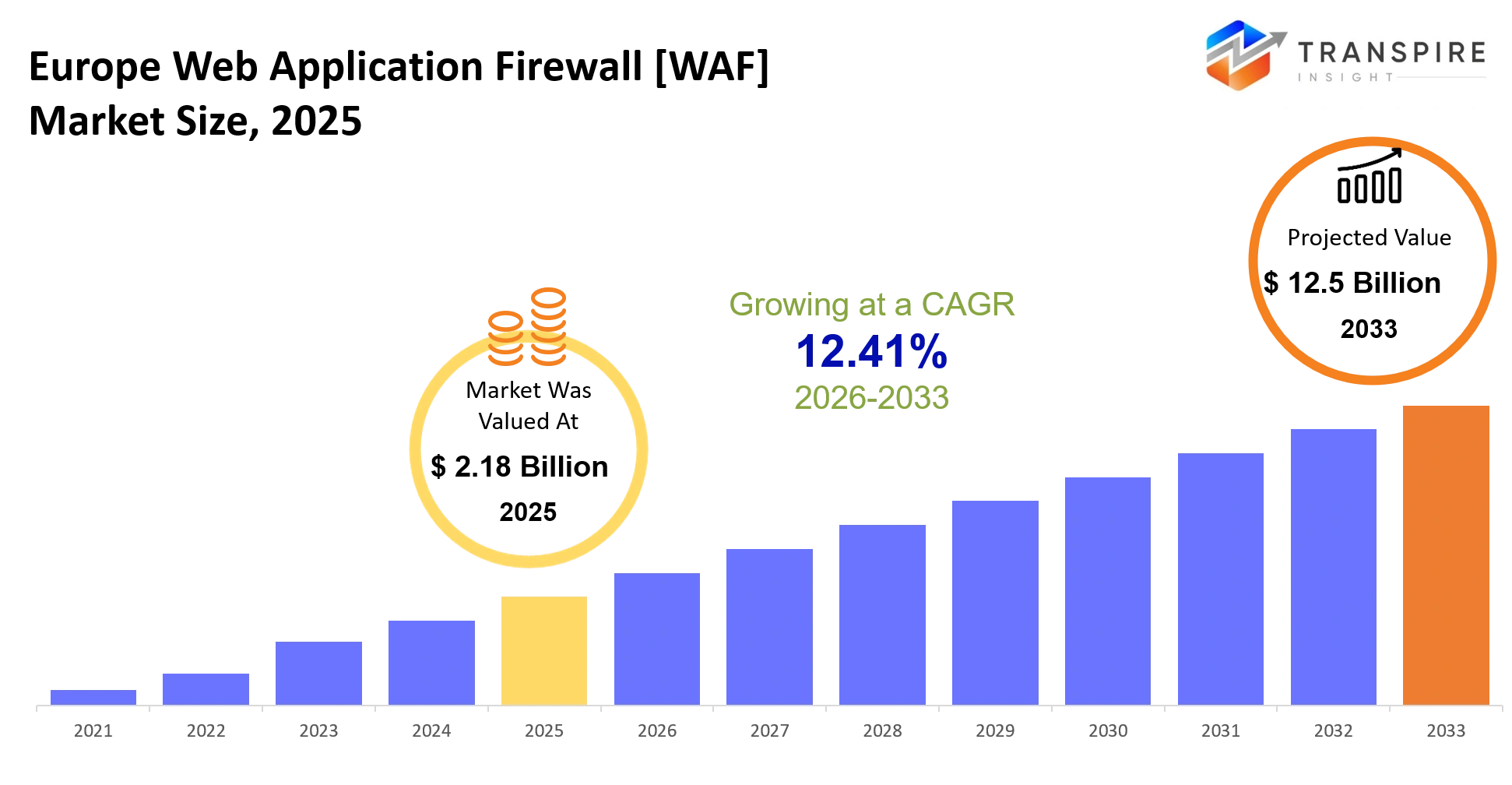
As per Transpire Insight Analysis the Europe Web Application Firewall [WAF] Market size is estimated at USD 2.18 Billion in 2025 and is anticipated to reach USD 12.5 Billion by 2033, growing at a CAGR of 12.41% from 2026 to 2033.
The Europe Web Application Firewall (WAF) market sits in the middle of things, protecting business-critical web applications, customer portals, payment platforms, and cloud-based services from cyberattacks that can knock operations off course, leak sensitive data, and also weaken regulatory compliance. A lot of banking, healthcare, manufacturing, retail and government groups use WAF tools so they can filter bad traffic while keeping digital services running smoothly for customers, and for employees too.
Over the last three to five years, the market vibe moved from hardware-first deployments toward cloud native and mixed environments, where WAF platforms blend into wider cybersecurity architectures, kind of like a bigger ecosystem. That shift got even faster after the swift growth of remote work and digital services during the COVID-19 period, when the attack surface for internet-facing apps grew quite a bit. Since application setups became more spread out, many enterprises leaned toward adaptive security models, so protections could cover workloads across several clouds plus on premises infrastructure, all in one approach.
This progression is now fueling steady spending in smarter WAF platforms, helping build stronger recurring service revenue streams and, at the same time, increasing rollouts among organizations chasing long term digital transformation.
Europe Web Application Firewall [WAF] Market Size & Forecast:
- Europe Web Application Firewall [WAF] Market Size 2025: USD 2.18 Billion
- Expected Market Value 2033: USD 12.5 Billion
- Forecast CAGR: 12.41%
- Leading region in 2025: Western Europe
- Fastest Growing region: Central and Eastern Europe (CEE)
- Key Profile: Cloudflare, Akamai, F5, Imperva, Fortinet, AWS, Microsoft, Barracuda Networks, Radware, Sophos, Fastly, Citrix, Palo Alto Networks, Check Point, Oracle
Key Market Insights
- Western Europe pretty much led the Europe Web Application Firewall (WAF) market, taking around 67% market share in 2025, and this was backed by a more mature digital setup and tight cybersecurity rules.
- Meanwhile, Central and Eastern Europe will still be the fastest growing regional area during 2025–2033, mainly because cloud adoption keeps widening, public sector digital services are pushing ahead, and company spending on enterprise protection budgets keeps climbing.
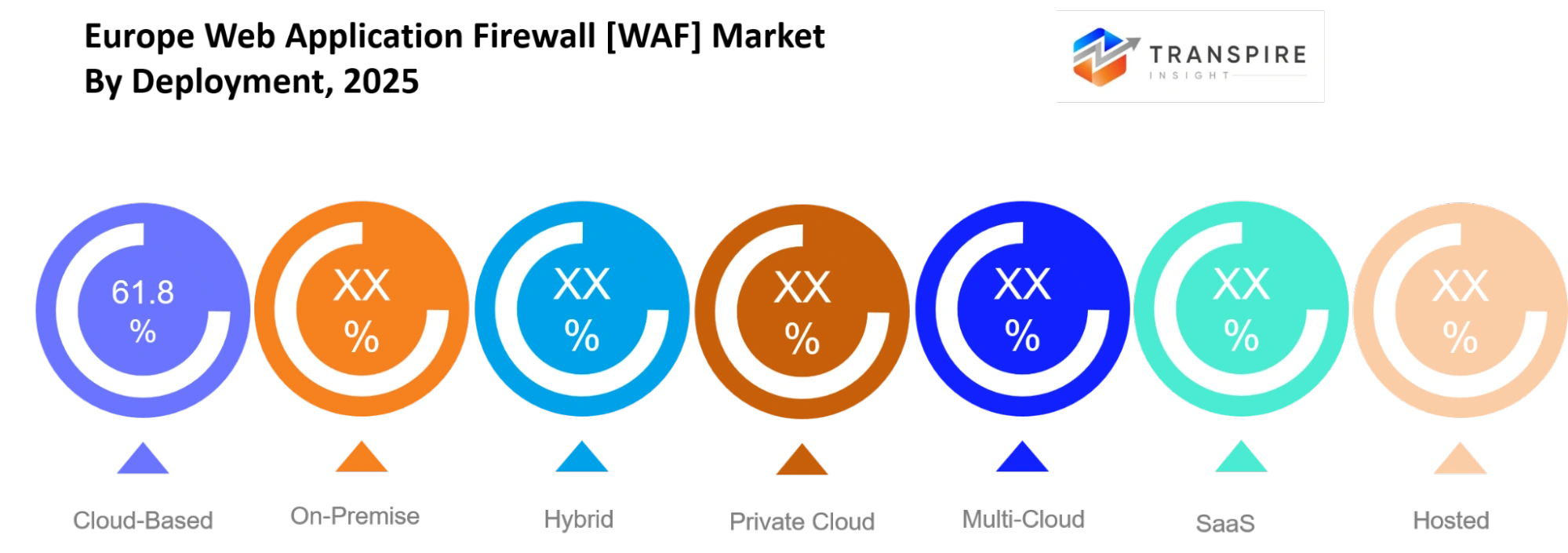
- On the product side, cloud-based WAF solutions were in front with about 61% market share in 2025, which kinda points to how enterprises are shifting toward scalable cloud-native security blueprints.
- Hybrid WAF deployments sat in the second spot as well, because regulated industries try to get cloud flexibility but also keep coverage for older, legacy infrastructure which still matters.
- AI-enabled WAF platforms, though, are expected to expand the quickest through 2033, powered by automated threat intelligence and real time adaptive policy administration.
- For application type, BFSI apps had roughly 31% market share in 2025, since banks and other financial institutions keep reinforcing defenses against more advanced web app and API assaults.
- Healthcare applications are set to grow the fastest during the forecast window, because digital health services are expanding and they need steady application-layer safeguards, all the way through.
- As for end users, large enterprises stayed on top, holding roughly 64% market share in 2025, supported by big digital footprints and complicated compliance obligations.
- Smaller companies and mid-sized businesses will likely show the fastest growth through 2033, supported by managed cloud security services, they help cut down deployment headaches, mostly.
What are the Key Drivers, Restraints, and Opportunities in the Europe Web Application Firewall [WAF] Market?
The main pressure pushing the Europe Web Application Firewall market forward is pretty much the fast shift toward cloud-native apps and API centered operations, you know. As stricter cybersecurity rules roll in, like NIS2 taking shape and more data protection obligations, enterprises start paying more attention to application-layer safeguards. So instead of leaning only on conventional network firewalls, companies are now securing the customer-facing portals, the payment systems, and their internal enterprise applications. That change expands recurring subscription income for managed and cloud-delivered WAF vendors and it also helps lock in longer term platform adoption across finance, healthcare, manufacturing, and government sectors.
The toughest structural snag is how complicated it gets to secure hybrid setups and multi cloud environments with steady, consistent security rules. A lot of organizations still run older applications side by side with newer cloud workloads, which leads to security designs that feel split up and hard to unify quickly. On top of that, qualified cybersecurity staff are still in short supply across several European markets. According to Transpire Insight, based on a review of regional purchasing announcements and go-live timelines, the biggest execution problem stays tied to supply chain concentration. All of this tends to slow deployments, holds back enterprise upgrades, and stretches procurement timelines for advanced security platforms ,sometimes more than teams expected.
A big chance sits inside AI-powered application security platforms that merge a Web Application Firewall with API security, bot mitigation, and runtime protection all under one roof architecture, sort of unified. In Europe, organizations keep leaning harder into zero trust mindsets and Secure Access Service Edge deployments. Central and Eastern Europe looks especially interesting for investing too, since digital infrastructure modernization is speeding up. Vendors who can bring automated threat intelligence, smoother deployment, and compliance reporting that’s more straightforward will likely help build that steady recurring revenue, while also pushing wider enterprise adoption in industries that are still underserved.
What Has the Impact of Artificial Intelligence Been on the Europe Web Application Firewall [WAF] Market?
Artificial intelligence has, kind of fundamentally reshaped the European web application security landscape by making it possible to do continuous inspection of application traffic without leaning only on the predefined security rules . A lot of the modern security platforms end up automatically spotting abnormal behavior , they tend to bump the highest risk events to the top and then create those dynamic protection policies that cut down on the amount of manual work the security operations teams usually do. Machine learning models then go through billions of requests, to forecast how attacks might look, help tell genuine visitors apart from malicious bots , and also improve how policy enforcement happens, before threats can disrupt business services. With these predictive abilities , application availability usually improves, false positives get reduced, and security teams can respond to new vulnerabilities faster across both cloud and hybrid environments.
AI also seems to boost day to day operational efficiency by automating compliance reporting, making policy tuning simpler, and shrinking investigation time for the analysts. Many organizations say they see tangible gains in incident response speed, operational visibility, and even better infrastructure utilization once intelligent WAF platforms get connected with broader security operations tools. That said , AI adoption still runs into practical limits . Integration costs can be steep especially for enterprises stuck with complicated legacy environments, and machine learning models need a lot of high quality traffic data in order to keep detection accuracy steady. If data quality ends up inconsistent across hybrid infrastructures, prediction reliability can take a hit, and then you still get this need for ongoing human validation, even while automation keeps increasing.
Key Market Trends
- Since 2022 , enterprises have sort of moved more and more away from appliance based WAF setups toward cloud delivered protection services, for distributed app settings.
- Now, NIS2 compliance staff is pushing organizations in the 2024–2027 window to modernize their application layer defenses across key infrastructure domains, like really directly.
- Also, API security has turned into a strategic investment priority as enterprises start exposing extra digital services via cloud native architectures after 2023.
- At the same time AI assisted threat detection keeps replacing static signature inspections, which helps spot zero-day intrusions faster , and it can even tune policies automatically without much manual work.
- Managed security services have also spread among small and medium businesses since 2023, reducing operational burden and making cloud WAF adoption feel less painful.
- Cloudflare, F5 and Akamai Technologies keep putting money into AI powered application protection, and they are expanding the integrated security capabilities across European regions.
- More security vendors now bundle WAF with bot management API protection and DDoS mitigation into one combined stack, just to simplify enterprise cybersecurity operations.
- Meanwhile zero trust security architectures have shifted buying patterns since 2023 , so companies favor integrated application security rather than isolated perimeter defense technologies.
- Finally, the regional cloud infrastructure growth across Central and Eastern Europe is backing broader deployment of cloud native security platforms across the forecast period.
Europe Web Application Firewall [WAF] Market Segmentation
By Deployment :
Cloud based solutions held the leading share because companies kept shifting customer-facing apps, digital services, and enterprise workloads into cloud environments, almost like it just made sense. The whole flexible deployment angle, plus automatic updates, and yes, reduced infrastructure costs , helped more and more firms adopt it across financial services, healthcare, retail, and technology. These cloud platforms also boosted scalability when web traffic spiked, while still keeping security performance pretty solid. There was also strong alignment with modern DevSecOps routines which made it easier to justify long-term investment.
Hybrid deployment came in as the second-largest slice because quite a lot of organizations tried to balance what they already had with new cloud applications. Big enterprises often went for gradual migration plans rather than just throwing out their current infrastructure. Meanwhile, on-premise offerings stayed relevant for groups managing sensitive information, or those with strict compliance obligations. Multi-Cloud, SaaS, Hosted, Private Cloud, and a few other deployment approaches kept growing too, as businesses chose settings based on operational needs, regulatory limits, and performance requirements.
By Component :
Solutions end up being the largest component, since companies really needed an integrated cover against application-layer attacks, bad traffic flows, and those unauthorized access tries. They kept pushing continuous feature upgrades and added wider security capabilities , so investment looked more worth it across different industries. Demand kind of kept rising too, especially when firms folded security into digital transformation work. In the modern setup, many solutions allow centralized policy management, across several application environments, which helps a lot in practice.
Services were the next big slice, mostly because enterprises leaned on implementation work, consulting, and steady technical assistance to lift overall security performance. Managed Services saw the quickest growth, largely because true dedicated security teams are still limited in a lot of organizations. Alongside that, Professional Services, Analytics Tools, Threat Intelligence, Monitoring Tools, and a bunch of other offerings kept supporting proactive risk management, quicker incident response, and better day-to-day operational efficiency. A broader set of services also helped organizations simplify cybersecurity operations that used to feel pretty complex.
By Application :
DDoS Protection took the biggest slice overall , mainly because nobody can really afford losing uninterrupted access to digital platforms, it just stays crucial for business continuity and for customer trust. Money, from financial institutions, retailers, and public organizations, went into preventing service disruption from big scale attacks. On top of that , dependable traffic management meant fewer operational losses when the network behaved abnormally. And yeah, stable application performance still ended up being a major reason for buying, without much debate.
API Security showed up as the fastest-growing application, since digital platforms keep relying more and more on connected services and cloud-based application programming interfaces. Bot Protection, Data Protection, Regulatory Compliance, Threat Detection, Traffic Filtering , and a few other application types also kept climbing, as cyber threats became more sophisticated. Getting wider security coverage worked like a double win, lowering business risks while also backing regulatory compliance. Continuous monitoring additionally sharpened the response time, especially as new attack techniques started appearing.
By End User :
BFSI kinda stayed the main end-user group because financial organizations deal with high-value transfers and sensitive customer data, literally every single day. On top of that, strict regulatory rules, plus those constant attempts of cyberattackers, pushed them into ongoing spending for more advanced app security. Even secure digital banking platforms needed steady safeguards, against online threats that just keep changing. And the longer-term cybersecurity budgets really helped keep the financial sector deploying protections in a consistent way.
Healthcare, meanwhile, showed the quickest growth, because hospitals diagnostic centers and digital health providers kept moving more services online, including electronic health records and patient portals. Government, Retail, IT & Telecom, Manufacturing, Education and other sectors also boosted their investment to protect the growing digital setup. With more companies using cloud platforms , the demand for application-layer protection jumped across both public and private organizations. Overall, security modernization remained a top priority across many industries.
By Enterprise Size :
Large Enterprises took the top market share, mostly because having that kind of large digital setup really means you need advanced security across different business locations and also mixed cloud environments, so yes it is a lot. Big organizations tend to put money into integrated cybersecurity platforms that can handle centralized monitoring and automated policy management and all that. They also had solid financial reserves, which let them keep doing regular tech refreshes, plus ongoing security refinements. On top of that, organization-wide digital transformation initiatives helped adoption move faster and become more stable.
Small Enterprises looked like the fastest-growing part, largely because cloud-delivered security services cut down deployment expenses and made setup feel more straightforward. Medium Enterprises and Startups, along with Public Agencies, NGOs, Academic Institutions, and other types of organizations, expanded their spending too, mainly to protect web applications from cyber threats that keep getting more and more sophisticated. Subscription-based security models made it easier to access protection for groups with fewer technical resources. Going forward, the continuing digitalization push should help broader adoption across companies of every size, somehow in a more even way.
What are the Key Use Cases Driving the Europe Web Application Firewall [WAF] Market?
Banking and financial institutions pretty much stay the biggest use case, because uninterrupted protection of online banking, payment gateways, and customer portals is still key for day to day operations. Financial organizations end up investing in advanced web application security to lower fraud exposures, shield sensitive transaction data, and also to comply with strict European cybersecurity as well as data protection obligations.
Healthcare providers together with government agencies are ramping up adoption, since digital services are becoming more and more central for patient care, and public administration too. Retail along with IT and telecom organizations are also deploying enhanced defenses for e-commerce platforms, customer applications, and API based services that process huge numbers of digital transactions and user requests, all the time.
Manufacturing companies are starting to lock down connected production environments and supplier portals as industrial digitalization keeps growing. Educational institutions are going along as well, looking at advanced application security for cloud based learning platforms and research systems, while trying to meet tougher cybersecurity standards across Europe.
|
Report Metrics |
Details |
|
Market size value in 2025 |
USD 2.18 Billion |
|
Market size value in 2026 |
USD 2.71 Billion |
|
Revenue forecast in 2033 |
USD 12.5 Billion |
|
Growth rate |
CAGR of 12.41% from 2026 to 2033 |
|
Base year |
2025 |
|
Historical data |
2021 - 2024 |
|
Forecast period |
2026 - 2033 |
|
Report coverage |
Revenue forecast, competitive landscape, growth factors, and trends |
|
Regional scope |
Europe (Germany, United Kingdom, France, Italy, Spain and Rest of Europe) |
|
Key company profiled |
Cloudflare, Akamai, F5, Imperva, Fortinet, AWS, Microsoft, Barracuda Networks, Radware, Sophos, Fastly, Citrix, Palo Alto Networks, Check Point, Oracle . |
|
Customization scope |
Free report customization (country, regional & segment scope). Avail customized purchase options to meet your exact research needs. |
|
Report Segmentation |
By Deployment (Cloud-Based, On-Premise, Hybrid, Private Cloud, Multi-Cloud, SaaS, Hosted, Others); By Component (Solutions, Services, Managed Services, Professional Services, Analytics Tools, Threat Intelligence, Monitoring Tools, Others); By Application (DDoS Protection, API Security, Bot Protection, Data Protection, Regulatory Compliance, Threat Detection, Traffic Filtering, Others); By End User (BFSI, Government, Healthcare, Retail, IT & Telecom, Manufacturing, Education, Others); By Enterprise Size (Large Enterprises, Medium Enterprises, Small Enterprises, Startups, Public Agencies, NGOs, Academic Institutions, Others) |
Which Regions are Driving the Europe Web Application Firewall [WAF] Market Growth?
Western Europe sort of accounted for around 67% of total revenue in 2025, so in a way it’s still the biggest driver for market expansion. There’s also this strong push on cybersecurity regulations, like GDPR and NIS2 together with more advanced cloud infrastructure, which has kept investment flowing into application security tools and capabilities. A mature digital economy plus global cloud providers, cybersecurity vendors, managed security service providers, and enterprises that keep spending on technology have basically formed a solid commercial ecosystem. If cloud migration continues, regulation keeps getting enforced, and enterprise security architecture keeps getting modernized, regional leadership should stay in place through most of the forecast period.
Northern Europe still matters a lot as a revenue contributor, because organizations have been investing in secure digital infrastructure for years and years. The regulatory rules are relatively stable, digital maturity is high, and public plus private technology spending looks resilient, so procurement patterns stay predictable across government, finance, and telecommunications. Cloud services are widely adopted, and cybersecurity governance is strong, which helps support consistent deployment of advanced application protection platforms. Together this means dependable long term revenue, without needing those very fast, short term investment cycles.
Central and Eastern Europe is expected to see the fastest expansion in the 2026–2033 window, as digital infrastructure initiatives and enterprise cloud uptake keep pushing ahead , there’s a kind of snowball effect here. More adoption of European cybersecurity rules, plus greater spending on modern data centers, has basically pushed demand upward for application level protection across public as well as private institutions. At the same time, swift modernization in manufacturing, financial services, and government agencies has unlocked fresh openings for cloud based defense solutions that are a bit more sophisticated. Altogether this momentum should translate into compelling growth chances for technology sellers, managed security providers and even investors aiming for high growth territories around the region.
Who are the Key Players in the Europe Web Application Firewall [WAF] Market and How Do They Compete?
Competition is still kind of moderately consolidated, since only a few big global cybersecurity players take up a lot of the enterprise deployment share , and then other specialized security companies try to win via managed services and narrower strengths. In practice, tech progress plus cloud fit, AI based threat detection, and just general service quality stay as the main competitive levers, not price by itself, even if cost always matters somewhat. Meanwhile the long established vendors keep bolting on more integrated security platforms, and the more specialized providers grow by tackling things like API protection, bot mitigation, and managed detection needs that some larger suites may not push as hard.
Cloudflare sets itself apart with that globally spread cloud network, which delivers application security alongside DDoS protection and performance tuning all from one place. Akamai Technologies blends edge computing with application security, so enterprises can protect high volume digital services while keeping low latency especially across European markets. F5 tends to center on hybrid enterprise setups, by combining application delivery with stricter security guardrails , so moving away from old infrastructure feels less painful for bigger organizations.
Fortinet drives broader uptake by tying web application security into wider network security offerings, which helps simplify centralized oversight across distributed teams. Imperva, on the other hand, leans hard into advanced data protection, API security, and threat intelligence, so it attracts heavily regulated sectors where compliance is complicated and non-negotiable. Ongoing feature upgrades, cloud alliances, and continued spending on AI powered detection help these companies hold on to customers while also growing subscription type recurring revenue throughout Europe.
Company List
- Cloudflare
- Akamai
- F5
- Imperva
- Fortinet
- AWS
- Microsoft
- Barracuda Networks
- Radware
- Sophos
- Fastly
- Citrix
- Palo Alto Networks
- Check Point
- Oracle
Recent Development News
In April 2026, Cloudflare partnered with GoDaddy to integrate AI Crawl Control capabilities across GoDaddy-hosted websites. The partnership strengthens application-layer security and gives website owners greater control over automated AI crawler traffic, expanding advanced web protection capabilities for businesses. Source https://www.cloudflare.com/press/
In April 2025, Akamai Technologies launched App & API Protector Hybrid. The new hybrid web application firewall solution extends consistent WAF protection across multicloud, on-premises, and CDN-agnostic environments, strengthening enterprise application security and supporting broader hybrid deployment strategies. Source https://www.ir.akamai.com/
What Strategic Insights Define the Future of the Europe Web Application Firewall [WAF] Market?
Over the next five to seven years, the Europe Web Application Firewall [WAF] Market is likely to shift toward more unified application security platforms, where web protection and API security kind of blend together, plus bot mitigation, and AI driven threat detection all end up under one architecture. You can see this structural move being pushed by the fast expansion of cloud-native applications, tighter cybersecurity regulations, and also the wider adoption of zero trust security models across public and private orgs.
There is also this not-so-obvious risk, it’s the growing dependence on a small pool of global cloud security providers , and that can quietly raise vendor concentration, then enterprise buyers may find procurement less flexible. But at the same time, there’s an opportunity that’s starting to show up: securing AI powered business applications and operational technology web interfaces, especially as Central and Eastern Europe keeps investing in digital infrastructure.
For market participants, the upside is clearer if they build interoperable platforms that fit well with multi-cloud setups while also offering automated compliance reporting. Flexible, subscription style deployment models will matter too, because teams want quick adoption without heavy friction.
Europe Web Application Firewall [WAF] Market Report Segmentation
By Deployment
- Cloud-Based
- On-Premise
- Hybrid
- Private Cloud
- Multi-Cloud
- SaaS
- Hosted
By Component
- Solutions
- Services
- Managed Services
- Professional Services
- Analytics Tools
- Threat Intelligence
- Monitoring Tools
By Application
- DDoS Protection
- API Security
- Bot Protection
- Data Protection
- Regulatory Compliance
- Threat Detection
- Traffic Filtering
By End User
- BFSI
- Government
- Healthcare
- Retail
- IT & Telecom
- Manufacturing
- Education
By Enterprise Size
- Large Enterprises
- Medium Enterprises
- Small Enterprises
- Startups
- Public Agencies
- NGOs
- Academic Institutions
Frequently Asked Questions
Find quick answers to common questions.
The expected Europe Web Application Firewall [WAF] Market size for the market will be USD 12.5 Billion in 2033.
Key segments for the Europe Web Application Firewall [WAF] Market are By Deployment (Cloud-Based, On-Premise, Hybrid, Private Cloud, Multi-Cloud, SaaS, Hosted, Others); By Component (Solutions, Services, Managed Services, Professional Services, Analytics Tools, Threat Intelligence, Monitoring Tools, Others); By Application (DDoS Protection, API Security, Bot Protection, Data Protection, Regulatory Compliance, Threat Detection, Traffic Filtering, Others); By End User (BFSI, Government, Healthcare, Retail, IT & Telecom, Manufacturing, Education, Others); By Enterprise Size (Large Enterprises, Medium Enterprises, Small Enterprises, Startups, Public Agencies, NGOs, Academic Institutions, Others).
Major Europe Web Application Firewall [WAF] Market players are Cloudflare, Akamai, F5, Imperva, Fortinet, AWS, Microsoft, Barracuda Networks, Radware, Sophos, Fastly, Citrix, Palo Alto Networks, Check Point, Oracle.
The Europe Web Application Firewall [WAF] Market size is USD 2.18 Billion in 2025.
The Europe Web Application Firewall [WAF] Market CAGR is 12.41% from 2026 to 2033.
- Cloudflare
- Akamai
- F5
- Imperva
- Fortinet
- AWS
- Microsoft
- Barracuda Networks
- Radware
- Sophos
- Fastly
- Citrix
- Palo Alto Networks
- Check Point
- Oracle
About the Authors

Mayur Shinde
I am Mayur Shinde, a Senior Research Analyst at Transpire Insight, specializing in the Automotive & Transportation and Information & Communication Technology (ICT) Industry. My work focuses on analyzing emerging market trends, technological advancements, competitive landscapes, and industry developments to deliver accurate, data-driven insights. I am passionate about transforming complex market information into clear, actionable content that helps businesses, professionals, and decision-makers stay informed and make confident strategic decisions.

Chakradhar Khansole
Chakradhar serves as the Research Director at Transpire Insight, bringing over 8 years of experience in technology, innovation, and strategic market intelligence. He specializes in transforming complex market data into actionable business insights that enable organizations to make informed, growth-oriented decisions. Recognized for his strategic vision and analytical expertise, Chakradhar leads high-impact research initiatives, delivering comprehensive market assessments, competitive intelligence, and forward-looking industry analysis.
Recently Published Reports
-
Apr 2026
3D Optical Profiler Market
3D Optical Profiler Market Size, Share & Analysis Report By Type (Desktop 3D Optical Profiler, and Portable 3D Optical Profiler), By Technology (Confocal Technology, and White Light Interference), By End-Use Industry (Manufacturing, Research Institutions, Automotive, Aerospace and Defense, Medical Devices, and Other), and Geography (North America, Europe, Asia-Pacific, Middle East and Africa, South and Central America), 2021 - 2031
-
Apr 2026
Depth Sensor Market
Depth Sensor Market Size, Share & Analysis Report By Type (Infrared Depth Sensors, Time-of-Flight (ToF) Sensors, Stereo Vision Sensors, Structured Light Sensors, Ultrasonic Depth Sensors), By Application (Automotive, Robotics, Gaming, Consumer Electronics, Industrial Automation, Healthcare, Security & Surveillance, Others), By End Users (Automotive Manufacturers, Consumer Electronics Companies, Healthcare Providers, Industrial Companies, Security Agencies, Gaming Companies, Robotics Companies, Others), and Geography (North America, Europe, Asia-Pacific, Middle East and Africa, South and Central America), 2021 – 2031
-
Apr 2026
Digital Manufacturing Market
Digital Manufacturing Market Size, Share & Analysis Report By Component (Hardware, Software, and Services), By Technology (Robotics, 3D Printing, Internet of Things (IoT), and Others), By Application (Automotive and Transportation, Aerospace and Defense, Consumer Electronics, Industrial Machinery, and Others), By Process Type (Computer-Based Designing, Computer-Based Simulation, Computer 3D Visualization, Analytics, and Others), and Geography (North America, Europe, Asia-Pacific, Middle East and Africa, South and Central America), 2021 – 2031
-
Apr 2026
Digital Visa Services Market
Digital Visa Services Market Size, Share & Analysis Report By Type (Individual Travelers, Group Travelers), By Application (Tourism, Business Travel, Others), and Geography (North America, Europe, Asia-Pacific, Middle East and Africa, South and Central America), 2021 – 2031