
Europe Hybrid Cable Market Size & Forecast:
- Europe Hybrid Cable Market Size 2025: USD 415.7 Million
- Europe Hybrid Cable Market Size 2033: USD 853.3 Million
- Europe Hybrid Cable Market CAGR: 9.41%
- Europe Hybrid Cable Market Segments: By Cable Type (Fiber-Copper Hybrid Cables, Coaxial Hybrid Cables, Power-Fiber Hybrid Cables, Others); By Application (Telecommunications, Industrial Automation, Data Centers, Automotive, Others); By End User (IT & Telecom, Manufacturing, Energy, Others); By Installation (Indoor, Outdoor, Others); By Voltage (Low Voltage, Medium Voltage, Others); By Distribution Channel (Direct Sales, Distributors, Others)
Europe Hybrid Cable Market Summary
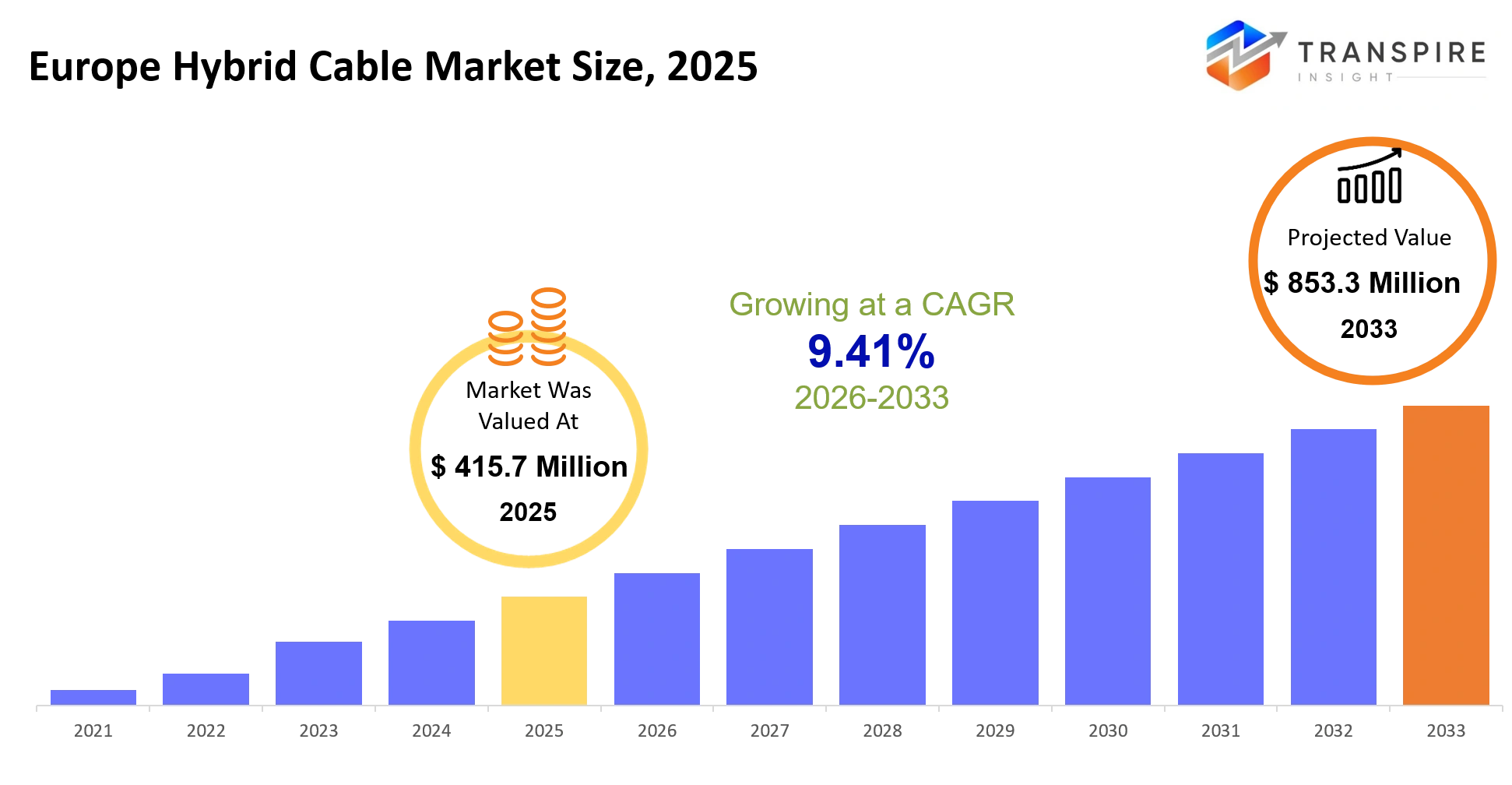
The Europe Hybrid Cable Market was valued at USD 415.7 Million in 2025. It is forecast to reach USD 853.3 Million by 2033. That is a CAGR of 9.41% over the period.
The Europe Hybrid Cable Market is really good for communication and power infrastructure because it can send electrical power and high-speed data through one cable system. This makes things easier to install saves space and means less maintenance is needed which makes the network more reliable for things like automation, telecommunications, data centers, transportation and renewable energy projects. Hybrid cable systems help people who run these systems make their infrastructure simpler while still getting bandwidth and power delivery in tough environments.
Over the few years the market has changed to use cables that have both fiber-optic and power parts because people are using more digital infrastructure, Industry 4.0 and edge computing in Europe. When Russia and Ukraine had a conflict it caused problems with getting things from suppliers so manufacturers and the people who build infrastructure had to find ways to get what they need and make more things in Europe. At the time people were spending more money on 5G networks, smart factories, electric vehicle charging stations and renewable energy projects which meant they needed cable systems that could do many things and were compact. All these things have made more people want to use cables, which is good for the companies that make cables because they can sell more expensive products make custom solutions and get long-term contracts, for infrastructure projects.
Key Market Insights
- Western Europe dominated the Europe Hybrid Cable Market with an estimated 48% share in 2025, supported by advanced telecom infrastructure and industrial automation investments.
- Central and Eastern Europe will record the fastest growth through 2033 as smart manufacturing, digital infrastructure, and renewable energy projects expand rapidly.
- Fiber-power hybrid cables hold the largest market share because they combine high-speed data transmission with reliable power delivery in a single installation.
- Power-fiber hybrid cables represent the second-largest segment, while industrial-grade hybrid cables will witness the fastest adoption during the forecast period.
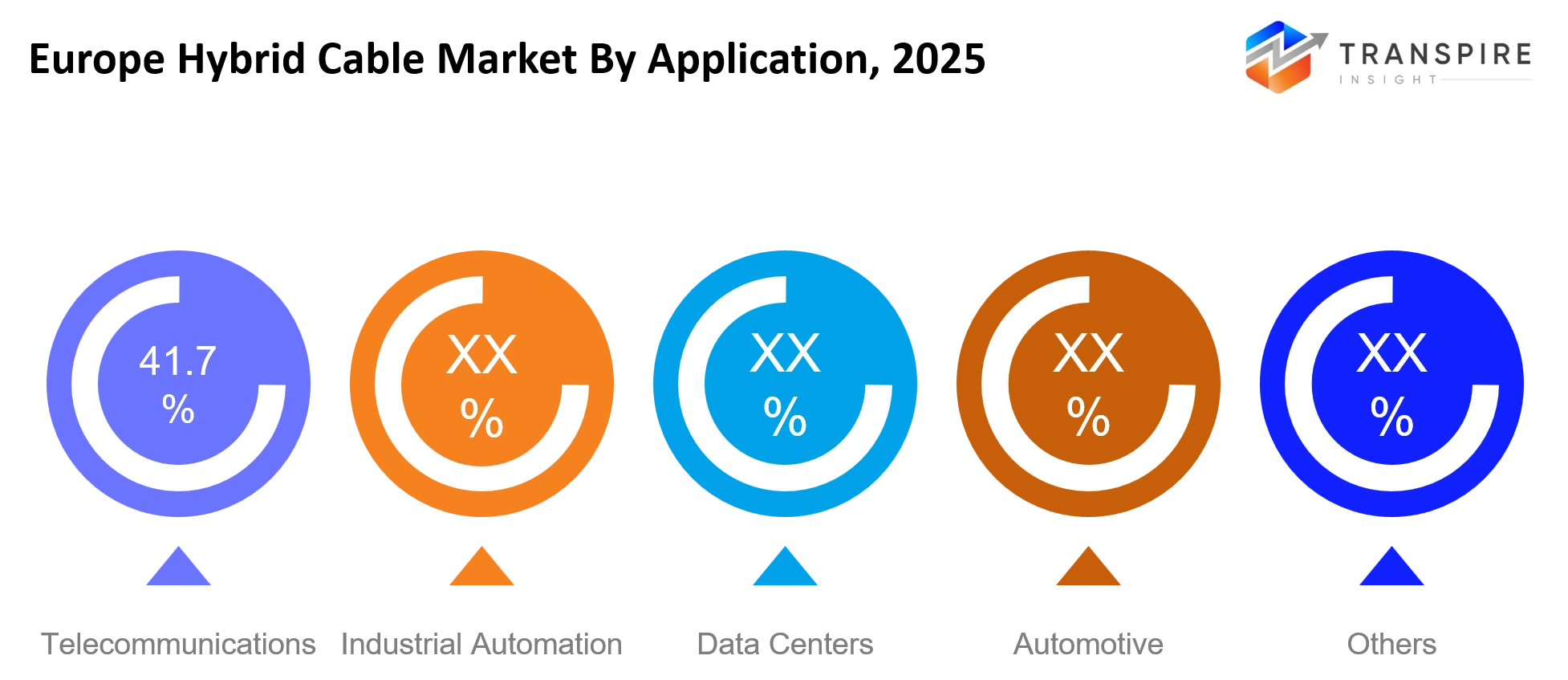
- Telecommunications accounts for nearly 40% of market demand, driven by expanding 5G rollout, fiber broadband deployment, and edge computing infrastructure.
- Data centers are emerging as the fastest-growing application as hyperscale facilities require compact, high-performance cabling systems for efficient network expansion.
- IT & telecom remains the leading end-user segment, while renewable energy developers are increasing adoption to simplify offshore and onshore infrastructure deployment.
- Prysmian Group, Nexans, Belden, Leoni AG, and HELUKABEL strengthen competitive positions through product innovation, strategic partnerships, and regional manufacturing expansion.
- Since 2023, manufacturers have increased investment in fire-resistant, lightweight, and high-bandwidth hybrid cable technologies to meet evolving European safety and performance standards.
- The Europe Hybrid Cable Market continues shifting toward integrated connectivity solutions, creating significant opportunities for suppliers focused on smart infrastructure, automation, and strategic expansion through 2033.
What are the Key Drivers, Restraints, and Opportunities in the Europe Hybrid Cable Market?
Drivers
The main thing that is driving the Europe Hybrid Cable Market is that digital infrastructure is getting bigger fast and more things are being automated. A lot of money is being spent on 5G networks, big data centers, smart factories and places that make energy. This means that there is a need for cables that can carry power and fast data at the same time. Europe Hybrid Cable Market is growing because of this need. This technology makes it faster to install things it takes up space and it costs less money overall. As people who build infrastructure want things to be smaller and work better more people want cable solutions, which means that the people who make cables and put systems together can make more money.
Restraints
The biggest problem is that it costs a lot of money to make cables and it is technically hard to do. You have to put fibers, power conductors, insulation materials and protective shielding all together in one product, which requires special engineering and manufacturing that is very precise. Europe Hybrid Cable Market has to follow strict safety and fire-resistance rules which makes it even more expensive to develop things and get certifications. These problems make it harder for projects to use hybrid cables and it slows down upgrades to infrastructure especially in smaller industrial facilities that use Europe Hybrid Cable Market solutions.
Opportunity
There is a chance for growth in the Europe Hybrid Cable Market because of smart grid modernization and edge computing infrastructure in Central and Eastern Europe. Governments and private investors are making connectivity and renewable energy networks bigger, which means they need cables that can do multiple things. Hybrid cables that are used for electric vehicle charging stations, systems that make energy in places and industrial internet of things applications will be in high demand. The Europe Hybrid Cable Market will be strong for companies that make cables that're light can handle a lot of bandwidth and are fire-resistant and that can make more products in the region. This will help them compete better over time until, at 2033 and the Europe Hybrid Cable Market will continue to grow.
What Has the Impact of Artificial Intelligence Been on the Europe Hybrid Cable Market?
Hybrid cable systems are getting better because of intelligence and new digital technologies. These technologies are helping with the design, manufacturing and management of cable systems in telecommunications, industrial automation and energy infrastructure.Artificial intelligence is used to check the quality of cable systems. It uses a type of vision to find problems with the insulation, the way the conductors are aligned and the fibers. This helps reduce waste and makes sure the products are consistent.Manufacturing control systems are also automated. These systems help with the production process making sure everything is done correctly and quickly. This helps manufacturers make hybrid cable systems without sacrificing quality.
Machine learning models look at data from cable systems that are connected. They use this data to predict when problems might happen, like when the insulation will degrade or when connectors will fail. They can even predict when thermal stress will occurDigital platforms check the temperature, electrical load, vibration and signal performance of cable systems. They use this information to decide when maintenance should be done. This helps prevent problems and reduces the cost of maintenance. It also helps cable systems last longer.Hybrid cable systems are used in places, like data centers, renewable energy projects and industrial facilities. The people in charge of these places benefit from using intelligence and digital technologies. They have unexpected problems and can use their assets more efficiently.
One problem is that it can be expensive to use intelligence with old manufacturing equipment and hybrid cable systems. The data, from installations is not always consistent which can make it harder to predict problems.With these challenges people are still investing in digital manufacturing and industrial internet of things. This will help more people use hybrid cable technologies in Europe. Hybrid cable systems will continue to get better and be used often.
Key Market Trends
- Since 2023 telecom operators have been using fiber-power hybrid cables. This helps support the growing 5G networks. It also makes installation less complicated and reduces costs.
- Many industrial manufacturers are now using systems. These systems combine power and communication cables. This makes equipment more reliable. Makes it easier to set up smart factories.
- Data center operators need bandwidth hybrid cables. They need these cables because edge computing and AI workloads are increasing. This is happening in major European technology hubs.
- Some companies like Prysmian Group, Nexans, Belden Leoni AG and HELUKABEL are doing well. They are making products and expanding their manufacturing. They are also working with companies on new technologies.
- There are rules for building safety in Europe. Because of these rules people are using fire-resistant and low-smoke hybrid cables.
- Since 2022 manufacturers have been getting materials from different places. They are also making products in regions. This helps reduce risks caused by problems between countries.
- Companies that make renewable energy are using cable systems. They use these systems for wind farms and solar installations. This makes installation easier and more reliable, in the run.
- New technologies are helping manufacturers make cables. These technologies use intelligence to inspect cables and predict when they need maintenance. This reduces defects. Makes cables more consistent.
- The region of Central and Eastern Europe is growing fast. This is because people are investing in infrastructure, industrial automation and broadband. This will continue until 2033.
- When people buy cable solutions they care about how well they work over time. They also care about how bandwidth they can handle and how easy they are to install. They do not just care about the price.
Europe Hybrid Cable Market Segmentation
By Cable Type
Fiber-copper hybrid cables make up the part of the market. This is because one cable can provide both electricity and fast data transmission. Telecommunications networks, factories and office buildings benefit from costs and less cable clutter. These cables work well with communication systems, which is why many industries use them. As people keep investing in infrastructure the demand for these cables will stay strong.Power-fiber hybrid cables are becoming more popular in energy projects, smart grids and electric car charging stations. They provide power and fast data transmission, which makes operations more efficient in tough environments. Coaxial hybrid cables are still important for some communication and surveillance uses. Improving these products will make them work better in installations.
By Application
The telecommunications industry leads the market because it needs cable systems to make fiber broadband and 5G infrastructure deployment easier. Network operators use hybrid cable solutions to make installation simpler. Transmission more reliable. The need for bandwidth supports technology upgrades in communication infrastructure. As digital transformation continues the market will keep growing.Industrial automation and data centers are using hybrid cables as manufacturers upgrade factories and cloud service providers expand computing capacity. The automotive industry also benefits from compact cabling solutions for vehicles and charging infrastructure. As people rely on automated systems the use of hybrid cables will increase. Infrastructure investment will support growth across industries.
By End User
The IT and telecom sector is the leading end-user segment because communication networks need transmission of power and data. Broadband expansion, edge computing and 5G deployment create demand for advanced cable technologies. Hybrid cables improve efficiency with high network performance and simple installation. Digital infrastructure projects will keep driving demand.The manufacturing and energy sectors are increasing their use of cables as factories automate and utilities modernize power networks. Renewable energy installations also need hybrid cabling. Infrastructure modernization supports investment in advanced cable systems. Term industrial development will create more commercial opportunities.
By Installation
Indoor installation is the segment because commercial buildings, factories, hospitals and data centers need organized cable management in limited space. Hybrid cable systems make installation simpler. Improve operational reliability. Compact designs make maintenance and future upgrades easier. As smart building projects expand this segment will stay the largest.
Outdoor installations are growing through energy projects, telecommunications networks, transportation systems and public infrastructure developments. Strong protective materials make these cables resistant to weather and mechanical stress. Infrastructure modernization increases deployment across large-scale projects. Continued public investment will strengthen demand.
By Voltage
voltage cables hold the largest share because communication networks, automation systems and commercial facilities mainly operate at low voltages. These cables are safe, energy-efficient and flexible to install, which supports their use. Digital infrastructure projects continue to drive demand. Technological improvements will enhance performance.Voltage hybrid cables are becoming more accepted in renewable energy installations, industrial facilities and utility infrastructure that need greater power transmission capacity. Higher-performance materials improve durability and operational reliability. Energy transition projects support deployment. Ongoing grid modernization will increase adoption.
By Distribution Channel
Direct sales are the leading distribution channel because large infrastructure projects require consultation and customized cable solutions. Manufacturers provide engineering support that improves installation efficiency and product selection. Strong customer relationships encourage repeat business. Technical expertise remains an advantage.Distributors expand market access, by supplying products to regional contractors, installers and smaller industrial customers. Local inventory and responsive delivery improve project execution. Value-added technical support strengthens customer satisfaction. Distribution network expansion will improve product availability.
What are the Key Use Cases Driving the Europe Hybrid Cable Market?
Telecommunications is the thing that people use hybrid cables for because they can send power and fast internet through one connection. This makes it easier to set up 5G networks and get people connected to fiber broadband. The people who run these networks can get everything up and running faster they need space and the internet works better in cities where there are a lot of people.There are places that are starting to use hybrid cables too like factories and big data centers. Factories use them to connect machines and sensors to the internet and data centers use them to make sure their computers can talk to each other fast.
Some new things that might start using cables are power grids, places that make renewable energy and stations where you can charge your electric car. These places need to be able to send power and information at the time so they can keep an eye on things and make sure everything is working properly. If people keep investing in technology for energy it will be good, for the people who make hybrid cables for a long time.
|
Report Metrics |
Details |
|
Market size value in 2025 |
USD 415.7 Million |
|
Market size value in 2026 |
USD 454.8 Million |
|
Revenue forecast in 2033 |
USD 853.3 Million |
|
Growth rate |
CAGR of 9.41% from 2026 to 2033 |
|
Base year |
2025 |
|
Historical data |
2021 - 2024 |
|
Forecast period |
2026 - 2033 |
|
Report coverage |
Revenue forecast, competitive landscape, growth factors, and trends |
|
Regional scope |
Europe |
|
Key company profiled |
Prysmian Group, Nexans, Belden, Leoni, TE Connectivity, CommScope, LS Cable & System, Furukawa Electric, Sumitomo Electric, Huber+Suhner, Corning, HELUKABEL, LAPP Group, Amphenol, Panduit |
|
Customization scope |
Free report customization (country, regional & segment scope). Avail customized purchase options to meet your exact research needs. |
|
Report Segmentation |
By Cable Type (Fiber-Copper Hybrid Cables, Coaxial Hybrid Cables, Power-Fiber Hybrid Cables, Others); By Application (Telecommunications, Industrial Automation, Data Centers, Automotive, Others); By End User (IT & Telecom, Manufacturing, Energy, Others); By Installation (Indoor, Outdoor, Others); By Voltage (Low Voltage, Medium Voltage, Others); By Distribution Channel (Direct Sales, Distributors, Others) |
Which Regions are Driving the Europe Hybrid Cable Market Growth?
The Europe Hybrid Cable Market is really big in Western Europe. This is because Western Europe has telecommunications systems, strong industries that use automation and people are always investing in digital connectivity. So there is a demand for hybrid cables in Western Europe. Countries like Germany, France, the United Kingdom and the Netherlands are always working on expanding their fiber broadband building data centers and creating more renewable energy networks. They also have strict building safety rules and are good at making things, which helps them use advanced hybrid cable solutions. The fact that Western Europe has a lot of suppliers and does a lot of research helps it stay ahead in the Europe Hybrid Cable Market.
Northern Europe is the biggest market for hybrid cables. It is growing because the economy is stable and people are investing in infrastructure and clean energy for the long term. Countries like Sweden, Denmark, Finland and Norway are making their industries more modern. Are working on smart grid projects and renewable energy projects in the ocean. They use a lot of technology and their rules are consistent which creates a steady demand for hybrid cable systems. This means that companies that make cables can expect to make money in a predictable way.
The Europe Hybrid Cable Market is going to grow fast in Central and Eastern Europe from 2026 to 2033. This is because governments are working on expanding broadband making industries more modern and improving transport systems. The European Union is giving them money to do this. There have been investments in smart manufacturing and digital connectivity in countries like Poland, Romania and their neighbors. More data centers and renewable energy facilities are being built, which means there is a demand for hybrid cables. This is an opportunity for companies that want to expand into the region and get long term contracts for infrastructure projects. The Europe Hybrid Cable Market is going to be really strong, in Central and Eastern Europe.
Who are the Key Players in the Europe Hybrid Cable Market and How Do They Compete?
The Europe Hybrid Cable Market is moderately consolidated, with global cable manufacturers competing alongside specialized regional suppliers. Competition depends on product performance, transmission reliability, fire safety compliance, engineering expertise, and customization rather than price alone. Established companies continue protecting market share through research investment, manufacturing expansion, and long-term supply agreements, while niche suppliers focus on application-specific cable solutions for industrial automation and data infrastructure. The ability to deliver integrated power and data systems with certified performance remains the primary competitive advantage.
Prysmian Group focuses on high-performance fiber and hybrid cable technologies designed for telecommunications, data centers, and energy infrastructure. Nexans differentiates through advanced electrification solutions and low-carbon cable technologies while expanding partnerships in renewable energy and smart grid projects. Belden specializes in industrial networking and automation, combining hybrid cabling with high-speed connectivity solutions that improve reliability in demanding operating environments.
Leoni AG strengthens competitiveness through customized automotive and industrial cable systems engineered for complex applications that require compact and durable designs. HELUKABEL expands its presence by broadening distribution networks and introducing specialized hybrid cable products for factory automation and renewable energy installations. Continued investment in advanced materials, regional manufacturing capacity, and application-specific product development enables these companies to strengthen customer relationships and maintain competitive differentiation across European infrastructure markets.
Company List
- Prysmian Group
- Nexans
- Belden
- Leoni
- TE Connectivity
- CommScope
- LS Cable & System
- Furukawa Electric
- Sumitomo Electric
- Huber+Suhner
- Corning
- HELUKABEL
- LAPP Group
- Amphenol
- Panduit
Recent Development News
- In July 2025, Prysmian Group entered a strategic partnership with E.ON to accelerate the development of more efficient and resilient electricity grids. The collaboration supports next-generation power and hybrid cable solutions required for grid modernization and renewable energy integration across Europe.https://www.prysmian.com
- In March 2025, LEONI launched its LEONI Mocar high-performance automotive cable portfolio, including hybrid cable solutions for electric and electronic vehicle architectures. The new product range strengthens the company's position in advanced automotive connectivity for electrified vehicles.https://www.leoni.com
- In March 2026, Prysmian Group launched the world's first 525 kV HVDC submarine cable qualified for operation at 90°C. The innovation increases transmission capacity from 2 GW to 2.5 GW per link, enabling more efficient hybrid interconnectors and supporting Europe's expanding renewable energy infrastructure.https://www.prysmian.com
What Strategic Insights Define the Future of the Europe Hybrid Cable Market?
The Europe hybrid cable market is structurally moving toward integrated power-and-data connectivity solutions that support digital infrastructure, industrial automation, renewable energy systems, and next-generation telecommunications. Over the next five to seven years, demand will be driven by the expansion of smart factories, edge computing, electric mobility, and high-capacity broadband networks, where hybrid cables reduce installation complexity while improving system reliability and space efficiency. This shift will encourage manufacturers to develop higher-performance, application-specific cable designs tailored to increasingly connected environments.
A less visible risk is the market's exposure to volatility in copper and specialty polymer supplies, which can raise production costs and delay large infrastructure projects. An emerging opportunity lies in hybrid fiber-power cables for AI data centers and edge computing facilities, particularly as Europe invests in digital sovereignty and advanced computing infrastructure. Market participants should prioritize modular cable platforms, sustainable material innovation, and close collaboration with equipment manufacturers to deliver customized connectivity solutions that align with evolving industrial and digital infrastructure requirements.
Europe Hybrid Cable Market Report Segmentation
By Cable Type
- Fiber-Copper Hybrid Cables
- Coaxial Hybrid Cables
- Power-Fiber Hybrid Cables
- Others
By Application
- Telecommunications
- Industrial Automation
- Data Centers
- Automotive
- Others
By End User
- IT & Telecom
- Manufacturing
- Energy
- Others
By Installation
- Indoor
- Outdoor
- Others
By Voltage
- Low Voltage
- Medium Voltage
- Others
By Distribution Channel
- Direct Sales
- Distributors
- Others
Frequently Asked Questions
Find quick answers to common questions.
The expected Europe Hybrid Cable Market size for the market will be USD 853.3 Million in 2033.
Key segments for the Europe Hybrid Cable Market are By Cable Type (Fiber-Copper Hybrid Cables, Coaxial Hybrid Cables, Power-Fiber Hybrid Cables, Others); By Application (Telecommunications, Industrial Automation, Data Centers, Automotive, Others); By End User (IT & Telecom, Manufacturing, Energy, Others); By Installation (Indoor, Outdoor, Others); By Voltage (Low Voltage, Medium Voltage, Others); By Distribution Channel (Direct Sales, Distributors, Others).
Major Europe Hybrid Cable Market players are Prysmian Group, Nexans, Belden, Leoni, TE Connectivity, CommScope, LS Cable & System, Furukawa Electric, Sumitomo Electric, Huber+Suhner, Corning, HELUKABEL, LAPP Group, Amphenol, Panduit.
The Europe Hybrid Cable Market size is USD 415.7 Million in 2025.
The Europe Hybrid Cable Market CAGR is 9.41% from 2026 to 2033.
- Prysmian Group
- Nexans
- Belden
- Leoni
- TE Connectivity
- CommScope
- LS Cable & System
- Furukawa Electric
- Sumitomo Electric
- Huber+Suhner
- Corning
- HELUKABEL
- LAPP Group
- Amphenol
- Panduit
About the Authors

Avinash Kumar
I’m Avinash Kumar, a Senior Research Analyst at Transpire Insight, with expertise in the Electronics and Semiconductor and Energy & Power industry. My work focuses on analyzing emerging technologies, market trends, industry developments, and innovation across these sectors. I specialize in transforming complex technical and market insights into clear, research-backed content that helps professionals, businesses, and decision-makers stay informed. Through continuous industry research and data-driven analysis, I strive to deliver accurate, reliable, and practical perspectives on the latest advancements shaping the semiconductor and energy landscape.

Chakradhar Khansole
Chakradhar serves as the Research Director at Transpire Insight, bringing over 8 years of experience in technology, innovation, and strategic market intelligence. He specializes in transforming complex market data into actionable business insights that enable organizations to make informed, growth-oriented decisions. Recognized for his strategic vision and analytical expertise, Chakradhar leads high-impact research initiatives, delivering comprehensive market assessments, competitive intelligence, and forward-looking industry analysis.
Recently Published Reports
-
Apr 2026
Active Power Filter Market
Active Power Filter Market Size, Share & Analysis Report By Type (Shunt Active Power Filters, Series Active Power Filter, Hybrid Active Power Filter), By Application (Harmonics Mitigation, Reactive Power Compensation, Voltage Regulation, Power Factor Correction), By Phase (Single Phase, Three Phase), By End-User Industry (Manufacturing, Healthcare, Commercial, Automotive, Oil and Gas, Others), and Geography (North America, Europe, Asia-Pacific, Middle East and Africa, South and Central America), 2021 - 2031
-
Apr 2026
Electrical Transformer Market
Electrical Transformer Market Size, Share & Analysis Report By Core (Closed, Shell, and Berry), By Insulation (Gas, Oil, Solid, Air, and Other), By Phase (Single, and Three), By Rating (100 MVA to 500 MVA, 501 MVA to 800 MVA, and 801 MVA to 1200 MVA), and Geography (North America, Europe, Asia-Pacific, Middle East and Africa, South and Central America), 2021 – 2031
-
Apr 2026
Hydraulic Piston Pumps Market
Hydraulic Piston Pumps Market Size, Share & Analysis Report By Type (Axial Piston Pumps, Radial Piston Pumps), By Operating Pressure (Low Pressure, Medium Pressure, High Pressure), By Application (Construction, Mining, Agriculture, Automotive, Oil & Gas, Industrial Machinery, Others), By End-User (OEMs, Aftermarket), and Geography (North America, Europe, Asia-Pacific, Middle East and Africa, South and Central America), 2021 – 2031
-
Apr 2026
Laboratory Gas Generators Market
Laboratory Gas Generators Market Size, Share & Analysis Report By Product (Nitrogen Gas Generator, Hydrogen Gas Generator, Zero Air Gas Generator, Purge Gas Generator, TOC Gas Generators, Others), By Application (Gas Chromatography, Liquid Chromatography-mass Spectrometry (LC-MS), Gas Analyzers, Others), By End-user (Life Science, Chemical & Petrochemical, Food & Beverage, Others), and Geography (North America, Europe, Asia-Pacific, Middle East and Africa, South and Central America), 2021 – 2031