

United States Cable Modem Termination System (CMTS) Market Size & Forecast:
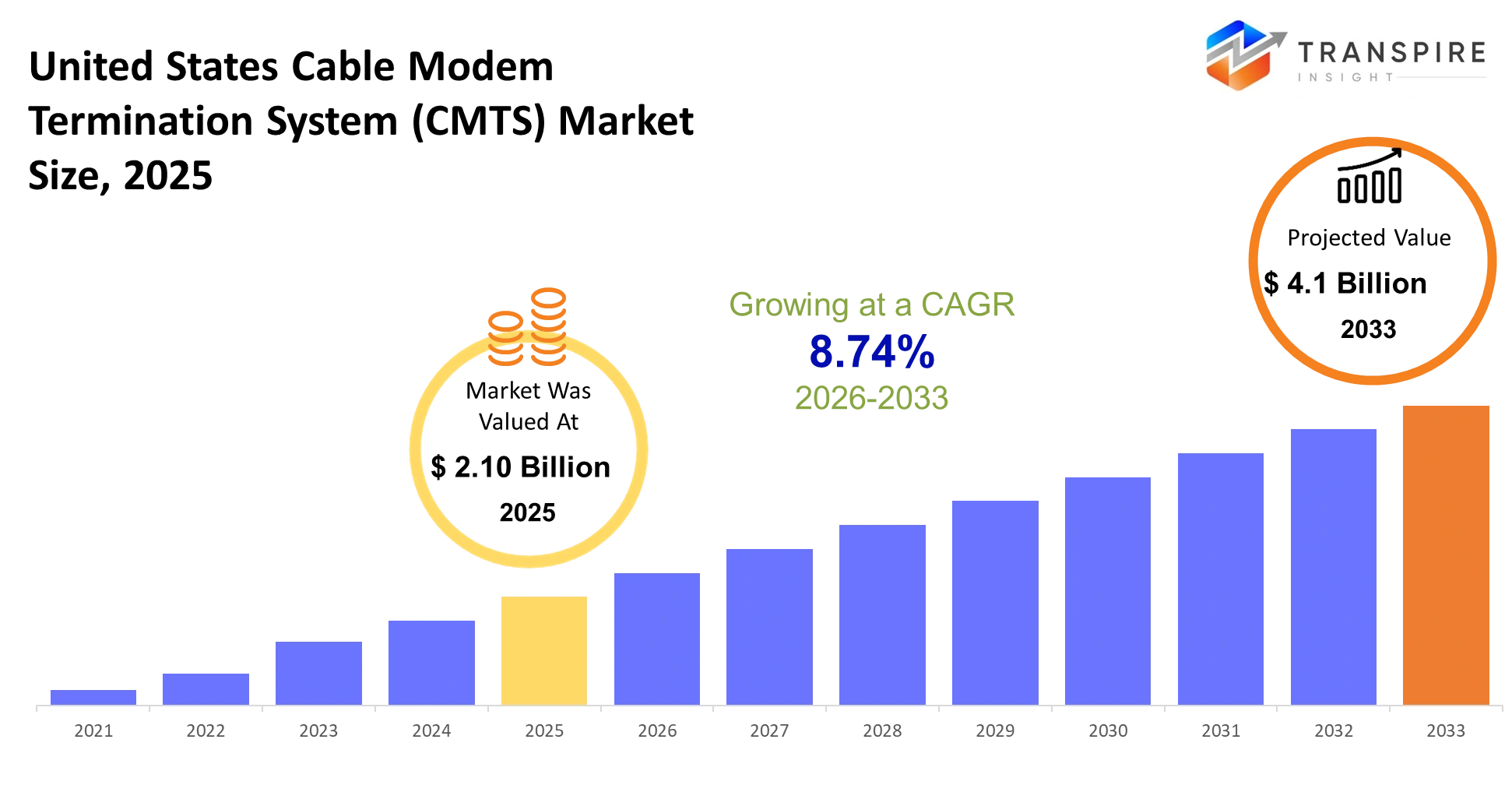
- United States Cable Modem Termination System (CMTS) Market Size 2025: USD 2.10 Billion
- United States Cable Modem Termination System (CMTS) Market Size 2033: USD 4.1 BillionÂ
- United States Cable Modem Termination System (CMTS) Market CAGR: 8.74%
- United States Cable Modem Termination System (CMTS) Market Segments:By Component (Core CMTS, Edge QAM, Upstream Receivers, Software Solutions, Network Management Systems, Others), By Technology (DOCSIS 3.0, DOCSIS 3.1, Integrated CMTS, Modular CMTS, Virtual CMTS, Others), By Application (Broadband Internet, Video Streaming, Voice Services, Enterprise Networking, Smart City Networks, Others), By End User (Cable Operators, ISPs, Enterprises, Government Organizations, Telecom Companies, Others).Â
To learn more about this report,  Download Free Sample Report
United States Cable Modem Termination System (CMTS) Market Summary:
The United States Cable Modem Termination System (CMTS) Market size is estimated at USD 2.10 Billion in 2025 and is anticipated to reach USD 4.1 Billion by 2033, growing at a CAGR of 8.74% from 2026 to 2033. The United States Cable Modem Termination System (CMTS) market kind of sits at the working heart of broadband cable networks, and yeah it helps cable operators steer, and distribute high-speed internet traffic across millions of homes and business lines. In real life, CMTS platforms handle a big, practical infrastructure issue : how to provide steady, low-latency bandwidth across the existing hybrid fiber-coaxial setup while also coping with growing data demand from streaming , cloud tools, remote work, and all those connected devices.
Over the last five years, this market has been moving away from purely hardware based rollouts, and toward more virtualized and distributed access styles. Cable operators are swapping out older centralized CMTS systems with software driven platforms that boost scalability , lower power usage, and make multi gigabit broadband upgrades feel more manageable. The COVID-19 remote connectivity jump sped things up, mostly because congestion and capacity limits showed up pretty clearly in the legacy setups. And as operators start putting more money into DOCSIS 4.0 and edge centric modernization programs, CMTS vendors are pulling in revenue via software licensing, cloud integration, plus ongoing network management services, rather than depending only on the usual equipment refresh cadence.
 Key Market Insights
- The Southern United States kind of dominated the United States Cable Modem Termination System (CMTS) Market with around 34% share in 2025, mostly because the broadband subscriber bases are pretty dense and packed.Â
- The Western United States meanwhile, is the fastest-moving regional market through 2030. This is being supported by fiber-coaxial modernization and also those higher rates of cloud connectivity adoption.Â
- In the Midwest, cable operators boosted CMTS infrastructure investments by more than 18% since 2022, to strengthen rural broadband network performance which is always a challenge.Â
- The Northeast is seeing a lot of demand for virtualized CMTS platforms because enterprise-grade low-latency broadband needs are rising there, steadily.Â
- Integrated CMTS platforms were at about 46% of the industry share in 2025, since big operators still rely on existing hybrid fiber-coaxial infrastructure as a baseline.Â
- Distributed Access Architecture solutions are second-largest segment too, backed by scalable bandwidth control and edge-network optimization abilities.Â
- Virtual CMTS solutions are the segment that’s growing quickest through 2030, propelled by software-defined networking and the push toward cloud-native broadband infrastructure trends, lately.
- DOCSIS 4.0 compatible CMTS equipment is also gaining meaningful market share because operators want multi-gigabit broadband services expansion, faster than before.Â
- For applications, residential broadband took the lead with over 58% revenue share in 2025, driven by streaming, gaming , and remote work usage that keeps rising.Â
- Enterprise connectivity applications are emerging quickly as companies need more upstream bandwidth and low-latency cloud communication services.
- Finally, video streaming traffic keeps shaping CMTS capacity upgrades. Average household bandwidth consumption is increasing more than 20êch year.
What are the Key Drivers, Restraints, and Opportunities in the United States Cable Modem Termination System (CMTS) Market?
The most powerful growth engine in the United States Cable Modem Termination System (CMTS) Market seems to be the shift toward DOCSIS 4.0 and a distributed access architecture network. Cable operators really kicked up infrastructure spend after those pandemic period traffic surges showed the bandwidth limits of older CMTS platforms. Streaming video, cloud gaming, and remote enterprise workloads kept pushing upstream traffic volumes higher than what the legacy gear could handle efficiently. Because of that, broadband providers started putting money into virtualized, and software defined CMTS platforms, which help improve spectrum utilization and also back multi-gigabit speeds. This move boosts vendor income right away, via equipment refreshes, software licensing, cloud integration services, and the longer term upkeep contracts.
The biggest structural obstacle is the very high upfront capital cost needed to swap out aging hybrid fiber coaxial infrastructure while still keeping subscriber service running without interruption. A lot of regional operators still lean on legacy CMTS systems that were installed more than ten years back. To move toward distributed and virtualized architectures, companies need major spending on fiber backhaul, edge nodes, and tech retraining too. Those expense loads can postpone modernization efforts, especially for mid sized providers. As a result near term deployment numbers stay lower, and revenue realization takes longer across the wider market.
A key future opportunity sits in the federally funded rural broadband expansion projects across underserved areas of the U.S. Funding programs focused on broadband accessibility are motivating smaller operators to install next generation CMTS platforms, rather than doing only small incremental upgrades to the older systems.
What Has the Impact of Artificial Intelligence Been on the United States Cable Modem Termination System (CMTS) Market?
Artificial intelligence and advanced network analytics are quietly, but really reshaping the United States Cable Modem Termination System (CMTS) Market , in a way that lets broadband operators automate traffic management, boost overall reliability, and also trim operational costs. More cable providers now rely on AI based monitoring platforms to do congestion finding faster, handle bandwidth distribution, and manage subscriber quality of service in distributed access settings. These platforms keep watching the traffic patterns and then, somewhat automatically, tune the network settings so latency spikes don’t pop up during peak streaming or cloud activity times.
On top of that, machine learning models are giving predictive maintenance a much stronger role inside CMTS infrastructure. Operators start using AI algorithms to read temperature changes , track packet loss behavior, and review hardware performance signals, so they can spot a likely node or amplifier failure before an outage actually happens. This “see it early†style of maintenance cuts down on emergency truck rolls, and it improves network uptime, especially when the broadband footprint sits in high-density metro areas. A few operators even mention double digit declines in service disruptions, plus reduced field maintenance spending after they folded AI assisted diagnostics into their network operations centers.
Meanwhile, newer digital methods are making DOCSIS 4.0 rollouts work better by enhancing spectrum utilization and doing upstream traffic forecasting. Still, AI adoption has a major snag , because plenty of older cable networks sit on fragmented infrastructure, with uneven data quality. When teams try to plug AI systems into older CMTS environments they often need costly system upgrades, and also a lot of retraining for the network engineering groups. All of that tends to slow down large scale deployment, even if the payoff sounds promising.
Key Market TrendsÂ
- Since 2021, a lot of major operators have shifted nearly 30% of the new CMTS deployments toward virtualized platforms , mostly to help scalability and also to cut down on infrastructure costs, or at least that’s what they were saying internally.
- After remote work adoption became normal, broadband traffic patterns kind of flipped, so upstream network upgrades started getting pushed more , instead of the usual downstream-focused capacity growth. It was a different vibe overall.
- Cisco Systems and CommScope also leaned more into cloud-native CMTS software investments after hardware margins tightened during 2022 to 2025. So the economics were squeezing a bit and they responded.
- Distributed access architecture adoption picked up fast because centralized CMTS systems had trouble handling low-latency gaming, streaming, and enterprise cloud traffic all at once, without things getting messy.
- Federal broadband infrastructure funding redirected operator spending toward underserved rural markets, which then increased next-generation CMTS procurement among regional cable providers starting since 2023. That part moved quicker than expected.
- Operators started to reduce reliance on proprietary hardware platforms and, more often than not, adopted software-driven network orchestration , to shorten the broadband service deployment timeline. Less waiting around for big lifts.
- AI-enabled traffic analytics showed up as a real competitive differentiator, after operators reported fewer outages and faster congestion handling through automated monitoring systems, so the reporting got better.
- The DOCSIS 4.0 migration changed what buyers cared about, moving away from bandwidth expansion only , toward energy-efficient network performance and lower operational power consumption, which sounds obvious but it wasn’t the main focus earlier.
- Strategic partnerships between Harmonic, Nokia, and regional broadband operators increased as fiber-coaxial modernization projects rolled out across metropolitan networks, more and more, in a pretty coordinated way.
United States Cable Modem Termination System (CMTS) Market Segmentation
By Component
Core CMTS platform , they still keep the biggest slice in the component segment even though it can feel slower at times because a lot of big cable operators continue to lean on centralized broadband management infrastructure across those long hybrid fiber-coaxial networks. Upstream receivers and Edge QAM systems stay at fairly steady deployment levels, mostly because bandwidth optimization projects are still ongoing and because video traffic management is not really going away. Software solutions , and also network management systems are growing faster lately, as operators push harder on automation , remote monitoring and this cloud-based orchestration style of control. At the same time, more and more people are looking toward AI-assisted diagnostics and predictive maintenance, which is why the need for advanced analytics software—pretty tightly integrated into CMTS ecosystems—has been rising.
For hardware suppliers there’s now a clear pressure to build energy-efficient platforms with reduced operational costs, while software vendors tend to like the shift since recurring licensing and support revenue keeps coming back. Going forward , the next round of investment should increasingly favor modular and software-driven architectures. Operators want scalable deployment models that lessen dependence on physical infrastructure and that also improve service agility across both metropolitan and rural broadband networks, even when conditions vary a lot.
By TechnologyÂ
DOCSIS 3.1 tech right now is kinda dominating the technology segment, largely because broadband providers sped up gigabit internet rollout, without really swapping out the older cable infrastructure in one clean move. DOCSIS 3.0 is still running along just fine in smaller regional setups, even if migration slowed down as bandwidth needs rose quite a lot after 2020.
Integrated CMTS systems still make up a pretty big part of the installed base, mainly due to those long replacement cycles and the high change-over costs that operators face. Still, modular, and virtual CMTS platforms are getting more traction, because a distributed access layout brings more network agility and trims down space and power usage at those centralized sites.
Virtual CMTS in particular seems to have the most future momentum, as cable operators shift toward cloud-native network management plus software-driven broadband delivery. At the same time, vendors are putting more money into DOCSIS 4.0 readiness, edge computing tie-ins and low-latency tuning features, in order to handle gaming, enterprise cloud work, and newer streaming uses across dense city markets where demand never really cools.

To learn more about this report, Download Free Sample Report
By Application
Broadband internet applications still take the biggest slice in the overall application category, mostly because both residential and enterprise folks keep generating heavy data traffic from things like streaming, cloud teamwork, and those connected devices. Video streaming is still a major money maker, even if the whole traffic management focus is moving toward upstream capacity optimization instead of the classic downstream expansion. Enterprise networking applications are rising more consistently now , as companies want low latency links for hybrid work setups, cloud infrastructure, and security operations. Smart city networks are showing up as an emerging chance, pushed along by municipal broadband modernization efforts, public Wi‑Fi rollouts, and connected infrastructure initiatives.
Voice services stay somewhat relevant, but mainly within bundled cable packages, even while standalone demand keeps slipping. Looking ahead, application trends are leaning more toward scalable, software-driven traffic control systems that can deal with those unpredictable bandwidth consumption surges. The next phase of growth will depend on whether operators and equipment manufacturers can keep delivering dependable multi‑gigabit performance without ramping up operational expenditure, at least not by much.
By End-User
Cable operators still tend to be the main end-user slice because national and regional providers control most of the hybrid fiber-coaxial broadband backbone, across the United States. Telecommunications firms are pushing CMTS adoption more and more, mostly via network convergence programs that try to fold broadband along with wireless backhaul and enterprise connectivity, into what is basically one integrated infrastructure platform. Meanwhile, internet service providers are showing faster growth, not just from market momentum, but also from government-backed rural broadband buildouts and the growing rivalry in parts that are still under served.Â
Enterprises and government organizations keep putting money in though more selectively into dedicated broadband infrastructure for safer communication setups, smart building management, and data-heavy operations. Smaller operators often run into cash limitations that slow down the move toward distributed and virtualized architectures, which then leads to uneven modernization, across different regional scenes. On top of that end-user purchasing seems to lean more toward long-term software support, cloud integration features and energy-efficient device design. Vendors that can handle flexible deployment methods, plus managed service agreements , are likely to keep a stronger market position during the next decade.
What are the Key Use Cases Driving the United States Cable Modem Termination System (CMTS) Market?
Residential broadband delivery still feels like the biggest “why†behind CMTS platforms , mostly because cable providers have to juggle huge streaming, gaming, and remote work traffic loads through very packed subscriber neighborhoods. Multi gigabit internet rollouts , plus DOCSIS 4.0 upgrades keep showing up on roadmaps , so the deployment pace among the big broadband players stays pretty strong.
On the enterprise side, and in public infrastructure too, things are stretching out in a steady way. Telecom companies and regional ISPs are backing cloud computing, edge links, and municipal broadband programs, which in turn makes enterprise networking feel more relevant day by day. In smart city setups, advanced traffic management approaches are increasingly used, helping preserve low latency connections for surveillance systems, public Wi-Fi, and also connected transportation frameworks.
Some newer angles are starting to appear as well , like AI based network orchestration , plus edge oriented bandwidth optimization aimed at autonomous service supervision. There is also private broadband infrastructure for industrial automation plants , and improved healthcare connectivity , and that combination looks like it could keep a long runway as operators modernize their distributed access architectures.
|
Report Metrics |
Details |
|
Market size value in 2025 |
USD 2.10 Billion |
|
Market size value in 2026 |
USD 2.28 Billion |
|
Revenue forecast in 2033 |
USD 4.1 Billion |
|
Growth rate |
CAGR of 8.74% from 2026 to 2033 |
|
Base year |
2025 |
|
Historical data |
2021 - 2024 |
|
Forecast period |
2026 - 2033 |
|
Report coverage |
Revenue forecast, competitive landscape, growth factors, and trends |
|
Geographic scope |
United States of America |
|
Key company profiled |
Cisco Systems, CommScope, Harmonic, Casa Systems, Nokia, Huawei, Vecima Networks, Teleste, ARRIS, Juniper Networks, Intel, Broadcom, Technetix, Cisco Meraki, Calix |
|
Customization scope |
Free report customization (country, regional & segment scope). Avail customized purchase options to meet your exact research needs. |
|
Report Segmentation |
By Component (Core CMTS, Edge QAM, Upstream Receivers, Software Solutions, Network Management Systems, Others), By Technology (DOCSIS 3.0, DOCSIS 3.1, Integrated CMTS, Modular CMTS, Virtual CMTS, Others), By Application (Broadband Internet, Video Streaming, Voice Services, Enterprise Networking, Smart City Networks, Others), By End User (Cable Operators, ISPs, Enterprises, Government Organizations, Telecom Companies, Others) |
Which Regions are Driving the United States Cable Modem Termination System (CMTS) Market Growth?
The Southern United States kind a leads the CMTS market because the big cable operators keep building out broad hybrid fiber coaxial networks across metropolitan and suburban areas that are growing very fast. Places like Texas, and Florida keep pulling in broadband dollars via helpful infrastructure policies , strong consumption growth for data and more residential developments. The major operators push forward with DOCSIS 4.0 and distributed access upgrades to handle streaming loads, enterprise cloud usage , and remote work connections. At the same time, a more mature ecosystem with equipment vendors, fiber contractors , cloud service providers, and regional data centers helps keep long-run modernization going across the region.
Meanwhile, the Northeastern United States stays steady as a contributor because broadband providers tend to favor network reliability, enterprise level connectivity, and low-latency service results, not just endless geographic expansion. The area’s dense urban systems plus very high commercial broadband adoption create a constant need for virtualized CMTS platforms and refined traffic management tools. Regional players routinely fund capacity optimization initiatives for banks, healthcare networks, and tech companies that can’t afford interruptions in high bandwidth communications. In comparison with the South, the Northeast moves ahead through careful infrastructure tuning and long term improvements in service quality, not simply more subscribers.
In the Western United States, the fastest growth momentum shows up, sort of, because accelerated fiber-coaxial modernization meets increasing adoption of cloud native broadband infrastructure. You see this in technology driven economies such as California, Washington, and Arizona, where operators were pushed to upgrade legacy systems after AI workloads, gaming traffic, and edge computing applications started rising sharply. After 2022, network congestion got worse in many places, so modernization stopped being optional. Also public broadband funding programs , plus smart city infrastructure investments, helped expand deployment opportunities for distributed and virtual CMTS architectures. All together this regional acceleration feels like a magnet for equipment vendors software providers, and infrastructure investors aiming for exposure to the next generation broadband transformation, covering 2026 through 2033.
Who are the Key Players in the United States Cable Modem Termination System (CMTS) Market and How Do They Compete?
The competitive scene for the United States Cable Modem Termination System (CMTS) Market stays sort of moderately consolidated because a small set of network infrastructure companies, tends to take most of the major cable operator deals. In practice, rivalry is shifting toward software-driven network modernization, not just the old talk about hardware capacity. A bunch of well-known vendors are trying to hold onto their existing subscriber footprints by pushing virtualized CMTS roadmaps, cloud connectivity features, and AI- assisted traffic management tooling. Meanwhile, newer software-first providers nudge at incumbents by touting lower operational expense, more pliable rollout patterns and quicker network expansion for regional broadband players. What really separates them now is tech differentiation plus long-term service support, not only equipment price, since operators want infrastructure that can shift with DOCSIS 4.0 and distributed access architecture needs.
Cisco Systems is still leaning hard into integrated broadband infrastructure plus cloud-managed networking platforms, mainly to let operators automate traffic optimization across huge subscriber networks. Its deep ties with major cable providers still feel like a real edge, because many operators already rely on Cisco routing and edge building blocks. CommScope, on the other hand, positions itself around distributed access architecture know-how and high-density network solutions made for bandwidth-heavy urban deployments. With strategic relationships in place, CommScope keeps expanding into virtualized access platforms and next-generation fiber coaxial modernization work.
Harmonic competes through sort of cloud native virtual CMTS platforms that are tuned for reduced power usage and scalable software deployment . Their strong specialization in virtual broadband delivery lets Harmonic move toward operators who want alternatives to hardware heavy legacy systems. Meanwhile Nokia leans on telecom grade network automation and edge computing know how to reinforce the overlap between broadband , wireless backhaul , and enterprise connectivity infrastructure , all in one picture. Casa Systems zeroes in on flexible, modular CMTS architectures that tend to attract mid sized and regional operators , especially those trying to modernize without getting swallowed by capital expenditure limits.
Company List
- Cisco Systems
- CommScope
- Harmonic
- Casa Systems
- Nokia
- Huawei
- Vecima Networks
- Teleste
- ARRIS
- Juniper Networks
- Intel
- Broadcom
- Technetix
- Cisco Meraki
- Calix
Recent Development News
In March 2026, Comcast Expands DOCSIS 4.0 & CMTS-Driven Multi-Gig Rollout Across U.S. Homes: Comcast has significantly expanded its DOCSIS 4.0 deployment, now reaching millions of U.S. homes, marking a major CMTS core-network upgrade phase. The rollout strengthens upstream capacity and enables multi-gig broadband services across its hybrid fiber-coax network.
Source: https://www.lightreading.com
In January 2026, Comcast Reports Broadband Pressure While Accelerating CMTS-Based Network Upgrade Strategy: Â Comcast disclosed continued broadband subscriber losses amid rising competition from fiber and 5G providers. In response, the company is accelerating CMTS modernization and HFC upgrades to stabilize performance and improve network efficiency.
Source: https://www.investing.com
What Strategic Insights Define the Future of the United States Cable Modem Termination System (CMTS) Market?
The United States Cable Modem Termination System (CMTS) Market is kinda moving, toward fully virtualized, software centric broadband infrastructure that’s supported by distributed access design and AI assisted traffic orchestration, all at once (or at least thats the direction). The real push behind that shift is the increasing mismatch between older centralized CMTS gear and today’s upstream heavy data consumption patterns, which are being shaped by cloud computing , edge apps, and those low latency digital services people now just expect. In the next five to seven years , operators are likely to favor scalable software licensing and automated network management rather than doing the usual hardware replacement loop.
There is also a risk that is less obvious, basically tech substitution pressure coming from fiber-to-the-home rollouts and fixed wireless access deployments. If installation costs keep sliding down , some regional providers might skip CMTS modernization altogether and move that capital toward other broadband blueprints. At the same time, a new chance is quietly forming around AI driven predictive network optimization for rural broadband setups, especially where federal infrastructure funding is in play. For market players , it helps to strengthen investments in interoperable cloud native platforms and managed service ecosystems, because many operators are preferring more flexible deployment models with reduced long-term operational complexity, which sounds simple but can be a big deal.
United States Cable Modem Termination System (CMTS) Market Report Segmentation
By Component
- Core CMTS
- Edge QAM
- Upstream Receivers
- Software Solutions
- Network Management Systems
- Others
By Technology
- DOCSIS 3.0
- DOCSIS 3.1
- Integrated CMTS
- Modular CMTS
- Virtual CMTS
- Others
By Application
- Broadband Internet
- Video Streaming
- Voice Services
- Enterprise Networking
- Smart City Networks
- Others
By End User
- Cable Operators
- ISPs
- Enterprises
- Government Organizations
- Telecom Companies
- Others
Frequently Asked Questions
Find quick answers to common questions.
The approximate United States Cable Modem Termination System (CMTS) Market size for the market will be USD 4.1 Billion in 2033.
The key segments of the United States Cable Modem Termination System (CMTS) Market are By Component (Core CMTS, Edge QAM, Upstream Receivers, Software Solutions, Network Management Systems, Others), By Technology (DOCSIS 3.0, DOCSIS 3.1, Integrated CMTS, Modular CMTS, Virtual CMTS, Others), By Application (Broadband Internet, Video Streaming, Voice Services, Enterprise Networking, Smart City Networks, Others), By End User (Cable Operators, ISPs, Enterprises, Government Organizations, Telecom Companies, Others).
Major players in the United States Cable Modem Termination System (CMTS) Market are Cisco Systems, CommScope, Harmonic, Casa Systems, Nokia, Huawei, Vecima Networks, Teleste, ARRIS, Juniper Networks, Intel, Broadcom, Technetix, Cisco Meraki, Calix.
The current market size of the United States Cable Modem Termination System (CMTS) Market is USD 2.10 Billion in 2025.
The United States Cable Modem Termination System (CMTS) Market CAGR is 8.74%.
- Cisco Systems
- CommScope
- Harmonic
- Casa Systems
- Nokia
- Huawei
- Vecima Networks
- Teleste
- ARRIS
- Juniper Networks
- Intel
- Broadcom
- Technetix
- Cisco Meraki
- Calix
Recently Published Reports
-
Apr 2026
3D Optical Profiler Market
3D Optical Profiler Market Size, Share & Analysis Report By Type (Desktop 3D Optical Profiler, and Portable 3D Optical Profiler), By Technology (Confocal Technology, and White Light Interference), By End-Use Industry (Manufacturing, Research Institutions, Automotive, Aerospace and Defense, Medical Devices, and Other), and Geography (North America, Europe, Asia-Pacific, Middle East and Africa, South and Central America), 2021 - 2031
-
Apr 2026
Depth Sensor Market
Depth Sensor Market Size, Share & Analysis Report By Type (Infrared Depth Sensors, Time-of-Flight (ToF) Sensors, Stereo Vision Sensors, Structured Light Sensors, Ultrasonic Depth Sensors), By Application (Automotive, Robotics, Gaming, Consumer Electronics, Industrial Automation, Healthcare, Security & Surveillance, Others), By End Users (Automotive Manufacturers, Consumer Electronics Companies, Healthcare Providers, Industrial Companies, Security Agencies, Gaming Companies, Robotics Companies, Others), and Geography (North America, Europe, Asia-Pacific, Middle East and Africa, South and Central America), 2021 – 2031
-
Apr 2026
Digital Manufacturing Market
Digital Manufacturing Market Size, Share & Analysis Report By Component (Hardware, Software, and Services), By Technology (Robotics, 3D Printing, Internet of Things (IoT), and Others), By Application (Automotive and Transportation, Aerospace and Defense, Consumer Electronics, Industrial Machinery, and Others), By Process Type (Computer-Based Designing, Computer-Based Simulation, Computer 3D Visualization, Analytics, and Others), and Geography (North America, Europe, Asia-Pacific, Middle East and Africa, South and Central America), 2021 – 2031
-
Apr 2026
Digital Visa Services Market
Digital Visa Services Market Size, Share & Analysis Report By Type (Individual Travelers, Group Travelers), By Application (Tourism, Business Travel, Others), and Geography (North America, Europe, Asia-Pacific, Middle East and Africa, South and Central America), 2021 – 2031