
France Smart Toys Market Size & Forecast:
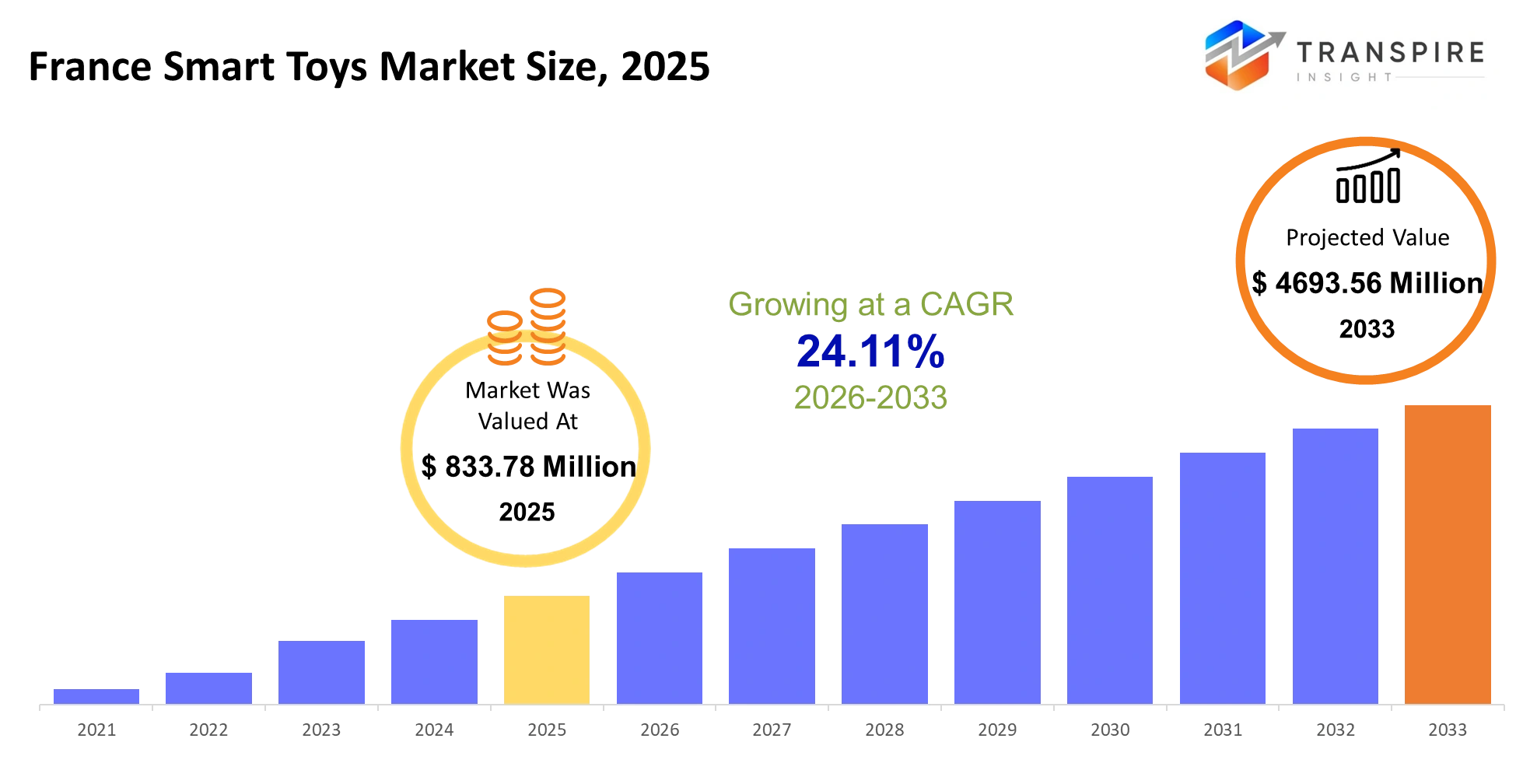
- France Smart Toys Market Size 2025: USD 833.78 Million
- France Smart Toys Market Size 2033: USD 4693.56 Million
- France Smart Toys Market CAGR: 24.11%
- France Smart Toys Market Segments: By Type (Interactive Toys, Robots, App-connected Toys, AR/VR Toys, Others); By Application (Education, Entertainment, Skill Development, STEM, Others); By End-User (Children, Schools, Parents, Institutes, Others); By Distribution (Online, Retail, Specialty, Others).
To learn more about this report,  Download Free Sample Report
France Smart Toys Market Summary
The France Smart Toys Market was valued at USD 833.78 Million in 2025. It is forecast to reach USD 4693.56 Million by 2033. That is a CAGR of 24.11% over the period.
In practice, smart toys in France kinda work like hands on learning companions, where play and adaptive education blend together. They support language growth and cognitive skill building for children, and not just in a “one way” manner. You can see them more and more with parents, also in schools, because they help reduce screen dependency while still giving individualized learning paths via sensors, voice recognition, and app-connected ecosystems.
Over the last 3–5 years, the market moved from standalone electronic toys towards connected AI-enabled learning platforms that are linked to mobile applications. The big structural change is the use of cloud-linked personalization engines, they tune difficulty levels and learning content in real time, based on how the child behaves during activities.
One key trigger, that really sped this shift up, was the pandemic era disruptions. Those pushed many families toward home-based learning tools and digital engagement products. It made purchasing habits change pretty much for good, since households started prioritizing hybrid educational entertainment. Because of that, manufacturers now lean into subscription-style content ecosystems, and this is reshaping the revenue models while also building stronger long-term customer retention.
Key Market Insights
- Île-de-France keeps the strongest regional share at around 34% , mostly because incomes are higher and smart device take up is pretty rapid.
- Provence-Alpes-Côte d’Azur looks like it is emerging as the fastest-growing area, led by the digital education roll out that just keeps expanding.
- In terms of products, AI-enabled educational toys take the lead with roughly 41% share, thanks to adaptive learning and sort of personalized education pathways.
- App-connected robotic toys place second, driven by more and more smartphone-linked interactive play setups. Also voice-interactive toys grow the quickest, because natural language processing keeps improving, like the systems are getting smarter.
- For applications, early childhood learning stays the dominant segment with about 46% share, linked to structured cognitive development needs.
- STEM-based toys are also moving fast, since French schools bring in technology-based learning frameworks.
- On the demand side, household consumers represent nearly 68% of total demand, mainly due to home-based digital learning behavior.
- And overall, the competitive edge is getting shaped by subscription content models, AR integration, and cloud-connected learning platforms, rather than only hardware features.
What are the Key Drivers, Restraints, and Opportunities in the France Smart Toys Market?
The main engine behind the France Smart Toys Market is the rapid adoption of AI-driven adaptive learning setups in everyday toys, so that educational content can be personalized in real time. This momentum really kicked in when early education got broadly digitized during pandemic related disruptions, and it kind of changed what parents expect… permanently. Because of that, toy makers are now chasing stronger recurring earnings via app subscriptions and ongoing content upgrades, instead of relying only on one time product sales. In practice this can raise the lifetime value of a customer quite a lot.
One of the biggest brakes is the cost and overall complexity of putting advanced AI, sensors, and safe cloud connectivity into child oriented products. It becomes a structural obstacle since EU child data protection requirements must be met, which adds extra development layers . So rollouts get slower. Smaller manufacturers have a harder time keeping up, which narrows the range of innovation types, and it also tends to hold prices relatively high. That delays wider adoption in mid income households.
A clear chance is in growing AI enabled bilingual plus STEM centered learning toys that match European curriculum expectations. France is putting more focus on digital education in primary schools, and that makes partnerships between public bodies and private firms easier to manage. Businesses that pair curriculum aligned AI modules with affordable hardware can tap into large institutional orders, in particular in less served suburban school areas where digital learning infrastructure is still catching up.
What Has the Impact of Artificial Intelligence Been on the France Smart Toys Market?
Artificial intelligence is, in France, changing the way smart toys work, mainly because it brings adaptive learning systems that can slide difficulty up or down, shift the narratives, and give feedback in a more nuanced way based on how a child interacts. In practice, machine learning models tucked inside companion apps look at the way a kid uses the toy, then they personalize the learning journey, which tends to boost engagement and retention compared with more static toy styles. Lately, voice recognition systems are also getting more common, they help create conversational learning, so children practice language and cognitive skills through dialogue that feels more interactive.
From an operational point of view, AI powered platforms let manufacturers fine tune product performance using real time usage insights, in other words they can spot which parts actually hold attention and which ones need a rethink. Predictive analytics are used too, to anticipate future product updates as well as content demand, this helps with inventory planning for digital learning modules, and for subscription services as well.
When looking at measurable outcomes, companies often mention longer engagement time per session and better subscription renewal rates after AI personalization is applied, which suggests higher lifetime product value. Still, there are limits: the voice and emotion recognition features can behave inconsistently in busy, noisy homes or in multilingual contexts, which lowers accuracy when it’s used in everyday life. Plus, the costs of integrating secure AI processing, and meeting EU child data rules, are still quite high, and that tends to cap scalability for smaller firms.
Key Market Trends
- From 2022 to 2025, AI based adaptive learning toys started replacing the old static electronic kinds across a bunch of major French retail channels, kinda quietly at first then more visible later.
- In the same period, subscription linked smart toy ecosystems also grew, with companies like Mattel, and LEGO Group, pushing digital content platforms that feel less like “just toys” and more like ongoing experiences.
- After 2023, voice enabled toys adoption jumped notably, mostly because natural language processing got more accurate, like, for real this time and not only in demos.
- Meanwhile, STEM focused smart toys gained more share as French schools began weaving technology driven learning frameworks into early education, in a way that also made administrators and teachers pay attention.
- Retailers then shifted from hardware only selling to bundled hardware plus app models, and that change helped recurring revenue streams become a thing rather than an exception.
- Parents, on the other hand, leaned more toward screen free interactive learning tools, combining physical play with digital intelligence, which sounds opposite but it actually makes sense in practice.
- On the compliance side, data privacy rules in France and across the EU reshaped product design, with stronger encryption, and child safe AI models that are less risky by default.
- Also, Asian manufacturers such as Xiaomi expanded pretty aggressively into Europe, using cost competitive smart toy ecosystems that undercut some local offerings.
- Hospitals, schools, and educational institutions increasingly adopted smart toys for special education and developmental therapy programs, not just general learning.
- Finally, cloud connected toy platforms improved how fast content updates could roll out, so innovation cycles sped up, and upgrades for continuous learning became smoother.
France Smart Toys Market Segmentation
By Type
Interactive Toys keep a pretty strong hold in the France Smart Toys Market, mostly because they blend hands on play with real-time digital reactions, you know in a way that feels responsive. A lot of people choose them, especially parents, for the structured learning vibe they bring, helping early cognitive growth while not leaning too much on passive screen time. You also see educational institutions bring these toys inside their programs, mainly to reinforce basics through guided play sessions, and it tends to be easier for teachers to manage because the interaction is built in. On top of that, good compatibility with mobile apps basically boosts their whole relevance in connected learning setups, since parents can use the companion app.
Robots are showing up as a segment that keeps growing fast, since programmable and AI-enabled models are getting more attention in STEM settings, classrooms and clubs alike. The demand comes from hands-on coding lessons and problem solving activities, which schools and extracurricular programs keep rolling out. App-connected Toys stay on a steady path because they work with smartphones, so content can be tailored a bit more, plus parents get those monitoring type features. AR/VR Toys are still more niche, though the interest is slowly rising, helped by immersive narratives and simulation based learning experiences. Then there are the other categories, like traditional electronic hybrids, which are still appealing for budget conscious households. Over the forecast period, robotics and AR driven formats are likely to change how products are invented, and that should push manufacturers to go further into deeper AI integration, even when the hardware costs are not small.
By Application
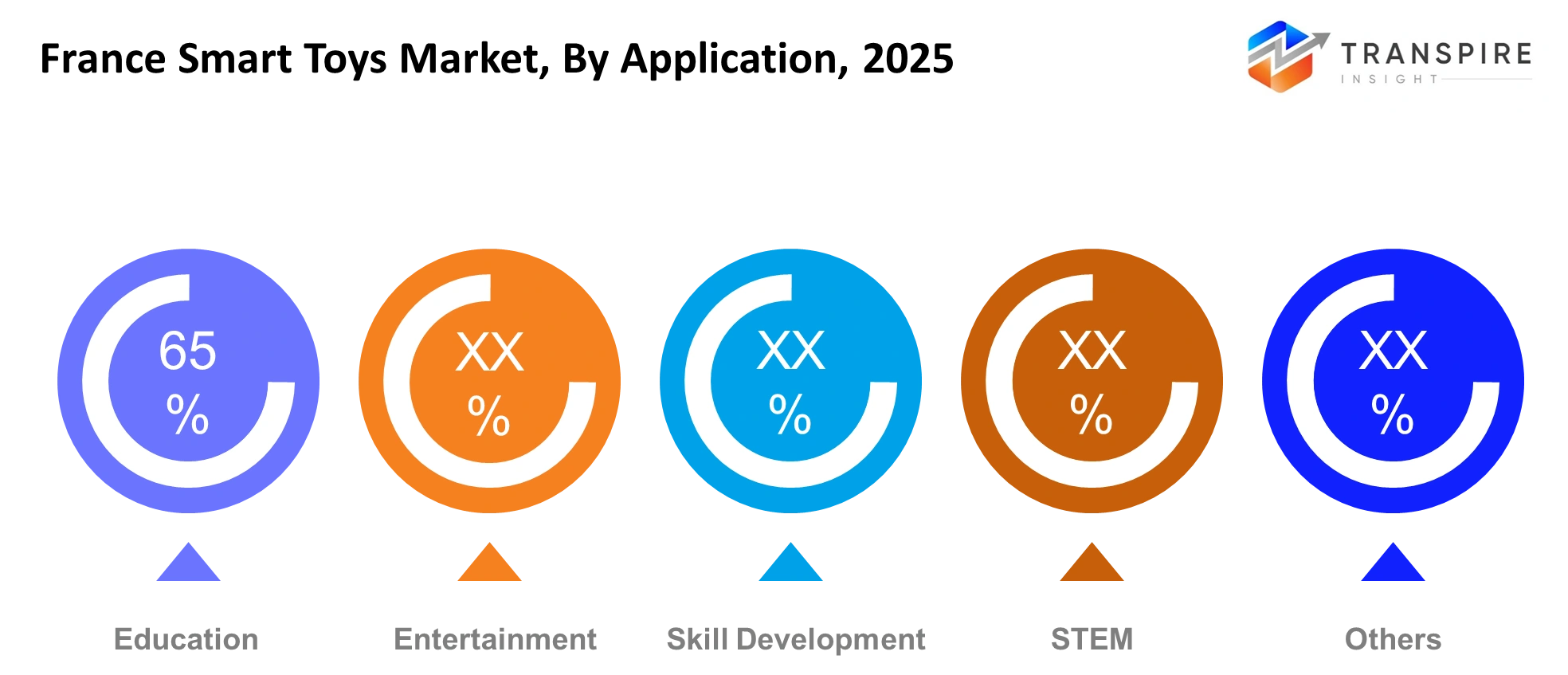
Education still basically dominates the France Smart Toys Market , because there is solid demand for structured learning tools that boost literacy, numeracy , and general cognitive abilities in the early years. You see schools and parents really pushing for toys that provide more measurable learning outcomes, but they still want it to feel fun so kids stay engaged, that part is mostly from interactive design. Also the way these toys get integrated with digital curricula makes adoption easier in both home settings and in institutions. This category also tends to ride along with the national push for education digitization initiatives.
Entertainment is not going away, it stays as an important supporting use case , mainly due to interest in immersive storytelling and play sessions that are gamified, kind of like little quests. Meanwhile Skill Development is growing too, as toys increasingly aim for problem solving, memory strengthening and motor coordination type activities. STEM Learning is showing the quickest structural growth , mostly because schools and extracurricular programs are putting more weight on science and technology education. Other areas, like therapeutic use and language learning, are slowly showing up in more specialized education environments. Over the forecast period, STEM plus skill driven applications should, in practice, start reshaping product design priorities into more outcome focused learning ecosystems.
To learn more about this report, Download Free Sample Report
By End-User
Children are, kinda the key end-user group in the France Smart Toys Market, mainly because age-specific educational and entertaining tools are being adopted pretty widely. There is strong pull from parents who are looking for safe, more organized, and interactive alternatives to the usual screen based pastime. The way products are made is mostly about keeping attention high, adding a sense of personalization, and hitting developmental milestones. So this segment kind of keeps the market steady, across urban and suburban households , even when tastes shift.
Schools are also the fastest-growing end-user category, since digital learning tools keep getting built into everyday classroom routines. Educational institutes are leaning in more and more toward smart toys for “hands on” learning, especially within STEM initiatives and language development programs. Parents stay as a fairly solid secondary group, buying smart toys so kids can do at home learning reinforcement, plus some recreational engagement. There are also other types of institutional buyers, like therapy centers and child development organizations, which are gradually increasing their use for behavioral guidance and developmental support programs. Over time, institutional demand should rise quicker than household usage, mainly because curriculum integration brings in a more structured demand.
By Distribution Channel
Online Retail keeps a leading position in the France Smart Toys Market, mainly because of the convenience factor, a wider product line, and solid integration with digital marketing ecosystems. Through e-commerce platforms consumers can do quick product comparisons, check reviews, and get subscription style content bundles, it really boosts purchase confidence. Then there’s the logistics side of strong networks, plus fast delivery options, that kind of cements this channel as the top choice. Also, digital-first buying habits among urban families continue to speed up online adoption, pretty steadily.
Offline Retail Stores still matter, not because they are “old school” but because of the hands-on feel of products. In-store demonstrations help parents make decisions on the spot, even when they looked elsewhere before. Specialty Toy Stores contribute a lot for premium positioning, especially for advanced robotics and educational kits that need a guided walkthrough. Other routes, like department stores, and institutional procurement channels, handle bulk requirements and localized demand. Over the forecast period online channels are likely to grow faster than offline, however specialty stores will stay crucial for higher value, more experiential smart toy categories.
What are the Key Use Cases Driving the France Smart Toys Market?
The dominant use case is early childhood cognitive development, where smart toys sort of deliver adaptive learning via voice interaction and sensor-based feedback. The demand is strongest among households looking for structured play, based learning tools, that reinforce core literacy and numeracy skills, without leaning on screens too much.
Secondary use cases are starting to show up in STEM learning support, and language development, especially in homes and within educational institutions. Schools and daycare centers are using connected toys more often as a supplement to regular teaching, in particular for hands-on problem solving, and bilingual learning across urban areas in France.
Nascent applications show up too, like therapeutic support for children with developmental delays, and also emotional regulation practice tools. This is getting more attention in special education programs where adaptive AI style behavior helps tailor engagement, and can enhance attention span gradually, over time.
|
Report Metrics |
Details |
|
Market size value in 2025 |
USD 833.78 Million |
|
Market size value in 2026 |
USD 1034.79 Million |
|
Revenue forecast in 2033 |
USD 4693.56 Million |
|
Growth rate |
CAGR of24.11%from 2026 to 2033 |
|
Base year |
2025 |
|
Historical data |
2021 - 2024 |
|
Forecast period |
2026 - 2033 |
|
Report coverage |
Revenue forecast, competitive landscape, growth factors, and trends |
|
Regional scope |
France |
|
Key company profiled |
LEGO, Mattel, Hasbro, Fisher-Price, WowWee, Sphero, Anki, Spin Master, VTech, Bandai, Playmobil, DJI, Sony, Nintendo, TOMY. |
|
Customization scope |
Free report customization (country, regional & segment scope). Avail customized purchase options to meet your exact research needs. |
|
Report Segmentation |
By Type (Interactive Toys, Robots, App-connected Toys, AR/VR Toys, Others); By Application (Education, Entertainment, Skill Development, STEM, Others); By End-User (Children, Schools, Parents, Institutes, Others); By Distribution (Online, Retail, Specialty, Others). |
Which Regions are Driving the France Smart Toys Market Growth?
Île-de-France is leading the France Smart Toys Market, mostly because of its dense urban population and the fact that many households have relatively higher incomes, plus people tend to adopt connected learning devices early on or so it feels. The area also leans on a solid digital infrastructure, with widespread high speed broadband access. In Paris and nearby metropolitan zones, educational institutions bring in smart learning tools faster than in several other regions, and because of that whole setup there is a sustained demand for AI enabled toys, both in retail and institutional sales.
Auvergne-Rhône-Alpes grows in a steadier way, thanks to a mix that’s kind of balanced between urban innovation hubs and mid-sized cities that are economically more stable. Here, growth is not as much about jumping to early tech leadership like you might see elsewhere, instead it leans on consistent household spending and slow but steady digital education adoption. Regional retailers and education providers tend to integrate smart learning tools into traditional curricula step by step, almost like incremental upgrades, and that creates revenue that feels reliable rather than that rollercoaster type of growth.
Provence-Alpes-Côte d’Azur, though, is moving the quickest. It’s backed by rising digital schooling initiatives and also more smart parenting trends, which is probably why adoption keeps accelerating. Broadband access in the region has improved recently, and educational technology funding is increasing too, so suburban and coastal cities are adopting these tools faster. Local governments have also pushed digital learning programs in primary education, and that helps institutional demand for interactive toys keep climbing. Overall, this trajectory looks like a strong entry opportunity for manufacturers aiming at education markets that are still somewhat underserved, but modernizing quickly, at least compared to the past.
Who are the Key Players in the France Smart Toys Market and How Do They Compete?
Competition in the France Smart Toys Market is kind of moderately consolidated, where large global toy players together with newer tech-enabled innovators compete, not only on price, more so on digital capability and that whole “experience” feeling. Existing brands try to hold their share by adding AI-driven learning systems, while smaller players tend to go for narrower themes, like niche robotics or app centered ecosystems, which sounds simpler but it actually helps them stand out. In general, the main race looks less about classic toy manufacturing scale, and more about technology integration, content ecosystems, plus subscription based engagement models that keep the user around longer, even after the first purchase.
LEGO Group competes with immersive educational ecosystems, basically stitching digital learning platforms into physical building toys, so kids spend more time interacting and the brand sticks. Mattel keeps momentum by using app-connected learning products and content subscriptions, and that approach extends product lifecycles well past the initial sale, kinda like the toy becomes a gateway. Hasbro leans into licensed interactive toys and AI enhanced storytelling experiences, using solid entertainment partnerships so its offerings feel more unique, not just “smart” for smart’s sake.
VTech Holdings holds a cost efficient edge by focusing on early education segments, offering feature-rich smart learning devices that are still affordable. Sony Group Corporation differentiates through advanced voice recognition and multimedia integration, which puts its lineup closer to hybrid entertainment learning systems rather than standalone gadgets. Xiaomi moves aggressively, using competitive pricing and ecosystem integration, and it leverages its wider smart home platform to push into connected toy segments, even if it takes a bit of time to establish trust in that category.
Company List
- LEGO
- Mattel
- Hasbro
- Fisher-Price
- WowWee
- Sphero
- Anki
- Spin Master
- VTech
- Bandai
- Playmobil
- DJI
- Sony
- Nintendo
- TOMY
Recent Development News
In January 2026, LEGO Group launched new LEGO SMART Play sets at Spielwarenmesse 2026 in Germany. The sets integrate interactive smart brick technology that connects physical building play with digital responsiveness, strengthening LEGO’s position in AI-enabled educational toys across European markets including France.
Source: http://www.licenseglobal.com
In April 2026, Hasbro announced a strategic media and distribution partnership with Get After It Media to launch “Hasbro Legends.” The FAST channel expansion strengthens its digital ecosystem strategy, enabling deeper integration between entertainment content and connected toy engagement in European markets, including France.
Source: https://en.wikipedia.org
What Strategic Insights Define the Future of the France Smart Toys Market?
France's Smart Toys market is moving, kinda obviously but not fully, toward ecosystem driven education platforms where physical toys act like a sort of entry point into continuous digital learning subscriptions. You can see this as the stuff where edtech meets AI personalization , and also because households want learning tools that feel structured but still flexible. Over the next 5–7 years value creation is expected to slide more into software ecosystems than into hardware units alone, so the way revenue gets shared across manufacturers is likely to be reshuffled.
There is also a less visible risk , the growing dependency on cloud based personalization services. This can make companies face tougher EU child data governance enforcement, and even operational restrictions, not just compliance paperwork. At the same time, an emerging opportunity is curriculum aligned AI toys built with school use in mind, especially since French education authorities are expanding digital learning requirements in primary classrooms.
So the key strategic recommendation for anyone active in this market is to move away from purely product centric innovation. Instead build platform based ecosystems that combine hardware with AI content and partnerships with institutions, so you can secure recurring revenue and keep long-term user involvement, without needing the next single launch every time.
France Smart Toys Market Report Segmentation
By Type
- Interactive Toys
- Robots
- App-connected Toys
- AR/VR Toys
- Others
By Application
- Education
- Entertainment
- Skill Development
- STEM Learning
- Others
By End-User
- Children
- Schools
- Parents
- Educational Institutes
- Others
By Distribution Channel
- Online Retail
- Offline Retail Stores
- Specialty Toy Stores
- Others
Frequently Asked Questions
Find quick answers to common questions.
The approximate France Smart Toys Market size for the market will be USD 4693.56 Million in 2033.
Key segments for the France Smart Toys Market are By Type (Interactive Toys, Robots, App-connected Toys, AR/VR Toys, Others); By Application (Education, Entertainment, Skill Development, STEM, Others); By End-User (Children, Schools, Parents, Institutes, Others); By Distribution (Online, Retail, Specialty, Others).
Major France Smart Toys Market players are LEGO, Mattel, Hasbro, Fisher-Price, WowWee, Sphero, Anki, Spin Master, VTech, Bandai, Playmobil, DJI, Sony, Nintendo, TOMY.
The France Smart Toys Market size is USD 833.78 Million in 2025.
The France Smart Toys Market CAGR is 24.11% from 2026 to 2033.
- LEGO
- Mattel
- Hasbro
- Fisher-Price
- WowWee
- Sphero
- Anki
- Spin Master
- VTech
- Bandai
- Playmobil
- DJI
- Sony
- Nintendo
- TOMY
Recently Published Reports
-
Apr 2026
Bottled Water Market
Bottled Water Market Size, Share & Analysis Report By Product Type (Still Bottled Water, Carbonated Bottled Water, Functional Bottled Water, and Others), By Packaging (PET, Cans, and Others), By Sales Channel (Supermarkets/Hypermarkets, Convenience Stores/Drug Stores, Grocery Stores/Club Stores, Foodservice, and Others) and Geography (North America, Europe, Asia-Pacific, Middle East and Africa, South and Central America), 2021 - 2032
-
Apr 2026
Color Cosmetic Packaging Market
Color Cosmetic Packaging Market Size, Share & Analysis Report By Application (Mascara Packaging, Liquid Packaging, and Liquid Face), By Type (Tubes & Bottles, Pens & Markers, Compacts & Containers, and Droppers & Pumps), and Geography (North America, Europe, Asia-Pacific, Middle East and Africa, South and Central America), 2021 - 2031
-
Apr 2026
External Microphone For Camera Market
External Microphone For Camera Market Size, Share & Analysis Report By Type (Shotgun Microphone, Lavalier Microphone, and Others), By Application (Digital Camera, Professional Video Camera, and Others), and Geography (North America, Europe, Asia-Pacific, Middle East and Africa, South and Central America), 2021 - 2031
-
Apr 2026
Foot Orthotic Insoles Market
Foot Orthotic Insoles Market Size, Share & Analysis Report By Type (Pre-fabricated, and Custom-made), By Material (Thermoplastic, Composite Carbon Fiber, and Others), By Distribution Channel (Drug Stores, Hospitals & Clinics, and Others), and Geography (North America, Europe, Asia-Pacific, Middle East and Africa, South and Central America), 2021 - 2031