
South Korea Web Application Firewall Market Size & Forecast:
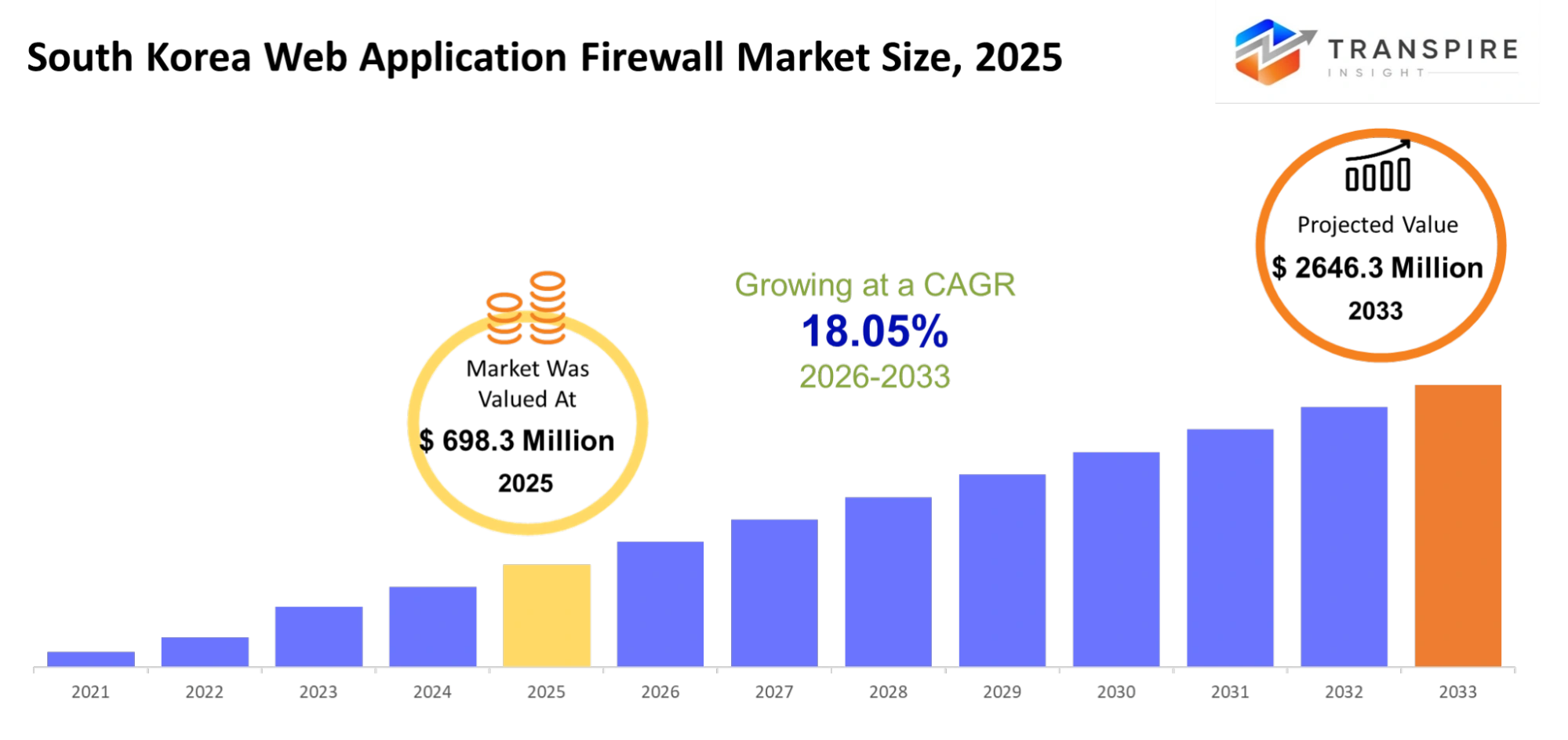
- South Korea Web Application Firewall Market Size 2025: USD 698.3 Million
- South Korea Web Application Firewall Market Size 2033: USD 2646.3 Million
- South Korea Web Application Firewall Market CAGR: 18.05%
- South Korea Web Application Firewall Market Segments: By Deployment (Cloud-based, On-premise, Hybrid), By Application (BFSI, E-commerce, Healthcare, Government), By Component (Software, Services, Appliances), By End-User (Enterprises, SMEs, Government, IT Firms)
To learn more about this report,  Download Free Sample Report
South Korea Web Application Firewall Market Summary:
The South Korea Web Application Firewall Market size is estimated at USD 698.3 Million in 2025 and is anticipated to reach USD 2646.3 Million by 2033, growing at a CAGR of 18.05% from 2026 to 2033.
The South Korea Web Application Firewall Market within the country’s cybersecurity industry will continue to take shape as businesses place stronger attention on protecting digital touchpoints that directly connect with customers. The market will grow because online banking and e-commerce platforms and mobile-first services will need secure user experiences that function without interruptions. South Korean consumers want companies to deliver quick applications that provide complete security protection, which forces businesses to select firewall systems that operate silently while managing advanced security threats. The industry will require system developers to create advanced systems that enable thorough security evaluation without sacrificing system efficiency.
The government will tighten data protection regulations and breach disclosure requirements, which will compel businesses to seek solutions that deliver comprehensive monitoring and reporting functionalities. The vendors will establish machine learning systems that analyze traffic patterns, which enables them to detect unusual behavior with better accuracy, thus creating web security solutions that function in predictive modes instead of reactive modes.
What Has the Impact of Artificial Intelligence Been on the South Korea Web Application Firewall Market?
The South Korea web application firewall market uses AI technology to deliver instant threat detection through its precise analysis of extensive web traffic data. Organizations can build stronger cybersecurity systems because machine learning algorithms detect patterns and unusual activities together with new attack methods. The South Korean web application firewall market uses artificial intelligence to help researchers and analysts better understand changing cyber threats and customer behavior and market competition.
AI-based smart automation systems drive performance improvements in the South Korea web application firewall market through their operational benefits. The system achieves increased accuracy and faster response times through its automated rule generation and adaptive filtering and continuous monitoring capabilities which minimize the need for human input. The new technologies help companies save money because they streamline resource distribution and decrease operational interruptions.
AI creates new solutions which help South Korean web application firewall companies gain competitive advantage through specialized security systems which adapt to user requirements. Vendors are developing intelligent firewalls that dynamically adjust protection levels based on user behavior and threat intelligence. The transition to AI-based cybersecurity solutions protects organizations better while helping them handle advanced cyber threats, which leads to continuous market expansion.
Key Market Trends & Insights:
- The Seoul metropolitan area controls more than 70% of South Korea's web application firewall market which will reach 2025 because of its extensive business and cloud computing facilities.
- The digital transformation investments will drive Busan and emerging tech hubs to become the fastest-growing areas with an expected 18% annual growth through 2030.
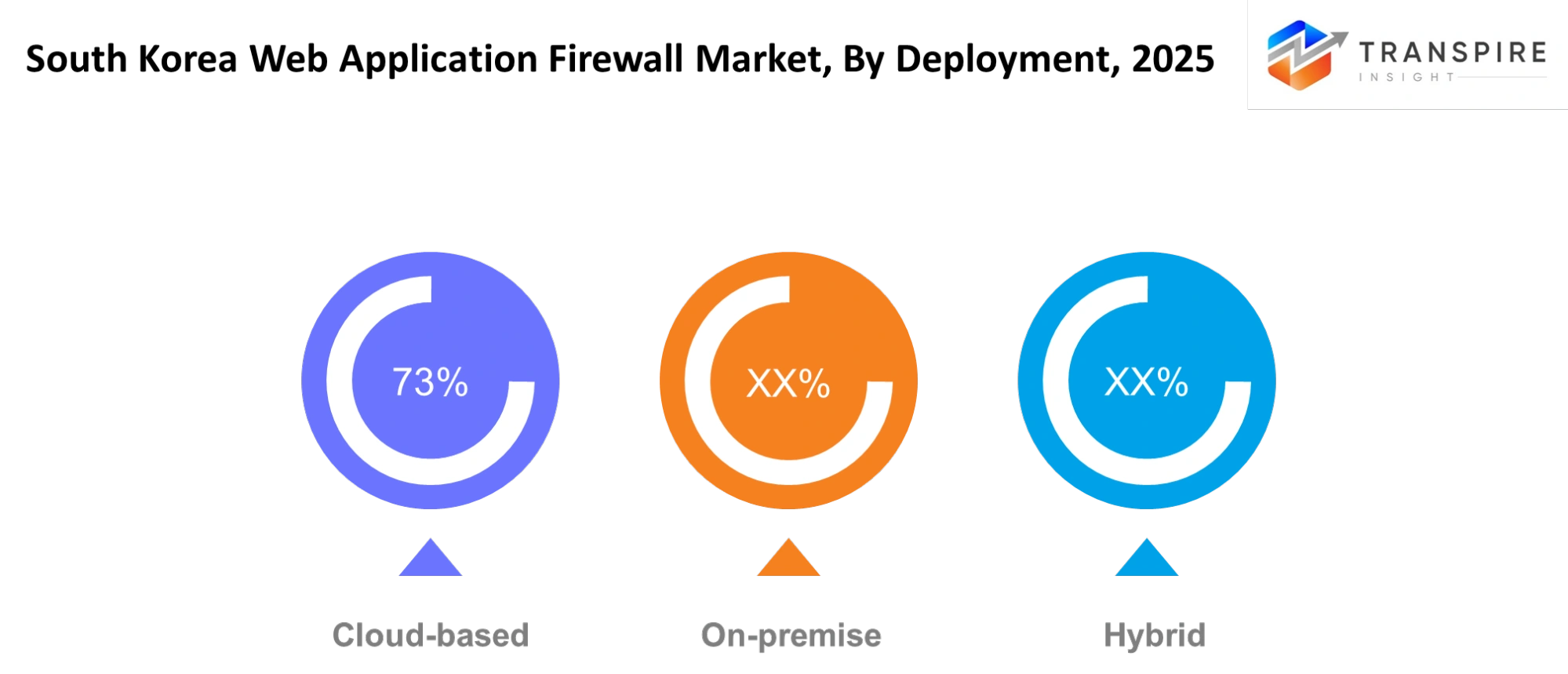
- The market for cloud-based WAF solutions will reach approximately 58% in 2025 because businesses increasingly adopt hybrid cloud environments to achieve scalable solutions.
- The on-premise WAF system maintains its position as the second-largest market segment which accounts for approximately 30% of market share because financial and government organizations need to meet regulatory compliance standards.
- The segment of AI-powered WAF solutions has emerged as the fastest-growing market segment which will experience more than 22% compound annual growth through 2030 because of its ability to detect threats in real time.
- The South Korean web application firewall market shows its highest market share through the BFSI sector which controls more than 35% of the market share because of its need to comply with strict data protection and cybersecurity laws.
- The e-commerce and digital platforms show the strongest growth among application segments because their online transaction volume increases at a rate of 20% compound annual growth.
- The 2025 market share shows large enterprises will control approximately 65% of the market because they spend heavily on cybersecurity and operate complex IT systems
- The end-user segment that experiences the fastest growth rate consists of SMBs which develop at a 19% compounded annual growth rate because of increased adoption of budget-friendly cloud-based WAF solutions.
- The main companies operating in the South Korean web application firewall market are Samsung SDS LG CNS Cloudflare Akamai Technologies F5 Networks and Palo Alto Networks.
South Korea Web Application Firewall Market Segmentation
By Deployment :
People are using cloud-based deployment because it provides them with flexible access and requires them to spend less money at the start while they can easily expand their services on digital platforms. Organizations will prefer remote management and faster updates, especially where traffic fluctuates. The approach enables businesses to efficiently connect with current apps while they expand their digital activities without needing to invest in extensive system upgrades.
Organizations that need complete data and system control should continue using on-premise deployment, which still holds value. In-house systems will become the primary method that sectors with strict compliance requirements use to handle their sensitive data. The hybrid deployment method enables organizations to control their systems while retaining the ability to adapt their operations through existing systems, which can manage multiple workloads across different environments.
To learn more about this report, Download Free Sample Report
By Application :
The BFSI segment creates demand because of increasing digital transactions and its requirement for strong data security measures. Financial institutions will spend money on better application security systems to stop security violations and build customer trust. E-commerce platforms need multiple security measures because online shopping continues to grow while their systems face increasing cyber threats.
Healthcare and government sectors show consistent adoption driven by the need to protect sensitive records and ensure uninterrupted services. Security solutions become necessary for hospitals and public systems because they process large amounts of confidential information. Digital transformation initiatives in these sectors will further support steady demand for application protection technologies.
By Component :
The market depends on software solutions which provide customizable security through continuous updates and seamless compatibility with current systems. Organizations will select software solutions because they offer both budget savings and simple installation processes. Organizations can improve their security operations through ongoing monitoring and active threat detection systems which protect their systems from evolving dangers.
Organizations which do not have internal resources rely on services to help them with all their needs, including implementation and maintenance and support. Dedicated hardware appliances deliver essential performance for high-demand situations although they lack the operational flexibility of other solutions. The system achieves operational efficiency through its different components which address specific tasks but they all work together to improve system performance.
By End-User :
Large enterprises dominate usage because their digital infrastructure needs exceed their ability to handle cyber threats. These organizations will spend money on advanced security tools which will protect their various applications while they keep their business operations running. IT companies deliver substantial value to the market because their security services are now part of the client solutions.
Small and medium enterprises show growing interest as awareness of cyber risks increases. The combination of affordable solutions together with managed services creates a straightforward path for smaller businesses to adopt new technologies. Government agencies keep improving their digital systems which results in ongoing requirements for dependable security solutions across all public service platforms.
What are the Main Challenges for the South Korea Web Application Firewall Market Growth?
The South Korea web application firewall market faces several technical and operational challenges that limit performance and scalability. The current WAF solutions must handle large amounts of encrypted network data yet they need to deliver one hundred percent uptime which creates difficulties for systems and results in both false positive detections and actual security breaches. Security threats arrive at South Korea web application firewall markets because cyberattack methods evolve so quickly that they need organizations to use fresh threat intelligence who continuously update their systems.
The South Korean web application firewall market faces additional pressure because manufacturing and commercialization barriers create obstacles. Organizations need to spend substantial amounts of money on research and infrastructure and cybersecurity knowledge so they can create superior WAF systems which use AI-based features. The high expenses for development and upkeep activities create marketplace restrictions which particularly affect smaller companies that attempt to expand their operations.
The existing infrastructure shortages which prevent WAF systems from functioning with outdated technologies present an additional implementation challenge. The market faces two growth obstacles because strong competition from zero trust architectures and secure access service edge (SASE) models creates both pricing pressure and future market uncertainty.
Country Insights
The South Korean Web Application Firewall Market is experiencing steady growth as digital services continue to expand across the finance, retail, and public sectors. Organizations will implement firewall solutions which filter out harmful traffic because their online application usage will increase their vulnerability to cyber threats. The demand for data protection will remain strong because regulations require organizations to protect data, people increasingly understand data protection requirements, and organizations continue to spend money on safe cloud systems.
The major urban centers of Seoul together with its industrial zones create a strong demand pattern which technology users follow because businesses in these areas continue to expand their operations. Organisations that develop advanced technologies will implement next-generation firewall solutions to protect their customers' information while complying with national cybersecurity requirements.
The secondary cities of other regions experience slow technology adoption because small and medium enterprises begin to adopt digital platforms. The government-backed digital transformation programs will enable broader security solution implementation which will let the South Korea Web Application Firewall Market extend its reach beyond its main urban centers while achieving controlled expansion in all geographical areas.
Recent Development News
In April 2026, SK Shieldus strengthened its cybersecurity platform by integrating next-generation Web Application Firewall capabilities into its SOC services. The integration improved automated threat response and reduced response times for web-based intrusion attempts across Korean enterprise networks.
Sourcehttps://www.skshieldus.com/
In March 2026, KT Corporation expanded its managed security services portfolio by upgrading its WAF-as-a-Service offering for enterprise clients. The service enhancement aimed to support SMEs in South Korea with scalable application-layer protection against ransomware and bot attacks.
Sourcehttps://www.kt.com/
|
Report Metrics |
Details |
|
Market size value in 2025 |
USD 698.3 Million |
|
Market size value in 2026 |
USD 828.5 Million |
|
Revenue forecast in 2033 |
USD 2646.3 Million |
|
Growth rate |
CAGR of 18.05% from 2026 to 2033 |
|
Base year |
2025 |
|
Historical data |
2021 - 2024 |
|
Forecast period |
2026 - 2033 |
|
Report coverage |
Revenue forecast, competitive landscape, growth factors, and trends |
|
Regional scope |
United States; Canada; Mexico; United Kingdom; Germany; France; Italy; Spain; Denmark; Sweden; Norway; China; Japan; India; Australia; South Korea; Thailand; Brazil; Argentina; South Africa; Saudi Arabia; United Arab Emirates |
|
Key company profiled |
Cloudflare, Akamai, Imperva, F5 Networks, Fortinet, Barracuda, AWS, Microsoft Azure, Google Cloud, Radware, Citrix, Check Point, Sophos, Trend Micro, Fastly |
|
Customization scope |
Free report customization (country, regional & segment scope). Avail customized purchase options to meet your exact research needs. |
|
Report Segmentation |
By Deployment (Cloud-based, On-premise, Hybrid), By Application (BFSI, E-commerce, Healthcare, Government), By Component (Software, Services, Appliances), By End-User (Enterprises, SMEs, Government, IT Firms) |
How Can New Companies Establish a Strong Foothold in the South Korea Web Application Firewall Market?
New companies entering the South Korea web application firewall market should establish their presence by concentrating on specific security needs which currently show increasing demand. Companies can protect their specific weaknesses by targeting healthcare and fintech and smart city infrastructure because these fields enable them to safeguard patient data and stop payment fraud and prevent IoT attacks.
The South Korean web application firewall market requires both technological innovation and product differentiation to achieve permanent market presence. Companies should allocate resources toward developing AI-powered threat identification systems, which include behavioral analysis tools and dynamic threat defense methods that monitor ongoing security breaches. The combination of machine learning and predictive analytics improves precision while decreasing false positive results, which organizations consider their most significant operational challenge. AhnLab's cloud security solutions and S2W Lab's market entry demonstrate how advanced analytics and threat intelligence platforms enable startups to gain competitive advantage through innovative business strategies.
Establishing strategic partnerships enables companies to enter new markets and expand their operations. The company achieves faster deployment and wider customer access through its partnerships with cloud service providers, telecom operators, and system integrators. The partnerships assist companies in connecting WAF solutions to their current enterprise systems, reducing the difficulty of adopting these solutions. New companies can enter the South Korean web application firewall market through niche targeting and advanced technology, and ecosystem partnerships, which help them compete with established players while achieving sustainable business growth.
Key South Korea Web Application Firewall Market Company Insights
The South Korea Web Application Firewall Market will continue to grow as people increasingly worry about data breaches and cybersecurity threats affecting online platforms. Businesses across finance, retail, and public services will increase spending on security layers that protect web applications from unauthorized access, ensuring stable operations and stronger customer trust in online systems.
The competitive environment shows steady activity with both global security providers and regional firms strengthening product offerings. Companies will work to enhance their ability to detect threats, improve their deployment options for cloud services, and strengthen their system integration capabilities. Companies will use strategic partnerships together with product updates to achieve their goals of securing long-term contracts while increasing their enterprise-level market presence across different industries.
Company List
- Cloudflare
- Akamai
- Imperva
- F5 Networks
- Fortinet
- Barracuda
- AWS
- Microsoft Azure
- Google Cloud
- Radware
- Citrix
- Check Point
- Sophos
- Trend Micro
- Fastly
What are the Key Use-Cases Driving the Growth of South Korea Web Application Firewall Market?
The South Korean web application firewall market is growing as digital banking and fintech platforms expand rapidly. Financial institutions use WAF solutions to safeguard online transactions, prevent fraud, and support compliance with strict data security laws. Businesses in South Korea face an increased need for intelligent threat detection systems due to rising cyberattacks on payment gateways and mobile banking applications.
The market expands as e-commerce and digital consumer platforms grow. Online retailers and service providers need strong defense systems which protect against bot attacks, credential stuffing and data breaches, especially during peak business periods. The South Korea web application firewall market benefits from this demand by enabling scalable, cloud-based security solutions that ensure uninterrupted user experience.
The healthcare and public sectors have made it essential to safeguard sensitive information and vital systems from unauthorized access. Secure web applications help hospitals and government portals and smart city systems handle extensive personal and operational data. The South Korea web application firewall market supports these sectors by offering customized security frameworks that address sector-specific risks.
South Korea Web Application Firewall Market Report Segmentation
By Deployment
- Cloud-based
- On-premise
- Hybrid
By Application
- BFSI
- E-commerce
- Healthcare
- Government
By Component
- Software
- Services
- Appliances
By End-User
- Enterprises
- SMEs
- Government
- IT Firms
Frequently Asked Questions
Find quick answers to common questions.
The approximate South Korea Web Application Firewall Market size for the market will be USD 2646.3 Million in 2033.
Key segments for the South Korea Web Application Firewall Market are By Deployment (Cloud-based, On-premise, Hybrid), By Application (BFSI, E-commerce, Healthcare, Government), By Component (Software, Services, Appliances), By End-User (Enterprises, SMEs, Government, IT Firms).
Major South Korea Web Application Firewall Market players are Cloudflare, Akamai, Imperva, F5 Networks, Fortinet, Barracuda, AWS, Microsoft Azure, Google Cloud, Radware, Citrix, Check Point, Sophos, Trend Micro, Fastly.
The South Korea Web Application Firewall Market size is USD 698.3 Million in 2025.
The South Korea Web Application Firewall Market CAGR is 18.05%.
- Cloudflare
- Akamai
- Imperva
- F5 Networks
- Fortinet
- Barracuda
- AWS
- Microsoft Azure
- Google Cloud
- Radware
- Citrix
- Check Point
- Sophos
- Trend Micro
- Fastly
Recently Published Reports
-
Apr 2026
3D Optical Profiler Market
3D Optical Profiler Market Size, Share & Analysis Report By Type (Desktop 3D Optical Profiler, and Portable 3D Optical Profiler), By Technology (Confocal Technology, and White Light Interference), By End-Use Industry (Manufacturing, Research Institutions, Automotive, Aerospace and Defense, Medical Devices, and Other), and Geography (North America, Europe, Asia-Pacific, Middle East and Africa, South and Central America), 2021 - 2031
-
Apr 2026
Depth Sensor Market
Depth Sensor Market Size, Share & Analysis Report By Type (Infrared Depth Sensors, Time-of-Flight (ToF) Sensors, Stereo Vision Sensors, Structured Light Sensors, Ultrasonic Depth Sensors), By Application (Automotive, Robotics, Gaming, Consumer Electronics, Industrial Automation, Healthcare, Security & Surveillance, Others), By End Users (Automotive Manufacturers, Consumer Electronics Companies, Healthcare Providers, Industrial Companies, Security Agencies, Gaming Companies, Robotics Companies, Others), and Geography (North America, Europe, Asia-Pacific, Middle East and Africa, South and Central America), 2021 – 2031
-
Apr 2026
Digital Manufacturing Market
Digital Manufacturing Market Size, Share & Analysis Report By Component (Hardware, Software, and Services), By Technology (Robotics, 3D Printing, Internet of Things (IoT), and Others), By Application (Automotive and Transportation, Aerospace and Defense, Consumer Electronics, Industrial Machinery, and Others), By Process Type (Computer-Based Designing, Computer-Based Simulation, Computer 3D Visualization, Analytics, and Others), and Geography (North America, Europe, Asia-Pacific, Middle East and Africa, South and Central America), 2021 – 2031
-
Apr 2026
Digital Visa Services Market
Digital Visa Services Market Size, Share & Analysis Report By Type (Individual Travelers, Group Travelers), By Application (Tourism, Business Travel, Others), and Geography (North America, Europe, Asia-Pacific, Middle East and Africa, South and Central America), 2021 – 2031