

United States Digital Human Market Size & Forecast:
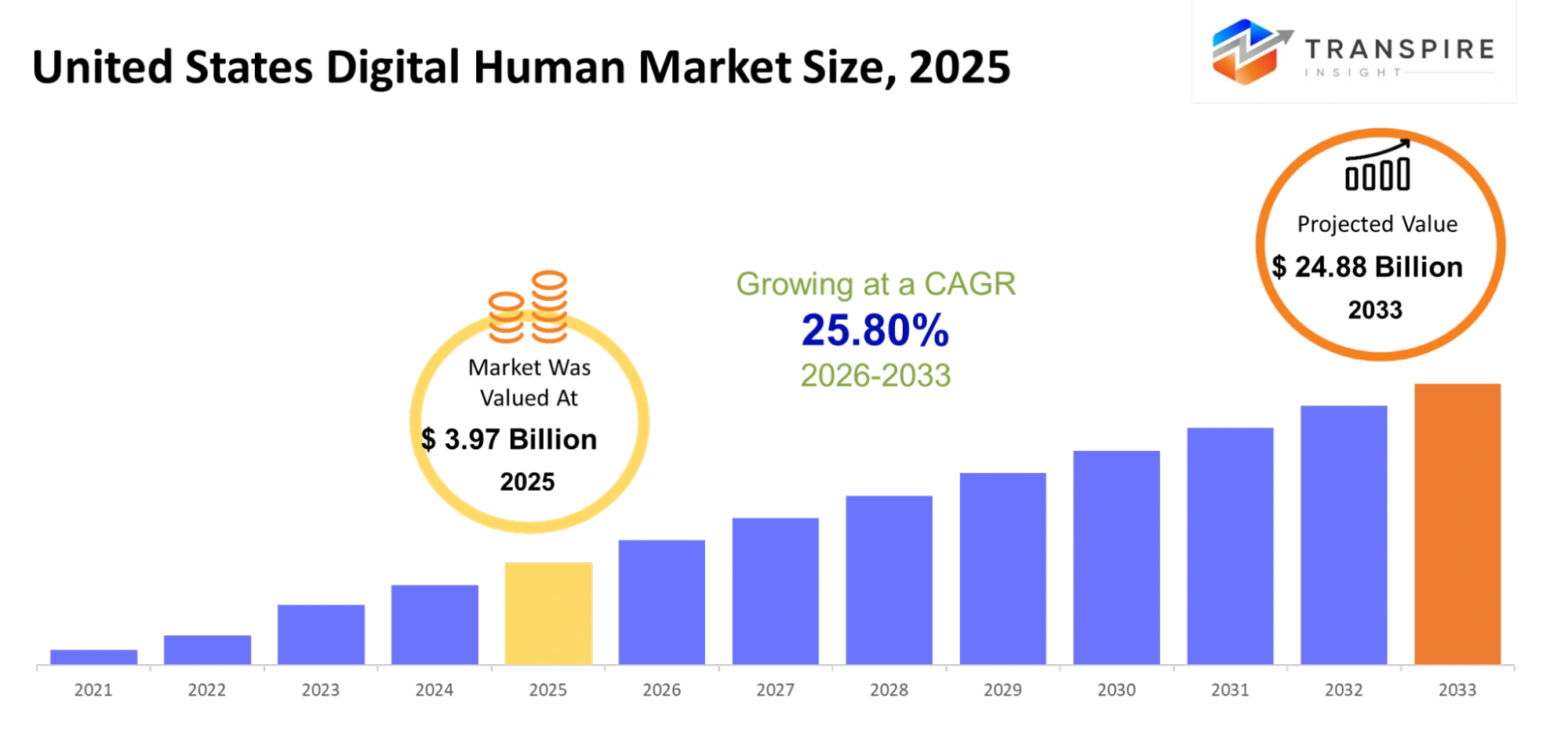
- United States Digital Human Market Size 2025: USD 3.97 Billion
- United States Digital Human Market Size 2033: USD 24.88 Billion
- United States Digital Human Market CAGR: 25.80%
- United States Digital Human Market Segments:By Component (Software, Hardware, Services, Platforms), By Application (Customer Service, Healthcare, Education, Entertainment), By Deployment (Cloud, On-premise, Hybrid), By Technology (AI, NLP, 3D Modeling, Animation), By End-User (Enterprises, Media Companies, Healthcare Providers, Retailers).
To learn more about this report,  Download Free Sample Report
United States Digital Human Market Summary:
The United States Digital Human market size is estimated at USD 3.97 Billion in 2025 and is anticipated to reach USD 24.88 Billion by 2033, growing at a CAGR of 25.80% from 2026 to 2033. The digital human market in the United States shows fast expansion because artificial intelligence and computer graphics and natural language processing technologies advance. Companies now use digital humans to provide customer support and virtual help and create interactive brand experiences. Retail and healthcare and entertainment sectors use realistic avatars to improve user interaction and personalised experiences. The market will grow because of two factors: people want interactive solutions that are affordable and businesses keep developing new technologies. Digital humans will become essential elements of upcoming digital transformation plans.
Key Market Trends & Insights:
- Companies are increasingly using digital humans as virtual assistants and brand representatives. The service provides customers with real-time personalised interactions which enhance their satisfaction while reducing operational expenses.
- The market is experiencing growth because of fast developments in AI technology, which helps to solve problems through speech recognition and emotional intelligence. Digital humans acquire this capacity, which enables them to execute more authentic human exchanges through their conversational abilities.
- Digital humans are used in healthcare to deliver patient assistance and mental health support and medical education. The system delivers consistent healthcare through digital platforms which enable users to access medical services at any time.
- The entertainment sector uses digital humans to create virtual influencers and gaming characters and storytelling elements. The avatars enhance audience interaction while they enable new artistic expression methods.
- Businesses are emphasising tailored user experiences through digital humans. The avatars use user data analysis to adjust their tone and language and response styles according to user preferences.
- Organisations implement digital human solutions to decrease their need for extensive human personnel. The developed solutions enable organisations to expand their operations throughout multiple platforms without incurring major extra expenses.
- Educational institutions and enterprises are using digital humans for simulations and skill development. Interactive learning is delivered through their educational system, which provides users with direct experience.
United States Digital Human Market Segmentation
By Component
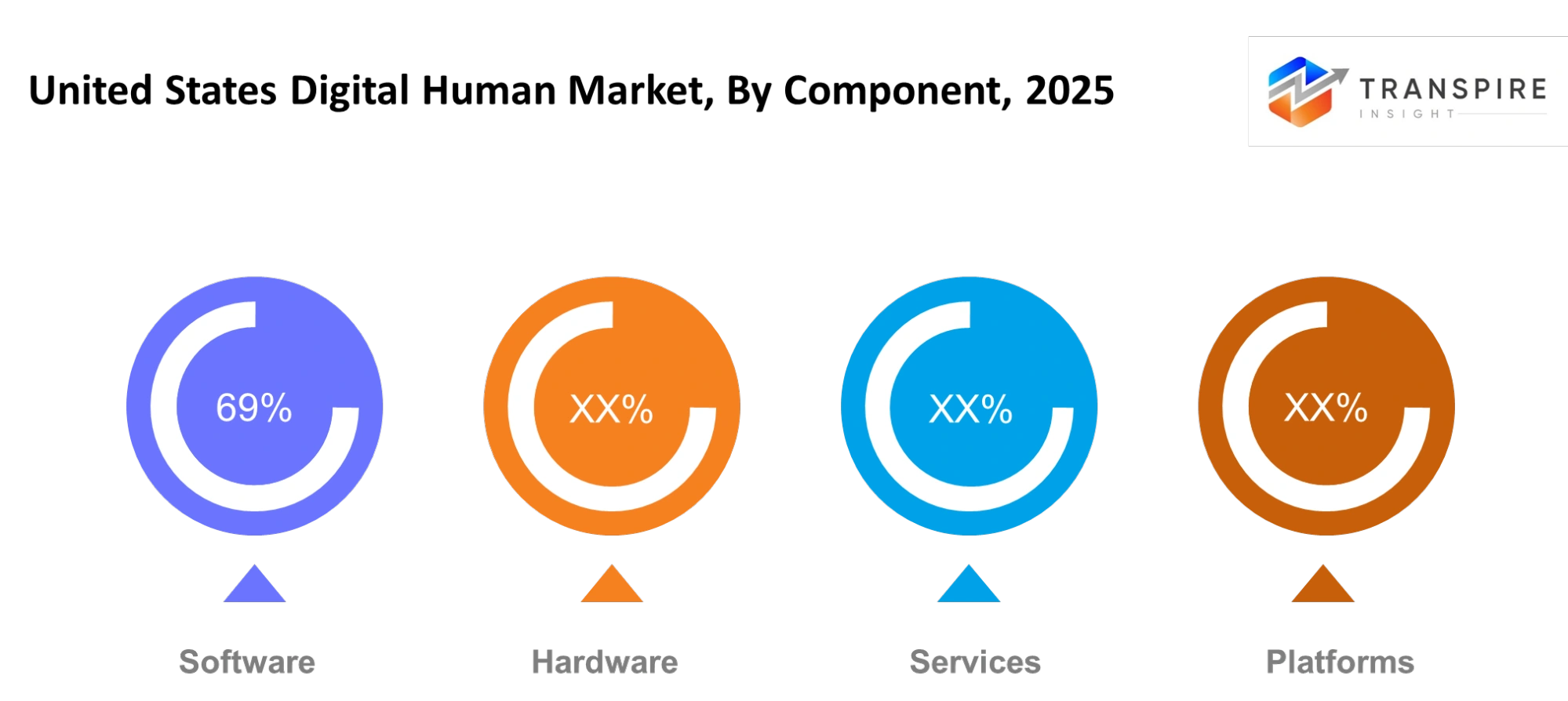
- Software: Digital human technology depends on software which provides essential functions for speech synthesis and facial expression rendering and human interaction capabilities. The AI-based software system receives continuous updates which increase its ability to provide realistic results while maintaining interactive capabilities. Companies are making substantial investments to build scalable systems which will function across different platforms because software development serves as the primary driver of market innovation.
- Hardware: Digital human systems require hardware components which deliver both processing capabilities and visual output functions. The system requires high-performance GPUs together with sensors and AR/VR devices to achieve smooth rendering and real-time user interaction. The development of technology has resulted in the creation of smaller and more affordable hardware products which enable businesses to use digital human technology.
- Services: The services provided by the company encompass consulting work and digital human solution customisation and system integration and ongoing solution maintenance. Organisations depend on specialised service providers who develop unique digital human solutions to meet their particular requirements. Organisations receive ongoing support which enables them to achieve their best performance while professional services assist them in implementing these technologies in a successful manner.
- Platforms: Digital human technology needs platforms to create and manage digital humans and deploy them in various applications. The platforms provide design tools together with animation tools and systems for managing user interactions. The efficiency of cloud-based platforms allows companies to expand their digital human applications through multiple channels which operate on various devices.
To learn more about this report, Download Free Sample Report
By Application
- Customer Service: Digital humans revolutionise customer service operations by providing immediate personal contact responses to customers. The system operates continuously throughout the day to provide customer service, which lessens waiting periods while enhancing user satisfaction. Users receive better service because businesses need fewer resources to operate their systems while creating authentic human contact through digital interfaces.
- Healthcare: Digital humans support healthcare operations through their functions, which include patient communication and mental health assistance and medical advisory services. The system provides better access to services, which benefits people who live in remote locations. The solutions maintain constant patient contact through compassionate dialogue while minimising the workload for healthcare providers.
- Education: Digital humans function as virtual tutors and trainers to create better learning experiences for students. The platform provides interactive educational materials which enable students to learn at their own pace. Students gain academic benefits through instant evaluation feedback which teachers deliver according to their learning progress.
- Entertainment: Digital humans enable the entertainment industry to create virtual influencers and develop gaming and interactive storytelling experiences. The avatars bring characters to life through their ability to demonstrate authentic facial expressions and body movements. The system gives creators freedom to design fresh interactive content which results in original interactive experiences for their audience.
By Deployment
- Cloud: Digital human solutions benefit from cloud deployment because it provides businesses with flexible and scalable options which reduce their operational costs. The system enables users to remotely control their applications through the cloud without needing to build extensive physical infrastructure. The cloud-based systems become attractive to businesses because they provide regular updates and seamless integration capabilities to support their expansion needs.
- On-premise: Organisations that need to protect their data and system security need this deployment method because it gives them better control over their assets. Organisations that need to meet strict compliance standards choose this deployment method. The system requires higher initial investment costs, but it enables users to customise and control their digital human systems.
- Hybrid: The deployment model combines two components, which include cloud computing and on-premise systems. The solution enables businesses to keep their sensitive information protected through on-site storage while they use cloud resources to expand their operations. The balanced solution has become popular among companies because it enables them to operate flexibly while maintaining their security measures.
By Technology
- AI: AI functions as the foundational intelligence which powers digital humans to make decisions and change their behaviour in response to different situations. The system enables better user experiences through customised content delivery and avatar-based user behaviour learning. AI research progress enables digital human technologies to develop humanlike behaviour through their enhanced capabilities.
- NLP (Natural Language Processing): Natural language processing allows digital humans to understand and respond to human language effectively. The system enhances both the quality and accuracy of spoken interactions. Digital humans now possess improved language models which enable them to conduct more authentic and contextually aware dialogues.
- 3D Modeling: 3D modeling creates the visual structure of digital humans, which defines their main visual characteristics and their levels of realistic appearance. Advanced techniques guarantee the creation of authentic humanlike details and facial expressions. This technology enhances user interaction through visually attractive avatar representation.
- Animation: Animation produces animated digital humans who display both movement and facial expressions. The system provides natural movement patterns which enable users to interact with digital humans through realistic ways. The field of animation is undergoing continuous development which enables digital humans to show more energetic and captivating performances.
By End-User
- Enterprises: Digital humans improve customer engagement and training and internal communication for enterprises. The solutions help businesses achieve operational efficiency while decreasing their operational expenses. Digital humans have become a standard practice in digital transformation initiatives which large organisations now implement.
- Media Companies: Digital humans assist media companies in creating content and developing virtual influencers and generating storytelling content. The avatars establish new connections with audiences. The software allows marketers to create fresh advertising strategies while delivering 3D media experiences to users.
- Healthcare Providers: Digital humans enable healthcare providers to interact with patients and educate them and deliver support. The systems help organisations achieve better accessibility while operating efficiently. The tools enable medical staff to deliver standardised treatment while reducing their workload.
- Retailers: Retailers use digital humans to create better shopping experiences while providing better customer service. The system delivers customised product suggestions while providing immediate support to users. The technology enhances customer satisfaction, which leads to increased sales for businesses operating in competitive environments.
Country Insights
The United States' digital human market is shaped by a strong technological ecosystem and early adoption of advanced innovations. Leading AI companies, creative studios and research institutions operate in the country to develop cutting-edge technology which creates more realistic and interactive digital experiences. Businesses across sectors such as retail healthcare and entertainment actively use digital humans to improve customer interaction and operational efficiency.
The solutions can be deployed easily because people have high internet access and they use smart devices extensively. Ethical AI practices and data privacy standards, together with transparent operations, have become vital requirements for businesses in the U.S. market to establish customer trust. Businesses invest in immersive technologies which include augmented reality and virtual reality to enhance their market presence. The United States operates as the primary centre of innovation because it develops new trends which shape international digital human technology advancements.
Recent Development News
In April 2026, the U.S. pushes global expansion of AI systems: the U.S. government has launched initiatives to export full-stack AI solutions globally. This move strengthens digital human ecosystems by promoting American AI technologies worldwide.
In April 2026, Enterprise AI Agents Transform Workplace Interaction: AI-powered agents, including digital human interfaces, are becoming integrated into enterprise workflows. They are expected to act as digital coworkers, improving productivity and automation.
|
Report Metrics |
Details |
|
Market size value in 2025 |
USD 3.97 Billion |
|
Market size value in 2026 |
USD 4.99 Billion |
|
Revenue forecast in 2033 |
USD 24.88 Billion |
|
Growth rate |
CAGR of 25.80% from 2026 to 2033 |
|
Base year |
2025 |
|
Historical data |
2021 – 2024 |
|
Forecast period |
2026 – 2033 |
|
Report coverage |
Revenue forecast, competitive landscape, growth factors, and trends |
|
Country scope |
United States |
|
Key company profiled |
Soul Machines, UneeQ, Microsoft, NVIDIA, Epic Games, Unity, Meta, Google, Amazon AWS, IBM, Samsung, Tencent, Baidu, Adobe, OpenAI |
|
Customization scope |
Free report customization (country, regional & segment scope). Avail customized purchase options to meet your exact research needs. |
|
Report Segmentation |
By Component (Software, Hardware, Services, Platforms), By Application (Customer Service, Healthcare, Education, Entertainment), By Deployment (Cloud, On-premise, Hybrid), By Technology (AI, NLP, 3D Modeling, Animation), By End-User (Enterprises, Media Companies, Healthcare Providers, Retailers). |
Key United States Digital Human Company Insights
The digital human market in the United States operates as a competitive environment where businesses pursue three main objectives, which are to create innovative products and achieve realistic results and maintain user interest. The top companies are developing realistic virtual avatars through their investments in cutting-edge artificial intelligence and three-dimensional modelling and interactive speech systems. The increasing demand from multiple sectors, including healthcare and retail and media, has led companies to establish strategic partnerships while developing new capabilities. Startups are entering the market with specialised products, which leads to increased competition. Companies focus on three main objectives, which are to enhance customer experiences through personalised services and expandable systems and responsible artificial intelligence implementation in order to develop their business operations.
Company List
- Soul Machines
- UneeQ
- Microsoft
- NVIDIA
- Epic Games
- Unity
- Meta
- Amazon AWS
- IBM
- Samsung
- Tencent
- Baidu
- Adobe
- OpenAI
United States Digital Human Market Report Segmentation
By Component
- Software
- Hardware
- Services
- Platforms
By Application
- Customer Service
- Healthcare
- Education
- Entertainment
By Deployment
- Cloud
- On-premise
- Hybrid
By Technology
- AI
- NLP
- 3D Modeling
- Animation
By End-User
- Enterprises
- Media Companies
- Healthcare Providers
- Retailers
Frequently Asked Questions
Find quick answers to common questions.
The approximate United States Digital Human Market size for the market will be USD 24.88 Billion in 2033.
The key segments of the United States Digital Human Market are By Component (Software, Hardware, Services, Platforms), By Application (Customer Service, Healthcare, Education, Entertainment), By Deployment (Cloud, On-premise, Hybrid), By Technology (AI, NLP, 3D Modeling, Animation), By End-User (Enterprises, Media Companies, Healthcare Providers, Retailers).
Major players in the United States Digital Human Market are Soul Machines, UneeQ, Microsoft, NVIDIA, Epic Games, Unity, Meta, Google, Amazon AWS, IBM, Samsung, Tencent, Baidu, Adobe, OpenAI.
The current market size of the United States Digital Human Market is USD 3.97 Billion in 2025.
The United States Digital Human Market CAGR is 25.80%.
- Soul Machines
- UneeQ
- Microsoft
- NVIDIA
- Epic Games
- Unity
- Meta
- Amazon AWS
- IBM
- Samsung
- Tencent
- Baidu
- Adobe
- OpenAI
Recently Published Reports
-
Apr 2026
3D Optical Profiler Market
3D Optical Profiler Market Size, Share & Analysis Report By Type (Desktop 3D Optical Profiler, and Portable 3D Optical Profiler), By Technology (Confocal Technology, and White Light Interference), By End-Use Industry (Manufacturing, Research Institutions, Automotive, Aerospace and Defense, Medical Devices, and Other), and Geography (North America, Europe, Asia-Pacific, Middle East and Africa, South and Central America), 2021 - 2031
-
Apr 2026
Depth Sensor Market
Depth Sensor Market Size, Share & Analysis Report By Type (Infrared Depth Sensors, Time-of-Flight (ToF) Sensors, Stereo Vision Sensors, Structured Light Sensors, Ultrasonic Depth Sensors), By Application (Automotive, Robotics, Gaming, Consumer Electronics, Industrial Automation, Healthcare, Security & Surveillance, Others), By End Users (Automotive Manufacturers, Consumer Electronics Companies, Healthcare Providers, Industrial Companies, Security Agencies, Gaming Companies, Robotics Companies, Others), and Geography (North America, Europe, Asia-Pacific, Middle East and Africa, South and Central America), 2021 – 2031
-
Apr 2026
Digital Manufacturing Market
Digital Manufacturing Market Size, Share & Analysis Report By Component (Hardware, Software, and Services), By Technology (Robotics, 3D Printing, Internet of Things (IoT), and Others), By Application (Automotive and Transportation, Aerospace and Defense, Consumer Electronics, Industrial Machinery, and Others), By Process Type (Computer-Based Designing, Computer-Based Simulation, Computer 3D Visualization, Analytics, and Others), and Geography (North America, Europe, Asia-Pacific, Middle East and Africa, South and Central America), 2021 – 2031
-
Apr 2026
Digital Visa Services Market
Digital Visa Services Market Size, Share & Analysis Report By Type (Individual Travelers, Group Travelers), By Application (Tourism, Business Travel, Others), and Geography (North America, Europe, Asia-Pacific, Middle East and Africa, South and Central America), 2021 – 2031