
Global AI Data Centre HVDC Power Supply System Market Size & Forecast:
- Global AI Data Centre HVDC Power Supply System Market Size 2025: USD 1.53 Billion
- Global AI Data Centre HVDC Power Supply System Market Size 2033: USD 3.639 Billion
- Global AI Data Centre HVDC Power Supply System Market CAGR: 11.44%
- Global AI Data Center HVDC Power Supply System Market Segments: By Component (Rectifiers, Converters, PDUs, Monitoring Systems, Busbars, Controllers, Switchgear, Others); By Power Rating (Below 1 MW, 1-5 MW, 5-10 MW, Above 10 MW, Others); By Application (Hyperscale Data Centers, Colocation, Enterprise Data Centers, Edge Data Centers, Others); By End User (Cloud Providers, Telecom Operators, Enterprises, Others); By Cooling Integration (Air, Liquid, Hybrid, Others).
Global AI Data Centre HVDC Power Supply System Market Summary:
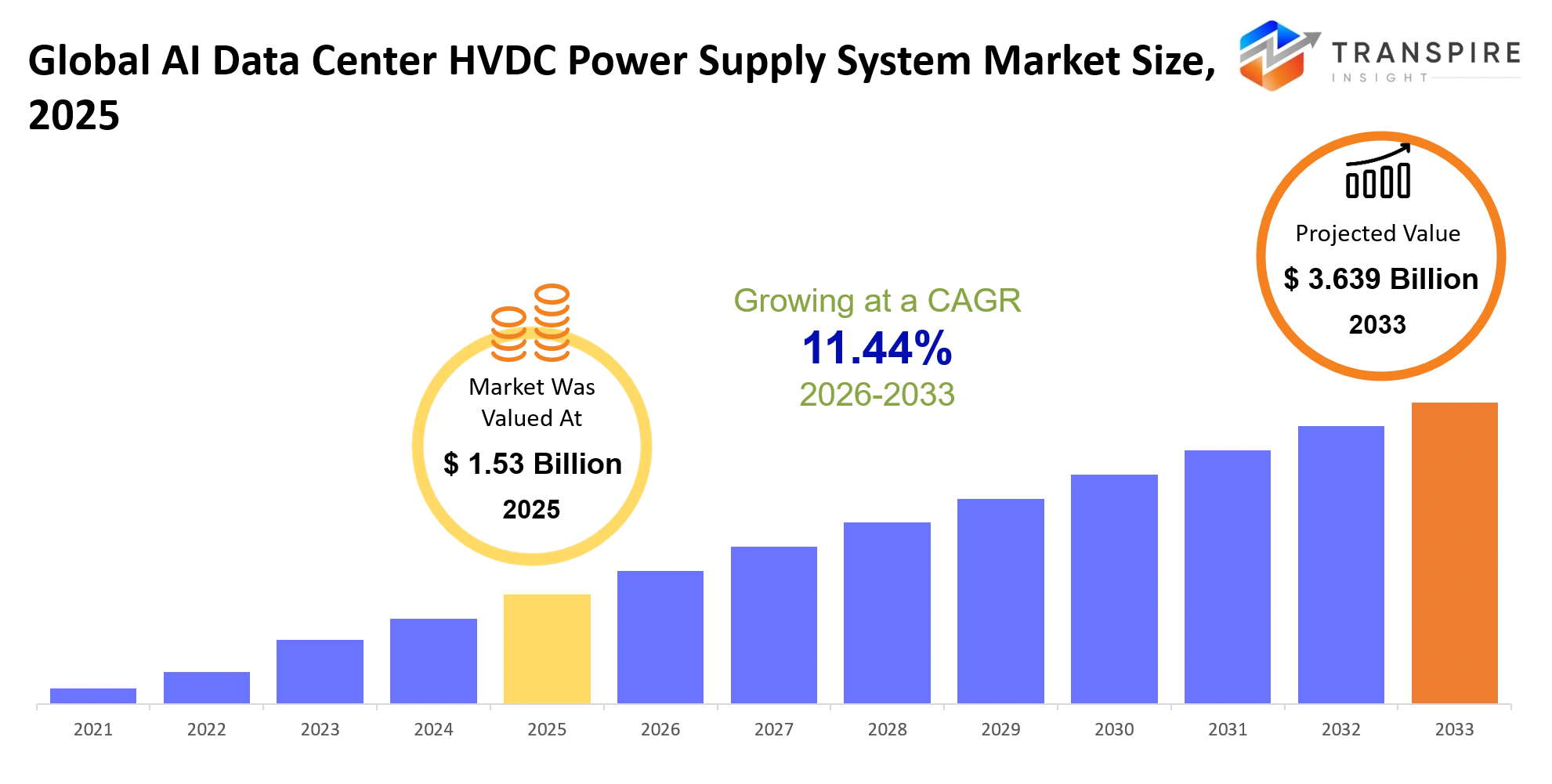
As per Transpire Insight Analysis, the Global AI Data Centre HVDC Power Supply System Market size is estimated at USD 1.53 Billion in 2025 and is anticipated to reach USD 3.639 Billion by 2033, growing at a CAGR of 11.44% from 2026 to 2033.
AI infrastructure must deal with unprecedented power needs and thermal density, making HVDC a must-have for next-gen systems. Unlike their traditional electrical distribution methods, HVDC will minimise losses associated with multiple energy conversion processes while managing the heavy and sustained workload produced by multiple-GPU clusters. During the past three to five years, the global market has evolved from traditional AC distribution towards HVDC power system ecosystems integrating smart sensors and liquid cooling. There’s a major structural shift in favour of modular high voltage DC architectures designed especially for high-concentration AI centres rather than multi-purpose data centres. GenAI’s commercial explosion and hyperscale-based AI learning platforms created, perhaps, the first tangible real-world inflexion point, catalysing worldwide hyperscale data centre development efforts. As operating capacity increases, data centre managers are deploying HVDC as a tool for more efficient energy consumption, lower operation costs, higher max per-rack power capacity and building more robust future- proof systems.
Key Global AI Data Centre HVDC Power Supply System Market Insights:
The market is moving from traditional power systems towards intelligent, software-controlled electrical systems that are optimised for AI computing performance. Innovations, digital power management, and investments in hyperscale AI are transforming supplier strategies in today's global competitive landscape.
- As Schneider Electric develops modular HVDC platforms for AI-ready infrastructure, hyperscale data centers make up 43% of deployments.
- Liquid-cooled HVDC systems are expected to grow at a 22.4% CAGR, as Vertiv is moving forward with integrated power-and-cooling solutions for dense GPU racks.
- As Eaton unveils scalable DC power architectures for AI hosting environments, colocation facilities account for 24% of installations.
- Enterprise data centres account for 16%, while ABB enhances intelligent power controllers powering phased HVDC modernisation projects.
- Edge data centers are growing at 8% while Delta Electronics is developing compact HVDC systems for distributed AI inference applications.
- Above 10 MW installations are growing most rapidly, as NVIDIA's AI clusters need ultra-high-capacity electrical distribution, with minimal conversion losses.
- The modern AI campus is investing in digital monitoring, predictive maintenance and software-defined energy optimisation, instead of manual electrical supervision.
- Cloud providers, semiconductor companies, and power equipment suppliers jointly advance standardised HVDC solutions for the world's AI infrastructure.
What are the Key Drivers, Restraints, and Opportunities in the Global AI Data Centre HVDC Power Supply System Market?
Driver:
The deployment of ultra-high-density AI compute that uses substantially less power than today’s server data centres. Generative AI, foundational AI, and GPU workloads, and associated hyperscale AI campus deployments, have unleashed unprecedented levels of investment where infrastructure electrical losses become operational cost expenses. HVDC infrastructure reduces conversion stages, optimises electrical utilisation, increases rack density, and improves infrastructure efficiency, allowing our partners to extract as much computing power as possible with reduced operating costs and long-term energy costs.
In June 2026, Vertiv launched its Vertiv™ PowerDirect™ Rack system, a hybrid-ready direct-current power distribution infrastructure engineered to natively support an 800 VDC input. This deployment streamlines power delivery and removes multi-stage AC conversion losses, allowing hyperscale partners to drastically increase power density per rack.
Restraint:
The major hindrance is the significant financial barrier to retrofitting operational systems that rely on AC. To modify existing operational sites requires a deep knowledge base, similar infrastructure, significant commissioning, downtime and installation complexity. It remains a systemic problem as nearly all currently implemented data centre designs have been engineered from the ground up based upon an AC power delivery.
Opportunity:
AI-native greenfield data centres, including renewables and storage, liquid cooling, and intelligent HVDC delivery within the system design from concept. Large-scale infrastructure development in APJ and the Middle East is accelerating the take-up of software-defined electric solutions with autonomy and self-optimisation at their heart. Silicon Carbide-based power electronics, twin and AI-delivered energy orchestration solutions will increase system effectiveness. There will be lucrative new opportunities for power system suppliers to be at the cutting edge. In April 2026, Hitachi Energy and Adani Energy Solutions Ltd. (AESL) successfully commissioned one of the world's largest city-centre HVDC infeeds in Mumbai, Hitachi Energy Press Release. This megawatt-scale 1,000 MW infrastructure layout feeds clean, direct-current power from external renewable grids directly into urban hubs.
What Has the Impact of Artificial Intelligence Been on the Global AI Data Centre HVDC Power Supply System Market?
AI is evolving HVDC power systems into smart and responsive energy control centres. They do so by monitoring their electrical load; the thermal signature of all components like rectifiers, converters, controls, and all the way to power distributors; equipment health and power quality. This monitoring can even predict failures. The combination will slash the operating time of such infrastructure, but make available more time where mission-critical AI functions depend on stable power and where electricity could be dynamically switched to GPU clusters that manage load balancing in a hyperscale infrastructure. AI-controlled digital monitoring centres are becoming responsible for synchronising power delivery to cooling requirements in facilities. The result is stability during rapid change in computational load and lowered operating costs. Scheduling can be improved and equipment lifetimes increased in massive AI campuses with greater operational flexibility. This transition is still lagging, as most traditional electrical installations need to catch up to widespread sensing and standardised interfaces and have the correct hardware architecture in place. Deploying these systems is costly, and integrating them into existing IT infrastructure is difficult.
In April 2026, Schneider Electric's CTO Jim Simonelli unveiled an expanded digital twin control framework at Data Centre World 2026. This omniverse-capable software architecture integrates deep-learning computing models to automatically synchronise real-time HVDC power delivery directly with liquid cooling loops.
Key Global AI Data Centre HVDC Power Supply System Market Trends:
The market is moving from traditional electrical infrastructure to intelligent, AI-driven power ecosystems for increased efficiency, automation, and scalability. HVDC architecture, digital monitoring and advanced cooling technologies are converging to drive realignment of investment priorities in next-generation AI data centres.
- Data centre designs have shifted from simple centralised power structures to modular ones based on HVDC, which allow for quick expansion of AI infrastructure.
- Power management is becoming more and more software-driven with the shift away from manual electrical monitoring to an autonomous power optimisation platform.
- Liquid cooling is quickly becoming a universal infrastructure need as power density keeps increasing in AI facilities.
- Semiconductor and power equipment companies are working more closely together at project design to develop electrical ecosystems that are AI-ready.
- Predictive maintenance is no longer planned maintenance and has become real-time asset health analytics, driven by intelligent monitoring technologies.
- Sustainability concerns are driving renewable-friendly HVDC projects, which can enhance electrical efficiency and reduce facility emissions.
- Prefabricated power modules are shortening construction timeframes, which leads to quicker hyperscale AI data centre projects' commissioning.
- Open electrical architecture and interoperable digital control platforms are being sought as preferred procurement criteria to enhance the long-term flexibility of infrastructure.
Global AI Data Centre HVDC Power Supply System Market Segmentation
By Component:
HVDC component-level Market share(Share by components) rectifier by using power AC to DC voltage with lower efficiency loss for high - density AI servers, which saves lots of power in power supplies. Converters and PDU optimise voltage Regulation with efficient distribution and intelligent powering, monitoring systems, and real-time inspection systems, while replacing old cabling with busbars for higher efficiency and easy installation. Controllers, switchgear, and other components boost reliability, automated protection, and management.
By Power Rating:
Above 10MW, 5-10MW systems dominate investment, as hyperscale AI datacenters demand massive, always-on power for enormous GPU clusters. Smaller solutions are proliferating throughout regional AI campus environments and in modular or edge enterprise deployments. In general, modular power architecture facilitates scalability and adaptability. It increases operating efficiency, decreases risks related to installation and operation, and facilitates future AI load growth.
By Application:
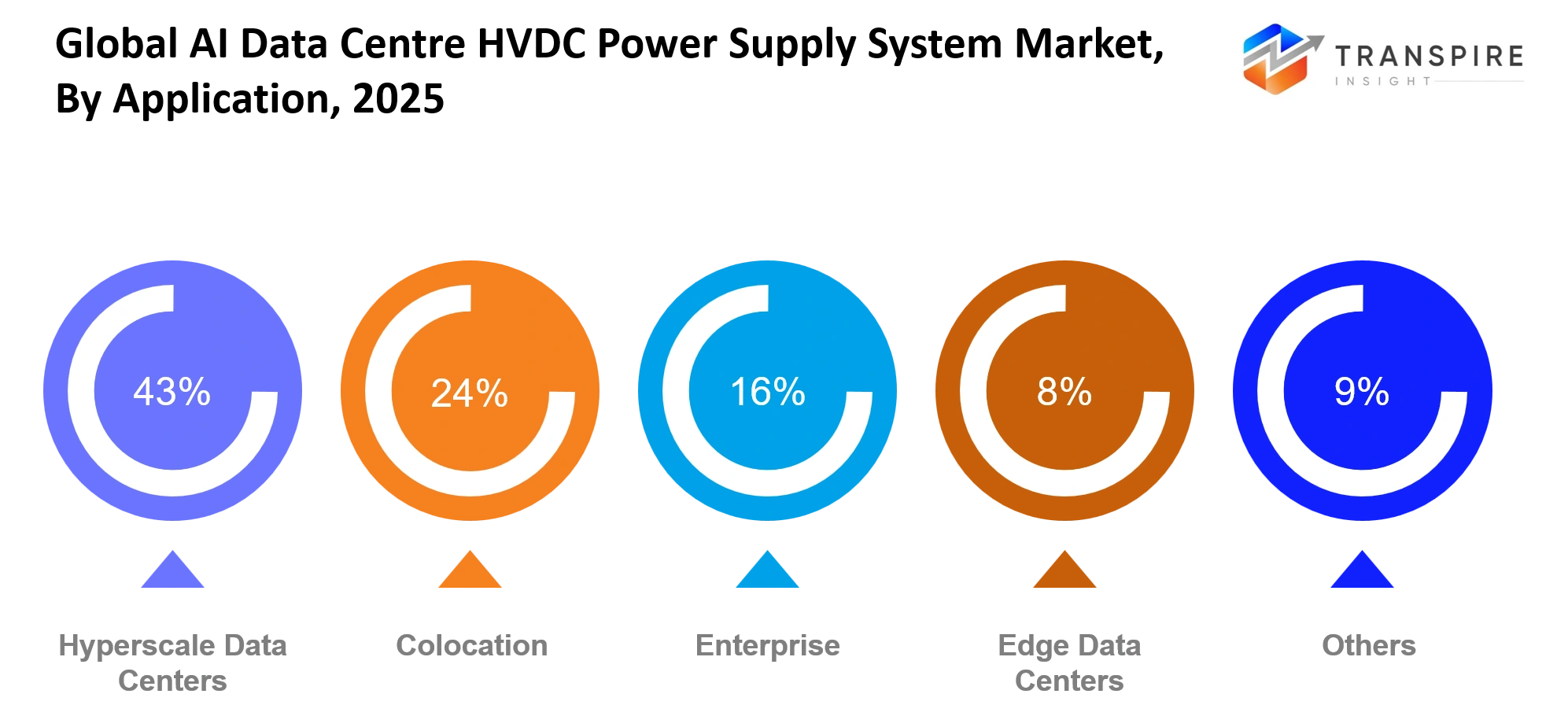
Hyperscale data centres command 43% of the market due to their consistent demand from cloud vendors for AI training capacity; the total Colocation facilities make up 24% as they allow businesses to obtain pre-equipped IT capacity for AI applications without constructing them, while the total Enterprise data centres remain 16% because of continuing digital evolution. Edge data centres contribute 8% to provide local data services with low latencies, and the total Others comprise 9% for government, R&D, and other functions, which expands the market reach of scalable and energy-efficient HVDC technologies.
By End-User:
Cloud providers remain the largest adopters because AI model training demands scalable electrical architecture, while telecom operators modernise edge infrastructure, enterprises upgrade mission-critical facilities, and other institutional users expand resilient computing environments.
By Cooling Integration:
Air-cooled systems still exist widely in current facilities due to low integration thermal loss, while liquid-cooled HVDC systems are expected to expand by 22.4% CAGR over the projected term of period when new AI processors are much hotter and of high density. Hybrid cooling methods are now the trends which provide operational advantages with increased thermal efficiencies for the future.
What are the Key Use Cases Driving the Global AI Data Center HVDC Power Supply System Market?
The leading use case is for hyperscale AI training where ultra-high-density GPU clusters depend on the use of ultra-high power capacity; high-availability HVDC distribution for constant compute workflows; Colocation; AI in Enterprises (e.g. Financials, Healthcare, Manufacturing); Telco; Future Uses.
The infrastructure adoption is growing across a diverse range of applications, including sovereign AI data centres, scientific supercomputing (HPC), autonomous vehicle developments, semiconductor design and Digital Twin simulation.
The advent of computationally intensive AI workloads has led to increased deployment alongside liquid cooling and a shift towards greater inclusion of renewables in a grid alongside HVDC energy distribution and Intelligent Energy Management to support performance, operational resilience and future scale.
|
Report Metrics |
Details |
|
Market size value in 2025 |
USD 1.53 Billion |
|
Market size value in 2026 |
USD 1.705 Billion |
|
Revenue forecast in 2033 |
USD 3.639 Billion |
|
Growth rate |
CAGR of 11.44% from 2026 to 2033 |
|
Base year |
2025 |
|
Historical data |
2021 - 2024 |
|
Forecast period |
2026 - 2033 |
|
Report coverage |
Revenue forecast, competitive landscape, growth factors, and trends |
|
Regional scope |
United States; Canada; Mexico; United Kingdom; Germany; France; Italy; Spain; Denmark; Sweden; Norway; China; Japan; India; Australia; South Korea; Thailand; Brazil; Argentina; South Africa; Saudi Arabia; United Arab Emirates |
|
Key company profiled |
Schneider Electric, Vertiv, ABB, Eaton, Siemens, Delta Electronics, Huawei, Mitsubishi Electric, Hitachi Energy, Legrand, Rittal, Cummins, Panduit, Socomec, Delta Power Solutions. |
|
Customization scope |
Free report customization (country, regional & segment scope). Avail customized purchase options to meet your exact research needs. |
|
Report Segmentation |
By Component (Rectifiers, Converters, PDUs, Monitoring Systems, Busbars, Controllers, Switchgear, Others); By Power Rating (Below 1 MW, 1-5 MW, 5-10 MW, Above 10 MW, Others); By Application (Hyperscale Data Centers, Colocation, Enterprise Data Centers, Edge Data Centers, Others); By End User (Cloud Providers, Telecom Operators, Enterprises, Others); By Cooling Integration (Air, Liquid, Hybrid, Others). |
Which Regions are Driving the Global AI Data Centre HVDC Power Supply System Market Growth?
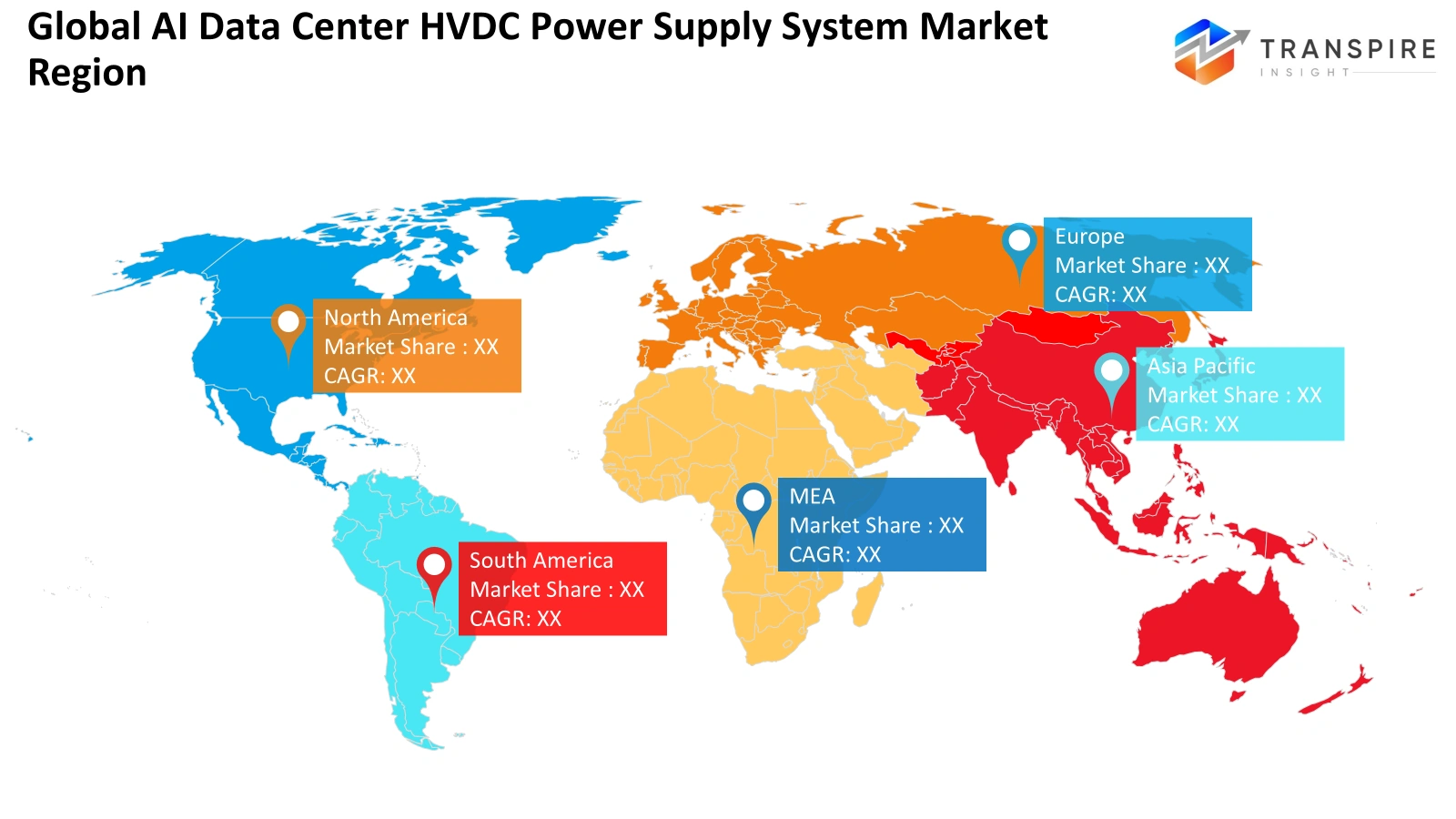
North America holds the largest market share at 44%, attributable to large hyperscale cloud operator presence, developed semiconductor supply chains, significant investment in the region’s AI infrastructure, the prevalence of ample High voltage electricity network availability, existing digital infrastructures to enable quick development of its high voltage direct current AI camps, government policies favouring local semiconductor development, a digital infrastructure more likely to achieve Energy efficiency. Such constant investments by prominent Cloud vendors ensure new-generation AI datacenters are commercially realised quickly.
In February 2026, ABB expanded its strategic power technology partnership with Applied Digital. This deployment supplies advanced medium-voltage power distribution and custom electrical solutions for the 300 MW Polaris Forge 2 AI data centre campus in North Dakota.
Although accounting for 20% of the global marketplace, the European region pursues a different trajectory than North America, driven by its focus on improving energy efficiencies, managing carbon reduction, and upgrading infrastructure. Utilities are now more frequently opting for the deployment of HVDC to adhere to their more demanding environmental standards and optimize its energy use. An efficient HVDC implementation would provide durability to the sector's overall value chains, given ongoing green energy expansion and dedicated green digital infrastructure investment. Utility/vendor/data centre collaborative studies would increase the deployment efficiency of these technologies.
Asia Pacific constitutes 29% of the total market in 2022 and is expected to show the fastest growth with a CAGR of 23.6% in terms of private as well as governmental investments, increasing AI computing power at a lightning pace. Increase in adoption of clouds, native semiconductor and build out of hyperscale campuses led to massive disruption in investment in the region in recent years. India, China, Japan and Southeast Asian economies are building up AI-ready digital infrastructure aided by the latest electrical power systems. This region proves to be the largest long-term prospect for HVDC power supply providers.
Who are the Key Players in the Global AI Data Centre HVDC Power Supply System Market and how do they Compete?
The competition in the global AI Data Centre HVDC Power Supply System market shifts towards power efficiency, digital intelligence, thermal integration, and rapid deployment capabilities beyond hardware supply. Vendors are setting themselves apart with modular systems, software-driven power management, life cycle services, global engineering expertise, and investments in their manufacturing capacity as AI hardware deployment accelerates. Schneider Electric, Vertiv, ABB, Eaton, and Siemens compete through integrated intelligent power distribution, monitoring, and scalable high-voltage DC systems for large hyper-scale operations.
Delta Electronics and Huawei are growing their share with ultra-high efficiency power electronic equipment, space-saving conversion technologies, and AI-powered systems that improve efficiency. Mitsubishi Electric and Hitachi Energy differentiate with robust industrial high voltage electrical expertise and cutting-edge conversion technology to enable high-output AI sites. Meanwhile, Legrand, Rittal, Panduit, and Socomec win by providing intelligent power distribution, cabinet integration and protection equipment, modular components and space-saving hardware. Cummins broadens offerings with robust uninterruptible power supply capabilities, while Delta Power Solution delivers efficient, compact power solutions. All around this market, the vendors are building a greater variety of Software platforms, increasing their global presence in manufacturing, forming partnerships and building ready-to-deploy solutions that create a more complete solution offering.
Key Players are:
- Schneider Electric
- Vertiv
- ABB
- Eaton
- Siemens
- Delta Electronics
- Huawei
- Mitsubishi Electric
- Hitachi Energy
- Legrand
- Rittal
- Cummins
- Panduit
- Socomec
- Delta Power Solutions
Recent Development News
In January 2026, AcBel Polytech (a subsidiary of Kinpo Group) officially pushed forward its high-voltage direct current strategy by introducing its 1MW 800V DC Power Rack system designed for hyperscale deployment. This high-capacity power infrastructure achieves an 80 PLUS Ruby-level 97.5% conversion efficiency.
Source: https://www.digitimes.com/
In January 2026, ST Telemedia Global Data Centres (STT GDC) launched the FutureGrid Accelerator, Southeast Asia’s first live High Voltage Direct Current (HVDC)-powered AI infrastructure testbed in Singapore. Developed in partnership with LITEON, this live testing platform successfully validates direct-current power architectures up to loads of at least 325kW.
Source: https://www.sttelemediagdc.com
In June 2026, Delta Electronics debuted its modular 800VDC In-Row Power shelf and 800VDC e-Fuse protection solutions at the COMPUTEX 2026 exhibition. This unified power architecture completely bypasses conventional AC-to-DC conversion stages to elevate overall energy efficiency to 92%.
Source: https://www.deltapowersolutions.com
What Strategic Insights Define the Future of the Global AI Data Centre HVDC Power Supply System Market?
AI infrastructure is going fully integrated; power supply, cooling, battery storage, and smart software are becoming the “energy ecosystem,” no longer separate siloed components. Future competitive differentiation hinges on providing software-defined, scalable HVDC platforms that can flex for changing AI hardware requirements. More discrete threat - infrastructure standards because varying regional electric standards, coupled with custom architectures for proprietary systems, will hinder system integration. Long-term greenfield campus developments that use native AI power infrastructure are the ultimate greenfield campus opportunity, combining clean energy, liquid cooling and novel power electronics for technology partners. Module design, open software platforms and smart joint ventures with chip, cloud and cooling providers will set technology leaders up with decades-long contracts. Smart energy orchestration and full lifecycle service offerings are the next step, where technology will become a battleground.
Key Segmentations are:
By Component
- Rectifiers
- Converters
- PDUs
- Monitoring Systems
- Busbars
- Controllers
- Switchgear
- Others
By Power Rating
- Below 1 MW
- 1-5 MW
- 5-10 MW
- Above 10 MW
- Others
By Application
- Hyperscale Data Centres
- Colocation
- Enterprise Data Centres
- Edge Data Centres
- Others
By End User
- Cloud Providers
- Telecom Operators
- Enterprises
- Others
By Cooling Integration
- Air
- Liquid
- Hybrid
- Others
Regional Outlook
North America
- United States
- Canada
- Mexico
Europe
- Germany
- United Kingdom
- France
- Spain
- Italy
- Rest of Europe
Asia Pacific
- Japan
- China
- Australia & New Zealand
- South Korea
- India
- Rest of Asia Pacific
South America
- Brazil
- Argentina
- Rest of South America
Middle East & Africa
- Saudi Arabia
- United Arab Emirates
- South Africa
- Rest of the Middle East & Africa
Frequently Asked Questions
Find quick answers to common questions.
The global AI data centre HVDC power supply system market size was valued at USD 1.53 Billion in 2025 and is poised to reach USD 3.639 Billion by 2033, expanding at a 11.44% CAGR.
Key segments for the global AI data center HVDC power supply system market are By Component (Rectifiers, Converters, PDUs, Monitoring Systems, Busbars, Controllers, Switchgear, Others); By Power Rating (Below 1 MW, 1-5 MW, 5-10 MW, Above 10 MW, Others); By Application (Hyperscale Data Centers, Colocation, Enterprise Data Centers, Edge Data Centers, Others); By End User (Cloud Providers, Telecom Operators, Enterprises, Others); By Cooling Integration (Air, Liquid, Hybrid, Others).
Growth is primarily driven by rapid hyperscale AI data centre expansion, increasing GPU power density, and the adoption of energy-efficient HVDC architectures for high-performance computing.
The global AI data centre HVDC power supply system market is led by major manufacturers, including Schneider Electric, Vertiv, ABB, Eaton, Siemens, Delta Electronics, Huawei, Mitsubishi Electric, Hitachi Energy, Legrand, Rittal, Cummins, Panduit, Socomec, and Delta Power Solutions.
North America holds 44% of the global market, supported by strong hyperscale cloud investments, advanced digital infrastructure, semiconductor innovation, and large-scale AI data centre deployments.
Major opportunities lie in AI-native greenfield data centres, renewable energy-integrated HVDC systems, liquid cooling technologies, and expanding hyperscale investments across Asia-Pacific and the Middle East.
- Schneider Electric
- Vertiv
- ABB
- Eaton
- Siemens
- Delta Electronics
- Huawei
- Mitsubishi Electric
- Hitachi Energy
- Legrand
- Rittal
- Cummins
- Panduit
- Socomec
- Delta Power Solutions
About the Authors

Avinash Kumar
I’m Avinash Kumar, a Senior Research Analyst at Transpire Insight, with expertise in the Electronics and Semiconductor and Energy & Power industry. My work focuses on analyzing emerging technologies, market trends, industry developments, and innovation across these sectors. I specialize in transforming complex technical and market insights into clear, research-backed content that helps professionals, businesses, and decision-makers stay informed. Through continuous industry research and data-driven analysis, I strive to deliver accurate, reliable, and practical perspectives on the latest advancements shaping the semiconductor and energy landscape.

Chakradhar Khansole
Chakradhar serves as the Research Director at Transpire Insight, bringing over 8 years of experience in technology, innovation, and strategic market intelligence. He specializes in transforming complex market data into actionable business insights that enable organizations to make informed, growth-oriented decisions. Recognized for his strategic vision and analytical expertise, Chakradhar leads high-impact research initiatives, delivering comprehensive market assessments, competitive intelligence, and forward-looking industry analysis.
Recently Published Reports
-
Apr 2026
Active Power Filter Market
Active Power Filter Market Size, Share & Analysis Report By Type (Shunt Active Power Filters, Series Active Power Filter, Hybrid Active Power Filter), By Application (Harmonics Mitigation, Reactive Power Compensation, Voltage Regulation, Power Factor Correction), By Phase (Single Phase, Three Phase), By End-User Industry (Manufacturing, Healthcare, Commercial, Automotive, Oil and Gas, Others), and Geography (North America, Europe, Asia-Pacific, Middle East and Africa, South and Central America), 2021 - 2031
-
Apr 2026
Electrical Transformer Market
Electrical Transformer Market Size, Share & Analysis Report By Core (Closed, Shell, and Berry), By Insulation (Gas, Oil, Solid, Air, and Other), By Phase (Single, and Three), By Rating (100 MVA to 500 MVA, 501 MVA to 800 MVA, and 801 MVA to 1200 MVA), and Geography (North America, Europe, Asia-Pacific, Middle East and Africa, South and Central America), 2021 – 2031
-
Apr 2026
Hydraulic Piston Pumps Market
Hydraulic Piston Pumps Market Size, Share & Analysis Report By Type (Axial Piston Pumps, Radial Piston Pumps), By Operating Pressure (Low Pressure, Medium Pressure, High Pressure), By Application (Construction, Mining, Agriculture, Automotive, Oil & Gas, Industrial Machinery, Others), By End-User (OEMs, Aftermarket), and Geography (North America, Europe, Asia-Pacific, Middle East and Africa, South and Central America), 2021 – 2031
-
Apr 2026
Laboratory Gas Generators Market
Laboratory Gas Generators Market Size, Share & Analysis Report By Product (Nitrogen Gas Generator, Hydrogen Gas Generator, Zero Air Gas Generator, Purge Gas Generator, TOC Gas Generators, Others), By Application (Gas Chromatography, Liquid Chromatography-mass Spectrometry (LC-MS), Gas Analyzers, Others), By End-user (Life Science, Chemical & Petrochemical, Food & Beverage, Others), and Geography (North America, Europe, Asia-Pacific, Middle East and Africa, South and Central America), 2021 – 2031