
Europe Quantum-behavior AI Training Market Size & Forecast:
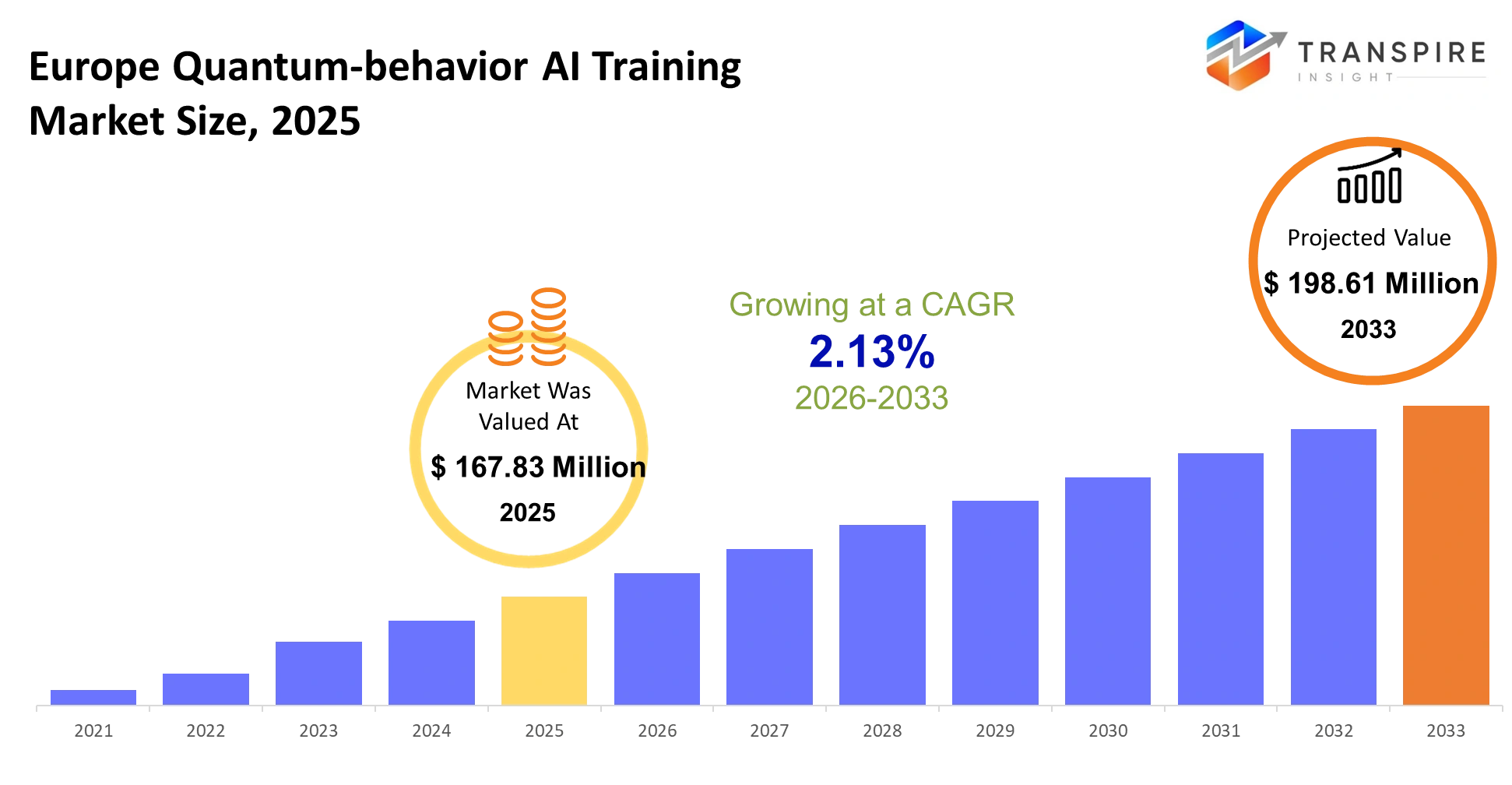
- Europe Quantum-behavior AI Training Market Size 2025: USD 167.83 Million
- Europe Quantum-behavior AI Training Market Size 2033: USD 198.61 Million
- Europe Quantum-behavior AI Training Market CAGR: 2.13%
- Europe Quantum-behavior AI Training Market Segments: By Type (Quantum Algorithms, AI Training Platforms, Simulation Tools, Services, Others); By Application (Optimization, Drug Discovery, Financial Modeling, Cybersecurity, Materials Science, Others); By End-User (Research Institutes, Enterprises, BFSI, Healthcare, Government, Others); By Deployment (Cloud, On-premise, Hybrid, Others)
To learn more about this report,  Download Free Sample Report
Europe Quantum-behavior AI Training Market Summary
The Europe Quantum-behavior AI Training Market was valued at USD 167.83 Million 2025. It is forecast to reach USD 198.61 Million by 2033. That is a CAGR of 2.13% over the period.
The Europe quantum-behavior AI training market functions as a specialized component within advanced AI development, which enables organizations to simulate complex decision-making processes that involve multiple probabilities when operating in situations where conventional deterministic AI solutions fail. The system enables autonomous maritime navigation and industrial optimization and high-stakes logistics planning because it allows systems to manage uncertainty through continuous operation instead of depending only on fixed rules.
Organizations have shifted away from traditional machine learning methods to hybrid quantum-inspired algorithms during the last three to five years because these algorithms provide better simulations of non-linear multi-variable systems. The transition gained speed after Russia-Ukraine conflict-related disruptions demonstrated European supply chain vulnerabilities which compelled industries to develop more flexible intelligence systems.
The companies have dedicated their budgets to develop training systems which maintain operational effectiveness in situations that involve ambiguous requirements. This development leads to organizations establishing extensive contracts which involve operational systems to operate maritime and industrial activities at higher financial levels.
Key Market Insights
- The Quantum-behavior AI Training Market in Europe shows Western Europe as its main market segment because it will generate 45% of the market share in 2025, which Germany, France, and the UK will drive.
- The Northern European area experiences the fastest growth because it will achieve more than 18% growth until 2030 through its strong AI research ecosystems.
- The training platforms and simulation software control about half of the industry size because businesses choose to build AI model development systems that can grow.
- The second-largest market share belongs to consulting and integration services because businesses need specific AI solutions for their industrial operations.
- The quantum-inspired algorithm training tools represent the market segment with highest growth potential which will double between 2026 and 2030 because of advanced modeling requirements.
- The industrial automation sector controls about 40% of the market because manufacturers use quantum-behavior AI to enhance their production processes that involve multiple variables.
- The application of autonomous maritime navigation shows highest growth because it meets the need for systems that can make decisions in unpredictable ocean environments.
- The European market for Quantum-behavior AI Training exists as a corporate sector which large companies control through their higher spending on advanced AI systems that constitute 60% of the market.
- The mid-sized technology companies represent the end-user group which shows highest growth rate because quantum-inspired solutions become cheaper and more accessible.
- Businesses obtain competitive advantage by using cloud ecosystems to develop quantum-behavior modeling systems which permit them to conduct real-time AI training and deployment at scale.
What are the Key Drivers, Restraints, and Opportunities in the Europe Quantum-behavior AI Training Market?
The European Quantum Behavior AI Training Market experiences rapid growth because businesses adopt probabilistic decision-making systems to handle supply chain disruptions between operational and supply chain uncertainties. The energy and logistics networks between European nations experienced major disruptions after the Russia-Ukraine conflict emerged as a global crisis. Maritime and manufacturing and logistics companies began funding AI training systems which build AI models to test multiple scenarios instead of using fixed forecast methods. Organizations increase their use of advanced training systems because they spend more money on these systems which help their workforce become more resilient while minimizing expensive errors during work.
The most significant barrier is the limited availability of quantum-ready infrastructure and specialized talent. Quantum-behavior AI training requires expertise in both advanced mathematics and hybrid computing architectures, which remain scarce across Europe. The existing infrastructure creates structural constraints because educational institutions and companies need to change their workforce training programs at a pace that exceeds their current capacity. Businesses experience extended project development periods together with increased expenses which both hinder short-term earnings and prevent market expansion.
Cloud-based quantum simulation platforms present a significant growth opportunity for development. Providers are increasingly offering quantum-inspired training environments through scalable cloud infrastructure, lowering entry barriers for mid-sized firms. The Nordic AI hubs attract more investment which establishes the ideal environment for adoption because the region possesses strong digital infrastructure together with government-supported innovation initiatives that accelerate commercial development.
What Has the Impact of Artificial Intelligence Been on the Europe Quantum-behavior AI Training Market?
Marine emission control systems together with industrial fleets provide real operational data to develop training environments for quantum-behavior models through artificial intelligence and advanced digital technologies. AI-powered platforms now perform automatic scrubber monitoring and control functions through their continuous assessment of exhaust gas cleaning parameters which include sulfur content and flow rates and washwater quality. The training datasets work with complex non-linear conditions to help operators develop decision-making models for both compliance needs and operational efficiency. Machine learning models provide scrubber performance systems with predictive maintenance capabilities because they can detect early indicators of corrosion and scaling and pump failures. Predictive algorithms evaluate emissions output based on different fuel types to assist operators in tracking their emissions levels for environmental compliance.
The operational enhancements lead to measurable performance improvements. Fleet operators observe directional progress which includes maintenance cost reductions between 10 and 15 percent and better operational availability through their ability to identify faults earlier. The existing data quality issues together with the connectivity problems which occur at sea serve as major obstacles that prevent progress. The limited capacity for real-time data transfer affects model precision and hinders ongoing learning processes which leads to restricted capabilities of AI-powered optimization in nautical settings.
Key Market Trends
- European manufacturers have departed from using deterministic AI models so they can now use probabilistic training systems which help them make better decisions when their production and logistics operations face unpredictable conditions.
- After the Russia-Ukraine conflict logistics firms increased their investment in simulation-driven AI training by more than 20 percent because they needed to handle uncertain routing and energy cost variations.
- Between 2022 and 2025 cloud-based quantum-inspired platforms achieved market growth because their deployment process required 30 percent less time than conventional on-premise AI training systems.
- Maritime operators implemented AI training tools for compliance scenario simulation because regulatory authorities demanded both emission control and operational transparency.
- Companies like IBM Google and Atos expanded their collaboration network with European research institutes to accelerate the development of hybrid quantum-classical training frameworks which they started in 2023.
- The market now demands training ecosystems that link directly with industrial control systems and deliver real-time operational data streams instead of standalone AI tools.
- Mid-sized firms increased adoption rates after 2024 as subscription-based training platforms lowered entry costs and reduced dependency on in-house quantum expertise.
- Northern European countries strengthened their position by investing heavily in AI infrastructure with public funding for quantum research rising by approximately 15 percent since 2022.
- Buyers increasingly prioritize explainable AI within training models because they must comply with EU guidelines that require algorithm transparency, which were introduced between 2022 and 2024.
Europe Quantum-behavior AI Training Market Segmentation
By Type:
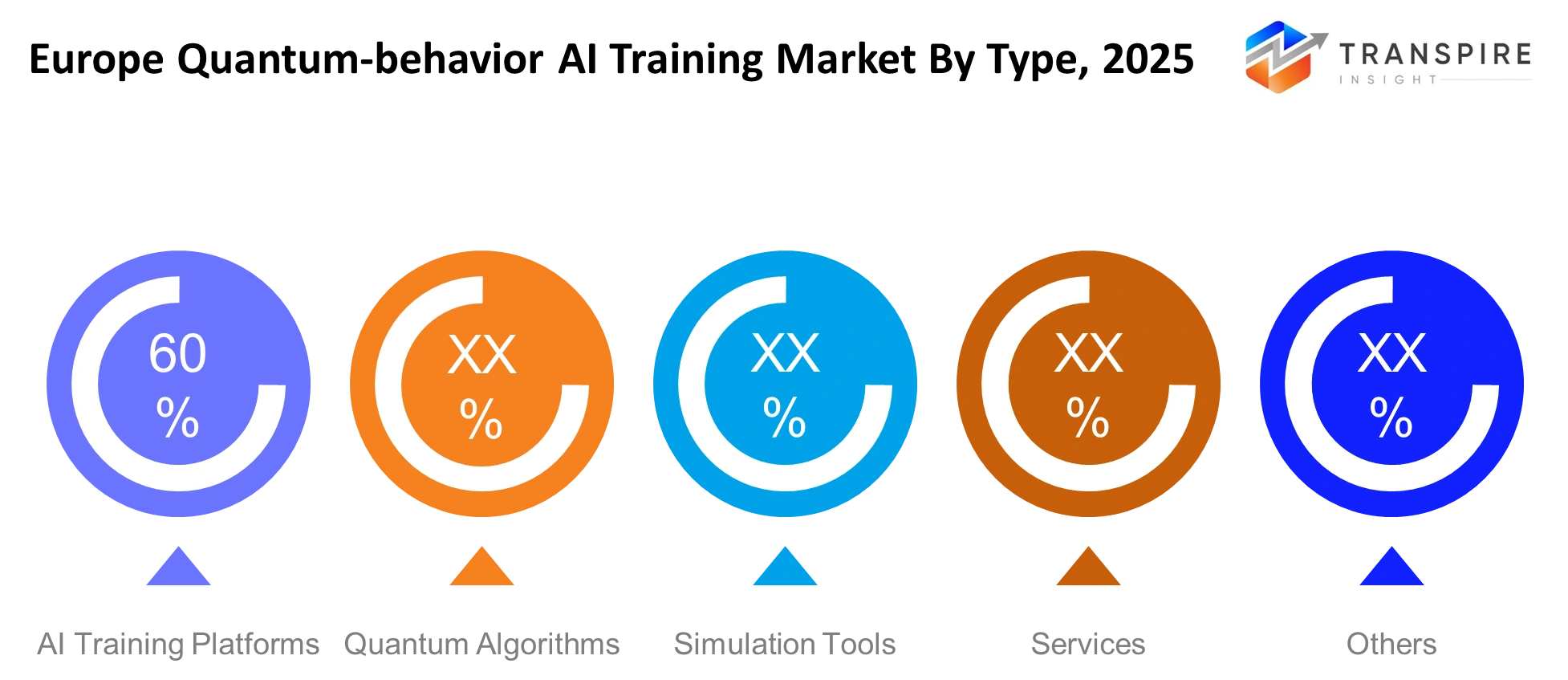
The market currently supports AI training platforms because enterprises require scalable environments which they use to create and evaluate quantum-behavior models. The platforms combine cloud infrastructure with data pipelines and hybrid algorithms to provide essential components for operational use. The second largest market segment consists of simulation tools which develop solutions for logistics and industrial operations that require modeling uncertain multi-variable systems. The field of quantum algorithms has emerged as a small but fast-growing sector that encounters challenges from its technical complexity yet experiences growth because of advancements in computing power.
Enterprise requirements for complete solutions which minimize both deployment time and operational risk drive the growth of AI training platforms. Simulation tools experience increased adoption because of their application in scenario planning which helps organizations that face unpredictable conditions particularly in maritime and energy sectors. The service market undergoes constant growth because businesses need integration services while they struggle with employee shortages in specialized fields which limits their service distribution.
The commercial value of quantum algorithms will increase during the forecast period because hardware and software systems will develop beyond their current state. Platform providers and investors will concentrate their efforts on creating modular systems which enable interoperability between simulation and training functions to support their implementation in various industrial sectors.
To learn more about this report, Download Free Sample Report
By Application:
The application segment receives its highest market share through optimization because optimization directly affects cost efficient operations which lead to better performance results in logistics and manufacturing and energy system operations. Financial modeling ranks as the second-largest application, as institutions adopt probabilistic AI to manage risk and portfolio variability. The industry currently focuses on two emerging fields which are cybersecurity and materials science. The drug discovery sector operates as a specialized high-value market because of its need for complex computing power and its strict compliance requirements.
Optimization leads the field because it offers instant financial advantages through supply chain routing solutions and energy usage reduction strategies. Financial modeling benefits from the ability to simulate complex market scenarios, especially under volatile economic conditions. Organizations increase their cybersecurity systems because they want to use adaptive threat detection models which can handle changing attack patterns.
The upcoming period will drive materials science and drug discovery fields forward because research institutions will form partnerships to enhance computational methods. Application diversity will drive developers to develop more specialized training programs, while investors will focus on sectors that deliver high-profit results through research-based solutions.
By End-User:
The end-user segment of enterprises constitutes the largest portion of end-user markets because their budget sizes exceed those of other segments and they require immediate operational solutions for logistics and manufacturing and maritime operations. Research institutes follow as a significant segment, focusing on foundational development and experimental applications. The BFSI and healthcare sectors continue to grow, while government agencies choose to adopt new technologies in a manner that supports their core priorities.
Enterprise growth depends on organizations needing to improve their decision-making processes which involve uncertain conditions and their need to decrease their operational productivity losses. Research institutes benefit from public funding and collaborations, which support early-stage innovation. The BFSI sector requires risk modeling solutions, while healthcare applications face limitations because of existing data privacy regulations and regulatory conditions.
Enterprises and mid-sized organizations together with particular industry users will increase their training platform usage when training platform access becomes easier for them. The cooperative relationship between research institutes and commercial enterprises will drive innovation processes, which will generate fresh possibilities for developing specialized solutions and sustained financial backing.
By Deployment:
Cloud deployment dominates the market because it provides better scalability and lower initial expenses and simplifies digital system integration. Organizations now adopt hybrid models to achieve their goal of securing data while maintaining flexible computing capabilities. The use of on-premise deployment exists mainly in industries that require strict data control measures because of their regulatory needs.
Organizations require cloud deployment because it enables them to conduct fast experiments and continuously update their systems in response to changing operational conditions. Hybrid deployment benefits organizations that require both secure data handling and access to advanced computational resources. Organizations that use on-premise systems must deal with two main challenges which include high capital expenditure needs and restricted ability to expand their operations.
The upcoming years will see hybrid deployment grow rapidly because of developing regulatory systems and better systems that allow different technologies to work together. Technology providers are likely to invest in flexible architectures that support seamless transitions between cloud and on-premise environments which will enable broader adoption across diverse industry segments.
What are the Key Use Cases Driving the Europe Quantum-behavior AI Training Market?
The primary use case which drives European organizations to implement Quantum-behavior AI Training Market solutions occurs through optimization work which handles their logistics and industrial operations. The training models enable manufacturers and shipping operators to create simulations that demonstrate how different routing patterns and fuel usage rates and production practices will perform during situations with unpredictable elements. This use case generates the most demand because it directly reduces operational costs and improves decision accuracy in environments exposed to volatility.
The BFSI sector and major corporations are adopting financial modeling and cybersecurity as their two primary application areas. Banks use probabilistic training systems to simulate market shocks and portfolio risks, while cybersecurity teams deploy adaptive models to anticipate evolving threat patterns across digital infrastructure.
The new research areas of materials science and drug discovery work together with research institutes to test compounds and optimize materials through their use of advanced simulation technologies. The applications currently exist in their early-development phase, yet they demonstrate strong market potential because of their upcoming growth in computational power and research partnerships.
|
Report Metrics |
Details |
|
Market size value in 2025 |
USD 167.83 Million |
|
Market size value in 2026 |
USD 171.41 Million |
|
Revenue forecast in 2033 |
USD 198.61 Million |
|
Growth rate |
CAGR of 2.13% from 2026 to 2033 |
|
Base year |
2025 |
|
Historical data |
2021 - 2024 |
|
Forecast period |
2026 - 2033 |
|
Report coverage |
Revenue forecast, competitive landscape, growth factors, and trends |
|
Regional scope |
Europe (Germany, United Kingdom, France, Italy, Spain, Rest of Europe) |
|
Key company profiled |
IBM, Google, Microsoft, Amazon, D-Wave, Rigetti, IonQ, Honeywell Quantum, NVIDIA, Intel, Accenture, Deloitte, Atos, Fujitsu, Alibaba |
|
Customization scope |
Free report customization (country, regional & segment scope). Avail customized purchase options to meet your exact research needs. |
|
Report Segmentation |
By Type (Quantum Algorithms, AI Training Platforms, Simulation Tools, Services, Others); By Application (Optimization, Drug Discovery, Financial Modeling, Cybersecurity, Materials Science, Others); By End-User (Research Institutes, Enterprises, BFSI, Healthcare, Government, Others); By Deployment (Cloud, On-premise, Hybrid, Others) |
Which Regions are Driving the Europe Quantum-behavior AI Training Market Growth?
The European Union shows its superior market position through its strict regulation and developed industrial systems which control Western European countries. The compliance systems established by Germany France and the United Kingdom require businesses to develop AI systems that can learn through training. The leadership position of this organization exists because it operates through multiple research institutions and cloud infrastructure providers together with established maritime operators. The existing digital capabilities of ports and industrial complexes allow for speedy implementation of quantum-behavior training in actual operational settings.
Northern Europe develops its own identity through stable investment tools which deliver consistent funding to its markets but distribute their financial resources. The Scandinavian countries Sweden and Denmark together with Finland provide stable funding for AI research while their economic systems maintain stability which enables ongoing progress in their markets. Businesses in this area test new technologies at a gradual pace while they concentrate on achieving dependable operation and extended product lifespan. The organization generates stable income which enables it to test new training software applications throughout the entire area.
Eastern Europe has developed into its fastest expanding region because of recent infrastructure improvements and dedicated digital transformation efforts. The Polish and Romanian governments have raised their spending on smart port systems and industrial automation since the year 2023. The market shift has created opportunities for companies to use advanced training systems in regions that have not yet reached full market development. The regional development between 2026 and 2033 indicates strong possibilities for new businesses and investors who want to develop their operations.
Who are the Key Players in the Europe Quantum-behavior AI Training Market and How Do They Compete?
The European Quantum-behavior AI Training Market displays a semi-consolidated competitive structure because major technology corporations control significant market share while facing competition from dedicated AI startups and organizations that focus on research. The primary basis of competition centers on technological capability, particularly the ability to integrate quantum-inspired algorithms with scalable cloud platforms. The established companies from the industry work to protect their market share through ecosystem development while the emerging businesses from the market compete with their specialized simulation products and rapid implementation processes. Companies use service integration together with industry-specific customization to create unique product offerings.
IBM develops its competitive strength through hybrid quantum-classical platforms which connect directly to enterprise AI workflows, helping clients to execute complex simulations without changing their current systems. Google establishes its market distinction through its advanced research capabilities and its exclusive quantum technology framework, which it develops through partnerships with European research organizations to create practical solutions. Microsoft uses its cloud platform to integrate quantum-behavior training into its popular enterprise software products, which helps its current clients to adopt new technology.
Atos delivers high-performance computing solutions that meet European market demands through its focus on creating customized solutions for regulated industries, which include defense and energy sectors. SAP enables real-time operational decision support through its enterprise resource planning systems, which integrate quantum-inspired AI training. These companies expand through partnerships with research institutes and regional cloud providers, strengthening their position by aligning advanced training capabilities with industry-specific requirements.
Company List
- IBM
- Microsoft
- Amazon
- D-Wave
- Rigetti
- IonQ
- Honeywell Quantum
- NVIDIA
- Intel
- Accenture
- Deloitte
- Atos
- Fujitsu
- Alibaba
Recent Development News
In October 2025, Google launched a new quantum computing algorithm called Quantum Echoes. The breakthrough enables faster generation of AI training datasets, improving real-world applications in materials science and drug discovery. https://www.reuters.com
In August 2025, IBM entered a partnership with AMD to develop hybrid quantum-classical computing architectures. The collaboration aims to integrate high-performance computing with quantum systems, strengthening scalable training environments for complex AI models. https://www.axios.com
What Strategic Insights Define the Future of the Europe Quantum-behavior AI Training Market?
The Europe Quantum-behavior AI Training Market is creating an integrated environment which depends on cloud technology to deliver training and simulation and real-time decision systems as a unified system that covers all industrial and maritime activities. The direction of this development stems from the requirement to develop adaptive intelligence systems which need to learn from actual dynamic environments instead of using fixed models. The next five to seven years will see competitive advantage shift to providers who can implement quantum-inspired training methods within their business processes for large-scale operations.
The less visible threat comes from technology substitution because rapid AI technological progress in classical optimization will decrease the demand for advanced quantum behavioral methods. Buyers will show uncertainty about the solution which will result in delayed high-value investments despite the solution's potential for strong long-term benefits.
Eastern Europe is developing an emerging opportunity which digital infrastructure upgrades and policy incentives have created to support rapid implementation of advanced training systems. The most important goal for market participants should be to develop modular solutions which work together without problems because this will help industrial operators implement systems faster while preparing for upcoming quantum hardware developments.
Europe Quantum-behavior AI Training Market Report Segmentation
By Type
- Quantum Algorithms
- AI Training Platforms
- Simulation Tools
- Services
- Others
By Application
- Optimization
- Drug Discovery
- Financial Modeling
- Cybersecurity
- Materials Science
- Others
By End-User
- Research Institutes
- Enterprises
- BFSI
- Healthcare
- Government
- Others
By Deployment
- Cloud
- On-premise
- Hybrid
- Others
Frequently Asked Questions
Find quick answers to common questions.
The Europe Quantum-behavior AI Training Market size is USD 198.61 Million in 2033.
Key segments for the Europe Quantum-behavior AI Training Market are By Type (Quantum Algorithms, AI Training Platforms, Simulation Tools, Services, Others); By Application (Optimization, Drug Discovery, Financial Modeling, Cybersecurity, Materials Science, Others); By End-User (Research Institutes, Enterprises, BFSI, Healthcare, Government, Others); By Deployment (Cloud, On-premise, Hybrid, Others).
Major Europe Quantum-behavior AI Training Market players are IBM, Google, Microsoft, Amazon, D-Wave, Rigetti, IonQ, Honeywell Quantum, NVIDIA, Intel, Accenture, Deloitte, Atos, Fujitsu, Alibaba.
The Europe Quantum-behavior AI Training Market size is USD 167.83 Million in 2025.
The Europe Quantum-behavior AI Training Market CAGR is 2.13% from 2026 to 2033.
- IBM
- Microsoft
- Amazon
- D-Wave
- Rigetti
- IonQ
- Honeywell Quantum
- NVIDIA
- Intel
- Accenture
- Deloitte
- Atos
- Fujitsu
- Alibaba
Recently Published Reports
-
Apr 2026
3D Optical Profiler Market
3D Optical Profiler Market Size, Share & Analysis Report By Type (Desktop 3D Optical Profiler, and Portable 3D Optical Profiler), By Technology (Confocal Technology, and White Light Interference), By End-Use Industry (Manufacturing, Research Institutions, Automotive, Aerospace and Defense, Medical Devices, and Other), and Geography (North America, Europe, Asia-Pacific, Middle East and Africa, South and Central America), 2021 - 2031
-
Apr 2026
Depth Sensor Market
Depth Sensor Market Size, Share & Analysis Report By Type (Infrared Depth Sensors, Time-of-Flight (ToF) Sensors, Stereo Vision Sensors, Structured Light Sensors, Ultrasonic Depth Sensors), By Application (Automotive, Robotics, Gaming, Consumer Electronics, Industrial Automation, Healthcare, Security & Surveillance, Others), By End Users (Automotive Manufacturers, Consumer Electronics Companies, Healthcare Providers, Industrial Companies, Security Agencies, Gaming Companies, Robotics Companies, Others), and Geography (North America, Europe, Asia-Pacific, Middle East and Africa, South and Central America), 2021 – 2031
-
Apr 2026
Digital Manufacturing Market
Digital Manufacturing Market Size, Share & Analysis Report By Component (Hardware, Software, and Services), By Technology (Robotics, 3D Printing, Internet of Things (IoT), and Others), By Application (Automotive and Transportation, Aerospace and Defense, Consumer Electronics, Industrial Machinery, and Others), By Process Type (Computer-Based Designing, Computer-Based Simulation, Computer 3D Visualization, Analytics, and Others), and Geography (North America, Europe, Asia-Pacific, Middle East and Africa, South and Central America), 2021 – 2031
-
Apr 2026
Digital Visa Services Market
Digital Visa Services Market Size, Share & Analysis Report By Type (Individual Travelers, Group Travelers), By Application (Tourism, Business Travel, Others), and Geography (North America, Europe, Asia-Pacific, Middle East and Africa, South and Central America), 2021 – 2031