

Asia Pacific Fertilizers Market Size & Forecast
- Asia Pacific Fertilizers Market Size 2025: USD 108.9 Billion
- Asia Pacific Fertilizers Market Size 2026: USD 112.2 Billion
- Asia Pacific Fertilizers Market Size 2033: USD 138.3 Billion
- Asia Pacific Fertilizers Market CAGR: 3.03%
- Asia Pacific Fertilizers Market Segments: By Product Type (Nitrogen Fertilizers, Phosphate Fertilizers, Potash Fertilizers, Compound Fertilizers, Organic Fertilizers, Biofertilizers, Micronutrient Fertilizers, Others); By Form (Granular Fertilizers, Liquid Fertilizers, Water-Soluble Fertilizers, Powder Fertilizers, Controlled-Release Fertilizers, Slow-Release Fertilizers, Foliar Fertilizers, Others); By Crop Type (Cereals & Grains, Fruits & Vegetables, Oilseeds & Pulses, Plantation Crops, Turf & Ornamentals, Commercial Crops, Horticultural Crops, Others); By Application Method (Broadcasting, Fertigation, Foliar Application, Seed Treatment, Band Placement, Side Dressing, Drip Irrigation, Others); By End User (Commercial Farmers, Smallholder Farmers, Agricultural Cooperatives, Greenhouse Growers, Government Agriculture Programs, Plantation Owners, Research Farms, Others)
Asia Pacific Fertilizers Market Summary
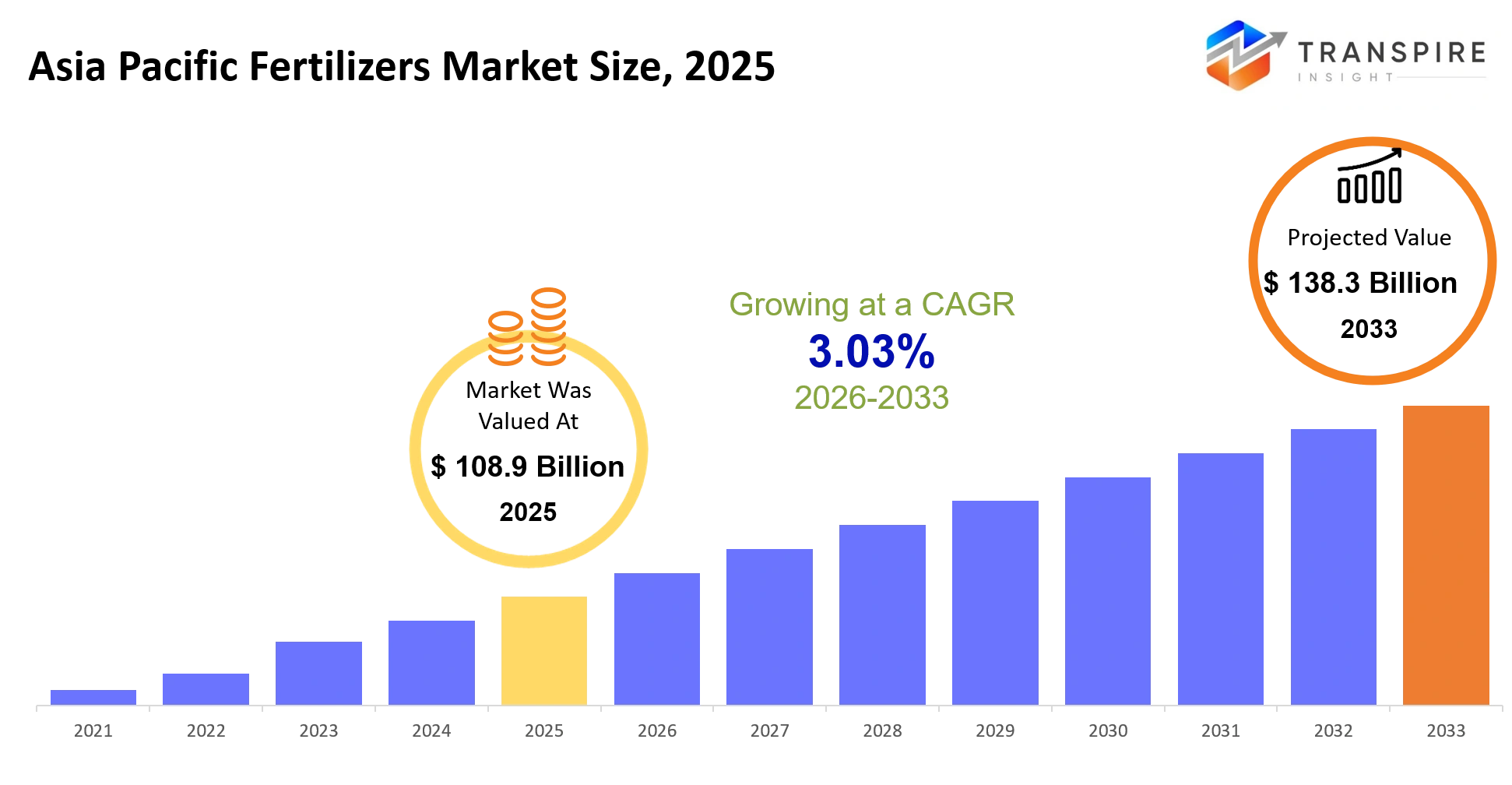
As per Transpire Insight Analysis the Asia Pacific Fertilizers Market size is estimated at USD 108.9 Billion in 2025 and is anticipated to reach USD 138.3 Billion by 2033, growing at a CAGR of 3.03% from 2026 to 2033.
Fertilizers replace what harvests remove from soil. Every ton of rice, wheat, or palm fruit pulled off a field takes nitrogen, phosphorus, and potassium with it, and the Asia Pacific fertilizers market exists to put those nutrients back at a scale that matches the region's role as the world's largest food producer. Valued at USD 108.9 Billion in 2025, the market covers everything from bulk urea shipped into Indian ports to precision liquid blends metered through drip lines on Australian horticulture farms.
The defining structural shift of the last several years is the move from blanket nutrient application toward targeted, crop-specific formulations. Government soil health card programs in India and precision agriculture subsidies in China have pushed millions of smallholders toward compound and micronutrient products that match actual soil deficiencies rather than generic NPK ratios applied out of habit.
The trigger that reshaped near-term market behavior was the 2022 global fertilizer price shock, when Russian and Belarusian potash export restrictions combined with natural gas price spikes to more than double urea and DAP prices across Asia within a single growing season. Governments in India, Indonesia, and Bangladesh responded with expanded subsidy programs to protect farmer purchasing power, which stabilized volumes even as import bills rose sharply, and that subsidy infrastructure now underwrites steady demand through the forecast period.
Key Asia Pacific Fertilizers Market Insights
- China holds the largest country-level share of the Asia Pacific fertilizers market at approximately 34% in 2025, supported by domestic phosphate and nitrogen production capacity that reduces reliance on imports compared to neighboring markets.
- India is the fastest-growing major market in the region, expanding at a CAGR above 4.1% through 2033, driven by government fertilizer subsidy expansion and rising per-hectare application rates as farmers shift toward higher-yield hybrid seed varieties.
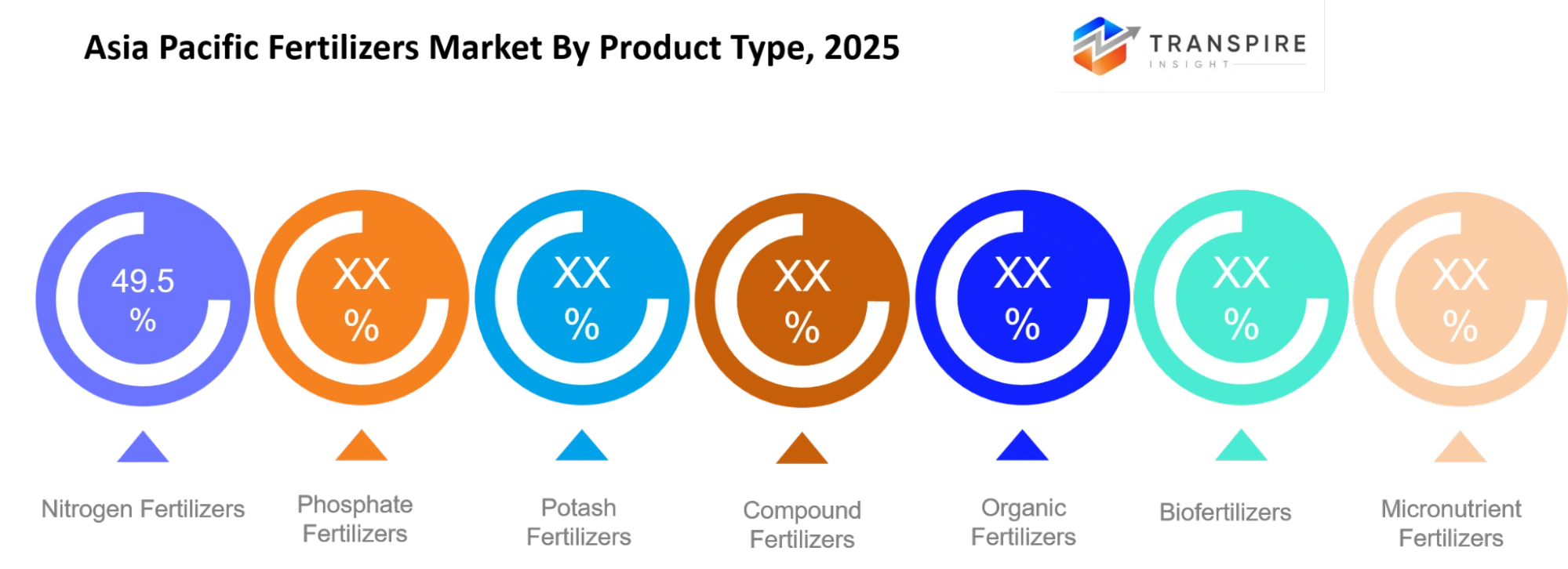
- Nitrogen Fertilizers dominate the product type segment with 49.5% of regional revenue in 2025, reflecting nitrogen's role as the single most yield-limiting nutrient across the region's dominant cereal and grain cropping systems.
- Granular Fertilizers remain the leading form segment, though Water-Soluble Fertilizers are the fastest-growing form category as fertigation adoption expands across high-value horticulture operations in China, India, and Vietnam.
- Cereals & Grains represent the largest crop type segment by fertilizer consumption, given the region's position as the primary global producer of rice and wheat.
- Broadcasting remains the most widely used application method across smallholder farms, while Fertigation and Drip Irrigation are gaining share fastest among commercial horticulture and plantation operators.
- Smallholder Farmers account for the largest end-user share of regional volume, though Agricultural Cooperatives and Government Agriculture Programs are growing procurement influence through bulk purchasing arrangements.
- Nutrien and Yara International lead multinational supply into the region through long-term offtake agreements with national fertilizer distribution networks in India, Indonesia, and the Philippines.
- Coromandel International and IFFCO dominate India's domestic phosphatic and nitrogenous fertilizer production, benefiting directly from the country's Nutrient Based Subsidy scheme.
- Biofertilizers and Micronutrient Fertilizers are the fastest-growing product categories in percentage terms, though from a small base, as regenerative agriculture pilots expand across Australia, Japan, and South Korea.
What are the Key Drivers, Restraints, and Opportunities in the Asia Pacific Fertilizers Market?
Driver: The primary growth driver is government subsidy infrastructure that keeps fertilizer affordable despite volatile global input costs. India's Nutrient Based Subsidy program alone channels billions of dollars annually into keeping urea and DAP prices below import parity, which sustains application volumes that would otherwise contract during price spikes. This subsidy architecture, replicated in various forms across Indonesia, Bangladesh, and the Philippines, decouples regional consumption from global commodity price swings and gives fertilizer producers a demand floor that markets without comparable support structures do not have.
Restraint: The structural barrier limiting faster growth is fragmented smallholder landholding. The average farm size across much of South and Southeast Asia remains under two hectares, which caps individual purchasing power and makes precision, higher-margin products economically unreachable for a large share of the farmer base. This fragmentation cannot resolve quickly since land consolidation runs against deep cultural and legal ownership patterns, keeping average selling prices lower than in consolidated farming economies.
Opportunity: The clearest opportunity is digital advisory-linked fertilizer distribution. Mobile soil testing and crop advisory platforms, including India's Kisan Suvidha and several private agritech ventures backed by companies like UPL, are beginning to recommend and even pre-order specific nutrient blends directly to farmers. As mobile penetration deepens in rural Asia, this channel could shift millions of smallholders from generic urea purchases toward higher-margin compound and micronutrient products tailored to their actual soil data.
What Has the Impact of Artificial Intelligence Been on the Asia Pacific Fertilizers Market?
Artificial intelligence is entering the Asia Pacific fertilizers market primarily through satellite and sensor-based nutrient recommendation systems. Companies including Yara International have deployed AI models that analyze multispectral satellite imagery alongside historical yield data to generate field-specific nitrogen application recommendations, replacing generic regional guidelines with plot-level precision that adjusts for soil variability within a single farm.
Machine learning models are also being applied to demand forecasting at the distribution level, helping cooperatives and government agencies predict regional fertilizer demand ahead of planting seasons and reduce the stockout and overstock cycles that have historically disrupted rural supply chains, particularly during the monsoon-driven planting windows across South Asia.
The clear limitation is data access in smallholder-dominated markets: AI recommendation systems require historical yield and soil data that most farms below two hectares simply do not have on record, which restricts precision AI tools largely to commercial farms, plantations, and cooperative-managed land where digitized records already exist.
Key Market Trends
The Asia Pacific fertilizers market is growing at 3.03% CAGR from USD 108.9 Billion in 2025 to USD 138.3 Billion by 2033, with nitrogen fertilizer demand and government subsidy programs anchoring stable regional volume growth even as global commodity prices remain volatile.
- China's fertilizer export restrictions, first imposed in 2021 and extended periodically since, have redirected domestic phosphate supply inward, reshaping regional trade flows for importers like India and Vietnam.
- India's urea production capacity expanded with the reopening of several dormant plants between 2022 and 2025, gradually reducing the country's historic reliance on imported urea.
- Controlled-release and slow-release fertilizer adoption grew across Japanese and South Korean turf and ornamental segments as labor shortages pushed growers toward lower-frequency application products.
- Indonesia and the Philippines expanded fertilizer subsidy budgets in 2023 and 2024 in direct response to the lingering effects of the 2022 global price shock on smallholder purchasing power.
- Biofertilizer pilot programs backed by national governments expanded across India and Vietnam as both countries pursue reduced chemical fertilizer dependency targets tied to soil health and emissions goals.
- Coromandel International and Deepak Fertilisers both announced capacity expansions in specialty and water-soluble fertilizer production between 2023 and 2025 to capture rising horticulture demand.
- Fertigation-compatible water-soluble fertilizer volumes grew faster than any other form category in China's protected greenhouse vegetable sector between 2022 and 2025.
- EuroChem and K+S both increased potash export volumes into Southeast Asia following supply chain disruptions from Belarusian and Russian export restrictions imposed since 2022.
Asia Pacific Fertilizers Market Segmentation
By Product Type
Nitrogen Fertilizers lead the product type segment with 49.5% of regional revenue in 2025, a position rooted in the region's cereal-dominant cropping pattern, where rice and wheat both require heavy nitrogen input relative to other nutrients. Phosphate and Potash Fertilizers follow as the next-largest categories, largely imported given the region's limited domestic potash reserves outside China. Compound Fertilizers are gaining ground among commercial farmers seeking balanced nutrient delivery in a single application, while Biofertilizers and Micronutrient Fertilizers, though small in absolute revenue, are growing fastest as government soil health initiatives push farmers toward deficiency-specific products rather than blanket nitrogen application.
By Form
Granular Fertilizers hold the largest form segment share, remaining the standard product for broadcasting-based application across the region's smallholder-dominated farmland. Liquid and Water-Soluble Fertilizers are expanding fastest, tied directly to fertigation adoption in China's greenhouse vegetable sector and drip-irrigated horticulture in India and Australia. Controlled-Release and Slow-Release variants are gaining traction in labor-constrained markets like Japan and South Korea, where reduced application frequency lowers operating costs.
By Crop Type
Cereals & Grains consume the largest share of regional fertilizer volume given rice and wheat's dominance across South and East Asian farmland. Fruits & Vegetables represent the fastest-growing crop segment as horticulture expansion in China and India drives demand for higher-value, nutrient-specific formulations, while Plantation Crops sustain steady demand across Indonesia, Malaysia, and Vietnam's palm oil and rubber estates.
By Application Method
Broadcasting remains the dominant application method, reflecting its low cost and compatibility with smallholder farming practices across the region. Fertigation and Drip Irrigation are the fastest-growing methods, expanding alongside commercial horticulture and plantation investment in China, India, and Australia, where precision water-nutrient delivery reduces both waste and labor input compared to manual broadcasting.
By End User
Smallholder Farmers account for the largest end-user share of regional fertilizer volume, a direct reflection of Asia's fragmented landholding structure. Agricultural Cooperatives and Government Agriculture Programs are growing their share of procurement through bulk buying arrangements that improve smallholder access to subsidized products, while Plantation Owners and Greenhouse Growers represent smaller but higher-value segments tied to commercial-scale, precision-input farming operations.
What are the Key Use Cases Driving the Asia Pacific Fertilizers Market?
The dominant use case remains staple cereal production, where fertilizer application directly determines national food security outcomes across rice- and wheat-growing economies. Government procurement and subsidy programs are structured almost entirely around sustaining yields in this use case, which is why nitrogen products retain such a large share of total regional demand.
Commercial horticulture and greenhouse vegetable cultivation represent an expanding secondary use case, particularly across China's protected cropping sector and India's export-oriented fruit and vegetable farms, where fertigation-compatible water-soluble products are replacing traditional granular application to improve both yield consistency and produce quality for export markets.
An emerging use case is regenerative and reduced-chemical farming tied to national emissions and soil health targets. India's natural farming push and Vietnam's organic export ambitions are both creating early but expanding demand for biofertilizers and organic nutrient products that remain niche today but are positioned to scale as certification infrastructure matures.
|
Report Metrics |
Details |
|
Market size value in 2025 |
USD 108.9 Billion |
|
Market size value in 2026 |
USD 112.2 Billion |
|
Revenue forecast in 2033 |
USD 138.3 Billion |
|
Growth rate |
CAGR of 3.03% from 2026 to 2033 |
|
Base year |
2025 |
|
Historical data |
2021 - 2024 |
|
Forecast period |
2026 - 2033 |
|
Report coverage |
Revenue forecast, competitive landscape, growth factors, and trends |
|
Regional scope |
China; India; Japan; South Korea; Australia; Indonesia; Vietnam; Thailand; Philippines; Malaysia; Bangladesh; Rest of Asia Pacific |
|
Key companies profiled |
Nutrien, Yara International, ICL Group, CF Industries, Mosaic Company, Coromandel International, Indian Farmers Fertiliser Cooperative (IFFCO), Sinofert, UPL, EuroChem, K+S, Haifa Group, OCI Global, Deepak Fertilisers, Koch Fertilizer |
|
Customization scope |
Free report customization (country, regional & segment scope). Avail customized purchase options to meet your exact research needs. |
|
Report Segmentation |
By Product Type (Nitrogen Fertilizers, Phosphate Fertilizers, Potash Fertilizers, Compound Fertilizers, Organic Fertilizers, Biofertilizers, Micronutrient Fertilizers, Others); By Form (Granular Fertilizers, Liquid Fertilizers, Water-Soluble Fertilizers, Powder Fertilizers, Controlled-Release Fertilizers, Slow-Release Fertilizers, Foliar Fertilizers, Others); By Crop Type (Cereals & Grains, Fruits & Vegetables, Oilseeds & Pulses, Plantation Crops, Turf & Ornamentals, Commercial Crops, Horticultural Crops, Others); By Application Method (Broadcasting, Fertigation, Foliar Application, Seed Treatment, Band Placement, Side Dressing, Drip Irrigation, Others); By End User (Commercial Farmers, Smallholder Farmers, Agricultural Cooperatives, Greenhouse Growers, Government Agriculture Programs, Plantation Owners, Research Farms, Others) |
Which Countries are Driving the Asia Pacific Fertilizers Market Growth?
China leads the Asia Pacific fertilizers market with approximately 34% of regional revenue in 2025, sustained by domestic nitrogen and phosphate production capacity that limits import dependency compared to most regional peers. The country's scale in protected greenhouse horticulture also drives disproportionate demand for higher-value water-soluble and specialty fertilizer products relative to its cereal acreage alone.
India follows as the second-largest market and the fastest-growing among the major economies, expanding above 4.1% CAGR through 2033. Growth here is subsidy-driven rather than purely consumption-driven: the Nutrient Based Subsidy scheme keeps urea and DAP affordable for a farmer base where average landholding remains under two hectares, and expanding coverage of this program directly correlates with rising national fertilizer offtake.
Southeast Asia, led by Indonesia, Vietnam, and the Philippines, represents the region's most structurally diverse growth story. Plantation crop demand in Indonesia and Malaysia sustains steady potash and compound fertilizer consumption, while Vietnam's export-oriented horticulture sector is pulling in water-soluble and organic product categories at a faster pace than its overall market growth rate, positioning the subregion as an increasingly important destination for specialty fertilizer suppliers through the forecast period.
Who are the Key Players in the Asia Pacific Fertilizers Market and How Do They Compete?
The Asia Pacific fertilizers market is fragmented at the country level, with domestic producers holding strong positions in their home markets while multinational suppliers compete primarily on potash and specialty nutrient imports that regional producers cannot source domestically. Competition centers on production cost, subsidy program alignment, and distribution network depth rather than brand differentiation, since fertilizer remains a largely commoditized input at the smallholder level.
Coromandel International and IFFCO dominate Indian domestic production and benefit directly from the country's subsidy architecture, giving them a cost and distribution advantage that international suppliers cannot easily replicate. Nutrien and Yara International compete through long-term potash and specialty nutrient supply agreements with national distribution networks, positioning themselves as import partners rather than domestic competitors. Sinofert holds a comparable domestic advantage within China, while EuroChem and K+S compete on potash export volumes into markets with limited domestic reserves, particularly Indonesia and Vietnam. UPL and Deepak Fertilisers differentiate through specialty and micronutrient product lines targeting the region's fastest-growing horticulture and precision farming segments.
Asia Pacific Fertilizers Market Companies
- Nutrien
- Yara International
- ICL Group
- CF Industries
- Mosaic Company
- Coromandel International
- Indian Farmers Fertiliser Cooperative (IFFCO)
- Sinofert
- UPL
- EuroChem
- K+S
- Haifa Group
- OCI Global
- Deepak Fertilisers
- Koch Fertilizer
Recent Developments
In February 2026, Coromandel International announced the commissioning of a new water-soluble fertilizer production line at its Andhra Pradesh facility to meet rising fertigation demand from horticulture exporters. https://www.coromandel.biz/news (Coromandel International Investor Relations).
In January 2026, Yara International entered a supply and distribution partnership with a Southeast Asian agri-cooperative network to expand specialty nutrient access for smallholder rice and vegetable farmers across Vietnam and Cambodia. https://www.yara.com/news (Yara International Press Room).
In March 2026, IFFCO expanded production capacity at its nano-fertilizer manufacturing facility in Gujarat following strong domestic uptake of its nano-urea and nano-DAP product lines among Indian smallholder farmers. https://www.iffco.in/news (IFFCO Corporate Communications).
What Strategic Insights Define the Future of the Asia Pacific Fertilizers Market?
Over the next five to seven years, the Asia Pacific fertilizers market will shift structurally toward precision, subsidy-linked distribution rather than pure volume growth. The underlying force is fiscal: governments across the region are under increasing budget pressure from broad-based subsidy programs and are beginning to redesign support around targeted, data-linked distribution that rewards efficient nutrient use rather than blanket consumption, a shift that will favor producers who can integrate advisory and precision tools into their distribution model.
The hidden risk is fiscal sustainability of subsidy programs themselves. India's Nutrient Based Subsidy budget has grown substantially since the 2022 price shock, and any future consolidation or reform of this program could suppress volume growth faster than headline demand indicators currently suggest, particularly for nitrogen-heavy product lines that depend most on subsidy support to remain affordable at the farm gate.
The emerging opportunity is nano and micronutrient fertilizer scale-up, currently a small but rapidly growing category led by IFFCO's nano-urea rollout in India. As application efficiency and lower logistics costs make nano-formulations commercially viable beyond pilot scale, they represent a genuine alternative delivery format that could reshape unit economics across the region's largest product category. Market participants should prioritize early investment in nano and micronutrient manufacturing capacity, since first movers in this format are positioned to set the technical and regulatory benchmarks other producers will need to follow.
Asia Pacific Fertilizers Market Report Segmentation
By Product Type
- Nitrogen Fertilizers
- Phosphate Fertilizers
- Potash Fertilizers
- Compound Fertilizers
- Organic Fertilizers
- Biofertilizers
- Micronutrient Fertilizers
- Others
By Form
- Granular Fertilizers
- Liquid Fertilizers
- Water-Soluble Fertilizers
- Powder Fertilizers
- Controlled-Release Fertilizers
- Slow-Release Fertilizers
- Foliar Fertilizers
- Others
By Crop Type
- Cereals & Grains
- Fruits & Vegetables
- Oilseeds & Pulses
- Plantation Crops
- Turf & Ornamentals
- Commercial Crops
- Horticultural Crops
- Others
By Application Method
- Broadcasting
- Fertigation
- Foliar Application
- Seed Treatment
- Band Placement
- Side Dressing
- Drip Irrigation
- Others
By End User
- Commercial Farmers
- Smallholder Farmers
- Agricultural Cooperatives
- Greenhouse Growers
- Government Agriculture Programs
- Plantation Owners
- Research Farms
- Others
Frequently Asked Questions
Find quick answers to common questions.
The Asia Pacific Fertilizers Market size is expected to reach USD 138.3 Billion by 2033.
The key segments of the Asia Pacific Fertilizers Market are By Product Type, By Form, By Crop Type, By Application Method, and By End User.
Major players in the Asia Pacific Fertilizers Market include Nutrien, Yara International, ICL Group, CF Industries, Mosaic Company, Coromandel International, Indian Farmers Fertiliser Cooperative (IFFCO), Sinofert, UPL, EuroChem, K+S, Haifa Group, OCI Global, Deepak Fertilisers, and Koch Fertilizer.
The Asia Pacific Fertilizers Market size is USD 108.9 Billion in 2025.
The Asia Pacific Fertilizers Market CAGR is 3.03% from 2026 to 2033.
- Nutrien
- Yara International
- ICL Group
- CF Industries
- Mosaic Company
- Coromandel International
- Indian Farmers Fertiliser Cooperative (IFFCO)
- Sinofert
- UPL
- EuroChem
- K+S
- Haifa Group
- OCI Global
- Deepak Fertilisers
- Koch Fertilizer
About the Authors

Pankaj Ghogare Patil
I am Pankaj Ghogare Patil, a Senior Research Analyst at Transpire Insight, specializing in the Pharmaceutical, Chemicals & Materials, Healthcare IT, and Biotechnology industry. My expertise lies in conducting comprehensive market research, analyzing industry trends, evaluating competitive landscapes, and translating complex data into actionable insights. At Transpire Insight, I closely follow emerging technologies, regulatory developments, and market innovations to create accurate, well-researched, and informative content that helps businesses and professionals make informed decisions. I am committed to producing credible, evidence-based articles that reflect industry best practices while making technical topics accessible and valuable for a broad audience.

Chakradhar Khansole
Chakradhar serves as the Research Director at Transpire Insight, bringing over 8 years of experience in technology, innovation, and strategic market intelligence. He specializes in transforming complex market data into actionable business insights that enable organizations to make informed, growth-oriented decisions. Recognized for his strategic vision and analytical expertise, Chakradhar leads high-impact research initiatives, delivering comprehensive market assessments, competitive intelligence, and forward-looking industry analysis.
Recently Published Reports
-
May 2026
Healthcare Polymer Packaging Market
Healthcare Polymer Packaging Market Size, Share & Analysis Report By Packaging Type (Syringes, IV Bottles and Pouches, Clamshells, Blisters, Bottles & Jars, Containers, Tubes, IV Parental Packaging, Others), By Type (Regulated, Non-regulated), By Polymer Type (LDPE (Low-Density Polyethylene), HDPE (High-Density Polyethylene), Homo-polymer (Homo), Random Copolymer (Random), Block Copolymer (Block), PET, Polystyrene, Polyvinyl Chloride, Polyamide/EVOH, Others), and Geography (North America, Europe, Asia-Pacific, Middle East and Africa, South and Central America), 2021 - 2031
-
Apr 2026
Hydrophilic Tape (Waterstop) Market
Hydrophilic Tape (Waterstop) Market Size, Share & Analysis Report By Type (Bentonite-Based Hydrophilic Tape, Rubber-Based Hydrophilic Tape), By Application (Residential Buildings, Commercial Buildings, Infrastructure Projects), and Geography (North America, Europe, Asia-Pacific, Middle East and Africa, South and Central America), 2021 - 2031
-
Apr 2026
Metalens Market
Metalens Market Size, Share & Analysis Report By Type (Visible Light Metalens, and Infrared Metalens), By Application (Consumer Electronics, Automotive Electronics, Industrial, Medical, and Others), and Geography (North America, Europe, Asia-Pacific, Middle East and Africa, South and Central America), 2021 - 2031
-
Apr 2026
PBT Resin Market
PBT Resin Market Size, Share & Analysis Report By Type (Reinforced PBT Resin, Unreinforced PBT Resin), By Processing Method (Injection Molding, Extrusion, Blow Molding, Others), By End-User (Automotive, Electrical & Electronics, Consumer Appliances, Industrial Machinery, Medical Devices, Packaging, Others), and Geography (North America, Europe, Asia-Pacific, Middle East and Africa, South and Central America), 2021 - 2031