
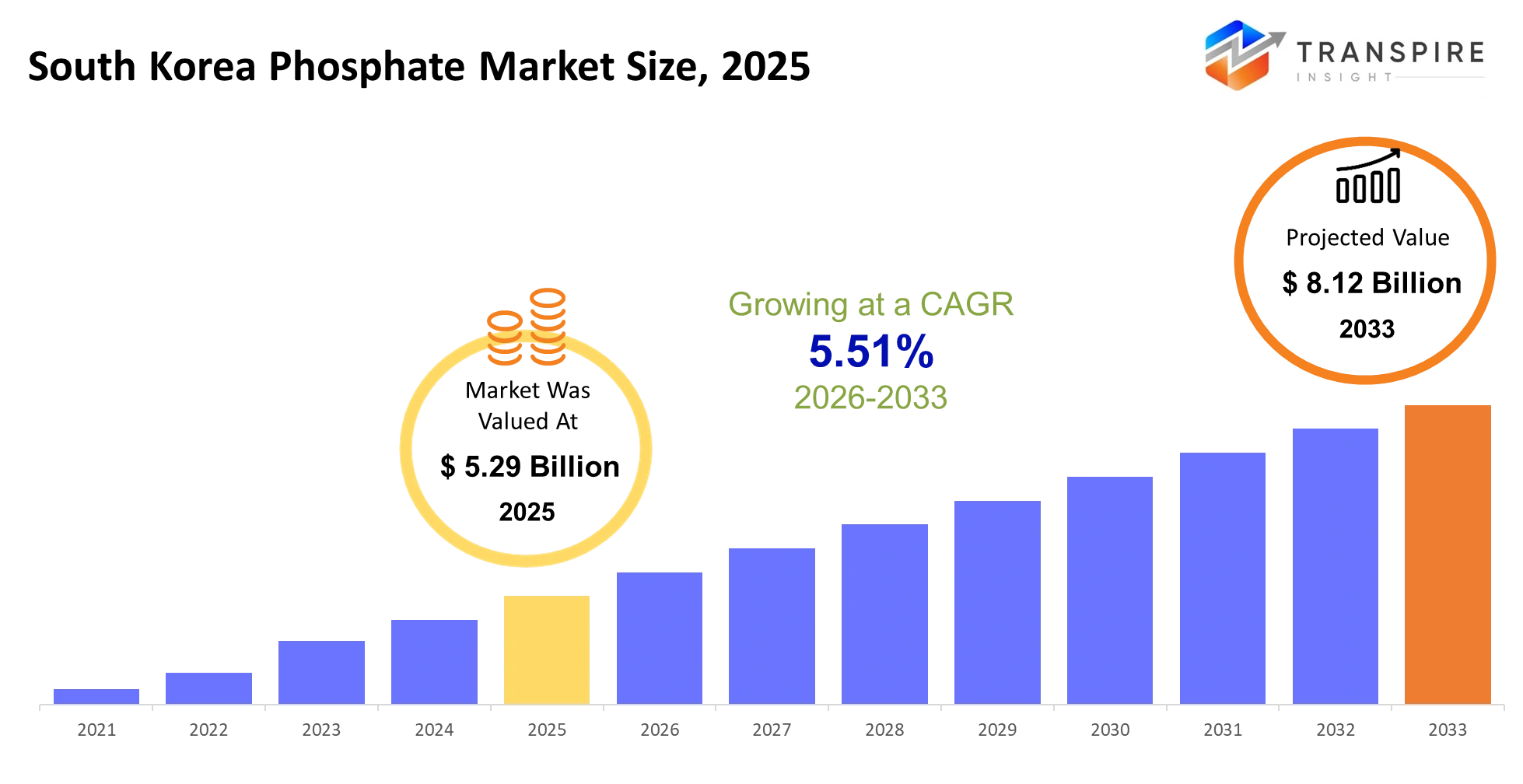
South Korea Phosphate Market Size & Forecast:
- South Korea Phosphate Market Size 2025: USD 5.29 Billion
- South Korea Phosphate Market Size 2033: USD 8.12 Billion
- South Korea Phosphate Market CAGR: 5.51%
- South Korea Phosphate Market Segments: By Type (Ammonium Phosphate, Calcium Phosphate, Potassium Phosphate), By Application (Fertilizers, Food Additives, Industrial Chemicals), By End-User (Agriculture, Food Industry, Chemical Industry).
To learn more about this report,  Download Free Sample Report
South Korea Phosphate Market Summary:
South Korea Phosphate Market size was estimated at USD 5.29 Billion in 2025 and is anticipated to reach USD 8.12 Billion by 2033, growing at a CAGR of 5.51% from 2026 to 2033.
The South Korea Phosphate Market exists as a specialized chemical and agricultural input market which depends on domestic food consumption and precise industrial operations for its functioning. The market will include processed foods and water treatment and electronics products which require purity standards. Urban consumers will increasingly expect traceable, safer food, pushing manufacturers to refine phosphate use with cleaner sourcing and controlled application.
Producers need to implement low-emission processing and recycling methods because environmental regulations demand stricter environmental protection measures. The new formulation technologies will create more efficient nutrient delivery systems which will generate less waste material. The country will maintain high levels of dependence on imports but stockpiling strategies and supplier diversification will become more important because of ongoing geopolitical tensions and supply chain disruptions that affect product availability and market prices.
Key Market Trends & Insights:
- The South Korea Phosphate Market demonstrates permanent growth because farmers consistently use fertilizers in their high-intensity farming operations. Farmers need to produce more crops while maintaining soil health which drives them to use phosphate fertilizers. Farmers in domestic agriculture practice phosphate-based farming because they need to apply fertilizers efficiently on their limited arable land.
- The South Korean phosphate market needs imported phosphate rock and related materials because the country lacks significant natural phosphate resources. Companies face an increased risk of losing access to materials and experiencing price changes because they rely on international supply networks.The way products are imported affects their manufacturing expenses because companies need to adjust to changes in international relations and trade regulations that impact their main supply countries.
- The South Korea Phosphate Market benefits from its growing applications in food processing and water treatment and chemical production. Phosphate compounds serve multiple functions including their use in preservation and cleaning agents and industrial processing. The demand for industrial production will keep increasing because technological breakthroughs will generate stable growth that exceeds the existing agricultural demand.
- The South Korea Phosphate Market receives more government scrutiny because of environmental problems that arise from phosphate runoff and water contamination. The government pushes for both controlled phosphate usage and sustainable phosphate replacement solutions. Production methods and application methods must follow compliance standards which force industries to create efficient products with less environmental damage.
- The phosphate market in South Korea sees slow progress as companies start using new processing methods which help them work more efficiently while producing less waste. The innovations enable better nutrient absorption which results in more efficient product development. Research and development investments improve product quality which enables manufacturers to stay competitive while they meet environmental and economic requirements.
South Korea Phosphate Market Segmentation
By Type:
- Ammonium Phosphate: Ammonium phosphate maintains its strong market position because it serves two essential functions which include providing crop nutrition and improving soil quality. The need for balanced nutrient supply in farming areas occurs because it helps to enhance crop yield quality. The production process requires both a consistent flow of ammonia and the operation of phosphate rock processing facilities. The South Korea Phosphate Market experiences pricing variations because agricultural demand fluctuates with seasonal changes and customers exhibit sensitivity to product costs.
- Calcium Phosphate: Calcium phosphate maintains its consistent market demand because it serves food processing and pharmaceutical and feed applications through its mineral enrichment capabilities. The industry requires consistent purity standards to achieve regulatory compliance for its products. The manufacturing process uses controlled chemical reactions to achieve required quality standards. The South Korea Phosphate Market shows growth patterns that depend on two factors which include dietary supplement usage and livestock feeding practices.
- Potassium Phosphate: Potassium phosphate meets agricultural and industrial requirements because it provides potassium enrichment and buffering capabilities. The product serves two main applications which include liquid fertilizers and specialty chemicals. The market for this product experiences increasing demand because farmers adopt advanced agricultural methods and hydroponic systems. The South Korea Phosphate Market maintains supply stability through two mechanisms which include raw material imports and functioning processing systems.
By Application:
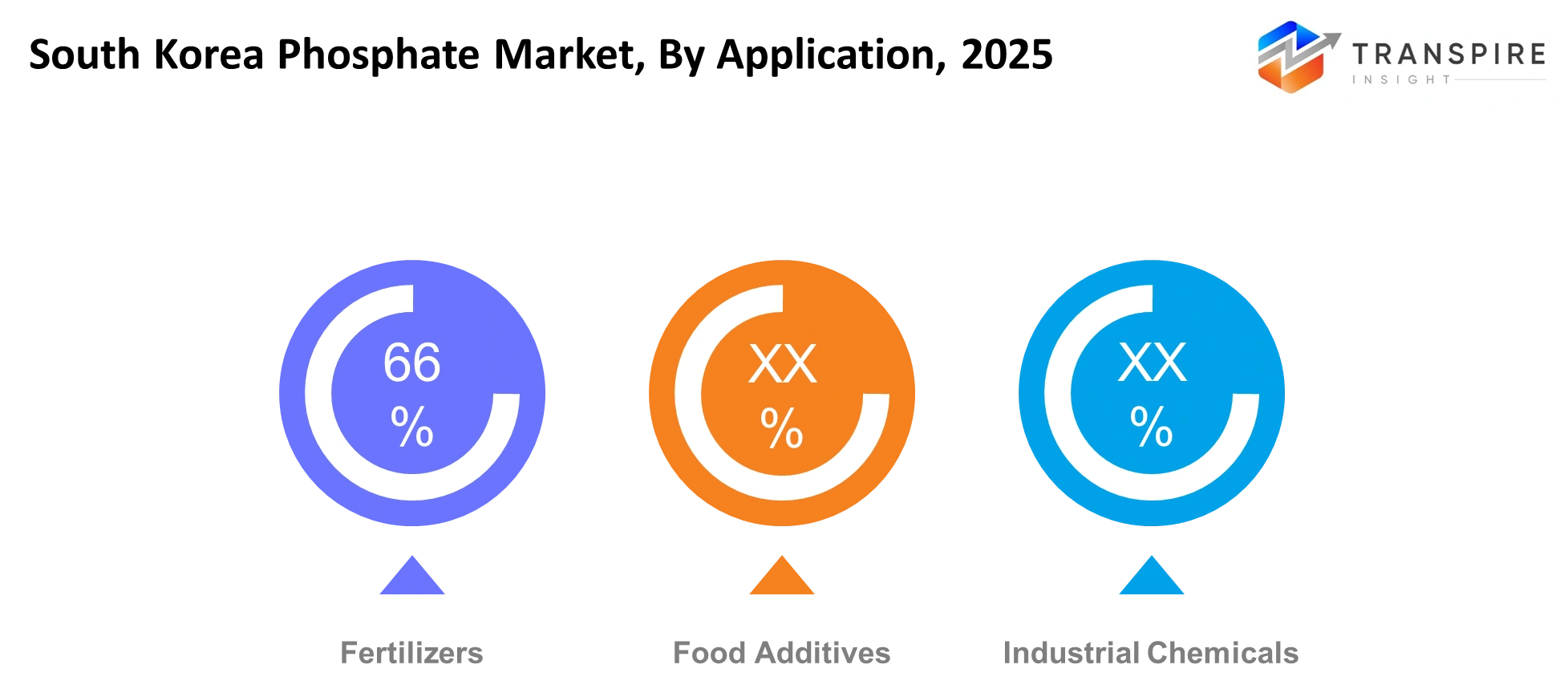
- Fertilizers: The ongoing need for soil fertility enhancement leads to fertilizer application as the primary factor for total agricultural consumption. The plant nutrition product which contains phosphate-based nutrients enables roots to grow while providing strength to crops. Agricultural demand for products exists during specific seasonal periods which correspond to government agricultural support programs. The South Korea Phosphate Market experiences stable growth because its distribution systems operate efficiently and its businesses create new products.
- Food Additives: The usage of food additives depends on compliance with safety standards and meeting quality control specifications. Phosphates function as stabilizing agents which also act as emulsifiers and leavening agents in the manufacturing of processed foods. The increasing demand for packaged food products results in continuous market requirements. The South Korea Phosphate Market requires manufacturers to achieve product differentiation through their dedication to maintaining pure products which meet all regulations.
- Industrial Chemicals: The industrial sector uses chemical substances for multiple purposes which include water purification and metal surface finishing and detergent manufacturing. Phosphates deliver both corrosion protection and enhanced cleaning performance across different industrial applications. The industrial sector requires more resources because businesses need to expand their operations while accomplishing their environmental protection targets. The South Korea Phosphate Market experiences changes in production methods and product usage patterns because companies face mounting demands from regulatory bodies regarding their waste disposal activities.
To learn more about this report, Download Free Sample Report
By End-User:
- Agriculture: The primary sector of economic activity depends on agriculture because farmers need to work continuously to improve their crop yields while maintaining soil health. Farmers need phosphate fertilizers to provide their crops with essential nutrients required for proper growth.The atmosphere of demand gets shaped by government policies and land use patterns and seasonal fluctuations. The availability of phosphate products throughout South Korea depends on supply chain efficiency which directly affects their distribution process.
- Food Industry: The food industry demands processing additives which must meet established standards for quality and safety throughout their entire processing cycle. Phosphates enhance product texture while extending shelf life and maintaining product stability. The connection between growth and increased consumption of ready-to-eat and packaged food items establishes a definite relationship. The South Korea Phosphate Market uses food regulations to determine the methods which companies will use to acquire their needed materials.
- Chemical Industry: The chemical industry requires materials to produce detergents and coatings and specialty compounds. Phosphates function as essential components for multiple chemical reactions and product development processes. The technological progress and industrial production capacity determine the current market demand. The South Korea Phosphate Market main aspects depend on environmental standards together with cost management which determines their manufacturing methods and future demand tendencies.
Country Insights
- The continuous industrial and agricultural activities of South Korea drive ongoing phosphate demand from its industries and farms. Fertilizer application enables farmers to achieve crop productivity on their restricted agricultural fields, while the food processing and chemical sectors generate extra phosphate demand. The government implements phosphate consumption controls to maintain food security and industrial stability across various sectors.
- The country needs to import all raw phosphate and associated materials because its domestic production capacity remains restricted. The country needs to maintain its trade partnerships with major exporting nations to ensure it can obtain necessary supplies. The global market price changes will determine how companies develop their procurement plans, which will lead them to establish permanent procurement contracts and create new avenues for obtaining materials.
- The environmental laws and sustainability objectives whichSouth Korea established to guide its phosphate use have created new usage patterns. The importance of waste management and recycling programs and effective fertilizer distribution systems has increased. The industrial sector will start to use environmentally friendly technologies which will decrease their pollution emissions. This shift will affect phosphate processing and distribution and usage practices throughout the upcoming years.
Recent Development News
Crude oil swap policy stabilizes chemical production
In March 2026, The government introduced a crude oil swap system allowing refiners to borrow reserves temporarily. This policy helps stabilize chemical production, including phosphate-based fertilizers and industrial chemicals that rely on steady petrochemical inputs.
Rising global phosphate production influences Asian buyers
In February 2026, Increased phosphate rock production in regions like Africa (e.g., Kropz expansion) is expected to improve global supply. This may benefit South Korea by easing import pressures and stabilizing fertilizer input costs.
|
Report Metrics |
Details |
|
Market size value in 2025 |
USD 5.29 Billion |
|
Market size value in 2026 |
USD 5.58 Billion |
|
Revenue forecast in 2033 |
USD 8.12 Billion |
|
Growth rate |
CAGR of 5.51% from 2026 to 2033 |
|
Base year |
2025 |
|
Historical data |
2021 - 2024 |
|
Forecast period |
2026 - 2033 |
|
Report coverage |
Revenue forecast, competitive landscape, growth factors, and trends |
|
Country scope |
South Korea |
|
Key company profiled |
Mosaic Company, Nutrien Ltd., OCP Group, PhosAgro Group, EuroChem Group AG, Yara International ASA, ICL Group Ltd., Coromandel International Ltd., Ma’aden (Saudi Arabian Mining Company), CF Industries Holdings Inc., Indian Farmers Fertiliser Cooperative Ltd., Wengfu Group, Sinofert Holdings Ltd., Gujarat State Fertilizers & Chemicals Ltd., Haifa Group. |
|
Customization scope |
Free report customization (country, regional & segment scope). Avail customized purchase options to meet your exact research needs. |
|
Report Segmentation |
By Type (Ammonium Phosphate, Calcium Phosphate, Potassium Phosphate), By Application (Fertilizers, Food Additives, Industrial Chemicals), By End-User (Agriculture, Food Industry, Chemical Industry). |
Key South Korea Phosphate Company Insights
- The South Korean phosphate market maintains stable operations through major chemical companies and specialized phosphate manufacturers who serve both industrial and agricultural needs. The organization gives priority to maintaining product quality through handling operations and supply chain management. The local businesses have developed strong partnerships with fertilizer producers, food processing companies, and water treatment facilities, which enables them to maintain consistent product off-take across different industries.
- The South Korea Phosphate Market requires businesses to establish competitive advantages through their ability to manage product pricing and obtain raw materials and create enduring agreements with their downstream business partners. The company develops its business approach through investments in processes that produce cleaner outputs and enhance operational effectiveness. The company focuses on export possibilities to Asian markets that border its territory while domestic demand provides stable revenue streams that support its slow growth objectives.
South Korea Phosphate Market Companies:
- Mosaic Company
- Nutrien Ltd.
- OCP Group
- PhosAgro Group
- EuroChem Group AG
- Yara International ASA
- ICL Group Ltd.
- Coromandel International Ltd.
- Ma’aden (Saudi Arabian Mining Company)
- CF Industries Holdings Inc.
- Indian Farmers Fertiliser Cooperative Ltd.
- Wengfu Group
- Sinofert Holdings Ltd.
- Gujarat State Fertilizers & Chemicals Ltd.
- Haifa Group
South Korea Phosphate Market Segmentation
By Type
- Ammonium Phosphate
- Calcium Phosphate
- Potassium Phosphate
By Application
- Fertilizers
- Food Additives
- Industrial Chemicals
By End-User
- Agriculture
- Food Industry
- Chemical Industry
Frequently Asked Questions
Find quick answers to common questions.
The approximate South Korea Phosphate Market size for the market will be USD 8.12 Billion in 2033.
Key segments for the South Korea Phosphate Market are By Type (Ammonium Phosphate, Calcium Phosphate, Potassium Phosphate), By Application (Fertilizers, Food Additives, Industrial Chemicals), By End-User (Agriculture, Food Industry, Chemical Industry).
Major South Korea Phosphate Market players are Mosaic Company, Nutrien Ltd., OCP Group, PhosAgro Group, EuroChem Group AG, Yara International ASA, ICL Group Ltd., Coromandel International Ltd., Ma’aden (Saudi Arabian Mining Company), CF Industries Holdings Inc., Indian Farmers Fertiliser Cooperative Ltd., Wengfu Group, Sinofert Holdings Ltd., Gujarat State Fertilizers & Chemicals Ltd., Haifa Group.
The South Korea Phosphate Market size is USD 5.29 Billion in 2025.
The South Korea Phosphate Market CAGR is 5.51%.
- Mosaic Company
- Nutrien Ltd.
- OCP Group
- PhosAgro Group
- EuroChem Group AG
- Yara International ASA
- ICL Group Ltd.
- Coromandel International Ltd.
- Ma’aden (Saudi Arabian Mining Company)
- CF Industries Holdings Inc.
- Indian Farmers Fertiliser Cooperative Ltd.
- Wengfu Group
- Sinofert Holdings Ltd.
- Gujarat State Fertilizers & Chemicals Ltd.
- Haifa Group
Recently Published Reports
-
May 2026
Healthcare Polymer Packaging Market
Healthcare Polymer Packaging Market Size, Share & Analysis Report By Packaging Type (Syringes, IV Bottles and Pouches, Clamshells, Blisters, Bottles & Jars, Containers, Tubes, IV Parental Packaging, Others), By Type (Regulated, Non-regulated), By Polymer Type (LDPE (Low-Density Polyethylene), HDPE (High-Density Polyethylene), Homo-polymer (Homo), Random Copolymer (Random), Block Copolymer (Block), PET, Polystyrene, Polyvinyl Chloride, Polyamide/EVOH, Others), and Geography (North America, Europe, Asia-Pacific, Middle East and Africa, South and Central America), 2021 - 2031
-
Apr 2026
Hydrophilic Tape (Waterstop) Market
Hydrophilic Tape (Waterstop) Market Size, Share & Analysis Report By Type (Bentonite-Based Hydrophilic Tape, Rubber-Based Hydrophilic Tape), By Application (Residential Buildings, Commercial Buildings, Infrastructure Projects), and Geography (North America, Europe, Asia-Pacific, Middle East and Africa, South and Central America), 2021 - 2031
-
Apr 2026
Metalens Market
Metalens Market Size, Share & Analysis Report By Type (Visible Light Metalens, and Infrared Metalens), By Application (Consumer Electronics, Automotive Electronics, Industrial, Medical, and Others), and Geography (North America, Europe, Asia-Pacific, Middle East and Africa, South and Central America), 2021 - 2031
-
Apr 2026
PBT Resin Market
PBT Resin Market Size, Share & Analysis Report By Type (Reinforced PBT Resin, Unreinforced PBT Resin), By Processing Method (Injection Molding, Extrusion, Blow Molding, Others), By End-User (Automotive, Electrical & Electronics, Consumer Appliances, Industrial Machinery, Medical Devices, Packaging, Others), and Geography (North America, Europe, Asia-Pacific, Middle East and Africa, South and Central America), 2021 - 2031