
South Korea Aluminum Hydroxide Market Size & Forecast:
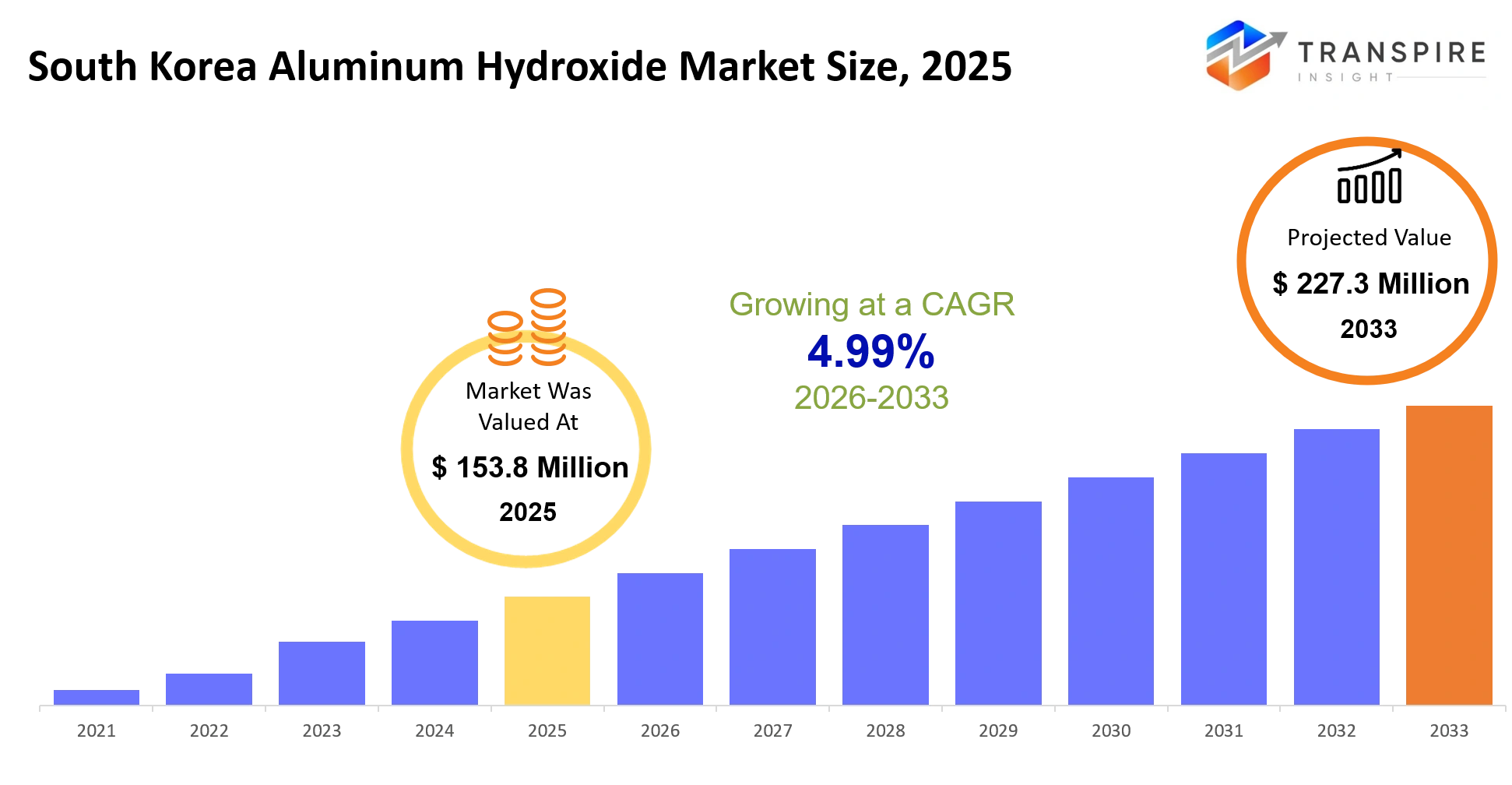
- South Korea Aluminum Hydroxide Market Size 2025: USD 153.8 Million
- South Korea Aluminum Hydroxide Market Size 2033: USD 227.3 Million
- South Korea Aluminum Hydroxide Market CAGR: 4.99%
- South Korea Aluminum Hydroxide Market Segments: By Grade (Industrial Grade, Pharma Grade, Flame Retardant Grade, Others); By Application (Flame Retardants, Water Treatment, Pharmaceuticals, Chemicals, Others); By End User (Construction, Chemical, Healthcare, Others).
South Korea Aluminum Hydroxide Market Summary
The South Korea Aluminum Hydroxide Market was valued at USD 153.8 Million in 2025. It is forecast to reach USD 227.3 Million by 2033. That is a CAGR of 4.99% over the period.
Aluminium hydroxide is mainly used in South Korea for improved safety and stability in industrial materials: plastic formulations, coatings, electronic component casings, construction composite materials, shipbuilding applications. In these cases fire performance and thermal stability were already essential, rather than desirable features. Over the last 3 to 5 years, there has been a general transition away from halogenated flame retardants and into mineral-based, low toxicity fillers, as companies redevelop their materials to be compliant and exportable. The main drivers for this trend have been strict fire safety enforcement within high-risk industries like shipbuilding and consumer electronics, especially after major industrial fires, coupled with supply chain disruptions which revealed dependence on chemically intermediate products exported from China. Accordingly, producers in Korea are ramping up local refining and high-purity grades of aluminium hydroxide and making it an important, safety-critical industrial material instead of a commodity filler.
Key Market Insights
- South Korea Aluminum Hydroxide Market will be driven by requirement of fire safe material over the shipbuilding and electronics manufacturing centers in 2024-2026.
- Seoul-Gyeonggi takes the lion's share of the market in 2025 with almost 48% representing the very high concentration of electronics and chemical processing industries.
- Ulsan and Busan industrial belt is the most dynamic for 2026-2030 with shipbuilding retrofit and export-oriented compliance upgrades.
- Demand for aluminum hydroxide with purity levels higher than 99% carries the largest market share at an estimated 52% in 2025, owing to increasingly high-quality requirements for flame-retardant fiberglass resins.
- The standard industrial grade has just earned the second largest market share: it is common in construction composites and filler plastics.
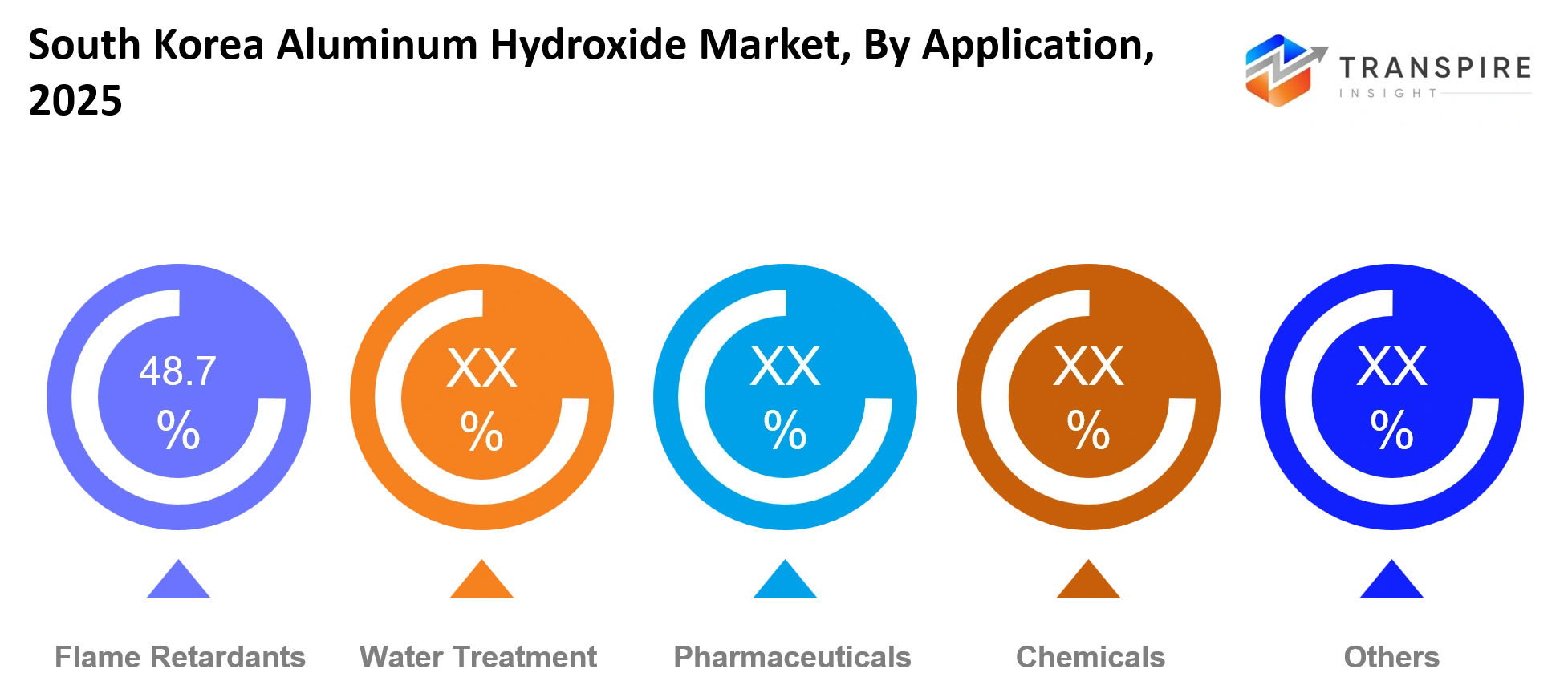
- Additives used for flame retarding are by far the largest application segment with more than 55% market share as a result of legislative substitution of halogen containing chemicals.
- Electrical insulation and low-smoke applications-fastest growing product segment through 2030 as safety becomes an even greater concern.
- Electronics suppliers are still the largest end-use, accounting for about 40% of the market in 2025 thanks to demand for semiconductors and device housing.
- This is the fastest expanding end-user segment, supported by IMO-related material safety upgrades.
What are the Key Drivers, Restraints, and Opportunities in the South Korea Aluminum Hydroxide Market?
The most significant driver for the South Korea Aluminum Hydroxide Market is increased regulation in industrial fire safety across electronics, shipbuilding and construction material industries. Governmental regulations and export compliance requirements encourage suppliers and customers to shift away from halogenated flame retardants toward minerals like aluminum hydroxide. This shift is a direct driver in polymer systems, coatings, and composite materials since the original equipment manufacturer will reengineer the product line for certification rather than a sustainable standard which is considered optional. Thus, procurement will often be dictated by compliance deadlines and this provides stable and regulated revenue growth.
The most significant constraint is cost sensitivity due to high purity requirements. The processing for an aluminum hydroxide product with low impurity and specific particle size utilizes an energy intensive refining process as well as a precipitation process. Smaller, domestic producers are often challenged with economies of scale which causes them to be reliant on intermediate imports, and prevents competitive pricing. This systemic issue slows substitution in mid-tier industrial applications, where regulatory pressure is not the dominant factor over cost constraints.
The largest opportunity is domestic high purity production linked to the broader high technology industry in South Korea. If domestic refining capacity is developed around the petrochemical cluster at Ulsan, as well as near the shipbuilding cluster in Busan, dependence on imports could lessen while supply chains would become more resilient. This could lead to greater collaboration and integration with both next generation marine coatings and electronics-grade polymers.
What Has the Impact of Artificial Intelligence Been on the South Korea Aluminum Hydroxide Market?
In South Korea, artificial intelligence is playing an increasing role in optimizing process efficiency throughout the value chain for aluminum hydroxide, including refining, quality assessment, and in-use performance in downstream applications. Within production, real-time, AI-powered control strategies can now take inputs of real-time particle size distribution, precipitating conditions, and impurities, allowing for improved stability of the higher purity grades that find application in flame retardant material (used in electronics) or marine coatings.
Within downstream applications such as exhaust gas cleaning (EGC) technology and marine emission control (MEC) systems, machine learning (ML) algorithms can now predict performance parameters and material degradation of scrubber components. Operating parameters are then automatically adjusted to optimize EGC or MEC efficiency; this means earlier prediction of scaling or decreased absorption efficiency, reducing unplanned maintenance, improving uptime, and increasing compliance certainty for shipyard customers.
AI has also seen success in emissions forecasting and predictive maintenance scheduling in industrial settings where sensor readings from chemical plants are analyzed to predict drift and optimize component replacement schedules of aluminum hydroxide based materials. Significant improvements have been demonstrated through a combination of decreased downtime and more consistent, predictable regulatory compliance performance.
Although adoption is growing, barriers to AI implementation exist due to the limited availability of high-quality training data from actual industrial and marine applications. Because operating conditions in many industrial processes, particularly those within offshore scrubbing, are subject to large fluctuations, many ML models tend to have decreased prediction accuracy and therefore require more expensive implementation.
Key Market Trends
- Over 35% of halogenated flame retardant reduction was achieved by manufacturers from 2022 to 2025, leading to a more rapid implementation of substitution of aluminum hydroxide in safety critical applications.
- As of 2023, shipbuilders in Busan increasingly used higher-purity grades to satisfy the stricter fire safety certification based on IMO regulations for export vessels.
- Electronics producers reduced purchases of bulk imports and switched to domestic certified suppliers after the supply chain disruptions of 2024 revealed the dependence risk of China intermediaries.
- By 2025, nearly 40% of the contracts shifted to long-term agreements to replace the spot buying practice and stabilize purchasing price as well as guarantee the certification consistency.
- Particle size controlling technology improved 20% of dispersion characteristics in polymer flame retardant systems from 2022 to 2026.
- After 2023, Korean chemical producers expanded the localization capacity of refining in order to stabilize the supply of feedstock and improve the feedstock quality for high-purity aluminum hydroxide.
- Due to increased auditing and inspections from the regulator after the fire safety incidents from 2023, manufacturers were obligated to enhance their material traceability and certification documents systems.
- From 2024 to 2026, electronics companies enhanced the usage of aluminum hydroxide for low-smoke casings, substituting old brominated types for consumer electronics products.
- Post 2024, competitive strategies have changed to focus on localized technical cooperation within Korean industries from market leaders such as Nabaltec AG and Huber Engineered Materials.
- From 2023, investment focused on R&D for surface-treated grades to improve compatibility of materials with high-performance resins for automotive and maritime composites.
South Korea Aluminum Hydroxide Market Segmentation
By Grade :
The industrial grade is a generally used grade in construction materials, building materials, and general industrial processing owing to the relatively stable price and availability of the product. However, since 2023, more demand has moved towards higher degree of particle control because safety of the materials is preferred in polymer systems and coating formulations.
Flame retardant grade tends to be adopted more rapidly in electronics and building applications. The pharmaceutical grade market is smaller but developing steadily on increasing requirements for purity in regulated chemical applications. The other market is very small, but used mostly in various industrial processing areas that require custom or smaller scale production depending on specific processing conditions.
By Application :
Flame retardants continue to be a key application area and the markets have been growing rapidly as the need for safe and effective Flame retardants have increased significantly with tightened regulations after 2023. Halogen free additives continue to replace existing halogen based ones for flame retardant purposes for plastics and resins. Market growth is attributed to the enhanced needs for material safety compliance in production not an increase in overall usage.
Water treatment is a constant market with applications for purified water by adsorbent systems, with stable physical chemical properties. Pharmaceutical grade remains a restricted market in small volume for its very high standards and controls required. Other applications include many different kinds of chemical usage, acting as catalizer, intermediary and supports or processing aids in other industries for their stability.
By End User :
The demand for the construction sector increased after 2022 because of enforcement of rigorous fire safety regulations for building materials and insulation systems. There has been a shift towards use of safer low-smoke composites and this is fueling up demand from the construction sector to meet newer certification standards and use of aluminum hydroxide for enhancing the thermal resistance of these materials for infrastructure works.
There is a continuous but rather static demand from the chemical industry for process assistance and formulating support. Application in the medical sector is still in a relatively stable niche but consistent for high-purity needs, while increasing gradually from other industries like electronics and manufacturing where demand is dictated by performance requirements and regulatory norms.
What are the Key Use Cases Driving the South Korea Aluminum Hydroxide Market?
The primary driver for the South Korea Aluminum Hydroxide Market is its continued role in flame retardant systems for plastics, resins and industrial composites. Stringent fire safety standards within manufacturing and construction environments are compelling the demand for low-smoke and safer plastics and composites. Demand in the areas of housing and construction panels, and industrial insulation is significant with manufacturers switching from halogen based additives and their harmful smoke production, and compliance with export standards is compelling this transition. Fire safety is now becoming standard for designers rather than optional.
Increasing uses are seen within water treatment processes, as well as chemical processing industries; aluminum hydroxide can enhance filtration effectiveness and provide stable reaction control. Usage is seeing rapid increases within construction material suppliers and chemical producers with increasing demand for safer inputs in building materials, and stable operations in bulk processes.
Applications are beginning to develop in the field of advanced polymer composites for automotive applications and second generation electronics; also, application is seen in specialized industrial coatings where an increased number of applications demand for thermally stable, environmentally safe inputs, are escalating year over year.
|
Report Metrics |
Details |
|
Market size value in 2025 |
USD 153.8 Million |
|
Market size value in 2026 |
USD 161.6 Million |
|
Revenue forecast in 2033 |
USD 227.3 Million |
|
Growth rate |
CAGR of 4.99% from 2026 to 2033 |
|
Base year |
2025 |
|
Historical data |
2021 - 2024 |
|
Forecast period |
2026 - 2033 |
|
Report coverage |
Revenue forecast, competitive landscape, growth factors, and trends |
|
Country scope |
South Korea |
|
Key company profiled |
Alcoa, Huber Engineered Materials, Nabaltec, Sumitomo Chemical, Showa Denko, Almatis, LKAB Minerals, TOR Minerals, MAL Hungarian Aluminium, Hindalco, Chalco, KC Corporation, Rusal, Sasol, BASF. |
|
Customization scope |
Free report customization (country, regional & segment scope). Avail customized purchase options to meet your exact research needs. |
|
Report Segmentation |
By Grade (Industrial Grade, Pharma Grade, Flame Retardant Grade, Others); By Application (Flame Retardants, Water Treatment, Pharmaceuticals, Chemicals, Others); By End User (Construction, Chemical, Healthcare, Others). |
Which Regions are Driving the South Korea Aluminum Hydroxide Market Growth?
The Seoul-Gyeonggi region holds the majority share in South Korea's Aluminum Hydroxide Market because of its highest concentration of electronics manufacturers, chemical processors and advanced material production plants. Strict regulations for industrial safety have forced the companies within the region to start the practice of using high purity flame retardant materials sooner than others. Production facilities like semiconductor fabrication plants and assembly plants of consumer electronics require stable high volumes of material with a precise quality, therefore these companies provide an ongoing high-volume demand. High volume consumption levels together with an extensive supplier base have made the demand of the region so large.
The Ulsan-Busan region is a strong second in the South Korea Aluminum Hydroxide Market supported by the strong industrial activity of its extensive heavy industrial, shipbuilding, and petrochemical enterprises. Unlike the leading region, the demand of the region is not primarily based on precision production, but more on needs regarding long term product durability. A focus for a company producing industrial grade, or intermediate grade aluminum hydroxide for use within a coatings or a composite production facility or in a chemical processing plant is more common in this region. Due to large investment cycles in large industrial enterprises the consumption of aluminum hydroxide is rather stable irrespective of export demand.
The growth acceleration region is in Chungcheong, it has registered a growth since 2013 with many new industrial parks and innovation centers. Incentives for the production of high-end material with the government support in the region and diversification programs for manufacturing will lead to new manufacturing units. New investments in logistical infrastructure and industrial zones has increased accessibility for many middle sized chemical companies in the region. High growth rates indicate the potential for higher entry levels to supplying businesses for new networks of dispersed manufacturing beyond industrial belts.
Who are the Key Players in the South Korea Aluminum Hydroxide Market and How Do They Compete?
The competition environment of the South Korea Aluminum Hydroxide Market can be categorized as moderately concentrated. Global specialty chemical manufacturers and local manufacturers centered around cost and supply reliability compete in the market. In particular, the product purity level, the technology for particle control, and the compliance of strict fire safety certification requirements are crucial. Existing players protect their position by supplying grades with stable characteristics to electronic and industrial material suppliers and new entrants tend to be cost-competitive, targeting applications in the construction and chemical industries.
Albemarle Corporation competes by providing high-performance material formulations for applications in flame retardants with emphasis on the quality consistency and support of regulatory compliance for its industrial customers, aiming at strengthening its position in high-end applications through superior grades suitable for easy integration with electronic polymers.
Nabaltec AG competes through highly specialized aluminum hydroxide and aluminum oxide trihydrate products with strict control over the particle size distribution for electronic and engineering plastics manufacturers where excellent dispersion characteristics are requested, focusing on increasing presence in the market by concluding application support cooperation agreements with Asia based manufacturers.
Huber Engineered Materials utilizes specific materials engineering solutions tailored to applications and provides customized flame retardant solutions to the construction and plastics industry. It gains its advantage by focusing on localized solutions through partnerships and improving local delivery reliability and application support integration.
Sumitomo Chemical's competitiveness is characterized by vertically integrated chemical production in Asia with stable supply of raw materials and cost efficiency, aiming at expanding into downstream markets of electronic and industrial material suppliers through downstream integration in respective markets.
TOR Minerals utilizes niche, high-purity mineral additives by consistently supplying products with consistent characteristics to specialty industrial application providers and expansion is focused on targeted distribution partnerships, exploring niche applications within high-specification manufacturing sectors.
Company List
- Alcoa
- Huber Engineered Materials
- Nabaltec
- Sumitomo Chemical
- Showa Denko
- Almatis
- LKAB Minerals
- TOR Minerals
- MAL Hungarian Aluminium
- Hindalco
- Chalco
- KC Corporation
- Rusal
- Sasol
- BASF
Recent Development News
In July 2025, Advanced Energy Minerals entered into a distribution agreement with YEEYOUNG CERACHEM CO., LTD. to expand its presence in South Korea for high-purity alumina and aluminum hydroxide materials. The agreement strengthens local supply access for semiconductor and ceramics industries by formalizing a Korean distribution channel for advanced aluminum-based materials.
Source: https://aemhpa.com/
In December 2025, SeAH Aerospace & Defense Materials signed a long-term supply agreement with Boeing to supply high-strength aluminum alloy materials for aircraft components starting in 2026. The deal reinforces South Korea’s aerospace aluminum value chain and expands export-oriented demand for advanced aluminum materials produced by Korean suppliers.
Source: https://cm.asiae.co.kr/
What Strategic Insights Define the Future of the South Korea Aluminum Hydroxide Market?
The South Korean market for aluminum hydroxide is progressively morphing from one of volume driven commodity growth to one that is specifications-driven and regulation-led. The next 5-7 years of demand will be increasingly tied to flame-retardant applications for EV battery systems, semiconductor fabricating materials and technical ceramics, boosted by South Korea's increasingly stringent industrial safety requirements, and its electrification of its industrial ecosystems. A somewhat hidden threat will come from the potential replacement of high-spec applications by next-generation FR solutions, such as phosphate- and nano-ceramics based FR solutions, further diminishing aluminum hydroxide's value proposition faster than its aggregate demand growth will suggest.
Simultaneously, an almost equally imminent opportunity exists with respect to ultra-high-purity grades utilized in semiconductor encapsulation, as well as in EV battery thermal barriers, for which local South Korean supply-chain localization policies will drive an acceleration of adoption. Companies in this space would be wise to pursue vertical integration into downstream compound formulations in partnership with the battery and electronics OEMs, rather than expanding basic raw production capacity, in order to capture specifications-driven demand and escape the commodity-level pressure stemming from regional excess capacity at the primary alumina processing level.
South Korea Aluminum Hydroxide Market Report Segmentation
By Grade
- Industrial Grade
- Pharma Grade
- Flame Retardant Grade
By Application
- Flame Retardants
- Water Treatment
- Pharmaceuticals
- Chemicals
By End User
- Construction
- Chemical
- Healthcare
Frequently Asked Questions
Find quick answers to common questions.
The South Korea Aluminum Hydroxide Market size is USD 227.3 Million in 2033.
Key segments for the South Korea Aluminum Hydroxide Market are By Grade (Industrial Grade, Pharma Grade, Flame Retardant Grade, Others); By Application (Flame Retardants, Water Treatment, Pharmaceuticals, Chemicals, Others); By End User (Construction, Chemical, Healthcare, Others).
Major South Korea Aluminum Hydroxide Market players are Alcoa, Huber Engineered Materials, Nabaltec, Sumitomo Chemical, Showa Denko, Almatis, LKAB Minerals, TOR Minerals, MAL Hungarian Aluminium, Hindalco, Chalco, KC Corporation, Rusal, Sasol, BASF.
The South Korea Aluminum Hydroxide Market size is USD 153.8 Million in 2025.
The South Korea Aluminum Hydroxide Market CAGR is 4.99% from 2026 to 2033.
- Alcoa
- Huber Engineered Materials
- Nabaltec
- Sumitomo Chemical
- Showa Denko
- Almatis
- LKAB Minerals
- TOR Minerals
- MAL Hungarian Aluminium
- Hindalco
- Chalco
- KC Corporation
- Rusal
- Sasol
- BASF
About the Authors

Pankaj Ghogare Patil
I am Pankaj Ghogare Patil, a Senior Research Analyst at Transpire Insight, specializing in the Pharmaceutical, Chemicals & Materials, Healthcare IT, and Biotechnology industry. My expertise lies in conducting comprehensive market research, analyzing industry trends, evaluating competitive landscapes, and translating complex data into actionable insights. At Transpire Insight, I closely follow emerging technologies, regulatory developments, and market innovations to create accurate, well-researched, and informative content that helps businesses and professionals make informed decisions. I am committed to producing credible, evidence-based articles that reflect industry best practices while making technical topics accessible and valuable for a broad audience.

Chakradhar Khansole
Chakradhar serves as the Research Director at Transpire Insight, bringing over 8 years of experience in technology, innovation, and strategic market intelligence. He specializes in transforming complex market data into actionable business insights that enable organizations to make informed, growth-oriented decisions. Recognized for his strategic vision and analytical expertise, Chakradhar leads high-impact research initiatives, delivering comprehensive market assessments, competitive intelligence, and forward-looking industry analysis.
Recently Published Reports
-
May 2026
Healthcare Polymer Packaging Market
Healthcare Polymer Packaging Market Size, Share & Analysis Report By Packaging Type (Syringes, IV Bottles and Pouches, Clamshells, Blisters, Bottles & Jars, Containers, Tubes, IV Parental Packaging, Others), By Type (Regulated, Non-regulated), By Polymer Type (LDPE (Low-Density Polyethylene), HDPE (High-Density Polyethylene), Homo-polymer (Homo), Random Copolymer (Random), Block Copolymer (Block), PET, Polystyrene, Polyvinyl Chloride, Polyamide/EVOH, Others), and Geography (North America, Europe, Asia-Pacific, Middle East and Africa, South and Central America), 2021 - 2031
-
Apr 2026
Hydrophilic Tape (Waterstop) Market
Hydrophilic Tape (Waterstop) Market Size, Share & Analysis Report By Type (Bentonite-Based Hydrophilic Tape, Rubber-Based Hydrophilic Tape), By Application (Residential Buildings, Commercial Buildings, Infrastructure Projects), and Geography (North America, Europe, Asia-Pacific, Middle East and Africa, South and Central America), 2021 - 2031
-
Apr 2026
Metalens Market
Metalens Market Size, Share & Analysis Report By Type (Visible Light Metalens, and Infrared Metalens), By Application (Consumer Electronics, Automotive Electronics, Industrial, Medical, and Others), and Geography (North America, Europe, Asia-Pacific, Middle East and Africa, South and Central America), 2021 - 2031
-
Apr 2026
PBT Resin Market
PBT Resin Market Size, Share & Analysis Report By Type (Reinforced PBT Resin, Unreinforced PBT Resin), By Processing Method (Injection Molding, Extrusion, Blow Molding, Others), By End-User (Automotive, Electrical & Electronics, Consumer Appliances, Industrial Machinery, Medical Devices, Packaging, Others), and Geography (North America, Europe, Asia-Pacific, Middle East and Africa, South and Central America), 2021 - 2031