

SMB Software Market Summary:
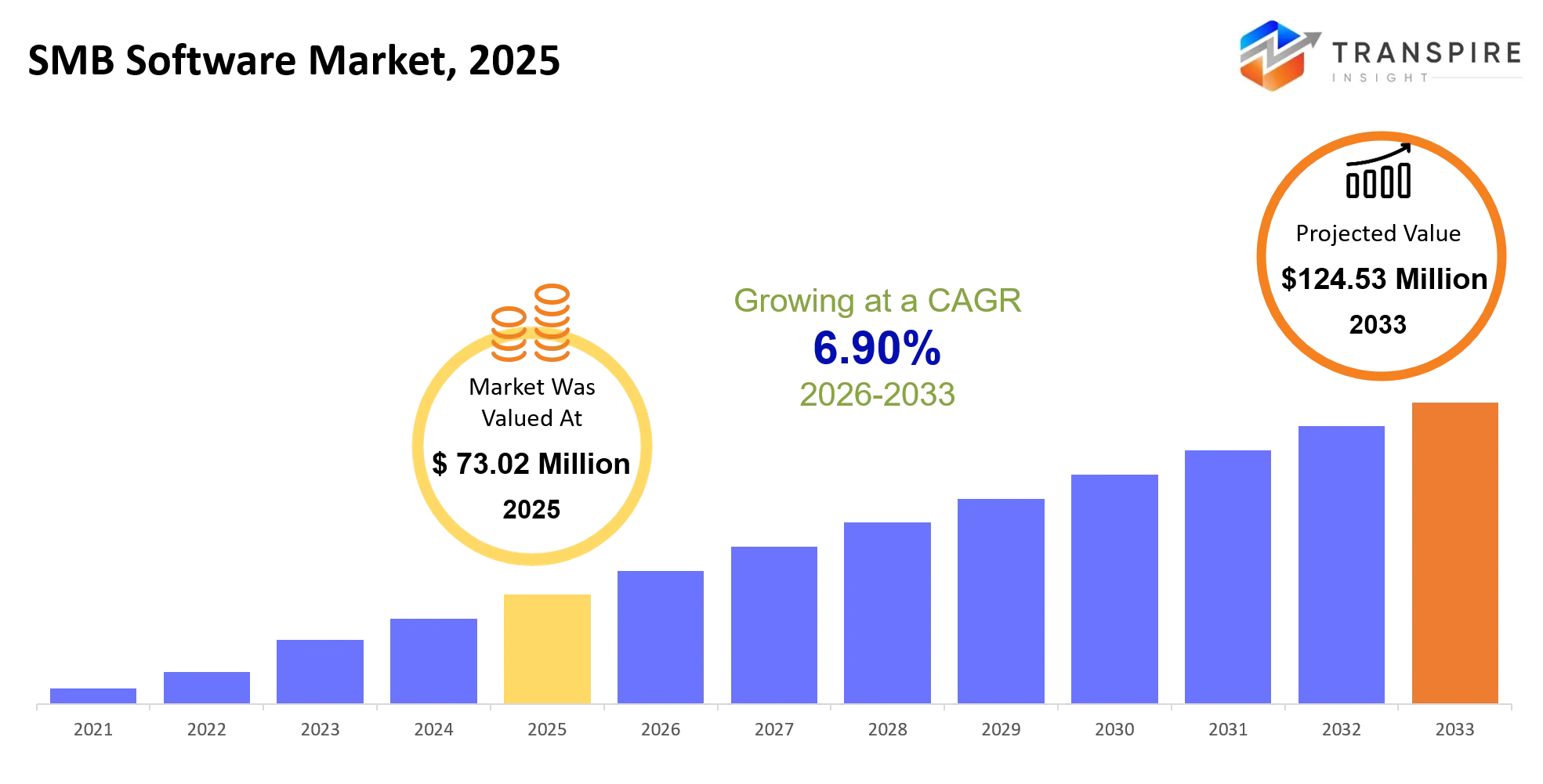
As per the Transpire Insight Analysis, The SMB Software Market size is estimated at USD 73.02 billion in 2025 and is anticipated to reach USD 124.53 billion by 2033, growing at a CAGR of 6.90% from 2026 to 2033. ‘
The SMB software offers smaller firms off-the-shelf systems for invoicing, bookkeeping, sales pipelines, payroll, inventory, marketing, and support, without the need to build their own IT. Over the last three to five years, cloud subscriptions have turned these tools from isolated desktop transactions into integrated services that synchronise across devices and link banks, marketplaces, and payment providers. The next change involves weaving in artificial intelligence and automation; the cloud will do more processing, even in familiar workflows. Digitisation and remote work, the forces driving the market, are expanding the number of transactions and making human reconciliation expensive; policy is also playing its part: the European Union's VAT in the Digital Age package, which recently came into force, enables member states to require e-invoicing, and electronic cross-border reporting will likely begin from 2030. Software will convert transactions into usable, compliant data; small-business owners will be able to close their books more quickly, be more responsive to customers, and make better choices with less administrative toil-anywhere in the world.
SMB Software Market Size & Forecast:
- Market Size 2025: USD 73.02 Billion
- Expected Market Value (2033): USD 124.53 Billion
- Forecast CAGR (2026–2033): 6.90%
- Leading Region in 2025: North America
- Fastest Growing Region: Asia Pacific
- Key Company Profiles: Microsoft, Salesforce, Intuit, Adobe, HubSpot, Zoho, QuickBooks, Xero, SAP, Oracle, Google, Freshworks, Monday.com, ServiceNow, Sage.
Key SMB Software Market Insights:
SMB software is becoming more than a collection of business tools, evolving into AI-enabled platform operating systems that integrate finance, sales, operations, and customer service. Sources of competitive advantage are shifting: from workflow automation to embedded intelligence, and from pricing models to reflect small businesses' cash-flow realities.
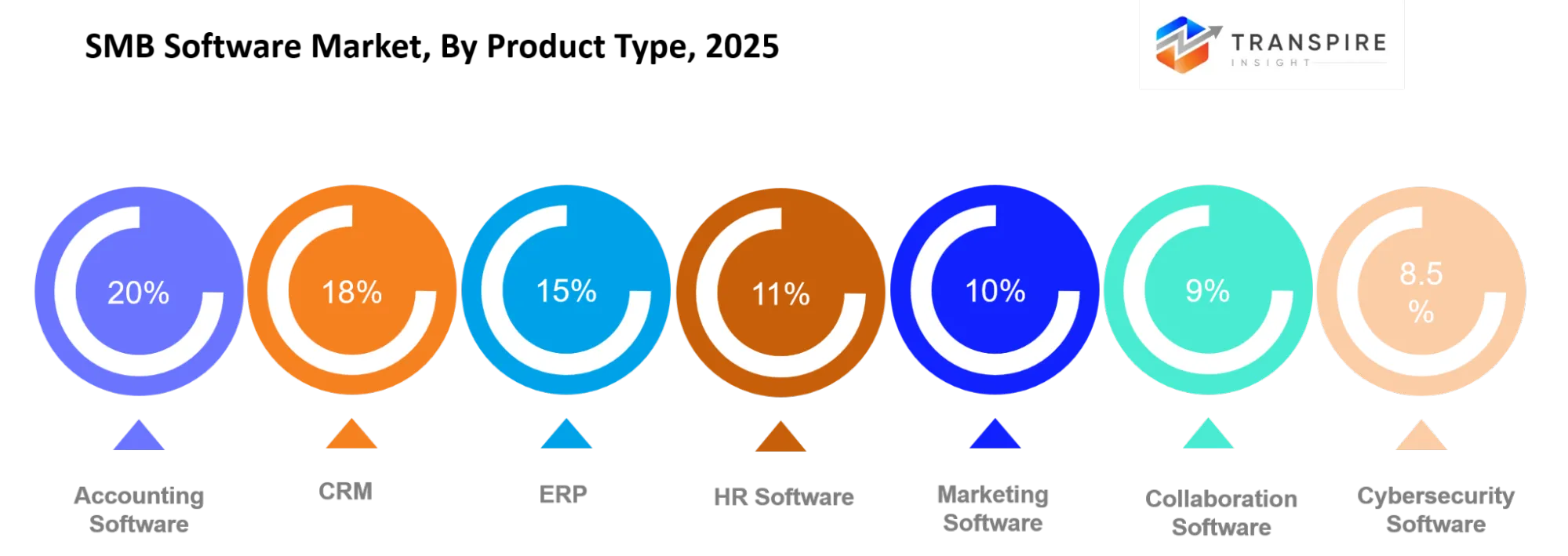
- Cloud/SaaS deployment dominates the market at 68.5%, with Microsoft rolling out Copilot for SMB workflows in Word, Excel, Outlook, Teams, and Dynamics 365.
- The shift from content generation to transaction processing and decision support is driving AI-enabled SMB software to grow at a 14.7% CAGR.
- Accounting software is leading by type at 20.0%, with Intuit's agents categorising more than half of QuickBooks transactions in January 2026.
- CRM accounts for 18.5% of the market, and in July 2026, Salesforce introduced its SMB Growth Kit in India, which includes Agentforce Sales, Slack, and Tableau.
- ERP accounts for 15.0%, and SAP and Oracle NetSuite will add AI transaction matching and financial-flux analysis to their 2026 versions.
- HR software makes up 11.5%, followed by payroll automation, hiring workflows, and compliance management for distributed teams.
- Marketing software commands 10.0%, with HubSpot and Adobe leading the way in AI-driven campaign personalisation, content creation, and customer-data activation.
- Collaboration software will account for 9.0%, with Monday.com and Zoho using low-code to automate and consolidate work management.
- Cybersecurity software is growing in significance because of cloud adoption's increasing needs for IDP, endpoints, and data protection, with a market share of 8.5%.
- Project management software takes a 7.5% share of the market, with ServiceNow and Freshworks focusing on service workflows and cross-team operational visibility.
What are the Key Drivers, Restraints, and Opportunities in the SMB Software Market?
Driver:
AI-enabled automation is now the primary growth driver. SMBs are applying AI to invoicing, customer replies, scheduling, marketing content, and data analysis; 39% use it for business insights and 29% for operations automation. The trigger is falling model and subscription costs, which turn capabilities once reserved for enterprises into affordable monthly services. This raises adoption and supports premium tiers because firms can measure time savings—48% of AI-using SMBs save at least four hours weekly.
Restraint:
Fragmented records, weak app connectivity, and limited staff time make implementation disruptive. Costs extend beyond subscriptions: migration, training, cybersecurity, and maintenance require cash and expertise. OECD’s 2026 SME survey identifies time, maintenance costs and skills gaps as barriers; firms may buy software but use few features, limiting upgrades and retention.
Opportunity:
Vendors can grow by consolidating workflows and automating compliance. Embedded AI in accounting, CRM and messaging can serve microbusinesses without dedicated technical teams. WhatsApp’s Business AI rollout in India, for example, supports customer replies, lead capture and bookings in local languages. Modular integrations, secure migration and accountant-led onboarding can reduce switching risk and unlock recurring premium revenue from automation and industry-specific packages, and improve customer retention as firms expand gradually.
Relative impact percentages are analyst estimates of each driver’s contribution to market growth; they total 100%.
|
Driver |
Relative Impact on Growth (%) |
Geographic Relevance |
Impact Timeline |
Demand Strength |
Growth Mechanism |
Key Beneficiaries |
Major Constraint |
|
Cloud and SaaS adoption among SMBs |
25% |
North America, Europe, Asia Pacific |
Short-term (≤2 years) |
High |
Subscription access lowers upfront costs and accelerates deployment. |
SMB users, SaaS vendors, cloud infrastructure providers |
Recurring fees, migration effort, and connectivity gaps constrain uptake. |
|
Digitization and integration of core business workflows |
24% |
North America, Europe, Asia Pacific |
Medium-term (2–4 years) |
High |
Connected finance, CRM, inventory, and HR reduce manual work. |
ERP and CRM vendors, implementation partners, SMB operators |
Legacy systems, fragmented data, and limited staff skills impede integration. |
|
Embedded generative AI and workflow automation |
21% |
North America, Europe, Asia Pacific |
Short-term (≤2 years) |
High |
AI features automate routine tasks and improve software productivity. |
Software vendors, SMB employees, AI infrastructure providers |
Unclear returns, training needs, and data privacy concerns slow adoption. |
|
Cybersecurity, privacy, and compliance requirements |
16% |
Europe, North America, Asia Pacific |
Medium-term (2–4 years) |
High |
Risk controls and reporting needs increase demand for secure software. |
Security vendors, compliance software firms, SMB customers |
Cost, regulatory complexity, and shortages of security expertise limit uptake. |
|
Digital commerce and omnichannel customer management |
14% |
Asia Pacific, North America, Europe |
Medium-term (2–4 years) |
Medium |
Online sales drive demand for connected payments, CRM, and inventory. |
E-commerce platforms, payment providers, SMB retailers |
Platform fees, intense competition, and channel integration costs constrain growth. |
What Has the Impact of Artificial Intelligence Been on the SMB Software Market?
AI has shifted small and medium-sized business software from one kind of record keeper to another, aiding operational decision-making. In accounting and finance, AI powers invoice matching, expense categorisation, reconciliations, and cash-flow forecasting. Customer relationship management and marketing software use predictive scoring for lead prioritisation, demand forecasting, and tailored messaging. Customer service software uses chatbots to triage inbound questions and qualify leads, and operations software uses robotic process automation to help with order scheduling, inventory replenishment, and document processing. Generative AI currently dominates in marketing copywriting, customer communication, documentation, and coding. The operational impact of AI is measurable: 52% of SMB AI users report ROI, and nearly half save at least four hours per week. Prediction and forecasting that were once the domain of data scientists now help smaller firms forecast staffing, churn, payments, and demand without dedicated analytics staff. There remains room for more accurate, integrated data: 31% of SMBs say they don't trust AI's outputs because of unclean, unconnected data, and most keep a human in the loop before allowing AI to run on autopilot. High compute costs and vendor-industry inertia can impact margins and hinder deployment.
In October 2026, BILL launched agentic AI capabilities for its small and medium-sized business financial operations platform. The integration directly addresses the SMB trust gap by implementing automated risk intelligence, natural language querying, and a centralised management system that enforces human-in-the-loop controls before transactions execute autonomously.
Key SMB Software Market Trends:
Software is becoming more integrated than discrete tools for tasks, with common financial and customer data and workflows. AI is turning into an in-product assistant, and compliance and security are becoming part of the regular workflows.
- Cloud has evolved from remote access to the core of linked bookkeeping, payments, and CRM.
- PDF invoicing is becoming a thing of the past and moving to structured records for easier reporting and automated reconciliation.
- Adoption of AI is progressing from AI chatbots to AI-powered assistants available in business applications and company information.
- Property owners want systems to do more than simply maintain records or produce reports, but to automate routine work.
- Software vendors are bundling onboarding and human guidance with subscriptions to deliver value to smaller customers.
- More SMBs are consolidating apps as integrations decrease duplicate data entry and provide owners with a single operations perspective.
- With more workflows and records being transitioned online, cybersecurity has become more of an operational need and not just an IT support function.
- Customer AI in local languages is helping to extend access for small businesses that do not have a dedicated service team or developers.
SMB Software Market Segmentation
Software Type:
Accounting software leads with a 20.0% share because every SMB must manage invoicing, tax, payroll, and cash flow; its growth logic rests on automation of reconciliation and compliance, pointing toward AI-led financial control. CRM follows at 18.5%, driven by lead tracking, customer retention, and sales forecasting, and will increasingly function as an AI-guided revenue platform. ERP holds 15.0%, growing as inventory, procurement, and operations become digitally connected. HR software accounts for 11.5%, supported by payroll, hiring, and workforce-compliance needs. Marketing software represents 10.0%, propelled by campaign automation and personalisation. Collaboration software, cybersecurity software, and project management software account for 9.0%, 8.5%, and 7.5%, respectively; security is likely to gain share as AI adoption expands attack exposure.
Deployment:
Cloud and SaaS account for 68.5%, offering lower upfront costs, automatic updates, and remote access that suit lean SMB teams. On-premise systems remain useful where firms need local control or operate with limited connectivity. Hybrid models combine hosted or private cloud environments with local infrastructure, while public cloud scales easily across locations. Edge deployment supports time-sensitive processing close to devices. As businesses modernize, flexible architectures help connect legacy systems, protect sensitive records, and avoid disruptive all-at-once migrations over time.
Application:
Finance, sales, marketing, HR, operations, customer service and IT management cover business workflows, while analytics and compliance sit among other uses. Finance applications support bookkeeping, invoicing and cash-flow visibility; sales and marketing tools organize leads and campaigns. HR and operations software coordinate staffing, inventory and processes. Customer service platforms manage inquiries across channels, and IT tools support access and security. Shared records reduce duplicate entry, reveal process bottlenecks and help firms add capabilities as teams and transaction volumes grow.
Business Size:
Micro and small firms prioritise simple, low-administration tools that replace spreadsheets without requiring specialist IT staff. Medium businesses need permissions, reporting and integrations as departments and volumes expand. Startups value rapid setup and flexible plans while testing business models. Family businesses may prioritise continuity and shared access across generations; franchises need centralised oversight across multiple locations. Professional services firms depend on client records, scheduling, and time tracking. Other firms choose software by operational complexity, skills, and growth priorities.
Pricing Model:
Subscription and per-user plans spread costs over time and make budgeting easier, while freemium tiers let owners test features before committing. Usage-based and tiered pricing align spending with transaction volumes, storage, or advanced capabilities. One-time licenses can suit firms preferring a purchase, and transaction-based fees fit payment-linked workflows. Other models address specialized needs, including bundled services or seasonal use by firms. Transparent pricing and predictable upgrade paths help SMBs control costs as staff, customers and software requirements change.
End User:
Retailers use software to link inventory, point-of-sale transactions and online orders. Healthcare businesses need scheduling, billing and secure handling of sensitive records; manufacturers prioritize production planning, purchasing and traceability. Professional services firms rely on CRM, invoicing and time tracking, while construction companies manage job costing. Hospitality operators coordinate reservations, payments and staffing; education providers handle enrollment and communications. Other sectors need tools suited to their compliance and workflow demands. Vertical packages can reduce configuration work and support growth.
What are the Key Use Cases Driving the SMB Software Market?
Accounting, the largest category at 20.0%, anchors invoicing, reconciliation, expense tracking, cash flow, and tax records. Cloud/SaaS (68.5%) gives owners and bookkeepers a shared ledger; CRM (18.5%) links customer histories and follow-up to sales.
ERP connects purchasing and inventory with retail sales, manufacturing schedules, and construction job costs. HR and payroll coordinate hiring, time and pay, while marketing and collaboration tools support communications across online channels and distributed teams.
AI-enabled software, projected at 14.7% CAGR, adds service automation, demand forecasts, and anomaly alerts. Healthcare can streamline appointment reminders and billing; hospitality can forecast bookings and staffing. E-invoicing prepares structured records for digital reporting, reducing manual compliance work for growing firms.
|
Report Metrics |
Details |
|
Market size value in 2025 |
USD 73.02 Billion |
|
Market size value in 2026 |
USD 78.06 Billion |
|
Revenue forecast in 2033 |
USD 124.53 Billion |
|
Growth rate |
CAGR of 6.90% from 2026 to 2033 |
|
Base year |
2025 |
|
Historical data |
2021 - 2024 |
|
Forecast period |
2026 - 2033 |
|
Report coverage |
Revenue forecast, competitive landscape, growth factors, and trends |
|
Regional scope |
United States; Canada; Mexico; United Kingdom; Germany; France; Italy; Spain; Denmark; Sweden; Norway; China; Japan; India; Australia; South Korea; Thailand; Brazil; Argentina; South Africa; Saudi Arabia; United Arab Emirates |
|
Key companies profiled |
Microsoft, Salesforce, Intuit, Adobe, HubSpot, Zoho, QuickBooks, Xero, SAP, Oracle, Google, Freshworks, Monday.com, ServiceNow, Sage. |
|
Customization scope |
Free report customization (country, regional & segment scope). Available customized purchase options to meet your exact research needs. |
|
Report Segmentation |
Software Type (Accounting Software, CRM, ERP, HR Software, Marketing Software, Collaboration Software, Cybersecurity Software, Project Management Software)Deployment (Cloud, On-Premise, Hybrid, SaaS, Hosted, Private Cloud, Public Cloud, Edge)Application (Finance, Sales, Marketing, HR, Operations, Customer Service, IT Management, Others)Business Size (Micro Businesses, Small Businesses, Medium Businesses, Startups, Family Businesses, Franchise Businesses, Professional Services Firms, Others)Pricing Model (Subscription, Per-User, Freemium, Usage-Based, Tiered Pricing, One-Time License, Transaction-Based, Others)End User (Retail, Healthcare, Manufacturing, Professional Services, Construction, Hospitality, Education, Others) |
Which Regions are Driving the SMB Software Market Growth?
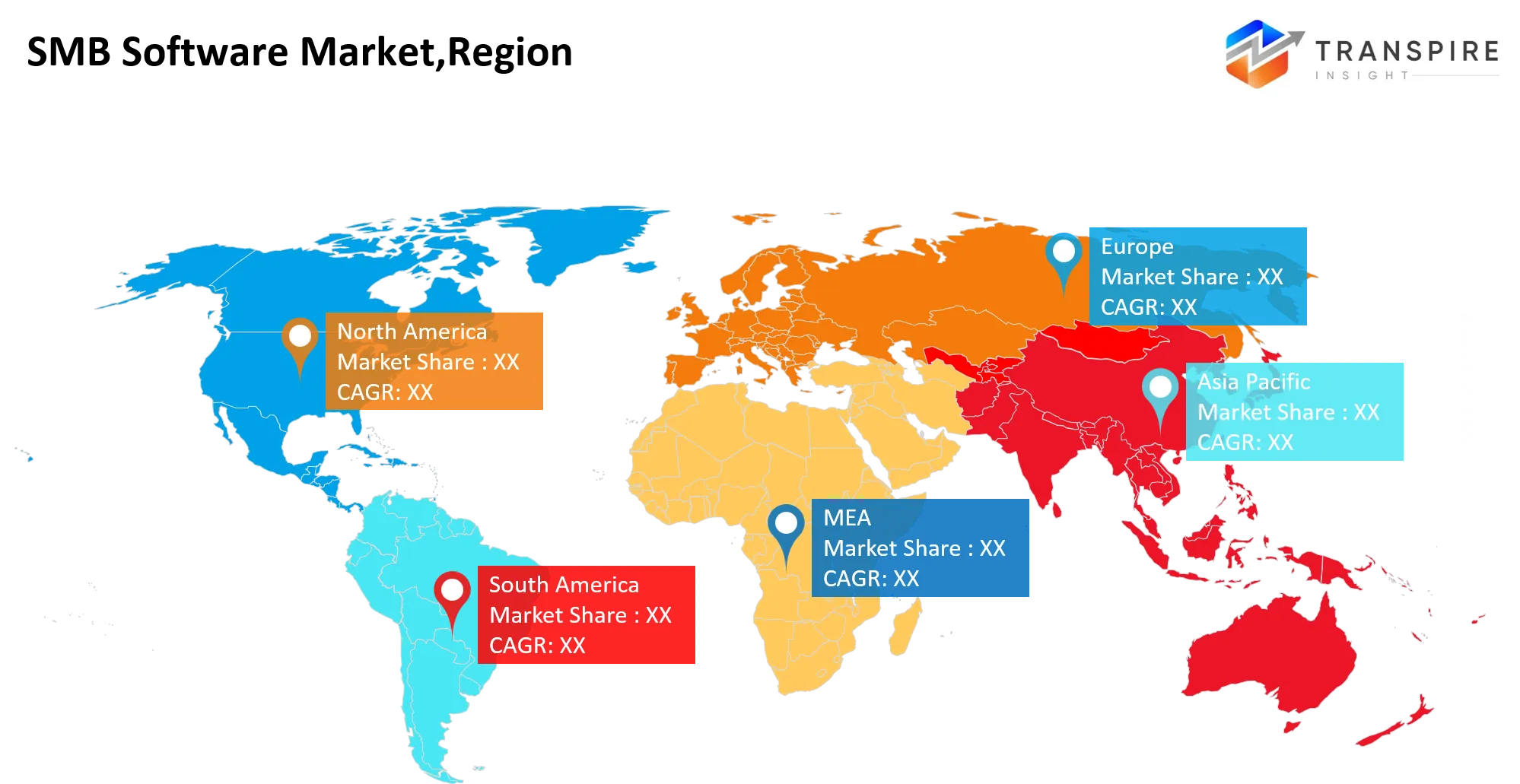
North America holds a 39.0% share of the market, driven by its mature cloud infrastructure, high software spend, and an extensive pool of SaaS vendors. Many sectors use subscriptions for finance, customer management, and collaboration to drive their suite upgrades. Broadband access, digital payments, and cloud marketplaces lower barriers to adoption and deployment and extend the vendor footprint. Also, competition, labour efficiency, and AI-powered productivity growth incentivise continuous upgrades in most sectors.
In January 2026, Amazon Web Services launched centralised data cataloguing and governance updates for Amazon DataZone.
Europe contributes 28.0% of the market and, like North America, has greater national-market fragmentation, but steady demand benefits from mature SMEs and public cloud digitisation efforts. The General Data Protection Regulation (GDPR) and the European Union (EU) Data Act, which have come into force, have shaped purchasing considerations around privacy, data portability and cloud-switching. While these EU mandates are designed to drive the emergence of more interoperable services, they raise implementation challenges, with a flexible, multilingual, cross-tax-board broadband and accounting digitisation on renewals.
In April 2026, Caruso secured a $6.6 million Series A funding round. This investment allows the B2B accounting and fintech software provider to scale its artificial intelligence capabilities, directly addressing the strict data interoperability requirements of the EU Data Act and supporting digitised accounting workflows across fragmented European SME systems.
https://www.softwaresuggest.com/blog/saas-companies-got-funded/
Asia Pacific accounts for 23.5%, fastest-growing at 13.8% CAGR. Adoption is influenced by a high SMB base, mobile commerce, and digital payments; this drives adoption of affordable, mobile-first software with bundled AI. Salesforce' India SMB Growth Kit now integrates sales, collaboration, and analytics for faster implementation. Growth opportunities include automation in local languages, partner onboarding and industry applications, representing 5.7% of the market in Latin America and 3.8% in the Middle East & Africa.
In October 2026, Salesforce finalised its acquisition of Braze for $5.66 billion. This transaction incorporates an advanced, real-time consumer engagement layer directly into its marketing suite to complement its foundational enterprise tools.
https://www.reuters.com/business/salesforce-acquire-braze-566-billion-deal-2026-10-20/
Who are the Key Players in the SMB Software Market, and how do they compete?
The current competitive set is centred on bringing AI into the daily workflows of SMBs, but also on making simple, inexpensive and interoperable products. Vendors are moving away from feature-based positioning toward platform plays around applications, data, automation and partner ecosystems.
Microsoft is an innovation-led contender with breadth of Copilot across productivity and business apps, and through Azure partner pathways that accelerate SMB cloud migration and AI adoption. Salesforce differentiates on deep CRM and data unification with Pro Suite and the SMB Growth Kit based in India as a comprehensive sales, service, marketing, and analytics powerhouse. Intuit and Xero have cost and workflow as their strengths: Intuit with AI agents on QuickBooks plans; Xero with its JAX AI assistant integrated with Microsoft 365 and automating document capture and reconciliation. Zoho and HubSpot are competing on affordability and CRM-led sales-and-marketing workflows. SAP, Oracle and Sage are working to meet the needs of expanding SMBs seeking full ERP, finance and compliance. Google, Adobe, Freshworks, Monday.com and ServiceNow are developing ecosystems enabled by AI that help with productivity, customer experience and work management.
Key Players are:
- Microsoft
- Salesforce
- Intuit
- Adobe
- HubSpot
- Zoho
- QuickBooks
- Xero
- SAP
- Oracle
- Freshworks
- Monday.com
- ServiceNow
- Sage
SMB Software Market — Enhanced Competitive Benchmarking
|
Company |
Est. Revenue Share Range |
Key Offerings |
Strategic Positioning |
Geographic Strength |
Technology Focus |
|
Microsoft |
Estimated 8–12% |
Microsoft 365 Business, Teams, Dynamics 365 Business Central |
Broad suite distribution with cross-product bundling |
North America, Europe, Asia Pacific |
Cloud productivity, embedded AI, workflow integration |
|
Intuit |
Estimated 5–8% |
QuickBooks Online, QuickBooks Payroll, Mailchimp |
Small-business finance platform with adjacent services |
North America, UK, Australia |
Cloud accounting, AI agents, payments automation |
|
|
Estimated 4–7% |
Google Workspace, Gmail, Drive, Gemini for Workspace |
Accessible collaboration suite with freemium entry |
North America, Europe, Asia Pacific |
Cloud collaboration, generative AI, browser-based apps |
|
Salesforce |
Estimated 3–5% |
Starter Suite, Sales Cloud, Service Cloud |
CRM-led growth platform with scalable add-ons |
North America, Europe, Asia Pacific |
Customer data platform, AI agents, workflow automation |
|
Adobe |
Estimated 2–4% |
Acrobat for teams, Acrobat Sign, Adobe Express, Creative Cloud for teams |
Premium document and content tools for small teams |
North America, Europe, Asia Pacific |
Generative content AI, e-signatures, cloud document workflows |
|
Shopify |
Estimated 2–4% |
Shopify, Shopify POS, Shopify Payments, commerce apps |
Unified commerce platform monetized through subscriptions and transactions |
North America, Europe, Asia Pacific |
Omnichannel commerce, embedded payments, AI-assisted selling |
|
Sage |
Estimated 1–3% |
Sage Accounting, Sage 50, Sage Intacct, Sage Payroll |
Finance-led software with strong accountant and compliance channels |
North America, UK and Europe, South Africa |
Cloud financial management, payroll, AI-assisted controls |
|
Zoho |
Estimated 1–2% |
Zoho One, Zoho CRM, Zoho Books, Zoho Desk |
Broad, value-oriented suite with integrated applications |
Asia Pacific, North America, Europe |
Unified cloud apps, low-code customization, workflow automation |
|
Xero |
Estimated 0.5–1.5% |
Xero Accounting, invoicing, expenses, projects |
Cloud accounting differentiated by accountant and app ecosystem |
Australia and New Zealand, UK, North America |
Cloud ledger, bank feeds, AI-assisted finance workflows |
|
HubSpot |
Estimated 0.5–1.5% |
Smart CRM, Marketing Hub, Sales Hub, Service Hub |
Easy-to-adopt customer platform with freemium-led expansion |
North America, Europe, Asia Pacific |
Unified CRM data, marketing automation, AI content tools |
Recent Development News
In July 2026, Trimble launched Trimble Financials, a construction-focused accounting and job-costing platform for small-business contractors. The software gives smaller firms real-time project profitability data and AI-assisted support, helping them manage finances without enterprise-level systems.
In August 2026, Melio launched Expense Management for small and midsize businesses. The tool automates receipt collection and expense categorisation while syncing transactions with accounting software, extending Melio’s financial operations offering.
In May 2026, Xero launched Xero Coaches in the United States, pairing its accounting software with one-to-one onboarding and product training for new small-business customers. The program aims to help businesses set up financial workflows and use the platform more effectively during their first 90 days.
https://www.xero.com/nz/media-releases/xero-coaches-launch
What Strategic Insights Define the Future of the SMB Software Market?
SMB software progress remains standalone; from an SMB perspective, software becomes a runtime environment for finance, customer records, collaboration, and AI in one context. Google, Salesforce, and Intuit have infused AI into everyday tools. Data Act in Europe unlocks data access and transition to the cloud, and the AI Act sets transparency rules for particular categories of AI-generated content, shaping Europe's digital ecosystem.
The complexity is disguised as convenience, with companies stacking overlapping software suites without clarity of ownership - expanding privacy exposures and renewal costs. AI pilots can be disappointing when scattered information or limited dedicated staff time doesn't drive the redesign of workflows. However, the potential opportunity is in cost-effective vertical bundles of software and setup, onboarding, and local-language support for small businesses underserved. Vendors should emphasise open integrations, data controls, and tangible time or revenue impacts; buyers should prioritise interoperable systems, assign AI governance owners, and test automation via measurable workflows before scaling, with human review checks.
Key Segmentations are:
Software Type
- Accounting Software
- CRM
- ERP
- HR Software
- Marketing Software
- Collaboration Software
- Cybersecurity Software
- Project Management Software
Deployment
- Cloud
- On-Premise
- Hybrid
- SaaS
- Hosted
- Private Cloud
- Public Cloud
- Edge
Application
- Finance
- Sales
- Marketing
- HR
- Operations
- Customer Service
- IT Management
- Others
Business Size
- Micro Businesses
- Small Businesses
- Medium Businesses
- Startups
- Family Businesses
- Franchise Businesses
- Professional Services Firms
- Others
Pricing Model
- Subscription
- Per-User
- Freemium
- Usage-Based
- Tiered Pricing
- One-Time License
- Transaction-Based
- Others
End User
- Retail
- Healthcare
- Manufacturing
- Professional Services
- Construction
- Hospitality
- Education
- Others
Frequently Asked Questions
Find quick answers to common questions.
The SMB software market size was valued at USD 73.02 billion in 2025 and is poised to reach USD 124.53 billion by 2033, expanding at a 6.90% CAGR.
Key segments for the SMB software market are Software Type (Accounting Software, CRM, ERP, HR Software, Marketing Software, Collaboration Software, Cybersecurity Software, Project Management Software)Deployment (Cloud, On-Premise, Hybrid, SaaS, Hosted, Private Cloud, Public Cloud, Edge)Application (Finance, Sales, Marketing, HR, Operations, Customer Service, IT Management, Others)Business Size (Micro Businesses, Small Businesses, Medium Businesses, Startups, Family Businesses, Franchise Businesses, Professional Services Firms, Others)Pricing Model (Subscription, Per-User, Freemium, Usage-Based, Tiered Pricing, One-Time License, Transaction-Based, Others)End User (Retail, Healthcare, Manufacturing, Professional Services, Construction, Hospitality, Education, Others).
Growth is primarily driven by wider cloud adoption, digital payments and e-commerce, demand to automate finance and customer workflows, and AI features that help small teams reduce routine work.
The SMB software market is led by major manufacturers including Microsoft, Salesforce, Intuit, Adobe, HubSpot, Zoho, QuickBooks, Xero, SAP, Oracle, Google, Freshworks, Monday.com, ServiceNow, and Sage.
North America holds 39.0% of the market, supported by mature cloud infrastructure, high software spending, established SaaS adoption, and a strong vendor and partner ecosystem.
Opportunities include affordable AI-enabled software, integrated finance and CRM suites, vertical-specific tools, local-language solutions, and onboarding services that help SMBs adopt connected workflows.
- Microsoft
- Salesforce
- Intuit
- Adobe
- HubSpot
- Zoho
- QuickBooks
- Xero
- SAP
- Oracle
- Freshworks
- Monday.com
- ServiceNow
- Sage
About the Authors

Mayur Shinde
I am Mayur Shinde, a Senior Research Analyst at Transpire Insight, specializing in the Automotive & Transportation and Information & Communication Technology (ICT) Industry. My work focuses on analyzing emerging market trends, technological advancements, competitive landscapes, and industry developments to deliver accurate, data-driven insights. I am passionate about transforming complex market information into clear, actionable content that helps businesses, professionals, and decision-makers stay informed and make confident strategic decisions.

Chakradhar Khansole
Chakradhar serves as the Research Director at Transpire Insight, bringing over 8 years of experience in technology, innovation, and strategic market intelligence. He specializes in transforming complex market data into actionable business insights that enable organizations to make informed, growth-oriented decisions. Recognized for his strategic vision and analytical expertise, Chakradhar leads high-impact research initiatives, delivering comprehensive market assessments, competitive intelligence, and forward-looking industry analysis.
Recently Published Reports
-
Apr 2026
3D Optical Profiler Market
3D Optical Profiler Market Size, Share & Analysis Report By Type (Desktop 3D Optical Profiler, and Portable 3D Optical Profiler), By Technology (Confocal Technology, and White Light Interference), By End-Use Industry (Manufacturing, Research Institutions, Automotive, Aerospace and Defense, Medical Devices, and Other), and Geography (North America, Europe, Asia-Pacific, Middle East and Africa, South and Central America), 2021 - 2031
-
Apr 2026
Depth Sensor Market
Depth Sensor Market Size, Share & Analysis Report By Type (Infrared Depth Sensors, Time-of-Flight (ToF) Sensors, Stereo Vision Sensors, Structured Light Sensors, Ultrasonic Depth Sensors), By Application (Automotive, Robotics, Gaming, Consumer Electronics, Industrial Automation, Healthcare, Security & Surveillance, Others), By End Users (Automotive Manufacturers, Consumer Electronics Companies, Healthcare Providers, Industrial Companies, Security Agencies, Gaming Companies, Robotics Companies, Others), and Geography (North America, Europe, Asia-Pacific, Middle East and Africa, South and Central America), 2021 – 2031
-
Apr 2026
Digital Manufacturing Market
Digital Manufacturing Market Size, Share & Analysis Report By Component (Hardware, Software, and Services), By Technology (Robotics, 3D Printing, Internet of Things (IoT), and Others), By Application (Automotive and Transportation, Aerospace and Defense, Consumer Electronics, Industrial Machinery, and Others), By Process Type (Computer-Based Designing, Computer-Based Simulation, Computer 3D Visualization, Analytics, and Others), and Geography (North America, Europe, Asia-Pacific, Middle East and Africa, South and Central America), 2021 – 2031
-
Apr 2026
Digital Visa Services Market
Digital Visa Services Market Size, Share & Analysis Report By Type (Individual Travelers, Group Travelers), By Application (Tourism, Business Travel, Others), and Geography (North America, Europe, Asia-Pacific, Middle East and Africa, South and Central America), 2021 – 2031