

Digital Marketing Software Market Summary:
According to Transpire Insight, a detailed research report on the market reflects that the CRM software segment dominates the Digital Marketing Software Market, accounting for approximately 22.7% of the total market share in 2025. Adobe Inc. leads the market with an estimated 18% market share, making it a key contributor to digital marketing software development, innovation, AI-powered marketing solutions, advanced customer engagement capabilities, expanding software offerings, and market growth dynamics.
Market Snapshot
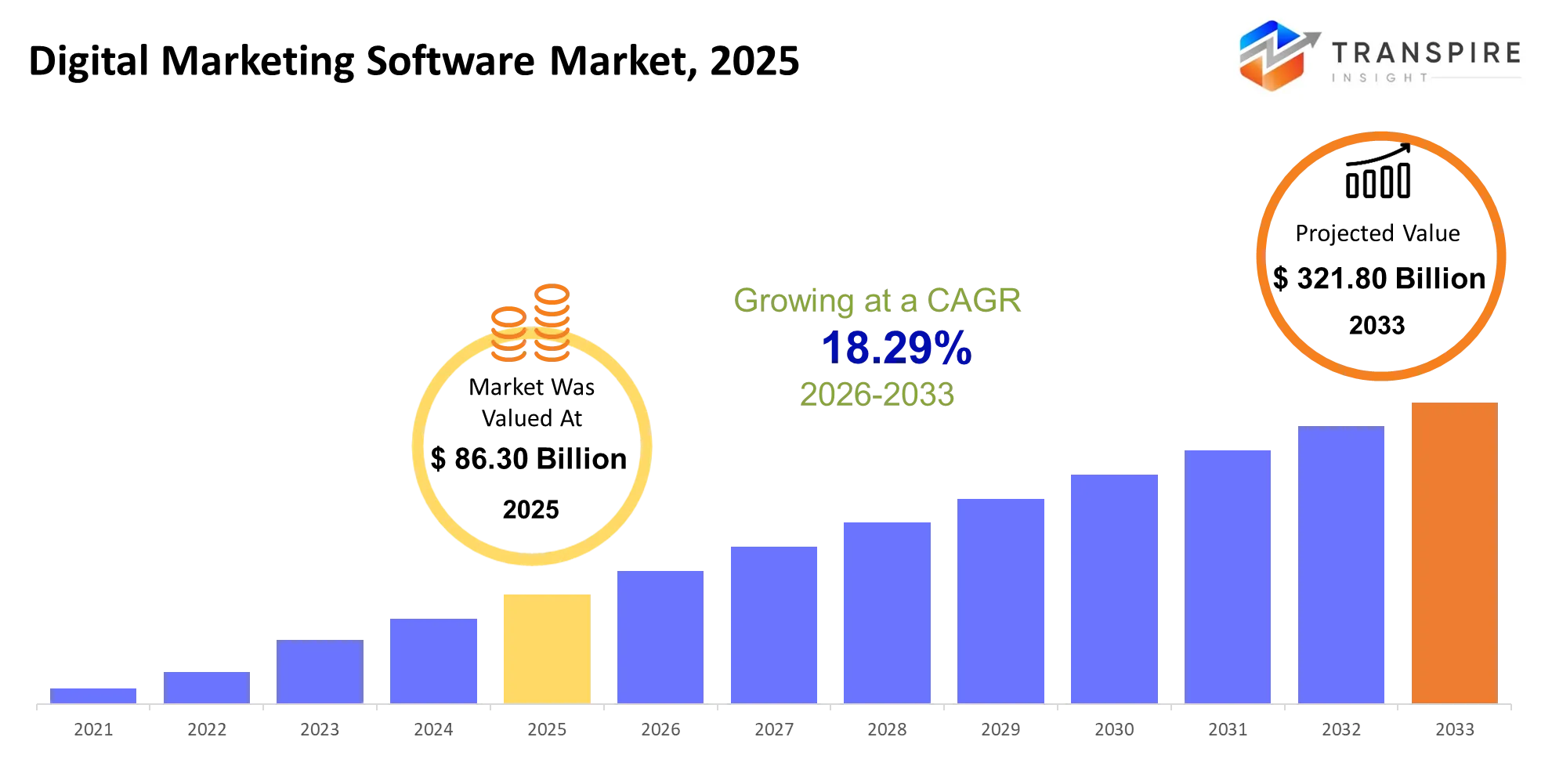
- Market Value (2025): USD 86.30 Billion.
- Expected Market Value (2026): USD 99.30 Billion.
- Estimated Market Value (2033): USD 321.80 Billion.
- Forecast CAGR (2026–2033): 18.29%
- Leading Region in 2025: North America
- Second-largest Region: Asia Pacific
- Fastest Growing Region: Europe
Introduction
The Digital Marketing Software (DMS) market consists of all aspects of the business of developing and using online software solutions that are utilized by companies to plan, implement, automate and analyze their marketing campaigns through digital channels such as email, social networks, and search engines. Digital marketing software includes the tools and systems that can be used by businesses to plan, implement, manage, analyze and optimize their online marketing efforts via different digital channels such as search engines, social media, emails, and websites. The use of digital marketing software helps a lot in terms of operational and strategic advantages because it offers automation, targeting, analytics, personalization, and omnichannel capabilities. Automation ensures that repetitive tasks such as emails and social media posting become easier, thus increasing efficiency and effectiveness in marketing campaigns. Targeting through software allows for better targeting as real-time and zero-party data help identify different segments based on behavior and other related factors. Analytics provide insights into how the campaign is doing and what kind of results are being achieved. Personalization through the use of AI ensures that personalized messages and offers are delivered effectively to customers.
For instance:- The Asia Pacific Digital Marketing Software Market is dominated by Regional Investments in Mobile Commerce, Smartphone Penetration, and E-Commerce Growth across China, India, and ASEAN; Organizations are increasingly embracing sophisticated cloud and AI-based marketing software solutions for more customized interactions with customers.
Market Highlights: -
- North America is anticipated to hold almost 36% share of the Digital Marketing Software Market over the predicted timeframe.
- Asia Pacific is expected to grow at a rapid CAGR in the Digital Marketing Software Market by holding almost 30% of the share during the forecast period.
- Europe is anticipated to hold almost 28% share of the Digital Marketing Software Market over the predicted timeframe.
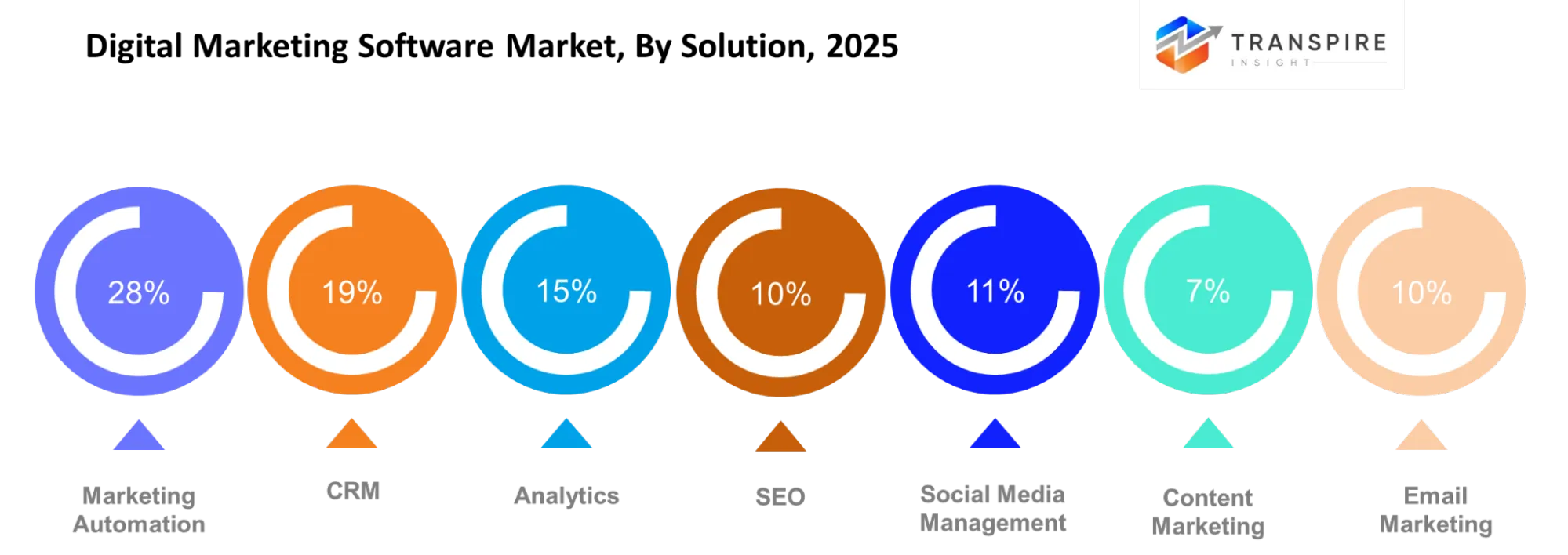
- By solution, the CRM segment dominated the market and holds nearly 22% share in 2025 and is projected to grow at a substantial CAGR during the forecast period.
- By application, the Campaign Management segment dominated the market and holds nearly 28% share in 2025 and is projected to grow at a substantial CAGR during the forecast period.
- By end user, the BFSI segment dominated the market and holds nearly 25% share in 2025 and is projected to grow at a substantial CAGR during the forecast period.
- Through the RAMP Programme, the TEAM Initiative has been initiated by the Ministry of MSME in India to assist Micro and Small Enterprises in utilizing ONDC for digital commerce. The initiative facilitates digital cataloging and account management support to these companies, thereby enhancing their online presence, customer engagement, digital marketing practices, and technology usage.
How is Technology Driving Growth in the Digital Marketing Software Market?
The Digital Marketing Software Market is experiencing a profound technological revolution with the advent of Artificial Intelligence (AI), Machine Learning (ML), advanced analytics, cloud computing, and the emergence of integrated client engagement platforms. AI and ML aid in the automation of marketing processes, forecasting, and customization of communications with customers. In turn, Big Data technologies provide the processing of vast data sets for segmentation, campaign planning, and message formats. Furthermore, cloud solutions provide flexibility due to the scalability, low-cost, and accessibility of the marketing software. Moreover, the omnichannel and CRM integration allows the consolidation of customer information that is scattered across various channels, such as email, social networks, and websites, and provides the opportunity to analyze the customer's journey.
|
Report Metrics |
Details |
|
Market size value in 2025 |
USD 86.30 Billion |
|
Market size value in 2026 |
USD 99.30 Billion |
|
Revenue forecast in 2033 |
USD 321.80 Billion |
|
Growth rate |
CAGR of 18.29% from 2026 to 2033 |
|
Base year |
2025 |
|
Historical data |
2021 - 2024 |
|
Forecast period |
2026 - 2033 |
|
Report coverage |
Revenue forecast, competitive landscape, growth factors, and trends |
|
Regional scope |
United States; Canada; Mexico; United Kingdom; Germany; France; Italy; Spain; Denmark; Sweden; Norway; China; Japan; India; Australia; South Korea; Thailand; Brazil; Argentina; South Africa; Saudi Arabia; United Arab Emirates |
|
Key company profiled |
Adobe, Salesforce, HubSpot, Oracle, SAP, Microsoft, Google, Adobe Marketo, Hootsuite, Sprinklr, Semrush, Mailchimp, Klaviyo, Constant Contact, ActiveCampaign |
|
Customization scope |
Free report customization (country, regional & segment scope). Avail customized purchase options to meet your exact research needs. |
|
Report Segmentation |
By Solution (Marketing Automation, CRM, Analytics, SEO, Social Media Management, Content Marketing, Email Marketing, Others); By Deployment (Cloud, On-premise, Hybrid, SaaS, Private Cloud, Public Cloud, Hosted, Others); By Application (Lead Generation, Customer Acquisition, Campaign Management, Brand Management, Customer Engagement, Conversion Optimization, Retention, Others); By Enterprise Size (Large Enterprises, SMEs, Startups, Mid-sized, Multinationals, Agencies, Government, Others); By Channel (Search, Social Media, Email, Display, Video, Mobile, Affiliate, Others); By End User (Retail, BFSI, Healthcare, IT & Telecom, Manufacturing, Media, Education, Others); By Pricing Model (Subscription, Freemium, Usage-based, Per-user, License, Performance-based, Enterprise, Others) |
Market Drivers
The expansion of the Digital Marketing Software Industry is fueled by the demand for data-centric personalization, which allows organizations to utilize customer data platforms, instant analytics, and focused messaging. AI and automation are changing the course of marketing operations by simplifying repetitive activities, predicting customer behavior, and enhancing the trajectory of customers. The increasing adoption of digitalization, higher penetration of smartphone usage, wider access to the internet, and e-commerce evolution are pushing advertising spending to digital media. In addition, the rise of cloud marketing solutions is due to their flexibility, scalability, and cost-efficiency in the implementation of omnichannel campaigns. These trends lead to the increased use of digital marketing tools by firms, enhancing their advertising campaigns, boosting customer engagement, and contributing to the industry's development. Digital marketing software is changing the modern marketing operations due to automation, accurate targeting, measurable outcomes, and campaign management. Automation eliminates repetitive tasks such as email marketing, social media scheduling, lead nurturing, and customer engagement. AI-driven targeting and customer intelligence platforms help businesses to segment customers, tailor offerings, and create appropriate messages through the digital channels. Predictive analytics make it possible to obtain up-to-date information regarding campaigns’ performance, conversion rate, customer acquisition cost, and marketing ROI, which helps businesses make data-driven decisions. Finally, scalable cloud-based platforms will allow small and medium businesses to run campaigns in different markets without huge investments in infrastructure and speed up their digital transformation.
For Instance: -
- The digital marketing software ecosystem in Russia is currently experiencing a structural shift towards domestic technology ecosystems such as Yandex and VK after the exit of Western providers. The investments in the industry are mostly channeled towards AI-powered advertising automation, programmatic platforms for the Russian market, and the integration of e-commerce media.
- Europe Digital Marketing Software Market investments within Europe are increasing at an incredible rate, where the leading economies include Germany, the UK, and France, focusing on cloud-based solutions and artificial intelligence applications.
Restrain
There are many restrictions faced by the Digital Marketing Software Market in terms of cybersecurity and privacy risks with personal information. The high integration and maintenance costs lead to added complexities in the IT systems, and click fraud reduces the effectiveness of advertising, as well as profit. A shortage of skilled workers has also hindered the usage of advanced solutions. High levels of competition and market saturation have made it hard for suppliers to sell their services as the clients have become wary.
|
Driver |
Relative Impact on Growth (%) |
Geographic Relevance |
Impact Timeline |
Demand Strength |
Growth Mechanism |
Key Beneficiaries |
Major Constraint |
|
AI-Powered Marketing Automation and Agentic AI |
27% |
North America, Europe, Asia-Pacific |
Short-term |
High |
Automates campaigns, decisions, optimization, and customer interactions |
Software vendors, AI providers, enterprises, marketing agencies |
Data quality and AI implementation costs |
|
Data-Driven Personalization and Customer Intelligence |
24% |
North America, Europe, Asia-Pacific |
Short-term |
High |
Improves targeting, segmentation, personalization, and conversion efficiency |
CRM vendors, CDP providers, retailers, advertisers |
Fragmented data and privacy requirements |
|
Cloud Adoption and Omnichannel Marketing Integration |
20% |
North America, Europe, Asia-Pacific |
Medium-term |
High |
Unifies customer journeys across digital marketing channels |
Cloud vendors, SaaS providers, enterprises, agencies |
Integration complexity and cybersecurity risks |
|
Digital Commerce, Social Media, and Mobile Adoption |
17% |
Asia-Pacific, North America, Europe |
Short-term |
High |
Expands digital touchpoints, advertising demand, and customer acquisition |
E-commerce firms, social platforms, marketers, SMEs |
Platform dependency and advertising fraud |
|
SME Digitalization and Government-Supported Market Access |
12% |
Asia-Pacific, Latin America, Middle East & Africa |
Medium-term |
Medium |
Expands software adoption through digital commerce enablement |
SaaS vendors, SMEs, ONDC partners, agencies |
Limited budgets and digital skills shortages |
Analysis of Prices and Consumer Behaviour
In the digital marketing software market, CRM software is leading with a share of 22.4% in overall market revenue for 2025 (primarily due to the high demand for managing customer information, personalized interaction, marketing automation and possibilities of integrated customer relationship). Software available on cloud is accounting for around 71.4% of the market revenue due to advantages of scalability, easy access, fast deployment and few infrastructure requirements. The BFSI industry represents around 21.6% of revenues due to the high need for customized interaction with customers, digital customer acquisition, retention and data-enabled marketing. The purchasing behavior of companies shows that the criteria for choosing the software solution are defined by scalability, automation, analytics, system integration and data safety. The purchases are increasingly made through subscription formats, as they are affordable in terms of technology costs, provide endless updates to the platforms, scalability of functions and uninterrupted access to the software.
|
Investment Factor |
Why It Matters to Investors |
Opportunity |
Investment Implication |
|
AI-Powered Marketing Automation & Agentic AI |
AI adoption is reshaping marketing workflows and spending |
Agentic campaigns, autonomous optimization, AI content, predictive marketing |
Prioritize scalable AI-native platforms with recurring software revenue |
|
Real-Time Personalization & Customer Intelligence |
Personalization increasingly influences customer engagement and conversion |
CDPs, predictive analytics, behavioral segmentation, next-best-action engines |
Invest in unified-data platforms enabling personalized customer journeys |
|
Recurring SaaS Revenue & Platform Consolidation |
Subscription models support predictable, scalable revenue generation |
Integrated CRM, automation, analytics, content, and customer-data platforms |
Favor platforms expanding customer lifetime value through cross-selling |
|
Generative Search, AEO & Digital Discovery |
AI search is changing how customers discover brands |
AEO, GEO, AI visibility, content optimization, conversational search analytics |
Target solutions adapting marketing measurement to AI-driven discovery |
|
SME Digitalization & Emerging-Market Expansion |
Digitization is widening software adoption beyond large enterprises |
Affordable SaaS, localized platforms, ONDC-enabled commerce, SMB marketing tools |
Expand through scalable low-cost offerings across emerging economies |
|
Enterprise Data Integration & Privacy-Centric Marketing |
Fragmented data limits AI effectiveness and personalization |
CDP integration, first-party data, governance, privacy-focused analytics |
Back interoperable platforms solving data quality and compliance challenges |
Who are the Key Players in the Digital Marketing Software Market and how do they compete?
Competitiveness in the international market concerning digital marketing software is predicated upon organizations specializing in AI technologies, industry-specific solutions, and development of integrated marketing solutions globally. This way of competition enables firms to compete not only in terms of pricing but also with regard to marketing automation, customer analytics, personalization, omnichannel engagement, and CRM integration.
In its turn, Adobe creates its competitive advantage by offering intelligent marketing solutions, analytics, and integrated customer experience platforms. The process of marketing automation, CRM development, and implementation of knowledge-based customer engagement solutions helps companies achieve the required level of competitiveness. Salesforce establishes a robust position in the market by providing its clients with integrated marketing solutions.
Top Companies in the Digital Marketing Software Market
- Adobe
- Salesforce
- HubSpot
- Oracle
- SAP
- Microsoft
- Adobe Marketo
- Hootsuite
- Sprinklr
- Semrush
- Mailchimp
- Klaviyo
- Constant Contact
- ActiveCampaign
|
Company |
Est. Revenue Share Range |
Key Offerings |
Strategic Positioning |
Geographic Strength |
Technology Focus |
|
Adobe Inc. |
10–14% |
Adobe Experience Cloud, Adobe Experience Platform, Adobe Journey Optimizer, Marketo Engage |
Integrated enterprise experience-platform strategy |
North America, Europe, Asia-Pacific |
AI-driven personalization, CDP, journey orchestration, analytics |
|
Salesforce Inc. |
9–13% |
Agentforce Marketing, Marketing Cloud Next, Data 360, Account Engagement |
AI-led CRM and marketing ecosystem integration |
North America, Europe, Asia-Pacific |
Agentic AI, CDP, automation, real-time personalization |
|
Oracle Corporation |
5–8% |
Eloqua Marketing Automation, Responsys, Unity CDP, Fusion Marketing |
Enterprise marketing automation and data integration |
North America, Europe, Asia-Pacific |
AI, CDP, marketing automation, customer intelligence |
|
HubSpot, Inc. |
4–7% |
Marketing Hub, Content Hub, CRM, Operations Hub |
Integrated inbound marketing and CRM platform |
North America, Europe, Asia-Pacific |
AI, automation, CRM, content intelligence |
|
Microsoft Corporation |
4–7% |
Dynamics 365 Customer Insights, Customer Insights–Journeys, Copilot |
Enterprise ecosystem and Microsoft-stack integration |
North America, Europe, Asia-Pacific |
Copilot AI, CDP, journey orchestration, analytics |
|
SAP SE |
3–5% |
SAP Engagement Cloud, SAP Emarsys, Customer Data solutions |
Enterprise customer-experience and commerce integration |
Europe, North America, Asia-Pacific |
AI, customer data, personalization, omnichannel engagement |
|
Google LLC |
3–5% |
Google Marketing Platform, Analytics 360, Campaign Manager 360, Display & Video 360 |
Data-driven advertising and measurement ecosystem |
North America, Europe, Asia-Pacific |
AI, advertising analytics, audience intelligence, automation |
|
Intuit Inc. (Mailchimp) |
2–4% |
Mailchimp Marketing Platform, Customer Journey Builder, Email Marketing, Analytics |
SMB-focused multichannel marketing platform |
North America, Europe, Asia-Pacific |
AI, marketing automation, predictive analytics, CRM |
|
Klaviyo, Inc. |
2–4% |
Klaviyo Marketing Platform, CDP, Email, SMS, B2C CRM |
Customer-data-driven commerce marketing specialization |
North America, Europe, Asia-Pacific |
AI, predictive analytics, CDP, personalized automation |
|
Sprinklr, Inc. |
1–3% |
Sprinklr Service, Social, Insights, Marketing |
Unified customer-experience and social engagement platform |
North America, Europe, Asia-Pacific |
AI, social listening, conversational analytics, automation |
Market Segmentation
The Digital Marketing Software Market share is divided into seven categories: By solution, deployment, application, enterprise size, channel, end user and pricing model.
The CRM dominated the market, accounting for nearly 22% in 2025 and is expected to rise at a significant CAGR during the forecast period.
The Digital Marketing Software Market is segmented by solution into Marketing Automation, CRM, Analytics, SEO, Social Media Management, Content Marketing, Email Marketing, Others. Among these, the CRM segment dominated the market, accounting for nearly 22% in 2025 and expected to increase at a significant CAGR during the forecast period. In 2025, the market was led by the CRM sector owing to the factors like centralizing consumer communications, streamlining sales processes, increasing visibility through better data access, increasing retention of customers, etc. The increased demand for digital interaction, customized customer experience, importance of data-driven decisions, and company operations is likely to maintain the growth of the CRM market in the coming years.
The Campaign Management dominated the market, accounting for nearly 28% in 2025, and is expected to rise at a significant CAGR during the forecast period.
The Digital Marketing Software Market is segmented by application into Lead Generation, Customer Acquisition, Campaign Management, Brand Management, Customer Engagement, Conversion Optimization, Retention, Others. Among these, the Campaign Management segment dominated the market, accounting for nearly 28% in 2025 and expected to increase at a significant CAGR during the forecast period. The Campaign Management sector dominated the market in 2025, owing to the rising requirement for automated data-driven strategies for marketing in the digital space. It enables efficient campaign preparation and execution through customer segmentation and targeting, monitoring, and real-time optimization, which helps engagement and marketing efficiency.
The BFSI dominated the market, accounting for nearly 25% in 2025 and is expected to rise at a significant CAGR during the forecast period.
The Digital Marketing Software Market is segmented by end user into Retail, BFSI, Healthcare, IT & Telecom, Manufacturing, Media, Education, Others. Among these, the BFSI segment dominated the market, accounting for nearly 25% in 2025 and expected to increase at a significant CAGR during the forecast period. In 2025, the BFSI sector led the market since more banks and other financial organizations are using digital banking platforms, personalized customer outreach, and automated services. Various financial companies are leveraging different advanced technologies and effective practices to optimize customer communication, enhance retention rates, and increase efficiency in the operational processes.
Regional Segment Analysis of the Digital Marketing Software Market:
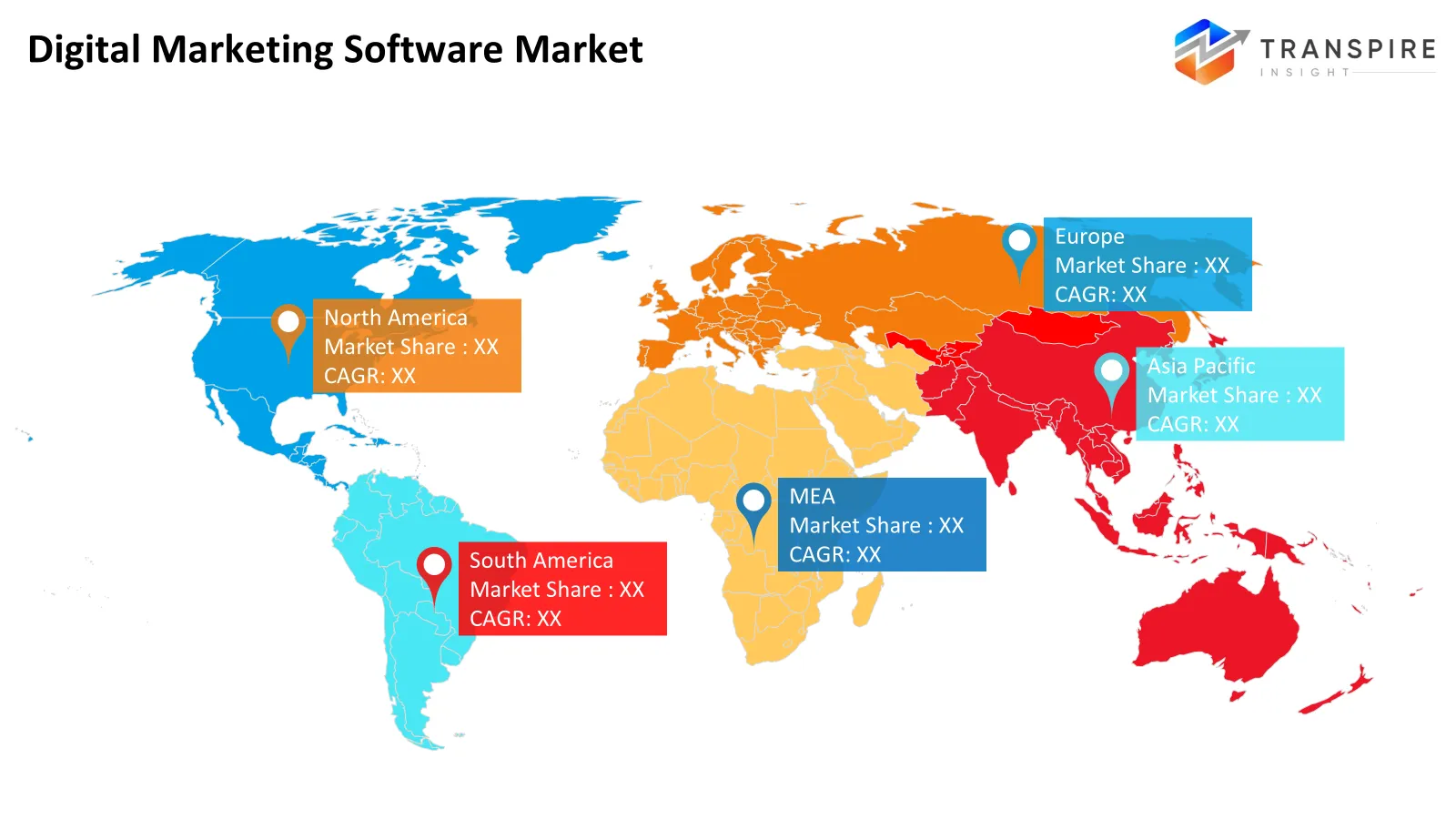
- North America (U.S., Canada, Mexico)
- Europe (Germany, France, U.K., Italy, Spain, Rest of Europe)
- Asia-Pacific (China, Japan, India, Rest of APAC)
- South America (Brazil and the Rest of South America)
- The Middle East and Africa (UAE, South Africa, Rest of MEA)
North America is the fastest-growing region in the Digital Marketing Software Market during the period, holding almost 36% share.
North America is expected to grow at a rapid CAGR in the Digital Marketing Software Market holding almost 36% share during the forecast period. North America has emerged as the fastest growing region in the Digital Marketing Software Market, driven by superior digital infrastructure, strong adoption of enterprise technology, and considerable demand for data-driven marketing solutions. The large-scale use of AI-based analytics, marketing automation, customization of the customer experience, and multiple-channel engagement provides businesses with opportunities to improve their campaigns and enhance acquisition and efficiency in the marketing process.
Asia Pacific is the fastest-growing region in the Digital Marketing Software Market during the period, holding almost 30% share.
Asia pacific is the fastest-growing region in the Digital Marketing Software Market during the forecast period, holding almost 30% share during the forecast period. Asia Pacific constitutes a rapidly developing area of the Digital Marketing Software Market mainly due to increasing digitalization in the region, growing ecosystems of e-commerce, more advanced internet usage, as well as a larger number of companies employing marketing automation tools. Rising investments in artificial intelligence-based analytics, personalized interaction with consumers, social media marketing, and omnichannel strategies are reinforcing the demand for flexible digital marketing solutions among various businesses in the region.
Europe is expected to grow at a rapid CAGR in theDigital Marketing Software Market, holding almost 28% of the share during the forecast period.
Europe is expected to grow at a rapid CAGR in the Digital Marketing Software Market holding almost 28% share during the forecast period. Europe will register impressive growth in its Digital Marketing Software Market with strong digital transformation, advanced enterprise marketing capabilities, and automation and analytics services. As businesses in Europe increasingly emphasize on customer engagement, omnichannel marketing, AI-based campaign optimization and data-driven techniques to better their marketing efforts, the demand for advanced digital marketing solutions continues to grow.
Strategies for Market Growth in Non-Leading Regions:
Small and medium-sized enterprises can benefit from the introduction of digital marketing software platforms that aid in the economic development of remote regions of the world. Implementation of digital marketing solutions on the spot, as well as developing regional software capability requirements will allow lessening technology dependence and marketing expenditures as a whole. Building strategic partnerships with regional companies, advertising companies, stt technology suppliers and distribution services will increase market penetration for digital marketing software manufacturers. Educational activities and training will also be needed to raise awareness about marketing automation, customer analytics, AI-humanized personalization, campaign management and omnichannel engagement. Furthermore, flexible subscription plans, long-term business contracts and managed services will make digital marketing solutions more affordable for enterprises and promote their usage within the companies. Collaborating with governmental and non-governmental initiatives in technology and digital marketing as well as implementing digital sales will make digital marketing programs available in a broader sense and enable sustainable growth in less developed regions of the world.
Future Market Trends for the Digital Marketing Software Market: -
- Content Creation & Operations through Generative AI Technology: Companies are employing built-in generative AI engines to step up content production, perform instant testing of campaigns and manage the pricing of advertising in real time.
- AEO (Answer Engine Optimization): As consumers turn to chatbots over traditional search engines, the industry is shifting towards assisting brands in maintaining structured hubs of topics as well as conversational answers.
- Importance of Zero-Party Data in Terms of Privacy: Due to the high degree of regulation, zero-party information (deliberately given by consumers) and other forms of value exchange with the customers have become crucial for personalization.
- Striving for Effective Revenue Attribution: Incorrect data is today exchanged for seamless revenue attribution that links marketing effectiveness to corporate valuation and ROIs.
Recent Development
- In April 2026: The GrowthLoop introduced its Composable AI Decisioning software that facilitates real-time allocation and optimization of campaigns using artificial intelligence. This cloud-based software enhances marketing automation, personalization, customer segmentation, and omnichannel engagement. This technology advancement aids data-driven decision-making and is an example of increasing usage of artificial intelligence technology in the Digital Marketing Software Market.
- In June 2026: Brand Visibility by Adobe is a new AI-driven solution that helps measure and optimizes brand visibility on AI discovery platforms such as ChatGPT, Microsoft Copilot, and Perplexity AI. It enables Generative Engine Optimization, content optimization, competitor analysis, and customer engagement. This enhances the AI capabilities of digital marketing within the developing Digital Marketing Software Market.
- In July 2026: Agentforce Commerce from Salesforce was enhanced by incorporating AI to enable agentic commerce, personalization, customer engagement, and workflow automation. The advancements made in search functionality, integration into the customer journey, and merchant automation improve digital marketing capabilities through various channels. Such enhancements help improve marketing automation, omnichannel engagement, personalized customer experience, and data-based decision-making in the developing Digital Marketing Software Market.
This study forecasts revenue at global, regional and country levels from 2020 to 2033. Transpire Insight has segmented the Digital Marketing Software Market based on the below-mentioned segments:
Digital Marketing Software Market, By Solution
- Marketing Automation
- CRM
- Analytics
- SEO
- Social Media Management
- Content Marketing
- Email Marketing
- Others
Digital Marketing Software Market, By Deployment
- Cloud
- On-premise
- Hybrid
- SaaS
- Private Cloud
- Public Cloud
- Hosted
- Others
Digital Marketing Software Market, By Application
- Lead Generation
- Customer Acquisition
- Campaign Management
- Brand Management
- Customer Engagement
- Conversion Optimization
- Retention
- Others
Digital Marketing Software Market, By Enterprise Size
- Large Enterprises
- SMEs
- Startups
- Mid-sized
- Multinationals
- Agencies
- Government
- Others
Digital Marketing Software Market, By Channel
- Search
- Social Media
- Display
- Video
- Mobile
- Affiliate
- Others
Digital Marketing Software Market, By End User
- Retail
- BFSI
- Healthcare
- IT & Telecom
- Manufacturing
- Media
- Education
- Others
Digital Marketing Software Market, By Pricing Model
- Subscription
- Freemium
- Usage-based
- Per-user
- License
- Performance-based
- Enterprise
- Others
By Regional Analysis
North America
- US
- Canada
- Mexico
Europe
- Germany
- UK
- France
- Italy
- Spain
- Russia
- Rest of Europe
Asia Pacific
- China
- Japan
- India
- South Korea
- Australia
- Rest of Asia Pacific
South America
- Brazil
- Argentina
- Rest of South America
Middle East & Africa
- UAE
- Saudi Arabia
- Qatar
- South Africa
- Rest of the Middle East & Africa
Frequently Asked Questions
Find quick answers to common questions.
The Digital Marketing Software Market is valued at approximately USD 86.30 billion in 2025, reflecting strong technology adoption.
AI automation, personalization, cloud adoption, analytics, omnichannel marketing, e-commerce expansion, and increasing digitalization are driving market growth globally.
CRM dominates the market, accounting for nearly 22% in 2025, supported by customer data management, personalization, and marketing automation.
North America leads the market, supported by advanced digital infrastructure, enterprise technology adoption, AI analytics, automation, and data-driven marketing solutions.
The market is projected to expand at a CAGR of 18.29% from 2026 to 2033, reaching USD 321.80 billion.
- Adobe
- Salesforce
- HubSpot
- Oracle
- SAP
- Microsoft
- Adobe Marketo
- Hootsuite
- Sprinklr
- Semrush
- Mailchimp
- Klaviyo
- Constant Contact
- ActiveCampaign
About the Authors

Mayur Shinde
I am Mayur Shinde, a Senior Research Analyst at Transpire Insight, specializing in the Automotive & Transportation and Information & Communication Technology (ICT) Industry. My work focuses on analyzing emerging market trends, technological advancements, competitive landscapes, and industry developments to deliver accurate, data-driven insights. I am passionate about transforming complex market information into clear, actionable content that helps businesses, professionals, and decision-makers stay informed and make confident strategic decisions.

Chakradhar Khansole
Chakradhar serves as the Research Director at Transpire Insight, bringing over 8 years of experience in technology, innovation, and strategic market intelligence. He specializes in transforming complex market data into actionable business insights that enable organizations to make informed, growth-oriented decisions. Recognized for his strategic vision and analytical expertise, Chakradhar leads high-impact research initiatives, delivering comprehensive market assessments, competitive intelligence, and forward-looking industry analysis.
Recently Published Reports
-
Apr 2026
3D Optical Profiler Market
3D Optical Profiler Market Size, Share & Analysis Report By Type (Desktop 3D Optical Profiler, and Portable 3D Optical Profiler), By Technology (Confocal Technology, and White Light Interference), By End-Use Industry (Manufacturing, Research Institutions, Automotive, Aerospace and Defense, Medical Devices, and Other), and Geography (North America, Europe, Asia-Pacific, Middle East and Africa, South and Central America), 2021 - 2031
-
Apr 2026
Depth Sensor Market
Depth Sensor Market Size, Share & Analysis Report By Type (Infrared Depth Sensors, Time-of-Flight (ToF) Sensors, Stereo Vision Sensors, Structured Light Sensors, Ultrasonic Depth Sensors), By Application (Automotive, Robotics, Gaming, Consumer Electronics, Industrial Automation, Healthcare, Security & Surveillance, Others), By End Users (Automotive Manufacturers, Consumer Electronics Companies, Healthcare Providers, Industrial Companies, Security Agencies, Gaming Companies, Robotics Companies, Others), and Geography (North America, Europe, Asia-Pacific, Middle East and Africa, South and Central America), 2021 – 2031
-
Apr 2026
Digital Manufacturing Market
Digital Manufacturing Market Size, Share & Analysis Report By Component (Hardware, Software, and Services), By Technology (Robotics, 3D Printing, Internet of Things (IoT), and Others), By Application (Automotive and Transportation, Aerospace and Defense, Consumer Electronics, Industrial Machinery, and Others), By Process Type (Computer-Based Designing, Computer-Based Simulation, Computer 3D Visualization, Analytics, and Others), and Geography (North America, Europe, Asia-Pacific, Middle East and Africa, South and Central America), 2021 – 2031
-
Apr 2026
Digital Visa Services Market
Digital Visa Services Market Size, Share & Analysis Report By Type (Individual Travelers, Group Travelers), By Application (Tourism, Business Travel, Others), and Geography (North America, Europe, Asia-Pacific, Middle East and Africa, South and Central America), 2021 – 2031