

HealthcareFinance And Accounting Outsourcing Market Summary:
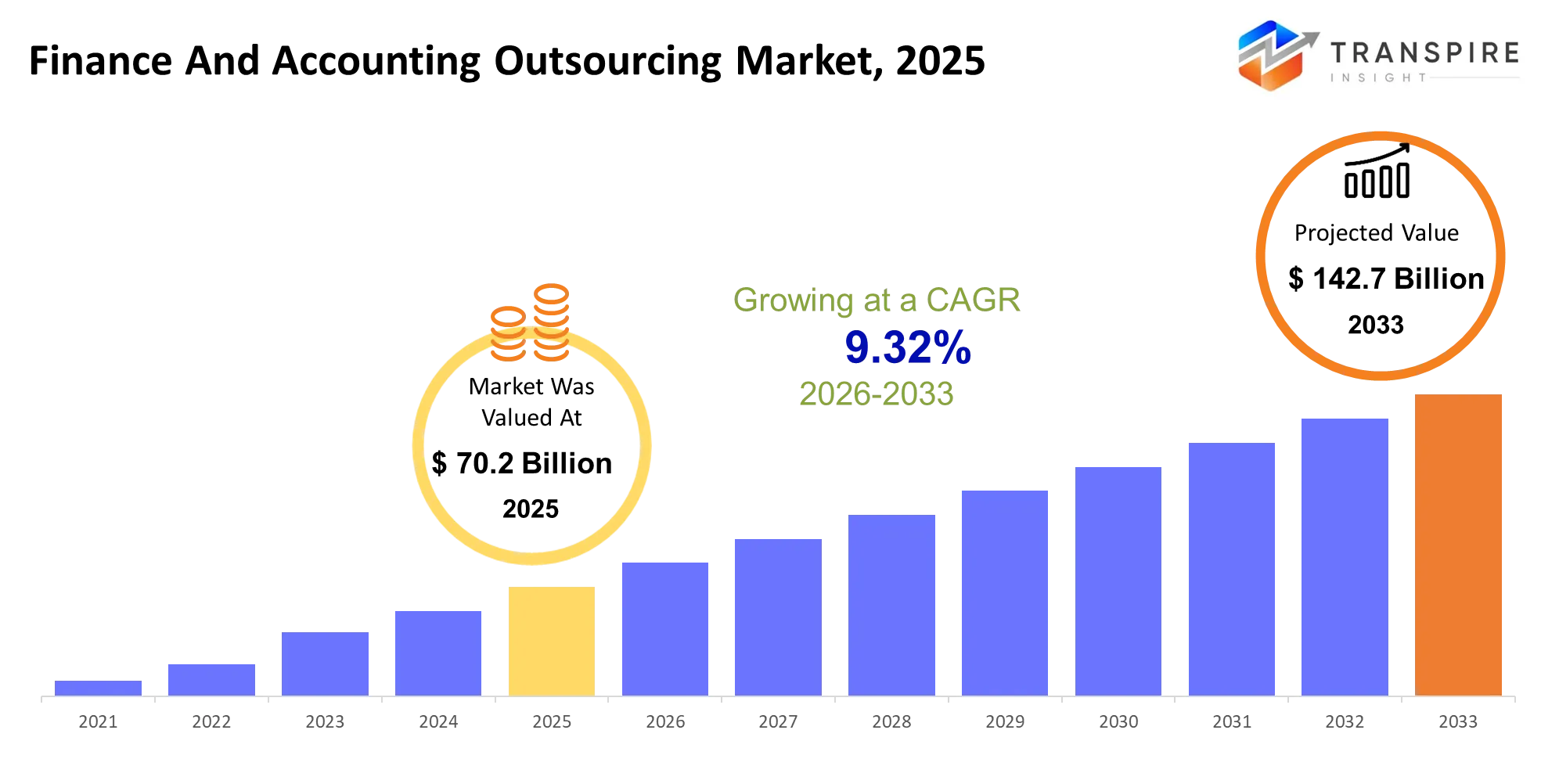
As per the Transpire Insight Analysis, The Finance and Accounting Outsourcing Market size is estimated at USD 70.2 billion in 2025 and is anticipated to reach USD 142.7 billion by 2033, growing at a CAGR of 9.32% from 2026 to 2033.
finance and accounting outsourcing (FAO) shifts transactional finance activities, such as bookkeeping, payroll, tax compliance, invoicing, reconciliation, reporting, and audit support, to a dedicated service provider. The market has shifted to technology-led finance over the last 3–5 years, accounting for the majority of work performed through standard FAO pathways. Automation of the workflows is being driven by tools like artificial intelligence, robotic process automation, cloud ERP integration, and analytics. One large shift is the growing use of artificial intelligence by providers for everything from anomaly detection, cash application, reconciliation, and predictive cash-flow forecasting to automated financial commentary-all while moving beyond manual-only processing. A real-world trigger has been the growth of e-invoicing and real-time tax-reporting mandates in more than 80 countries-demanding compliant, technology-led tax and invoice processing for multinationals. Higher market growth is also driven by continued accounting skills shortages and the rise in compliance complexity, which drive the cost of maintaining in-house finance functions. Third-party providers utilizing automation platforms and delivery models can address process volume, reporting accuracy, and channel internal people to planning, control, and decision-making support.
Finance And Accounting Outsourcing Market Size & Forecast:
- Market Size 2025: USD 70.2 Billion
- Expected Market Value (2033): USD 142.7 Billion
- Forecast CAGR (2026–2033): 9.32%
- Leading Region in 2025: North America
- Fastest Growing Region: Asia Pacific
- Key Company Profiles: Accenture, Genpact, WNS, Wipro, Infosys, Tata Consultancy Services, Cognizant, Capgemini, IBM, HCLTech, EXL, Sutherland, RSM International, Deloitte, PwC.
Key Finance And Accounting Outsourcing Market Insights:
The buyer is moving from offshore capacity to accountable, AI-driven finance operations. Providers’ moves focus on predictive insights, cash recovery, and compliance-ready delivery.
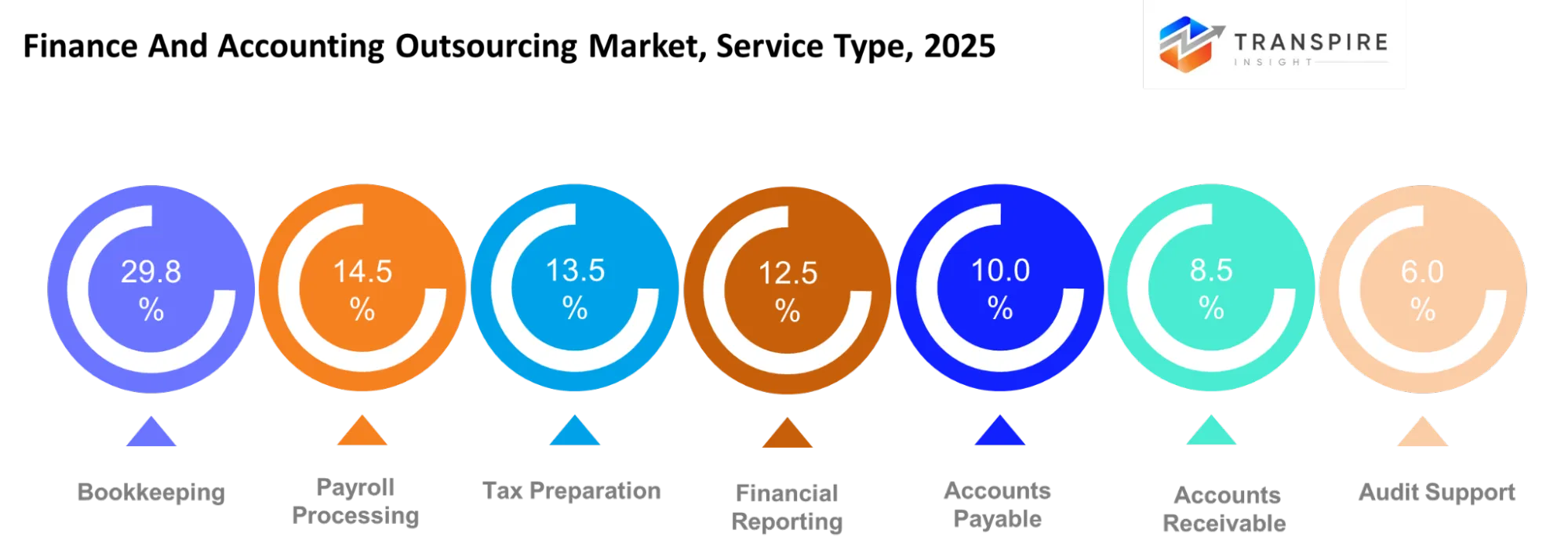
- The bookkeeping and accounting leads at 29.8% are ledgers being automated for coding, reconciling, and handling exceptions.
- AI/RPA-driven services are growing at 10.9% CAGR, as they're transitioning to agentic, multi-step finance processes.
- Genpact is differentiating itself with its AI Gigafactory and agentic AP Suite, which focus on production-level automation, not pilots.
- HCLTech is further reinforcing its record-to-report and tax services using its ReOps framework, predictive GL coding and automation centres of excellence.
- Infosys is enhancing AI agents, analytics and cloud ERP partnerships to drive fast reporting and FP&A delivery.
- Accenture is launching outcome-based pricing, agentic AI platforms and private-equity/mid-market finance solutions.
- By shifting from transactional processing to forecasting, profitability analysis, and executive decision support, WNS is striving to become more than just another solution. WNS is working to go beyond transactional processing to forecasting, profitability analytics, and executive decision support.
- Cloud-based deployment is at 61.2% of the adoption, allowing for unified delivery, automation, and analytics.
- Asia Pacific is the fastest-growing region with an 11.8% CAGR, owing to scalable delivery hubs and the swift digital-finance adoption rate.
What are the Key Drivers, Restraints, and Opportunities in the Finance And Accounting Outsourcing Market?
Driver:
The strongest growth driver is the shift from headcount-based outsourcing to AI- and RPA-enabled finance operations. Providers are deploying intelligent document processing, automated journal entries, invoice matching, reconciliations, exception handling, and predictive cash-flow models. This shift was triggered by the maturity of generative AI and agentic automation after 2024, when many providers moved from pilots to production deployment. The revenue impact is significant: clients increasingly buy outcome-based services faster closes, lower exception rates, and improved working-capital visibility rather than simply offshore labour.
Restraint:
The main restraint is weak process and data standardization. Acquirers often inherit different ERP systems, chart-of-accounts structures, and approval rules, so migration, reconciliation, and governance costs persist even after work moves externally. Sensitive payroll and financial data add security, residency, and audit requirements, slowing approvals and limiting which tasks can be transferred.
Opportunity:
The next major opportunity is “Finance-as-a-Service” built on cloud platforms and agentic AI. Instead of outsourcing individual processes, enterprises can subscribe to end-to-end workflows for procure-to-pay, order-to-cash, record-to-report, and tax compliance. Cloud-based deployment already leads adoption, while AI-enabled tax validation, e-invoicing readiness, ESG reporting, and real-time audit trails create premium service opportunities. For example, providers are combining AI, cloud ERP integration, and delivery centres to automate VAT returns, statutory filings, and cross-border tax compliance.
The impact percentages are analyst estimates of each driver’s relative contribution and sum to 100%.
|
Driver |
Relative Impact on Growth (%) |
Geographic Relevance |
Impact Timeline |
Demand Strength |
Growth Mechanism |
Key Beneficiaries |
Major Constraint |
|
AI, GenAI, and intelligent process automation |
25% |
North America, Europe, India |
Short-term (≤2 years) |
High |
Automates reconciliations, invoice handling, close, and exception workflows |
FAO providers, enterprise finance teams, automation vendors |
Legacy systems, data quality, and governance risks |
|
Cost control and scalable finance operations |
24% |
North America, Europe, Asia Pacific |
Short-term (≤2 years) |
High |
Converts fixed finance overhead into scalable service capacity |
Multinationals, midmarket firms, offshore delivery providers |
Transition costs and savings realization can disappoint |
|
Finance and accounting talent shortages |
20% |
North America, Europe; delivery hubs in India and the Philippines |
Medium-term (2–4 years) |
High |
Fills accounting, tax, analytics, and controllership skill gaps |
CFOs, shared service centers, India-based providers |
Wage inflation and attrition erode talent advantages |
|
E-invoicing, tax, and reporting compliance complexity |
18% |
Europe, Asia Pacific, Latin America, Middle East |
Short-term (≤2 years) |
High |
Outsources mandate monitoring, filings, e-invoicing, and controls |
businesses, tax specialists, compliance technology vendors |
Jurisdictional complexity and client liability exposure |
|
Demand for strategic finance and specialist services |
13% |
North America, Europe, Asia Pacific |
Medium-term (2–4 years) |
Medium |
Adds outsourced FP&A, treasury, reporting, and decision support |
CFOs, specialist BPOs, analytics and cloud-platform firms |
Sensitive data and weak integration limit adoption |
What Has the Impact of Artificial Intelligence Been on the Finance And Accounting Outsourcing Market?
AI is moving outsourced finance away from manual document processing to exception management. Optical character recognition and machine-learning models can extract fields from invoices, classify expenses, and match purchase orders. Robotic process automation can post approved transactions across multiple ERP systems. This shifts work from manual data entry to tackling tricky, disputed invoices; models can also help identify transactions, reconcile bank feeds, spot outliers, and prepare explanations for variances. Tools based on payment history can help forecast cash flow and outlier late payers, prioritise collections, and estimate risks for financial close. Analytics can help providers balance workloads, monitor service levels, and drive faster closes and greater capacity without corresponding increases in headcount.
AI still needs a human in the loop, however, as models can misread scanned documents, misclassify unfamiliar transactions, or generate unsupported explanations. Combining with legacy ERP systems and challenges around poor master data, privacy controls, and audit trails all add cost and complexity. In Deloitte's 2026 finance survey, 63% of finance leaders have adopted AI and 21% found quantifiable value, showing that implementations are outstripping benefits. Those providers that can pair automation with review, explainability, and client-specific controls could turn pilots into quality, trusted services.
In April 2026, Goldman Sachs Alternatives invested $50 million into BLP to accelerate domain-specific finance automation and agentic AI tools. This influx of late-stage capital highlights the industry's shift toward operationalizing robust, cross-platform enterprise automation that goes beyond simple OCR document extraction to execute complex, end-to-end accounting workflows. https://www.kenfromfinance.com/blog/this-week-in-finance-automation-2026-04-19
Key Finance And Accounting Outsourcing Market Trends:
The market is going from task offshoring to technology-enabled controlled outcomes. Outsourced teams are expected to deliver enhanced close quality, cash visibility, and compliance readiness more than ever before.
- From single RPA pilots to AI integration throughout procure-to-pay, record-to-report, and tax workflows.
- Agentic AI is now becoming a reality to perform multi-step activities like reconciliation, exception resolutions, journal entry generation, and compliance follow-ups.
- Businesses are being pushed toward adopting a single, API-enabled compliance solution by e-invoicing and real-time tax reporting requirements. The e-invoicing and real-time tax reporting requirements are driving firms toward a single, API-integrated compliance solution.
- Cloud is taking the place of infrastructure for scalable finance automation, analytics, and remote delivery.
- Outsourcing is moving beyond just preparing returns to include indirect-tax automation, transfer pricing, statutory filing, and cross-border compliance.
- In addition to financial statements, record-to-report services now incorporate ESG data, regulatory disclosures, and narrative reporting.
- Working-capital analytics is emerging as a high-value service, and is connecting receivables, payables, payment terms and cash forecasting.
- SMEs are looking to cloud finance services to gain enterprise-grade controls without developing large in-house teams.
- The pricing models are slowly changing from FTE-based contracts to transaction-based commercial contracts or platform-based.
- Providers are training employees in new positions such as data engineer, AI compliance advisor, process designer, and compliance specialist.
Finance And Accounting Outsourcing Market Segmentation
Service Type:
Bookkeeping & Accounting, which holds a 29.8% market share, remains in demand for ledger management, account reconciliation, and report preparation. Payroll Processing makes up 14.5%, driven by tasks like employee payments, deductions, and regulations. Tax Preparation covers 13.5%; Financial Reporting takes up 12.5%, with clients seeking timely financial statements; Accounts Payable accounts for 10.0%, and Accounts Receivable makes up 8.5%, with client teams processing outgoing payables, incoming receivables, and collections. Audit Support accounts for 6.0%; Financial Analysis comprises 5.2%, as outsourced teams provide assurance and decision support. AI/RPA-enabled financial services are projected to increase with a 10.9% CAGR, shifting repetitive processing toward exception handling, controls monitoring, and analysis.
Deployment:
Cloud-based models lead with a 61.2% share, enabling remote finance teams to work through connected systems. ERP connectivity supports transaction flows, while real-time dashboards give managers visibility into cash, close status, and exceptions. Cloud infrastructure also makes AI deployment easier to scale across workflows. SaaS and managed-service arrangements are gaining traction among SMEs seeking predictable access to finance expertise. Hybrid models suit regulated enterprises that keep sensitive workloads on-premises while moving suitable processes into secure cloud environments.
Enterprise Size:
Large enterprises and multinational corporations remain the primary buyers because they manage complex operations, multiple entities, currencies, systems, and regulatory obligations. Outsourcing helps coordinate close, payroll, tax, and reporting across markets. SMEs and startups are expanding adoption fastest as cloud-based finance and accounting outsourcing lowers the cost of professional capability without requiring a full internal department. Government agencies and nonprofits are also adopting these services gradually, responding to tighter expectations for compliance, traceability, and transparent use of funds.
End User:
BFSI is a major demand centre because reporting, auditability, and risk controls are central to its operations, with audit trails essential. Healthcare adoption is expanding around billing, claims reconciliation, and workforce payments. IT and telecom companies outsource finance tasks across subscription and geographically dispersed operations. Manufacturers and retailers use providers to coordinate high transaction volumes, supplier payables, and customer receivables. Professional services rely on billing and payroll support, while real estate and government represent smaller, compliance-led opportunities.
Service Provider:
Third-party providers and BPO firms dominate through delivery scale, specialist teams, and automation platforms that can serve multiple clients across industries and regions. Captive centres and shared service centres are increasingly combining internal control with external expertise, creating hybrid delivery models. Accounting firms compete through local tax and compliance knowledge, while consulting firms add transformation and advisory capabilities. FinTech providers differentiate through software-led workflows, integrations, and analytics; these specialised offerings can complement broader outsourcing arrangements for clients.
Technology:
AI and RPA are key engines, automating repetitive finance tasks and routing exceptions for human review. Cloud computing connects distributed teams and systems, while analytics and machine learning support forecasting, anomaly detection, and workload prioritization. OCR extracts invoice and receipt data, reducing manual entry. AI/RPA-enabled services are projected to grow at a 10.9% CAGR, reflecting movement toward intelligent automation. Blockchain remains an emerging option for records and reliable audit trails, rather than a mainstream transaction-processing layer in outsourcing.
What are the Key Use Cases Driving the Finance And Accounting Outsourcing Market?
The core use case is bookkeeping and accounting, leading at 29.8%. Providers maintain ledgers, reconcile accounts, close books, and report accurately. This gives SMEs records without an internal team, while multinationals use delivery centres during peaks.
Expanding applications include payroll, tax preparation, accounts payable and receivable. Healthcare teams reconcile claims and payroll; retailers match invoices and collections; manufacturers connect purchasing, inventory receipts and supplier payments. Reporting and audit support meet lender and board deadlines.
Emerging uses link AI/RPA-enabled services, growing at 10.9% CAGR, with exception management, cash forecasting, e-invoice compliance and control monitoring. Providers use OCR, analytics and human review to flag anomalies, prioritise collections and prepare data for reporting.
|
Report Metrics |
Details |
|
Market size value in 2025 |
USD 70.2 Billion |
|
Market size value in 2026 |
USD 76.5 Billion |
|
Revenue forecast in 2033 |
USD 142.7 Billion |
|
Growth rate |
CAGR of 9.32% from 2026 to 2033 |
|
Base year |
2025 |
|
Historical data |
2021 - 2024 |
|
Forecast period |
2026 - 2033 |
|
Report coverage |
Revenue forecast, competitive landscape, growth factors, and trends |
|
Regional scope |
United States; Canada; Mexico; United Kingdom; Germany; France; Italy; Spain; Denmark; Sweden; Norway; China; Japan; India; Australia; South Korea; Thailand; Brazil; Argentina; South Africa; Saudi Arabia; United Arab Emirates |
|
Key companies profiled |
Accenture, Genpact, WNS, Wipro, Infosys, Tata Consultancy Services, Cognizant, Capgemini, IBM, HCLTech, EXL, Sutherland, RSM International, Deloitte, PwC |
|
Customization scope |
Free report customization (country, regional & segment scope). Available customized purchase options to meet your exact research needs. |
|
Report Segmentation |
Service Type (Bookkeeping, Payroll Processing, Tax Preparation, Financial Reporting, Accounts Payable, Accounts Receivable, Audit Support, Financial Analysis)Deployment (Cloud-Based, On-Premise, Hybrid, SaaS, Hosted, Managed Service, Remote Delivery, Others)Enterprise Size (Large Enterprises, SMEs, Startups, Multinational Corporations, Mid-Sized Firms, Government, Nonprofits, Others)End User (BFSI, Healthcare, IT & Telecom, Manufacturing, Retail, Professional Services, Government, Real Estate)Service Provider (Third-Party Providers, Captive Centers, BPO Firms, Accounting Firms, Consulting Firms, FinTech Providers, Shared Service Centers, Others)Technology (AI, RPA, Cloud Computing, Blockchain, Analytics, Machine Learning, OCR, Others) |
Which Regions are Driving the Finance And Accounting Outsourcing Market Growth?
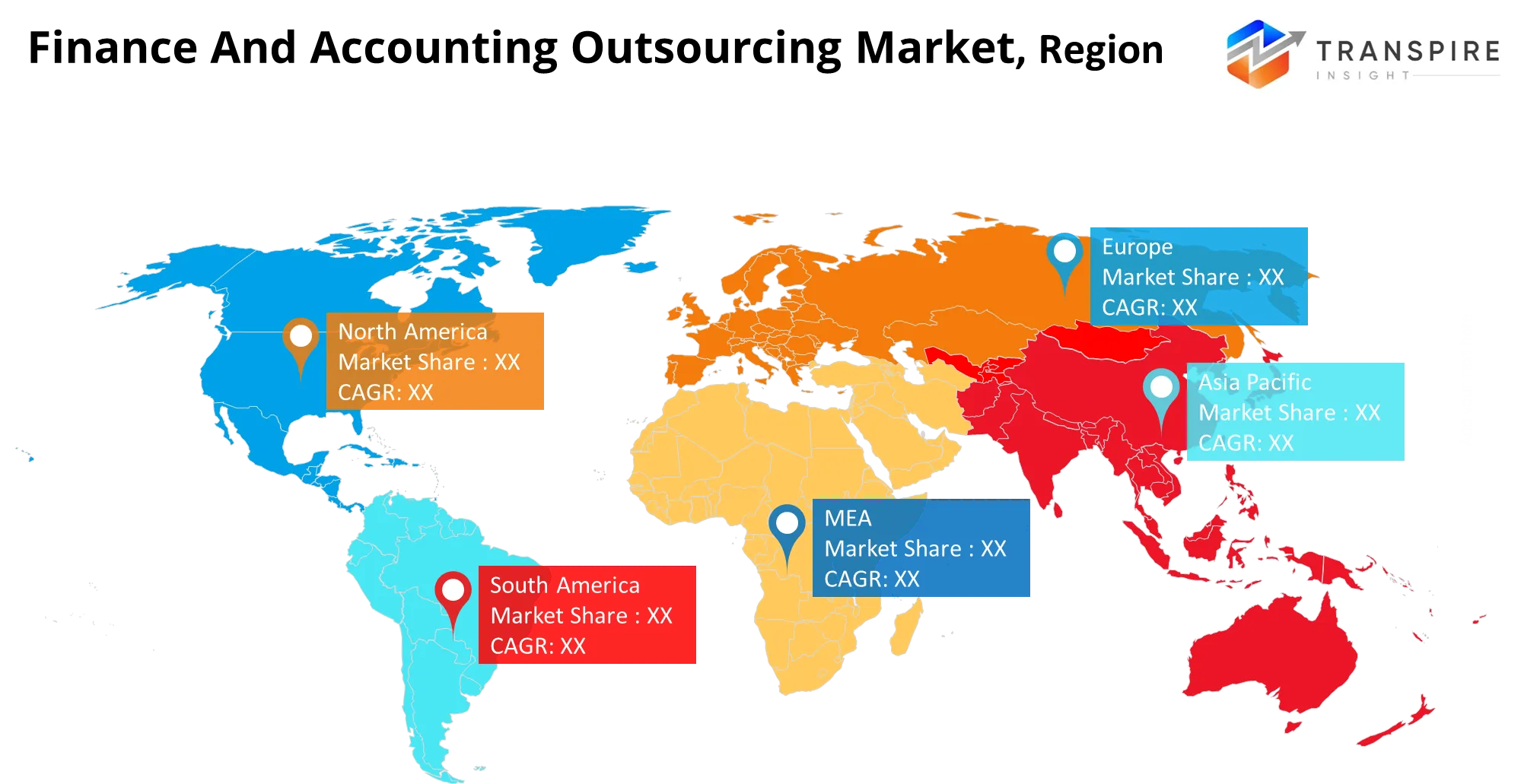
North America has a clear lead in the world of FAO, with 39.8% of its market. North America has a mature CFO agenda, high reporting demands, and early adoption of AI-powered finance platforms by organizations. It is driven by a mature ecosystem of ERP vendors and hyperscalers, tax-technology players, delivery providers, and is often characterised by high-level corporate governance, e-invoicing readiness programs, and the need for real-time cash-flow visibility – all of which ensure strong demand for managed finance services.
In October 2026, Aprio announced an expanded strategic partnership with Intuit to accelerate the rollout of AI-powered advisory and accounting services for mid-market North American businesses. https://www.prnewswire.com/news-releases/aprio-broadens-its-ai-powered-advisory-partnership-with-intuit-to-further-accelerate-mid-market-business-growth-302913705.html
Europe has a 28.1% share of the market and plays on deep regulation instead of scale. Volumes in Europe are more aligned than in North America with the digitisation of VAT, statutory reporting, ESG disclosures and cross-border tax compliance. Demand remains stable for the continent given the EU's broadening scope of digital reporting, with standing audit and professional service network and multinational business presence that require consistent controls across borders.
In January 2026, Pennylane secured a $204 million Series E funding round at a $4.25 billion valuation led by TCV to accelerate its cross-border financial copilot expansion into Germany. https://www.apideck.com/resources/europe-accounting-integration-map-2026
Asia Pacific leads the way with 11.8% CAGR and 22.5% share. Recently, we have seen a shift away from the low-cost delivery model to a hybrid capability sourcing model for tax in India, the Philippines, and ASEAN. Service providers continue to build and benefit from cloud capability, automation skills, and sector-specific tax digitalization solutions that provide opportunities for serving both local businesses and companies based overseas. Latin America (5.6%) and the Middle East and Africa (4.0%) are smaller geographies, but they are gaining relevance through tax digitalization, near-shore, and government-led tax digitalization projects.
In June 2026, Deloitte India launched an AI-led SAP Delivery Centre in Bengaluru. This dedicated capability hub is designed to help enterprises accelerate cloud adoption, intelligent automation, and AI-powered business transformations using specialized AI talent. https://cio.economictimes.indiatimes.com/news/corporate-news/deloitte-india-sap-launch-ai-led-delivery-centre-in-bengaluru/131656306
Who are the Key Players in the Finance and Accounting Outsourcing Market, and how do they compete?
The industry aspires to shift focus from input-based resources to outcome-based delivery; competition in FAO has gained momentum with a focus on translating artificial intelligence, cloud ERP integration, and domain expertise into actual financial results. Overall, service providers are moving from FTE-based contracts to outcome-based models around faster financial closes, fewer exceptions, better working capital management, and compliance accuracy.
Genpact stands out through its innovation-led transformation via its AI Gigafactory, agentic AP Suite, and process-intelligence capabilities to advance clients from pilots to production-scale autonomous finance. It competes through consulting-led transformation integrated into delivery and industry-based AI deployment. HCLTech competes through its digital-first R2R and tax engagement model, its ReOps framework, predictive GL coding, and automation centres that improve close accuracy and statutory compliance, and through its standardised delivery centres and CFO-aligned services around working capital. Infosys, with platform partnerships, embedded AI agents, and analytics-led financial planning and analysis (FP&A) integrated with agile reporting and cloud accounting platform integration, provides differentiation. WNS has differentiated with planning, forecasting, profitability, and executive decision-making support, aligned to clients who want information and insights, not the basics. Capgemini, Accenture, IBM, TCS, Wipro, Cognizant, EXL, Sutherland, RSM International, Deloitte, PwC differentiate with a hybrid consulting + operations approach, a proprietary AI platform, sector-specific knowledge and deep industry expertise, including ESG, risk, tax and FP&A.
Key Players are:
- Accenture
- Genpact
- WNS
- Wipro
- Infosys
- Tata Consultancy Services
- Cognizant
- Capgemini
- IBM
- HCLTech
- EXL
- Sutherland
- RSM International
- Deloitte
- PwC
Finance and Accounting Outsourcing Market — Enhanced Competitive Benchmarking
|
Company |
Est. Revenue Share Range |
Key Offerings |
Strategic Positioning |
Geographic Strength |
Technology Focus |
|
Accenture |
Estimated 3–5% |
Procure-to-pay; order-to-cash; record-to-report; finance transformation |
scale with transformation-led end-to-end managed services |
North America, Europe, Asia Pacific |
GenAI, process mining, RPA, cloud ERP integration |
|
Capgemini, including WNS |
Estimated 2–4% |
Invoice-to-pay; order-to-cash; record-to-report; financial planning and analysis |
Scale through WNS acquisition; AI-led intelligent operations |
Europe, North America, Asia Pacific |
Agentic AI, intelligent automation, analytics, cloud platforms |
|
Genpact |
Estimated 2–4% |
Accounts payable; invoice-to-cash; record-to-report; finance advisory |
F&A specialist with process depth and measurable outcomes |
North America, Europe, Asia Pacific |
Agentic AI, process mining, NLP, workflow automation |
|
IBM |
Estimated 1.5–3% |
Finance and accounting BPO; finance transformation; managed operations |
Enterprise-managed operations with AI-led workflow redesign |
North America, Europe, Asia Pacific |
AI assistants, watsonx, intelligent workflows, ERP automation |
|
Tata Consultancy Services (TCS) |
Estimated 1.5–3% |
Finance operations; accounting services; risk and control services; finance transformation |
Efficient delivery with cloud-based finance transformation |
Asia Pacific, North America, Europe |
Cognitive automation, AI, BPaaS, cloud finance platforms |
|
Deloitte |
Estimated 1–2.5% |
Finance and accounting operations; tax compliance; finance analytics; managed services |
Premium managed services for complex finance and compliance needs |
North America, Europe, Asia Pacific |
AI-enabled finance platforms, analytics, controls automation |
|
Cognizant |
Estimated 1–2.5% |
Invoice-to-pay; order-to-cash; record-to-report; tax and FP&A services |
Integrated F&A operations with flexible models and IT convergence |
North America, Europe, Asia Pacific |
Agentic AI, intelligent automation, finance data analytics |
|
Wipro |
Estimated 1–2.5% |
Finance transformation; accounting operations; planning-as-a-service; F&A BPaaS |
Automation-led transformation with industry-specific delivery |
Asia Pacific, North America, Europe |
AI, RPA, analytics, cloud ERP, digital finance platforms |
|
Infosys BPM |
Estimated 0.8–2% |
Procure-to-pay; accounts receivable; accounting and reconciliation; tax compliance |
Cost-efficient BPM scale with standardized finance processes |
Asia Pacific, North America, Europe |
Live Enterprise, cognitive interfaces, automation, analytics |
|
EXL |
Estimated 0.7–1.8% |
Finance and accounting BPO; financial planning; accounting operations; analytics-led services |
Analytics-led specialization across finance process towers |
North America, Europe, Asia Pacific |
AI, advanced analytics, process automation, data-led operations |
Recent Development News
- In August 2026, Gloo agreed to acquire Cedarstone, a provider of finance and development outsourcing for nonprofits. The acquisition is set to add outsourced accounting, donor operations, and fractional CFO services to Gloo’s platform. https://investors.gloo.com/news-releases/news-release-details/gloo-announces-definitive-agreement-acquire-financial-and
- In May 2026, Genpact and Google Cloud expanded their alliance to build and scale agentic AI solutions for the Office of the CFO. The partnership aims to modernize finance operations, including accounting workflows, through AI-enabled tools and services. https://www.prnewswire.com/news-releases/genpact-and-google-cloud-expand-alliance-to-bring-agentic-solutions-to-the-office-of-the-cfo-302765266.html
- In March 2026, Quatrro Business Support Services completed its multi-year organic growth and back-office acquisition strategy by unifying its entire portfolio of brands—including QBSS, ContinuServe, and USWired—under the single brand name ContinuServe. https://www.prnewswire.com/news-releases/quatrro-business-support-services-unifies-portfolio-as-continuserve-to-simplify-client-experience-302709252.html
What Strategic Insights Define the Future of the Finance And Accounting Outsourcing Market?
The market is shifting from a commoditised outsourced transaction capability to integrated, outcome-based finance operations. Service providers will create integrated end-to-end solutions based on cloud ledgers, AI agents, process mining, and human control teams, and clients will retain the line of sight on policy and judgment. The unseen peril is control fragmentation; automated workflows may cross ERP, service provider, and client systems, raising questions around ownership of exceptions, data lineage, and audit evidence. A near-term opportunity is compliance-driven modernisation. European e-invoicing and digital reporting regulations, as well as IFRS 18 changes in 2027, will demand data mapping, reconciliation, and reporting. Agentic cash application (CA) will provide tangible working capital value. Buyers should look for vendors who can "show they know how to do controlled automation, can explain their outputs, can port data, have regional compliance expertise, and deliver service level outcomes." Pilot a high-volume workstream, establish baseline accuracy and cycle time, then scale once controls, ownership of exceptions, and cost savings are validated.
Key Segmentations are:
Service Type
- Bookkeeping
- Payroll Processing
- Tax Preparation
- Financial Reporting
- Accounts Payable
- Accounts Receivable
- Audit Support
- Financial Analysis
Deployment
- Cloud-Based
- On-Premise
- Hybrid
- SaaS
- Hosted
- Managed Service
- Remote Delivery
- Others
Enterprise Size
- Large Enterprises
- SMEs
- Startups
- Multinational Corporations
- Mid-Sized Firms
- Government
- Nonprofits
- Others
End User
- BFSI
- Healthcare
- IT & Telecom
- Manufacturing
- Retail
- Professional Services
- Government
- Real Estate
Service Provider
- Third-Party Providers
- Captive Centres
- BPO Firms
- Accounting Firms
- Consulting Firms
- FinTech Providers
- Shared Service Centres
- Others
Technology
- AI
- RPA
- Cloud Computing
- Blockchain
- Analytics
- Machine Learning
- OCR
- Others
By Regional Analysis
North America
- US
- Canada
- Mexico
Europe
- Germany
- UK
- France
- Italy
- Spain
- Russia
- Rest of Europe
Asia Pacific
- China
- Japan
- India
- South Korea
- Australia
- Rest of Asia Pacific
South America
- Brazil
- Argentina
- Rest of South America
Middle East & Africa
- UAE
- Saudi Arabia
- Qatar
- South Africa
- Rest of the Middle East & Africa
Frequently Asked Questions
Find quick answers to common questions.
The finance and accounting outsourcing market size was valued at USD 70.2 billion in 2025 and is poised to reach USD 142.7 billion by 2033, expanding at a 9.23% CAGR.
Key segments for the finance and accounting outsourcing market are Service Type (Bookkeeping, Payroll Processing, Tax Preparation, Financial Reporting, Accounts Payable, Accounts Receivable, Audit Support, Financial Analysis)Deployment (Cloud-Based, On-Premise, Hybrid, SaaS, Hosted, Managed Service, Remote Delivery, Others)Enterprise Size (Large Enterprises, SMEs, Startups, Multinational Corporations, Mid-Sized Firms, Government, Nonprofits, Others)End User (BFSI, Healthcare, IT & Telecom, Manufacturing, Retail, Professional Services, Government, Real Estate)Service Provider (Third-Party Providers, Captive Centers, BPO Firms, Accounting Firms, Consulting Firms, FinTech Providers, Shared Service Centers, Others)Technology (AI, RPA, Cloud Computing, Blockchain, Analytics, Machine Learning, OCR, Others).
Growth is primarily driven by finance talent shortages, pressure to control costs, expanding cross-border compliance needs, cloud and ERP integration, and automation of high-volume accounting workflows.
The finance and accounting outsourcing market is led by major manufacturers, including Accenture, Genpact, WNS, Wipro, Infosys, Tata Consultancy Services, Cognizant, Capgemini, IBM, HCLTech, EXL, Sutherland, RSM International, Deloitte, and PwC.
North America leads with a 39.8% share, supported by established outsourcing networks, large enterprise finance operations, advanced cloud adoption, and complex reporting and control requirements.
Opportunities include AI-enabled invoice and cash workflows, digital tax-compliance support, cash forecasting, and managed finance services for mid-sized businesses.
- Accenture
- Genpact
- WNS
- Wipro
- Infosys
- Tata Consultancy Services
- Cognizant
- Capgemini
- IBM
- HCLTech
- EXL
- Sutherland
- RSM International
- Deloitte
- PwC
About the Authors

Mayur Shinde
I am Mayur Shinde, a Senior Research Analyst at Transpire Insight, specializing in the Automotive & Transportation and Information & Communication Technology (ICT) Industry. My work focuses on analyzing emerging market trends, technological advancements, competitive landscapes, and industry developments to deliver accurate, data-driven insights. I am passionate about transforming complex market information into clear, actionable content that helps businesses, professionals, and decision-makers stay informed and make confident strategic decisions.

Chakradhar Khansole
Chakradhar serves as the Research Director at Transpire Insight, bringing over 8 years of experience in technology, innovation, and strategic market intelligence. He specializes in transforming complex market data into actionable business insights that enable organizations to make informed, growth-oriented decisions. Recognized for his strategic vision and analytical expertise, Chakradhar leads high-impact research initiatives, delivering comprehensive market assessments, competitive intelligence, and forward-looking industry analysis.
Recently Published Reports
-
Apr 2026
3D Optical Profiler Market
3D Optical Profiler Market Size, Share & Analysis Report By Type (Desktop 3D Optical Profiler, and Portable 3D Optical Profiler), By Technology (Confocal Technology, and White Light Interference), By End-Use Industry (Manufacturing, Research Institutions, Automotive, Aerospace and Defense, Medical Devices, and Other), and Geography (North America, Europe, Asia-Pacific, Middle East and Africa, South and Central America), 2021 - 2031
-
Apr 2026
Depth Sensor Market
Depth Sensor Market Size, Share & Analysis Report By Type (Infrared Depth Sensors, Time-of-Flight (ToF) Sensors, Stereo Vision Sensors, Structured Light Sensors, Ultrasonic Depth Sensors), By Application (Automotive, Robotics, Gaming, Consumer Electronics, Industrial Automation, Healthcare, Security & Surveillance, Others), By End Users (Automotive Manufacturers, Consumer Electronics Companies, Healthcare Providers, Industrial Companies, Security Agencies, Gaming Companies, Robotics Companies, Others), and Geography (North America, Europe, Asia-Pacific, Middle East and Africa, South and Central America), 2021 – 2031
-
Apr 2026
Digital Manufacturing Market
Digital Manufacturing Market Size, Share & Analysis Report By Component (Hardware, Software, and Services), By Technology (Robotics, 3D Printing, Internet of Things (IoT), and Others), By Application (Automotive and Transportation, Aerospace and Defense, Consumer Electronics, Industrial Machinery, and Others), By Process Type (Computer-Based Designing, Computer-Based Simulation, Computer 3D Visualization, Analytics, and Others), and Geography (North America, Europe, Asia-Pacific, Middle East and Africa, South and Central America), 2021 – 2031
-
Apr 2026
Digital Visa Services Market
Digital Visa Services Market Size, Share & Analysis Report By Type (Individual Travelers, Group Travelers), By Application (Tourism, Business Travel, Others), and Geography (North America, Europe, Asia-Pacific, Middle East and Africa, South and Central America), 2021 – 2031