
Agentic AI Monitoring, Analytics, And Observability Tools Market Summary:
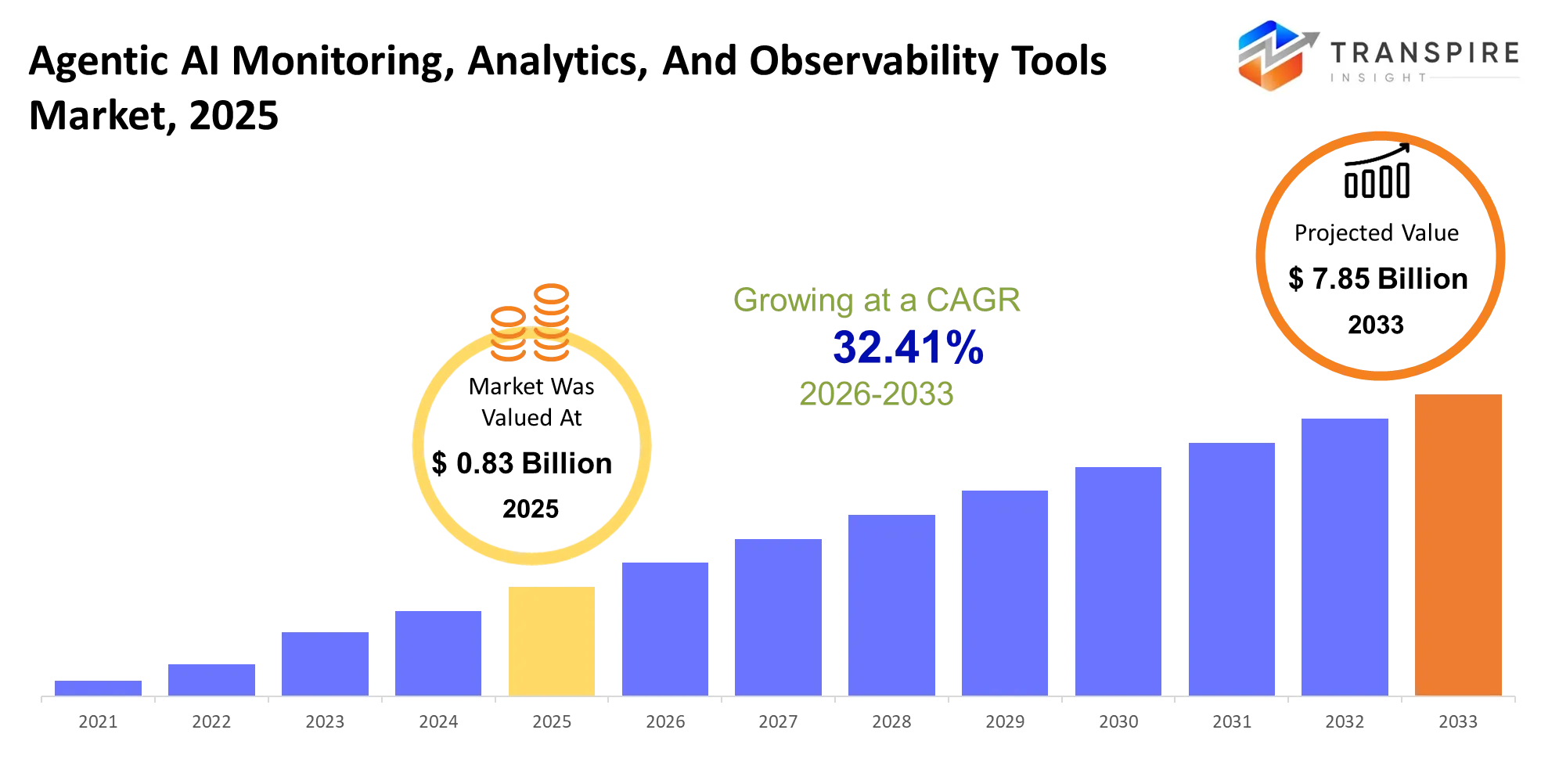
As per the Transpire Insight Analysis, The Agentic AI Monitoring, Analytics, and Observability Tools Market size is estimated at USD 0.83 billion in 2025 and is anticipated to reach USD 7.85 billion by 2033, growing at a CAGR of 32.41% from 2026 to 2033.
agentic AI monitoring, analytics, and observability tools. For enterprise use cases, broad visibility into agent actions across all stages of the reasoning process will become critical to understanding model performance, including model calls, tool interactions, data access, latency, costs, and performance. This will enable teams to fix failures before they affect customers or users. This has already evolved from straightforward Large Language Model logging into full execution tracing, behavioural scoring, and controls as agents move from simply generating text to making their own decisions. Structural change is happening in the form of OpenTelemetry-based GenAI telemetry by monitoring tools, which is bringing agent activity into the existing enterprise observability stack. In a 2026 survey, 76% of organisations have invested in this standard. Incidents of hallucinations, boundless tool calls, and unmanaged agent costs have driven this change. With autonomous workflows, the inability to explain why an agent made a decision can become a material operational, financial, and compliance risk, making observability non-optional.
Agentic AI Monitoring, Analytics, And Observability Tools Market Size & Forecast:
- Market Size 2025: USD 0.83 Billion
- Expected Market Value (2033): USD 7.85 Billion
- Forecast CAGR (2026-2033): 32.41%
- Leading Region in 2025: North America
- Fastest Growing Region: Asia Pacific
- Key Company Profiles: Datadog, Dynatrace, Splunk, New Relic, IBM, Microsoft, Google Cloud, Amazon Web Services, Cisco, Elastic, Grafana Labs, Arize AI, LangSmith, Langfuse, Weights & Biases.
Key Agentic AI Monitoring, Analytics, And Observability Tools Market Insights:
The market is shifting from traditional infrastructure monitoring to agent-level accountability that focuses on successful task completion, cost of task execution, security, and decision traceability in addition to system uptime. Future competitive advantage will be based on technical telemetry that can be tied to business results.
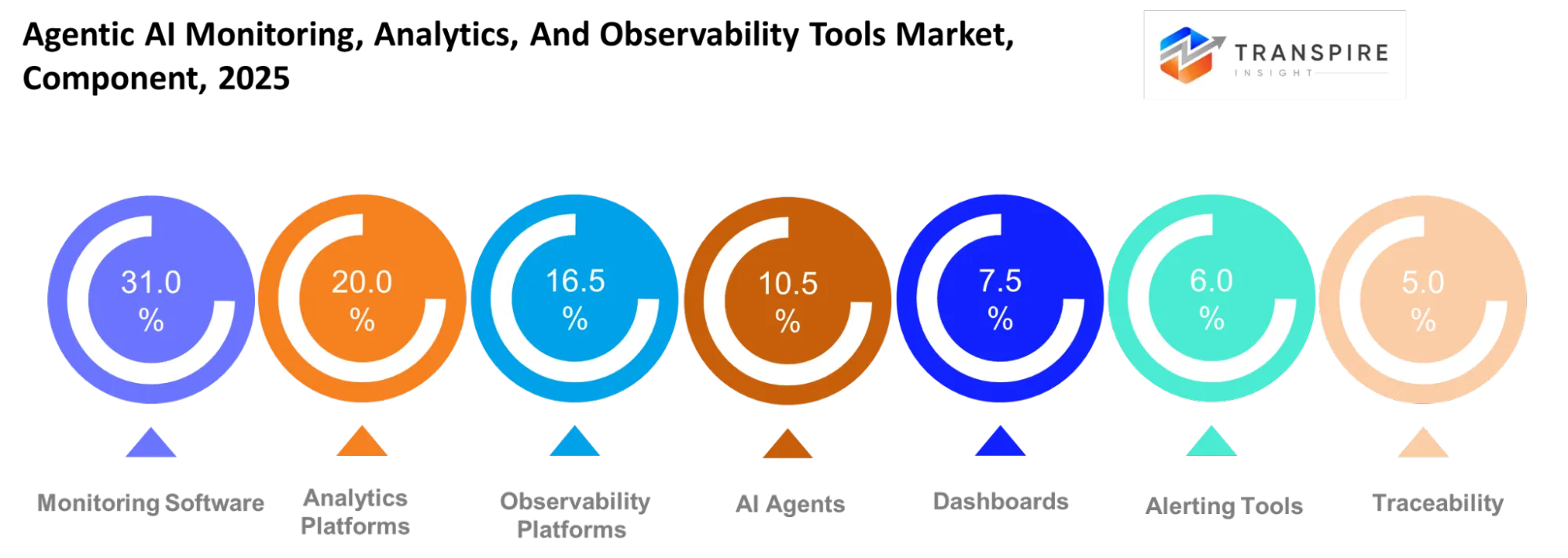
- Monitoring software is 31.0% of the revenue, and Datadog's Agent Observability adds full-stack tracing to agent tool calls, handoffs, latency, errors, and cost, furthering its installed-base advantage.
- Agent behaviour analytics is the fastest-growing capability at 24.5% CAGR, and Arize AI is unique because it scores production behaviour and provides evaluation datasets, in addition to infrastructure monitoring.
- Analytics platforms account for 20.0% of the market, and LangSmith offers a developer-native tracing, prompt evaluation and dataset management experience for teams developing LLM and agent applications.
- Observability platforms make up 16.5%, while Dynatrace's Davis AI provides causal analysis and topology-aware root cause detection to cut down on false correlations in complex multi-cloud environments.
- AI agents contribute 10.5%: In 2026, New Relic introduced a no-code Agentic Platform and SRE Agent, shifting from AI support to autonomous incident management governed by AI.
- Dashboards represent 7.5% of the market, and Grafana Labs is making strides in open, composable agent observability with support for OpenTelemetry and integration with MCP, which aligns with enterprises seeking to escape vendor lock-in.
- Alerting tools make up 6.0%, with New Relic reporting that accounts with the AI features had double the rate of issues being correlated and 27% less alert noise than accounts without the AI features.
- Traceability is 5.0%, while Langfuse's self-hosted, open-source platform is ideal for cost-conscious and data-sovereignty-driven teams that demand complete agent-managed visibility.
- Others are in the middle, with 3.5% holding that they are expanding from model training to production evaluation, with Weights & Biases helping enterprises to bridge the gap between pre-deployment benchmarks and live agent performance.
What are the Key Drivers, Restraints, and Opportunities in the Agentic AI Monitoring, Analytics, And Observability Tools Market?
Driver:
The main growth driver is the transition from experimental AI assistants to agents that execute multi-step tasks across enterprise applications. Failures can now occur during planning, tool selection, memory retrieval, API execution, or handoffs between agents, making conventional application monitoring insufficient. The rollout of coding agents and automated IT workflows has increased the need to trace complete execution paths, measure task success, and attribute inference costs. OpenTelemetry's developing GenAI conventions for agent invocations, workflow execution, and tool calls support more consistent instrumentation across these complex systems. This improves troubleshooting and gives enterprises greater confidence to expand deployments.
Restraint:
Fragmented frameworks, incompatible telemetry formats, and limited visibility into proprietary model decisions complicate implementation. Capturing prompts, outputs, and tool activity can also expose confidential information or personal data. Integrating monitoring with existing security, cloud, and application-management systems adds engineering costs, particularly for smaller businesses. These structural challenges can delay procurement and restrict adoption to high-value workloads.
Opportunity:
A key opportunity lies in unified platforms that combine agent evaluation, cost attribution, policy enforcement, and audit-ready traceability. The EU AI Act’s transparency requirements, including provisions applying from August 2026, strengthen the need for documented AI operations, depending on the system and its intended use. Vendors offering privacy-aware telemetry, interoperable integrations, and flexible deployment options can attract regulated enterprises. Demand is likely to strengthen among organisations operating across multiple cloud environments that require consistent oversight, data protection, and reliable AI governance.
Driver Impact Analysis: Agentic AI Monitoring, Analytics, and Observability Tools Market
|
Driver |
Relative Impact on Growth (%) |
Geographic Relevance |
Impact Timeline |
Demand Strength |
Growth Mechanism |
Key Beneficiaries |
Major Constraint |
|
Autonomous AI agent deployment across enterprise workflows |
28% |
North America, Europe, Asia-Pacific |
Short-term (≤2 years) |
High |
Expands demand for tracing, execution visibility, and continuous production monitoring. |
Observability vendors, enterprise AI teams, cloud service providers |
Unpredictable agent behavior complicates reliable production deployment. |
|
Real-time monitoring, debugging, and multi-agent traceability |
23% |
North America, Europe, Asia-Pacific |
Short-term (≤2 years) |
High |
Captures tool calls, agent handoffs, latency, failures, and execution costs. |
APM vendors, AI developers, platform engineering teams |
High-volume telemetry increases storage and processing expenses. |
|
AI governance, security, compliance, and operational risk management |
19% |
Europe, North America, Asia-Pacific |
Medium-term (2-4 years) |
High |
Enables auditable decisions, policy enforcement, risk detection, and accountability. |
Governance platforms, cybersecurity vendors, regulated enterprises |
Fragmented standards complicate cross-border compliance implementation. |
|
Continuous evaluation, hallucination detection, and agent reliability optimisation |
17% |
North America, Europe, Asia-Pacific |
Medium-term (2-4 years) |
High |
Detects semantic failures and quality regressions through automated evaluations. |
AI evaluation vendors, model developers, enterprise application teams |
Inconsistent evaluation benchmarks limit measurement accuracy. |
|
Inference-cost optimisation and integrated observability infrastructure |
13% |
North America, Asia-Pacific, Europe |
Long-term (≥4 years) |
Medium |
Links token usage, latency, and infrastructure consumption to operating costs. |
Cloud providers, observability platforms, enterprise FinOps teams |
Budget constraints and vendor lock-in discourage platform expansion. |
|
Total |
100% |
— |
— |
— |
— |
— |
— |
What Has the Impact of Artificial Intelligence Been on the Agentic AI Monitoring, Analytics, And Observability Tools Market?
AI is evolving observability from reactive to something that can infer agent behaviour, diagnosing emerging failures and suggesting fixes. AI/ML-enhanced analytics may be applied to discover repeats and categories of errors, anomalies in token consumption, correlation between latency and failures in model or tool chains, and identifying incident repeats versus workflow-wide failure patterns. For example, trace analysis can help pinpoint whether a customer-service agent's encountered failure while verifying an order is due to a retrieval, an authentication, or an external API.
Similarly, predictive analytics can improve planning. In addition to using past cost and execution traces to predict resource spikes, failure rates, and agents to monitor pre-rollout, automated scoring can compare output against predefined quality, safety, and policy standards, helping reduce manual review workload. Natural-language virtual interfaces make complex telemetry more readily understandable by operators and developers. AI-driven prognosis need not always be reliable, as replicating weird agent behaviour is no guarantee. The combination of high volumes of telemetry, inference costs, integrations, and sensitive prompt data may increase operating costs as well. As a result, human audits, guardrails, and privacy constraints will be needed.
In October 2026, Grafana Labs launched the general availability of its Agent Observability suite with native OpenTelemetry support alongside the release of its automated Assistant Watchers. https://www.hpcwire.com/bigdatawire/this-just-in/grafana-labs-expands-ai-observability-and-agentic-operations-in-grafana-cloud/
Key Agentic AI Monitoring, Analytics, And Observability Tools Market Trends:
The market is moving beyond simple uptime monitoring to gain insights into agent decision-making, execution quality, and business results. The number of people who are expecting a unified view of models, tools, workflows, costs, and governance controls is on the rise.
- Agent monitoring is now going beyond just LLM answers and into full multi-step workflows such as planner decisions, tool calls, retries, and handoffs between agents.
- The integration layer is becoming the OpenTelemetry layer, with agent traces showing up alongside traditional application and infrastructure telemetry.
- The observability of costs is emerging as a board-level mandate as token usage, redundant calls, and unmanaged tool usage have a direct impact on the economics of the AI unit.
- Behaviour analytics is replacing basic error tracking by tracking task completion, policy adherence, hallucination risk, and consistency across agent versions.
- Security monitoring is moving toward the run-time controls of prompt injection, over-privileged access, exposure of sensitive data, and unauthorised system actions.
- Compliance monitoring is getting productized, as enterprises gather evidence for the EU AI Act's transparency and accountability obligations.
- While 80% of enterprises are running LLM features, only a quarter are using specific AI observability products, and enterprises are integrating disparate open-source tooling into a single platform.
- AIOps vendors are integrating agentic capabilities, shifting from reactive alerting to proactive and autonomous remediation with human approval controls.
- The need for multi-agent tracing is a new requirement as organisations have different types of agents performing coding, data, workflow, and customer service jobs.
- Evaluation-led deployment is becoming more popular, as teams are making use of pre-production benchmarks and live feedback loops before giving agents more autonomy.
Agentic AI Monitoring, Analytics, And Observability Tools Market Segmentation
Component:
Monitoring software has a 31.0% share, providing the visibility needed to enable the safe rollout of agents into production. Analytics platforms have a 20.0% share, with growth driven by behaviour scoring, evaluation, and root-cause analysis. Observability platforms enable integrating traces, logs, metrics and agent sessions into a single unified operational view and have a 16.5% share. Artificial intelligence agents make up 10.5% of the market, dashboards 7.5%, alerting tools 6.0%, traceability 5.0% and others 3.5%. Agent behaviour analytics is a rapidly growing feature set, with a 24.5% compound annual growth rate as organizations attempt to validate the trustworthiness of autonomous decision-making over time.
Capability:
Agent monitoring and performance analytics dominate early spending because enterprises first need visibility into agent actions, latency, failures, and operational outcomes. Behaviour tracking, anomaly detection, and traceability are becoming key differentiators as organisations seek to validate decision quality and identify unsafe patterns. Cost monitoring is rising as inference, token consumption, and tool-call expenses become material. Meanwhile, security and compliance monitoring are gaining importance as regulatory scrutiny and enterprise risk controls require auditable evidence of agent behaviour and access.
Deployment:
Cloud and SaaS models lead because they enable rapid instrumentation, elastic storage for high-volume telemetry, and continuous feature updates without heavy internal infrastructure. These models suit organisations deploying agents quickly across distributed applications and AI services. Hybrid and multi-cloud deployments are gaining traction in regulated sectors that require data residency, private-model access, and integration with existing security tools. This shift reflects a growing need to balance observability scalability with control over sensitive data, model governance, and jurisdiction-specific compliance obligations.
Agent Type:
Autonomous, conversational, coding, workflow, and customer-service agents are the primary adoption centres for monitoring and observability tools. Coding and IT-operations agents depend heavily on traceability because their actions can affect source code, infrastructure, deployments, and incident response. Customer-facing conversational agents require transparency, quality evaluation, and escalation controls to maintain trust and regulatory compliance. As organisations deploy multiple specialised agents, demand is increasing for cross-agent tracing, role-based permissions, and unified visibility across interconnected workflows and decision paths.
Enterprise Size:
Large enterprises currently account for the largest share because they operate complex, multi-system environments and face stronger governance, security, and audit obligations. Their scale makes unmonitored agent actions operationally and financially risky, encouraging investment in centralised observability platforms. SMEs and startups are adopting managed, SaaS-based observability to avoid building internal telemetry infrastructure and specialised AI-monitoring teams. This creates demand for affordable, developer-friendly solutions with rapid onboarding, usage-based pricing, and prebuilt integrations for popular agent frameworks.
Application:
IT operations, software development, cybersecurity, customer service, and finance are the leading use cases for agentic AI monitoring, analytics, and observability tools. These functions involve high-volume decisions, sensitive data, and direct operational impact, making traceability and performance monitoring essential. Healthcare and business operations are emerging as high-potential areas where auditability, human oversight, and decision traceability determine deployment readiness. As agents move into regulated and customer-facing workflows, organizations will prioritize platforms that provide evidence, control, and measurable task outcomes.
What are the Key Use Cases Driving the Agentic AI Monitoring, Analytics, And Observability Tools Market?
The core use case is IT operations and software development, aligned with the leading monitoring-software segment. Teams use agent observability to trace code-generation agents, automated incident diagnosis, and remediation workflows, capturing each model call, repository action, test result, and deployment decision. This reduces mean-time-to-resolution while preventing unsafe autonomous changes.
Expanding applications include customer service, cybersecurity, and finance. Conversational service agents are monitored for escalation quality, hallucination risk, and disclosure compliance; security teams use behaviour tracking to identify abnormal data access or tool misuse; financial institutions apply traceability to audit agent-driven approvals and transaction workflows.
Emerging use cases include multi-agent business operations, where workflow, data, and decision agents collaborate across procurement, marketing, and healthcare processes. Here, cross-agent tracing, cost attribution, and compliance evidence become essential for scaling beyond isolated pilots.
|
Report Metrics |
Details |
|
Market size value in 2025 |
USD 0.83 Billion |
|
Market size value in 2026 |
USD 1.10 Billion |
|
Revenue forecast in 2033 |
USD 7.85 Billion |
|
Growth rate |
CAGR of 32.41% from 2026 to 2033 |
|
Base year |
2025 |
|
Historical data |
2021 - 2024 |
|
Forecast period |
2026 - 2033 |
|
Report coverage |
Revenue forecast, competitive landscape, growth factors, and trends |
|
Regional scope |
United States; Canada; Mexico; United Kingdom; Germany; France; Italy; Spain; Denmark; Sweden; Norway; China; Japan; India; Australia; South Korea; Thailand; Brazil; Argentina; South Africa; Saudi Arabia; United Arab Emirates |
|
Key companies profiled |
Datadog, Dynatrace, Splunk, New Relic, IBM, Microsoft, Google Cloud, Amazon Web Services, Cisco, Elastic, Grafana Labs, Arize AI, LangSmith, Langfuse, Weights & Biases |
|
Customization scope |
Free report customization (country, regional & segment scope). Available customised purchase options to meet your exact research needs. |
|
Report Segmentation |
Component (Monitoring Software, Analytics Platforms, Observability Platforms, AI Agents, Dashboards, Alerting Tools, Consulting Services, Support Services)Capability (Agent Monitoring, Performance Analytics, Behavior Tracking, Cost Monitoring, Security Monitoring, Traceability, Compliance Monitoring, Anomaly Detection)Deployment (Cloud, On-Premise, Hybrid Cloud, Multi-Cloud, SaaS, Private Cloud, Public Cloud, Edge)Agent Type (Autonomous Agents, Conversational Agents, Coding Agents, Data Agents, Decision Agents, Workflow Agents, Customer-Service Agents, Others)Enterprise Size (Large Enterprises, SMEs, Startups, Government, Research Institutions, Technology Firms, Financial Institutions, Healthcare Organizations)Application (IT Operations, Software Development, Customer Service, Cybersecurity, Finance, Marketing, Healthcare, Business Operations) |
Which Regions are Driving the Agentic AI Monitoring, Analytics, And Observability Tools Market Growth?
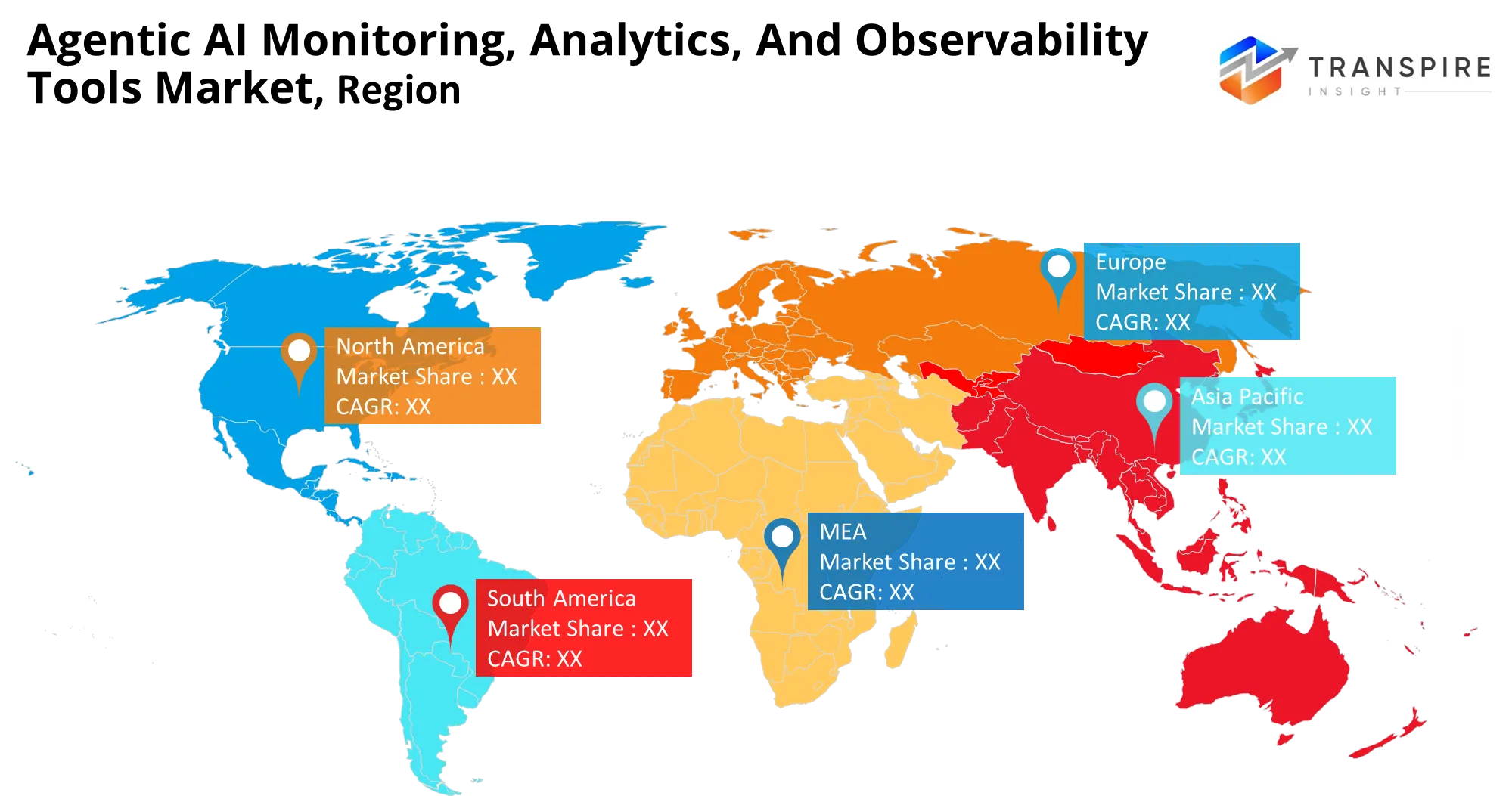
North America dominates with 45.5% market share, benefiting from mature cloud infrastructure, high enterprise software spend, and a large number of AI developers and adopters. North America benefits from mature observability ecosystems that combine application monitoring, security analytics, and AI governance. Enterprises have large deployments in financial services, software engineering, and cloud operations, and companies like Datadog and Microsoft leverage their existing enterprise relationships and the ability to embed monitoring into larger technology platforms.
In June 2026, Datadog acquired Adaptive ML, a frontier AI startup specialising in Reinforcement Learning Operations (RLOps). This acquisition accelerates Datadog’s AI research investments into world models and agentic LLM post-training, directly integrating specialised agent capabilities into its cloud monitoring ecosystem. https://investors.datadoghq.com/news-releases/
Europe comprises 27.0% of the market, driven in part by the sensitivity of regulators to compliance, privacy and risk. Unlike North America, where the commercial market prefers to move fast and break things, Europe's risk aversion is related to the importance placed on auditability, privacy and documented process controls. Europe's historically mature industrial, financial and public sector technology industries provide a relatively stable customer base. Vendor opportunities include explainable monitoring and configurable data retention and deployment controls.
In October 2026, European standardisation bodies CEN and CENELEC officially published EN 18286:2026, the first harmonised European standard dedicated to AI quality management systems under the EU AI Act. https://www.cencenelec.eu/news-events/news/2026/en-in-the-spotlight/2026-10-15-en-18286-2026-published-in-ojeu/
Asia Pacific is 19.2% and the fastest-growing region at a compound annual growth rate of 25.8%. Driven by rapid digitalisation, proliferation of cloud infrastructure, and government-led artificial intelligence programs in India, Japan, South Korea, Singapore, and Australia. Emerging innovations are around enterprises' increased adoption of artificial intelligence-enabled customer support, application development, and financial activities, and an increasing number of local data residency laws. Opportunities are possible in localised, multi-cloud observability solutions that provide low-cost telemetry storage combined with support for local languages, privacy regulations, and sovereign cloud deployments.
In June 2026, OpenObserve launched its Asia Pacific South-1 (Mumbai) cloud region on AWS, enabling organisations to process and store observability data closer to Indian operations. The expansion supports lower-latency telemetry ingestion and helps address regional data-residency requirements, creating a stronger foundation for locally deployed AI monitoring and enterprise observability workloads. https://openobserve.ai/whats-new
Who are the Key Players in the Agentic AI Monitoring, Analytics, and Observability Tools Market, and how do they compete?
The market of competitors is split between mature observability vendors with enterprise-oriented, large-scale infrastructure-centric solutions and experts in evaluation via artificial intelligence. The offerings of established vendors are broad, integrated with enterprise architectures, and revolve around consumption-based pricing. The specialists are oriented towards evaluation granularity, developer experience, and agent-centric analytics. The focus of the strategic discussion is moving into the agent control plane, specifically how to instrument, evaluate, protect, and govern autonomous workflows across diverse models, tools, and clouds.
Datadog strengthens its AI investigation and autonomous operations, while Dynatrace brings deterministic analytics and agentic automation for controlled operational decision-making. Splunk adds agent evaluation, cost monitoring, and guardrails for security, while Cisco bolsters its infrastructure and security ecosystem. Microsoft, Google Cloud, AWS and IBM leverage the near-ubiquitous enterprise utility it builds on for fast adoption. Elastic, New Relic and Grafana Labs competitively differentiate via flexible integrations, search and support for open telemetry. Experts such as Arize AI, LangSmith, Langfuse and Weights & Biases focus on model evaluation, trace analysis, experimentation and agent quality. LangSmith stands out by way of framework-agnostic tracing, online evaluation, and cost monitoring. Broadly, vendors compete on depth of integration, evaluation accuracy, deployment flexibility, pricing, and ability to demonstrate the degree of agent reliability improvement.
Key Players are:
- Datadog
- Dynatrace
- Splunk
- New Relic
- IBM
- Microsoft
- Google Cloud
- Amazon Web Services
- Cisco
- Elastic
- Grafana Labs
- Arize AI
- LangSmith
- Langfuse
- Weights & Biases
Agentic AI Monitoring, Analytics, and Observability Tools Market — Enhanced Competitive Benchmarking
|
Company |
Est. Revenue Share Range |
Key Offerings |
Strategic Positioning |
Geographic Strength |
Technology Focus |
|
Datadog |
Estimated 7-11% |
LLM Observability, APM, distributed tracing, infrastructure monitoring |
Unified observability for enterprise AI workloads |
North America, Europe, Asia Pacific |
End-to-end telemetry, LLM tracing, AI cost analytics |
|
Dynatrace |
Estimated 6-10% |
Dynatrace AI Observability, Davis AI, Dynatrace Intelligence, distributed tracing |
Enterprise-grade causal analytics and autonomous operations |
North America, Europe, Asia Pacific |
Causal AI, agentic automation, full-stack telemetry correlation |
|
Microsoft |
Estimated 6-10% |
Microsoft Foundry observability, Azure Monitor, Application Insights, agent tracing |
Integrated AI development, monitoring, and governance ecosystem |
North America, Europe, Asia Pacific |
OpenTelemetry, multi-agent tracing, evaluation and governance |
|
Amazon Web Services |
Estimated 5-9% |
Amazon CloudWatch GenAI Observability, Bedrock AgentCore observability, CloudWatch Application Signals |
Cloud-native monitoring integrated with managed AI infrastructure |
North America, Asia Pacific, Europe |
Agent telemetry, model performance analytics, automated quality monitoring |
|
New Relic |
Estimated 4-7% |
New Relic AI Monitoring, APM, distributed tracing, New Relic AI |
Application-centric agent monitoring with accessible troubleshooting |
North America, Europe, Asia Pacific |
Agent workflow tracing, latency analysis, model cost and quality |
|
Google Cloud |
Estimated 4-7% |
Vertex AI observability, Cloud Monitoring, Cloud Trace, Gemini evaluation capabilities |
Integrated observability across cloud-hosted AI development |
North America, Asia Pacific, Europe |
Model evaluation, telemetry analysis, managed AI lifecycle monitoring |
|
Cisco (Splunk) |
Estimated 3-6% |
Splunk Observability Cloud, Splunk Enterprise, IT Service Intelligence, AI-assisted analytics |
Enterprise telemetry analytics and operational intelligence |
North America, Europe, Asia Pacific |
Log analytics, event correlation, anomaly detection, incident investigation |
|
Arize AI |
Estimated 2-5% |
Arize AX, Phoenix, LLM and agent tracing, evaluation and monitoring |
Specialist AI observability for production reliability and evaluation |
North America, Europe, Asia Pacific |
LLM evaluation, trace analytics, embedding and drift monitoring |
|
LangChain |
Estimated 2-5% |
LangSmith tracing, evaluation, monitoring, deployment and debugging |
Developer ecosystem for agent lifecycle visibility and testing |
North America, Europe, Asia Pacific |
Agent trajectory tracing, dataset evaluation, prompt and tool debugging |
|
Braintrust |
Estimated 1-3% |
Braintrust observability, evaluation, tracing, experiment and dataset management |
Evaluation-led quality management for AI applications |
North America, Europe, Asia Pacific |
Automated evaluation, production trace analysis, regression testing |
Recent Development News
- In September 2026, Amazon Web Services launched Amazon CloudWatch Omni, an observability, evaluation, and experimentation solution designed for AI agents across different model providers, frameworks, and runtimes. The platform supports trace analysis, built-in quality evaluators, prompt comparisons, and automated regression detection, helping development and operations teams assess agent behaviour and maintain reliability throughout deployment.https://aws.amazon.com/blogs/aws/introducing-amazon-cloudwatch-omni-ai-powered-observability-for-generative-ai-and-agentic-workloads
- In October 2026, Grafana Labs announced general availability of Agent Observability with OpenTelemetry support, alongside new agentic operations capabilities at ObservabilityCON 2026. The release enables enterprises to monitor agent activity and associated costs using open-standard telemetry, strengthening visibility into production AI workloads while supporting more integrated incident investigation and operational automation.https://grafana.com/press/2026/10/20/observabilitycon-2026-ai-updates
- In September 2026, Honeycomb introduced its AI Ecosystem for fleet-wide visibility into AI agents in production, including agent health, operating costs, performance, and individual conversations. The launch helps enterprises identify agent-level issues, investigate production failures with additional development context, and improve operational oversight as agent deployments expand.https://www.prnewswire.com/news-releases/honeycomb-unveils-new-ai-observability-features-to-close-the-gap-between-shipping-agents-and-understanding-them-302892466.html
What Strategic Insights Define the Future of the Agentic AI Monitoring, Analytics, And Observability Tools Market?
The market is moving toward consolidated agent-governance platforms that bridge tracing, evaluation, security policies, cost attribution, and regulatory audit evidence in a single, coherent workflow. Enterprise buying teams are demanding outcomes accountability as fully autonomous AI systems take on more complex business functions. As the number of traces per agent action rises, however, the hidden risk for adopting telemetry is that these monitoring costs will outweigh the operational savings of automation. An emerging best practice in compliance-ready observability is to match EU AI Act transparency requirements - for agents that will interact with end-users in regulated industries and follow vendors who incorporate privacy, reliable evaluation, and easy access to auditable agent execution records as a competitive differentiator. Cloud hosts should seek platforms that target OpenTelemetry-native instrumentation, outcomes evaluation, and predictable pricing. Buyers should seek a solution with a track record of demonstrating agent accountability, controlling telemetry collection costs, and avoiding vendor lock-in by retaining telemetry portability.
Key Segmentations are:
Component
- Monitoring Software
- Analytics Platforms
- Observability Platforms
- AI Agents
- Dashboards
- Alerting Tools
- Consulting Services
- Support Services
Capability
- Agent Monitoring
- Performance Analytics
- Behaviour Tracking
- Cost Monitoring
- Security Monitoring
- Traceability
- Compliance Monitoring
- Anomaly Detection
Deployment
- Cloud
- On-Premise
- Hybrid Cloud
- Multi-Cloud
- SaaS
- Private Cloud
- Public Cloud
- Edge
Agent Type
- Autonomous Agents
- Conversational Agents
- Coding Agents
- Data Agents
- Decision Agents
- Workflow Agents
- Customer-Service Agents
- Others
Enterprise Size
- Large Enterprises
- SMEs
- Startups
- Government
- Research Institutions
- Technology Firms
- Financial Institutions
- Healthcare Organisations
Application
- IT Operations
- Software Development
- Customer Service
- Cybersecurity
- Finance
- Marketing
- Healthcare
- Business Operations
By Regional Analysis
North America
- US
- Canada
- Mexico
Europe
- Germany
- UK
- France
- Italy
- Spain
- Russia
- Rest of Europe
Asia Pacific
- China
- Japan
- India
- South Korea
- Australia
- Rest of Asia Pacific
South America
- Brazil
- Argentina
- Rest of South America
Middle East & Africa
- UAE
- Saudi Arabia
- Qatar
- South Africa
- Rest of the Middle East & Africa
Frequently Asked Questions
Find quick answers to common questions.
The agentic AI monitoring, analytics, and observability tools market size was valued at USD 0.83 billion in 2025 and is poised to reach USD 7.85 billion by 2033, expanding at a 32.41% CAGR
Key segments for the agentic AI monitoring, analytics, and observability tools market are Component (Monitoring Software, Analytics Platforms, Observability Platforms, AI Agents, Dashboards, Alerting Tools, Consulting Services, Support Services)Capability (Agent Monitoring, Performance Analytics, Behavior Tracking, Cost Monitoring, Security Monitoring, Traceability, Compliance Monitoring, Anomaly Detection)Deployment (Cloud, On-Premise, Hybrid Cloud, Multi-Cloud, SaaS, Private Cloud, Public Cloud, Edge)Agent Type (Autonomous Agents, Conversational Agents, Coding Agents, Data Agents, Decision Agents, Workflow Agents, Customer-Service Agents, Others)Enterprise Size (Large Enterprises, SMEs, Startups, Government, Research Institutions, Technology Firms, Financial Institutions, Healthcare Organizations)Application (IT Operations, Software Development, Customer Service, Cybersecurity, Finance, Marketing, Healthcare, Business Operations)
Growth is primarily driven by increasing enterprise adoption of autonomous AI agents, demand for real-time performance monitoring, agent behaviour analytics, cost optimisation, security oversight, and regulatory compliance
The agentic AI monitoring, analytics, and observability tools market is led by major manufacturers, including Datadog, Dynatrace, Splunk, New Relic, IBM, Microsoft, Google Cloud, Amazon Web Services, Cisco, Elastic, Grafana Labs, Arize AI, LangSmith, Langfuse, and Weights & Biases
North America dominates with a 45.5% market share, supported by advanced cloud infrastructure, strong AI investment, established technology providers, and early enterprise adoption of agentic AI
Key opportunities include unified agent governance platforms, AI-driven evaluation, cost attribution, privacy-aware telemetry, regulatory compliance monitoring, and interoperable multicloud observability solutions.
- Datadog
- Dynatrace
- Splunk
- New Relic
- IBM
- Microsoft
- Google Cloud
- Amazon Web Services
- Cisco
- Elastic
- Grafana Labs
- Arize AI
- LangSmith
- Langfuse
- Weights & Biases
About the Authors

Mayur Shinde
I am Mayur Shinde, a Senior Research Analyst at Transpire Insight, specializing in the Automotive & Transportation and Information & Communication Technology (ICT) Industry. My work focuses on analyzing emerging market trends, technological advancements, competitive landscapes, and industry developments to deliver accurate, data-driven insights. I am passionate about transforming complex market information into clear, actionable content that helps businesses, professionals, and decision-makers stay informed and make confident strategic decisions.

Chakradhar Khansole
Chakradhar serves as the Research Director at Transpire Insight, bringing over 8 years of experience in technology, innovation, and strategic market intelligence. He specializes in transforming complex market data into actionable business insights that enable organizations to make informed, growth-oriented decisions. Recognized for his strategic vision and analytical expertise, Chakradhar leads high-impact research initiatives, delivering comprehensive market assessments, competitive intelligence, and forward-looking industry analysis.
Recently Published Reports
-
Apr 2026
3D Optical Profiler Market
3D Optical Profiler Market Size, Share & Analysis Report By Type (Desktop 3D Optical Profiler, and Portable 3D Optical Profiler), By Technology (Confocal Technology, and White Light Interference), By End-Use Industry (Manufacturing, Research Institutions, Automotive, Aerospace and Defense, Medical Devices, and Other), and Geography (North America, Europe, Asia-Pacific, Middle East and Africa, South and Central America), 2021 - 2031
-
Apr 2026
Depth Sensor Market
Depth Sensor Market Size, Share & Analysis Report By Type (Infrared Depth Sensors, Time-of-Flight (ToF) Sensors, Stereo Vision Sensors, Structured Light Sensors, Ultrasonic Depth Sensors), By Application (Automotive, Robotics, Gaming, Consumer Electronics, Industrial Automation, Healthcare, Security & Surveillance, Others), By End Users (Automotive Manufacturers, Consumer Electronics Companies, Healthcare Providers, Industrial Companies, Security Agencies, Gaming Companies, Robotics Companies, Others), and Geography (North America, Europe, Asia-Pacific, Middle East and Africa, South and Central America), 2021 – 2031
-
Apr 2026
Digital Manufacturing Market
Digital Manufacturing Market Size, Share & Analysis Report By Component (Hardware, Software, and Services), By Technology (Robotics, 3D Printing, Internet of Things (IoT), and Others), By Application (Automotive and Transportation, Aerospace and Defense, Consumer Electronics, Industrial Machinery, and Others), By Process Type (Computer-Based Designing, Computer-Based Simulation, Computer 3D Visualization, Analytics, and Others), and Geography (North America, Europe, Asia-Pacific, Middle East and Africa, South and Central America), 2021 – 2031
-
Apr 2026
Digital Visa Services Market
Digital Visa Services Market Size, Share & Analysis Report By Type (Individual Travelers, Group Travelers), By Application (Tourism, Business Travel, Others), and Geography (North America, Europe, Asia-Pacific, Middle East and Africa, South and Central America), 2021 – 2031