

Wireless Infrastructure Monitoring Market Summary:
According to Transpire Insight, a detailed research report on the Wireless Infrastructure Monitoring Market reflects that the hardware/component segment dominates the Wireless Infrastructure Monitoring Market, accounting for approximately 60.85% of the total share worldwide. The Wireless Infrastructure Monitoring Market is valued at approximately USD 5.32 billion in 2026 and is projected to reach USD 9.69 billion by 2031, expanding at a 12.74% CAGR during 2026-2031. Siemens AG leads the market with significant market presence, making it a leading contributor to market development, innovation, advanced wireless infrastructure monitoring solutions, expanding technological capabilities, and growth dynamics.
Market Snapshot
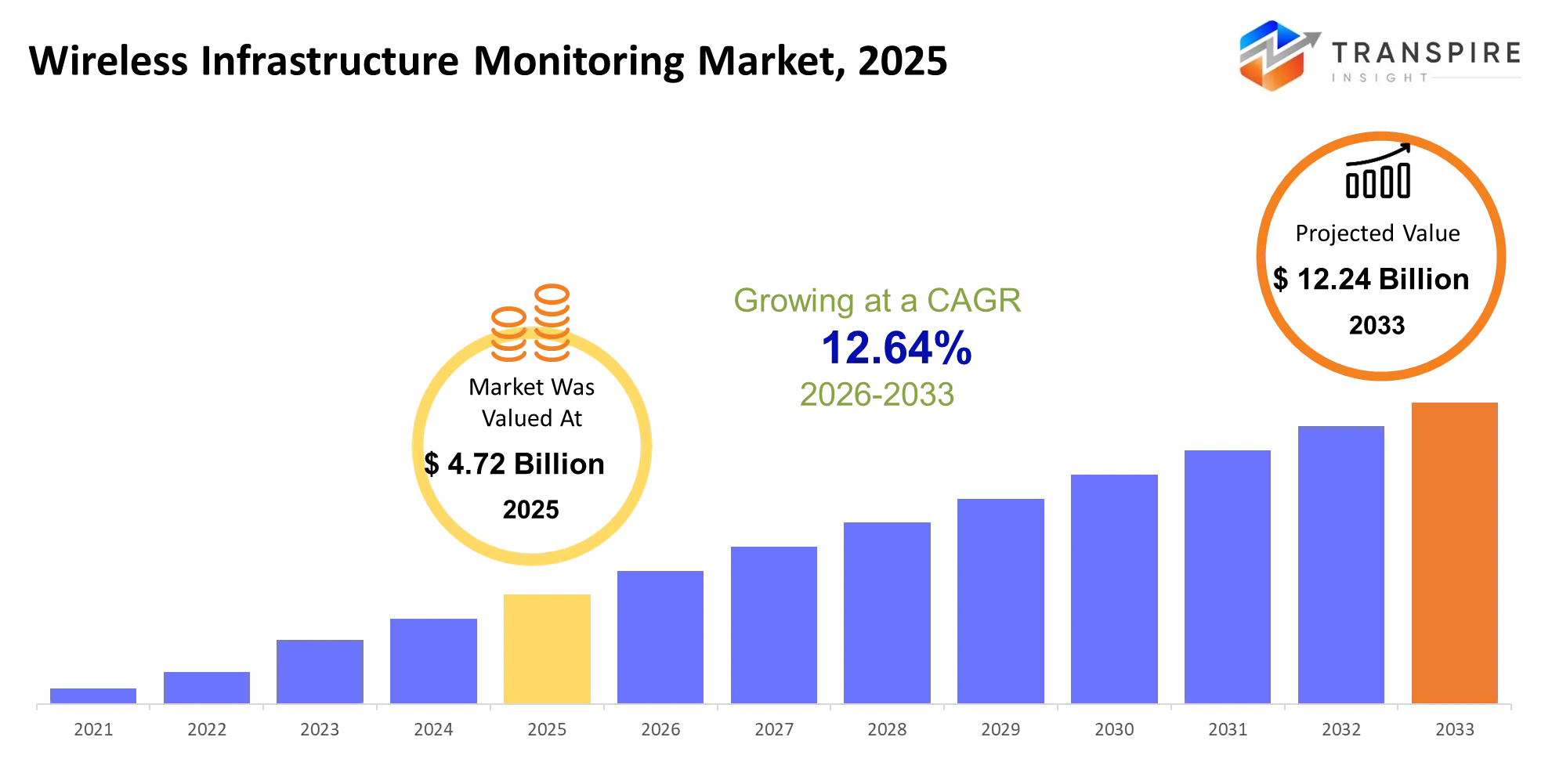
- Market Value (2025): USD 4.72 Billion.
- Expected Market Value (2026): USD 5.32 Billion.
- Estimated Market Value (2033): USD 12.24 Billion.
- Forecast CAGR (2026-2033): 12.64%.
- Leading Region in 2025: Asia Pacific
- Second-largest Region: North America
- Fastest Growing Region: Europe
Introduction
The Wireless Infrastructure Monitoring Market consists of wireless sensor, connectivity, data collection, and analysis tools designed to provide monitoring services for critical infrastructure assets' condition. This market provides for continuous and remote monitoring of bridges, tunnels, dams, transport networks, energy infrastructures, pipelines, mining facilities, and other asset-heavy industries. Through wireless technologies, infrastructure owners can have access to real-time data on their asset condition, without reliance on heavy cable connections and constant physical inspections. The growing use of IoT-powered sensors, low-power connectivity, cloud computing, edge computing, and predictive analytics is facilitating a shift from reactive asset management to condition-based and predictive asset management. Applications include structural health, geotechnical, environmental, seismic, vibration, and corrosion monitoring.
For instance:-
- North America: Aging infrastructure, federal rehabilitation budgeting, and high levels of IoT adoption drive the need for wireless infrastructure monitoring and predictive maintenance.
- Europe: Modernization of infrastructure, high safety regulations, and digital transformation drive the adoption of wireless monitoring and predictive maintenance in transportation and civil infrastructure.
Key Market Highlights: -
- Asia Pacific is expected to grow at a rapid CAGR in the Wireless Infrastructure Monitoring Market by holding around 28% of the share during the forecast period.
- North America is anticipated to hold roughly 34% share of the Wireless Infrastructure Monitoring Market over the predicted timeframe.
- Europe is anticipated to hold nearly 28% share of the Wireless Infrastructure Monitoring Market over the predicted timeframe.
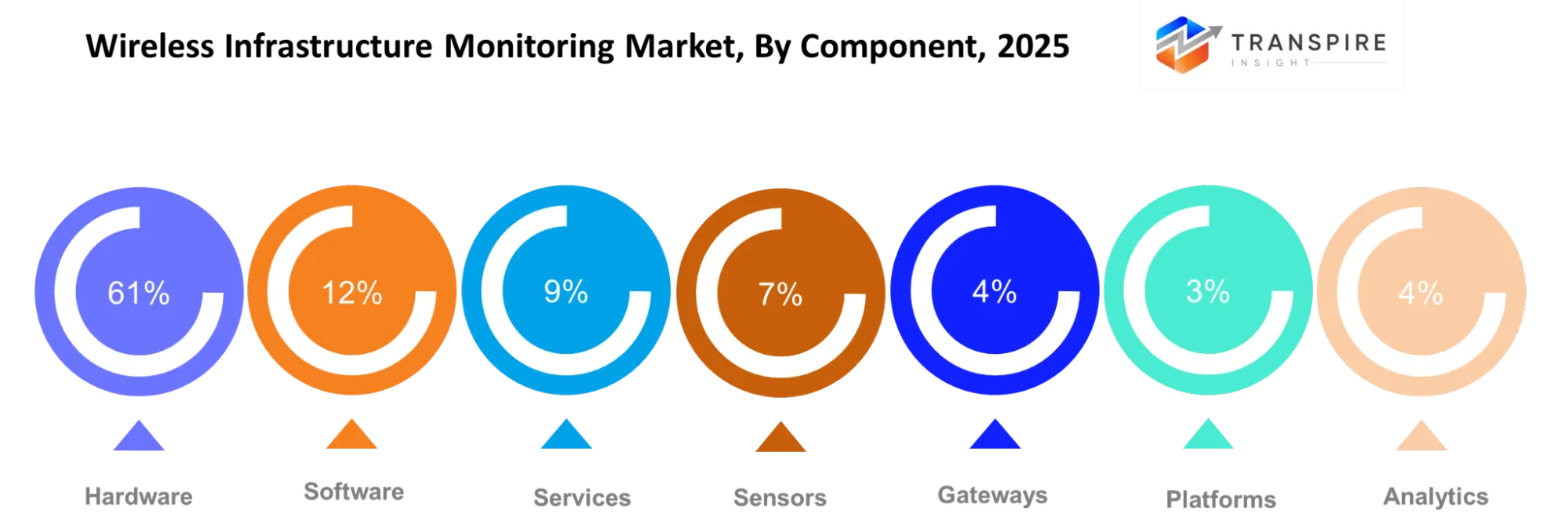
- By Component, the Hardware segment dominated the market and holds nearly 57.8% share in 2025 and is projected to grow at a substantial CAGR during the forecast period.
- By Connectivity, the Wi-Fi dominated the market and holds close to 32% share in 2025 and is projected to grow at a substantial CAGR during the forecast period.
- By Application, the Structural Monitoring dominated the market and holds about 46% share in 2025 and is projected to grow at a substantial CAGR during the forecast period.
- Government-sponsored infrastructure modernization and digitalization drive the adoption of wireless infrastructure monitoring solutions globally.
How is Technology Driving Growth in the Wireless Infrastructure Monitoring Market?
The Wireless Infrastructure Monitoring Market will be driven by advancements in technology that include Internet of Things (IoT) sensing, LPWAN & Cellular Connectivity, edge processing, cloud platforms, and predictive analytics using AI. The use of advanced wireless sensor networks facilitates real-time monitoring of various conditions including structural, environmental and operational at sites like bridges, tunnels, energy infrastructure and others. Edge processing not only ensures quick detection of anomalies but also eliminates the unnecessary transmission of data. The cloud platform enables visualizing and remote management of assets on a central platform.
|
Report Metrics |
Details |
|
Market size value in 2025 |
USD 4.72 Billion |
|
Market size value in 2026 |
USD 5.32 Billion |
|
Revenue forecast in 2033 |
USD 12.24 Billion |
|
Growth rate |
CAGR of 12.64% from 2026 to 2033 |
|
Base year |
2025 |
|
Historical data |
2021 - 2024 |
|
Forecast period |
2026 - 2033 |
|
Report coverage |
Revenue forecast, competitive landscape, growth factors, and trends |
|
Regional scope |
United States; Canada; Mexico; United Kingdom; Germany; France; Italy; Spain; Denmark; Sweden; Norway; China; Japan; India; Australia; South Korea; Thailand; Brazil; Argentina; South Africa; Saudi Arabia; United Arab Emirates |
|
Key company profiled |
Siemens, Honeywell, Schneider Electric, ABB, Emerson, National Instruments, Campbell Scientific, Trimble, Hitachi, IBM, Cisco, Monnit, Libelium, Worldsensing, Sensata Technologies |
|
Customization scope |
Free report customization (country, regional & segment scope). Avail customized purchase options to meet your exact research needs. |
|
Report Segmentation |
By Component (Hardware, Software, Services, Sensors, Gateways, Platforms, Analytics, Others); By Connectivity (LPWAN, Wi-Fi, 5G/Cellular, Bluetooth, Zigbee, LoRaWAN, Satellite, Others); By Application (Structural Monitoring, Corrosion Monitoring, Environmental Monitoring, Asset Monitoring, Security Monitoring, Energy Monitoring, Traffic Monitoring, Others); By Infrastructure Type (Bridges & Tunnels, Buildings, Dams, Roads, Railways, Renewable Energy Assets, Pipelines, Others); By Sensor (Strain/Stress Gauges, Accelerometers/Vibration Sensors, Temperature Sensors, Pressure Sensors, Tilt Sensors, Displacement Sensors, Acoustic Sensors, Others); By End User (Civil Infrastructure Owners, Utilities & Energy, Transportation, Construction, Oil & Gas, Government, Industrial, Others); By Deployment (Fixed, Mobile, Remote, Cloud-based, On-premise, Edge, Hybrid, Others) |
Market Drivers
Main factors driving the Wireless Infrastructure Monitoring Market Growth include shifting from reactive to predictive maintenance with the help of wireless sensors. IoT sensors offer structural, environmental, and operational data in real time, while artificial intelligence-based analytics will help with early detection and maintenance planning. Aging infrastructure, along with demands for safety and smart cities, has increased the need for remote monitoring of infrastructure such as bridges, tunnels, transportation systems, energy systems, and other facilities. Another benefit of wireless sensors is that they do not require cables and can be used in inaccessible locations.
For instance:-
- Asia Pacific: Urbanization, smart city projects, development of infrastructure, and industrial digital transformation drive the adoption of wireless sensors and monitoring systems in transportation and energy infrastructures.
- Middle East and Africa: Large-scale infrastructure projects and energy developments open up opportunities for wireless monitoring solutions suitable for remote infrastructure, extreme conditions, structures, and continuous operation monitoring.
Restrain
Restrictions in the Wireless Infrastructure Monitoring Market include high costs for implementation and integration, especially in case of integration of aged infrastructure. Interference with wireless signals, barriers due to physical infrastructure and difficult environments are also likely to make connectivity through sensors and gateways problematic. Batteries can limit the maintenance of remote sensor networks. Security concerns and data privacy issues may hinder the uptake of the technology. Lack of skilled personnel who can manage wireless sensing, IoT platforms and advanced analytics may act as restrictions on implementation, especially in the transition from conventional inspection and maintenance approaches.
|
Driver |
Relative Impact on Market Growth (%) |
Geographic Relevance |
Impact Timeline |
Demand Strength |
Growth Mechanism |
Key Beneficiaries |
Major Constraint |
|
Driver 1: Aging Infrastructure and Continuous Structural Health Monitoring |
27% |
North America, Europe, Asia Pacific |
Short-term |
High |
Enables continuous asset-condition monitoring and predictive maintenance |
Sensor manufacturers, monitoring platforms, infrastructure owners |
High deployment and maintenance costs |
|
Driver 2: IoT, LPWAN, 5G and Edge-Enabled Monitoring |
23% |
Asia Pacific, North America, Europe |
Medium-term |
High |
Connects distributed sensors for real-time low-power infrastructure intelligence |
IoT vendors, connectivity providers, sensor manufacturers |
Connectivity coverage and interoperability challenges |
|
Driver 3: Government Infrastructure Investment and Monitoring Requirements |
20% |
North America, Europe, Asia Pacific |
Short-term |
High |
Infrastructure programs create large-scale procurement for automated monitoring systems |
Government agencies, engineering firms, monitoring providers |
Lengthy public procurement and approval cycles |
|
Driver 4: AI, Predictive Analytics and Digital Twin Integration |
17% |
North America, Europe, Asia Pacific |
Medium-term |
High |
Converts sensor data into predictive insights and maintenance decisions |
AI vendors, software providers, infrastructure operators |
Data quality and integration complexity |
|
Driver 5: Renewable Energy and Remote Infrastructure Expansion |
13% |
Asia Pacific, Middle East, North America |
Long-term |
Medium |
Expands monitoring demand across distributed and hard-to-access assets |
Energy companies, sensor vendors, monitoring service providers |
Harsh environments and sensor battery limitations |
|
Total |
100% |
— |
— |
— |
— |
— |
— |
Analysis of Prices and Consumer Behaviour
In terms of products and services provided to customers, the main segment dominating the market of Wireless Infrastructure Monitoring is high-quality monitoring solutions (68% of the total market - mainly because of the demand from the critical infrastructure, transportation, energy and industrial markets). The price of high-quality monitoring solutions (with high precision, standards and equipped with advanced sensing, connectivity and analysis functions) is estimated to be 35% higher than those for other products, since such a solution will use advanced monitoring technologies and components and provide the same level of monitoring accuracy. About 45% of all units sold of the wireless infrastructure monitoring solutions are sold as wireless sensor-based solutions. The reason behind that is the flexibility of wireless monitoring solutions to different infrastructures and lack of requirements to cabling. The demand from infrastructure, industrial and energy markets makes up about 70% of the overall demand of the markets mentioned above. As far as customer behavior is concerned, about 55% of customers give priority to monitoring accuracy, reliability and standardization of data. Also, 33% of customers like to buy monitoring systems in large quantities in order to decrease the cost of acquisition and ensure reliable source of supply.
|
Company |
Est. Revenue Share Range |
Key Offerings |
Strategic Positioning |
Geographic Strength |
Technology Focus |
|
Siemens AG |
6-9% |
Industrial wireless monitoring; MindSphere/Industrial IoT; digital twin integration; automation systems |
Enterprise-scale platform diversification and integrated monitoring |
Europe, North America, Asia Pacific |
Industrial IoT, digital twins, edge analytics |
|
Honeywell International Inc. |
5-8% |
OneWireless; WirelessHART solutions; Experion PKS; industrial asset monitoring |
Industrial automation integration and installed-base expansion |
North America, Middle East, Europe |
WirelessHART, IoT, predictive analytics |
|
ABB Ltd. |
4-7% |
ABB Ability; wireless instrumentation; condition monitoring; asset performance solutions |
Automation-led monitoring across energy-intensive industries |
Europe, Asia Pacific, North America |
Industrial IoT, smart sensors, asset analytics |
|
Trimble Inc. |
4-6% |
GNSS monitoring; robotic total stations; geotechnical monitoring; cloud monitoring platforms |
Precision positioning and infrastructure intelligence specialization |
North America, Europe, Asia Pacific |
GNSS, geospatial analytics, cloud monitoring |
|
Campbell Scientific |
3-5% |
Data acquisition systems; structural monitoring; vibrating-wire measurement; environmental monitoring |
High-precision sensing for complex infrastructure applications |
North America, Europe, Asia Pacific |
Data acquisition, sensor integration, edge measurement |
|
RST Instruments Ltd. |
2-4% |
Geotechnical instrumentation; wireless data acquisition; dam monitoring; mine monitoring |
Specialized geotechnical monitoring and rugged field instrumentation |
North America, Asia Pacific, Europe |
Wireless telemetry, geotechnical sensing, remote monitoring |
|
Geokon, Incorporated |
2-4% |
Vibrating-wire sensors; structural monitoring; geotechnical instrumentation; data acquisition |
Sensor-centric specialization for critical infrastructure |
North America, Europe, Asia Pacific |
Vibrating-wire sensing, structural instrumentation, telemetry |
|
Emerson Electric Co. |
2-4% |
WirelessHART devices; Rosemount measurement; AMS monitoring; industrial wireless networks |
Process-industry monitoring through connected instrumentation |
North America, Middle East, Asia Pacific |
WirelessHART, smart instrumentation, predictive maintenance |
|
Bentley Systems, Incorporated |
1-3% |
iTwin platform; infrastructure digital twins; asset analytics; monitoring integration |
Software-led infrastructure digitalization and digital twins |
North America, Europe, Asia Pacific |
Digital twins, cloud analytics, infrastructure AI |
|
Worldsensing |
1-3% |
Loadsensing; geotechnical monitoring; structural monitoring; wireless sensor networks |
Wireless-network specialization for infrastructure and mining |
Europe, Asia Pacific, North America |
LoRa connectivity, wireless sensor networks, cloud platforms |
Who are the Key Players in the Wireless Infrastructure Monitoring Market and how do they compete?
The competitiveness of the Wireless Infrastructure Monitoring industry in the international market requires companies dealing with technologies, industry-specific solutions, and distribution network development. Competing not on price but on the basis of durable monitoring equipment, advanced sensor technology, intelligent and connected solutions, integration into the digital platform and operational systems, this type of competition results in continuous product innovation as well as allows organizations to become more productive, efficient, and resourceful.
Siemens develops its position through the intelligent monitoring systems and wireless sensor networks and IoT solutions and connected infrastructure technologies. Honeywell differentiates from its competitors through the development of infrastructure monitoring solutions of high performance dedicated to the purpose of structural monitoring, asset management, industrial application, and other infrastructure needs. Schneider Electric builds its position through providing integrated solutions in infrastructure monitoring, industrial automation, connectivity, and smart infrastructure.
Top Companies in the Wireless Infrastructure Monitoring Market
- Siemens
- Honeywell
- Schneider Electric
- ABB
- Emerson
- National Instruments
- Campbell Scientific
- Trimble
- Hitachi
- IBM
- Cisco
- Monnit
- Libelium
- Worldsensing
- Sensata Technologies
|
Investment Factor |
Why It Matters to Investors |
Opportunity |
Investment Implication |
|
Aging Infrastructure Modernization |
Aging bridges, tunnels, dams, railways, and industrial assets require continuous condition assessment. |
Wireless structural and geotechnical monitoring solutions |
Supports sustained demand from infrastructure owners and engineering firms. |
|
IoT, LPWAN and 5G Integration |
Low-power connectivity enables economical monitoring across geographically dispersed assets. |
LPWAN-enabled sensors, 5G connectivity, edge monitoring platforms |
Creates scalable opportunities for connectivity, sensor, and platform providers. |
|
AI-Driven Predictive Maintenance |
AI converts continuous sensor data into actionable failure and maintenance insights. |
AI analytics, anomaly detection, predictive maintenance software |
Supports higher-value software, analytics, and recurring service revenues. |
|
Digital Twin Integration |
Live monitoring data improves infrastructure visualization, diagnostics, and lifecycle management. |
Digital-twin-enabled structural monitoring platforms |
Enables integrated software ecosystems and stronger customer retention. |
|
Remote and Renewable Infrastructure |
Remote energy and infrastructure assets require monitoring without frequent physical inspections. |
Wireless monitoring for wind, solar, pipelines, mines, and remote facilities |
Expands addressable applications and supports long-term deployment growth. |
|
Monitoring-as-a-Service Models |
Customers increasingly value continuous monitoring without extensive internal infrastructure investment. |
Managed monitoring, cloud analytics, maintenance-alert services |
Creates recurring revenue streams and scalable service-based business models. |
Wireless Infrastructure Monitoring Market Segmentation
The Wireless Infrastructure Monitoring Market share is divided into seven categories: By Component, By Connectivity, By Application, By Infrastructure Type, By Sensor, By End User, By Deployment.
The Hardware segment dominated the market, accounting for nearly 57.8% in 2025 and is expected to rise at a significant CAGR during the forecast period.
The Wireless Infrastructure Monitoring Market is by component into hardware, software, services, sensors, gateways, platforms, analytics, others. Among these, the Hardware segment dominated the market, accounting for nearly 57.8% in 2025 and expected to increase at a significant CAGR during the forecast period. Hardware accounted for the largest market share due to rising demand for robust wireless sensors, gateways, and monitoring equipment used for real-time monitoring of infrastructure conditions, connectivity, and predictive maintenance.
The Wi-Fi dominated the market, accounting for close to 32% in 2025, and is expected to rise at a significant CAGR during the forecast period
The Wireless Infrastructure Monitoring Market is segmented by connectivity into lpwan, wi-fi, 5g/cellular, bluetooth, zigbee, lorawan, satellite, others. Among these, the Wi-Fi dominated the market, accounting for close to 32% in 2025 and expected to increase at a significant CAGR during the forecast period. Wi-Fi accounted for the leading position due to wide availability, reliable connectivity, cost-effective nature, and seamless integration of wireless infrastructure monitoring systems and IoT platforms.
The Structural Monitoring dominated the market, accounting for about 46% in 2025 and is expected to rise at a significant CAGR during the forecast period.
The Wireless Infrastructure Monitoring Market by application into structural monitoring, corrosion monitoring, environmental monitoring, asset monitoring, security monitoring, energy monitoring, traffic monitoring, others. Among these, theStructural Monitoring dominated the market, accounting for about 46% in 2025 and expected to increase at a significant CAGR during the forecast period. Structural Monitoring accounted for the dominant position due to aging infrastructure, safety requirements, real-time condition analysis, predictive maintenance implementations, and continuous integrity monitoring demands.
Regional Segment Analysis of the Wireless Infrastructure Monitoring Market
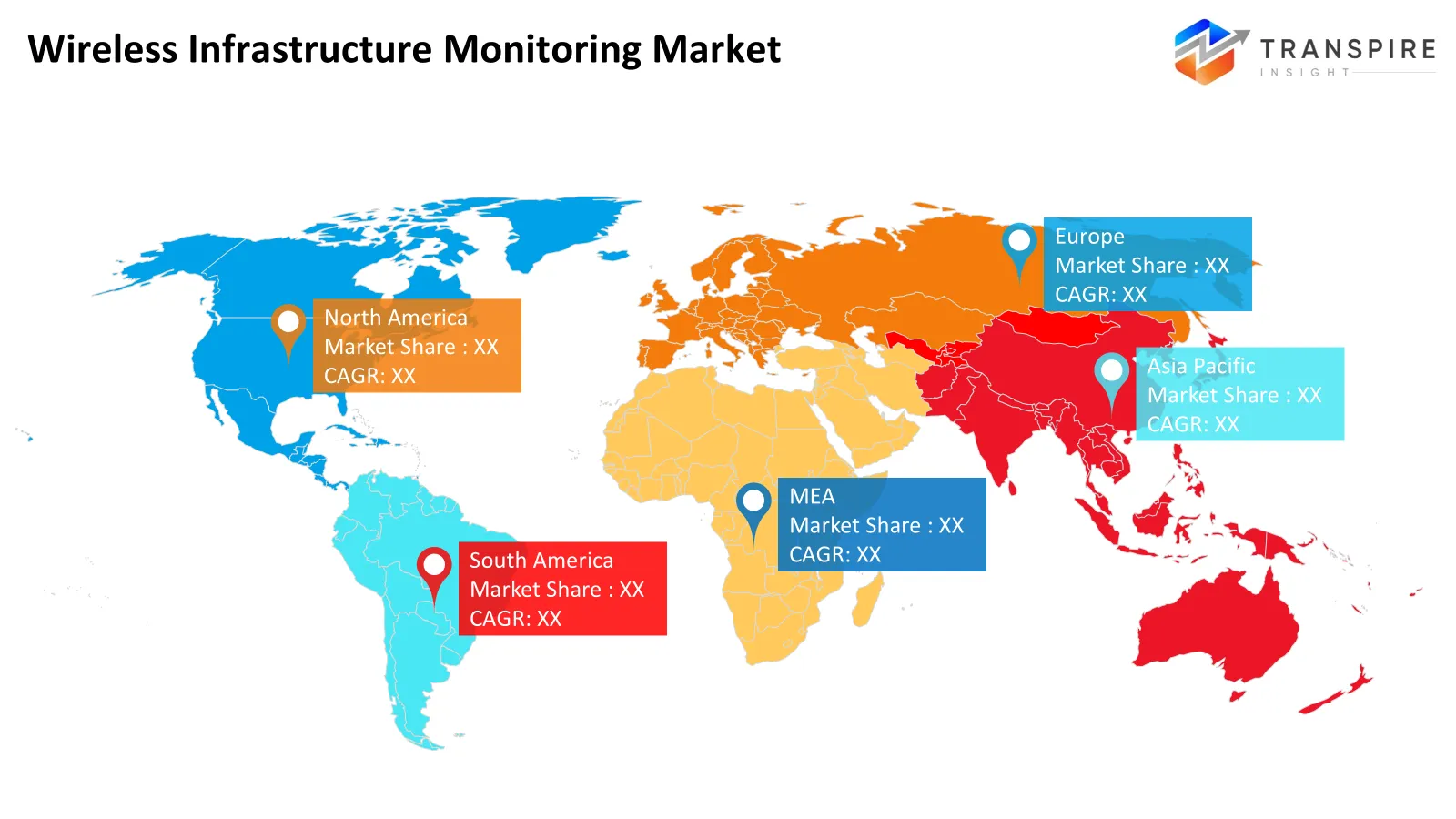
- Europe (Germany, France, U.K., Italy, Spain, Rest of Europe)
- North America (U.S., Canada, Mexico)
- Asia-Pacific (China, Japan, India, Rest of APAC)
- South America (Brazil and the Rest of South America)
- The Middle East and Africa (UAE, South Africa, Rest of MEA)
Asia Pacific is expected to grow at a rapid CAGR in the Wireless Infrastructure Monitoring Market, holding around 28% of the share during the forecast period.
Asia Pacific is likely to witness rapid growth in the Wireless Infrastructure Monitoring Market due to fast-paced infrastructure development, urbanization, smart cities projects, and industrial digitization. The growing demand for real-time monitoring and predictive maintenance solutions is driven by expanding transportation, energy, telecommunication, and industrial infrastructure in the region.
North America is the high-growth region in the Wireless Infrastructure Monitoring Market during the period, holding roughly 34% share.
North America is among the highest growth regions in the Wireless Infrastructure Monitoring Market owing to aging infrastructure, increased demands for asset safety, and adoption of IoT-based monitoring solutions. Investments in bridge construction, transportation systems, energy infrastructure, and industrial infrastructures are increasing the demand for real-time condition monitoring and predictive maintenance. With advanced wireless connectivity, cloud computing platforms, and existing programs for modernizing infrastructure, scalability and deployment of monitoring solutions becomes much easier in North America.
Europe is the fastest-growing region in the Wireless Infrastructure Monitoring Market during the period, holding nearly 28% share.
Europe is the fastest-growing region in the Wireless Infrastructure Monitoring Market owing to infrastructure modernization, increased demands for safety measures, and adoption of digital asset management technologies. Investments in transportation infrastructure, energy infrastructure, bridges, tunnels, and industrial infrastructure are increasing the demand for real-time monitoring and predictive maintenance. Increasing use of IoT sensors, wireless connectivity, cloud platforms, and artificial intelligence-based analytics increases visibility and efficiency in European markets.
Strategies for Market Growth in Non-Leading Regions:
Development of lagging regions by means of scalable and cost-effective wireless infrastructure monitoring technologies is likely to have positive implications for small to medium-sized infrastructure operators and service providers. Implementation of local wireless sensor networks, IoT-based monitoring systems, and regional data processing facilities is going to lower dependency on foreign monitoring tools and help to cut costs for the deployment and maintenance of the infrastructure monitoring technologies. Creating strategic partnerships with regional owners of infrastructure, engineering companies, energy firms, industrial organizations, and technology vendors will positively affect the sales of wireless infrastructure monitoring solutions. Training and improving professional skills of engineers and technicians in order to increase awareness in wireless sensing, connectivity, data analytics, cybersecurity, integration, and monitoring standards will be necessary. Besides, flexible financing, long-term service contracts, and monitoring as a service will help to make the infrastructure monitoring solutions cheaper and more attractive for implementation in developing countries. Development of collaboration programs in cooperation with governments, modernization of infrastructure, smart cities, transportation, and energy projects along with the use of digital sales and monitoring platforms will provide access to the wireless infrastructure monitoring solutions.
Future Market Trends for the Wireless Infrastructure Monitoring Market: -
- Transition to Predictive Maintenance: The increasing trend of wireless sensors and predictive analytics will facilitate fault detection in advance and increase asset lifespans by optimal maintenance scheduling.
- AI, Edge Computing, and Cloud Platforms: The integration of AI, edge computing, and cloud platforms will improve real-time anomaly detection, monitoring, predictive insights, and visibility of operations of distributed infrastructure assets.
- Regional Expansion and Monitoring: The demand in the APAC region is expected to remain robust, whereas the MEA region will see increased growth with megaprojects; LPWAN and 5G will increase remote monitoring of infrastructure.
Recent Development
- In May 20, 2026 - Launch: Emerson introduced the Synchros™ IIoT platform to provide additional visibility on the health of wireless assets using WirelessHART® technology and scalable continuous infrastructure monitoring.
- In June 2026 - Technology Launch: Platforms were launched that would allow monitoring protocols natively to gather information on vibrations and structural health from the existing PLCs without the need for any sensors or gateways.
- In March 2026 - Framework Launch: Wireless Broadband Alliance released its report “Enterprise Security for Private 5G Networks,” which promoted Zero-Trust security and centralized monitoring for wireless infrastructure in enterprises.
- In September 9, 2026 - Regulatory Development: The FCC issued a draft Report and Order dealing with NEPA Reviews for wireless infrastructure projects.
Market Segment
This study forecasts revenue at global, regional and country levels from 2020 to 2033. Transpire Insight has segmented the Wireless Infrastructure Monitoring Market based on the below-mentioned segments:
Wireless Infrastructure Monitoring Market, By Component
- Hardware
- Software
- Services
- Sensors
- Gateways
- Platforms
- Analytics
- Others
Wireless Infrastructure Monitoring Market, By Connectivity
- LPWAN
- Wi-Fi
- 5G/Cellular
- Bluetooth
- Zigbee
- LoRaWAN
- Satellite
- Others
Wireless Infrastructure Monitoring Market, By Application
- Structural Monitoring
- Corrosion Monitoring
- Environmental Monitoring
- Asset Monitoring
- Security Monitoring
- Energy Monitoring
- Traffic Monitoring
- Others
Wireless Infrastructure Monitoring Market, By Infrastructure Type
- Bridges & Tunnels
- Buildings
- Dams
- Roads
- Railways
- Renewable Energy Assets
- Pipelines
- Others
Wireless Infrastructure Monitoring Market, By Sensor
- Strain/Stress Gauges
- Accelerometers/Vibration Sensors
- Temperature Sensors
- Pressure Sensors
- TiltSensors
- Displacement Sensors
- Acoustic Sensors
- Others
Wireless Infrastructure Monitoring Market, By End User
- Civil Infrastructure Owners
- Utilities & Energy
- Transportation
- Construction
- Oil & Gas
- Government
- Industrial
- Others
Wireless Infrastructure Monitoring Market, By Deployment
- Fixed
- Mobile
- Remote
- Cloud-based
- On-premise
- Edge
- Hybrid
- Others
Non-Invasive Surgical Wound Closure Market, By Regional Analysis
North America
- US
- Canada
- Mexico
Europe
- Germany
- UK
- France
- Italy
- Spain
- Russia
- Rest of Europe
Asia Pacific
- China
- Japan
- India
- South Korea
- Australia
- Rest of Asia Pacific
South America
- Brazil
- Argentina
- Rest of South America
Middle East & Africa
- UAE
- Saudi Arabia
- Qatar
- South Africa
- Rest of the Middle East & Africa
Frequently Asked Questions
Find quick answers to common questions.
Aging infrastructure, predictive maintenance, IoT sensors, wireless connectivity, smart-city development, and increasing demand for real-time asset monitoring are driving market growth.
Wi-Fi dominates due to widespread availability, reliable connectivity, cost efficiency, and seamless integration with wireless monitoring systems and IoT platforms.
AI enables real-time anomaly detection, predictive maintenance, data analysis, operational visibility, and faster decision-making across distributed critical infrastructure assets.
Structural monitoring dominates due to aging infrastructure, safety requirements, continuous condition assessment, predictive maintenance adoption, and infrastructure integrity monitoring needs.
Key trends include predictive maintenance, AI integration, edge computing, cloud platforms, LPWAN connectivity, 5G deployment, and expanding remote infrastructure monitoring.
- Siemens
- Honeywell
- Schneider Electric
- ABB
- Emerson
- National Instruments
- Campbell Scientific
- Trimble
- Hitachi
- IBM
- Cisco
- Monnit
- Libelium
- Worldsensing
- Sensata Technologies
About the Authors

Mayur Shinde
I am Mayur Shinde, a Senior Research Analyst at Transpire Insight, specializing in the Automotive & Transportation and Information & Communication Technology (ICT) Industry. My work focuses on analyzing emerging market trends, technological advancements, competitive landscapes, and industry developments to deliver accurate, data-driven insights. I am passionate about transforming complex market information into clear, actionable content that helps businesses, professionals, and decision-makers stay informed and make confident strategic decisions.

Chakradhar Khansole
Chakradhar serves as the Research Director at Transpire Insight, bringing over 8 years of experience in technology, innovation, and strategic market intelligence. He specializes in transforming complex market data into actionable business insights that enable organizations to make informed, growth-oriented decisions. Recognized for his strategic vision and analytical expertise, Chakradhar leads high-impact research initiatives, delivering comprehensive market assessments, competitive intelligence, and forward-looking industry analysis.
Recently Published Reports
-
Apr 2026
3D Optical Profiler Market
3D Optical Profiler Market Size, Share & Analysis Report By Type (Desktop 3D Optical Profiler, and Portable 3D Optical Profiler), By Technology (Confocal Technology, and White Light Interference), By End-Use Industry (Manufacturing, Research Institutions, Automotive, Aerospace and Defense, Medical Devices, and Other), and Geography (North America, Europe, Asia-Pacific, Middle East and Africa, South and Central America), 2021 - 2031
-
Apr 2026
Depth Sensor Market
Depth Sensor Market Size, Share & Analysis Report By Type (Infrared Depth Sensors, Time-of-Flight (ToF) Sensors, Stereo Vision Sensors, Structured Light Sensors, Ultrasonic Depth Sensors), By Application (Automotive, Robotics, Gaming, Consumer Electronics, Industrial Automation, Healthcare, Security & Surveillance, Others), By End Users (Automotive Manufacturers, Consumer Electronics Companies, Healthcare Providers, Industrial Companies, Security Agencies, Gaming Companies, Robotics Companies, Others), and Geography (North America, Europe, Asia-Pacific, Middle East and Africa, South and Central America), 2021 – 2031
-
Apr 2026
Digital Manufacturing Market
Digital Manufacturing Market Size, Share & Analysis Report By Component (Hardware, Software, and Services), By Technology (Robotics, 3D Printing, Internet of Things (IoT), and Others), By Application (Automotive and Transportation, Aerospace and Defense, Consumer Electronics, Industrial Machinery, and Others), By Process Type (Computer-Based Designing, Computer-Based Simulation, Computer 3D Visualization, Analytics, and Others), and Geography (North America, Europe, Asia-Pacific, Middle East and Africa, South and Central America), 2021 – 2031
-
Apr 2026
Digital Visa Services Market
Digital Visa Services Market Size, Share & Analysis Report By Type (Individual Travelers, Group Travelers), By Application (Tourism, Business Travel, Others), and Geography (North America, Europe, Asia-Pacific, Middle East and Africa, South and Central America), 2021 – 2031