
Middle East and Africa Internet of Things Market Summary
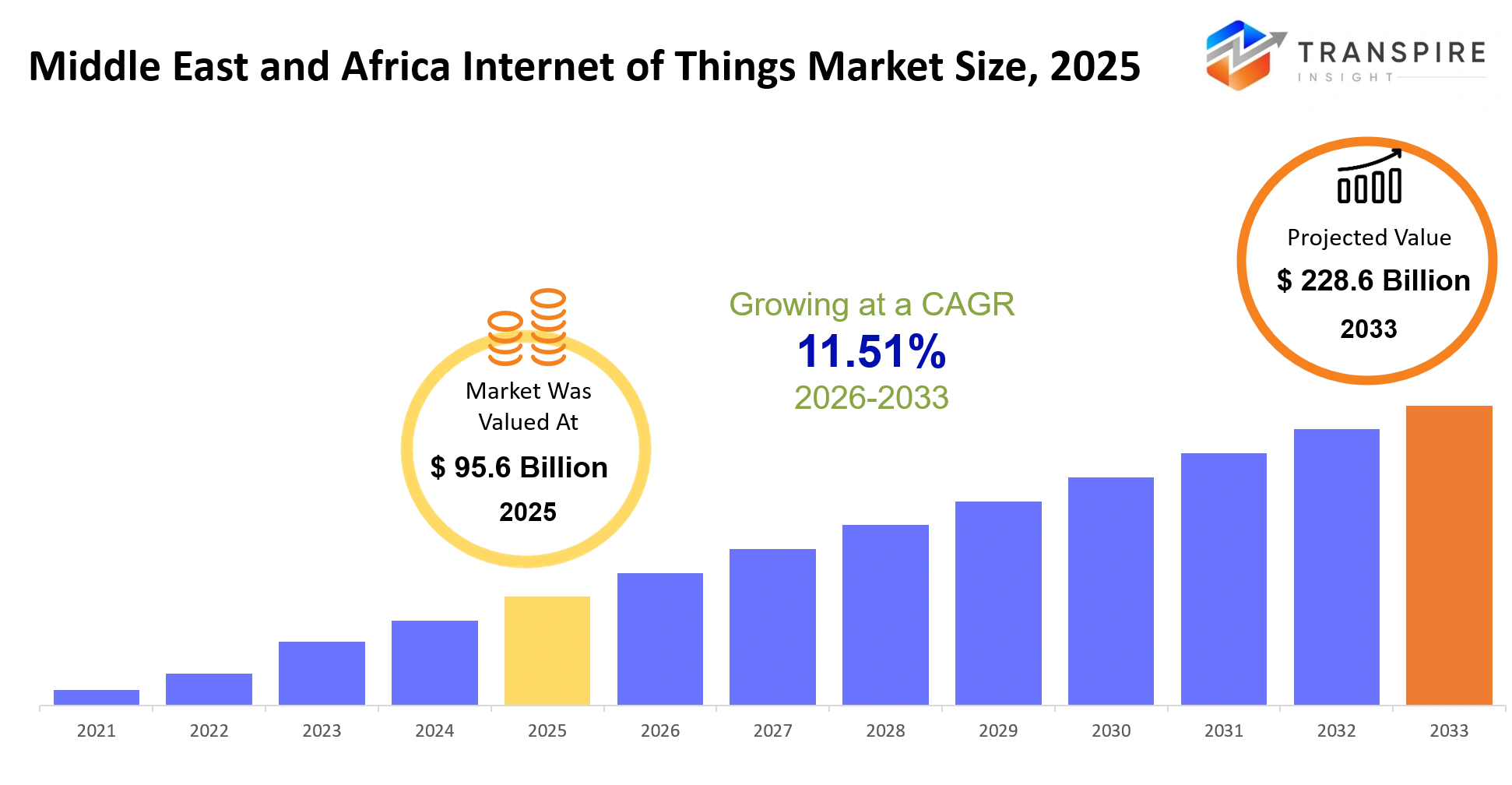
As per Transpire Insight Analysis the Middle East and Africa Internet of Things Market size is estimated at USD 95.6 Billion in 2025 and is anticipated to reach USD 228.6 Billion by 2033, growing at a CAGR of 11.51% from 2026 to 2033.
In the Middle East and Africa Internet of Things market, organizations kind of get a way to connect physical assets ,machines, cars and vehicles, utilities, and broader infrastructure using sensors plus intelligent networks. The whole point is to push out real-time operational data, sort of continuously. You’ll see this used in manufacturing, oil and gas, logistics, healthcare, utilities, and smart cities, where IoT platforms help improve asset utilization, cut downtime , bolster safety, and also help automate decision making.
Over the last five years, the market seems to move from separate or “standalone” IoT rollouts toward more integrated edge computing, AI-enabled analytics, and private 5G connectivity that can handle large-scale industrial use cases. And then the COVID-19 pandemic sped things up, because remote asset monitoring and digital operations became more necessary.Businesses have been looking for “ resilience” basically, with fewer folks on site, that sort of practical reality. Since then government-backed smart city programs, the more and more 5G buildout, and industrial digitalization efforts have turned those earlier trials into deployments across the whole enterprise. And now that change is pushing software, connectivity, and managed service revenues upward, while also making it easier to argue for long term investment on both the public and private sides.
Middle East and Africa Internet of Things Market Size & Forecast:
- Middle East and Africa Internet of Things Market Size 2025: USD 95.6 Billion
- Expected Market Value 2033: USD 228.6 Billion
- Forecast CAGR: 11.51%
- Leading region in 2025:
- Fastest Growing region:
- Key Profile: Cisco, Microsoft, IBM, Huawei, Siemens, Bosch, Intel, Qualcomm, SAP, Oracle, PTC, Schneider Electric, Honeywell, Ericsson, Nokia.
Key Market Insights
- The Middle East and Africa Internet of Things market is forecast to end up at about USD 228.6 Billion by 2033, while it also shows sustained enterprise digital transformation spend.
- In this region, the Middle East seems to hold the bigger chunk, with an estimated 68%+ market share in 2025, largely because smart city projects keep moving and industrial automation investments are really ramping.
- Africa, on the other hand, is expected to grow the quickest through 2033, supported by more widespread mobile connectivity , stronger digital infrastructure, plus smart agriculture initiatives that keep expanding every year.
- When it comes to components, hardware is still out front with roughly 34% market share , fueled by large-scale deployment of sensors, gateways, and other connected devices.
- Platforms and software sit next as the second-largest slice, since enterprises are expanding cloud-based IoT management and analytics, step by step.
- Edge computing solutions are projected to be the fastest-growing segment from 2026 to 2033, because it helps with lower latency and makes real-time industrial decisions much more feasible.
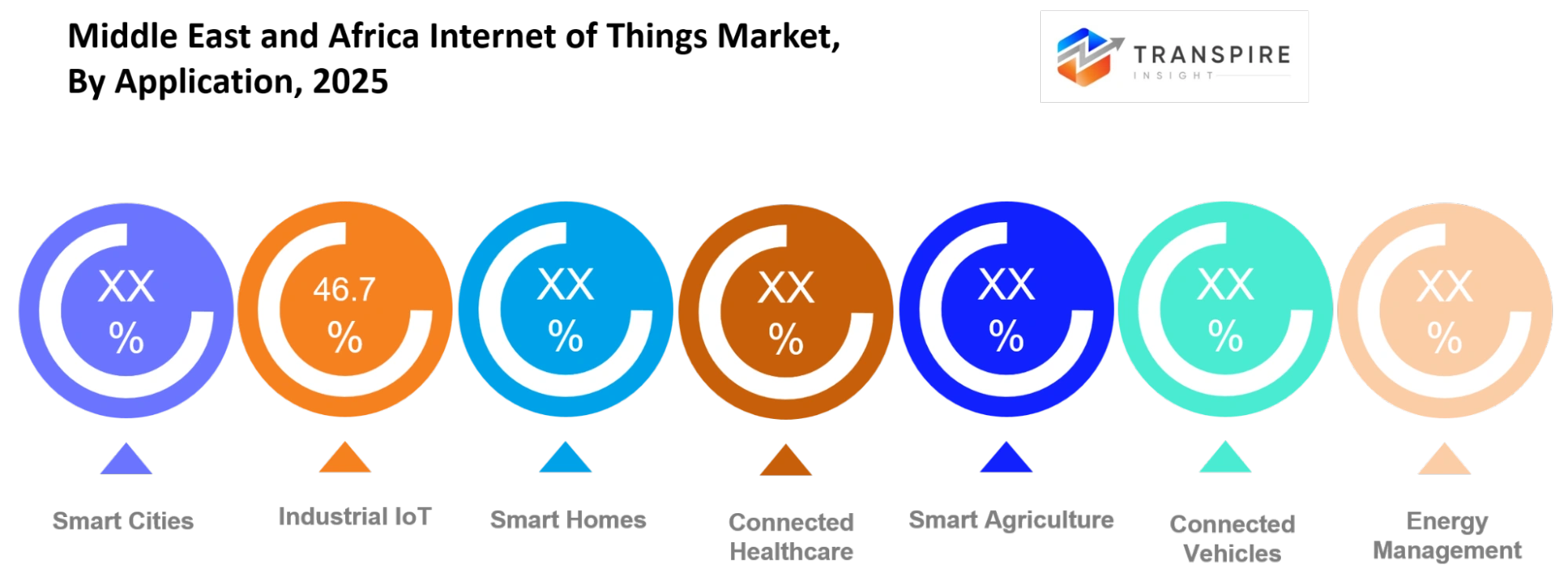
- Looking at what people actually use, Industrial IoT is close to 30% of application revenue, driven by predictive maintenance, production monitoring, and operational optimization.
- Connected healthcare is also picking up speed—one of the quicker applications—because remote patient monitoring is expanding and digital hospital initiatives are getting more attention.
- For end-users, Manufacturing remains the biggest category with around 28% market share, while energy and utilities are continuing to accelerate IoT rollouts, steadily.
- Key players like Cisco, Microsoft, IBM, Huawei, Siemens, Schneider Electric, Honeywell, Ericsson, Nokia, and SAP are working to strengthen their presence through AI-enabled platforms, industrial partnerships, cloud integration, and ongoing regional digital infrastructure investments.
What are the Key Drivers, Restraints, and Opportunities in the Middle East and Africa Internet of Things Market?
Main driver for market expansion is that digital transformation is moving really fast across industries, and it is backed by government supported smart infrastructure schemes and, also, 5G connectivity that keeps getting broader. Things like Saudi Vision 2030, the UAE Smart Cities programs and Industry 4.0 funding have pushed manufacturers, utilities, ports, plus logistics players to roll out connected sensors, sort of intelligent monitoring systems, and industrial analytics platforms. And when communication networks get more dependable, while cloud computing costs slowly decline, companies can link thousands of assets, improve maintenance scheduling, gain stronger operational visibility, and push resource efficiency a bit further. This overall movement boosts recurring income for IoT platforms, connectivity providers, software vendors and managed service partners.
The biggest restraint still feels like fragmented digital infrastructure, plus cybersecurity issues across multiple African economies. Broadband availability, cloud environments and skilled technical staff are not spread evenly, so large scale IoT rollouts tend to stall outside the biggest urban centers. On top of that, older industrial machinery often needs expensive upgrades first, before it can speak with modern digital platforms, and that kind of delay is hard. Because of these structural problems, enterprise adoption gets postponed, timelines stretch out, and revenue potential for solution providers gets suppressed.
There is also a solid opportunity by pairing IoT with artificial intelligence, and adding private 5G networks, across energy, mining, transport, and smart city environments. In practice industrial operators want autonomous asset monitoring, predictive upkeep, and real time operational intelligence, not just standalone sensor installations.
What Has the Impact of Artificial Intelligence Been on the Middle East and Africa Internet of Things Market?
Artificial intelligence has expanded, quite a lot, the value of connected device ecosystems by taking raw sensor data and turning it into something like actionable operational intelligence. In manufacturing plants, AI algorithms are used to kinda automate production monitoring , spot equipment anomalies, and tune maintenance timing before failures pop up. Utilities then bring in machine learning to forecast electricity demand, uncover network faults , and raise energy distribution efficiency. Meanwhile in oil and gas, those intelligent monitoring systems keep checking equipment conditions, pipeline integrity, and environmental signals, which can reduce unexpected downtime , while also backing up worker safety. Smart city operators on the other hand blend AI with IoT platforms to help steer traffic management, smart lighting, waste collection, and public safety systems, all of it powered by real time analytics or something like that.
Machine learning models, in plain terms , basically support predictive maintenance, by watching vibration patterns, temperature fluctuations, pressure shifts and historical equipment performance. With this, asset uptime gets better, maintenance expenses go down, and overall operational reliability gets strengthened across industrial facilities. AI-based analytics also assist with improved inventory management, logistics optimization, and more automated, decision making across connected supply networks.
Still, there’s a downside and it matters: high integration costs. A lot of organizations keep using older, legacy equipment that simply doesn’t play well with advanced AI-enabled IoT platforms. In multiple regions of Africa, uneven network coverage, constrained cloud infrastructure , and even shortages of skilled AI professionals add extra friction . All of that slows down rollout, so enterprises can’t realize the operational advantages of intelligent connected systems as fast as they would like.
Key Market Trends
- Since 2021 enterprises kind of moved away from those pilot IoT trials, and more toward enterprise wide digital transformation runs, with AI involved , plus cloud computing, and even edge analytics stuff.
- Meanwhile, government smart city efforts, across Saudi Arabia and the UAE, keep pushing connected infrastructure spending, not only for transport but also for utilities, healthcare, and public services .
- Manufacturers are also leaning harder into pairing IoT with predictive maintenance platforms, so unexpected equipment failures drop , and production planning feels a bit smoother, along with better day to day operational efficiency.
- On top of that private 5G rollouts have grown industrial IoT ability, because they deliver secure low latency connectivity for mission critical manufacturing, and energy workloads too.
- Cloud service providers have been putting more money into regional data centers since 2022 , which helps with scalability, compliance, and real time analytics capabilities.
- Industrial buyers then seem to care a lot about cybersecurity enabled IoT platforms, since ransomware incidents and infrastructure exposure risks are still shaping procurement decisions, almost every quarter.
- Also, AI powered analytics has now become normal inside modern IoT platforms. It’s more than plain monitoring; it shifts into automated operational recommendations, plus anomaly detection.
- Energy companies, for their part , are deploying connected sensors for pipeline monitoring, asset integrity management, and predictive maintenance, especially across remote operations where it matters.
- Healthcare providers keep growing remote patient monitoring and connected medical device ecosystems, trying to improve access to care in underserved regions.
- And the leading vendors, Cisco, Microsoft, Siemens, IBM, Huawei, Schneider Electric, Ericsson, and Nokia, continue to reinforce regional partnerships, cloud integration , and industrial AI capabilities.
Middle East and Africa Internet of Things Market Segmentation
By Component
Hardware kind of sits as the base for connected environments via gateways, controllers, communication modules, and embedded devices, which then gather and pass along operational data. Sensors pick up stuff like temperature pressure, motion, vibration, humidity and also location signals, so you can keep watching things across industrial sites, healthcare centers, and infrastructure projects. Then edge devices handle information nearer to where it happens, which cuts latency and makes response faster for those critical operations. There are also other component groups that step in for more specific needs, and those needs shift a lot between industrial setups and commercial deployments.
On the software side, it drives device management, analytics, security, and application creation. That lets the connected system deliver real business value, instead of only raw signals. Platforms pull together connected assets, data processing, visual dashboards, plus tie-ins with enterprise apps, all in one kind of unified environment. Services cover consulting, deployment, integration, maintenance, and managed support, so the whole rollout feels less messy and the long run stays stable. Connectivity, in turn, strings every piece together through dependable communication networks, and that keeps the data exchange moving continuously across distributed assets.
By Connectivity
5G kind of supports fast communication, low delay, and steady performance for industrial automation, self-directed systems, and smart infrastructure undertakings. Wi-Fi is still used a lot in enterprise buildings, campuses, hospitals, and commercial setups, where local reach helps keep connected activities running. Bluetooth gives short-range links for wearable gadgets, asset tracking, and consumer electronics. Meanwhile Zigbee supports very energy efficient communication, especially for smart lighting, building automation, and home-control systems. There are also other networking options that keep working for specific communication needs across different operating spaces, and well, mixed environments.
LoRaWAN works for long distance communication while keeping power use low, so it fits farming use cases, environmental observation, and remote infrastructure. NB-IoT supports efficient messaging for utility meters, parking arrangements, and smart city services, where low bandwidth connectivity is the point. Satellite IoT expands the coverage to mining sites, offshore energy installations, and isolated industrial areas, where ground based infrastructure is limited. Picking connectivity comes down to coverage, the bandwidth you actually need, energy consumption, the deployment cost, and the operational needs you have.
By Application
Industrial IoT still feels like the main play, you know, especially with equipment monitoring, predictive maintenance, process automation, and production optimization across both manufacturing and energy places. Smart cities also help in the real world with public services, through intelligent traffic control, lighting that’s actually connected, environmental monitoring, and then managing digital infrastructure kind of end to end. Smart homes go more toward security plus energy efficiency, appliance control, and home automation using connected devices, which is pretty standard now, but still. Energy management solutions help tune down electricity use and raise operational efficiency across commercial and industrial facilities, which is a win for everyone.
Connected healthcare backs up patient monitoring, hospital asset management, and digital health services by leveraging connected medical equipment. Smart agriculture supports irrigation control, livestock monitoring, weather observation, and precision farming, helping productivity along while improving resource management at the same time. Connected vehicles, meanwhile, make fleet tracking easier, support route optimization, improve driver safety, and enable predictive maintenance across transportation networks.
And really, the other uses keep growing, because organizations keep spotting new operational needs, and also new digital service opportunities, sort of continuously.
By End User
Manufacturing kinda ends up being the biggest end-user segment, since connected production systems boost efficiency , equipment utilization, better quality control, and real operational visibility, you know. Energy and utilities also lean on connected infrastructure for grid monitoring , pipeline management, doing asset inspection, and predictive maintenance, which in turn backs up dependable service delivery. Transportation organizations roll out connected tech for fleet management, logistics optimization, cargo tracking, and even infrastructure monitoring. Government agencies keep putting money into digital public infrastructure, that really supports urban development as well as modernization of public services.
In healthcare, organizations integrate connected systems for patient monitoring, medical equipment tracking, plus day-to-day hospital operations that help raise service quality and make resource utilization feel smoother. Retail businesses adopt connected technologies to get inventory visibility, improve customer engagement, and tighten supply chain optimization. Agriculture gets a boost from connected irrigation systems, environmental sensors, and livestock monitoring, and that leads to better productivity alongside more resource efficiency. Other industries are still moving toward connected solutions based on what their operational priorities look like, and on their broader digital transformation strategies.
By Deployment
Cloud based deployment helps with scalable data storage , centralized management, and remote access, while also trimming down infrastructure complexity for enterprises that are working across a bunch of different locations. On the other side, edge computing handles information near the connected assets, so decisions come faster , especially for industrial automation and those time sensitive applications. Meanwhile , on premise deployment still matters a lot for organizations that want direct control over their infrastructure, security, and regulatory compliance. Hybrid deployment is kind of the middle ground, it mixes cloud flexibility with local processing, to juggle performance, safety, and day to day operational needs.
Then there’s AI integrated IoT that strengthens connected environments using predictive analytics, anomaly detection , automated decision support, and more intelligent process optimization. Private networks give secure, dedicated communication, which is useful in industrial facilities energy operations, and critical infrastructure projects that have strict performance expectations. Public networks still matter too, because they provide wide connectivity, supporting commercial rollouts and consumer style applications across large geographic regions. And of course , other deployment approaches keep showing up, they keep serving specialized operational needs across different industries, depending on what’s required.
What are the Key Use Cases Driving the Middle East and Africa Internet of Things Market?
Industrial automation is probably the most relevant use case, especially when you look at manufacturing and energy facilities. Stuff like connected production equipment, predictive maintenance approaches, and real time asset monitoring… all of that helps cut downtime , boosts operational efficiency, and makes it easier to keep production going with better use of resources too.
At the same time smart city infrastructure and connected healthcare keep growing across the region. City leaders typically roll out intelligent traffic management, linked lighting systems, and environmental monitoring. In healthcare, providers lean on remote patient monitoring and connected medical devices, so service delivery improves while day to day operations run more efficiently.
More new applications are showing up too, think precision agriculture and connected mining operations. Smart irrigation , soil monitoring, livestock tracking, and remote equipment management support higher productivity in agriculture. And for mining, connected sensing plus autonomous monitoring, strengthen safety and overall operational performance across those sites during the forecast period.
|
Report Metrics |
Details |
|
Market size value in 2025 |
USD 95.6 Billion |
|
Market size value in 2026 |
USD 106.6 Billion |
|
Revenue forecast in 2033 |
USD 228.6 Billion |
|
Growth rate |
CAGR of 11.51% from 2026 to 2033 |
|
Base year |
2025 |
|
Historical data |
2021 - 2024 |
|
Forecast period |
2026 - 2033 |
|
Report coverage |
Revenue forecast, competitive landscape, growth factors, and trends |
|
Regional scope |
Middle East and Africa (Saudi Arabia, United Arab Emirates, South Africa, Rest of Middle East and Africa) |
|
Key company profiled |
Cisco, Microsoft, IBM, Huawei, Siemens, Bosch, Intel, Qualcomm, SAP, Oracle, PTC, Schneider Electric, Honeywell, Ericsson, Nokia. |
|
Customization scope |
Free report customization (country, regional & segment scope). Avail customized purchase options to meet your exact research needs. |
|
Report Segmentation |
By Component (Hardware, Software, Connectivity, Platforms, Services, Sensors, Edge Devices, Others); By Connectivity (5G, Wi-Fi, Bluetooth, Zigbee, LoRaWAN, NB-IoT, Satellite IoT, Others); By Application (Smart Cities, Industrial IoT, Smart Homes, Connected Healthcare, Smart Agriculture, Connected Vehicles, Energy Management, Others); By End User (Manufacturing, Healthcare, Retail, Energy & Utilities, Transportation, Government, Agriculture, Others); By Deployment (Cloud-Based, Edge Computing, On-Premise, Hybrid, AI-Integrated IoT, Private Networks, Public Networks, Others). |
Which Regions are Driving the Middle East and Africa Internet of Things Market Growth?
The Middle East stays kind of the dominant regional market because national digital transformation initiatives have already moved past the early pilot phase and now, they’re going into big scale rollouts across industry, energy, logistics, and even public infrastructure— you can see it clearly in how they plan things. Saudi Arabia and the United Arab Emirates keep funding smart cities, industrial automation, hyperscale data centers, and nationwide 5G networks, which then sets up strong conditions for connected technologies. Modern ports, improved logistics corridors, and regulatory rules that are supportive also help push deployments across transportation and supply chain operations. There’s also a fairly mature ecosystem—cloud providers, telecom operators, system integrators, and global technology companies— that keeps regional leadership alive by backing enterprise-level implementation and long term managed services
Africa, on the other hand, shows up as the second-largest regional contributor, even if the way the market grows is not quite the same as in the Middle East. The expansion depends less on huge government megaprojects and more on consistent spending in telecommunications, financial services, agriculture, and the modernization of utilities across countries like South Africa, Kenya, Nigeria, and Egypt. Mobile network growth, digital payment ecosystems, and enterprise connectivity programs help maintain steady adoption across both public and private areas. Broader economic diversification, better digital infrastructure, and ongoing investment from communication service providers make Africa a reliable source for long term market revenue.
Meanwhile the Gulf Cooperation Council countries look like the fastest-growing part during the forecast period, mostly because newer investments have sped up industrial digitalization and encouraged private 5G deployment.
Who are the Key Players in the Middle East and Africa Internet of Things Market and How Do They Compete?
Competition stays moderately consolidated, because major global technology providers pretty much steer the enterprise platform, connectivity, and industrial automation space, while regional system integrators do the more local tuning, and adapt deployments to what each industry really needs. In practice tech know how, cybersecurity, cloud integration, and these industry tailored solutions matter more, than pure hardware pricing, I mean. Vendors also seem to move faster toward end-to-end digital ecosystems where connectivity, analytics, artificial intelligence, and managed services are bundled together, instead of selling a lonely standalone connected device.
Cisco then leans into secure networking, industrial connectivity, and lifecycle governance through its IoT Control Center platform, which helps enterprises oversee connected assets across broad, sprawling geographic regions. Microsoft goes with cloud-native IoT services on Azure, so organizations can plug in artificial intelligence, analytics, and enterprise applications inside one digital environment, kind of seamlessly. Siemens, for its part, keeps tightening its grip via industrial automation, digital twins, and factory software, linking operational technology with enterprise information systems for manufacturing and energy customers.
Schneider Electric expands using the EcoStruxure platform, bringing energy management, industrial automation, and intelligent building technologies into one integrated blueprint. Honeywell specializes in connected industrial operations by blending operational technology with predictive maintenance, plus asset performance management, across energy, manufacturing, and infrastructure projects.
Company Lis
- Cisco
- Microsoft
- IBM
- Huawei
- Siemens
- Bosch
- Intel
- Qualcomm
- SAP
- Oracle
- PTC
- Schneider Electric
- Honeywell
- Ericsson
- Nokia
Recent Development News
In May 2025, Cisco announced participation in the AI Infrastructure Partnership (AIP) alongside Microsoft, NVIDIA, BlackRock, MGX, and Global Infrastructure Partners. The initiative aims to mobilize up to USD 100 billion for AI-ready digital infrastructure, strengthening future IoT and edge computing ecosystems.
Source: https://newsroom.cisco.com
In 2025, Schneider Electric and Cisco expanded their long-standing co-innovation partnership for Industrial IoT and smart building solutions. The collaboration enhances IT and OT convergence, cybersecurity, and EcoStruxure integration for industrial and commercial customers pursuing digital transformation.
Source: https://www.se.com
What Strategic Insights Define the Future of the Middle East and Africa Internet of Things Market?
The market is kinda moving toward intelligent, autonomous connected ecosystems where artificial intelligence, edge computing, and private wireless networks become like standard parts of enterprise operations, rather than optional little add-ons. You can see this structural shift happening because industrial digitalization is picking up speed, smart infrastructure investment keeps growing, and enterprises really want real-time operational intelligence so they can make faster business decisions… or at least that’s the goal.
There’s also a risk that’s a bit less obvious, it’s more about getting too reliant on a small set of global cloud and platform providers. That can then turn into issues around interoperability, cybersecurity concerns, and vendor concentration, which is not minor, honestly.
But there is an opportunity too. For example, AI-enabled edge computing could be rolled out across mining, renewable energy, and other remote industrial operations throughout Africa. In that setting, local data processing helps bypass connectivity limitations, which matters in practical terms. Market participants should focus on open, interoperable platforms, backed by solid regional partnerships. That way future expansion is easier, without accidentally causing long-term technology lock-in, while still keeping pace with changing regulatory expectations and industrial requirements.
Middle East and Africa Internet of Things Market Report Segmentation
By Component
- Hardware
- Software
- Connectivity
- Platforms
- Services
- Sensors
- Edge Devices
- Others
By Connectivity
- 5G
- Wi-Fi
- Bluetooth
- Zigbee
- LoRaWAN
- NB-IoT
- Satellite IoT
- Others
By Application
- Smart Cities
- Industrial IoT
- Smart Homes
- Connected Healthcare
- Smart Agriculture
- Connected Vehicles
- Energy Management
- Others
By End User
- Manufacturing
- Healthcare
- Retail
- Energy & Utilities
- Transportation
- Government
- Agriculture
- Others
By Deployment
- Cloud-Based
- Edge Computing
- On-Premise
- Hybrid
- AI-Integrated IoT
- Private Networks
- Public Networks
- Others
Frequently Asked Questions
Find quick answers to common questions.
The expected Middle East and Africa Internet of Things Market size for the market will be USD 228.6 Billion in 2033.
Key segments for the Middle East and Africa Internet of Things Market are By Component (Hardware, Software, Connectivity, Platforms, Services, Sensors, Edge Devices, Others); By Connectivity (5G, Wi-Fi, Bluetooth, Zigbee, LoRaWAN, NB-IoT, Satellite IoT, Others); By Application (Smart Cities, Industrial IoT, Smart Homes, Connected Healthcare, Smart Agriculture, Connected Vehicles, Energy Management, Others); By End User (Manufacturing, Healthcare, Retail, Energy & Utilities, Transportation, Government, Agriculture, Others); By Deployment (Cloud-Based, Edge Computing, On-Premise, Hybrid, AI-Integrated IoT, Private Networks, Public Networks, Others).
Major Middle East and Africa Internet of Things Market players are Cisco, Microsoft, IBM, Huawei, Siemens, Bosch, Intel, Qualcomm, SAP, Oracle, PTC, Schneider Electric, Honeywell, Ericsson, Nokia.
The Middle East and Africa Internet of Things Market size is USD 95.6 Billion in 2025.
The Middle East and Africa Internet of Things Market CAGR is 11.51% from 2026 to 2033.
- Cisco
- Microsoft
- IBM
- Huawei
- Siemens
- Bosch
- Intel
- Qualcomm
- SAP
- Oracle
- PTC
- Schneider Electric
- Honeywell
- Ericsson
- Nokia
About the Authors

Mayur Shinde
I am Mayur Shinde, a Senior Research Analyst at Transpire Insight, specializing in the Automotive & Transportation and Information & Communication Technology (ICT) Industry. My work focuses on analyzing emerging market trends, technological advancements, competitive landscapes, and industry developments to deliver accurate, data-driven insights. I am passionate about transforming complex market information into clear, actionable content that helps businesses, professionals, and decision-makers stay informed and make confident strategic decisions.

Chakradhar Khansole
Chakradhar serves as the Research Director at Transpire Insight, bringing over 8 years of experience in technology, innovation, and strategic market intelligence. He specializes in transforming complex market data into actionable business insights that enable organizations to make informed, growth-oriented decisions. Recognized for his strategic vision and analytical expertise, Chakradhar leads high-impact research initiatives, delivering comprehensive market assessments, competitive intelligence, and forward-looking industry analysis.
Recently Published Reports
-
Apr 2026
3D Optical Profiler Market
3D Optical Profiler Market Size, Share & Analysis Report By Type (Desktop 3D Optical Profiler, and Portable 3D Optical Profiler), By Technology (Confocal Technology, and White Light Interference), By End-Use Industry (Manufacturing, Research Institutions, Automotive, Aerospace and Defense, Medical Devices, and Other), and Geography (North America, Europe, Asia-Pacific, Middle East and Africa, South and Central America), 2021 - 2031
-
Apr 2026
Depth Sensor Market
Depth Sensor Market Size, Share & Analysis Report By Type (Infrared Depth Sensors, Time-of-Flight (ToF) Sensors, Stereo Vision Sensors, Structured Light Sensors, Ultrasonic Depth Sensors), By Application (Automotive, Robotics, Gaming, Consumer Electronics, Industrial Automation, Healthcare, Security & Surveillance, Others), By End Users (Automotive Manufacturers, Consumer Electronics Companies, Healthcare Providers, Industrial Companies, Security Agencies, Gaming Companies, Robotics Companies, Others), and Geography (North America, Europe, Asia-Pacific, Middle East and Africa, South and Central America), 2021 – 2031
-
Apr 2026
Digital Manufacturing Market
Digital Manufacturing Market Size, Share & Analysis Report By Component (Hardware, Software, and Services), By Technology (Robotics, 3D Printing, Internet of Things (IoT), and Others), By Application (Automotive and Transportation, Aerospace and Defense, Consumer Electronics, Industrial Machinery, and Others), By Process Type (Computer-Based Designing, Computer-Based Simulation, Computer 3D Visualization, Analytics, and Others), and Geography (North America, Europe, Asia-Pacific, Middle East and Africa, South and Central America), 2021 – 2031
-
Apr 2026
Digital Visa Services Market
Digital Visa Services Market Size, Share & Analysis Report By Type (Individual Travelers, Group Travelers), By Application (Tourism, Business Travel, Others), and Geography (North America, Europe, Asia-Pacific, Middle East and Africa, South and Central America), 2021 – 2031