

Healthcare Management Service Organization Market Summary:
According to Transpire Insight, a detailed research report on the market reflects that the revenue cycle management services segment dominates the Healthcare Management Service Organization Market, accounting for approximately 68% of the market share. Conifer Health Solutions is among the leading market participants, supported by its broad revenue-cycle management, patient access, and healthcare operations capabilities, contributing to market development, service innovation, digital healthcare management, and evolving healthcare outsourcing dynamics.
Market Snapshot
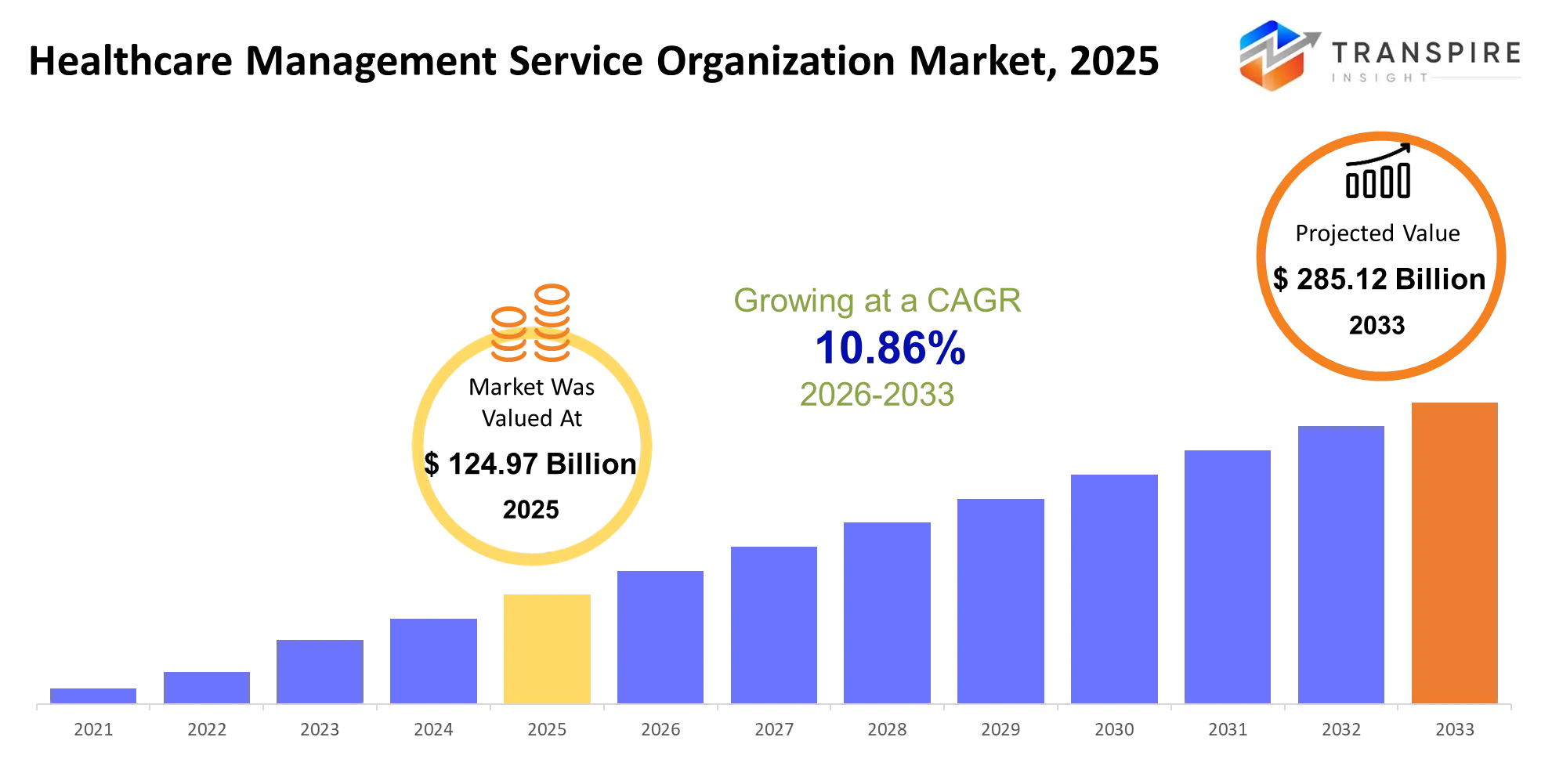
- Market Value (2025): USD 124.97 Billion.
- Expected Market Value (2026): USD 138.54 Billion.
- Estimated Market Value (2033): USD 285.12 Billion.
- Forecast CAGR (2026-2033): 10.86%
- Leading Region in 2025: North America
- Second-largest Region: Europe
- Fastest Growing Region: Asia Pacific
Introduction
Healthcare Management Services Organization (MSO) is an independent organization providing non-medical, non-clinical administrative assistance services such as billing, compliance, IT, human resources, etc., for medical practices and healthcare providers. The Management Services Organization (MSO) industry includes the entire commercial sphere associated with these administrative companies, networks of investors, and private equity firms collaborating with the physician-owned professional corporations for the purpose of making the business operations more efficient and handling medical regulations. The Management Services Organization (MSO) is the business component of the company. It can be owned by anyone, including non-physicians, corporations, and even private equity firms. The MSO owns the property, purchases medical equipment, and handles all back office infrastructure. The Healthcare Management Services Organization Market offers substantial advantages in terms of operation and finances as it allows healthcare facilities to entrust them with complex non-clinical operations. MSOs enhance operational effectiveness through HR management, IT, administration, and regulatory compliance. Specific RCM solutions make healthcare billing more efficient, decrease claim denials, and ensure more consistent cash flow. Centralization of procurement and the infrastructure helps in achieving economies of scale and improving procurement and vendor management practices. Dedicated compliance staff allows healthcare facilities to comply with regulatory requirements, including those related to HIPAA, while minimizing administrative risk. By delegating non-clinical duties to specialized management companies, physicians and clinicians can focus on healthcare delivery and quality.
For instance:- The MSO healthcare market in South Africa is growing at an incredibly rapid rate due to the digitalization of healthcare and NHI reforms. The private equity market is being heavily utilized to finance administration and management tools through companies such as RH Managers in South Africa and Discovery Health which have acquired MSO International.
Market Highlights: -
- North America is anticipated to hold roughly 49% share of the Healthcare Management Service Organization Market over the predicted timeframe.
- Europe is expected to grow at a rapid CAGR in the Healthcare Management Service Organization Market by holding roughly 25% of the share during the forecast period.
- Asia Pacific is anticipated to hold roughly 15% share of the Healthcare Management Service Organization Market over the predicted timeframe.
- By service, the Billing & Coding segment dominated the market and holds nearly 28% share in 2025 and is projected to grow at a substantial CAGR during the forecast period.
- By ownership, the Private segment dominated the market and holds nearly 30% share in 2025 and is projected to grow at a substantial CAGR during the forecast period.
- By end user, the Hospitals segment dominated the market and holds nearly 40% share in 2025 and is projected to grow at a substantial CAGR during the forecast period.
- Expansion of Ayushman Bharat PM-JAY Scheme to Citizens Over the Age of 70 Years Could Enhance Healthcare Utilization, Hospital Management, Claim Settlements, Coordination with Patients, and Health Care Management Through Technology.
How is Technology Driving Growth in the Healthcare Management Service Organization Market?
AI is rapidly influencing such markets as Healthcare Management Service Organization with technologies like predictive analytics, cloud computing, IoMT, and healthcare managed IT services. Solutions based on AI help to optimize the process of clinical documentation, automate processes related to administration, provide predictive risk assessment, etc. Cloud computing systems provide scalability of data management, interoperability, secure data sharing, and coordination of operations within healthcare organizations. IoMT devices and wearables help to monitor patients in real time and implement personalized and proactive approaches to patient care. In addition, the increasing demand for managed IT services, cybersecurity, infrastructure modernization, etc., is observed among healthcare management organizations.
|
Report Metrics |
Details |
|
Market size value in 2025 |
USD 124.97 Billion |
|
Market size value in 2026 |
USD 138.54 Billion |
|
Revenue forecast in 2033 |
USD 285.12 Billion |
|
Growth rate |
CAGR of 10.86% from 2026 to 2033 |
|
Base year |
2025 |
|
Historical data |
2021 - 2024 |
|
Forecast period |
2026 - 2033 |
|
Report coverage |
Revenue forecast, competitive landscape, growth factors, and trends |
|
Regional scope |
United States; Canada; Mexico; United Kingdom; Germany; France; Italy; Spain; Denmark; Sweden; Norway; China; Japan; India; Australia; South Korea; Thailand; Brazil; Argentina; South Africa; Saudi Arabia; United Arab Emirates |
|
Key company profiled |
Optum, Cardinal Health, McKesson, Conifer Health Solutions, R1 RCM, Envision Healthcare, Agilon Health, Privia Health, Tivity Health, TeamHealth, HCA Healthcare, Mednax, ApolloMD, VillageMD, Surgery Partners |
|
Customization scope |
Free report customization (country, regional & segment scope). Avail customized purchase options to meet your exact research needs. |
|
Report Segmentation |
By Service (Administrative Services, Revenue Cycle Management, Billing & Coding, HR Management, IT Services, Procurement, Compliance, Others); By Healthcare Setting (Hospitals, Physician Practices, Clinics, Ambulatory Surgery Centers, Specialty Centers, Diagnostic Centers, Dental Practices, Others); By Organization Size (Large, Medium, Small, Multisite, Independent, Integrated, Academic, Others); By Management Function (Finance, Operations, HR, IT, Supply Chain, Marketing, Compliance, Others); By Ownership (Private, Public, Non-profit, Investor-owned, Physician-owned, Hospital-owned, PE-backed, Others); By Delivery Model (On-site, Remote, Hybrid, Shared Services, Outsourced, Managed Services, SaaS-enabled, Others); By End User (Healthcare Providers, Medical Groups, Hospitals, Clinics, Specialty Practices, Healthcare Networks, ASCs, Others) |
Market Drivers
The Healthcare Management Services Organization Market is propelled by the shift towards value-based healthcare, motivating the adoption of efficient management systems from healthcare practitioners. Increased private equity funding is fueling the trend of practice consolidation and MSO development, which allows for increased efficiency and economies of scale. The increasing complexities of administration, regulation, and the cost of running a healthcare practice are leading more doctors to hire specialized MSOs to take care of their administration needs, leaving them to concentrate on patient care. Aging populations, chronic illnesses, and developments in EHRs, healthcare analytics, and digital management technologies are driving more demand for MSOs. The Healthcare Management Services Organization (MSO) offers several advantages in terms of operations and finance by removing complicated management responsibilities from the clinicians, such as billing, human resources, information technology, and regulatory requirements. The centralization in infrastructure offers economies of scale and improves the efficiency of procurement and reduces the cost of management. Moreover, the MSO helps in better value-based care preparedness through better analytics, reporting, and population health management. The standard workflows, governance models, and IT platform help to offer the operational scalability while also helping in acquiring new patients and growing the practices. Additionally, the partnership with an MSO may help in improving financial liquidity, financing, and succession planning.
For Instance: -
- The Russian market for services in healthcare management services organization (MSO) business is transforming itself into a hybrid public-private approach. Investments in the sector are significantly motivated by the government's IT upgrades and infrastructure, as well as telemedicine.
- The Europe Healthcare MSO market has been witnessing consistent growth due to factors such as digitalization, GDPR, and demographic changes. Private equity, infrastructure and sovereign wealth funds have started making investments in dedicated platforms which include orthopedic care, oncology, and mental healthcare sectors.
Restrain
The challenges that exist within the Healthcare Management Services Organization (MSO) market include the regulatory hurdles such as the Corporate Practice of Medicine legislation, anti-kickback regulations, and the rising private equity concerns in relation to the health care sector’s consolidation. Issues related to clinical independence may affect the relationship with the physicians, while other factors such as EHR integration may raise operational costs.
|
Driver |
Relative Impact on Growth (%) |
Geographic Relevance |
Impact Timeline |
Demand Strength |
Growth Mechanism |
Key Beneficiaries |
Major Constraint |
|
Administrative Outsourcing and Regulatory Complexity |
24% |
North America, Europe |
Short-term |
High |
Outsources complex administrative functions to specialized MSOs |
MSOs, healthcare providers, technology vendors |
Regulatory restrictions complicate MSO structures |
|
Revenue Cycle Management and Billing Optimization |
23% |
North America, Europe |
Short-term |
High |
Improves claims processing, reimbursement, and cash-flow efficiency |
RCM providers, hospitals, physician practices |
Integration complexity can increase implementation costs |
|
Value-Based Care Adoption |
21% |
North America, Europe |
Medium-term |
High |
Enables analytics, reporting, and population-health management |
MSOs, healthcare networks, physician groups |
Complex outcome measurement requirements constrain adoption |
|
Private Equity Investment and Practice Consolidation |
18% |
North America, Europe |
Medium-term |
High |
Funds MSO platforms and expands consolidated practice networks |
MSOs, investors, physician practices |
Regulatory scrutiny may restrict consolidation activity |
|
Healthcare Digitalization and AI Adoption |
14% |
North America, Asia Pacific |
Long-term |
High |
Automates workflows and strengthens technology-enabled management services |
Technology vendors, MSOs, healthcare providers |
Cybersecurity and interoperability challenges limit scalability |
Analysis of Prices and Consumer Behaviour
The dominant player in the healthcare management service organization market is revenue cycle management services (accounting for 68.36% of the total market share in 2024; mostly owing to the requirement among the healthcare providers to increase their reimbursement, claims processing, and financial efficiency). The demand for technology-enabled revenue cycle management services is being fueled by the increasing adoption of artificial intelligence-powered denial management, which is expected to grow at a CAGR of 11.23% till 2030, owing to the rising adoption of automated financial and administrative operations. In addition, around 43.55% of the total market in 2024 consisted of medium-size practices (having between 6-25 physicians), owing to their requirement for outsourcing in revenue cycle, operations, and administration. The demand for purchasing is driven by the requirement for integration management services such as revenue cycle management, practice operations, compliance, IT/EHR and cybersecurity among healthcare providers. Primary Care accounted for around 34.67% of the total market in 2024 owing to the size of primary care practices and the adoption of value-based care models. The pattern of purchasing activity among health care organizations shows that there is a concentration of 49.77% of the market within North America in 2024 due to their advanced health care system and use of management service organization approach. Further, the remaining 39.58% of the market share is of the private equity funded MSOs in 2024.
|
Investment Factor |
Why It Matters to Investors |
Opportunity |
Investment Implication |
|
Market Growth Potential |
Report projects strong expansion from 2025-2033, indicating substantial addressable-market growth. |
Scalable MSO platforms and outsourced healthcare administration. |
Medium- to long-term expansion opportunity |
|
Revenue Cycle Management |
RCM represents approximately 68% of market share, demonstrating significant service demand. |
Billing, coding, claims optimization, denial management, and revenue integrity. |
Prioritize recurring, technology-enabled RCM services |
|
AI and Digitalization |
AI, cloud, predictive analytics, IoMT, and automation are transforming MSO operations. |
AI-enabled RCM, analytics, workflow automation, and interoperable platforms. |
Technology investment supports scalable service delivery |
|
Value-Based Care |
Providers require analytics, reporting, risk management, and population-health capabilities. |
Value-based-care enablement for physician groups and healthcare networks. |
Medium-term opportunity for integrated MSO platforms |
|
Practice Consolidation & Private Equity |
Private equity investment is supporting MSO development and healthcare practice consolidation. |
Platform acquisitions, physician-network expansion, and shared-service models. |
M&A opportunities exist alongside regulatory exposure |
|
Regional Expansion |
North America leads while Asia Pacific represents an important growth market. |
Regional MSO infrastructure and technology-enabled administrative services. |
Long-term expansion opportunity beyond mature markets |
Who are the Key Players in the Healthcare Management Service Organization Market and how do they compete?
The competitiveness of the international market of healthcare management service organizations is determined by those companies, which deal with providing healthcare management solutions, revenue cycle management, value-based care, patient engagement and the development of technology-enabled healthcare service networks. Competitive not only in price but in terms of operating efficiency, digital healthcare platforms, data analysis, AI-enabled management and integration with healthcare providers and enterprises, in this way of competing, it is possible not only to introduce innovations in healthcare service delivery but also to ensure the effectiveness, profitability, results in treating patients and increased operational transparency for healthcare organizations.
In the same way, Conifer Health Solutions can build up its competitive advantage in the market, developing technology-enabled healthcare management solutions, revenue cycle management services and value-based care capabilities. Through the creation of comprehensive healthcare management and revenue cycle solutions designed for healthcare organizations (hospitals, health systems, physician organizations), companies gain the advantage over their competitors. Optum builds up its competitive advantage by providing integrated healthcare management, analytics, technology and administrative solutions, facilitating the work of healthcare providers and payers.
Top Companies in the Healthcare Management Service Organization Market
- Optum
- Cardinal Health
- McKesson
- Conifer Health Solutions
- R1 RCM
- Envision Healthcare
- Agilon Health
- Privia Health
- Tivity Health
- TeamHealth
- HCA Healthcare
- Mednax
- ApolloMD
- VillageMD
- Surgery Partners
|
Company |
Est. Revenue Share Range |
Key Offerings |
Strategic Positioning |
Geographic Strength |
Technology Focus |
|
UnitedHealth Group / Optum |
8-12% (Estimated) |
RCM, patient access, revenue integrity, healthcare consulting |
Integrated healthcare platform with broad service diversification |
North America |
AI-driven RCM, analytics, cloud platforms, automation |
|
R1 RCM |
4-7% (Estimated) |
Revenue cycle management, patient access, financial operations, clinical intelligence |
Technology-led revenue cycle management specialization |
North America |
AI, clinical intelligence, automation, revenue analytics |
|
Privia Health |
3-5% (Estimated) |
Practice management, RCM, care management, value-based care |
Physician partnership and value-based care platform |
North America |
Analytics, interoperability, care-management platforms |
|
Conifer Health Solutions |
3-5% (Estimated) |
RCM, patient access, value-based care, healthcare operations |
Hospital-focused integrated management services specialization |
North America |
AI-enabled RCM, cloud AI, analytics, automation |
|
agilon health |
2-4% (Estimated) |
Practice enablement, value-based care, care management, analytics |
Primary-care-focused value-based care enablement |
North America |
Proprietary analytics, risk adjustment, clinical data platforms |
|
Envision Healthcare |
2-4% (Estimated) |
Physician services, practice management, clinical operations |
Large-scale physician services and operational management |
North America |
Clinical analytics, workflow systems, digital operations |
|
OneOncology |
1-3% (Estimated) |
RCM, IT, analytics, pharmacy, compliance, practice operations |
Specialty-focused oncology MSO and shared-services model |
North America |
Analytics, RCM platforms, patient engagement technology |
|
athenahealth |
1-3% (Estimated) |
athenaOne, RCM, practice management, patient engagement |
Cloud-native ambulatory practice-management ecosystem |
North America |
AI-native RCM, cloud SaaS, interoperability, automation |
|
MedVanta |
<1-2% (Estimated) |
RCM, HR, compliance, technology, payer contracting, VBC |
Physician-owned MSO specialization for musculoskeletal practices |
North America |
Data analytics, EHR integration, technology-enabled MSO |
|
TeamHealth |
<1-2% (Estimated) |
Physician staffing, practice management, revenue-cycle support, operations |
Specialty physician-services and operational scale strategy |
North America |
Workflow analytics, scheduling, operational technology |
Market Segmentation
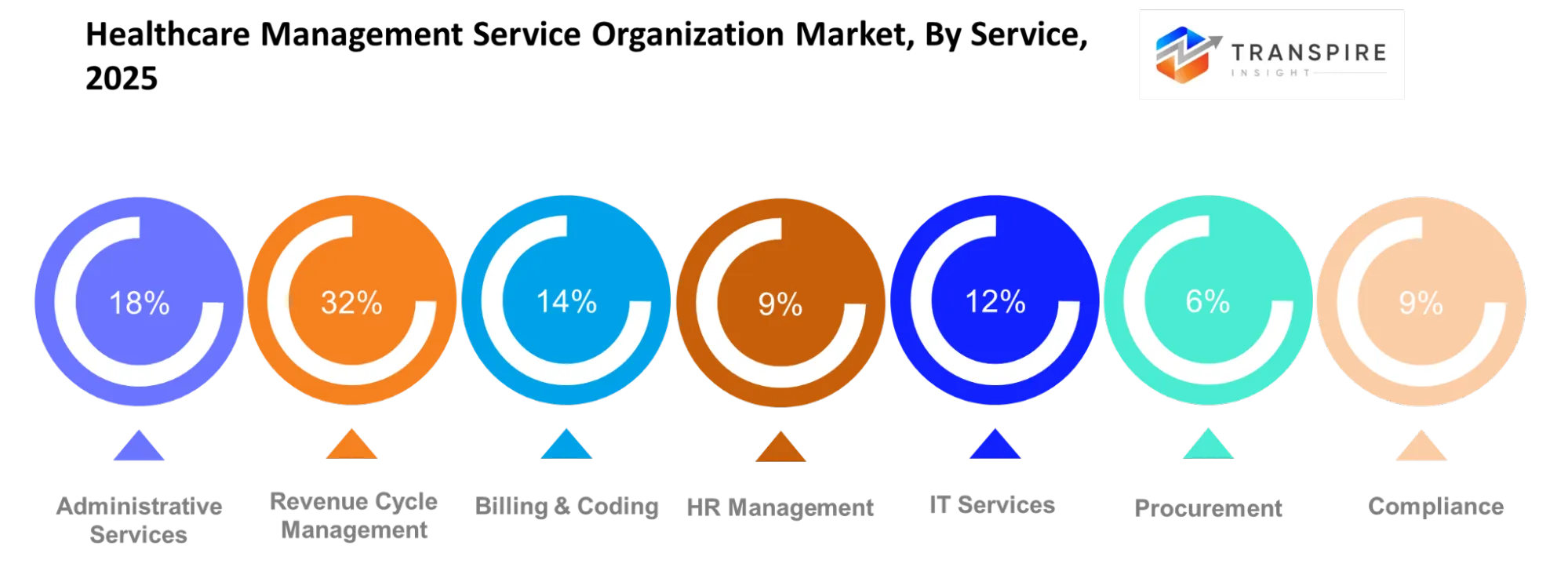
The Healthcare Management Service Organization Market share is divided into seven categories: By service, healthcare setting, organization size, management function, ownership, delivery model and end user.
The Billing & Coding dominated the market, accounting for nearly 28% in 2025 and is expected to rise at a significant CAGR during the forecast period.
The Healthcare Management Service Organization Market is segmented by service into Administrative Services, Revenue Cycle Management, Billing & Coding, HR Management, IT Services, Procurement, Compliance, Others. Among these, the Billing & Coding segment dominated the market, accounting for nearly 28% in 2025 and expected to increase at a significant CAGR during the forecast period. In 2025, the segment of Billing & Coding was highly prominent in the market of Healthcare Management Service Organizations, contributing almost 28%. This growth is due to the growing complexity of healthcare administration, strictness in coding, difficulties in claims processing, and reimbursement issues. MSOs assist providers in better coding, reducing claim denials, improving reimbursement process, and improving revenue cycle management.
The Private dominated the market, accounting for nearly 30% in 2025, and is expected to rise at a significant CAGR during the forecast period.
The Healthcare Management Service Organization Market is segmented by ownership into Private, Public, Non-profit, Investor-owned, Physician-owned, Hospital-owned, PE-backed, others. Among these, the Private segment dominated the market, accounting for nearly 30% in 2025 and expected to increase at a significant CAGR during the forecast period. The Private segment will be the largest player in the Healthcare Management Service Organization Market in 2025, contributing close to 30%, due to rising acceptance of outsourcing of administrative tasks by privately managed health care facilities. The demand is fueled by the potential to enhance the revenues cycle, manage costs, integrate technology, maintain compliance, and scalability of operations.
The Hospitals dominated the market, accounting for nearly 40% in 2025 and is expected to rise at a significant CAGR during the forecast period.
The Healthcare Management Service Organization Market is segmented by end user into Healthcare Providers, Medical Groups, Hospitals, Clinics, Specialty Practices, Healthcare Networks, ASCs, Others. Among these, the Hospitals segment dominated the market, accounting for nearly 40% in 2025 and expected to increase at a significant CAGR during the forecast period. In 2025, the Hospitals category held the leading market position among the Healthcare Management Service Organization Market with almost 40% share due to the need for intricate administrative processes, high numbers of patients, requirement for revenue cycle management, regulatory compliance, and increasing use of technologies. The Hospitals category utilizes MSO services to improve efficiency and enhance financial performance.
Regional Segment Analysis of the Healthcare Management Service Organization Market:
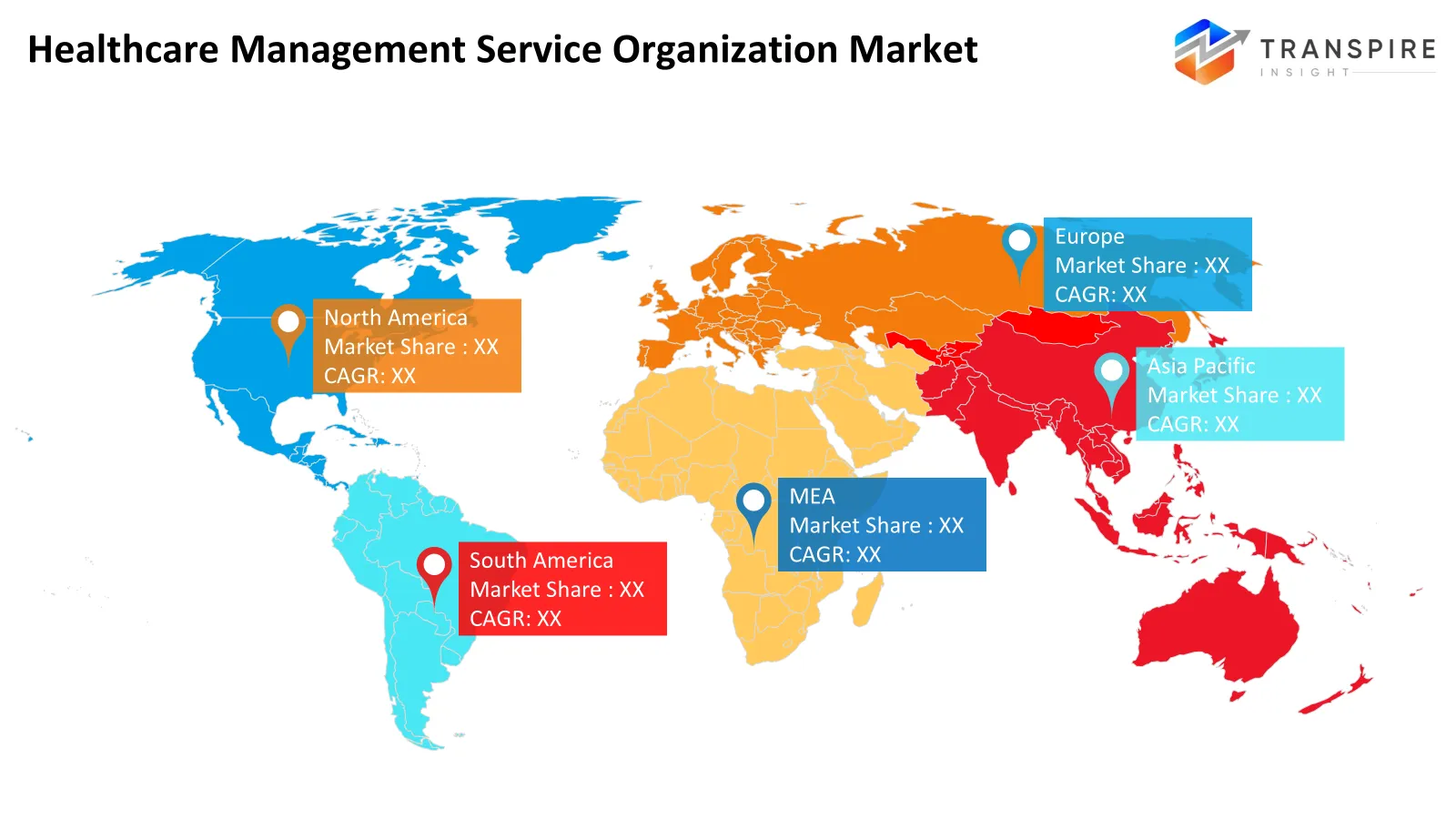
- North America (U.S., Canada, Mexico)
- Europe (Germany, France, U.K., Italy, Spain, Rest of Europe)
- Asia-Pacific (China, Japan, India, Rest of APAC)
- South America (Brazil and the Rest of South America)
- The Middle East and Africa (UAE, South Africa, Rest of MEA)
North America is the fastest-growing region in the Healthcare Management Service Organization Market during the period, holding roughly 49% share.
North America is expected to grow at a rapid CAGR in the Healthcare Management Service Organization Market holding roughly 49% share during the forecast period. North America has been found to be the region witnessing the fastest growth in the Healthcare Management Services Organization Market. The market in North America has a share of around 49%, which has been fueled by the following factors: advanced healthcare infrastructure, increased MSO adoption, presence of private equity firms, consolidation in the healthcare industry, and need for revenue cycle management.
Europe is expected to grow at a rapid CAGR in theHealthcare Management Service Organization Market, holding roughly 25% of the share during the forecast period
Europe is expected to grow at a rapid CAGR in the Healthcare Management Service Organization Market holding roughly 25% share during the forecast period. The Europe region will experience quick growth in terms of the Healthcare Management Services Organization Market, as it accounts for about 25% of the market in terms of shares over the forecast period, due to factors such as growing healthcare costs, growing complexity, digitalization, and demand for effective healthcare management services.
Asia Pacific is the fastest-growing region in the Healthcare Management Service Organization Market during the period, holding roughly 15% share.
Asia Pacific is the fastest-growing region in the Healthcare Management Service Organization Market during the forecast period, holding roughly 15% share during the forecast period. The Asia Pacific region represents the most rapidly growing segment within the Healthcare Management Service Organization Market with around 15% market share. This is owing to the development of healthcare infrastructure, increase in healthcare spending, growth in digitalization, and increasing demand for cost-effective administration services. The healthcare industry in the Asia Pacific region has been increasingly implementing MSO solutions.
Strategies for Market Growth in Non-Leading Regions:
The development of non-leading areas using advanced and scalable technology in delivery of healthcare management service will be advantageous to small and medium-sized healthcare management service providers. Development of healthcare management platforms as well as creation of regional service and technology infrastructure will reduce reliance on outsourced service providers and lower costs incurred. Strategic partnerships with regional hospitals, healthcare providers, technology providers, insurance firms and healthcare networks will facilitate market penetration for healthcare management service providers. In order to raise awareness about healthcare management, revenue cycle management, digital healthcare, data analytics and quality management, training and skills improvement programs will have to be developed. Flexibility in financing options, long-term service agreements and managed-service agreements will ensure accessibility to healthcare management services thus encouraging healthcare management service adoption. Development of joint programs between government, healthcare institutions and technology projects, coupled with the use of digital healthcare platforms will increase accessibility of healthcare management services and sustain worldwide market development in developing countries.
Future Market Trends for the Healthcare Management Service Organization Market: -
- Transition to Value-Based Care: Physician organizations are shifting their focus away from fee-for-service arrangements towards risk sharing and value-based contracts. MSOs bring the necessary infrastructure to track quality measurements, cost-effectiveness, and risk management.
- Private Equity Investment: Private equity companies are financing the formation of "platform" MSOs to buy out independent practices. It allows smaller practices to benefit from economies of scale and more effective negotiations with insurance companies.
- Technology Implementation: Advanced MSOs are implementing AI solutions, big data analysis, and automation of their digital platforms. Such innovations reduce cash flow delays in the cycle of revenue optimization.
- Administrative Outsourcing: Increased regulatory pressures, staffing shortages, and rising compliance needs drive medical practices to transfer nonclinical responsibilities to specialized MSOs.
- Specialty MSOs: There is an increase in the emergence of specialized MSOs for high-demand areas like orthopedic, oncology, and ambulatory care facilities.
Recent Development
- In May 2026: The Company introduced the Viz Pulmonary™ Suite, which is an AI-powered tool that provides for efficient delivery of pulmonary care through disease recognition, workflow optimization, electronic health record integration, care coordination, and patient follow-ups.
- In March 2026: Oasis Health Partners acquired Premier Health, an administrative services organization that focuses on the field of revenue cycle management and practice operations, to enhance its independent primary care offering, along with other value-based care, healthcare analytics, RCM, EMR optimization, and practice management services.
This study forecasts revenue at global, regional and country levels from 2020 to 2033. Transpire Insight has segmented the Healthcare Management Service Organization Market based on the below-mentioned segments:
Healthcare Management Service Organization Market, By Service
- Administrative Services
- Revenue Cycle Management
- Billing & Coding
- HR Management
- IT Services
- Procurement
- Compliance
- Others
Healthcare Management Service Organization Market, By Healthcare Setting
- Hospitals
- Physician Practices
- Clinics
- Ambulatory Surgery Centers
- Specialty Centers
- Diagnostic Centers
- Dental Practices
- Others
Healthcare Management Service Organization Market, By Organization Size
- Large
- Medium
- Small
- Multisite
- Independent
- Integrated
- Academic
- Others
Healthcare Management Service Organization Market, By Management Function
- Finance
- Operations
- HR
- IT
- Supply Chain
- Marketing
- Compliance
- Others
Healthcare Management Service Organization Market, By Ownership
- Private
- Public
- Non-profit
- Investor-owned
- Physician-owned
- Hospital-owned
- PE-backed
- Others
Healthcare Management Service Organization Market, By Delivery Model
- On-site
- Remote
- Hybrid
- Shared Services
- Outsourced
- Managed Services
- SaaS-enabled
- Others
Healthcare Management Service Organization Market, By End User
- Healthcare Providers
- Medical Groups
- Hospitals
- Clinics
- Specialty Practices
- Healthcare Networks
- ASCs
- Others
Window Coverings Market, By Regional Analysis
North America
- US
- Canada
- Mexico
Europe
- Germany
- UK
- France
- Italy
- Spain
- Russia
- Rest of Europe
Asia Pacific
- China
- Japan
- India
- South Korea
- Australia
- Rest of Asia Pacific
South America
- Brazil
- Argentina
- Rest of South America
Middle East & Africa
- UAE
- Saudi Arabia
- Qatar
- South Africa
- Rest of the Middle East & Africa
Frequently Asked Questions
Find quick answers to common questions.
Value-based care, administrative complexity, private equity investment, healthcare consolidation, digitalization, and demand for outsourced management services drive market growth.
Billing & Coding dominated in 2025, accounting for nearly 28%, supported by complex coding, claims processing, and reimbursement requirements.
North America leads with roughly 49% share, supported by advanced infrastructure, MSO adoption, healthcare consolidation, and revenue cycle management demand.
AI, cloud computing, IoMT, predictive analytics, and managed IT services enhance automation, interoperability, data management, and operational efficiency.
Regulatory requirements, anti-kickback rules, private equity scrutiny, clinical autonomy concerns, EHR integration, and increasing operational costs present challenges.
- Optum
- Cardinal Health
- McKesson
- Conifer Health Solutions
- R1 RCM
- Envision Healthcare
- Agilon Health
- Privia Health
- Tivity Health
- TeamHealth
- HCA Healthcare
- Mednax
- ApolloMD
- VillageMD
- Surgery Partners
About the Authors

Pankaj Ghogare Patil
I am Pankaj Ghogare Patil, a Senior Research Analyst at Transpire Insight, specializing in the Pharmaceutical, Chemicals & Materials, Healthcare IT, and Biotechnology industry. My expertise lies in conducting comprehensive market research, analyzing industry trends, evaluating competitive landscapes, and translating complex data into actionable insights. At Transpire Insight, I closely follow emerging technologies, regulatory developments, and market innovations to create accurate, well-researched, and informative content that helps businesses and professionals make informed decisions. I am committed to producing credible, evidence-based articles that reflect industry best practices while making technical topics accessible and valuable for a broad audience.

Chakradhar Khansole
Chakradhar serves as the Research Director at Transpire Insight, bringing over 8 years of experience in technology, innovation, and strategic market intelligence. He specializes in transforming complex market data into actionable business insights that enable organizations to make informed, growth-oriented decisions. Recognized for his strategic vision and analytical expertise, Chakradhar leads high-impact research initiatives, delivering comprehensive market assessments, competitive intelligence, and forward-looking industry analysis.
Recently Published Reports
-
Apr 2026
AI in Diabetic Retinopathy Market
AI in Diabetic Retinopathy Market Size, Share & Analysis Report By Type (Screening AI Systems, Diagnostic AI Systems, and Predictive AI Models), By Application Segment (Hospitals, Ophthalmology Clinics, Diagnostic Centers, and Research and Development), and Geography (North America, Europe, Asia-Pacific, Middle East and Africa, South and Central America), 2021 - 2031
-
Apr 2026
Psychometric Tests Market
Psychometric Tests Market Size, Share & Analysis Report By Type (Personality Tests, Ability/Aptitude Tests, Skill/Knowledge Tests, and Others), By Application (Talent Acquisition and Talent Management), and Geography (North America, Europe, Asia-Pacific, Middle East and Africa, South and Central America), 2021 – 2031
-
Apr 2026
Rare Biological Sample Collection Market
Rare Biological Sample Collection Market Size, Share & Analysis Report By Type (Isolation Kits & Reagent, Blood Collection Tubes, and Others), By Application (Oncology, Transcriptomics, Pharmacogenomics, and Others), and Geography (North America, Europe, Asia-Pacific, Middle East and Africa, South and Central America), 2021 – 2031
-
Jul 2026
Diabetic Retinopathy Market
Diabetic Retinopathy Market Size, Share & Analysis Report By Type (Proliferative Diabetic Retinopathy, and Diabetic Macular Edema (DME)), By Treatment Type (Anti VEGF Drug, Steroid Implants, Laser Surgeries, and Vitrectomy), and Geography (North America, Europe, Asia-Pacific, Middle East and Africa, South and Central America), 2021 – 2031
Our Clients







