

Small Molecule API Market Summary:
According to Transpire Insights, a detailed research report on the market reflects that product innovation represents a key function within the Innovation Management Market, which was valued at approximately USD 2.98 billion in 2025 and is projected to reach around USD 5.38 billion by 2030, expanding at a CAGR of 12.6% during 2025–2030. Product innovation is a major contributor to market development, technological advancement, new product development, innovation strategies, expanding R&D capabilities, digital transformation, and overall growth dynamics.
Market Snapshot
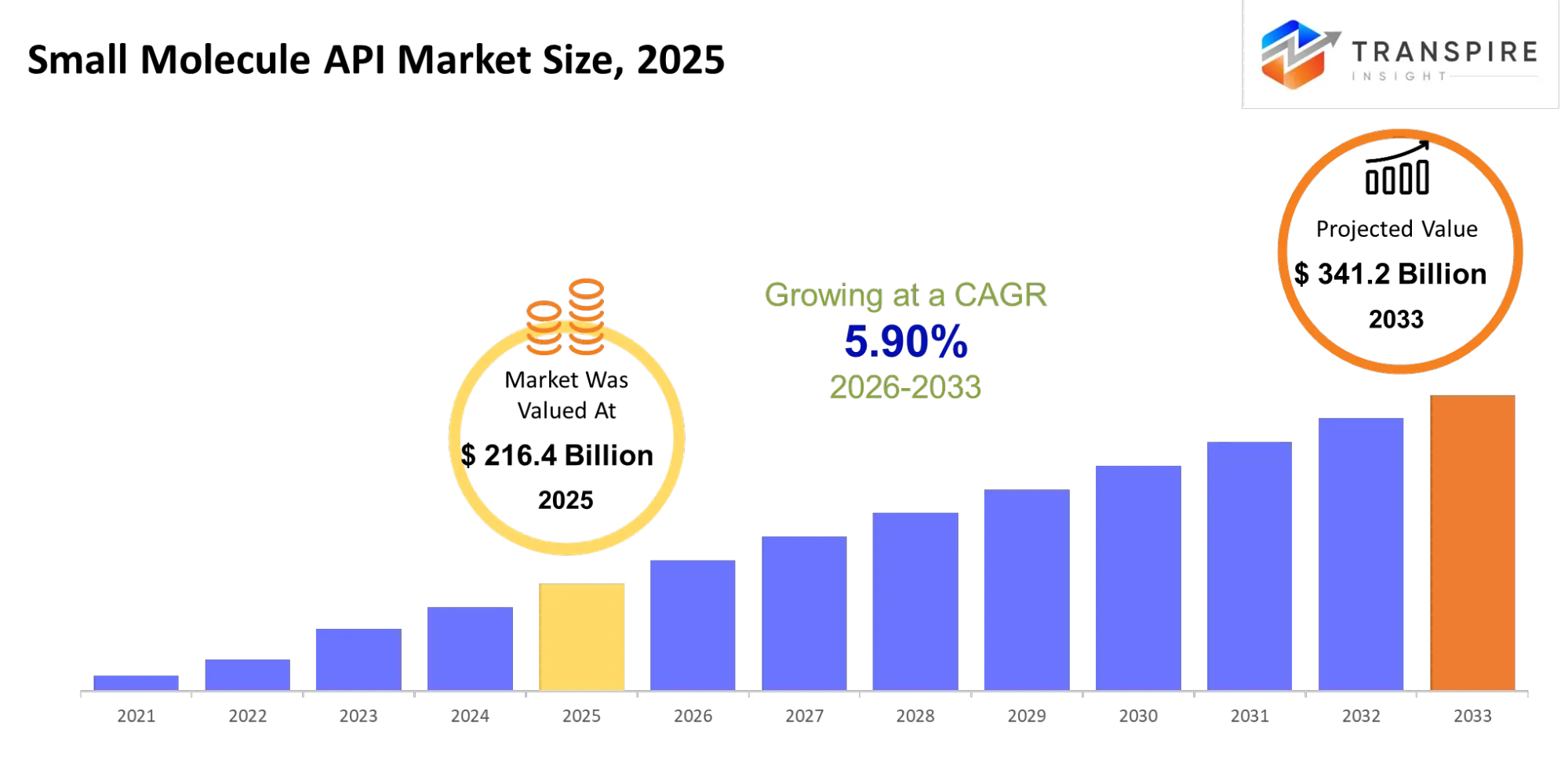
- Market Value (2025): USD 216.4 Billion.
- Expected Market Value (2026): USD 228.7 Billion.
- Estimated Market Value (2033): USD 341.2 Billion.
- Forecast CAGR (2026–2033): 5.90%.
- Leading Region in 2025: North America
- Second-largest Region: Asia Pacific
- Fastest Growing Region: Europe
Introduction
The Small Molecule API Market is comprised of active pharmaceutical ingredients, which are synthesized chemically, and are primarily used to act on specific biological targets in the human body. Small molecule APIs are critical to the development and manufacture of oral and other traditional pharmaceutical formulations. The market is propelled by the growing demand for effective treatment options for a range of chronic diseases including oncology, cardiovascular, neurological, metabolic, infectious and other diseases. Pharmaceutical companies, generic drug manufacturers, biotechnology companies and contract development and manufacturing organizations (CDMOs) are important players in the value chain. The market is further driven by the increasing outsourcing in pharmaceutical industry, technological advancements in API manufacturing, increasing demand for generic drugs and growing manufacturing capacities. The small molecule API market is expected to open lucrative opportunities for players in the market owing to increasing investments in highly potent APIs, advanced manufacturing technologies and specialized pharmaceutical production.
For instance: North America North America is characterized by strong pharmaceutical R&D, developed API manufacturing infrastructure, localized supply chain, demand for oncology, and growing capabilities of CDMOs for complex small molecule APIs.
Europe: Europe is strengthening its small molecule API industry through pharmaceutical reshoring, supply chain security initiatives, advanced manufacturing capabilities, regulatory compliance, and investment in domestic production capacity.
Market Highlights: -
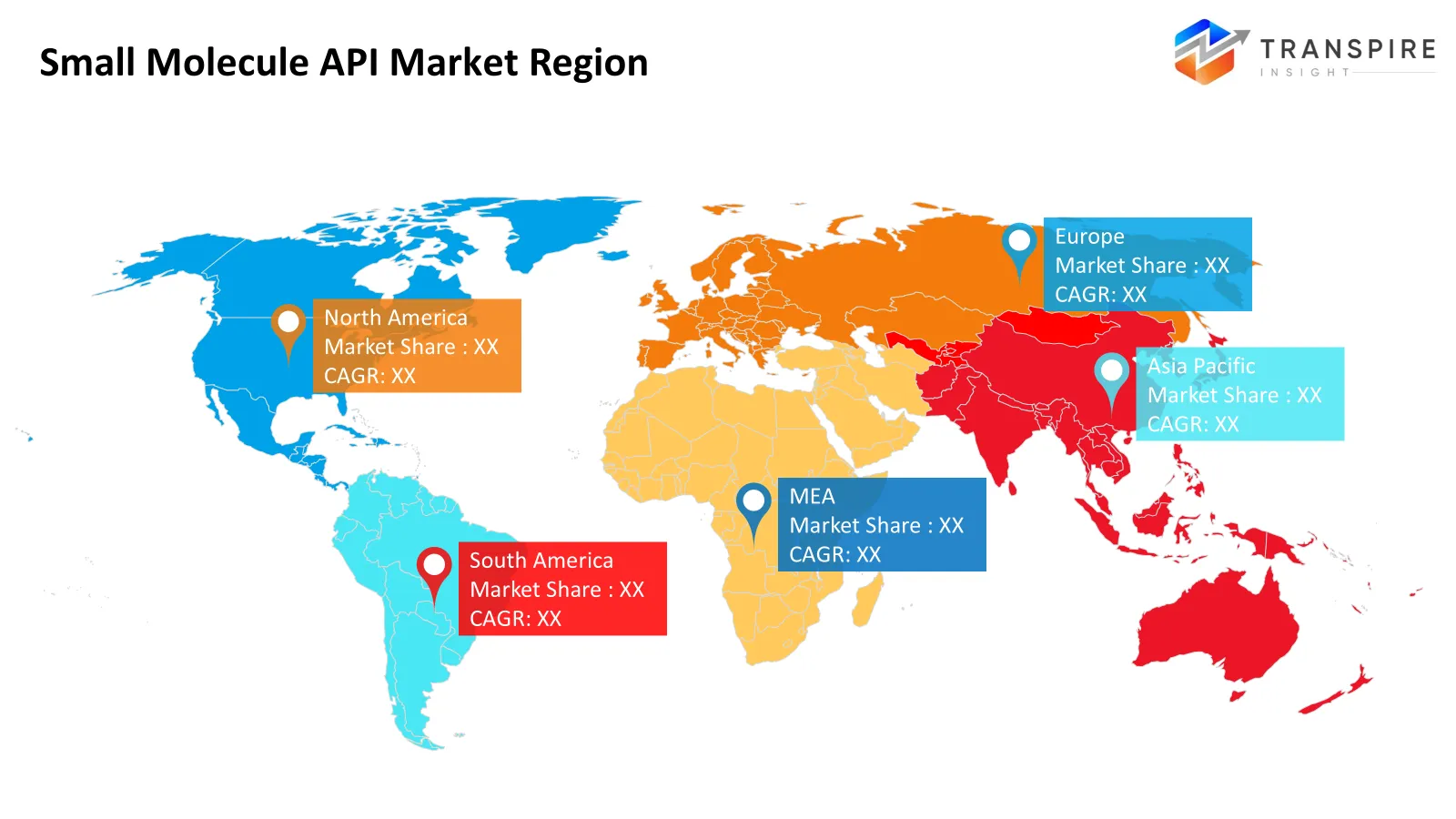
- North America is expected to grow at a rapid CAGR in the Small Molecule API Market by holding around 38% of the share during the forecast period.
- Asia Pacific is anticipated to hold roughly 31% share of the Small Molecule API Market over the predicted time frame.
- Europe is anticipated to hold around 20% share of the Small Molecule API Market over the predicted time frame.
- By Type, the Synthetic APIs dominated the market and holds nearly 65% share in 2025 and is projected to grow at a substantial CAGR during the forecast period.
- By Therapeutic Area, the Oncology Market Size segment dominated the market and holds nearly 20% share in 2025 and is projected to grow at a substantial CAGR during the forecast period.
- By Manufacturing Type, the Contract Manufacturing dominated the market and holds nearly 70% share in 2025 and is projected to grow at a substantial CAGR during the forecast period.
- India’s PLI Scheme and Bulk Drug Parks initiative, as well as U.S. and European manufacturing-support programs, are helping to increase domestic API production, supply chain resilience and pharmaceutical manufacturing capabilities.
How is Technology Driving Growth in the Small Molecule API Market?
Technology is driving the growth of the Small Molecule API Market by improving manufacturing efficiency, product quality, scalability and regulatory compliance. Continuous manufacturing and flow chemistry allow for consistent production, reduced waste, faster scale-up and improved process control. Process intensification and advanced containment technologies allow for safer and more efficient manufacturing of complex and highly potent APIs (HPAPIs). Meanwhile, artificial intelligence, predictive analytics, digital twins and automated compliance systems are advancing process monitoring, equipment reliability, yield optimization and real time data management. These technological advances are improving the manufacturing capabilities of APIs and helping to develop complex pharmaceutical ingredients.
|
Report Metrics |
Details |
|
Market size value in 2025 |
USD 216.4 Billion |
|
Market size value in 2026 |
USD 228.7 Billion |
|
Revenue forecast in 2033 |
USD 341.2 Billion |
|
Growth rate |
CAGR of 5.90% from 2026 to 2033 |
|
Base year |
2025 |
|
Historical data |
2021 - 2024 |
|
Forecast period |
2026 - 2033 |
|
Report coverage |
Revenue forecast, competitive landscape, growth factors, and trends |
|
Regional scope |
United States; Canada; Mexico; United Kingdom; Germany; France; Italy; Spain; Denmark; Sweden; Norway; China; Japan; India; Australia; South Korea; Thailand; Brazil; Argentina; South Africa; Saudi Arabia; United Arab Emirates |
|
Key company profiled |
Lonza, Cambrex, EUROAPI, Siegfried Holding, Piramal Pharma, Thermo Fisher Scientific, WuXi AppTec, Teva Pharmaceutical Industries, Dr. Reddy's Laboratories, Sun Pharmaceutical, Viatris, Divi's Laboratories, Aurobindo Pharma, Cipla, CordenPharma |
|
Customization scope |
Free report customization (country, regional & segment scope). Avail customized purchase options to meet your exact research needs. |
|
Report Segmentation |
By Type (Innovative APIs, Generic APIs, High Potency APIs, Synthetic APIs, Fermentation APIs, Controlled Substance APIs, Peptide APIs, Others); By Therapeutic Area (Oncology, Cardiovascular Diseases, CNS Disorders, Infectious Diseases, Diabetes, Respiratory Diseases, Gastrointestinal Disorders, Others); By Manufacturing Type (Captive Manufacturing, Contract Manufacturing, Merchant Manufacturing, Continuous Manufacturing, Custom Manufacturing, Others); By End User (Pharmaceutical Companies, Biotechnology Companies, CDMOs, Research Institutes, Generic Drug Manufacturers, Others); By Application (Prescription Drugs, OTC Drugs, Clinical Research, Biologics Support, Veterinary Medicines, Others) |
Market Drivers
Growing demand for pharmaceutical therapies, especially in the areas of oncology, cardiovascular, metabolic and neurological diseases, fuel the Small Molecule API Market. With more patents expiring and more generics being produced, the demand for cost-effective API manufacturing is increasing. The increasing pharmaceutical outsourcing is encouraging companies to collaborate with CDMO’s for flexible capacity, complex synthesis and specialized production capabilities. Localization of the supply chain and dual-sourcing strategies to improve security of supply are also driving investments in regional API manufacturing. At the same time, continuous manufacturing, flow chemistry, artificial intelligence, predictive analytics and advanced process-control technologies are improving production efficiency, quality, scalability and regulation compliance. As the demand for powerful, complex APIs continues to grow, so does the investment in dedicated facilities, containment systems and sophisticated manufacturing infrastructure across the globe.
For Instance: - Asia Pacific: Asia Pacific is supported by cost-effective manufacturing, wide-ranging chemical-processing capabilities, government incentives, growing API production, and increasing pharmaceutical outsourcing across India and China.
Restrain
Stringent regulatory requirements, escalating raw material and operational costs, and high capital requirements for GMP-compliant manufacturing facilities are hindering the Small Molecule API Market. Intense competition in generic pharmaceuticals continues to keep profit margins under control and pricing pressure in place. Supply-chain disruptions and reliance on critical raw materials may impact production continuity and delivery timelines. Moreover, the rising use of biologic and targeted treatments is putting pressure on traditional small molecule drug development. The complex validation, quality control and compliance requirements can also lengthen the development and commercialization timelines.
Analysis of Prices and Consumer Behaviour
The synthetic APIs dominate the small molecule APIs market (est. 68% of the total market) and are widely used in generic medicines, innovative pharmaceuticals and chronic disease treatments. High-potency and highly specialized APIs will likely cost 35% more than conventional products because of the need for advanced manufacturing technologies, strict containment systems, specialized facilities, and stringent quality controls. The demand for small molecule API is about 45 % driven by oral solid dosage formulations related to the widespread use in tablets and capsules and established manufacturing processes. The generic pharma and chronic disease treatment segments account for some 70% of the demand for small molecule APIs. Based on the purchasing behavior, 55% of pharmaceutical manufacturers consider API quality, purity, regulatory compliance and supply consistency as the most important factors. About 33% of buyers like to opt for bulk deals or long-term contracts to optimize procurement costs and ensure a reliable supply of APIs across pharmaceutical manufacturing operations.
Who are the Key Players in the Small Molecule API Market and how do they compete?
Companies that specialize in technological innovation, pharmaceutical-specific solutions and the creation of distribution networks are driving the competitiveness of the Small Molecule API Market in the international marketplace. This approach to competition, competing not only on price, but also on advanced manufacturing technologies, high-quality APIs, specialized production capabilities, & integration with modern pharmaceutical manufacturing systems results in constant product development, as well as helps organizations achieve greater productivity, efficiency, quality consistency, regulatory compliance, and supply-chain visibility.
Lonza is strengthening its market position by expanding development of advanced small molecule APIs, specialized manufacturing solutions, high-potency APIs and integrated pharmaceutical production capabilities. Cambrex is different from the competition by developing high-performance small molecule APIs for innovative pharmaceuticals, generic medicines and other therapeutic applications. EUROAPI’s proposition is based on integrated solutions in small molecule API manufacturing, pharmaceutical development, production and supply-chain capabilities, helping pharma companies improve productivity, operational efficiency and manufacturing reliability.
Top Companies in the Small Molecule API Market
- Lonza
- Cambrex
- EUROAPI
- Siegfried Holding
- Piramal Pharma
- Thermo Fisher Scientific
- WuXi AppTec
- Teva Pharmaceutical Industries
- Dr. Reddy's Laboratories
- Sun Pharmaceutical
- Viatris
- Divi's Laboratories
- Aurobindo Pharma
- Cipla
- CordenPharma
Market Segmentation
The Small Molecule API Market share is divided into five categories: By Type, By Therapeutic Area, By Manufacturing Type, By End User, By Application.
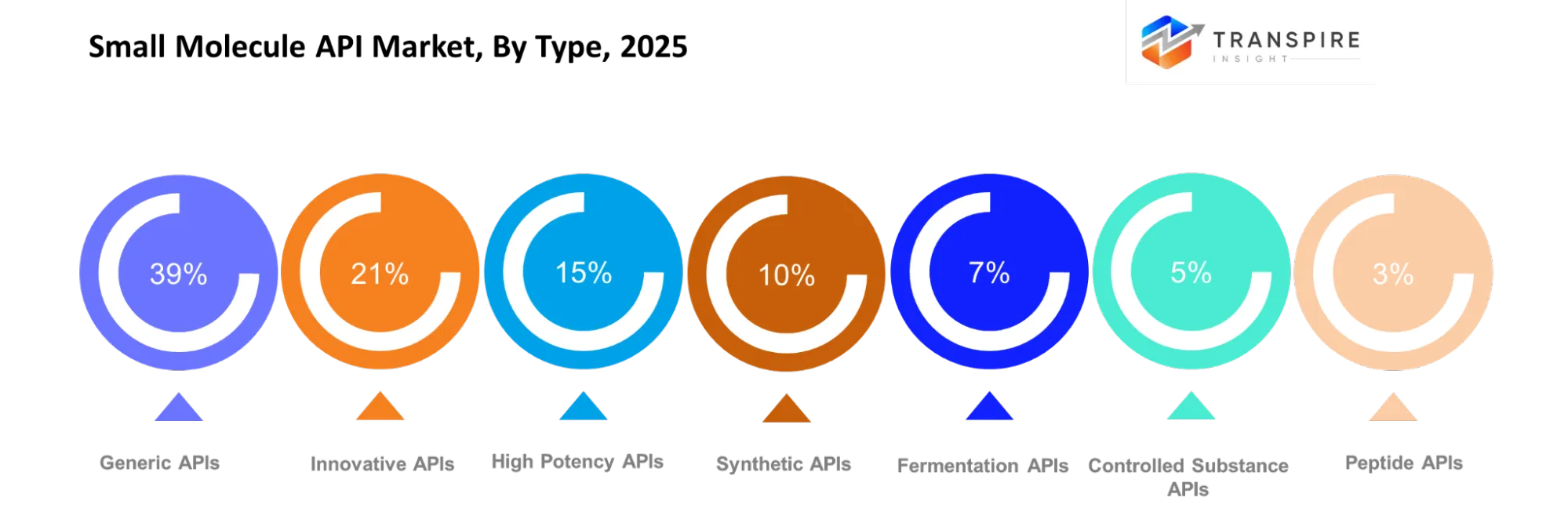
The Synthetic APIs dominated the market, accounting for nearly 65% in 2025 and is expected to rise at a significant CAGR during the forecast period.
The Small Molecule API Market is segmented by type into innovative apis, generic apis, high potency apis, synthetic apis, fermentation apis, controlled substance apis, peptide apis, others. Among these, the Synthetic APIs dominated the market, accounting for nearly 65% in 2025 and expected to increase at a significant CAGR during the forecast period. The Synthetic APIs segment led the market in 2025, attributable to well-set manufacturing processes, cost-effectiveness, large therapeutic areas and high demand for generic and novel drugs.
The Oncology Market Size segment dominated the market, accounting for nearly 20% in 2025, and is expected to rise at a significant CAGR during the forecast period.
The Small Molecule API Market is segmented by therapeutic area into oncology, cardiovascular diseases, cns disorders, infectious diseases, diabetes, respiratory diseases, gastrointestinal disorders, others. Among these, the Oncology Market Size segment dominated the market, accounting for nearly 20% in 2025 and expected to increase at a significant CAGR during the forecast period. The oncology segment is expected to lead owing to the rising incidence of cancer, increasing demand for targeted drug therapies, and high usage of small molecule APIs for the treatment of cancer.
The Contract Manufacturing dominated the market, accounting for nearly 70% in 2025 and is expected to rise at a significant CAGR during the forecast period.
The Small Molecule API Market is segmentedby manufacturing type into captive manufacturing, contract manufacturing, merchant manufacturing, continuous manufacturing, custom manufacturing, others. Among these, the Contract Manufacturing dominated the market, accounting for nearly 70% in 2025 and expected to increase at a significant CAGR during the forecast period. The Contract Manufacturing segment was the largest driver due to rising pharmaceutical outsourcing, cost efficiency, specialized manufacturing capabilities and increasing demand for flexible API manufacturing capacity
Regional Segment Analysis of the Small Molecule API Market:
- North America (U.S., Canada, Mexico)
- Europe (Germany, France, U.K., Italy, Spain, Rest of Europe)
- Asia-Pacific (China, Japan, India, Rest of APAC)
- South America (Brazil and the Rest of South America)
- The Middle East and Africa (UAE, South Africa, Rest of MEA)
North America is the fastest-growing region in the Small Molecule API Market during the period, holding around 38% share.
The largest market for Small Molecule API Market is North America owing to strong pharmaceutical R&D, advanced manufacturing infrastructure and significant investment in innovative drug development. The region has created pharmaceutical companies, expanding CDMO capabilities and increasing demand for complex and high potency APIs. Furthermore, efforts to localize the supply chain, technological innovations, strict quality standards, and increasing demand for the treatment of oncology and chronic diseases are boosting regional market growth and reinforcing North America's standing in the manufacturing and development of small molecule APIs.
Asia Pacific is expected to grow at a rapid CAGR in theSmall Molecule API Market, holding roughly 31%of the share during the forecast period.
The Small Molecule API Market is experiencing robust growth in the Asia Pacific region owing to the cost-effective manufacturing capability, increasing pharmaceutical production, and rising investments in API infrastructure. Well-developed chemical-processing ecosystems, skilled labor and growing CDMO capacity have benefited countries such as India and China. Demand for generic drugs is growing, coupled with government initiatives to boost domestic pharmaceutical manufacturing, the localization of supply chains, and the increasing use of advanced manufacturing technologies, which are further enhancing the region's competitiveness and speeding up the growth of the small molecule API market.
Europe is the fastest- Platform Market during the period, holding around 20% share.
Europe has a strong position in the Small Molecule API Market due to sophisticated pharmaceutical manufacturing infrastructure, well-established research facilities, and strict quality and regulatory standards. The region benefits from rising investments in API production, expanding CDMO activities and efforts to strengthen pharmaceutical supply-chain resilience. Increased demand for innovative and generic medicines, technological advances in manufacturing and initiatives to promote domestic production in key European pharmaceutical hubs are also supporting market development.
Strategies for Market Growth in Non-Leading Regions:
Efficient and scalable small molecule API manufacturing technologies would help small to medium-sized pharmaceutical manufacturers and CDMOs to develop in non-leading regions. Local API manufacturing and regional production facilities can reduce import dependence, improve supply chain resilience and boost overall production efficiency.Small molecule API suppliers can expand their market penetration by partnering with regional pharma companies, generic drug companies, biotech companies and CDMOs. Training programs and the improvement of technical skills will be necessary for increasing expertise in API synthesis, process optimization, quality control and regulatory compliance.Flexible financing, long-term supply arrangements and contract manufacturing arrangements will facilitate broader adoption of API and improve procurement efficiency.The development of collaborative programs with the governments, pharmaceutical associations and manufacturing organizations as well as digital channels of sale and distribution will improve availability of small molecule APIs and contribute to sustainable market growth worldwide in developing regions.
Future Market Trends for the Small Molecule API Market: -
- CDMO Outsourcing: pharmaceutical outsourcing to CDMOs is increasing, offering cost optimization, flexible production capacity, specialized manufacturing, and faster commercialization of small molecule APIs.
- Advanced Manufacturing: Continuous manufacturing, artificial intelligence, automation and green chemistry are improving production efficiency, process control, yield optimization, sustainability and regulatory compliance throughout API manufacturing.
- Complex API Development: The need for very potent APIs and targeted oncology therapies is increasing, which is driving manufacturers to invest in advanced synthesis, specialized containment and high quality small molecule API capabilities.
Recent Development
January 2026 – Agno Pharma Acquires Actylis’ Eugene, Oregon CDMO Facility to Strengthen cGMP Small-Molecule API Development and Commercial Manufacturing Capabilities.
January 2026 – Acquisition of JB Chemicals & Pharmaceuticals by Torrent Pharmaceuticals: Torrent Pharmaceuticals acquired JB Chemicals & Pharmaceuticals to strengthen its small-molecule API capacity and chronic-therapy pharmaceutical capabilities.
February 2026 – AbbVie Manufacturing Investment AbbVie announced a USD 380 million investment to expand advanced API manufacturing facilities in Illinois, boosting U.S. small-molecule API production capabilities.
This study forecasts revenue at , regional and country levels from 2020 to 2033. Transpire Insights has segmented the Small Molecule API Market based on the below-mentioned segments:
Small Molecule API Market, By Type
- Innovative APIs
- Generic APIs
- High Potency APIs
- Synthetic APIs
- Fermentation APIs
- Controlled Substance APIs
- Peptide APIs
- Others
Small Molecule API Market, By Therapeutic Area
- Oncology
- Cardiovascular Diseases
- CNS Disorders
- Infectious Diseases
- Diabetes
- Respiratory Diseases
- Gastrointestinal Disorders
- Others
Small Molecule API Market, By Manufacturing Type
- Captive Manufacturing
- Contract Manufacturing
- Merchant Manufacturing
- Continuous Manufacturing
- Custom Manufacturing
- Others
Small Molecule API Market, By End User
- Pharmaceutical Companies
- Biotechnology Companies
- CDMOs
- Research Institutes
- Generic Drug Manufacturers
- Others
Small Molecule API Market, By Application
- Prescription Drugs
- OTC Drugs
- Clinical Research
- Biologics Support
- Veterinary Medicines
- Others
Small Molecule API Market, By Regional Analysis
North America
- United States
- Canada
- Mexico
Europe
- Germany
- United Kingdom
- France
- Spain
- Italy
- Rest of Europe
Asia Pacific
- Japan
- China
- Australia & New Zealand
- South Korea
- India
- Rest of Asia Pacific
South America
- Brazil
- Argentina
- Rest of South America
Middle East & Africa
- Saudi Arabia
- United Arab Emirates
- South Africa
- Rest of the Middle East & Africa
Frequently Asked Questions
Find quick answers to common questions.
Rising chronic diseases, generic drug demand, pharmaceutical outsourcing, advanced manufacturing, and growing investments in complex and high-potency APIs are driving market growth.
Synthetic APIs dominate due to established manufacturing processes, cost efficiency, broad therapeutic applications, and strong demand across generic and innovative pharmaceuticals.
North America leads due to advanced pharmaceutical infrastructure, strong R&D, CDMO capabilities, supply-chain localization, and growing demand for complex APIs.
Continuous manufacturing, artificial intelligence, flow chemistry, automation, and predictive analytics are improving efficiency, quality, scalability, sustainability, and regulatory compliance.
Key trends include CDMO outsourcing, advanced manufacturing, complex API development, supply-chain localization, green chemistry, automation, and increasing demand for high-potency APIs.
- Lonza
- Cambrex
- EUROAPI
- Siegfried Holding
- Piramal Pharma
- Thermo Fisher Scientific
- WuXi AppTec
- Teva Pharmaceutical Industries
- Dr. Reddy's Laboratories
- Sun Pharmaceutical
- Viatris
- Divi's Laboratories
- Aurobindo Pharma
- Cipla
- CordenPharma
About the Authors

Pankaj Ghogare Patil
I am Pankaj Ghogare Patil, a Senior Research Analyst at Transpire Insight, specializing in the Pharmaceutical, Chemicals & Materials, Healthcare IT, and Biotechnology industry. My expertise lies in conducting comprehensive market research, analyzing industry trends, evaluating competitive landscapes, and translating complex data into actionable insights. At Transpire Insight, I closely follow emerging technologies, regulatory developments, and market innovations to create accurate, well-researched, and informative content that helps businesses and professionals make informed decisions. I am committed to producing credible, evidence-based articles that reflect industry best practices while making technical topics accessible and valuable for a broad audience.

Chakradhar Khansole
Chakradhar serves as the Research Director at Transpire Insight, bringing over 8 years of experience in technology, innovation, and strategic market intelligence. He specializes in transforming complex market data into actionable business insights that enable organizations to make informed, growth-oriented decisions. Recognized for his strategic vision and analytical expertise, Chakradhar leads high-impact research initiatives, delivering comprehensive market assessments, competitive intelligence, and forward-looking industry analysis.
Recently Published Reports
-
Jul 2026
Alopecia Treatment Market
Alopecia Treatment Market Size, Share & Analysis Report By Disease Type (Alopecia Areata, Cicatricial Alopecia, Traction Alopecia, Alopecia Totalis, Androgenetic Alopecia, Alopecia Universalis, and Other Disease Types), By Treatment Type (Topical Treatments, Oral Medications, Injectable Therapies, and Hair Transplantation), By Gender (Male, and Female), By Distribution Channel (Hospitals and Clinics, Retail Pharmacies, and Online Retailers), and Geography (North America, Europe, Asia-Pacific, Middle East and Africa, South and Central America), 2021 - 2031
-
Jul 2026
Medical Ultrasound Probe Market
Medical Ultrasound Probe Market Size, Share & Analysis Report By Type (Linear Type, Convex Type, Endocavitary Probe, Phased Array/Cardiac Probe, Transesophageal (TEE) Probe, and Others), By Application (Ophthalmology, Cardiology, Musculoskeletal, Oncology, Obstetrics & Gynecology, General Imaging, and Others), By End User (Hospitals & Clinics, Diagnostic Centers, Ambulatory Surgical Centers, and Others), and Geography (North America, Europe, Asia-Pacific, Middle East and Africa, South and Central America), 2021 – 2031
-
May 2026
Biosimilars Market
Biosimilars Market By Product Type (Monoclonal Antibodies, Recombinant Hormones, Erythropoietin, G-CSF, Others), By Indication (Oncology, Autoimmune Diseases, Blood Disorders, Diabetes, Others), By Manufacturing Type (In-House Manufacturing, Contract Manufacturing), By Distribution Channel (Hospital Pharmacies, Retail Pharmacies, Online Pharmacies), By Industry Analysis, Size, Share, Growth, Trends, and Forecasts 2021-2033
-
Apr 2026
Gastrointestinal Endoscopy Market
Gastrointestinal Endoscopy Market By Type (Rigid Gastrointestinal Endoscope, Flexible Gastrointestinal Endoscopes, Disposable Gastrointestinal Endoscope), By Procedure Type (Colonoscopy, Gastroscopy, Duodenoscopy, Enteroscopy, Flexible Sigmoidoscopy, Others), By Application (Diagnosis, Treatment), By End-Users (Hospitals, Ambulatory Surgical Centers, Specialty Clinics, Laboratories, Others), By Industry Analysis, Size, Share, Growth, Trends, and Forecasts 2021-2033