
Single-use Assemblies Market Summary:
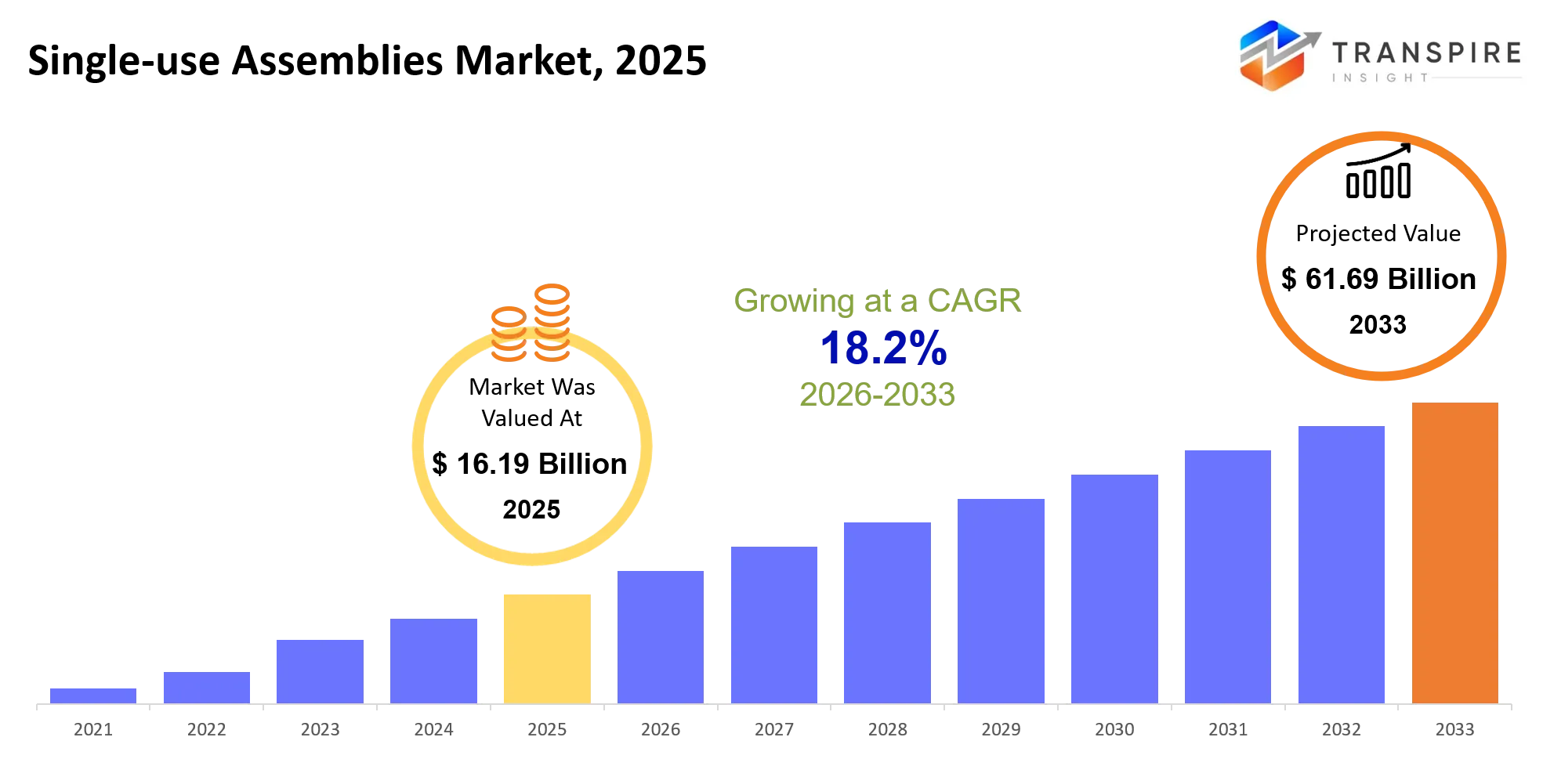
As per Transpire Insight Analysis, the Single-use Assemblies Market size is estimated at USD 16.19 billion in 2025 and is anticipated to reach USD 61.69 billion by 2033, growing at a CAGR of 18.2% from 2026 to 2033.
The single-use assemblies market provides manufacturing by offering parts that are ready to use for moving fluids, filtering, mixing taking samples storing materials and other steps in production. In the past three to five years, companies have started to use more flexible and disposable systems because they want quicker changes between products, less chance of getting things dirty and easier ways to make more. A big change in the industry has been the shift from using stainless-steel equipment to using modular and single-use production setups.The growth of biologics, cell and gene therapies and contract manufacturing has made it more important to have assembly setups that can be changed easily. As production becomes more flexible and handles different products, single-use assemblies are becoming more popular because they cut down on cleaning needs and make it simpler to change the process. This mix of being able to change, keeping things clean, and setting up faster is helping the market grow.
Single-use Assemblies Market Size & Forecast:
- Market Size 2025: USD 16.19 Billion
- Expected Market Value (2033): USD 61.69 Billion
- Forecast CAGR (2026–2033): 18.2%
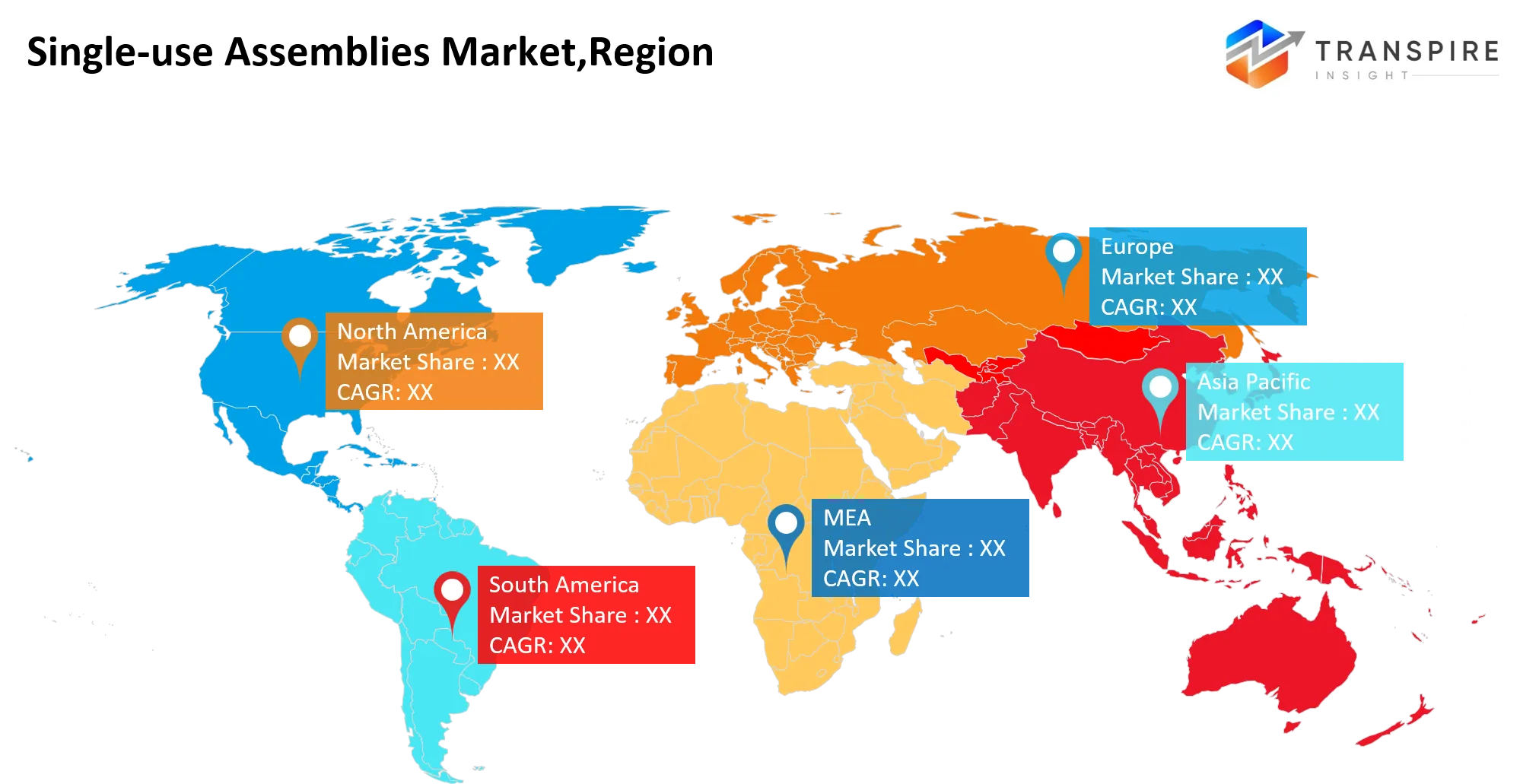
- Leading Region in 2025: North America
- Fastest Growing Region: Asia-Pacific
- Key Company Profiles: Thermo Fisher Scientific, Merck KGaA, Sartorius, Danaher, Avantor, Lonza, Saint-Gobain, Corning, Entegris, KUHNER, Parker Hannifin, Repligen, Meissner Filtration, Cytiva, Flexbiosys
Key Market Insights:
The market is moving from simple disposable consumables to sophisticated integrated assemblies that can enable more complicated biopharmaceutical process flow. Filtration continues to be the dominant product category, whereas cell culture and mixing are emerging application areas as flexible manufacturing capabilities increase.
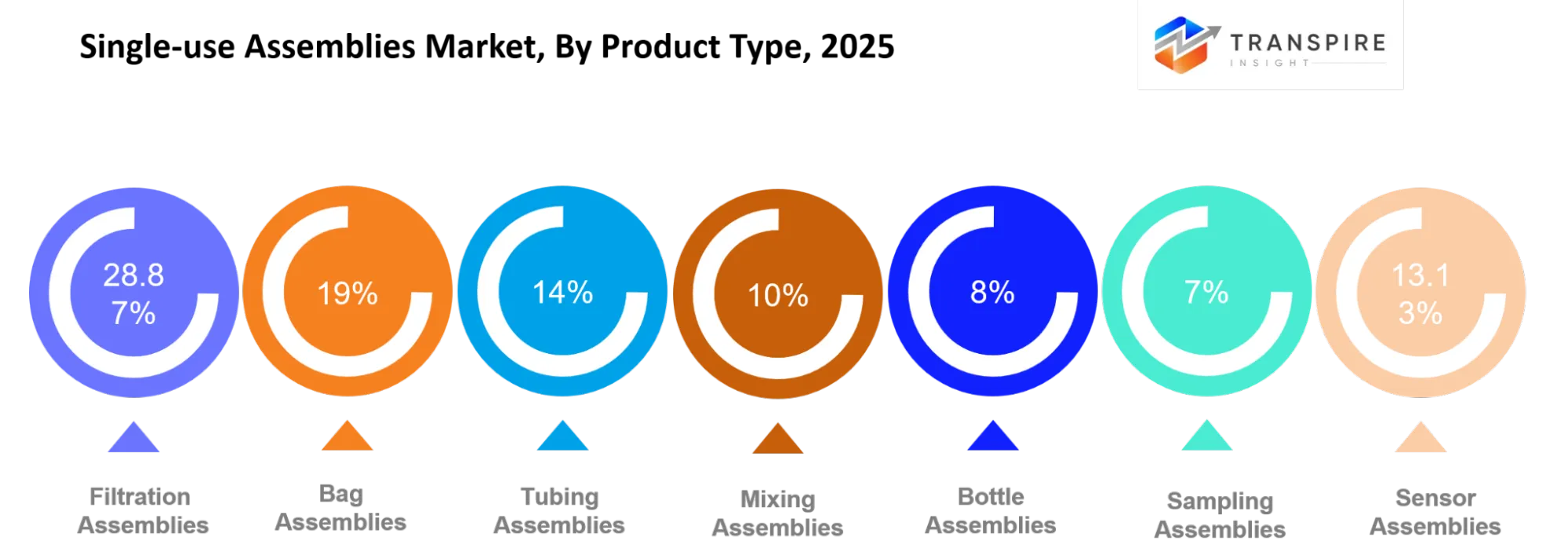
- The Filtration Assemblies constitute 28.87% of the market owing to their application in contaminant control and downstream processing.
- The development of integrated filtration systems for varied requirements is gaining popularity among the suppliers.
- Bag Assemblies constitute 19.00% of the market as they provide flexibility in storing, transporting, mixing and transferring fluids.
- 2D and 3D bag assembly systems are being developed by the suppliers to meet the requirements for various batch sizes.
- The Tubing Assemblies make up 14.00% of the market. The tubing assemblies are becoming integrated with connectors, filters, sensors and other fluid management devices to enable quick setup and sterile transfer.
- Mixing Assemblies account for 10.00%. Low shear and scalable mixing assemblies are being developed by the manufacturers. The mixing assemblies being developed currently aim at achieving consistency in process regardless of the scale of development/production.
- Sampling Assemblies account for 7.00% of the market. There has been increasing emphasis on controlled and contamination conscious sampling.
What are the Key Drivers, Restraints, and Opportunities in the Single-use Assemblies Market?
Drivers
Increased demand for flexible biopharmaceutical manufacturing has resulted in the development of single-use assemblies. Increased numbers of biologics and cell therapy products have also made it necessary for companies to develop equipment that can be easily switched between different batches with minimal cleaning and sterilisation. This enables faster production and has resulted in companies adopting ready-to-use bags, tubing, filtration, mixing, and fluid transfer assemblies.
Restraints
Material compatibility, extractables and leachables, and validation concerns continue to be significant challenges. It is necessary for the manufacturers to confirm that the polymers, connectors, filters, and other materials are still compatible with certain processing conditions. This continues to be important since any modification to the material or supplier will necessitate further qualification and testing.
Opportunities
Opportunity in the creation of modular and tailored assemblies that are made based on certain manufacturing processes. Manufacturers can integrate tubing, bags, filters, sensors, fittings, and many other components into an assembly to cut down on the manual set-up time. The rise of innovative therapies and flexible manufacturing allows for possibilities within modular systems, especially in the rising biopharmaceutical manufacturing region of Asia-Pacific.
What Has the Impact of Artificial Intelligence Been on the Single-use Assemblies Market ?
The use of artificial intelligence will affect single-use assemblies by making the overall bioprocessing environment more automated, monitored, and analytical. Models based on artificial intelligence could monitor parameters such as temperature, pressure, dissolved oxygen, pH levels, flow, and other factors through the sensor connections of the single-use assembly devices. Through such processes, it becomes easier to detect any irregularities within the process and predict potential deviations. In the case of cell cultures and mixing activities, predictive models could be used to detect changes in process behaviour and make necessary adjustments to ensure good performance. Artificial intelligence can also play a key role in the development of digital twin models by simulating process parameters and comparing the expected process results with the actual results from the production process. For assembly manufacturers, the adoption of AI will lead to greater demand for incorporation of sensors, compatible connections, and data-friendly features in disposable assembly equipment. Automation could also reduce the need for human intervention during transfer of fluids, sampling, and other preparation tasks. Adoption of AI is limited by the quality of data, model verification, system integration, security of information, and regulations.
Instance
In January 2026, Sartorius revealed that there is a rise in the use of artificial intelligence and machine learning in the analysis of bioprocessing data. This indicates the rise in the use of data-driven bioprocessing systems, which would lead to the potential for intelligent optimisation of single-use assemblies and related systems.
https://www.sartorius.com/en/knowledge/science-snippets/ai-in-cell-line-development-1757086
Key Market Trends:
The industry is shifting from mere disposable parts to connected systems that are configurable and specific to applications. Some of the emerging trends include automation, customisation, regional supply chains, and sustainability.
- Standard disposable components have been supplemented more and more by custom-built assemblies created specifically for particular manufacturing processes.
- Rather than assembling tubing, bags, and filters separately, manufacturers have been turning to integrated assemblies that help avoid manual assembly steps.
- Sensor integration is becoming increasingly crucial as manufacturers require real-time data from their increasingly flexible bioprocessing facilities.
- Industry has begun to move toward modular manufacturing as facilities can change their manufacturing capacities without building a whole new process line.
- Regional manufacturing and delivery of components have become increasingly important as biopharmaceutical companies try to shorten their supply chains.
- Advanced therapies are generating the demand for more compact and flexible processing setups.
Single-use Assemblies Market Segmentation
By Product
Filtration Assemblies lead the market with the largest market share of 28.87%, followed by Bag Assemblies that hold 19.00% of the market share, followed by Tubing Assemblies that constitute 14.00% of the market share. Mixing Assemblies make up 10.00% of the market share, while Bottle Assemblies constitute 8.00% of the market share. The remaining market share includes Sampling Assemblies, which constitute 7.00% of the market share, Sensor Assemblies that constitute 5.00% of the market share, and Other Assemblies, which constitute 8.13% of the market share.
By Application
Cell Culture & Mixing will be the fastest-growing application at a CAGR of 18.0%, owing to the rising need for flexible upstream processing. Filtration will be an important application since sterile filtration and downstream filtration are integral components of the manufacturing process. Storage and Fluid Transfer will continue to contribute to the transport and storage of process materials. Media Preparation and Buffer Preparation will continue to benefit from flexible mixing and fluid transport systems. Sampling and Filling & Finishing will require controlled fluid paths and contaminant-free designs. In the future, the application market is likely to focus more on integrated assemblies.
By Solution
Customised solutions will gain popularity as manufacturers perform various processes, equipment setups, batch sizes, and production volumes. Standard solutions will still have applicability when processes are repetitive, and component needs are known. Modular, Pre-assembled, Ready-to-use, Configurable, and Integrated solutions offer more flexibility to facilities that want quick installation and less assembly effort.
By End Use
Single-use assemblies offer significant market potential since the manufacture of biologics needs sterile fluid handling through various stages of manufacture. Single-use assemblies find application in pharmaceutical manufacturing, where they are used in transfer, filtration, preparation, and filling processes. The manufacturers of biotechnology and CDMOs/CMOs are some of the end-users due to their flexible production environments and rapid process changes. Cell & Gene Therapy and Academic Research contribute towards smaller scale and speciality demand. Vaccine manufacture and other new biological technologies increase the scope of applications for these assemblies.
By Modality
The Modality category includes Monoclonal Antibodies as one of the application areas owing to their established manufacturing facilities at the large scale. Vaccines also need flexible fluid handling, filtration, mixing, and storage facilities. Cell Therapy and Gene Therapy add more opportunities in this category since the nature of these therapies demands a controlled processing environment. Recombinant Proteins and Viral Vectors make more demand for single-use assemblies in upstream and downstream processes, and Plasma Products amongst others contribute to speciality demands.
What are the Key Use Cases Driving the Single-use Assemblies Market?
The use case filtration and Filtration Assemblies are available for this purpose. Filtration Assemblies are used for sterile processing, clarification, purification, and contamination control in the biopharmaceutical industry. Another use case is Cell Culture & Mixing, which is growing and tracks the. The components of this use case include single-use mixers, bags, tubing, and accessories. New use cases involve Cell & Gene Therapy, viral-vector processing, advanced sampling, automated fluid transfer, and configurable fill-finish systems. The use cases need flexible assemblies that can be configured for the processes.
|
Report Metrics |
Details |
|
Market size value in 2025 |
USD16.19 Billion |
|
Market size value in 2026 |
USD 19.14 Billion |
|
Revenue forecast in 2033 |
USD 61.69 Billion |
|
Growth rate |
CAGR of 18.2% from 2026 to 2033 |
|
Base year |
2025 |
|
Historical data |
2021 - 2024 |
|
Forecast period |
2026 - 2033 |
|
Report coverage |
Revenue forecast, competitive landscape, growth factors, and trends |
|
Regional scope |
United States; Canada; Mexico; United Kingdom; Germany; France; Italy; Spain; Denmark; Sweden; Norway; China; Japan; India; Australia; South Korea; Thailand; Brazil; Argentina; South Africa; Saudi Arabia; United Arab Emirates |
|
Key company profiled |
Thermo Fisher Scientific, Merck KGaA, Sartorius, Danaher, Avantor, Lonza, Saint-Gobain, Corning, Entegris, KUHNER, Parker Hannifin, Repligen, Meissner Filtration, Cytiva, Flexbiosys |
|
Customization scope |
Free report customization (country, regional & segment scope). Avail customized purchase options to meet your exact research needs. |
|
Report Segmentation |
Product (Filtration Assemblies, Bag Assemblies, Tubing Assemblies, Bottle Assemblies, Mixing Assemblies, Sampling Assemblies, Sensor Assemblies, Other Assemblies); Application (Filtration, Cell Culture & Mixing, Storage, Fluid Transfer, Media Preparation, Buffer Preparation, Sampling, Filling & Finishing); Solution (Customized, Standard, Modular, Pre-Assembled, Ready-to-Use, Configurable, Integrated, Others); End Use (Biopharmaceuticals, Pharmaceutical Manufacturing, Biotechnology, CDMOs/CMOs, Academic Research, Cell & Gene Therapy, Vaccines, Others); Modality (Monoclonal Antibodies, Vaccines, Cell Therapy, Gene Therapy, Recombinant Proteins, Viral Vectors, Plasma Products, Others) |
Which Regions are Driving the Single-use Assemblies Market Growth?
North America
North America dominates the market with a market share of 39.0% due to the already developed biopharmaceutical manufacturing base of the region, along with the high adoption of advanced technologies. The region has good infrastructure for the development of drugs, along with many biotech companies. The presence of big players and contract development and manufacturing organisations (CDMOs) helps in accessing single-use products and technical assistance.
In September 2026, Avantor inaugurated a new single-use fluid handling operation and logistics centre in Devens, Massachusetts, with the addition of a 175,000 square foot distribution centre dedicated to the distribution of single-use components and assemblies in North America.
https://corporate.avantorsciences.com/us/en/single-use-fluid-handling-hub
Europe
Europe accounts for 29.0% of the market and is home to a well-developed biopharmaceutical manufacturing network. In contrast with North America, demand in Europe is driven by already developed pharmaceutical production capacity, good infrastructure, and quality standards. Also, there is a presence of many companies supplying single-use technologies and having experience in bioprocessing.
In June 2025, Sartorius Stedim Biotech expanded its capacity at its Aubagne, France site, with expansion in cleanroom, production, logistics, and R&D of single-use bioprocessing products.
Asia-Pacific
The Asia-Pacific region represents 24.0% of the market and is the most rapidly growing market region with a 19.2% CAGR. The expansion of biopharmaceutical production in countries like China, India, South Korea, and Singapore increases the requirement for advanced process facilities. There have been many investments in setting up bioprocessing facilities in the region, which are increasing access to both expertise and single-use systems. There are thus many opportunities for companies providing regional manufacturing, assembly, and logistics.
In December 2025, Thermo Fisher Scientific expanded its bioprocessing network in Asia by opening a new centre in Hyderabad, India, and expanding in South Korea and Singapore, thus enabling access to single-use bioprocessing technologies.
Who are the Key Players in the single-use assemblies market, and how do they compete?
Competition in the worldwide single-use assemblies market relies on product offering, customisation, manufacturing capability, supply chain, technical support, and compatibility with wider bioprocessing platforms. The companies competing in the market include Thermo Fisher Scientific, Sartorius, Merck, Danaher through Cytiva and Pall, Avantor, Saint-Gobain, Corning, Entegris, Repligen, and others.Thermo Fisher Scientific's competitive advantage rests on the wide range of offerings, including bags, tubing, fluid transfer assemblies, bioreactors, mixers, and other technologies. The approach of the company involves the combination of standard offerings with configurable assemblies along with manufacturing facilities. Sartorius' competitive advantage is its offering of integrated bioprocessing technologies, automation, consumables, and process development technologies that can help integrate the single-use components with manufacturing processes.
Single-use Assemblies Market companies
- Thermo Fisher Scientific
- Merck KGaA
- Sartorius
- Danaher
- Avantor
- Lonza
- Saint-Gobain
- Corning, Entegris
- KUHNER
- Parker Hannifin
- Repligen
- Meissner Filtratio
- Cytiva
- Flexbiosys
Recent Development News
In May 2026, Sartorius reported an achievement related to connected bioprocessing technology following the operation of a number of Pionic modules in connection as a unified downstream process for 72 hours. This achievement indicates the industry’s trend towards integration and automation in manufacturing processes that have the potential to add value to connected single-use bioprocessing technologies.
In December 2025, Thermo Fisher Scientific announced the addition of bioprocessing capabilities in Asia through the establishment of the Bioprocess Design Centre in Hyderabad and extensions of existing centres in Incheon and Singapore. These facilities are equipped with advanced bioprocessing technology solutions, which include single-use and hybrid technologies.
What Strategic Insights Define the Future of the Single-use Assemblies Market?
The market for single-use assemblies is evolving towards more interconnected, customised, and automated environments for bioprocessing rather than just disposable replacement parts. Modular manufacturing along with digital design, sensors, and therapies may give rise to new expectations from assembly providers. A less obvious risk would be dependence on supply chains of specialised polymers, connectors, filters, and sterilisation services, which may disrupt manufacturing capabilities when disturbances occur. One of the opportunities that arise is regional manufacturing, especially in Asia Pacific countries, where there is growth in capacity for biopharmaceuticals and increased demand for local technical support. Providers may take advantage of assemblies that are easy to configure, validate, monitor, and integrate into automated processing platforms. It is important for manufacturers to strike a balance between customizability and standardised component platforms that would allow satisfying the needs of various clients without increasing manufacturing complexity.
Product
- Filtration Assemblies
- Bag Assemblies
- Tubing Assemblies
- Bottle Assemblies
- Mixing Assemblies
- Sampling Assemblies
- Sensor Assemblies
- Other Assemblies
Application
- Filtration
- Cell Culture & Mixing
- Storage
- Fluid Transfer
- Media Preparation
- Buffer Preparation
- Sampling
- Filling & Finishing
Solution
- Customized
- Standard
- Modular
- Pre-Assembled
- Ready-to-Use
- Configurable
- Integrated
- Others
End Use
- Biopharmaceuticals
- Pharmaceutical Manufacturing
- Biotechnology
- CDMOs/CMOs
- Academic Research
- Cell & Gene Therapy
- Vaccines
- Others
Modality
- Monoclonal Antibodies
- Vaccines
- Cell Therapy
- Gene Therapy
- Recombinant Proteins
- Viral Vectors
- Plasma Products
- Others
Frequently Asked Questions
Find quick answers to common questions.
The single-use assemblies market size was valued at USD 16.19 Billion in 2025 and is poised to reach USD 61.69 billion by 2033, expanding at an 18.2% CAGR.
Key segments for the single-use assemblies market are Product (Filtration Assemblies, Bag Assemblies, Tubing Assemblies, Bottle Assemblies, Mixing Assemblies, Sampling Assemblies, Sensor Assemblies, Other Assemblies); Application (Filtration, Cell Culture & Mixing, Storage, Fluid Transfer, Media Preparation, Buffer Preparation, Sampling, Filling & Finishing); Solution (Customized, Standard, Modular, Pre-Assembled, Ready-to-Use, Configurable, Integrated, Others); End Use (Biopharmaceuticals, Pharmaceutical Manufacturing, Biotechnology, CDMOs/CMOs, Academic Research, Cell & Gene Therapy, Vaccines, Others); Modality (Monoclonal Antibodies, Vaccines, Cell Therapy, Gene Therapy, Recombinant Proteins, Viral Vectors, Plasma Products, Others)
Growth is primarily driven by increasing use in biopharmaceutical manufacturing, increasing need for contamination-free manufacturing processes, increased use of flexible manufacturing systems, and increasing investments in cell and gene therapy manufacturing.
The market is led by major manufacturers including Thermo Fisher Scientific, Merck KGaA, Sartorius, Danaher, Avantor, Lonza, Saint-Gobain, Corning, Entegris, KUHNER, Parker Hannifin, Repligen, Meissner Filtration, Cytiva, Flexbiosys
The North American region holds 39.0% of the world single-use assemblies market, driven by a robust biopharmaceutical manufacturing industry, usage of disposable processing equipment, healthcare infrastructure and rising demand for flexible manufacturing systems.
Opportunities in the business include the use of disposable technology in manufacturing, growth in cell and gene therapy manufacturing, increase in demand for custom assemblies, and the use of preassembled systems to enhance manufacturing flexibility and minimize contamination risk.
- Thermo Fisher Scientific
- Merck KGaA
- Sartorius
- Danaher
- Avantor
- Lonza
- Saint-Gobain
- Corning, Entegris
- KUHNER
- Parker Hannifin
- Repligen
- Meissner Filtratio
- Cytiva
- Flexbiosys
About the Authors

Pankaj Ghogare Patil
I am Pankaj Ghogare Patil, a Senior Research Analyst at Transpire Insight, specializing in the Pharmaceutical, Chemicals & Materials, Healthcare IT, and Biotechnology industry. My expertise lies in conducting comprehensive market research, analyzing industry trends, evaluating competitive landscapes, and translating complex data into actionable insights. At Transpire Insight, I closely follow emerging technologies, regulatory developments, and market innovations to create accurate, well-researched, and informative content that helps businesses and professionals make informed decisions. I am committed to producing credible, evidence-based articles that reflect industry best practices while making technical topics accessible and valuable for a broad audience.

Chakradhar Khansole
Chakradhar serves as the Research Director at Transpire Insight, bringing over 8 years of experience in technology, innovation, and strategic market intelligence. He specializes in transforming complex market data into actionable business insights that enable organizations to make informed, growth-oriented decisions. Recognized for his strategic vision and analytical expertise, Chakradhar leads high-impact research initiatives, delivering comprehensive market assessments, competitive intelligence, and forward-looking industry analysis.
Recently Published Reports
-
Jul 2026
Alopecia Treatment Market
Alopecia Treatment Market Size, Share & Analysis Report By Disease Type (Alopecia Areata, Cicatricial Alopecia, Traction Alopecia, Alopecia Totalis, Androgenetic Alopecia, Alopecia Universalis, and Other Disease Types), By Treatment Type (Topical Treatments, Oral Medications, Injectable Therapies, and Hair Transplantation), By Gender (Male, and Female), By Distribution Channel (Hospitals and Clinics, Retail Pharmacies, and Online Retailers), and Geography (North America, Europe, Asia-Pacific, Middle East and Africa, South and Central America), 2021 - 2031
-
Jul 2026
Medical Ultrasound Probe Market
Medical Ultrasound Probe Market Size, Share & Analysis Report By Type (Linear Type, Convex Type, Endocavitary Probe, Phased Array/Cardiac Probe, Transesophageal (TEE) Probe, and Others), By Application (Ophthalmology, Cardiology, Musculoskeletal, Oncology, Obstetrics & Gynecology, General Imaging, and Others), By End User (Hospitals & Clinics, Diagnostic Centers, Ambulatory Surgical Centers, and Others), and Geography (North America, Europe, Asia-Pacific, Middle East and Africa, South and Central America), 2021 – 2031
-
May 2026
Biosimilars Market
Biosimilars Market By Product Type (Monoclonal Antibodies, Recombinant Hormones, Erythropoietin, G-CSF, Others), By Indication (Oncology, Autoimmune Diseases, Blood Disorders, Diabetes, Others), By Manufacturing Type (In-House Manufacturing, Contract Manufacturing), By Distribution Channel (Hospital Pharmacies, Retail Pharmacies, Online Pharmacies), By Industry Analysis, Size, Share, Growth, Trends, and Forecasts 2021-2033
-
Apr 2026
Gastrointestinal Endoscopy Market
Gastrointestinal Endoscopy Market By Type (Rigid Gastrointestinal Endoscope, Flexible Gastrointestinal Endoscopes, Disposable Gastrointestinal Endoscope), By Procedure Type (Colonoscopy, Gastroscopy, Duodenoscopy, Enteroscopy, Flexible Sigmoidoscopy, Others), By Application (Diagnosis, Treatment), By End-Users (Hospitals, Ambulatory Surgical Centers, Specialty Clinics, Laboratories, Others), By Industry Analysis, Size, Share, Growth, Trends, and Forecasts 2021-2033