

Self Storage Market Summary:
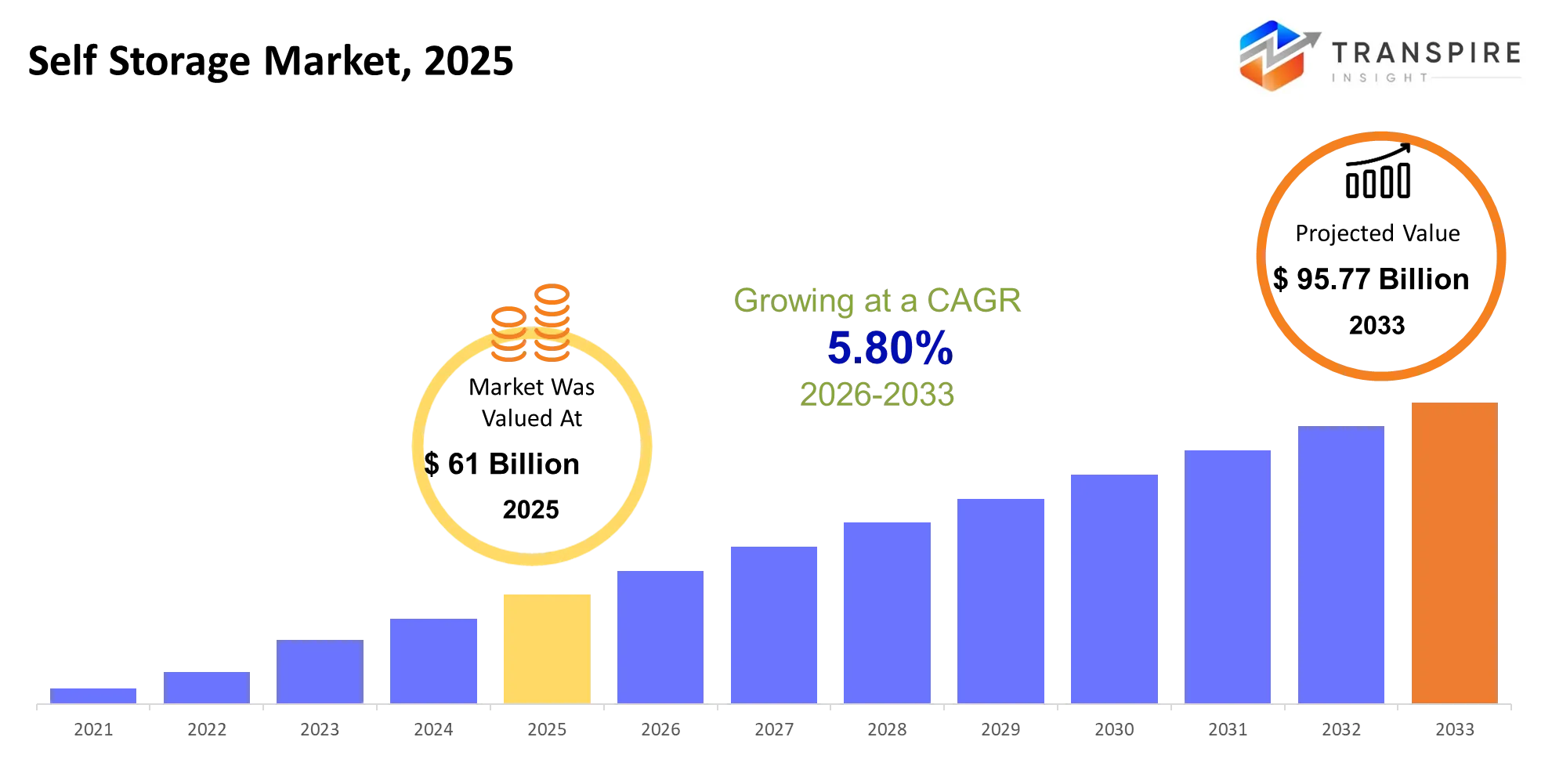
As per the Transpire Insight Analysis, The Self Storage Market size is estimated at USD 61 billion in 2025 and is anticipated to reach USD 95.77 billion by 2033, growing at a CAGR of 5.80% from 2026 to 2033.
The evolution of the self-storage market will shift from renting space to provisioning digitally-enabled storage services. Over the last three to five years, participants have bolstered the service offering to customers through expanded online booking, mobile access, remote management, climate control, and data-enabled pricing strategies. Simultaneously, the importance of personal-use customers is rising. A decentralisation of operations from the other end of the supply chain and into features of remotely operated facilities, enabled by smart locks and optimized customer journeys; nearly half of all operators in Europe offer fully online booking and payment. A tangible momentum for this shift has been driven by increased supply discipline and slowing market growth, which is influencing how operators win tenants and utilize available space. Revenue is generated by locking in conversions through online access, which helps reduce friction, and deploying pricing and occupancy analytics to better capture available capacity. Vacancy rates are projected to decline in the US due to renter retention and fewer move-outs, but supply growth will remain muted through 2026.
Self Storage Market Size & Forecast:
- Market Size 2025: USD 61 Billion
- Expected Market Value (2033): USD 95.77 Billion
- Forecast CAGR (2026-2033): 5.80%
- Leading Region in 2025: North America
- Fastest Growing Region: Asia Pacific
- Key Company Profiles: Public Storage, Extra Space Storage, CubeSmart, U-Haul, Life Storage, Safestore, Big Yellow Group, Shurgard, StorageMart, Prime Storage, National Storage Affiliates, Simply Self Storage, Access Self Storage, Lok'nStore, Storage King.
Key Self Storage Market Insights:
The market is moving towards data-driven, remotely operated storage, and consolidation and disciplined development are altering the way operators scale. Regional differences are also gaining significance as yields are optimized in mature markets and institutional platforms are established in emerging markets.
- More than 85% of the customers interact digitally on the platform, with North America accounting for 48% of sales, and Public Storage leveraging AI pricing, digital marketing, and self-service tools.
- Europe makes up 27%, and 89% of operators are investing in information technology, mainly AI-powered pricing and security improvements.
- Asia-Pacific is 17% and moving from early adoption to disciplined growth as urban households and SMEs embrace paid storage.
- In Latin America, the share of operators who move, package, and deliver is on the rise, with storage becoming a significant component to ease customer acquisition friction, accounting for 5%.
- The Middle East and Africa region accounts for 3% of demand, and this demand is focused on expatriate relocations, construction activity, and high-spec climate-controlled facilities.
- Personal storage is still the biggest use case at 57%, but customers are now demanding access to the app, electronic contracts, and contactless move-in.
- Business storage is growing at an 8.9% CAGR as e-commerce retailers move away from short-term warehouse leasing to flexible local storage.
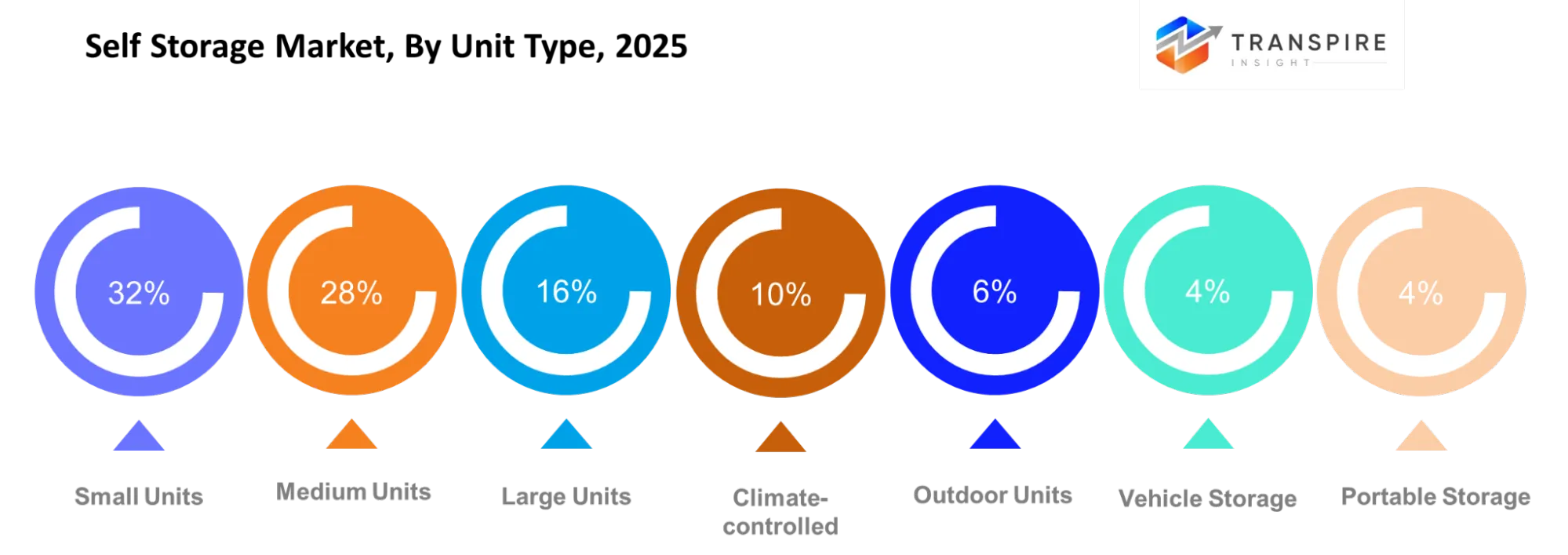
- Small units are leading with 32%, while medium units are at 28%, which indicates demand for affordable overflow for household and SME stockholding.
- The large units are 16%, and the climate-controlled units are 10%, indicating higher demand for equipment, documents, electronics, and sensitive goods.
What are the Key Drivers, Restraints, and Opportunities in the self-storage market?
Driver:
Digital operating models are converting self-storage from a manager-led service into a more automated property business. The trigger is rapid adoption of mobile access, online leasing, cloud management, and AI-based pricing; European operators report broad AI use for pricing, site selection, and analytics. This reduces front-desk workload, supports faster leasing and enables more responsive pricing, improving revenue capture per occupied unit and conversion, while allowing smaller sites to operate efficiently across lean models.
Restraint:
Land availability, planning constraints and financing costs limit new facility supply. The issue persists because storage competes with residential, logistics and commercial uses for well-located urban land, while higher borrowing costs weaken development economics. In the U.S., 2026 construction starts are running below the prior-year pace, yet markets with recent oversupply still face rent pressure, limiting pricing flexibility, delaying new projects, and extending investment timelines.
Opportunity:
Higher-density and remotely managed formats can unlock capacity where conventional sites are difficult to build. Multi-story, automated and climate-controlled facilities can increase usable space per parcel and support premium services. Europe provides a clear technology pathway: remote management is expanding, while AI-supported site selection and pricing can help operators identify underserved locations, optimise unit mix and improve asset productivity.
What has the Impact of Artificial Intelligence been on the self-storage market?
AI extends beyond marketing and has entered the strategic decision-making space in the self-storage industry. Self-storage operators are leveraging artificial intelligence and advanced analytics for dynamic pricing, site selection, customer segmentation, customer tracking, demand forecasting, and occupancy tracking. It is enabling managers to change pricing and promotions based on fluctuating local factors.
A recent study of the European sector found that 90% of operators were actively using AI, with use of pricing, site selection, and analytics all trending for most of those surveyed. AI can also be used for operational automation if linked to cloud property management systems, as the system can track tenants, payments, access events, and service requests to identify potential churn or system anomalies. Smart-entry systems can record access and provide remote access capabilities, reducing staff costs, while predictive tools can tell us what size or features are most likely to be leased next and when. Complexity arises where this integration is concerned; old facilities tend to use incompatible access, billing, and PMS systems, and limited historical data can reduce accuracy and increase the cost of implementation.
In March 2026, Storable launched comprehensive platform refreshes and new integrated AI capabilities for its SiteLink property management platform, including an automated Voice AI system designed to handle common customer calls.
Key Self Storage Market Trends:
The industry is shifting from traditional, labour-intensive storage to technology-driven facilities where access, pricing, and customer service are more and more becoming digital. New capacity is also being carefully managed by operators, as supply, land pricing and financing conditions redefine development economics.
- Facilities are moving from staffed reception desks to mobile booking, digital contracts, and app-based entry.
- Climate-controlled document, wine, and vehicle storage are becoming commonplace additions to standard rooms.
- Operators are not just building new places to park, but are also rehabilitating abandoned retail, industrial, and parking lots.
- Ecommerce businesses are moving inventory from excess space to local inventory, returns, and micro-fulfilment locations.
- Fixed rent schedules are being phased out in favour of location-, season-, occupancy-, and customer-sensitive rates, which are being driven by AI.
- Routine inspections are being reduced, and incident detection is enhanced with smart cameras, sensors, and connected gates.
- The services of pick-up, delivery, packaging, insurance, and moving are extending the market beyond mere space rentals.
- The demand for protected storage is growing due to climate resilience, where flooding, heat, and extreme weather events are putting household and business assets at risk.
- Multi-site operators are combining software, security, payments and customer data into a single operating platform.
Self Storage Market Segmentation
By Unit Type:
Small Units lead at 32%, followed by Medium Units at 28% and Large Units at 16%, reflecting strong preference for compact, flexible storage solutions. Climate-controlled Units account for 10%, supported by customers storing temperature-sensitive and higher-value belongings. Outdoor Units represent 6%, offering accessible space for larger items and equipment, while Vehicle Storage holds 4%. Portable Storage contributes 2%, providing flexible, location-independent capacity, and Others account for 2%. Overall, the mix supports varied customer requirements while creating opportunities for premium, convenient and specialised storage services.
By Storage Type:
Personal Storage dominates at 57%, supported by household relocation, renovations, downsizing and limited residential space. Business Storage records the fastest stated growth at 8.9% CAGR, reflecting inventory, equipment and flexible operational requirements. Vehicle Storage serves mobility-related needs, while Document, Wine, Archive and Student Storage address specialised requirements for security, preservation and accessibility. Other storage formats provide additional niche applications across diverse customer groups.
By Facility Type:
Indoor, Outdoor and Drive-up facilities serve different accessibility and cost requirements, while Multi-story formats improve land utilization in dense urban locations. Containerized and Mobile facilities provide flexible deployment where conventional construction is less practical. Automated facilities increasingly combine smart access with remote management, reducing onsite staffing requirements. This facility mix allows operators to balance land costs, customer convenience, security requirements and operational efficiency across different markets.
By Ownership:
REIT-owned operators benefit from institutional capital, portfolio scale and access to established investment networks. Independent Operators compete through localised knowledge, flexible pricing and customer relationships, while Corporate Chains leverage standardised processes and centralised technology. Franchise and Private Owner models support decentralised expansion, whereas Institutional and Partnership structures enable larger development programs. This diverse ownership structure creates different approaches to capital deployment, facility development and geographic expansion.
By Application:
Residential applications remain closely connected to the 57% Personal Storage position, supported by relocations, home renovations, downsizing and household space constraints. Commercial users require storage for inventory, equipment, and operational flexibility, while Retail and E-commerce applications support merchandise overflow and fulfilment needs. Construction and Manufacturing use facilities for materials and equipment, whereas Healthcare requires secure storage for supplies and records, creating specialised commercial opportunities.
By Size:
The market serves a broad range of requirements, from below 25 sq ft and 25-50 sq ft units to 50-100 sq ft, 100-200 sq ft, 200-500 sq ft, 500-1,000 sq ft, and above 1,000 sq ft formats. This range allows operators to optimise unit mix according to local tenant profiles, property constraints, and pricing potential while supporting both household and commercial requirements.
By Service:
Storage Rental remains the core service, while Moving Assistance helps customers transition belongings efficiently between locations. Insurance provides protection for stored assets, and Packaging supports preparation and organisation. Pickup & Delivery adds convenience for customers seeking minimal physical interaction, while Security and Access Control strengthen asset protection. Increasingly, digital access connects these services, creating smoother customer journeys and enabling more efficient facility management.
What are the Key Use Cases Driving the Self Storage Market?
Personal storage remains the core use case, reflecting the dominant 57% segment. Customers use small and medium units during relocation, renovation, marriage, retirement downsizing, and temporary housing changes, converting limited home space into a flexible monthly expense.
Business storage is expanding as SMEs, retailers, contractors, and e-commerce sellers use units for stock, tools, documents, packaging materials, and returns. The 8.9% CAGR for business storage reflects demand for lower-commitment capacity than conventional warehouses.
Emerging applications include micro-fulfilment, healthcare-record preservation, climate-protected valuables, vehicle storage, and portable units delivered to customers. These uses connect storage with last-mile logistics, disaster resilience, and specialised asset protection rather than simple household overflow.
|
Report Metrics |
Details |
|
Market size value in 2025 |
USD 61 Billion |
|
Market size value in 2026 |
USD 64.54 Billion |
|
Revenue forecast in 2033 |
USD 95.77 Billion |
|
Growth rate |
CAGR of 5.80% from 2026 to 2033 |
|
Base year |
2025 |
|
Historical data |
2021 - 2024 |
|
Forecast period |
2026 - 2033 |
|
Report coverage |
Revenue forecast, competitive landscape, growth factors, and trends |
|
Regional scope |
United States; Canada; Mexico; United Kingdom; Germany; France; Italy; Spain; Denmark; Sweden; Norway; China; Japan; India; Australia; South Korea; Thailand; Brazil; Argentina; South Africa; Saudi Arabia; United Arab Emirates |
|
Key companies profiled |
Public Storage, Extra Space Storage, CubeSmart, U-Haul, Life Storage, Safestore, Big Yellow Group, Shurgard, StorageMart, Prime Storage, National Storage Affiliates, Simply Self Storage, Access Self Storage, Lok'nStore, Storage King |
|
Customization scope |
Free report customisation (country, regional & segment scope). Available customised purchase options to meet your exact research needs. |
|
Report Segmentation |
By Unit Type (Small Units, Medium Units, Large Units, Climate-controlled Units, Outdoor Units, Vehicle Storage, Portable Storage, Others); By Storage Type (Personal Storage, Business Storage, Vehicle Storage, Document Storage, Wine Storage, Archive Storage, Student Storage, Others); By Facility Type (Indoor, Outdoor, Drive-up, Multi-story, Containerized, Automated, Mobile, Others); By Ownership (REIT-owned, Independent Operators, Corporate Chains, Franchise, Private Owners, Institutional, Partnership, Others); By Application (Residential, Commercial, Retail, E-commerce, Construction, Manufacturing, Healthcare, Others); By Size (Below 25 sq ft, 25-50 sq ft, 50-100 sq ft, 100-200 sq ft, 200-500 sq ft, 500-1,000 sq ft, Above 1,000 sq ft, Others); By Service (Storage Rental, Moving Assistance, Insurance, Packaging, Pickup & Delivery, Security, Access Control, Others). |
Which Regions are Driving the Self Storage Market Growth?
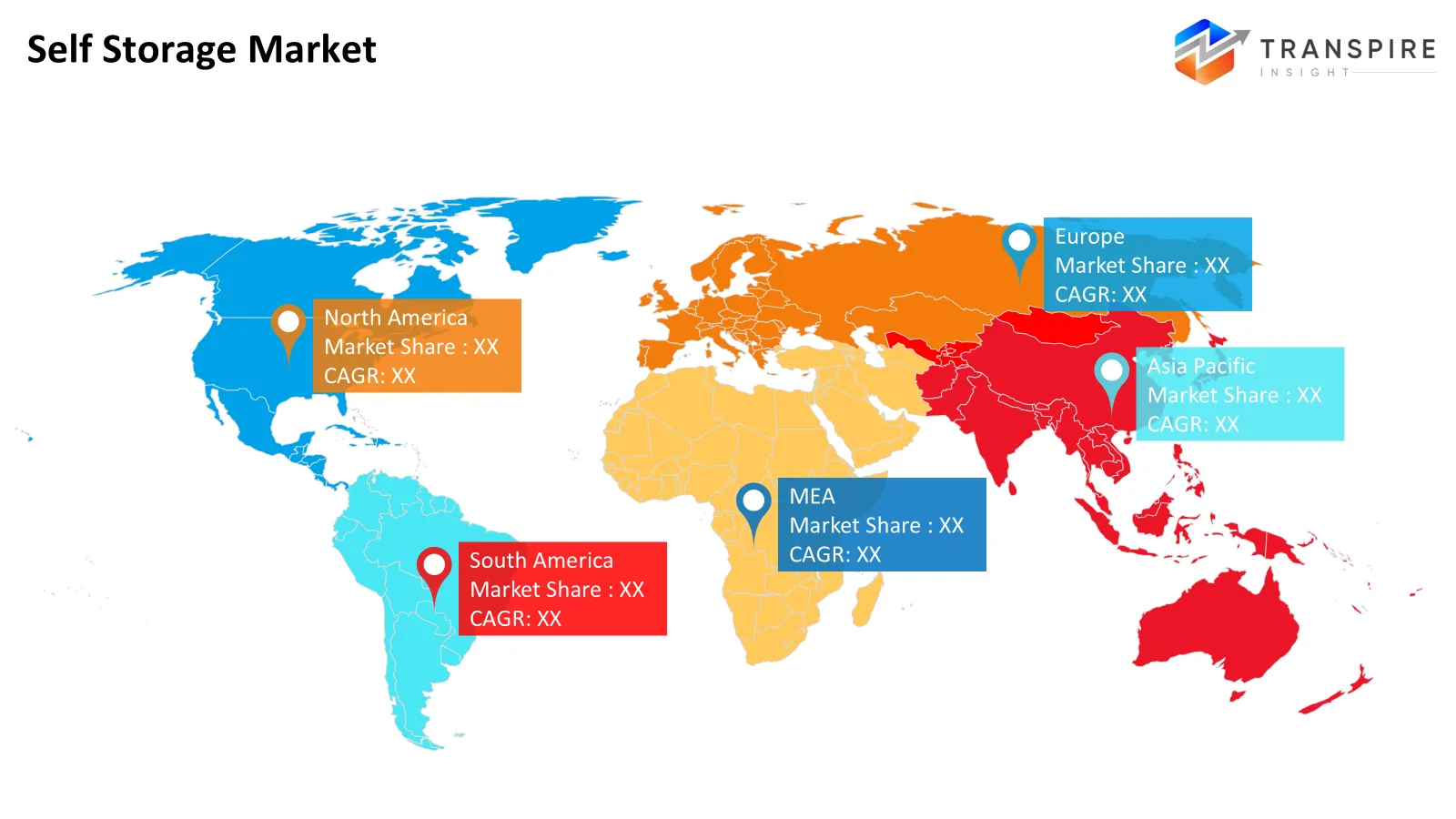
North America leads the market with 48% because self-storage is deeply established as a mainstream response to household mobility, suburban relocation, and business inventory needs. Its ecosystem combines mature REIT ownership, professional operators, dense facility networks, established financing, and strong consumer awareness. Digital leasing, automated gates, and data-led pricing are improving revenue management without requiring proportional labour growth. The region’s scale also supports acquisitions, portfolio consolidation, and standardised operating systems.
In June 2026, Public Storage announced an agreement to acquire Public Storage Canada. This transaction expands its footprint into major Canadian markets with low supply per capita.
Europe represents 27%, but benefits from rising urban density, limited apartment space, and increasing investor interest. Its development is shaped by stricter planning, energy, data-protection, and building requirements, which favour well-capitalised operators and adaptive reuse. Rental rates increased 5.4% in the latest European industry assessment, while 89% of operators reported plans to invest in store or information-technology improvements. These conditions create a stable, quality-focused market rather than rapid greenfield expansion.
In March 2026, QuadReal Property Group acquired a 27-asset UK self-storage portfolio from Padlock Euro Storage Fund I, alongside a joint venture with Clear Sky Capital.
https://www.savills.in/research_articles/165611/393075-1
Asia-Pacific accounts for 17% and is the fastest-growing region at a 10.7% CAGR. Recent progress reflects e-commerce adoption, smaller urban homes, rising disposable income, and growing awareness among SMEs. Unlike North America, growth is concentrated in dense metropolitan corridors and often uses compact, automated, or containerised formats. Future opportunity lies in localised facilities, mobile storage, last-mile inventory, and partnerships with residential developers and logistics providers.
In July 2026, RedBox Storage acquired 17 strata assets across Hong Kong. This transaction immediately doubled the company's operating network to 16 locations and expanded its gross floor area by 25% to directly address space constraints and dense urban living needs.
Who are the Key Players in the self-storage market, and how do they compete?
The storage industry is diverging into three competitor types: large-scale operators, tech-enabled consolidators, and local experts. Public Storage, Extra Space Storage, Cube Smart, U-Haul, Life Storage, Prime Storage, National Storage Affiliates, Simply Self Storage, and Storage Mart compete on density, M&A, third-party management, and digital pricing. Public Storage prioritises scale and automation; Extra Space runs integrated operating technology and management contracts and M&A.
Cube Smart centres on customer-friendly suburban facilities; U-Haul links storage with trucks, moving supplies, and relocation services; Life Storage and Prime Storage integrate community-centred density and redevelopment; National Storage Affiliates expands through partnerships with independent operators rather than exclusively owned assets. Europe's Safestore, Big Yellow Group, Shurgard, Access Self Storage, and Lok'nStore compete on urban density, brand trust, security, and digitally efficient rentals; Shurgard's multi-country rollout spurs cross-border standardisation; Big Yellow and Safestore focus on dense city markets and high-end tenants; Storage King targets local-market growth in Australia with flexible formats and franchise partnerships. Across the sector, differentiation shifts from cheap rent to convenience, access automation, climate protection, dynamic pricing, and integrations with movers and delivery firms.
Key Players are:
- Public Storage
- Extra Space Storage
- CubeSmart
- U-Haul
- Life Storage
- Safestore
- Big Yellow Group
- Shurgard
- StorageMart
- Prime Storage
- National Storage Affiliates
- Simply Self Storage
- Access Self Storage
- Lok'nStore
- Storage King
Recent Development News
- In March 2026, QuadReal Property Group acquired a 27-asset self-storage portfolio in the UK and formed a £480 million joint venture with Clear Sky Capital. The move expands its UK platform and supports further investment in self-storage assets. https://quadreal.com/quadreal-acquires-27-asset-uk-self-storage-portfolio-clear-sky-joint-venture/
- In June 2026, CRED iQ expanded its partnership with TractIQ to integrate self-storage CMBS performance, valuation, and market data into TractIQ’s platform and AI Connector. The development strengthens data-driven underwriting and portfolio analysis for storage operators and investors. https://www.prnewswire.com/news-releases/cred-iq-and-tractiq-expand-partnership-to-bring-50b-of-self-storage-performance-data-into-ai-workflows-302790401.html
- In January 2026, Yardi launched Yardi Storage Manager, an all-in-one software platform combining marketing, leasing, accounting, and operations for institutional self-storage operators. The launch supports centralized portfolio management and real-time operational visibility across multiple facilities. https://www.yardi.com/news/press-releases/yardi-launches-yardi-storage-manager-for-institutional-self-storage-operators/
What Strategic Insights Define the Future of the Self-Storage Market?
The market is shifting to asset-light, technology-enabled operating models, with remotely accessed, automated leasing, AI pricing, and shared management required to drive portfolio economics. The hidden danger is that fast-paced technology adoption could lead to fragmented systems, cyber risks, and inaccurate pricing where facilities lack sufficient historical demand and operating data. On the other hand, the opportunity lies in repurposing low-use, commercial or industrial properties into digitally managed storage facilities, especially in Asian cities where the market penetration is relatively low. The underdeveloped market structure of Asia-Pacific provides investors an opportunity to build a scalable, standardised platform before local competition is fully consolidated. As a result, operators should focus on high-constraint locations, design facilities with flexible unit layouts, and include digital access and demand-management capabilities from the outset. Capital allocation should be judicious, as disciplined supply and operating cost efficiency are becoming more important than capacity growth.
Key Segmentations are:
By Unit Type
- Small Units
- Medium Units
- Large Units
- Climate-controlled Units
- Outdoor Units
- Vehicle Storage
- Portable Storage
- Others
By Storage Type
- Personal Storage
- Business Storage
- Vehicle Storage
- Document Storage
- Wine Storage
- Archive Storage
- Student Storage
- Others
By Facility Type
- Indoor
- Outdoor
- Drive-up
- Multi-story
- Containerized
- Automated
- Mobile
- Others
By Ownership
- REIT-owned
- Independent Operators
- Corporate Chains
- Franchise
- Private Owners
- Institutional
- Partnership
- Others
By Application
- Residential
- Commercial
- Retail
- E-commerce
- Construction
- Manufacturing
- Healthcare
- Others
By Size
- Below 25 sq ft
- 25-50 sq ft
- 50-100 sq ft
- 100-200 sq ft
- 200-500 sq ft
- 500-1,000 sq ft
- Above 1,000 sq ft
Others
By Service
- Storage Rental
- Moving Assistance
- Insurance
- Packaging
- Pickup & Delivery
- Security
- Access Control
- Others
Window Coverings Market, By Regional Analysis
North America
- US
- Canada
- Mexico
Europe
- Germany
- UK
- France
- Italy
- Spain
- Russia
- Rest of Europe
Asia Pacific
- China
- Japan
- India
- South Korea
- Australia
- Rest of Asia Pacific
South America
- Brazil
- Argentina
- Rest of South America
Middle East & Africa
- UAE
- Saudi Arabia
- Qatar
- South Africa
- Rest of the Middle East & Africa
Frequently Asked Questions
Find quick answers to common questions.
The self-storage market size was valued at USD 61 billion in 2025 and is poised to reach USD 95.77 billion by 2033, expanding at a 5.80% CAGR.
Key segments for the self-storage market are By Unit Type (Small Units, Medium Units, Large Units, Climate-controlled Units, Outdoor Units, Vehicle Storage, Portable Storage, Others); By Storage Type (Personal Storage, Business Storage, Vehicle Storage, Document Storage, Wine Storage, Archive Storage, Student Storage, Others); By Facility Type (Indoor, Outdoor, Drive-up, Multi-story, Containerized, Automated, Mobile, Others); By Ownership (REIT-owned, Independent Operators, Corporate Chains, Franchise, Private Owners, Institutional, Partnership, Others); By Application (Residential, Commercial, Retail, E-commerce, Construction, Manufacturing, Healthcare, Others); By Size (Below 25 sq ft, 25-50 sq ft, 50-100 sq ft, 100-200 sq ft, 200-500 sq ft, 500-1,000 sq ft, Above 1,000 sq ft, Others); By Service (Storage Rental, Moving Assistance, Insurance, Packaging, Pickup & Delivery, Security, Access Control, Others).
Growth is primarily driven by urban space constraints, household relocations, e-commerce inventory needs, flexible business storage, digital leasing, smart access, remote facility management, and AI-enabled pricing optimisation.
The market is led by major manufacturers, including Public Storage, Extra Space Storage, CubeSmart, U-Haul, Life Storage, Safestore, Big Yellow Group, Shurgard, StorageMart, Prime Storage, National Storage Affiliates, Simply Self Storage, Access Self Storage, Lok'nStore, and Storage King.
North America holds 48% of the market, supported by mature REIT structures, established storage infrastructure, institutional investment, strong urban demand, and widespread digital leasing and access systems.
Commercial opportunities include automated and climate-controlled facilities, AI-based pricing, remote management, multi-story urban storage, e-commerce inventory storage, and expansion across high-growth Asia Pacific markets.
- Public Storage
- Extra Space Storage
- CubeSmart
- U-Haul
- Life Storage
- Safestore
- Big Yellow Group
- Shurgard
- StorageMart
- Prime Storage
- National Storage Affiliates
- Simply Self Storage
- Access Self Storage
- Lok'nStore
- Storage King
About the Authors

Mayur Shinde
I am Mayur Shinde, a Senior Research Analyst at Transpire Insight, specializing in the Automotive & Transportation and Information & Communication Technology (ICT) Industry. My work focuses on analyzing emerging market trends, technological advancements, competitive landscapes, and industry developments to deliver accurate, data-driven insights. I am passionate about transforming complex market information into clear, actionable content that helps businesses, professionals, and decision-makers stay informed and make confident strategic decisions.

Chakradhar Khansole
Chakradhar serves as the Research Director at Transpire Insight, bringing over 8 years of experience in technology, innovation, and strategic market intelligence. He specializes in transforming complex market data into actionable business insights that enable organizations to make informed, growth-oriented decisions. Recognized for his strategic vision and analytical expertise, Chakradhar leads high-impact research initiatives, delivering comprehensive market assessments, competitive intelligence, and forward-looking industry analysis.
Recently Published Reports
-
Apr 2026
3D Optical Profiler Market
3D Optical Profiler Market Size, Share & Analysis Report By Type (Desktop 3D Optical Profiler, and Portable 3D Optical Profiler), By Technology (Confocal Technology, and White Light Interference), By End-Use Industry (Manufacturing, Research Institutions, Automotive, Aerospace and Defense, Medical Devices, and Other), and Geography (North America, Europe, Asia-Pacific, Middle East and Africa, South and Central America), 2021 - 2031
-
Apr 2026
Depth Sensor Market
Depth Sensor Market Size, Share & Analysis Report By Type (Infrared Depth Sensors, Time-of-Flight (ToF) Sensors, Stereo Vision Sensors, Structured Light Sensors, Ultrasonic Depth Sensors), By Application (Automotive, Robotics, Gaming, Consumer Electronics, Industrial Automation, Healthcare, Security & Surveillance, Others), By End Users (Automotive Manufacturers, Consumer Electronics Companies, Healthcare Providers, Industrial Companies, Security Agencies, Gaming Companies, Robotics Companies, Others), and Geography (North America, Europe, Asia-Pacific, Middle East and Africa, South and Central America), 2021 – 2031
-
Apr 2026
Digital Manufacturing Market
Digital Manufacturing Market Size, Share & Analysis Report By Component (Hardware, Software, and Services), By Technology (Robotics, 3D Printing, Internet of Things (IoT), and Others), By Application (Automotive and Transportation, Aerospace and Defense, Consumer Electronics, Industrial Machinery, and Others), By Process Type (Computer-Based Designing, Computer-Based Simulation, Computer 3D Visualization, Analytics, and Others), and Geography (North America, Europe, Asia-Pacific, Middle East and Africa, South and Central America), 2021 – 2031
-
Apr 2026
Digital Visa Services Market
Digital Visa Services Market Size, Share & Analysis Report By Type (Individual Travelers, Group Travelers), By Application (Tourism, Business Travel, Others), and Geography (North America, Europe, Asia-Pacific, Middle East and Africa, South and Central America), 2021 – 2031