
Retail Sourcing & Procurement Market Summary:
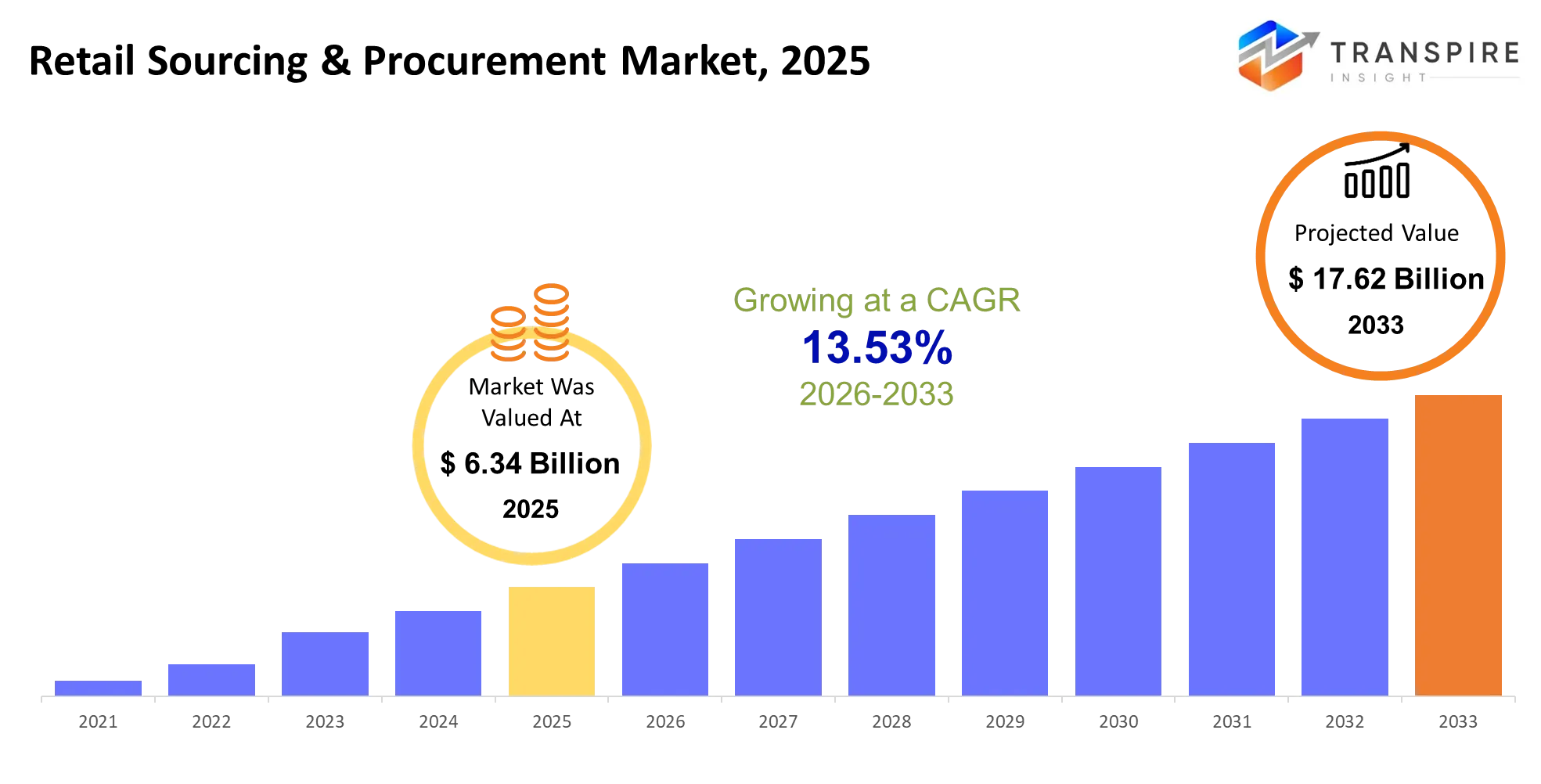
As per Transpire Insight Analysis, the Retail Sourcing & Procurement Market size is estimated at USD 6.34 billion in 2025 and is anticipated to reach USD 17.62 billion by 2033, growing at a CAGR of 13.53% from 2026 to 2033.
The retail sourcing and procurement market supports retailers in choosing suppliers, negotiating buying terms, keeping track of money spent, handling agreements and getting the goods and services needed to run their businesses. Over the past three to five years, procurement operations have slowly been moved away from manual procedures and isolated systems into fully integrated digital solutions. The use of cloud services, spend analytics, and AI is making it easier for retailers to analyse their suppliers, look at cost reduction possibilities, and make quick decisions when making purchases. Supplier issues that arose during the supply chain disruption revealed the dangers of depending on a few suppliers. As a result, retailers are giving more attention to diversifying suppliers and ensuring that there is more transparency and risk analysis. At the same time, changes in consumers’ demands have complicated the process of making purchasing decisions even further. All these issues have driven companies to implement advanced procurement software and streamline operations, leading to a rise in market growth through greater efficiency and resilience.
Retail Sourcing & Procurement Market Size & Forecast:
- Market Size 2025: USD 6.34 Billion
- Expected Market Value (2033): USD 17.62 Billion
- Forecast CAGR (2026–2033): 13.53%
- Leading Region in 2025: North America
- Fastest Growing Region: Asia Pacific
- Key Company Profiles: SAP Ariba, Coupa, Oracle, Jaggaer, Ivalua, GEP, Zycus, Basware, Corcentric, Workday, Informatica, Tradeshift, Zip, Fairmarkit, Sirion
Key Market Insights
Retail procurement is moving from purchasing processes to strategic cost management, supplier resiliency, and analytics.
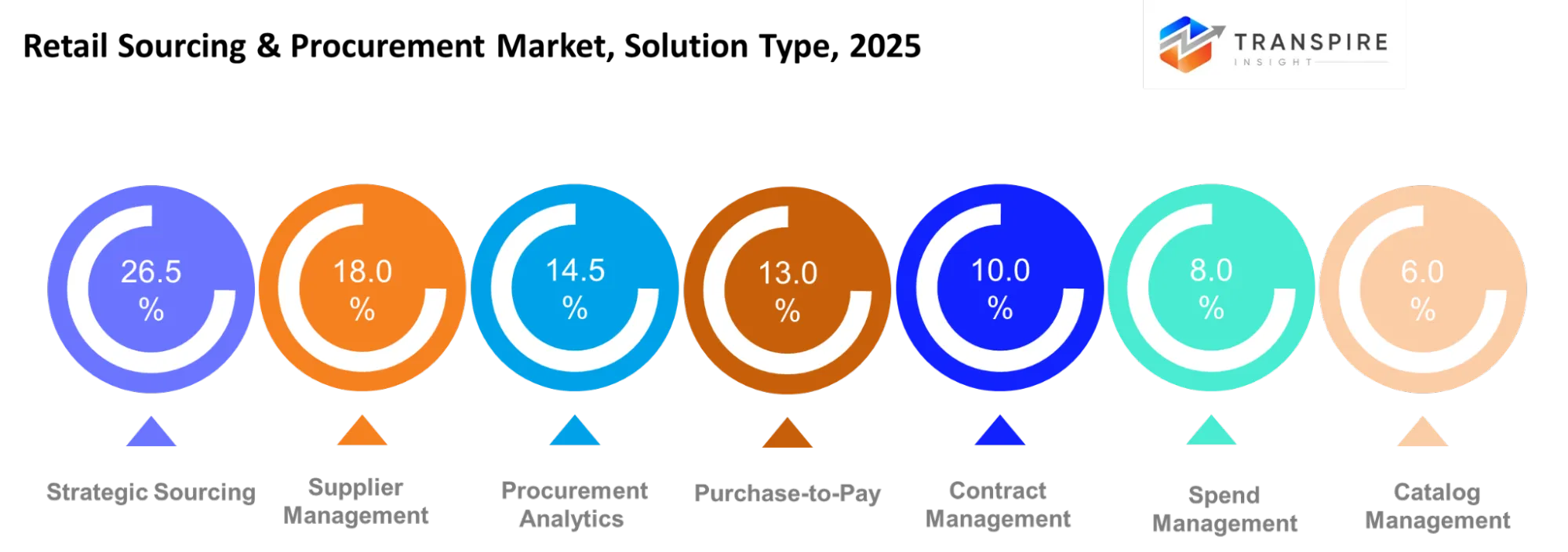
- Strategic sourcing accounts for 26.5% of the solution segment since the retailer focuses on the process of supplier selection and negotiation.
- Supplier management holds 18.0% of the segment because performance evaluation and management of suppliers, along with the continuity of supplies, is an important aspect.
- Procurement analytics has 14.5% of the segment since retailers analyse their expenditures to identify areas where they can reduce costs.
- The purchase-to-pay process takes up 13.0% of the segment since retailers try to link requisitioning, ordering, invoicing, and payment processes.
- Contract management takes up 10.0% of the segment since it is important to track commercial terms and timelines.
- Spend management holds 8.0% of the segment since retailers want to have a better view of their expenditures.
What are the Key Drivers, Restraints, and Opportunities in the Retail Sourcing & Procurement Market?
Drivers
Buying teams are faced with the task of maintaining margins on their supplier costs and inventory levels amid supply chains that have grown to be more complex. Changes in tariffs, logistics, and inflation have made supplier selection and price comparisons essential. Sourcing technologies give the buying team the chance to compare quotes and spend data to look for substitutes should there be any shortages in supply and increase the cost of procurement.
Restraint
Companies using old ERP systems, fragmented inventory management systems, and different information sources from suppliers in incompatible formats will have issues with integration. This process requires investment, qualified staff, cleansing data and users' training. Small companies can have trouble evaluating the worth of the software solution and concentrate on fast ROI. Some big companies face difficulties with long implementation times.
Opportunities
In the market, there are opportunities for AI-powered sourcing, predictive spending analysis and automated evaluation of the supplier risk that allow retailers to improve the quality of purchases. Retailers can evaluate bids, detect unpredictable changes in prices and predict problems with the suppliers. Cloud-based procurement software solutions provide the opportunity for mid-size retailers that cannot afford having big technology teams in their offices. With the growth of organized retail and e-commerce in Asia Pacific, there are new opportunities for connecting purchasing with suppliers, warehouses, brick-and-mortar stores and online channel.
|
Driver |
Relative Impact on Growth (%) |
Geographic Relevance |
Impact Timeline |
Demand Strength |
Growth Mechanism (5–10 words) |
Key Beneficiaries (5–10 words) |
Major Constraint (5–10 words) |
|
Digital Transformation and Cloud-Based Procurement Adoption |
25% |
North America, Europe, Asia Pacific |
Short-term (≤2 years) |
High |
Automates purchasing workflows and improves supplier visibility. |
Procurement software vendors, retailers, technology service providers. |
Legacy system integration and high implementation costs. |
|
Increasing Focus on Cost Optimization and Spend Visibility |
23% |
North America, Europe, Asia Pacific |
Short-term (≤2 years) |
High |
Identifies savings opportunities and strengthens purchasing control. |
Retail chains, procurement teams, sourcing consultants, suppliers. |
Budget constraints and fragmented procurement data. |
|
AI-Driven Procurement Analytics and Automation |
20% |
North America, Europe, Asia Pacific |
Medium-term (2–4 years) |
High |
Forecasts demand, evaluates suppliers, and automates decisions. |
AI vendors, procurement platforms, large retail enterprises. |
Poor data quality and limited AI expertise. |
|
Supply Chain Resilience and Supplier Diversification |
18% |
North America, Europe, Asia Pacific |
Medium-term (2–4 years) |
High |
Diversifies sourcing and reduces disruption-related procurement risks. |
Retailers, manufacturers, logistics providers, alternative suppliers. |
Higher sourcing costs and limited supplier availability. |
|
Sustainability, Ethical Sourcing, and Regulatory Compliance |
14% |
Europe, North America, Asia Pacific |
Long-term (≥4 years) |
Medium |
Tracks supplier compliance and supports responsible purchasing. |
Sustainable suppliers, compliance platforms, retailers, auditors. |
Limited traceability and higher sustainable sourcing costs. |
|
Total |
100% |
— |
— |
— |
— |
— |
— |
What Has the Impact of Artificial Intelligence Been on the Retail Sourcing & Procurement Market?
Artificial intelligence is revolutionising retail procurement through the use of AI tools that assist the purchasing teams in handling large amounts of information related to suppliers, pricing, contracts, and expenditures. In the case of strategic sourcing, the AI-assisted tools can be used to compare supplier quotes, summarise their proposals, and identify discrepancies in the delivery terms or purchasing costs. This allows reducing the time spent on manual analysis and concentrating on commercial decision-making. Another key area of application of artificial intelligence is predictive analytics, where AI-driven tools can analyse past expenses, sales, supplier performance, and deliveries to predict future price changes, purchasing needs, and risky suppliers.The use of artificial intelligence in retail procurement is still dependent on having reliable data and integrating the technology into the existing systems. Inaccurate supplier data, incomplete information on contracts, and unreliable historical data can make the recommendations less accurate. Moreover, implementation expenses, training of the employees, and human supervision are still relevant. That is why the best way for retailers to implement AI into procurement is to integrate it into specific processes, measure the results, and control supplier and purchasing choices.
Instance
In March 2026, AI-driven automation technology was launched by UiPath for procurement. In March 2026, UiPath unveiled its Purchase-to-Pay solution that employs agentic artificial intelligence to automate procurement and accounts payable operations such as purchase approvals, invoices, and exceptions. This launch proves the capability of artificial intelligence to streamline processes, cut down manual workload, increase procurement speed, enhance invoice accuracy, and optimise efficiency in the retail sourcing and procurement industry https://www.uipath.com/newsroom/uipath-announces-new-agentic-solution-to-accelerate-procurement-cycles
Key Market Trends:
The trend in retail procurement software will evolve from accounting software to software designed to enable planning, collaboration, and risk management.
- Retail businesses will switch from sourcing in Excel spreadsheets to the use of digital systems that will ensure higher transparency of the purchases made in their stores and businesses.
- The retail procurement software used by retail procurement teams is cloud-based software connecting suppliers, buyers, finances, and stock without reliance on a local IT environment.
- The usage of AI-enabled sourcing has become increasingly popular in recent years and now allows bid comparison, creation, and analysis of supplier responses.
- The process of supplier analysis involves not only price analysis but also the analysis of supplier delivery reliability, financial stability, regulatory compliance and supply disruption risks.
- The retail procurement team is getting more interested in spend analysis through the analysis of transactions to uncover fragmented procurement and supplier consolidation opportunities.
- The automation of invoice matching and routing is reducing the number of mundane tasks.
Retail Sourcing & Procurement Market Segmentation
By Solution Type
strategic sourcing leads the pack in market share with 26.5%, given its utility in choosing suppliers, conducting negotiations, and determining the purchase strategy. Vendor management comes in second with 18.0%, and procurement analytics comes third with 14.5%, owing to the necessity of assessing vendor performance and spending trends. Purchase-to-pay systems make up 13.0% of the market, contract management is next with 10.0%, spend management comes next with 8.0%, catalog management with 6.0%, and other solutions with 4.0%. The most rapidly growing segment is artificial intelligence in procurement, which is set to grow at a CAGR of 13.9% as indicated in the provided research.
By Deployment
Cloud and SaaS procurement platforms provide retailers with flexible, scalable access to procurement platforms, and allow some reaping of benefits from universal applications, more central update management, and easier sharing and coordination across multiple locations. On-premise models are still significant for organizations that demand more control of their infrastructure than the public cloud can provide or for those that have heavily invested into legacy environments. Hybrid deployments can enable retailers to get the benefits of modernising specific applications before any complete legacy system replacement, and provide a relatively low-resistance entry into a private or public cloud. Private cloud, public cloud, and multiclouds also present additional options for scaling, security, integration, and data governance.
By Organization Size
The large companies require procurement processes that can handle huge number of transactions, legal entities, foreign vendors, and approvals. Large retail chain stores and departmental stores tend to have centralized purchasing process in more than one location, and Internet based vendors have to be flexible when there is any change in the requirement and supply of their products. Small and medium size firms require cheap solutions which can be easily implemented. Midsize companies seek sophistication in control system.
By Procurement type
the direct procurement is relevant to products and materials integrated in the retailer's offering (products), thereby elevating the importance of raw supplier price levels, product quality, product availability, etc. The procurement of indirect products is related to the company's business needs (office equipment and supplies, operating equipment and services, etc.). Services procurement aims to support external service providers or production specialists; merchandise procurement aims to support the purchase of products for resale, store procurement aims to support the retailer's in-store operations; e-commerce procurement aims to support the digital retail environment; procurement aims to coordinate the sourcing of goods and services in supplier networks, etc. Such networks include the influence of movements of exchange rates and distances in trade requirements,
By Application
The use of applications in supplier selection helps identify and evaluate prospective suppliers. Cost management allows buyers to measure prices and costs saved. Inventory purchase creates a connection between purchasing activities and inventory management, thereby preventing shortages and over-supply. Contract management helps manage business agreements, while order management helps create links between purchase requisition and order processing. Compliance applications allow for the monitoring of compliance with internal policies and external standards, while spend analysis provides information on how spending has been allocated per category, per vendor, and per business unit. The better and more integrated the data provided by these applications are, the more useful they are.
By End User
Fashion retailers require adaptable sourcing methods to cope with seasonal collections, varied styles, and short-lived product life cycles. Grocery retailers require steady replenishment, product availability, and supplier negotiation. Electronics retailers require coping mechanisms for product launches, price variations, and lengthy supplier chains. Automotive retailers buy parts, accessories, and supplies for their workshops. Home improvement businesses work with a broad range of products and varied supplier needs. Hospitality retailers buy food products, equipment, and supplies. E-commerce businesses are highly concerned about fast-moving products and suppliers. Other retail end-users also use sourcing platform solutions for increased purchasing transparency, shorter lead times, and purchase price management.
What are the Key Use Cases Driving the Retail Sourcing & Procurement Market?
Sourcing is an important use case because retail businesses need to identify suitable suppliers, compare commercial offers, negotiate and secure supply of goods. The digital sourcing tools help buyers make choices on alternatives considering costs, quality and delivery of goods. The prospective use cases are related to supplier management, procurement analytics, contract management, and purchase to pay automation. The retail businesses that deal with fashion, food, electronics and home improvement goods can take advantage of digital sourcing tools in managing their procurement process and assessing suppliers' performance. The future use cases are AI-based quotation analysis, supplier risk prediction and automation of purchase request processing. With the implementation of procurement software into inventory management and other enterprise applications, retailers will be capable of reacting to stock changes and other procurement needs faster.
|
Report Metrics |
Details |
|
Market size value in 2025 |
USD 6.34 Billion |
|
Market size value in 2026 |
USD 7.25 Billion |
|
Revenue forecast in 2033 |
USD 17.62 Billion |
|
Growth rate |
CAGR of 13.53% from 2026 to 2033 |
|
Base year |
2025 |
|
Historical data |
2021 - 2024 |
|
Forecast period |
2026 - 2033 |
|
Report coverage |
Revenue forecast, competitive landscape, growth factors, and trends |
|
Regional scope |
United States; Canada; Mexico; United Kingdom; Germany; France; Italy; Spain; Denmark; Sweden; Norway; China; Japan; India; Australia; South Korea; Thailand; Brazil; Argentina; South Africa; Saudi Arabia; United Arab Emirates |
|
Key company profiled |
SAP Ariba, Coupa, Oracle, Jaggaer, Ivalua, GEP, Zycus, Basware, Corcentric, Workday, Informatica, Tradeshift, Zip, Fairmarkit, Sirion |
|
Customization scope |
Free report customization (country, regional & segment scope). Avail customized purchase options to meet your exact research needs. |
|
Report Segmentation |
Solution Type (Strategic Sourcing, Supplier Management, Procurement Analytics, Purchase-to-Pay, Contract Management, Spend Management, Catalog Management, Others)Deployment (Cloud, On-Premise, Hybrid, SaaS, Private Cloud, Public Cloud, Multi-Cloud, Others)Organization Size (Large Enterprises, SMEs, Mid-Sized Enterprises, Retail Chains, Department Stores, E-commerce Companies, Franchise Groups, Others)Procurement Type (Direct Procurement, Indirect Procurement, Services Procurement, Merchandise Procurement, Store Procurement, E-commerce Procurement, Procurement, Others)Application (Supplier Selection, Cost Management, Inventory Procurement, Contract Negotiation, Order Management, Compliance, Spend Analysis, Others)End User (Fashion Retail, Grocery, Electronics, Automotive Retail, Home Improvement, Hospitality Retail, E-commerce, Others) |
Which Regions are Driving the Retail Sourcing & Procurement Market Growth?
North America
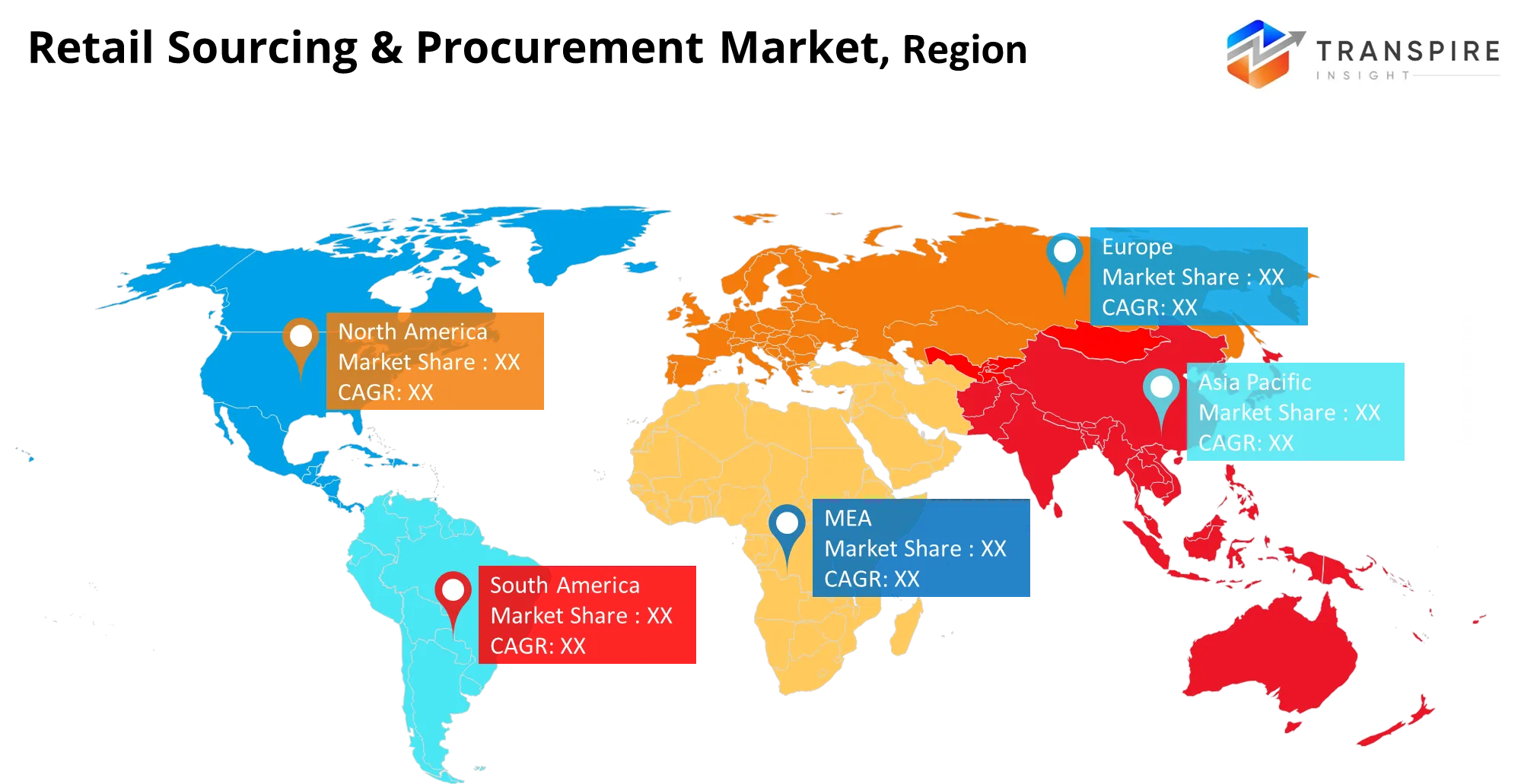
North America constitutes a 37.5% share because of high enterprise software adoption and the presence of large procurement technology vendors in the region. The retailers in North America leverage digital tools to handle their suppliers, keep track of their expenses and procure products in their extensive stores and e-commerce operations. Cloud-based infrastructure and established enterprise resource planning solutions enable the integration of procurement solutions with financial and inventory applications. Further development in AI-enabled sourcing and spend analytics is also an opportunity for improvement.
In February 2026, Nordstrom uses AI for procurement spend analysis. Nordstrom has been using Suplari’s procurement intelligence software to utilise artificial intelligence for spend analysis, supplier research and sourcing category strategies. This is an example of how North American retailers are utilising AI-based procurement tools to enhance their spending visibility, inform sourcing decision-making and improve procurement efficiency. https://www.retaildive.com/news/manifest-nordstrom-ai-procurement-spend-insights/812484/
Europe
Europe accounts for a 29.0% share of the supplied regional market distribution, ranking it second among all the regions in this study. The retail procurement landscape in Europe is characterised by cross-border trade, complicated supplier networks and the necessity to perform procurement activities consistently across different markets. The retailers will be able to leverage supplier risk management, contract management and centralised procurement data in their multi-market operations. Established enterprise software adoption and efficiency improvement initiatives facilitate the demand for sourcing and purchasing solutions.
In July 2026, ADEO partners with JAGGAER to enhance sourcing activities. ADEO, a leading European home-improvement retailer, announced a partnership with JAGGAER to optimise its international sourcing activities using the Advanced Sourcing Optimiser solution. https://www.jaggaer.com/press-release/new-collaboration-sourcing-solutions
Asia Pacific
The Asia-Pacific region represents 23.5% of the regional share supplied and has been projected to have the highest rate of growth with a CAGR of 13.1%. Growth of e-commerce, organized retailing, and digitalization of business operations has generated the need for synchronization of suppliers, stock, and procurement within large and diverse markets. Retailers can take advantage of cloud-based procurement and AI-based analysis to make the most out of the process of comparing suppliers and budgeting according to changing needs of products. Opportunities in the future will be more relevant to solutions that help retailers expand their network and source products from other nations.
In August 2025, Amazon Business broadens digital procurement availability in India. Amazon Business extended its registration eligibility to businesses with Udyam and FSSAI licences in addition to the current registration options. This means that digital procurement availability was extended to more micro, small and medium-sized businesses in India, making it possible for them to procure supplies via an online platform. https://press.aboutamazon.com/in/news/retail/2025/8/amazon-business-unlocks-digital-procurement-for-50m-msmes-across-india
Who are the Key Players in the Retail Sourcing & Procurement Marketand how do they compete?
Competitors in the worldwide retail sourcing and procurement industry include enterprise software providers, procurement platforms, and technology-driven consulting firms. The competition for SAP, Oracle, and IBM lies within their enterprise ecosystems and technology integrations that enable them to integrate purchasing processes for big retailers into their finance, inventory management, and other processes. Coupa specialises in spend management and data-driven procurement, while Ivalua concentrates on sourcing and supplier management solutions. Growth strategy is becoming more and more associated with product development, artificial intelligence technology integration, partner network growth, and customer base growth outside of one's own territory. The next-generation Ariba platform from SAP provides an example of the shift towards AI-based source-to-pay processes, while Ivalua's plan to expand until proves their commitment to their customers and partner network growth. It is safe to assume that retailers will evaluate vendors not by the features of the software, but by the results they can provide in terms of measurable savings.
Retail Sourcing & Procurement Market companies
- SAP Ariba
- Coupa
- Oracle
- JAGGAER
- Ivalua
- GEP
- Zycus
- Basware
- Corcentric
- Workday
- Informatica
- Tradeshift
- Zip
- Fairmarkit
- Sirion
|
Company |
Est. Revenue Share Range |
Key Offerings |
Strategic Positioning |
Geographic Strength |
Technology Focus |
|
SAP |
Estimated 5–9% |
SAP Ariba, SAP Business Network, strategic sourcing, supplier management |
Enterprise leadership through integrated procurement ecosystem |
North America, Europe, Asia Pacific |
AI-assisted sourcing, cloud integration, supplier-network intelligence |
|
Oracle |
Estimated 4–8% |
Fusion Cloud Procurement, sourcing, supplier qualification, contract management |
ERP-integrated procurement for large retail enterprises |
North America, Europe, Asia Pacific |
Cloud-native procurement, predictive analytics, workflow automation |
|
Coupa |
Estimated 3–7% |
Coupa Sourcing, contract management, spend analytics, procure-to-pay |
Spend optimization through connected business-spend management |
North America, Europe, Asia Pacific |
AI-driven spend intelligence, predictive analytics, community benchmarking |
|
GEP |
Estimated 2–5% |
GEP SMART, strategic sourcing, supplier management, procure-to-pay |
Unified software and managed procurement services |
North America, Europe, Asia Pacific |
AI-enabled sourcing, cloud workflows, procurement analytics |
|
Ivalua |
Estimated 2–4% |
Strategic sourcing, supplier management, contracts, spend analysis |
Configurable procurement suite for complex supplier ecosystems |
Europe, North America, Asia Pacific |
AI-assisted procurement, configurable workflows, supplier-data integration |
|
JAGGAER |
Estimated 2–4% |
JAGGAER ONE, sourcing, supplier collaboration, contract management |
Sourcing specialization with integrated supplier lifecycle management |
North America, Europe, Asia Pacific |
AI-assisted sourcing, supplier collaboration, spend analytics |
|
Zycus |
Estimated 1–3% |
Source-to-pay suite, e-sourcing, contract management, spend analysis |
AI-led procurement automation across enterprise workflows |
North America, Europe, Asia Pacific |
Merlin AI, intelligent automation, predictive spend analytics |
|
Basware |
Estimated 1–3% |
Invoice automation, purchase-to-pay, e-invoicing, supplier collaboration |
Finance-led procurement efficiency and invoice compliance |
Europe, North America, Asia Pacific |
AI invoice processing, e-invoicing networks, process automation |
|
Workday |
Estimated 1–3% |
Workday Strategic Sourcing, supplier contracts, spend management integrations |
Procurement coordination within enterprise finance ecosystems |
North America, Europe, Asia Pacific |
Cloud workflows, analytics, AI-assisted contract processes |
|
Zip |
Estimated 0.5–2% |
Intake-to-procure, procurement orchestration, approvals, supplier onboarding |
User-friendly procurement intake and workflow orchestration |
North America, Europe, Asia Pacific |
AI-enabled intake, workflow orchestration, procurement-system integrations |
Recent Development News
In January 2026, Ivalua announced record performance for 2025 as well as continued investments in AI innovation. This was marked by 24% growth in organic subscriptions and expansion of its international partners' network. This shows the competitive nature of having AI capability, supplier management, and a customer base in procurement software. https://www.ivalua.com/press-releases/ivalua-closes-a-strong-2025-marked-by-accelerating-growth-recognition-and-innovation/
In October 2025, SAP launched a new generation of SAP Ariba that is meant to help in sourcing, supplier management, contracts and invoices using AI-enabled processes. The company also announced future plans for AI-driven bid analysis and summaries of responses from suppliers. https://news.sap.com/2025/10/sap-connect-spend-management-procurement/
What Strategic Insights Define the Future of the Retail Sourcing & Procurement Market?
markets in retail sourcing and procurement are shifting to smart and connected solutions involving supplier intelligence, spending analysis, automation, and purchases. A competitive edge will be increasingly created via efficient transformation of procurement data into decisions, preserving margins and ensuring availability of goods. Artificial intelligence represents an emerging area that allows retailers to use such tools as quotation analysis, identification of inefficiencies in spending, and assessment of supplier risk much more efficiently. However, a hidden risk associated with sourcing and procurement is related to inconsistent data about suppliers and fragmented legacy systems.In the process of improving processes within sourcing and procurement, it makes sense to focus on concrete and quantifiable benefits. It is critical for retailers not to become too technology-driven and not to pursue innovation for innovation's sake only. It is sensible to integrate sourcing, suppliers, contracts, and spend analytics as part of the solution. Moreover, businesses must introduce artificial intelligence in a gradual manner, validate its recommendations, and keep control of all the relevant decisions related to suppliers and contracts.
Solution Type
- Strategic Sourcing
- Supplier Management
- Procurement Analytics
- Purchase-to-Pay
- Contract Management
- Spend Management
- Catalog Management
- Others
Deployment
- Cloud
- On-Premise
- Hybrid
- SaaS
- Private Cloud
- Public Cloud
- Multi-Cloud
- Others
Organization Size
- Large Enterprises
- SMEs
- Mid-Sized Enterprises
- Retail Chains
- Department Stores
- E-commerce Companies
- Franchise Groups
- Others
Procurement Type
- Direct Procurement
- Indirect Procurement
- Services Procurement
- Merchandise Procurement
- Store Procurement
- E-commerce Procurement
- Procurement
- Others
Application
- Supplier Selection
- Cost Management
- Inventory Procurement
- Contract Negotiation
- Order Management
- Compliance
- Spend Analysis
- Others
End User
- Fashion Retail
- Grocery
- Electronics
- Automotive Retail
- Home Improvement
- Hospitality Retail
- E-commerce
- Others
By Regional Analysis
North America
- US
- Canada
- Mexico
Europe
- Germany
- UK
- France
- Italy
- Spain
- Russia
- Rest of Europe
Asia Pacific
- China
- Japan
- India
- South Korea
- Australia
- Rest of Asia Pacific
South America
- Brazil
- Argentina
- Rest of South America
Middle East & Africa
- UAE
- Saudi Arabia
- Qatar
- South Africa
- Rest of the Middle East & Africa
Frequently Asked Questions
Find quick answers to common questions.
The retail sourcing & procurement market size was valued at USD 6.34 billion in 2025 and is poised to reach USD 17.62 billion by 2033, expanding at a 13.53% CAGR
Key segments for the retail sourcing & procurement market are Solution Type (Strategic Sourcing, Supplier Management, Procurement Analytics, Purchase-to-Pay, Contract Management, Spend Management, Catalog Management, Others)Deployment (Cloud, On-Premise, Hybrid, SaaS, Private Cloud, Public Cloud, Multi-Cloud, Others)Organization Size (Large Enterprises, SMEs, Mid-Sized Enterprises, Retail Chains, Department Stores, E-commerce Companies, Franchise Groups, Others)Procurement Type (Direct Procurement, Indirect Procurement, Services Procurement, Merchandise Procurement, Store Procurement, E-commerce Procurement, Procurement, Others)Application (Supplier Selection, Cost Management, Inventory Procurement, Contract Negotiation, Order Management, Compliance, Spend Analysis, Others)End User (Fashion Retail, Grocery, Electronics, Automotive Retail, Home Improvement, Hospitality Retail, E-commerce, Others)
Growth is primarily driven by increasing digitalisation of procurement processes, rising demand for cost optimisation, growing adoption of cloud-based solutions, the need for efficient supplier management, and increasing use of AI and data analytics to improve purchasing decisions and supply chain efficiency.
The market is led by major manufacturers including SAP Ariba, Coupa, Oracle, Jaggaer, Ivalua, GEP, Zycus, Basware, Corcentric, Workday, Informatica, Tradeshift, Zip, Fairmarkit, and Sirion
The North American region constitutes 37.5% of the total worldwide market share for retail sourcing and procurement owing to its well-developed digital procurement solutions, robust retail infrastructure, cloud usage, and the availability of leading technology vendors. The growing need for transparency in the supply chain, cost savings, and automated procurement adds to the market supremacy of the region.
Opportunities in the market for sourcing and procurement within retailing can be found in the use of AI-driven procurement tools, cloud sourcing tools, automation of the supplier process, real-time spending analysis, and sustainable sourcing methods. Growth in the use of digital procurement by smaller retailers creates opportunities for software and tech companies.
- SAP Ariba
- Coupa
- Oracle
- JAGGAER
- Ivalua
- GEP
- Zycus
- Basware
- Corcentric
- Workday
- Informatica
- Tradeshift
- Zip
- Fairmarkit
- Sirion
About the Authors

Mayur Shinde
I am Mayur Shinde, a Senior Research Analyst at Transpire Insight, specializing in the Automotive & Transportation and Information & Communication Technology (ICT) Industry. My work focuses on analyzing emerging market trends, technological advancements, competitive landscapes, and industry developments to deliver accurate, data-driven insights. I am passionate about transforming complex market information into clear, actionable content that helps businesses, professionals, and decision-makers stay informed and make confident strategic decisions.

Chakradhar Khansole
Chakradhar serves as the Research Director at Transpire Insight, bringing over 8 years of experience in technology, innovation, and strategic market intelligence. He specializes in transforming complex market data into actionable business insights that enable organizations to make informed, growth-oriented decisions. Recognized for his strategic vision and analytical expertise, Chakradhar leads high-impact research initiatives, delivering comprehensive market assessments, competitive intelligence, and forward-looking industry analysis.
Recently Published Reports
-
Apr 2026
3D Optical Profiler Market
3D Optical Profiler Market Size, Share & Analysis Report By Type (Desktop 3D Optical Profiler, and Portable 3D Optical Profiler), By Technology (Confocal Technology, and White Light Interference), By End-Use Industry (Manufacturing, Research Institutions, Automotive, Aerospace and Defense, Medical Devices, and Other), and Geography (North America, Europe, Asia-Pacific, Middle East and Africa, South and Central America), 2021 - 2031
-
Apr 2026
Depth Sensor Market
Depth Sensor Market Size, Share & Analysis Report By Type (Infrared Depth Sensors, Time-of-Flight (ToF) Sensors, Stereo Vision Sensors, Structured Light Sensors, Ultrasonic Depth Sensors), By Application (Automotive, Robotics, Gaming, Consumer Electronics, Industrial Automation, Healthcare, Security & Surveillance, Others), By End Users (Automotive Manufacturers, Consumer Electronics Companies, Healthcare Providers, Industrial Companies, Security Agencies, Gaming Companies, Robotics Companies, Others), and Geography (North America, Europe, Asia-Pacific, Middle East and Africa, South and Central America), 2021 – 2031
-
Apr 2026
Digital Manufacturing Market
Digital Manufacturing Market Size, Share & Analysis Report By Component (Hardware, Software, and Services), By Technology (Robotics, 3D Printing, Internet of Things (IoT), and Others), By Application (Automotive and Transportation, Aerospace and Defense, Consumer Electronics, Industrial Machinery, and Others), By Process Type (Computer-Based Designing, Computer-Based Simulation, Computer 3D Visualization, Analytics, and Others), and Geography (North America, Europe, Asia-Pacific, Middle East and Africa, South and Central America), 2021 – 2031
-
Apr 2026
Digital Visa Services Market
Digital Visa Services Market Size, Share & Analysis Report By Type (Individual Travelers, Group Travelers), By Application (Tourism, Business Travel, Others), and Geography (North America, Europe, Asia-Pacific, Middle East and Africa, South and Central America), 2021 – 2031